
Our readers keep the lights on and my morning glass full of iced black tea. As an Amazon Associate, I earn from qualifying purchases.
Specs are compiled from manufacturer listings and verified buyer reviews and can change over time — please confirm the key details on the product page before buying.
A 12V LiFePO4 battery charger is the piece of gear that decides whether your lithium battery lives a long life or dies an early death — and the wrong one can either cook your battery or leave it stranded at half charge. The good news: the best ones today are automatic, safe, and genuinely simple to run.
I’m Min — the founder and writer behind Gadgets Feed. This guide is built by comparing the manufacturers’ published specifications and the patterns across verified customer reviews, so you get each pick’s real strengths and trade-offs instead of marketing spin.
Whether you are topping off a 100Ah deep-cycle battery in the garage or reviving a dead one on the road, this guide breaks down the best 12v lifepo4 battery charger options so you can match the right amperage, connector, and safety features to how you actually use your battery.
Our Picks at a Glance


How To Choose The Best 12V LiFePO4 Battery Charger
Picking the right charger depends on four things: how fast you need to charge, what connector your battery uses, if you need 0V recovery, and how hot the unit runs under a long charge. Get those four right and you will never have to think about it again.
Amperage determines your charge time
Charging amperage is the single biggest lever on how long you wait. A 20A charger fills a 12V 100Ah LiFePO4 battery in about five hours; a 10A unit takes roughly ten. If you top off a large bank regularly — say a 200Ah or 300Ah setup — bumping up to 20A saves you real hours. For a small 50Ah or 100Ah battery topped off once in a while, a 10A unit is more than enough and often runs cooler.
Connector type matters more than people think
LiFePO4 chargers typically ship with one of three connectors: battery clamps (the spring-loaded jaws you clamp to the terminals), an Anderson connector (a locking plastic plug that clicks into place and cannot be reversed easily), or an SAE connector (a small two-pin plug common on trickle chargers). Anderson connectors are the preferred choice for anyone who leaves a pigtail wired permanently to the battery — you just click and go. Clamps are best for one-off charging where you move the charger between batteries.
0V activation — do you actually need it
When a lithium battery’s built-in BMS (battery management system — the internal electronic brain that shuts off current when the battery gets too low) trips, the battery reads 0V and many cheaper chargers simply refuse to charge it. A charger with 0V activation pushes a small current into the pack to wake the BMS back up. If you own a battery that has sat unused for months, this feature alone can save a battery. If your battery is used regularly, it is nice insurance but rarely needed.
Cooling and heat management
A 20A charger dissipates serious heat during a multi-hour charge. Aluminum housings and built-in cooling fans are the two common solutions. Aluminum shells passively dissipate heat and feel cool to the touch; fans actively move air but add noise. Neither is inherently better — fans cool faster in hot garages, but aluminum quiets down your workbench. If you charge in a sealed cabinet or on a boat, look for aluminum; if noise is a non-issue, a fan-cooled unit will stay cooler on long charges.
Quick Comparison
Three decision-relevant specs sit side by side below: charging amperage, output voltage, and connector type. Scan the columns to see which charger matches your battery setup at a glance.
| Model | Best For | Charging Amperage | Output Voltage | Connector Type | Amazon |
|---|---|---|---|---|---|
| LiTime 12V 20A Lithium Battery Charger★ Best Overall | Fast charging with Anderson connector | 20 A | 14.6V | Anderson 50A / M8 Terminal | Amazon |
| CTEK 56-926 Lithium USPremium Pick | Long-term maintenance on premium vehicles | 4.3 A | 12V | Battery Clamps | Amazon |
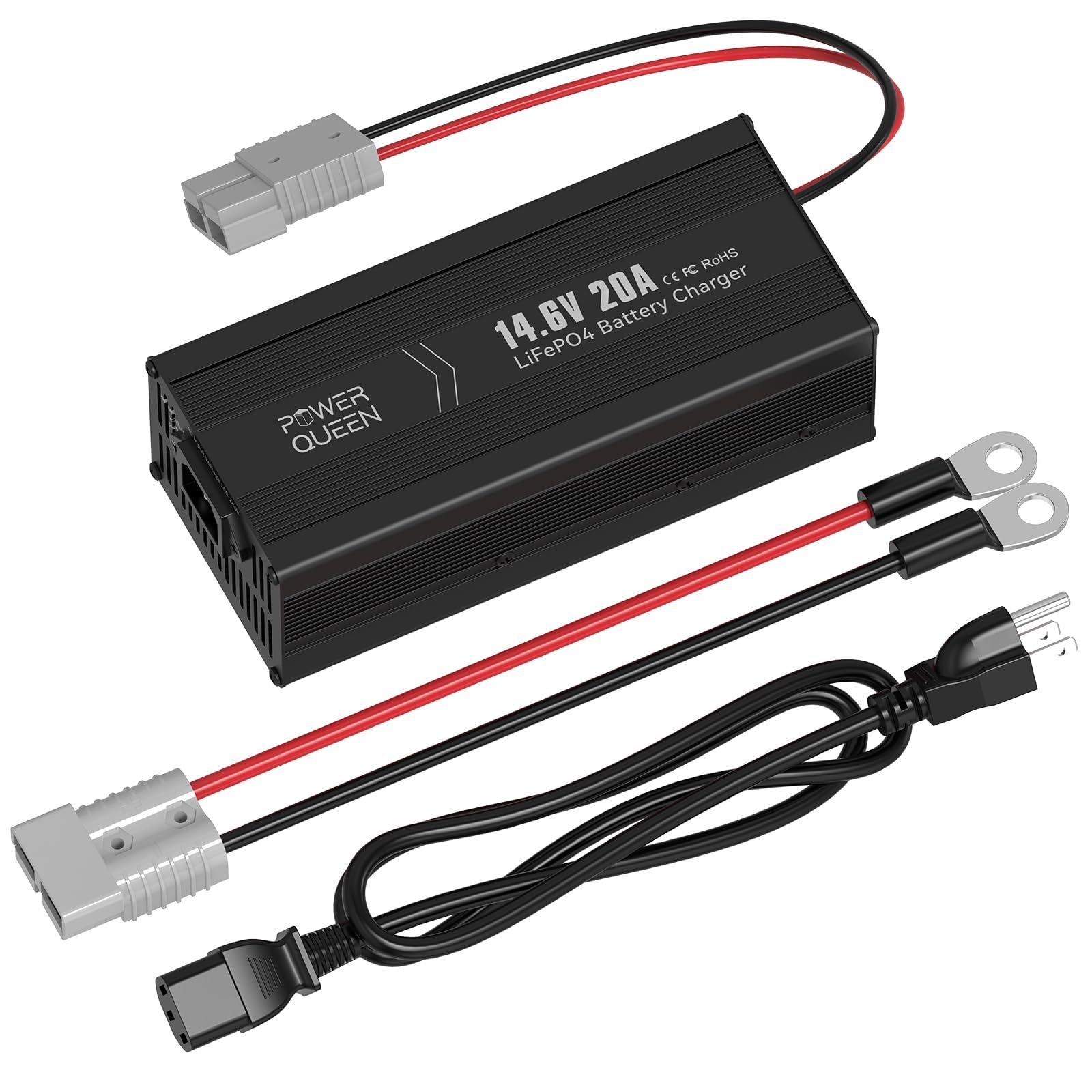
| Power Queen 12V 20A LiFePO4 ChargerBest Display | 20A fast charging for 100Ah batteries | 20 A | 14.6V | Anderson Connector | Amazon |
| Redodo 12V 20A Lithium Battery Charger | Fast 20A charging with locking connector | 20 A | 14.6V | Anderson Connector | Amazon |
| LiTime 12V 10A Lithium Battery Charger | Slower, cooler charging for small setups | 10 A | 14.6V | Anderson Connector | Amazon |
| ECO-WORTHY 12V 10A Battery Charger | Multi-type battery charging with LCD | 10 A | 12V | SAE | Amazon |
| NEXPEAK NC202 10-Amp Battery Charger | Display-heavy smart charging for cars | 10 A | 12V | Battery Clamps | Amazon |
| PZ.P 15-Amp 12V/24V Smart Battery Charger | 12V and 24V mixed battery fleet | 15 A | 12V DC | Battery Clamp / Cig Lighter | Amazon |
| 15A Car Battery Charger 12V 24V NC215 | Versatile 12V/24V with color screen | 15 A | 12V | Battery Clamps | Amazon |
In‑Depth Reviews
1. LiTime 12V 20A Lithium Battery Charger, 14.6V Output AC-DC, 0V Activation
Our pick — over 4.5★ from 950+ verified ratings; the strongest balance of quality and price.
The workhorse 20-amp lithium charger that wakes dead batteries and tops off 100Ah packs in a hurry.
The LiTime 12V 20A is the charger that keeps coming up when lithium owners talk about what actually works. At 20 amps feeding a 14.6V output, it delivers about twice the charge rate of a 10A unit — so a 100Ah LiFePO4 battery that used to take a full day to top off gets there in hours instead. The 0V activation feature lets it wake up batteries that have been sitting unused long enough for the internal BMS to shut down completely, which is the difference between rescuing a battery worth hundreds and having to replace it. LiTime rates it at 5 hours for a 100Ah pack, and the 2.9-pound aluminum body with a built-in cooling fan handles the heat. The whole unit is small enough to tuck into an RV storage bay — 8.13 inches long by 3.56 wide by 2.5 tall. It is not waterproof (LiTime warns against marine use like boats and trolling motors), so keep it dry.
What owners rave about most is how quickly the unit charges. One buyer put it simply: “It charged my brand new LiTime 12 volt 320 Amp hour Lifepo4 battery in about 8 hours, nice and slow.” A 60-amp charger would have been faster, but plenty of lithium owners actually prefer the gentler rate for battery health. The Anderson 50A connectors click firmly into place and can be wired permanently to a battery — many buyers report installing a pigtail once and then just clicking the charger on and off. Safety coverage is thorough: over-temp, over-voltage, short-circuit, over-current, low-voltage, and reverse polarity protections are all built in, plus FCC/CE/RoHS testing and a 2-year warranty.
Two things to know before buying. First, the cooling fan works hard during a 20A charge and it is audible across a garage — not obnoxious, but you will hear it. Second, this charger outputs a fixed 14.6V profile. If your battery’s BMS is capped lower (the occasional LiFePO4 pack from a different brand tops out at 14.4V), the charger will not override that ceiling — a handful of owners with non-LiTime batteries have hit this mismatch and swapped for an adjustable Bluetooth charger instead. For LiTime and most mainstream LiFePO4 packs, though, this is the set-and-go workhorse that earns its spot at the top.
What makes it the top pick
- 20A charging into a 14.6V LiFePO4 profile cuts charge time roughly in half versus 10A units
- 0V activation revives BMS-shutoff batteries other chargers cannot touch
- Anderson 50A connector locks in place and stays put on the battery
- Six-layer protection suite plus 2-year warranty and AIG liability coverage
What to expect
- Cooling fan is audible during charge — not silent operation
- Fixed 14.6V profile may not suit batteries with a 14.4V BMS ceiling
- Not waterproof — keep away from marine and wet environments
Reach for this if: you want the single best all-around 12V LiFePO4 charger for RV, off-grid, solar, or deep-cycle batteries up to several hundred amp hours.
Look elsewhere if: your battery’s BMS caps below 14.6V and you need an adjustable output profile.
2. CTEK 56-926 Lithium US | Fully Automatic Lithium Ion Phosphate LiFePO4 Battery Charger | 5.0Ah – 60Ah | Maintenance Charging up to 120Ah
A plug-in-and-forget maintainer built to baby an expensive lithium car battery through long winter sits.
If you own a vehicle with a factory lithium battery — or a sports car that sits for weeks — this is the charger that removes the whole problem. The CTEK 56-926 puts out just 4.3 amps, which is not the spec you want for bulk-charging a big deep-cycle bank. Where it shines is maintenance: it runs an 8-step program that tests battery condition, charges, and then drops into float/pulse maintenance to hold the battery healthy indefinitely. CTEK rates it for 5.0Ah to 60Ah batteries for charging and up to 120Ah for maintenance. The 1.8-pound body is compact and it weighs almost nothing in a trunk. Spark-free operation and reverse polarity protection mean you can hook it up without pulling the battery out of the car, and CTEK explicitly says no need to disconnect the battery from the vehicle while charging.
Owners who run lithium car batteries tend to be the ones who write about this charger, and the pattern is consistent: it brings batteries to full over a night and then holds them. A Porsche 911 owner described the contrast with a factory charger neatly — the OEM charger needed manual lithium mode selection every time, while the CTEK just connects and works. BMW owners like the indicator lights, which show both battery condition and charging stage, plus the included carrying case. One user keeps a 70Ah lithium car battery at full with alligator clips to the jump terminals and reports roughly a 6-hour charge cycle with a normal warm case. The whole value proposition — as owners put it — is that the charger costs a fraction of the lithium battery it protects.
The honest limitation is that 4.3 amps takes real time. If your battery is deeply discharged, expect the CTEK to bring it back slowly rather than quickly. And the maintenance mode is designed for batteries in the 5 to 120Ah window — bigger banks are outside its intended use. If your goal is fast charging, this is the wrong tool; if your goal is keeping an expensive lithium battery alive through inactivity, nothing in this list plays the same role.
The longevity angle: 4.3A output matched with an 8-step program that ends in float/pulse maintenance — the design goal is cell health, not speed, and the Porsche and BMW owners running lithium packs clearly value exactly that.
The speed trade-off: if you are expecting a fast top-off, 4.3 amps will not deliver it. Where this charger wins is on a battery that sits between drives.
The specialist’s choice: perfect for premium car lithium batteries in the 5 to 120Ah range that sit between drives.
Wrong tool for: bulk-charging large RV or solar banks where you need 20 amps of speed.
3. Power Queen 12V 20A LiFePO4 Battery Charger 14.6V Lithium Battery Charger
A 20-amp aluminum-bodied charger whose pre-charge function can wake a fully shut-down BMS.
Power Queen’s 20A charger takes a slightly different approach to waking dead batteries than the LiTime — instead of a simple 0V activation, it runs a specific Pre-Charge function that can push current into a LiFePO4 pack reading all the way down to 0V. That matters when a battery’s internal BMS has tripped and stopped everything: the Power Queen can bring it back where a basic charger would just throw an error. The rest of the spec sheet is standard 20A-class gear — 14.6V constant voltage, two-stage CC/CV charging (constant current, then constant voltage — the standard safe charging profile for lithium), aluminum housing with a cooling fan, and an Anderson connector. Power Queen rates it at 5 hours for a 12V 100Ah battery and sizes it for packs 20Ah and above. Its footprint is 8.13 inches long by 3.56 wide by 2.5 tall and it weighs 2.9 pounds.
What owners keep coming back to is just how much the charger does in a small package. One owner tracked the output with a Bluetooth BMS readout and saw 19.9 amps flowing steadily, and put it in perspective: the unit delivers 280 watts for hours continuously out of a body the size of a hardcover book. Another user topping off a marine battery was won over by the simplicity — indicator light turns green when charged, done. The aluminum case keeps it cool compared to plastic-bodied competitors, and users report it stays composed on long charging sessions. The Anderson connector is included and clicks firmly into place with a good tactile lock.
The trade-off is noise. The cooling fan on this unit runs loud enough that owners describe it as a bit loud for a small charger — understandable given the workload, but worth knowing if you plan to charge in a bedroom or a quiet cabin. A few owners also noted mixed results on power output, though those cases tended to involve mismatched batteries rather than the charger itself. If you charge in a garage or shop where fan noise is background, this charger holds up well against anything else in this category.
Why owners single it out: the Pre-Charge function reviving fully shut-down LiFePO4 packs is the standout capability — that is the exact scenario that makes cheaper chargers refuse to work.
What to know up front: the cooling fan is audible during long charges. Plan to run it where fan noise is not an issue.
Suits you if: you need to reliably wake dead LiFePO4 batteries and want 20A charging in an aluminum body.
Think twice if: fan noise matters — you charge in a bedroom or quiet workspace.
4. Redodo 12V 20A Lithium Battery Charger, 14.6V Output for LiFePO4 Batteries

A fast, no-frills 20-amp lithium charger that brings a half-drained 100Ah battery back in a few hours.
Redodo’s 12V 20A charger is the take-it-out-of-the-box-and-go option in this category. It pushes a max 20A into a 14.6V output, and Redodo rates it at bringing a 12V 100Ah LiFePO4 battery to 50% in 2.5 hours — about twice the pace of a 10A charger. On top of charging, it handles 0V activation for reviving batteries its BMS has shut down, runs a two-stage CC/CV profile (constant current into constant voltage — the standard safe charging pattern for lithium), and carries CE and RoHS certification. The aluminum case with two LED indicators keeps things simple, and the whole unit weighs 3 pounds — small enough to toss in a bag or mount on a wall bracket. Reverse polarity, short circuit, overvoltage, and battery isolation protections round out the package, and Redodo promises support feedback within 24 hours.
Owners who run this charger tend to talk about two things: the Anderson connector and the fan. The Anderson connector — a locking plastic plug that clicks firmly and cannot easily reverse — gets called out for being a step up from the alligator clips that come with cheaper chargers. And unlike the 10A NOCO LiFePO4 charger some owners came from, this unit is reported to stay cool during a full charge rather than getting hot. Owners running 100Ah batteries on sailboats rate the included lock-tight connector highly and just buy extra pigtails to keep on each battery. Backup-generator users who run the charger at night for camping report the batteries hold charge for a month between uses — no trickle maintenance needed.
Two things to go in knowing. First, the fan is loud enough that several owners describe it as noticeable — the trade-off for squeezing 20 amps out of a small aluminum body. Second, there is no progress display — the LEDs show state, not percentage — so if you want to track charge level in real time you will be guessing. A couple of owners flag this as a genuine gripe for a charger at this price, though the majority accept it as a reasonable simplification. Note also that Redodo does not publish a charge-time spec for the 320Ah-size packs taller batteries need.
What lands well: 20A output paired with the Anderson locking connector — a combination owners describe as superior to alligator-clip chargers they have owned, with reported cool running through full charge cycles.
The honest gap: no progress display. Two LEDs tell you state, not percent. If track-as-you-charge matters, plan to accept the simplicity.
The right pick for: anyone with 100Ah-class LiFePO4 batteries who wants fast charging and a locking connector without extra bulk.
Skip if: you need a live percentage readout while charging — this unit deliberately keeps it simple.
5. LiTime 12V 10A Lithium Battery Charger for 12.8V LiFePO4 Batteries, AC-DC

The gentler LiTime sibling — 10 amps of steady charging for smaller batteries that do not need the speed.
Not every lithium battery wants 20 amps shoved into it, and LiTime’s 12V 10A charger is built for the setups where slower is fine. It runs the same 14.6V output profile into 12.8V LiFePO4 packs, but at half the current — which LiTime rates at 10 hours for a 100Ah pack. It supports 0V activation for waking batteries with a shut-down BMS, uses CC/CV charging (constant current into constant voltage) with automatic float/cut off, and carries FCC, CE, RoHS, and PSE certifications. The aluminum body runs a built-in cooling fan, and LiTime rates it for operation in -4°F to 104°F. At 2.1 pounds and just 7.09 inches long by 3.58 wide by 2.03 tall, it is the most compact LiTime in this list — easy to stow in a truck cab. Anderson connector on the cable. Two-year warranty and AIG product liability coverage round it out.
Owners who go with the 10A LiTime tend to be topping off mid-sized batteries — often in a matched pair with another LiTime product. Reports describe charging a brand-new 100Ah battery in about 7 hours with the built-in fan keeping the body cool throughout. Owners running larger banks like a single 200Ah battery report it as the perfect matched setup for slower top-offs. The Anderson connector gets the same praise as on the 20A model — it locks tight and can be left wired on the battery. Auto shut-off prevents overcharging, so you can leave it connected without babysitting, and one owner with a 36V golf cart running three CHINS batteries uses it to keep each pack topped up individually with a simple connect-then-plug-in sequence.
The catch is going to be the fan noise and heat under long sessions. The unit physically heats up during extended charging, and the fan runs to compensate — owners describe it as audible but not obnoxious. That is a fair trade for the compact size. The bigger thing to note: 10 hours to charge a battery is real time. If you frequently arrive home with a depleted battery and want it ready by morning, the 10A pace is likely too slow; step up to the 20A model above. Where this shines is the occasional top-off and long-term storage maintenance on smaller lithium packs.
Why pick the 10A: if you own a 100Ah-class battery that gets topped off once in a while, the 10-hour charge time is acceptable and the compact 2.1-pound body makes storage easy.
When to size up: regular deep discharges mean the 10A pace will frustrate you. The 20A LiTime above delivers the same feature set at double the current.
Built for: RV owners and weekenders topping off a small 100Ah battery who value compact size over raw charge speed.
Wrong fit for: daily heavy discharge cycles — the 10-hour charge time is a real bottleneck.
6. ECO-WORTHY 12V 10A Battery Charger for Lead-Acid, LiFePO4 Battery

A lead-acid and lithium dual-chemistry charger built to keep a whole fleet of vehicles topped off.
If your garage holds a mix of battery types — a lead-acid lawnmower, a lithium boat trolling motor, a lead-acid car — the ECO-WORTHY 12V 10A handles both chemistries with a switch. It puts 10 amps into a 12V output, runs 100-110V AC input, and works across lead-acid, lithium LiFePO4, AGM, GEL, SLA, and Flooded types. It is not just a trickle charger: ECO-WORTHY builds in battery desulfation (which detects and tries to reverse sulfation — the chemical buildup that ages lead-acid plates) and prompts you when a battery is too damaged to save. The included battery clip and O-ring terminal cable runs a 10A fuse for safety, and the SAE connector is plug-and-play. ECO-WORTHY rates charge time at 3 hours and covers cars, motorcycles, lawn mowers, ATVs, lawn tractors, trucks, SUVs, boats, PWCs, and classic cars. Weight: 1.7 pounds — the lightest charger in this list.
The consistent owner experience here is that this thing does its job across very different batteries. Multi-type compatibility is the single most-appreciated feature: owners run it on lithium, then switch to lead-acid without issue. Users charging three 100Ah lithium batteries found it delivered fast results — and note the heat honestly. Many reviews do talk about the unit getting warm during extended charging, and owners generally accept it as normal for a 10A design. The LCD screen is praised for showing what is happening in real time. Setup is minimal: clip on, plug in, watch the display.
The honest caveat is that the heat is real, not just forum chatter. On long high-draw sessions — particularly charging a large lithium battery at a steady 10A for many hours — the case warms substantially and a few owners mention it running hotter than they would prefer, with no obvious thermal cutoff. The safe approach: give it airflow, do not stuff it inside an enclosed box during a long charge, and if you are regularly charging a very large battery, a fan-cooled unit at 20A will stay cooler. For mixed-fleet use with occasional deep charges, the ECO-WORTHY keeps things simple and versatile.
The versatility edge: dual-chemistry support lets you charge lead-acid and LiFePO4 batteries off one unit — a real win when your garage holds several battery types.
Room for improvement: the case warms up on long high-amp sessions. Give it open air and do not enclose the unit during a multi-hour charge.
Great fit for: garage owners who rotate between lead-acid and lithium batteries and want one outdoor-ready charger for all of them.
Consider alternatives if: you mainly charge large lithium batteries — the fan-cooled 20A units handle that sustained heat better.
7. NEXPEAK NC202 10-Amp Battery Charger, 12V 24V LiFePO4 Lead Acid Portable Car Battery Charger 8-Stage Trickle Charger Smart Battery Maintainer w/Temp Compensation

A display-heavy smart charger that keeps car and van batteries fresh through long winter sits.
The NEXPEAK NC202 is the everyday garage maintainer for anyone who wants to see what is going on. It charges at 10A on 12V and 5A on 24V, running an 8-stage program that ends in trickle/float maintenance — meaning you can leave it connected for months during storage and come back to a topped battery. NEXPEAK builds in temperature compensation on both ends (it adjusts charge behavior for hot and cold climates), plus reverse polarity protection, overcurrent, overcharge, and short circuit protection. The extra-large LCD shows voltage, current, temperature, and charge percentage in real time — clear to read even in direct sunlight. The 10-foot cable (longer than most competitors) gives you more slack to reach vehicles parked at odd angles. And pulse repair mode detects battery sulfation and tries to restore lost capacity, so old batteries get a fighting chance.
Owners running the NC202 tend to talk about visibility and control. One owner liked that the charger “charged my totally flat battery in pulses,” and could tell how close the battery was to full by watching the amperage drop — 10A tapering to 2A as the battery approached topped off, then automatic shut-off. Another user running a small home solar setup off two AGM batteries found the display genuinely useful for monitoring at a glance. A van owner bought it specifically to maintain both car and van batteries in storage and reports it does exactly what he wanted: charges fairly quickly, then automatically switches to maintenance. The longer cable comes up repeatedly as a real improvement over cheaper chargers with short leads.
Two things to know going in. First, the NC202 is not designed to activate a completely dead battery reading 0V — NEXPEAK explicitly says so — so it will not rescue lithium batteries whose BMS has tripped. If you need that capability, look at the LiTime or Power Queen chargers above. Second, first charges on nearly-flat batteries can be slow; a couple of owners note a 24-hour full recharge on a totally flat battery. That is normal for the 10A class, and the trade-off for the smaller form factor and lower heat than a 20A unit.
Where it shines: the real-time LCD showing voltage, current, temperature, and percentage makes the NC202 the most informative charger at its size.
The limitation to know: no 0V activation — it will not bring back a battery whose BMS has fully shut down.
Great value if: you keep cars, vans, or mowers topped off in storage and want the clearest on-screen view of what is happening.
Not for you if: you regularly revive completely dead LiFePO4 batteries — this unit cannot activate 0V packs.
8. PZ.P 15-Amp 12V/24V Smart Battery Charger, Maintainer & Trickle Charger for LiFePO4, Lead Acid Batteries – Fully Automatic 9-Stage Charging w/Temp Compensation
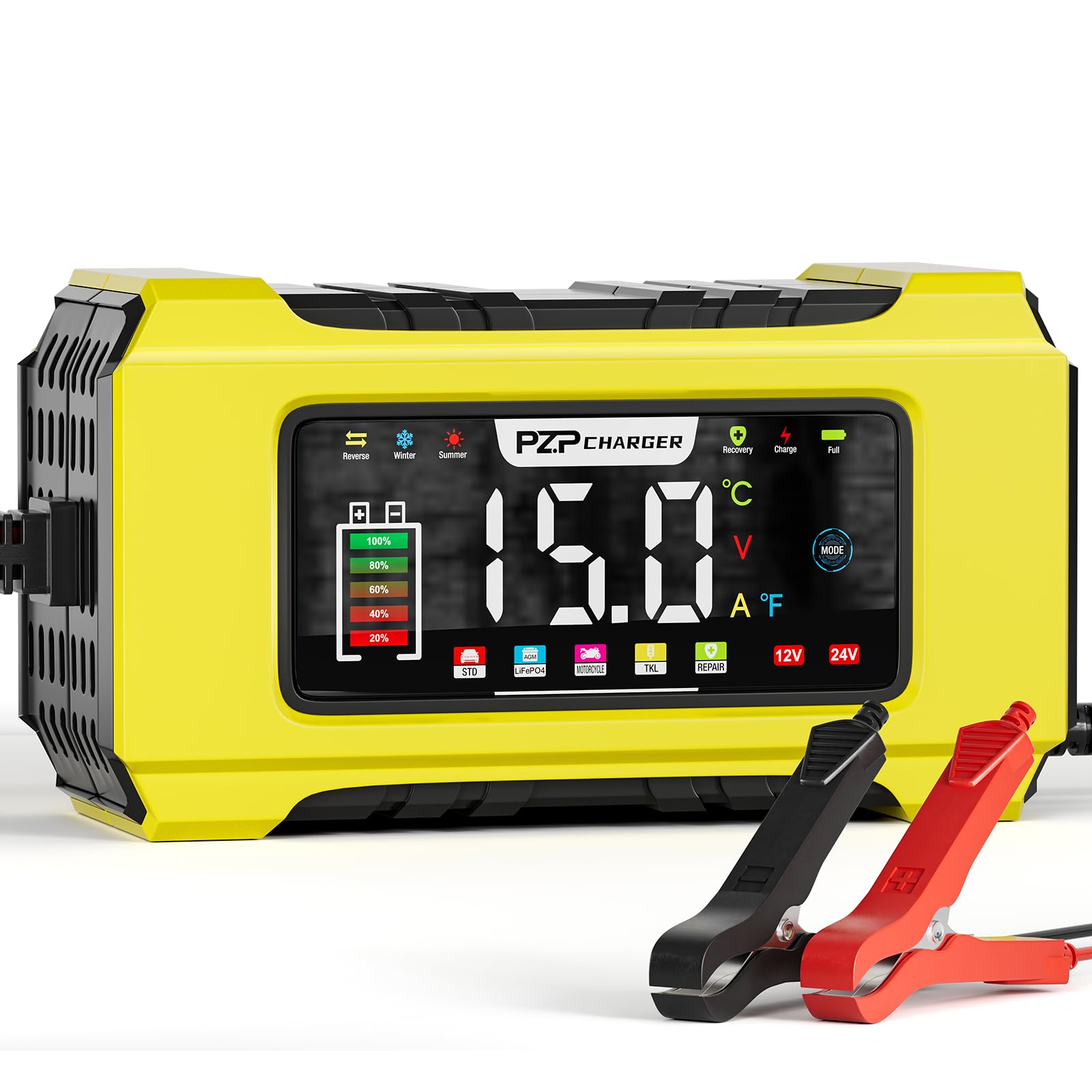
A dual-voltage fleet charger that swaps smoothly between 12V and 24V LiFePO4 and lead-acid packs.
The PZ.P 15-Amp is built for the person who owns several vehicles with different battery setups. It runs 12V at 15A and 24V at 8A — noticeably faster than the standard 10A or 8A chargers you find at similar price points. It works across LiFePO4, AGM, GEL, SLA, and Flooded batteries, so you can rotate it through cars, trucks, SUVs, motorcycles, lawnmowers, and boats without buying dedicated chargers. The 9-stage program finishes with a trickle/float mode (labeled TKL) that safely maintains a battery through months of inactivity — designed for winter storage. A large color LED screen shows charging voltage, current, internal temperature in Fahrenheit or Celsius, charge percentage, and the summer or winter mode setting. The 6.7-foot cable gives you reach to hard-to-access batteries, and once you set the mode, the unit remembers it next time.
Owners running the PZ.P for a lithium swap report good results once they get the mode selection right. One reviewer noted that the charger “charged 130AH LiFePO4 overnight; output 15A, BMS read 13.5-14A, 180W; cell failsafe tripped 4x.” That 13.5-14A delivered versus the 15A rated output is realistic cabling loss — the unit delivers honestly. A solar gate-opener user reports the PZ.P brought back dead batteries the previous charger could not. Multiple owners appreciate that the mode button is a touchscreen and that after first use, the unit remembers the setting — a genuine quality-of-life win for anyone swapping between chemistry modes.
The honest caveats worth knowing. First, if you own a LiFePO4 battery, you must switch to Mode 2 first — otherwise the charger enters a recovery mode intended for lead-acid that is harmful to lithium. Second, the unit is not weatherproof — do not leave it out in the rain. Third, the alligator clips are thin, and a couple of owners note the cell failsafe can trip during charging on larger lithium batteries. Those are real limitations but not dealbreakers: at its mix of dual voltage, 15A output, and LCD screen, the PZ.P covers ground that single-voltage chargers cannot.
What works well
- 15A at 12V and 8A at 24V — faster than standard 10A chargers at this size
- 9-stage program covers LiFePO4, AGM, GEL, SLA, and Flooded batteries in one unit
- Large color LCD with temperature (°F/°C), percentage, and mode display
- Memory function remembers your mode setting between uses
The trade-offs
- Must manually select Mode 2 for LiFePO4 — default recovery mode is unsafe for lithium
- Not weatherproof — indoor or covered use only
- Thin alligator clip contacts and occasional cell failsafe trips reported
Great for: households with multiple vehicles running both 12V and 24V packs who want one versatile charger on the workbench.
Double-check if: you want simple single-mode operation — this requires understanding the mode menu before you connect a lithium battery.
9. 15A Car Battery Charger 12V 24V Battery Trickle Charger Maintainer NC215

A compact 15-amp unit with a bright color screen that fits neatly into a fix-it garage or truck toolbox.
The NEXPEAK NC215 runs 15A at 12V and 8A at 24V through a 9-stage charging program — quicker than standard 10A units while staying small enough to store anywhere. It covers LiFePO4, lead-acid, and deep-cycle batteries across automotive, marine, AGM, GEL, SLA, and Flooded types, so the same charger works on a car battery, a boat battery, and a lawnmower battery without switching units. The trickle/float mode (TKL) keeps batteries topped off through winter storage, and the extra-large color LED screen shows voltage, current, internal temperature in both scales, percentage, and summer or winter mode — clear enough to read in direct sunlight. The 6.7-foot cord from the clips to the AC plug adds reach. Pulse repair detects sulfation and acid stratification and attempts restoration. Overall protections include temperature compensation, reverse protection, overcurrent, overvoltage, and short circuit protection, all housed in a body weighing just 0.66 kg. NEXPEAK warranties the unit for 10 years of spare-part availability.
Owners of the NC215 tend to describe it in the simplest possible terms — small, handy, works. Reported uses include keeping it in a fix-it garage for quick top-offs, and charging a range of batteries from compact lawnmower packs to full automotive batteries. The compact size keeps coming up — it does not take up shop space when not in use, and the color display makes monitoring easy. The 9-stage program is genuinely safer than a basic 2-stage charger for lithium and deep-cycle batteries because it includes pulse repair and temperature compensation phases alongside the standard charge curve.
The main thing to know before buying the NC215 is that it is not designed to activate completely dead batteries — those reading 0V. If your battery has been sitting long enough for its internal BMS or its sulfate layer to lock it down, this charger will not push through. That is a real limitation for anyone reviving old batteries. Also, unlike the LiTime and Redodo chargers above, this unit ships with alligator clamps rather than an Anderson connector, so if you want a permanent pigtail for quick attachment, plan on adding one. For active batteries that just need fast, safe charging with clear monitoring, the NC215 is a solid, compact workbench choice.
The case for it
- 15A at 12V / 8A at 24V — faster than standard 10A units in the same size class
- 9-stage program handles LiFePO4, lead-acid, AGM, GEL, and deep-cycle batteries
- Extra-large color screen visible in direct sunlight
- Compact 0.66 kg body stows easily in a toolbox or shop drawer
Know before you buy
- Cannot activate batteries reading 0V — no revival function for deeply discharged packs
- Ships with alligator clamps, not an Anderson connector
- LCD screen and modes require a few minutes of learning before first use
Perfect fit for: garages and shops that need a compact 15A charger covering both12V and 24V batteries with a bright screen for monitoring.
Skip if: you need 0V activation to revive shut-down LiFePO4 packs or want a locking Anderson connector from the start.
Understanding the Specs
Charging Amperage (Amps)
Amperage is how much current flows into your battery per hour — the single biggest lever on how long you wait. A 20A charger fills a 12V 100Ah LiFePO4 battery in roughly five hours; a 10A unit takes about ten. But higher amps are not always better: they demand better cooling, often mean more fan noise, and on a small 50Ah battery the extra current is wasted. Match the amperage to your battery bank size — 10A for occasional top-offs on a 100Ah pack, 20A when you run larger banks or discharge deeply on a regular cycle. Never exceed what the battery’s own BMS can safely accept.
0V Activation and Pre-Charge
When a lithium battery’s BMS (battery management system — the internal electronic brain that shuts current off when voltage drops too low) trips, the battery reads 0V and most chargers simply refuse to start. A charger with 0V activation pushes a small wake-up current into the pack to bring the BMS back online. If your battery has sat unused for months, this one feature can save a battery worth hundreds. If your battery cycles regularly, you will rarely need it — but as insurance against that one long storage period that drains everything, it is worth the small premium.
CC/CV Charging Profile
CC/CV stands for Constant Current / Constant Voltage — the standard safe charging pattern for lithium. It starts by feeding a steady current (the fast phase), then switches to holding a steady voltage once the battery nears full, so the last bit of charge trickles in without cooking the cells. Every serious 12V LiFePO4 charger in this list runs a CC/CV or CC/CV-plus-float profile. If a charger advertises only a simple step-charge curve without CC/CV, treat that as a warning sign — modern lithium packs expect this pattern for healthy long-term operation.
Anderson vs Clamp vs SAE Connectors
Anderson connectors (a locking plastic plug, commonly 50A rated) click firmly into place and cannot easily be plugged in reversed — the top choice for anyone who leaves a permanent pigtail wired to the battery. Battery clamps (the spring-loaded jaws) are best for one-off charging where you move the charger across multiple batteries. SAE connectors are the small two-pin plugs common on trickle chargers and can be wired permanently if you buy a matching pigtail. Pick based on whether you will leave the charger attached or swap it around your fleet.
FAQ
Will a 20A charger damage a 100Ah LiFePO4 battery?
How do I revive a 0V LiFePO4 battery?
Can I leave a 12V LiFePO4 charger connected all winter?
What is the difference between an Anderson connector and alligator clips on a lithium charger?
Why does my LiFePO4 charger run hot during charging?
Can I use a 24V LiFePO4 charger on a 12V battery?
Do I need a special charger for LiFePO4 or will a lead-acid charger work?
How long does it take to fully charge a 100Ah LiFePO4 battery?
Is it safe to charge a LiFePO4 battery indoors?
What does the 14.6V output mean for my 12V battery?
Final Thoughts: The Verdict
For most buyers the 12v lifepo4 battery charger winner is the LiTime 12V 20A — a 20A output that cuts charge time roughly in half versus 10A units, 0V activation to revive dead packs, Anderson connectors that lock firmly into place, and a 2-year warranty with AIG liability coverage behind it. It is the model that best survives the two scenarios that actually matter: quickly topping off a 100Ah-class battery and rescuing one that has sat unused too long.
If you own a premium car or a lithium battery that sits for weeks between drives and longevity matters more than speed, the CTEK 56-926 is the specialist — 4.3A of gentle 8-step charging with float/pulse maintenance designed to hold a lithium pack healthy through inactivity. And when your garage runs a mixed fleet of 12V and 24V batteries, or you need a compact toolbox charger with 0V activation, the NEXPEAK NC215 is a solid, compact 15A unit with a bright color screen. Match the amperage to your battery size, confirm the charger has the connector your setup uses, and any of these nine will serve you for years.
How We Picked
We do not accept paid placement. Every pick is matched to a real buyer and a real use-case; we do not hands-on test units.
Sources & Methodology
Specifications: manufacturer listings and product documentation. Review insights: verified customer reviews, as of September 2026. Pricing: not shown on this page (it changes often); check the current price via the retailer link.
As an Amazon Associate, Gadgets Feed earns from qualifying purchases. This does not affect which products we feature.