
Our readers keep the lights on and my morning glass full of iced black tea. As an Amazon Associate, I earn from qualifying purchases.
Specs are compiled from manufacturer listings and verified buyer reviews and can change over time — please confirm the key details on the product page before buying.
The problem is simple: you want to camp off-grid or sleep in your truck without running a loud generator all night. A standard home air conditioner needs 110V or 220V power, which drains your battery bank in under an hour. A 12V mini split changes everything — it runs directly off your vehicle’s DC electrical system, sips power instead of gulping it, and lets you enjoy real air conditioning wherever you park. Not all 12V units are created equal; the wrong one will leave you hot, frustrated, and out of pocket.
I’m Min — the founder and writer behind Gadgets Feed. This guide is built by comparing the manufacturers’ published specifications and the patterns across verified customer reviews, so you get each pick’s real strengths and trade-offs instead of marketing spin.
You need a 12v mini split that cools fast, runs quiet, and uses so little power you can sleep through the night on battery alone — whether you drive an RV, a van, a semi-truck, or a boat.
Our Picks at a Glance
How To Choose The Best 12V Mini Split
The biggest mistake buyers make is picking a unit with a high BTU rating without checking its actual power consumption in watts. A 12V AC that pulls 1,000W or more will kill a standard battery bank in a few hours, making it useless for off-grid camping. Match the unit’s power draw to your battery capacity.
Inverter Compressor: The Non-Negotiable Feature
An inverter compressor (also called a variable-frequency drive) is the brain that lets the air conditioner ramp up for fast cooling and then dial way back to maintain the temperature. Non-inverter units run at full blast or shut off completely — that cycling burns energy and makes them much louder. Look for “inverter compressor” or “variable frequency” in the specs. It is the single feature that turns a 12V AC from a novelty into a true off-grid solution.
Power Consumption and Your Battery Bank
This is the math that matters: your battery bank’s capacity in amp-hours (Ah) multiplied by your system voltage (12V) gives you total watt-hours. A unit that draws 350W in eco mode can run for 13 hours on a 400Ah battery (400Ah x 12V = 4,800Wh / 350W = 13.7h). A unit drawing 900W on turbo will cut that to about 5 hours. Always compare the “eco mode” or “sleep mode” wattage, not just the max number.
Noise Level — The Difference Between Sleep and Suffering
Noise is measured in decibels (dB). A typical conversation is around 60dB, a quiet library is about 40dB. If a unit runs at 55dB or higher, it will be a constant humming presence all night. The quietest 12V units hit 40-45dB in sleep mode, which is barely audible. Check the lowest dB number in the product specs for the quietest operation.
Quick Comparison
| Model | Best For | Cooling Power (BTU) | Power Draw (Watts) | Weight (Lbs) | Amazon |
|---|---|---|---|---|---|
| Outequip OutEquipPro★ Best Overall | Quiet rooftop replacement | 10000 | 960 | 45 | $895.00Amazon |
| Countrymod 10000 BTUAlso Great | All-night off-grid use | 10000 | 300-900 | Not listed | $939.00Amazon |
| Treeligo 11000 BTU | Largest cooling capacity | 11000 | 330-1000 | Not listed | Amazon |
| Gidrox 10000 BTU | Energy efficiency with smart controls | 10000 | 2930 | 59 | Amazon |
| Aspligo 10000 BTU | Budget split system | 10000 | 800 | 59 | Amazon |
In‑Depth Reviews
1. Outequip OutEquipPro 12V 10000 BTU Rooftop AC
Our pick — over 4.5★ from 80+ verified ratings; the strongest balance of quality and price.
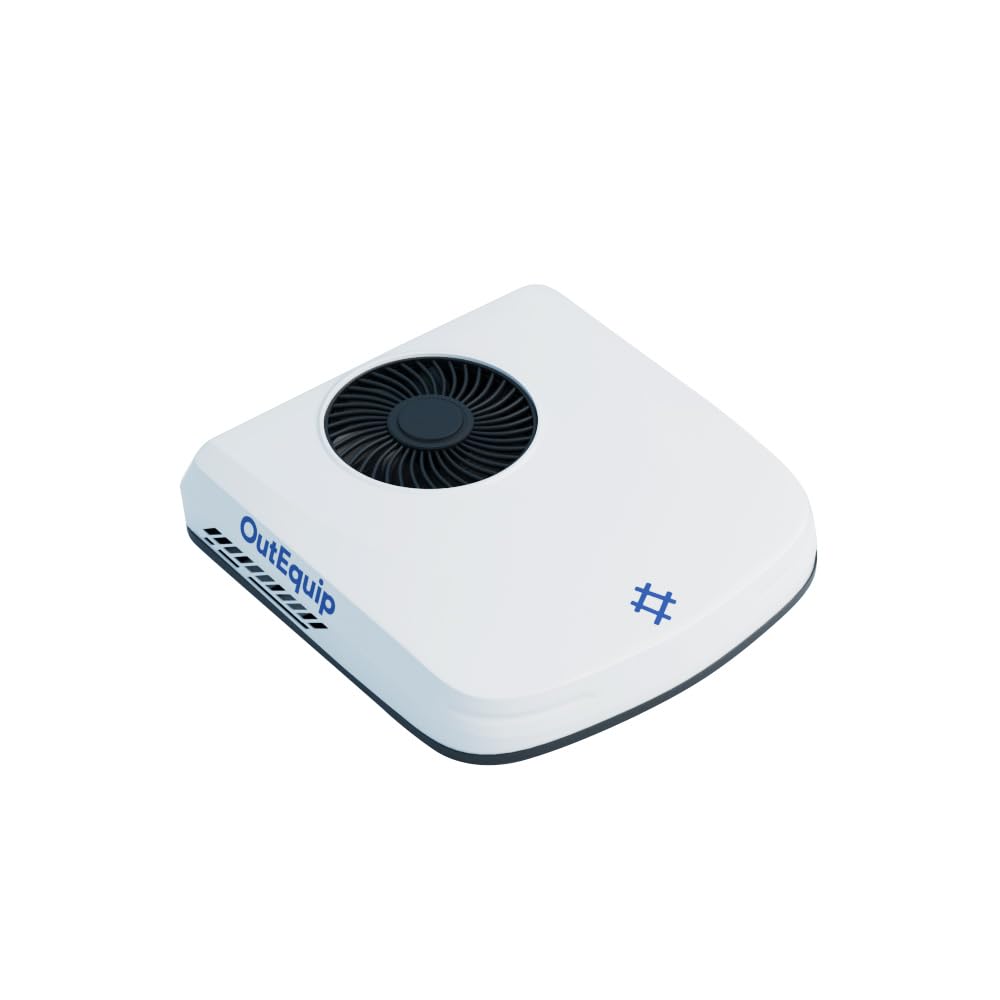
A 45-pound rooftop unit that is quiet enough to replace your old Coleman Mach without waking the neighbors.
If you have an RV with a standard 14×14 roof opening and you want a drop-in replacement that is dramatically quieter than a traditional RV AC, this is the one. Owners mention it is “very quiet (54dB)” and “light (45 lbs)” — compare that to a typical roof unit that can weigh 80-100 pounds and sound like a lawn mower. One reviewer even noted it was an easy swap for a Coleman Mach, which is a common brand in older RVs.
The trade-off is power consumption. In real terms, that means a 360Ah battery will give you about 6-7 hours of runtime, as one buyer measured. That is fine for a night’s sleep but not enough for a full day off-grid without recharging. The cooling power is 10,000 BTU, and it can drop the cabin from 89°F to 79°F in about 25 minutes, according to one reviewer.
It includes a remote control, eco mode, and sleep mode, plus a Bluetooth app for smartphone control. The build uses UV-stabilized ABS and a zinc-coated condenser, which helps it survive sun and road salt. It draws 55A at startup and drops to 20A on eco mode.
Perfect for weekenders: If you are at a campsite with partial hookups or you only need cooling for bedtime, the light weight and quiet operation make this a fantastic upgrade over a noisy old AC.
The real limitation: Its 960-watt draw means you will want at least 400Ah of battery to run it all night — this is not a unit for minimalist van dwellers.
Reach for this when: You want a simple, one-person rooftop install and you do not mind a moderate power draw for the comfort of a quick-cold and whisper-quiet unit.
Look elsewhere if: You are building an ultra-efficient off-grid system and need every watt to count — the Countrymod or Gidrox units sip less power.
2. Countrymod 10000 BTU 12V DC RV Air Conditioner
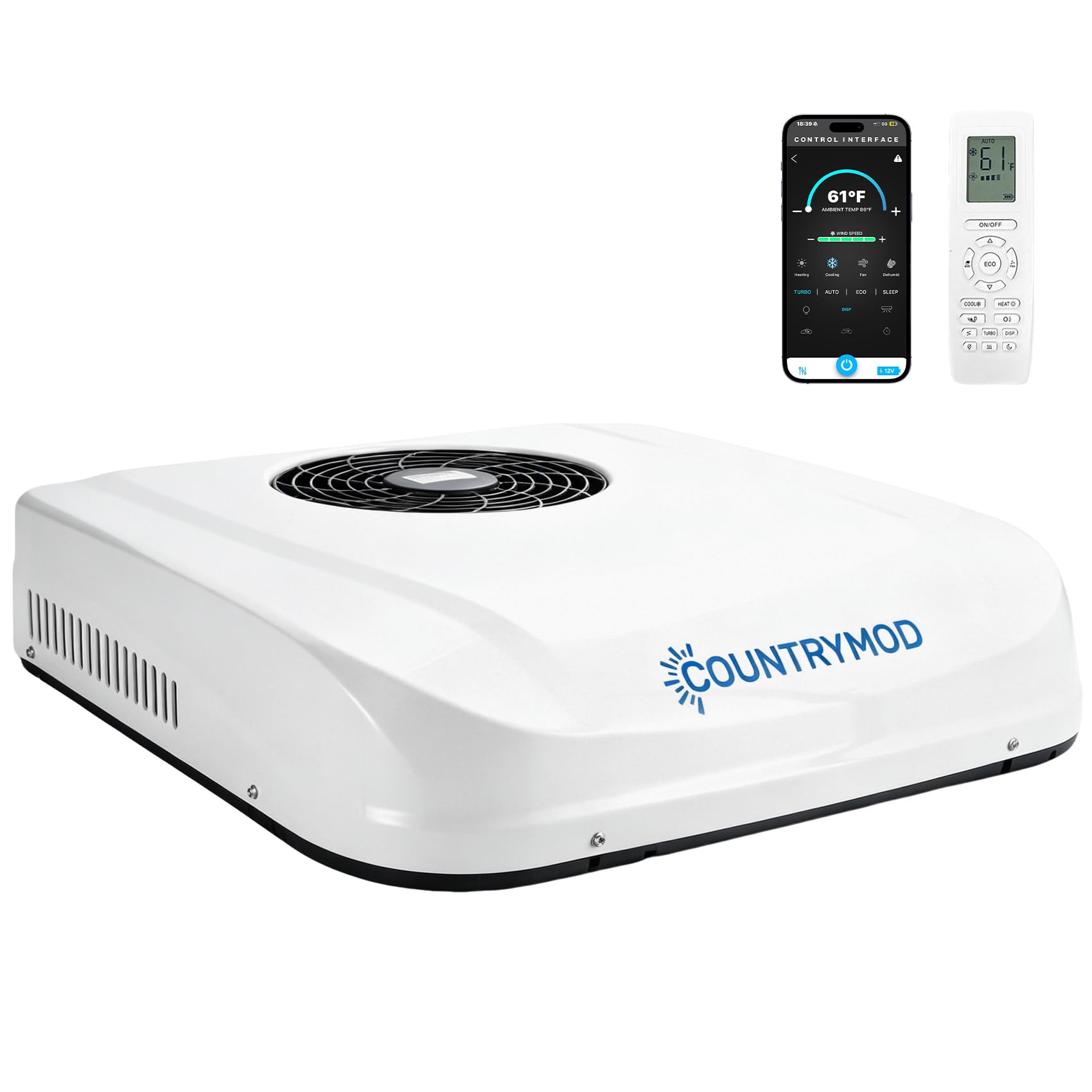
The inverter-driven unit that sips 260W in eco mode and keeps you cool all night without a generator.
The single number that matters here is 260 watts — that is what this unit draws in eco mode according to buyers. For context, the Outequip unit above pulls 960 watts even in its standard operation, making this Countrymod roughly 3.7x more efficient when you are trying to stretch your battery bank. It delivers 10,000 BTU of cooling power, the same as the others, but it does so with a variable-speed inverter compressor that adjusts its output on demand instead of cycling on and off.
Reviewers report that it fits a standard 14×14 inch roof vent and takes about 30 minutes to install. One reviewer noted that in a van with 360-degree windows in 113°F desert heat, it kept the interior at 80°F during the day and 72°F at night. The noise level is measured at 44dB in sleep mode — quiet enough to sound like a slight wind. Another reviewer mentions that a 300Ah battery lasted 12 hours on eco mode, which is the kind of real-world endurance you want for off-grid camping.
The controller can be a weak point — a buyer reported a non-working remote that was quickly replaced by the company’s customer service, which they said was excellent. For a unit in this premium tier, that responsive support is a real bonus if something goes wrong.
What makes it the top pick
- Inverter compressor lets it run on as little as 260W in eco mode
- Ultra-quiet at 44dB sleep mode, barely audible at night
- Fits standard 14×14 inch roof opening for easy swap
- Strong customer service reviews for replacements
The fine print to know
- Arched roofs may require longer bolts (8mm x 160mm) not included
- Some buyers report a 5/8 inch duct gap that needs tape to seal
- Installation instructions described as mediocre by several buyers
Your best bet for all-night cooling: If you have a battery bank of at least 300Ah and want to sleep cool without waking to a dead battery, this is the unit that delivers on its promise.
Watch out for: The roof fit is not truly universal — if you have an arched roof, plan to source longer bolts before you start your install.
3. Treeligo 11000 BTU 12V DC Rooftop AC with Heater
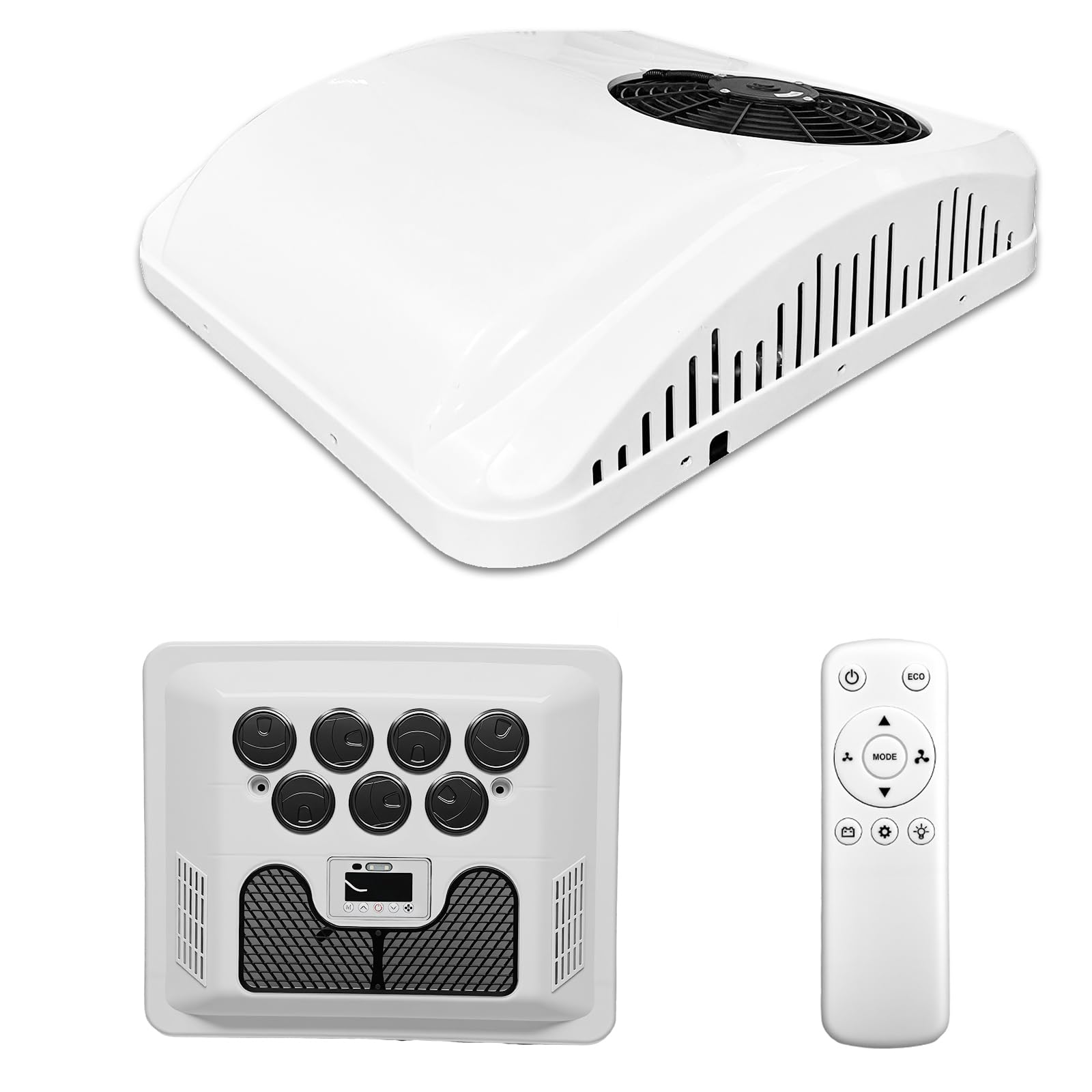
The only unit on this list that offers both cooling and heating in one rooftop package.
Most 12V DC units are cooling-only, but this Treeligo delivers 11,000 BTU of cooling and heating, making it a year-round solution for your RV or van. That is 10% more cooling power than the other 10,000 BTU units here. It uses an inverter compressor that sips between 330W and 1,000W depending on the mode, so it can be quite efficient when dialed down. It also claims to cool or heat within 5 minutes, which is fast for a roof-mounted system.
It runs at under 45 decibels (dB) — as quiet as the Countrymod — so you can sleep without a hum. It is FCC and UL certified, meaning the electronics are designed not to interfere with your vehicle’s radio or navigation systems. The minimum roof opening is 12.6 inches by 10.24 inches, smaller than the standard 14×14-inch cutout, so it fits non-standard roof openings more easily.
The downside? This is a premium-priced unit with only 16 ratings on Amazon, so the long-term reliability is not as proven as the more-reviewed models. It also does not have a built-in dehumidifier mode like some competitors, and the included components are listed simply as “conditioner,” meaning you may need to buy additional hardware.
Why it stands out
- Heating and cooling in one unit, saving roof space for winter camping
- Largest cooling capacity at 11,000 BTU
- Inverter compressor can drop to 330W in low-power mode
- Quieter than 45dB, which is library-quiet
Before you order
- FCC and UL certification is listed but not yet backed by extensive customer reviews
- No dehumidifier or app control, just remote and panel
- Heater function adds complexity — make sure your wiring can handle the higher wattage
Your move if: You need both heat and AC in one unit and have a battery bank that can handle up to 1,000W on heater mode, this is a rare all-in-one solution for four-season travel.
skip it if: You only need cooling or you prefer a unit with a proven track record — the Countrymod and Outequip have many more verified buyer experiences.
4. Gidrox 10000 BTU 12V DC RV Air Conditioner
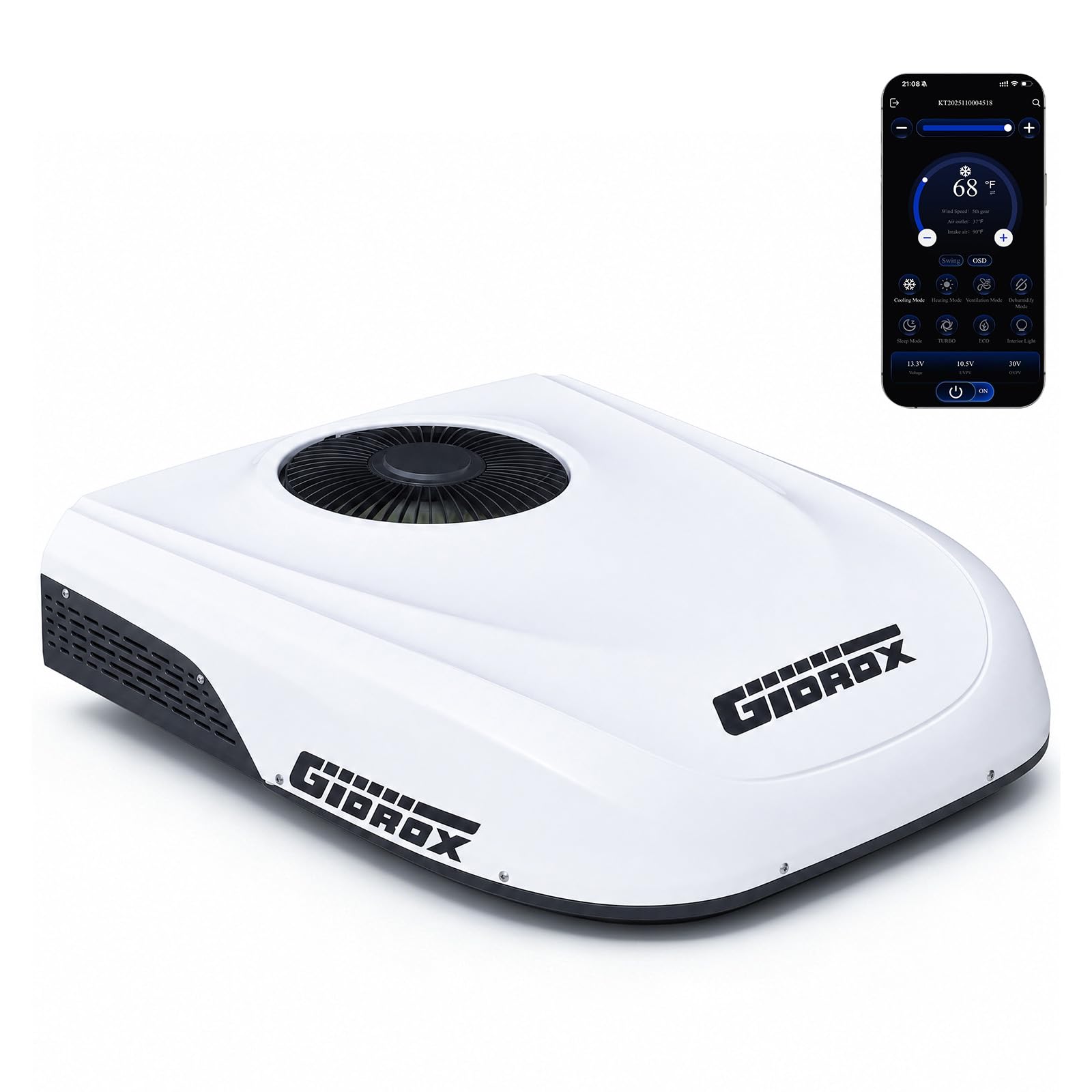
The smartest 12V AC on the list, with real-time wattage monitoring through a smartphone app.
This Gidrox unit is packed with smart features: you control it through a smartphone app (Bluetooth), an infrared remote, or physical buttons on the unit. One buyer tested it thoroughly and shared exact wattage readings — the dehumidifier mode draws about 250W, eco mode pulls around 350W, cooling mode draws 420W, and turbo hits 650-700W. When the compressor cycles off, it sips just 25-50W. That is incredibly low power draw compared to the Outequip’s 960W, making this a strong contender for serious off-gridders.
It delivers 10,000 BTU of cooling and uses an inverter compressor, so it can maintain temperature without cycling on and off. It also includes a HEPA filter, which is rare among 12V RV ACs and helpful if you camp in dusty areas or have allergies. The unit weighs 59 pounds and sits at 7 inches tall on the roof, making it one of the slimmest on the list. However, the official annual energy consumption is listed at 2,930 watts, which is high compared to the Countrymod’s 300-900W range — this likely reflects the max rating, not the real-world average.
The build quality is a concern. One buyer mentioned that a bolt insert pulled out during roof installation, leaving one corner unsecured; they had to use epoxy to fix it. The manual is also described as vague on wiring details. The overall rating is 4.5 stars from 18 ratings, but that one build issue is enough to give pause if you are installing on a rainy day.
What impresses
- Verified real-world power draw of 250W in dehumidifier mode and 350W in eco
- Smartphone app control with timer, temperature switching, and wattage monitoring
- HEPA filter for cleaner air inside the vehicle
The catch to consider
- A buyer reported a pulled-out bolt insert during installation, indicating a potential quality issue
- Manual is vague on wiring and bolt specs, requiring some DIY experience
- At 59 pounds, it is heavier than the Outequip (45 lbs)
Grab this if: You want granular control over your power usage and appreciate a HEPA filter (a high-efficiency air filter that traps dust and pollen) for cleaner air — the app alone separates it from most competitors.
Be careful if: You are a first-time installer; the vague manual and bolt issue suggest you will need some mechanical confidence to get it right.
5. Aspligo 10000 BTU 12V Mini Split Air Conditioner

The only true split system here, separating the noisy compressor from the indoor unit for a flexible install.
Unlike the rooftop units above, this is a split system — the compressor unit mounts outside (on the back of a truck cab, for example) and the evaporator mounts inside. This makes it ideal for semi-trucks, vans where roof space is tight, or boats where a roof hole is not possible. It claims a power draw of about 800W and a current of 60-80A, which is higher than the most efficient rooftop units but still usable with a large battery bank.
One owner reported that it took about 3 hours to install for a first-timer in hot weather, and that it runs great and cools the van quickly. Another reviewer said it has a lower power draw than expected, which is a good sign. However, the overall rating is just 3.7 stars from 15 ratings, and a concerning number of reviews report problems. One customer observed only the compressor and hoses arrived — the fan and controller were missing. Another said the unit “only works when 70°F and lower outside,” which suggests it may struggle in extreme heat. A third simply said it “was not functional for my use.”
It uses R134a refrigerant (not included), which is a common automotive refrigerant, but you will need to source it separately. The manufacturer claims fuel savings, but that figure is a marketing estimate, not independently verified.
A genuine value play: If you need a split-system form factor for a truck cab or a van with no roof space, this is one of the few affordable 12V split options on the market.
The gamble is real: The mixed reviews — missing parts, performance complaints, and low overall rating — mean you are taking a chance on quality control. Keep the box and paperwork for a potential return.
Choose this only if: You have a use case that demands a split system (like a semi-truck cab) and you are willing to work through potential missing parts and a finicky install.
Do not choose this if: You want a straightforward, reliable install that works from the start — the rooftop units above are far more proven.
Understanding the Specs
Inverter vs Non-Inverter Compressor
An inverter compressor (also called a variable-speed or variable-frequency drive) is not just a marketing buzzword — it is the key that makes 12V off-grid AC practical. A non-inverter unit runs at full power until the cabin reaches the set temperature, then shuts off completely. Then the temperature rises, and the compressor kicks on again at full blast. This on-off cycling uses way more energy because every startup draws a massive current spike. An inverter compressor, by contrast, ramps up to cool the space fast, then dials back to a whisper (as low as 260W on some units) to maintain the temperature. That is how a unit like the Countrymod can run for 12 hours on a 300Ah battery while a non-inverter unit would kill that same battery in 4-5 hours.
Power Draw: Watts, Amps, and Your Battery
These three numbers must be understood together. Watts (W) measure total power consumption. Amps (A) measure current draw — and since 12V systems measure current, you will hear people say “it pulls 55A.” The simple math is: watts divided by voltage equals amps (for example, 660W / 12V = 55A). Most lithium batteries are rated in amp-hours (Ah). A 400Ah battery holds 400Ah x 12V = 4,800 watt-hours. If your AC draws 400W on average, that gives you 4,800 / 400 = 12 hours of runtime. Always check the “eco mode” or “sleep mode” wattage, because that is the number that determines how long you actually sleep before the battery dies.
FAQ
Can I install a 12V mini split in my van myself?
How much battery capacity do I need for a 12V mini split to run all night?
Is a 12V mini split more efficient than a traditional rooftop RV AC?
Can a 12V mini split cool a large RV or a 30-foot camper?
What is the difference between a mini split and a rooftop unit?
Will a 12V mini split work with my lithium battery bank?
What size wire do I need for a 12V mini split installation?
Do I need a heater or can I just use a 12V mini split for cooling?
Final Thoughts: The Verdict
For most buyers, the best 12v mini split winner is the Countrymod 10000 BTU because its inverter compressor (a variable-speed compressor that adjusts power use) delivers real-world eco-mode wattage of 260W, quiet 44dB operation, and genuine all-night cooling on a moderate battery bank. If you want the lightest rooftop install with proven customer service, grab the Outequip OutEquipPro. And for a true split-system form factor that fits a semi-truck cab, the budget value of the Aspligo 10000 BTU stands out.
How We Picked
We do not accept paid placement. Every pick is matched to a real buyer and a real use-case; we do not hands-on test units.
Sources & Methodology
Specifications: manufacturer listings and product documentation. Review insights: verified customer reviews, as of July 2026. Pricing: not shown on this page (it changes often); check the current price via the retailer link.
As an Amazon Associate, Gadgets Feed earns from qualifying purchases. This does not affect which products we feature.
Related Guides
Product prices and availability are accurate as of the date/time indicated and are subject to change. Any price and availability information displayed on Amazon at the time of purchase will apply to the purchase of this product. As an Amazon Associate I earn from qualifying purchases.
CERTAIN CONTENT THAT APPEARS ON THIS SITE COMES FROM AMAZON. THIS CONTENT IS PROVIDED "AS IS" AND IS SUBJECT TO CHANGE OR REMOVAL AT ANY TIME.
Amazon and the Amazon logo are trademarks of Amazon.com, Inc. or its affiliates.