
Our readers keep the lights on and my morning glass full of iced black tea. As an Amazon Associate, I earn from qualifying purchases.
Specs are compiled from manufacturer listings and verified buyer reviews and can change over time — please confirm the key details on the product page before buying.
The biggest headache with any RV, van, or truck camper isn’t the driving — it’s sleeping through a hot night without draining your battery bank or running a generator. A 12V portable air conditioner promises off-grid cool without a generator, but the specs, connectors, and power claims can be a minefield for someone just looking to buy once. This guide covers seven top 12V portable air conditioners, their real battery impact, and the best fit for your rig.
I’m Min — the founder and writer behind Gadgets Feed. This guide is built by comparing the manufacturers’ published specifications and the patterns across verified customer reviews, so you get each pick’s real strengths and trade-offs instead of marketing spin.
All seven units run on 12V DC power, so you can skip the inverter and plug directly into your battery for efficient cooling wherever you park, and this organized breakdown of the 12v portable air conditioner market makes choosing the right one a straightforward process.
Our Picks at a Glance
How To Choose The Best 12V Portable Air Conditioner
The average buyer chases the highest BTU number without checking the unit’s watt draw at its lowest fan speed. Your battery bank’s amp-hour rating is the real limiter — a high-efficiency unit running all night on 350W beats a brute-force machine draining your reserve in two hours. Focus on three specs: operating wattage range, physical form factor, and whether the compressor uses inverter technology.
Understand Your Vehicle’s Electrical Setup
Before buying, confirm your battery bank voltage (12V is assumed, but many large RVs use 24V or 48V) and calculate your usable amp-hours. A unit pulling 50A continuously flattens a 100Ah battery in under two hours. Aim for a model whose mid-range power draw matches your battery’s capacity for an overnight run — typically 350 to 600W average draw with 200Ah or more of usable lithium capacity. Buyers report that a 600Ah lithium bank paired with strong solar can run a 16A draw unit all night in eco mode without issue.
Pick the Right Physical Form Factor
Rooftop units (like most RV air conditioners) are the most common because they mount out of the way, use the existing roof vent, and distribute cool air from above. Under-dash kits are smaller and keep your roofline clean but require moderate mechanical skills to install the condenser and compressor separately. Split units (like the CNCEST) mount the noisy compressor outside your living space and the slim fan unit inside, which keeps the interior quiet but adds installation complexity. Measure your roof opening (typically 14 by 14 inches) and your interior wall space before picking a form factor.
Demand an Inverter Compressor
A non-inverter compressor (the kind in traditional rooftop units) runs at full power until it hits the set temperature, then shuts off completely. This on/off cycling is loud and inefficient. An inverter compressor (found in the Treeligo, Outequip, and Countrymod units) varies its speed to maintain the exact temperature, running continuously at a low power draw instead of cycling. This usually cuts power consumption , which makes the difference between a battery that lasts three hours and one that lasts all night.
Quick Comparison
| Model | Best For | Cooling Capacity | Power Draw Range | Weight | Amazon |
|---|---|---|---|---|---|
| RV Air Conditioner, 12V 10000 BTU Rooftop★ Best Overall | Off-grid RV owners with large battery banks | 10,000 BTU (with 4,500 BTU heater) | 960W | 43 lbs | Amazon |
| CNCEST 12V DC Split Air Conditioner 11000 BTUBest Value Split | Semi truck and heavy vehicle owners on a budget | 11,000 BTU | 400-600W | 62 lbs | Amazon |
| Electric Air Conditioner 12v 10000btu Under Dash Kit | DIY mechanics retrofitting a van or boat | 10,000 BTU (heat and cool) | 550-600W | — | Amazon |
| Treeligo 11000 BTU 12V DC Rooftop RV AC | Small RVs and 5th wheels needing quiet, efficient cooling | 11,000 BTU (heat and cool) | 330-1000W | — | Amazon |
| 10000 BTU 12V DC RV Air Conditioner with Heater | Families wanting app-based control and all-night sleep mode | 10,000 BTU (heat and cool) | 2930W (max), ~350W avg | 52 lbs | Amazon |
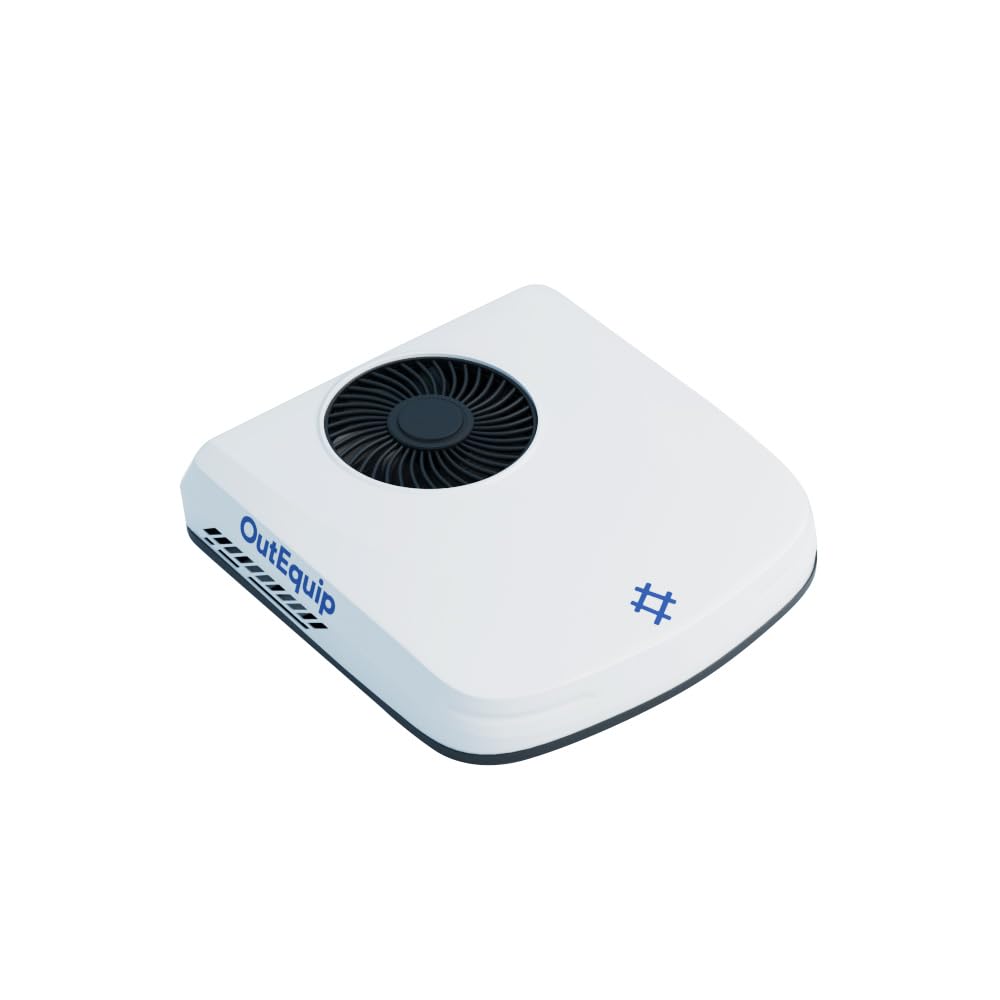
| Outequip RV Air Conditioner, 12V 10000 BTU Rooftop | VW bus and Class B van owners wanting easy install | 10,000 BTU | 960W | 43 lbs | Amazon |
| 12V DC RV Air Conditioner 10000 BTU | Large motorhome owners with big solar setups | 10,000 BTU | 300-900W | — | Amazon |
In‑Depth Reviews
1. RV Air Conditioner, 12V 10000 BTU Rooftop Air Conditioner for RVs, Trucks, Vans, Campers, Tractor, Low Profile Quiet AC Unit(w/heater)
Our pick — 4.5★ from 100+ verified ratings; the strongest balance of quality and price.
the just-right unit that cools fast and sips power, with a backup heater for chilly mornings.
This is the unit for the boondocker who wants one appliance to pull double duty: it delivers 10,000 BTU of cooling (able to cool an RV in around 15 minutes according to the specs) and backs that up with a 4,500 BTU PTC heater to take the chill off on cool evenings. It consumes 960 Watts at full tilt, at 960 Watts versus the CNCEST split unit at 400 Watts, but buyers running big battery banks say it works well — one reviewer noted that eco mode draws roughly 16A on his 600Ah LiFePO4 setup with 2200W of solar panels. The trade-off is that the 4,500 BTU heater is marketed as a supplementary warmth source, not a primary heat solution for extreme cold.
The brushless copper motor and spring-supported mounts keep noise down, and you get four control modes (eco, sleep, turbo) plus a remote or smartphone Bluetooth app for temperature monitoring. It weighs 43 pounds according to the data — at 43 pounds versus the traditional 90-pound Coleman Mach unit, which owners mention makes roof installation much easier. The core materials include a zinc-coated condenser and UV-stabilized ABS shell for weather resistance.
Why It Earns the Top Spot
- 10,000 BTU cools most RV interiors within 15 minutes
- 4,500 BTU PTC heater adds warmth for mild-cold mornings
- Inverter compressor and eco mode cut power draw for extended off-grid use
- 43-pound weight makes roof installation much easier than older units
One Real Limitation
- The PTC heater is not designed for freezing temperatures or very large spaces
- Some customers note fragile lid connectors on the unit shell during install
Reach for this if: you have a 400Ah+ battery bank and want one rooftop unit that both cools and provides backup heat without running a generator.
Look elsewhere if: you mostly camp in below-freezing conditions and need a primary heat source — the PTC heater here is a supplement, not a furnace replacement.
2. CNCEST 12V DC Split Air Conditioner 11000 BTU, Semi Truck Cab AC Unit
The smallest power draw in this guide, perfect for truck cabs where battery capacity is tight.
If your space is a semi cab, a work van, or an excavator, this split-system unit makes sense because it only pulls between 400 and 600 Watts — only pulls between 400 and 600 Watts, compared to 960 Watts for the Outequip rooftop unit above. That means you can run it for an estimated 1 to 3 hours after parking on a single 100Ah battery, which is critical for overnight rest stops. The 11,000 BTU rating gives it 10% more cooling power than the 10,000 BTU rooftop units here, yet at a fraction of the power cost. The form factor is a split system: the heavy iron-cased compressor mounts on the outside of the vehicle, and the slim interior unit with a digital display and five-speed fan stays inside.
The built-in under-voltage protection cuts the unit off below 11 volts to prevent draining your starter battery dead, a safety feature that the under-dash kit below also includes. The catch is reliability: reviewers point out that the unit “worked great until condenser leaked” and replacement support varied — one owner said the seller sent a replacement promptly, while another was told to buy a whole new unit. A few buyers also noted the control panel labels were in Chinese or Japanese characters, and no English instructions were included, which can make setup tricky for a first-timer.
What Makes It a Bargain
- 400-600W power draw is the most efficient in this comparison — ideal for small battery banks
- 11,000 BTU offers more raw cooling than any other pick here
- Under-voltage protection keeps your starter battery safe during rest stops
- Fits a wide range of vehicles beyond just RVs: semis, buses, excavators
Know Before You Buy
- Condenser leakage has been reported across several units in user reviews
- Control panel text is not in English, and instructions are not included
- Customer service responsiveness is inconsistent according to buyer feedback
Best for: truck drivers and van dwellers who need a cool cab overnight on a modest 100Ah battery and accept the split-system install work.
skip it if: you don’t have the tools or patience to mount an outdoor compressor unit and trace electrical connections yourself.
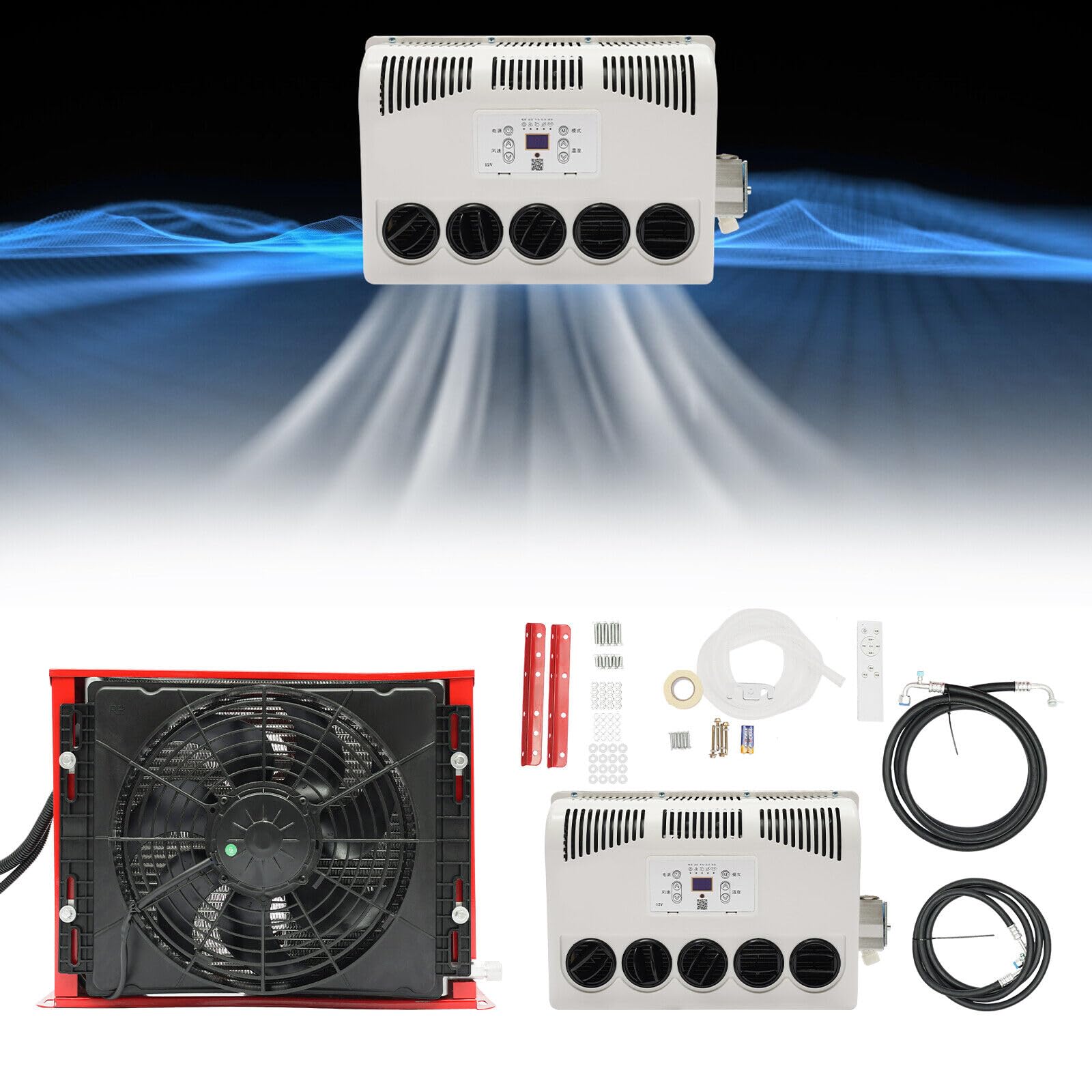
3. Electric Air Conditioner 12v 10000btu Under Dash air conditioning Kit 12 volt universal car ac system

The split-system retrofit for experienced mechanics who want to add AC to almost any vehicle.
This kit is a complete under-dash system that uses an electric 20CC scroll compressor to push 10,000 BTU of cooling power through a compact interior unit that measures about 15.9 by 13.6 by 6.1 inches. The integrated design combines the receiver dryer, condenser fan, and condenser into one assembly to reduce potential leak points compared to standard automotive AC retrofits. Shoppers say it is a bargain price and “easy install for experienced mechanics” but warn that the included instructions are basic.
The big advantage here is that it is a universal fit for cars, trucks, vans, RVs, campers, buses, and boats, so if your vehicle has no existing air conditioning at all, this fills the gap entirely. The low-voltage protection feature prevents the unit from starting when your battery is too low, protecting your vehicle’s start capability. However, the customer reviews are mixed: one buyer mentioned it works great and produces cold air after a straightforward install, while others reported broken units on arrival with unhelpful customer service. The manufacturer recommends R134A refrigerant, 500-550 grams of charge, and POE68 oil for the compressor — parts you supply separately.
Why It Fits a Certain Builder
- Universal fit for cars, vans, trucks, RVs, and even boats — no custom adapters needed
- Integrated condenser and receiver dryer design reduces potential refrigerant leak points
- Low-voltage protection helps avoid draining your starting battery
- Claims up to annual fuel savings for electric-only operation vs gas-powered AC
What Might Stop You
- Requires moderate-to-advanced mechanical skill; instructions are basic
- Several buyers reported broken units with unhelpful seller support
- Does not include refrigerant or compressor oil, which you must buy and charge yourself
Mechanics and van builders will appreciate the universal fit and complete kit design if they are comfortable running lines and charging refrigerant.
First-timers should stay away — the poor support and missing instructions make it a headache if something arrives damaged or you hit an install snag.
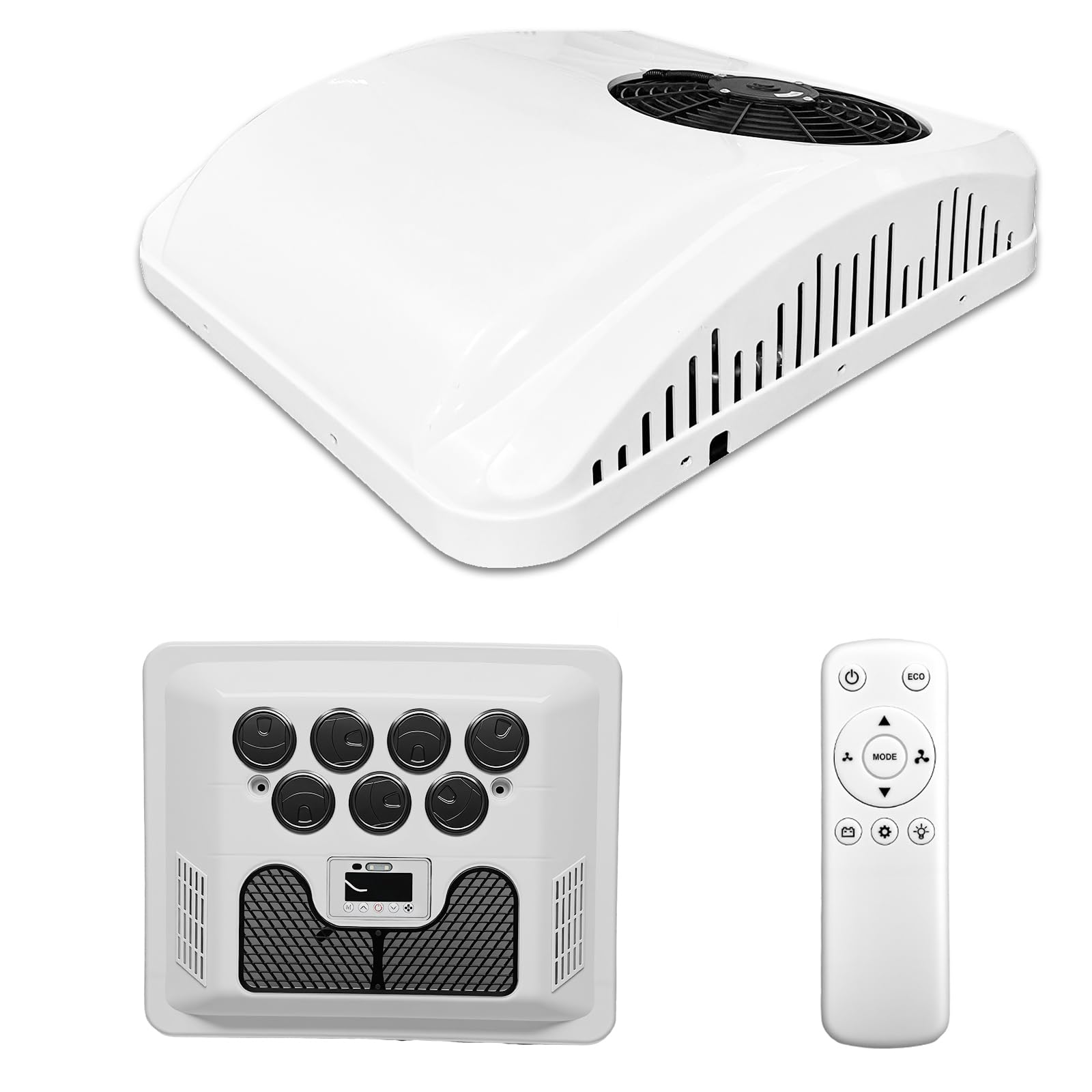
4. Treeligo 11000 BTU 12V DC Rooftop RV Air Conditioner, Battery Powered, Ultra Quiet & Fast Cooling Rooftop Inverter AC Unit with Heater
The quietest rooftop unit in the list, designed for off-grid couples who hate generator noise.
That is quieter than a library conversation, important for couples or solo travelers who value their sleep. The inverter compressor lets it pull between 330W and 1000W depending on the mode, and under a moderate load buyers report it runs well on a 12V 300Ah battery bank, drawing around 50A. It cools a 5th wheel bedroom quickly even in 100°F weather, per one owner’s review. The 12V DC system means no generator or fuel needed — a huge plus for off-grid boondocking.
The unit is FCC and UL certified for safety against current surges and electromagnetic interference with your vehicle’s navigation or radio. Installation requires a roof opening of at least 12.6 by 10.24 inches, which is smaller than the standard 14×14 vent found on many RVs, so converting may need a filler plate. The catch is occasional reliability issues: one owner reported that the unit quit cooling and displayed error codes (2P, 3P, 4P) and the manufacturer was unresponsive via email, Amazon, or the website. Other buyers called the customer support helpful, so it may be luck of the draw. Some builds also note that 6-gauge cables are undersized for a 200Ah battery — one owner swapped to 4-gauge for better performance.
Why You Might Love It
- 11,000 BTU is the highest capacity among rooftop units in this roundup
- Noise level stays below 45 dB, making it one of the quietest options
- 330-1000W inverter compressor sips power at low speeds
- FCC and UL certified for electrical safety and EMC (electromagnetic compatibility)
What Could Go Wrong
- Some owners experienced error codes and could not get customer support to help
- Minimum roof opening is non-standard at 12.6 x 10.24 inches
- Factory 6-gauge wiring may be too thin for larger 200Ah battery banks
Grab this for: a small RV or camper van where whisper-quiet operation and 11,000 BTU of inverter-driven cooling matter more than standard installation dimensions.
Think twice if: you want guaranteed customer support — the mixed reviews on responsiveness make this a risk for non-DIY buyers.
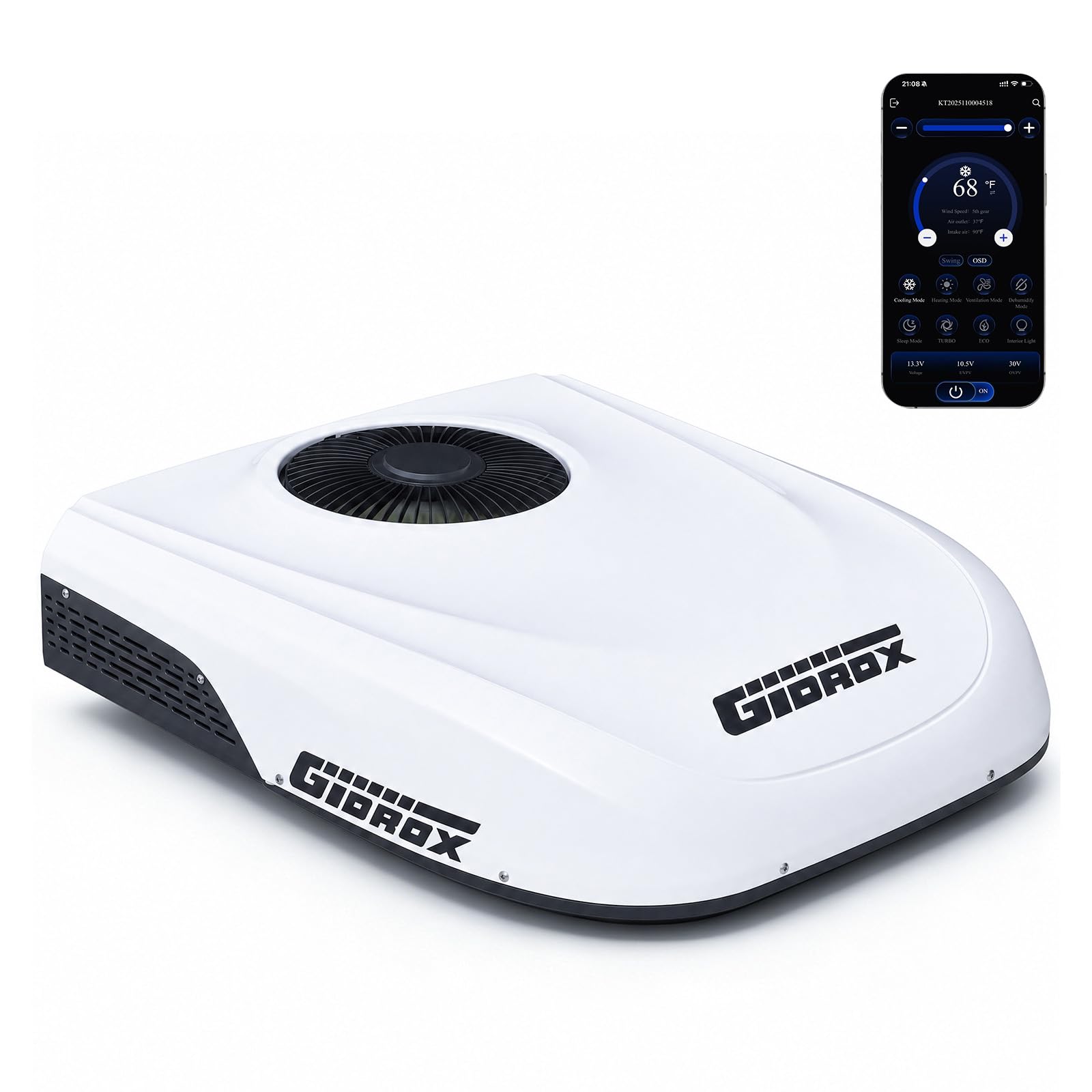
5. 10000 BTU 12V DC RV Air Conditioner with Heater – Battery Powered, Low Power Consumption, Ultra Quiet & Fast Cooling Upgraded Rooftop AC Unit with APP Remote
The app-connected rooftop unit that lets you tweak temps from your pillow without getting up.
This unit from Gidrox gives you three control methods: the unit’s physical buttons, an infrared remote, and a smartphone app via Bluetooth. You can set temperatures, timers, and switch between Turbo, ECO, and Sleep modes without walking across the RV. The Sleep mode is rated at only 40 decibels — roughly the same as a quiet library. It claims to hit your desired temperature within 3 minutes, backed by a 10,000 BTU cooling capacity and PTC technology for instant heat on cold mornings. The operating range is wide: the max listed annual energy consumption is 2930 Watts, but the tested average is only around 350W during nighttime operation in 30°C ambient conditions, according to the manufacturer. The 52-pound weight and 34.6-inch depth are note if your roof is small.
It fits the standard 14×14-inch roof opening common on most RVs, and the kit includes a 19.7-foot power cable plus mounting hardware. Owners mention that the installation is straightforward, but some ran into issues with 8mm threaded rods being too short for thicker camper roofs — a simple swap to longer all-thread solved it. The remote was also reported to have intermittent functionality, but the app serves as a backup. The unit is compatible with roof thicknesses between 1.5 and 3.5 inches, so thick foam roofs may need a spacer.
Standout Smart Features
- Bluetooth app control plus infrared remote plus physical panel gives you full flexibility
- Sleep mode runs at only 40 dB for undisturbed rest
- Tested average power draw of 350W at night can stretch a 400Ah battery through a full night
- Fits standard 14×14 roof openings with included hardware
Watch Out For
- Customer support responsiveness is a recurring complaint — some buyers could not reach anyone for over a week
- 8mm threaded rods may be too short for roof thicknesses over 3.5 inches
- Remote control sometimes doesn’t pair properly; the app becomes your backup
Smart-control fans will love the Bluetooth app integration and 40dB sleep mode if they want family-friendly comfort without leaving the bed to change settings.
Budget for a backup plan — if the remote fails and the app has issues, the physical panel still works, but the unreliable customer service is a real risk if something breaks.
6. Outequip RV Air Conditioner, 12V 10000 BTU Rooftop Air Conditioner for RVs, OutEquipPro 12V AC (12 voltage w/o heater)
The lightweight champion that a single person can hoist onto a van roof without a second set of hands.
At 43 pounds, this Outequip unit is the same weight as its in-line counterpart (product 1) but sold without the heater, making it a purist’s choice for hot climates where heating is not needed. It delivers the same 10,000 BTU of cooling, and the manufacturer claims it can provide 8 hours of cooling with a 480Ah power source and 10 hours with a 600Ah source when parked. That is a strong runtime promise for a 12V rooftop unit. The 960 Watt annual energy consumption matches the other Outequip model, and the same UV-stabilized ABS materials, EPDM foam gasket, and zinc-coated condenser construction apply for longevity in harsh weather. Buyers have installed this on VW Westfalia buses, Promaster vans, and pop-up campers with high satisfaction.
The brushless copper motor and spring-supported mounts keep noise low, and the Bluetooth app and remote give you eco, sleep, and turbo modes to manage battery drain. One buyer on a Ram Promaster with 360Ah lithium reported getting 6-7 hours on max cooling, noting van insulation makes a big difference. Reviews are overwhelmingly positive at 4.7 stars from 81 ratings, with buyers calling the noise level “crazy quiet” compared to older Coleman units. The downside is there is no heating function — if you camp in chilly weather, you will need a separate warmth source. Also, the included 6AWG power cable is 15 feet with a 100A fuse, so make sure your battery location can reach.
Why a Van Builder Loves It
- Weighs only 43 lbs — manageable for solo roof installation
- Rated for 8 hours on 480Ah battery and 10 hours on 600Ah battery while parked
- Bluetooth app, remote, eco, sleep, and turbo modes for flexible power management
- 4.7-star average from 81 reviews is the highest rating in this comparison
What It Doesn’t Do
- No heating function at all — this is cooling only (12V without heater model)
- Requires at least 480Ah of battery to hit the full 8-hour runtime claim
- 6AWG cable length (15 ft) may not be long enough for some battery placements
Reach for this if: you are a solo van builder who needs a light, quiet rooftop AC that a single person can install without a lift.
pass on it if: you need a built-in heater for four-season camping — this is a cooling-only unit that requires a separate heat source.
7. 12V DC RV Air Conditioner 10000 BTU RV AC Unit Low Power Consumption Rooftop RV Air Conditioners with APP Remote
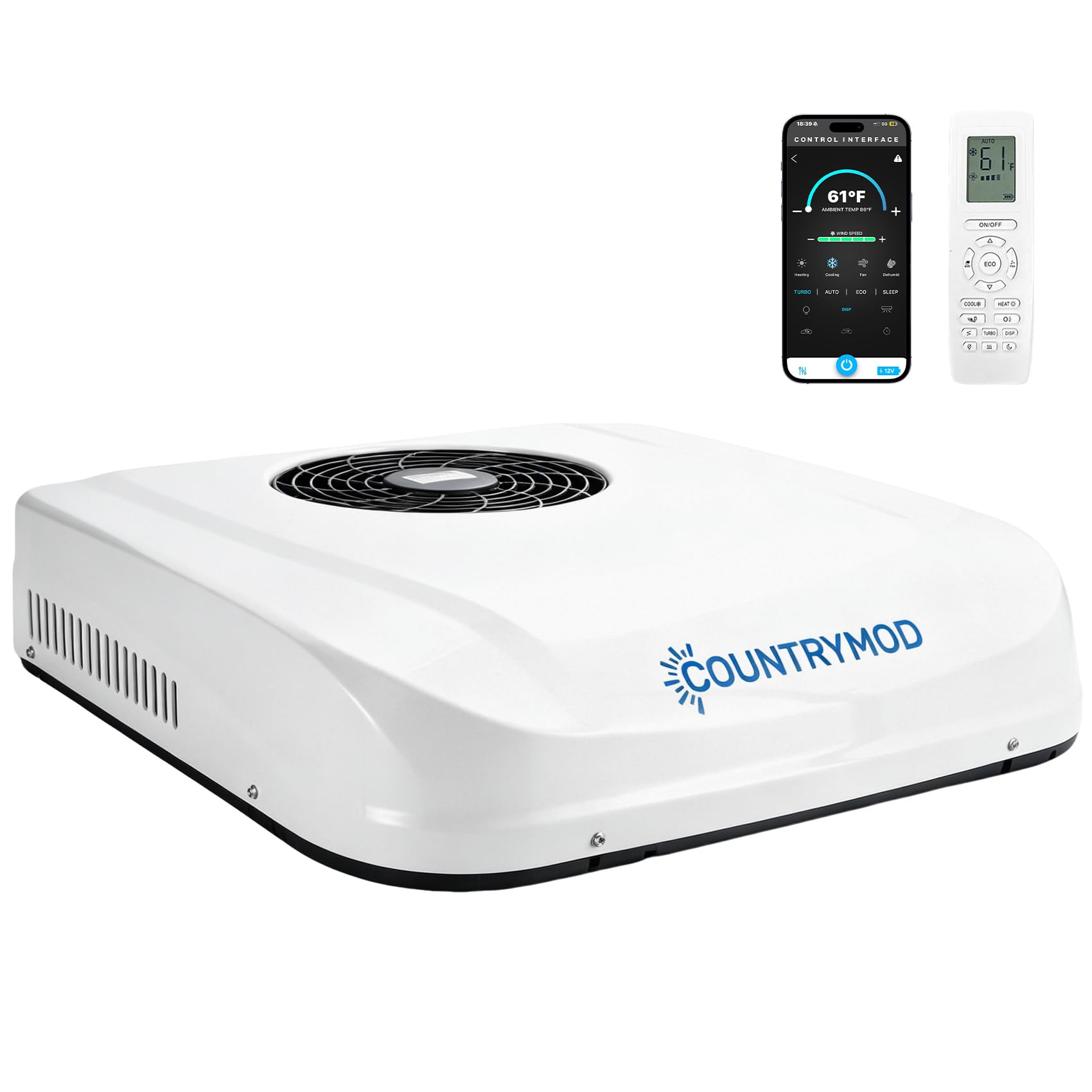
The big-rig contender designed for motorhomes with large roof vents and generous solar setups.
This Countrymod unit uses an inverter compressor that adjusts between 300 and 900 Watts, claiming a consumption of only 0.3 kWh per hour — compared to a standard 1.5 kWh/hour air conditioner. It offers up to 10 hours of battery life when paired with a large bank, which a reviewer confirmed by saying that his 480Ah battery “lasts all night” with this unit. The horizontal compressor design reduces vibration and lowers the center of gravity compared to traditional vertical compressors, which the manufacturer says adds to its durability on the road. It fits a standard 14×14-inch roof opening and includes a 14×14-inch steel frame that bolts to the roof from all four corners for stability.
The noise level is specified at 45-55 decibels, compared to the 40 dB of the Gidrox sleep-mode unit above — still moderate but not the quietest. Buyers with 36-foot motorhomes in Nevada desert conditions (113°F days) report it can cool about 100 square feet (a bedroom and bathroom) down to 80°F during the day and 72°F at night, which is impressive for a 10,000 BTU unit. Customer service gets high marks: multiple buyers mentioned that “Tony” from Countrymod responded quickly with replacement parts and updated Bluetooth controllers when needed. The unit does not include ducting, so it is only suitable for ductless installations that blow directly into the room below.
What Makes It Stand Out
- 300-900W inverter compressor claims 0.3 kWh consumption — roughly 5x more efficient than a standard unit
- Up to 10 hours of runtime on a 480Ah battery bank per owner reports
- Fits any standard 14×14 roof opening with a four-corner steel mounting frame
- Customer support is responsive — reviewers specifically name “Tony” for quick resolution
Consider This Trade-Off
- Noise level at 45-55 dB is slightly higher than the 40-45 dB competitors in this list
- Suitable for ductless installation only — will not work with pre-existing RV ductwork
- Some customers note the installation instructions are not the clearest, though the unit is relatively easy to mount
Perfect for: large motorhome owners who have a 14×14 roof opening and a substantial battery bank (480Ah+) and want a very efficient compressor that can deliver cool air for a full night.
Not ideal if: you need ducted air distribution or the quietest possible operation below 45 dB for shallow sleeping.
Understanding the Specs
Cooling Capacity (BTU)
British Thermal Units measure how much heat the air conditioner can remove per hour. For a 12V portable unit, 10,000 to 11,000 BTU is the common range. A higher number like 11,000 BTU cools a larger space faster than 10,000 BTU, but it also tends to pull more power at max speed. The real-world test is whether the unit can drop your van or cab temperature by 15-20 degrees during a hot afternoon. In this roundup, both the CNCEST and Treeligo offer 11,000 BTU, giving them a slight edge in raw cooling power over the 10,000 BTU units.
Power Draw (Watts) and Annual Energy Consumption
This is the number that determines whether your battery lasts two hours or all night. Look at the unit’s operating range — the best inverter units, like the Countrymod, go from 300W to 900W, meaning they can slow down to barely sip power on a mild evening. A fixed-speed unit like the Outequip at 960W runs at near full power until it hits the set temperature, then cycles off. Bigger is not better here: lower wattage at the same BTU rating means you get more efficient cooling per hour. The annual energy consumption figure (in watts) listed on the spec sheet is an estimate of maximum draw — but shop for the average running wattage in Eco or Sleep mode, which is what you will actually see on your battery monitor
FAQ
Will a 12V portable air conditioner run on my car battery without damaging it?
How many hours can a 12V AC run on a 100Ah battery?
What is the difference between an inverter compressor and a standard compressor in a 12V AC?
Can I install a rooftop 12V AC in a standard 14×14-inch RV roof vent?
Do I need a heater in addition to the AC for winter camping?
How loud are these 12V air conditioners at night?
Can I run a 12V AC on solar power alone?
What does a split-system AC mean for installation?
Final Thoughts: The Verdict
For most buyers, the 12v portable air conditioner winner is the RV Air Conditioner, 12V 10000 BTU Rooftop because it combines an inverter compressor, 10,000 BTU of cooling, a supplementary heater, and a solid 4.5-star reputation across 136 reviews — all in a lightweight 43-pound rooftop package that fits standard RVs. If you want the absolute lowest power draw for tight battery budgets, grab the CNCEST 12V DC Split Air Conditioner 11000 BTU which pulls only 400-600W and offers 11,000 BTU for small cabs. And for the smart-home enthusiast who wants app control and a 40dB sleep mode, the standout is the 10000 BTU 12V DC RV Air Conditioner with Heater from Gidrox.
How We Picked
We do not accept paid placement. Every pick is matched to a real buyer and a real use-case; we do not hands-on test units.
Sources & Methodology
Specifications: manufacturer listings and product documentation. Review insights: verified customer reviews, as of July 2026. Pricing: not shown on this page (it changes often); check the current price via the retailer link.
As an Amazon Associate, Gadgets Feed earns from qualifying purchases. This does not affect which products we feature.