
Our readers keep the lights on and my morning glass full of iced black tea. As an Amazon Associate, I earn from qualifying purchases.
Specs are compiled from manufacturer listings and verified buyer reviews and can change over time — please confirm the key details on the product page before buying.
If you want cool air in your parked RV without idling a diesel engine all night, a 12V DC rooftop unit is the answer — and the Outequip 10,000 BTU model is the strongest all-round pick here. It runs straight off your 12V house bank with no inverter, cools the cabin in about 15 minutes, and holds 4.5+ stars across 100+ ratings. The catch every buyer hits is battery sizing: these units pull serious current, and the size of your lithium bank decides whether you get a comfortable night or three hours of relief.
I’m Min — the founder and writer behind Gadgets Feed. This guide is built by comparing the manufacturers’ published specifications and the patterns across verified customer reviews, so you get each pick’s real strengths and trade-offs instead of marketing spin.
Most of these units mount on the same 14″ x 14″ roof opening your old vent already uses, which keeps the job simpler than you expect. Below you’ll find the honest differences in BTU output, noise level, and real power draw for every 12v rv ac here.
Our Picks at a Glance
How To Choose The Best 12V RV AC
Buying a 12V RV AC is really a two-part decision: how much cooling you need for the space, and whether your battery system can feed it through the night. Get the second part wrong and even a powerful unit becomes a three-hour appliance when the sun goes down.
Battery bank size rules everything
These air conditioners skip the inverter and run straight from your 12V system, which is efficient — but the current draw is large. A 480Ah power source is the figure Outequip cites for 8 hours of cooling, and 600Ah stretches that to 10 hours. Below those numbers you are looking at shorter run times or a big solar array to refill each day. Size the bank before you size the BTU rating.
BTU output and space
A 10,000 BTU rooftop unit is the common middle ground for camper vans and small trailers. The 11,000 BTU Treeligo adds heating as well, and the 12,000 BTU Gidrox unit pushes the most cooling power in this group. For a large motorhome or fifth wheel with a ducted system, check compatibility first — these rooftops are ductless and best suited to rigs with a single open cabin.
Rooftop vs split systems
Rooftop units drop into your existing vent opening and keep the interior floor plan clear. Split systems put the condenser outside and the evaporator inside, which can suit trucks where roof space or height is tight. Rooftop is the simpler install for most RV owners, and the slimmer bodies on some models keep wind resistance down so you can still clear height-restricted routes.
Quick Comparison
| Model | Best For | Cooling Power | Noise | Power Draw | Amazon |
|---|---|---|---|---|---|
| Outequip 10,000 BTU Rooftop★ Best Overall | All-round off-grid cooling | 10000 BTU | Quiet (spring mounts) | — | Amazon |
| Gidrox 10,000 BTU (Cooling Only)Smart Control Pick | Smart control and rapid cooling | 10000 BTU | 40dB Sleep | ~350W night | Amazon |
| Countrymod 10,000 BTU RooftopBest Efficiency | Inverter efficiency | 10000 BTU | 45-55dB | 0.3 kWh/hr | Amazon |
| Gidrox 12,000 BTU (Cooling Only) | Maximum cooling power | 12000 BTU | 40dB Sleep | ~360W night | Amazon |
| Outequip 10,000 BTU with Heater | Cooling plus mild-weather warmth | 10000 BTU + 4500 BTU heat | Quiet (spring mounts) | — | Amazon |
| ICECOSMOS Low Profile Rooftop | Whisper-quiet sleeping cabins | 10000 BTU | 39dB Eco | — | Amazon |
| Treeligo 11,000 BTU with Heating | Year-round cooling and heat | 11000 BTU + heat | below 45dB | 330-1000W | Amazon |
| Bailigo 9500 BTU Heater Combo | Heating and cooling combo | 9000 BTU | below 50dB | — | Amazon |
| Aspligo 10,000 BTU Split | Trucks without roof space | 10000 BTU | 50dB | 960W | Amazon |
| Aspligo 8000 BTU Ultra-thin | Low-cost entry point | 7000 BTU | 50dB | 750W | Amazon |
In‑Depth Reviews
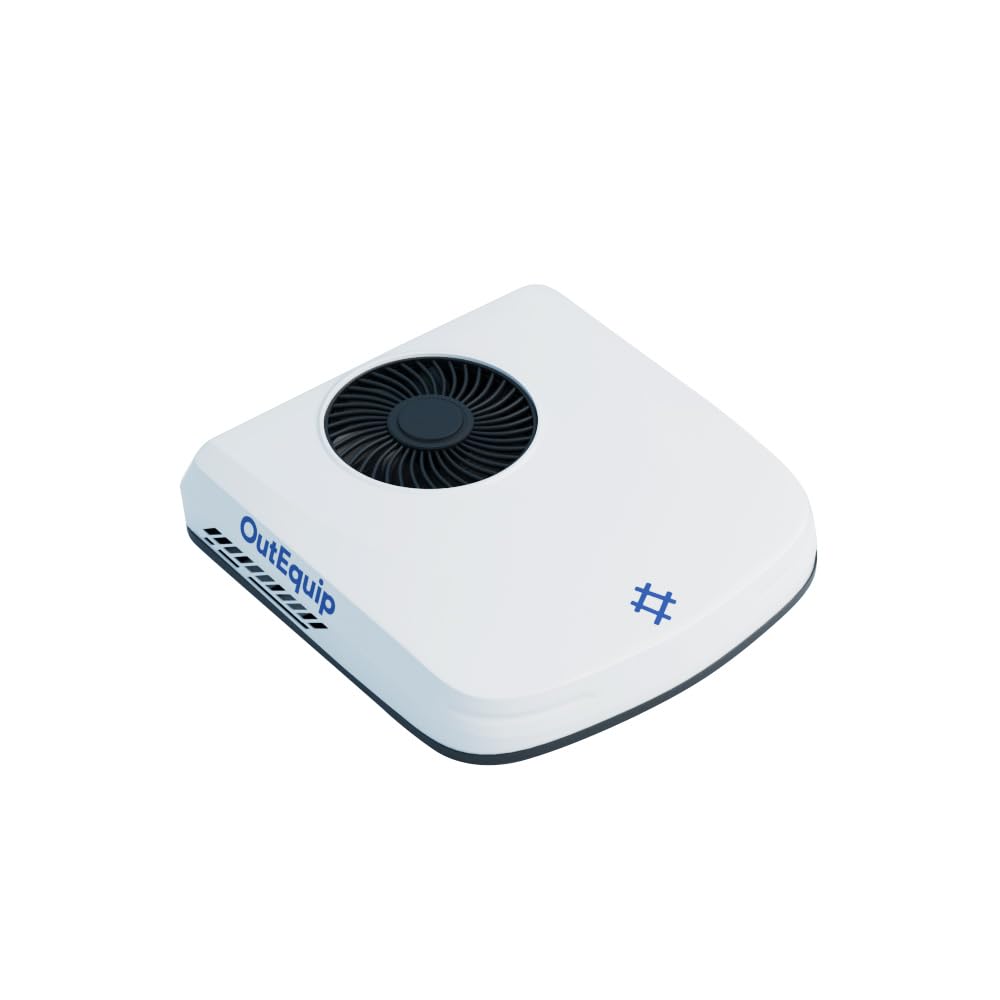
1. Outequip RV Air Conditioner 10,000 BTU Rooftop
Our pick — 4.5+★ from 100+ verified ratings; the strongest balance of quality and price.
A 10,000 BTU rooftop that cools in 15 minutes and runs quiet on 12V battery alone.
The Outequip 10,000 BTU unit wins this list because it gets the fundamentals right without a gimmick. It pulls straight from your 12V electrical system — no inverter, no generator — and cools your RV in just 15 minutes. That matters when you roll into a hot campsite at 3 p.m. and want relief before you even unpack.
Battery math is spelled out honestly here: 8 hours of cooling on a 480Ah power source, and 10 hours on a 600Ah bank while parked. If you already carry a large lithium setup, this unit slots in cleanly. What people rave about most is the overall build — the UV-stabilized ABS shell, EPDM foam gasket, and zinc-coated condenser are built for weather, and owners describe the cooling as genuinely effective with up to a 20-degree temperature difference.
Quiet operation is the second thing buyers notice, and the hardware backs it up: brushless copper motor fans, spring-supported mounts, and a directional duct that pushes air where you want it. You get a remote, temperature monitoring, and eco, sleep, and turbo modes. Compare it with the countrymod unit below: the Outequip uses 960 watts annually-rated versus the countrymod’s 3650W figure, though the latter’s inverter design trades that raw draw for varying speed.
rooftop bolt-on fit
- Cools a hot cabin in about 15 minutes on 10,000 BTU
- Runs 8-10 hours on 480-600Ah of battery, no generator
- Weather-tough ABS shell, EPDM gasket, zinc-coated condenser
- Remote with eco, sleep, and turbo modes
heavy roof load
- Needs a large battery bank to hit those run times
- Rooftop install means cutting or reusing a vent opening
- No heating function on this version
simple swap: RV owners with a 480Ah+ lithium bank who want reliable off-grid cooling without an inverter.
wiring limits: you need winter heat too — step up to the Outequip heater version below.
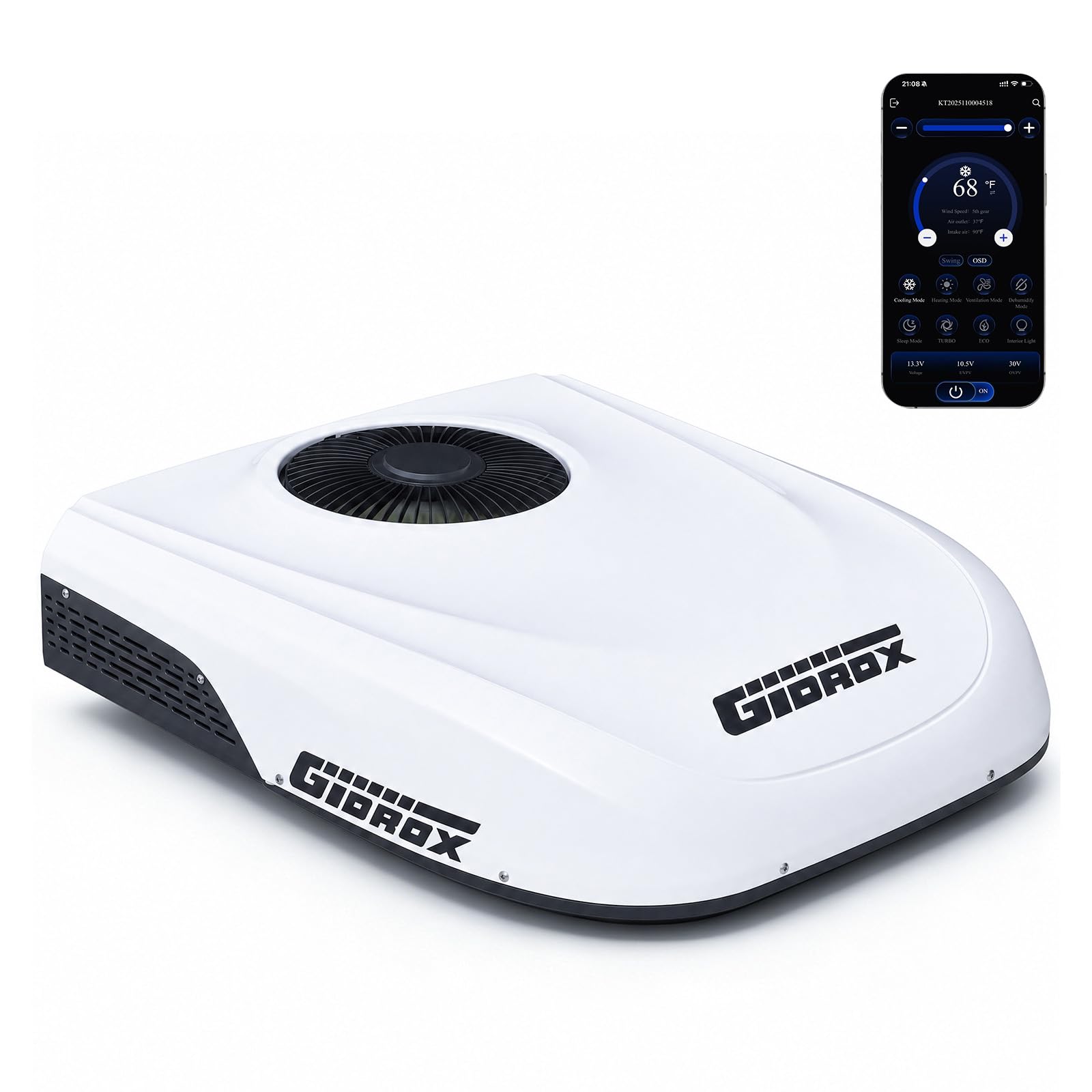
2. Gidrox 10,000 BTU 12V DC RV Air Conditioner (Cooling Only)
App, remote, and panel control plus a 40dB sleep mode make it the easiest to live with.
If you like setting the cabin temperature from your phone before you climb out of the driver’s seat, the Gidrox delivers. It gives you an app over Bluetooth, an infrared remote, and physical buttons on the unit itself. You can set timers and flip between °C and °F without touching a knob.
The efficiency story is the real draw. Paired with a 400Ah battery, that is enough for all-night use. Cooling is 10,000 BTU with inverter technology that hits a stable temperature in about 3 minutes, and Sleep mode drops to 40dB — genuinely quiet enough for a small cabin.
The install is a standard 14″ x 14″ roof cutout fit, and at 54 lbs it is manageable for one person to lift into place. Roof thickness of 1.5″ to 3.5″ is covered, and a 19.7 ft power cable is included. The trade-off: installation feedback is split — plenty find it straightforward, but a helper makes the rooftop lift easier, so plan for a second pair of hands.
dc control dial: App, remote, and panel all reach the same settings, so nobody fights over the remote at 2 a.m.
cooling only: Cooling only — no heat for shoulder-season mornings.
off-grid cooling: you want phone control and the lowest night-time draw on this list at 350W.
heat needed: your rig needs a heating function or you plan to work solo on the roof install.
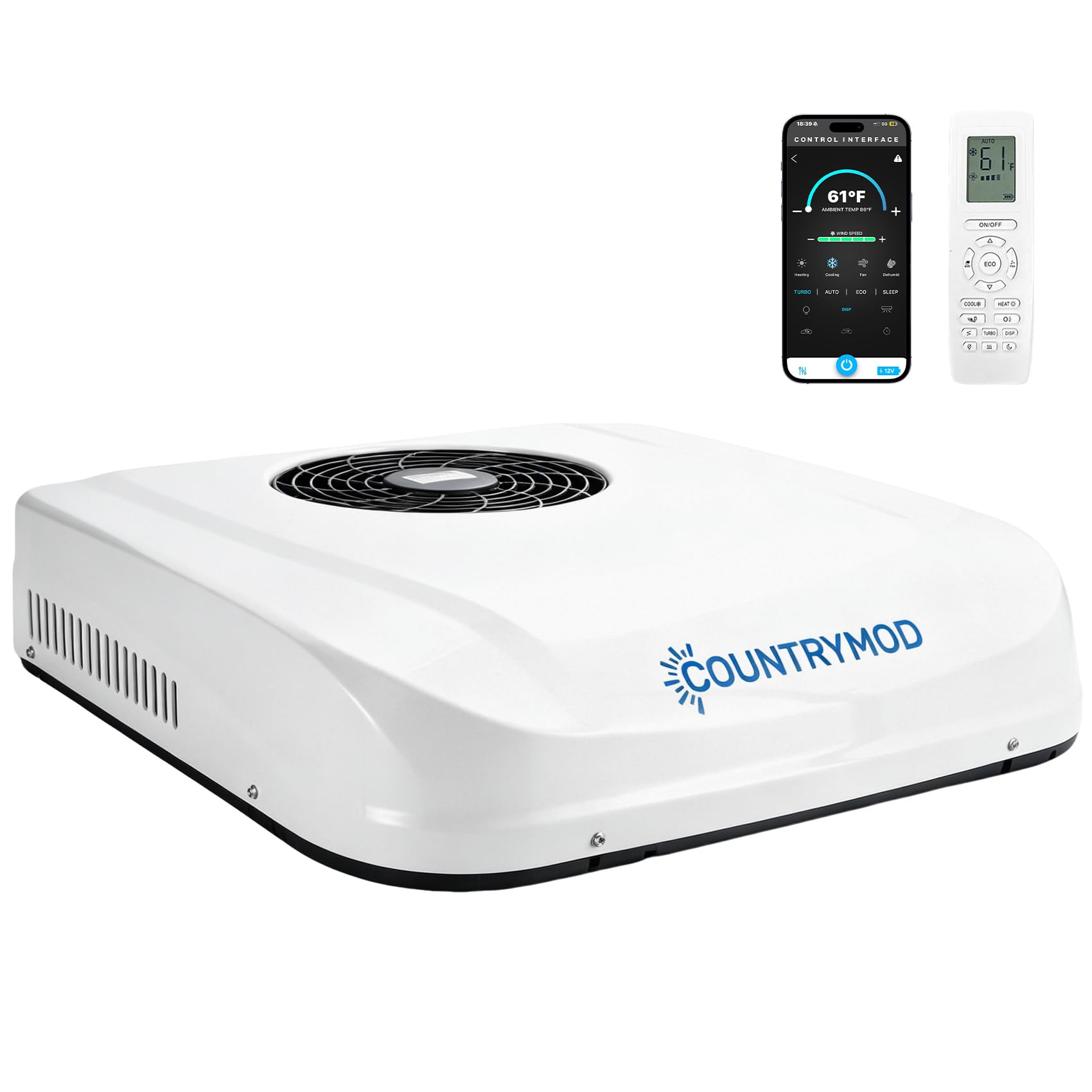
3. Countrymod 10,000 BTU 12V DC RV Air Conditioner Rooftop
Its inverter compressor draws 0.3 kWh an hour, stretching a 300Ah bank to 12 hours in ECO mode.
Countrymod’s headline is efficiency, and the numbers are specific: 0.3 kWh per hour against a standard air conditioner’s 1.5 kWh/hour, which the maker frames as five times more efficient. A variable-frequency compressor adjusts its speed to demand instead of running flat out, which is why a 300Ah battery can stretch to 12 hours on ECO mode in real use.
Performance is what owners discuss most, and it holds up in heat — the unit is reported working effectively up to 90 degrees outside, with even, soft airflow that avoids the blast of direct cold. Noise sits at 45-55 decibels, closer to a light wind than a compressor drone. A horizontal compressor layout cuts vibration and lowers the center of gravity compared to vertical designs, which helps stability on rough roads.
The install fits a standard 14″ x 14″ roof vent and is ductless, so it drops in without major modification. One thing to know: it is not suitable for RVs with existing ducts. Instructions are the weak spot — several buyers found them thin on detail, so budget time to watch a walkthrough video before you start.
efficiency first: choose this if runtime per amp-hour is your top priority and you have a ductless rig.
flexible mounting: ducted motorhomes, or anyone who wants hand-holding through the install.
4. Gidrox 12,000 BTU 12V DC RV Air Conditioner (Cooling Only)
At 12,000 BTU, the highest output in this lineup, for large cabins and brutal summer heat.
When the space is big or the outside temperature is punishing, BTU headroom matters more than anything. This Gidrox brings 12,000 BTU, the highest figure in this lineup, using the same inverter technology as its smaller sibling to hit a stable temperature in about 3 minutes.
Night-time draw stays modest at around 360W in 30°C ambient, and a 400Ah battery covers all-night use. Sleep mode drops it to 40dB with a brushless fan and sound insulation — library-quiet by the maker’s description. You get the same three control paths: Bluetooth app, infrared remote, and panel buttons, plus °C/°F switching and timers.
The install details match the smaller Gidrox: 54 lbs, 14″ x 14″ cutout, roof thickness 1.5″ to 3.5″, and a 19.7 ft cable included. Cooling only, no heater.
bigger btu output: 12,000 BTU tops every other unit on this list for raw cooling capacity.
power hungry: a thinner review history than the top pick — the specs are strong, the crowd evidence is still building.
large cabins: owners of larger rigs or very hot climates who want maximum BTU and phone control.
small batteries: if you want a long, proven owner track record or need heating.
5. Outequip RV Air Conditioner 10,000 BTU with Heater
The top pick’s 10,000 BTU cooling and 15-minute cooldown, plus a 4,500 BTU PTC heater for mild shoulder-season nights.
This is the Outequip formula with a PTC heater added. Cooling stays at 10,000 BTU with a 15-minute cooldown, and the heater contributes a supplementary 4,500 BTU. Read that word carefully — it is meant for mild temperatures and small spaces, not as a primary heat source in extreme cold.
Owners lean on the effectiveness of the whole package, and the efficiency figure is notable: roughly 250 watts an hour in use, which is easy on a modest battery bank. Turbo mode for quick cooling, plus eco and sleep modes, keeps it flexible through the day. Quiet operation and clear instructions round it out, and the weather-resistant shell uses the same UV-stabilized ABS and EPDM gasket as its sibling.
Compared with the heater-free Outequip above, you gain winter warmth for a slightly higher outlay. Compared with the Treeligo 11,000 BTU heater unit below, you get less raw heating capacity — 4,500 BTU PTC versus an 11,000 BTU system — but a stronger overall owner track record on the cooling side.
heat and cool
- 10,000 BTU cooling plus 4,500 BTU supplementary heat
- Roughly 250W per hour in real use
- Turbo, eco, and sleep modes with remote
- Lightweight with clear included instructions
heater adds draw
- The 4,500 BTU heater is not a cold-weather primary heat source
- Rooftop install requires a vent opening and access
- Supplementary heat suits mild temps only
four-season use: you want proven cooling with a bit of extra warmth for cool mornings.
mild climates: you camp in hard freezes and need serious heating power.
6. ICECOSMOS Low Profile 12V Rooftop Air Conditioner with PTC Heating Pro
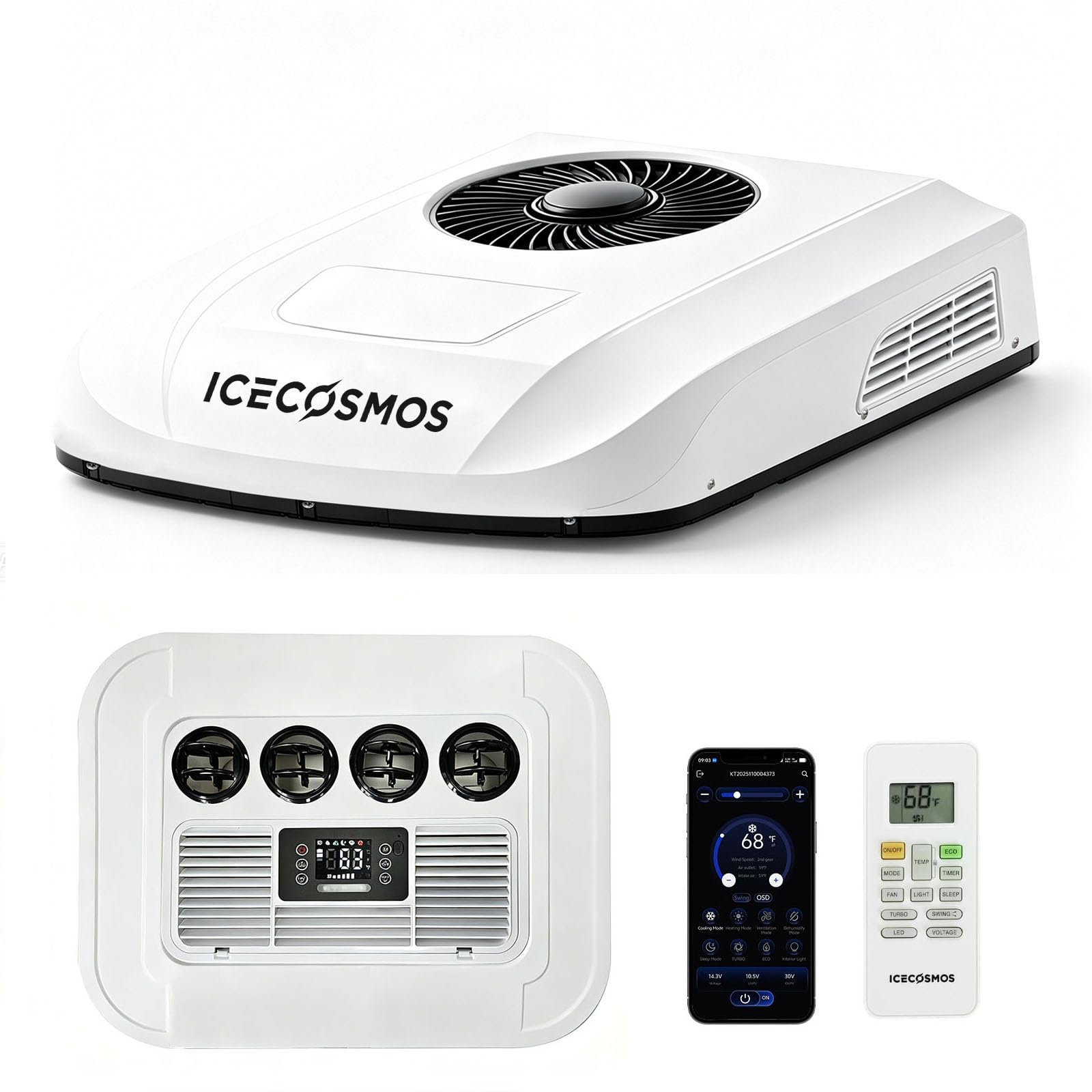
At 39dB in Eco mode it is the quietest unit here, and its 5.5-inch body keeps wind resistance and height down.
If you sleep light, this is the number that matters: 39dB in Eco mode, described as a soft whisper. The 10,000 BTU system also claims 12% more power than standard models, and it keeps 80% of standard performance even when outside temps climb above 113°F.
Battery life goes long off-grid — a 12V 400AH LFP battery is stated to run over 12 hours in ECO mode, and it pairs with a solar setup without an inverter in the way. The 5.5-inch front side design keeps wind resistance low and saves fuel on the road. Control is flexible through remote, phone app, or touch. You also get a 4,500 BTU PTC heater for supplementary warmth.
Install fits standard 14.1″ x 14.1″ openings, comes with a seal to keep water out, and the fan is IPX6-rated (spray-resistant), which matters in rain. What wins people over is cooling performance and reliability — cold air that comes out strong and keeps coming — and there are installation videos to walk you through it. The honest trade-off is that the PTC heater is supplementary, not a deep-winter solution.
tight roof space: light sleepers and noise-sensitive campers who still want strong off-grid cooling.
big rigs: you need a true winter heating system or a ducted connection.
7. Treeligo 11,000 BTU 12V DC Rooftop RV Air Conditioner with Heating
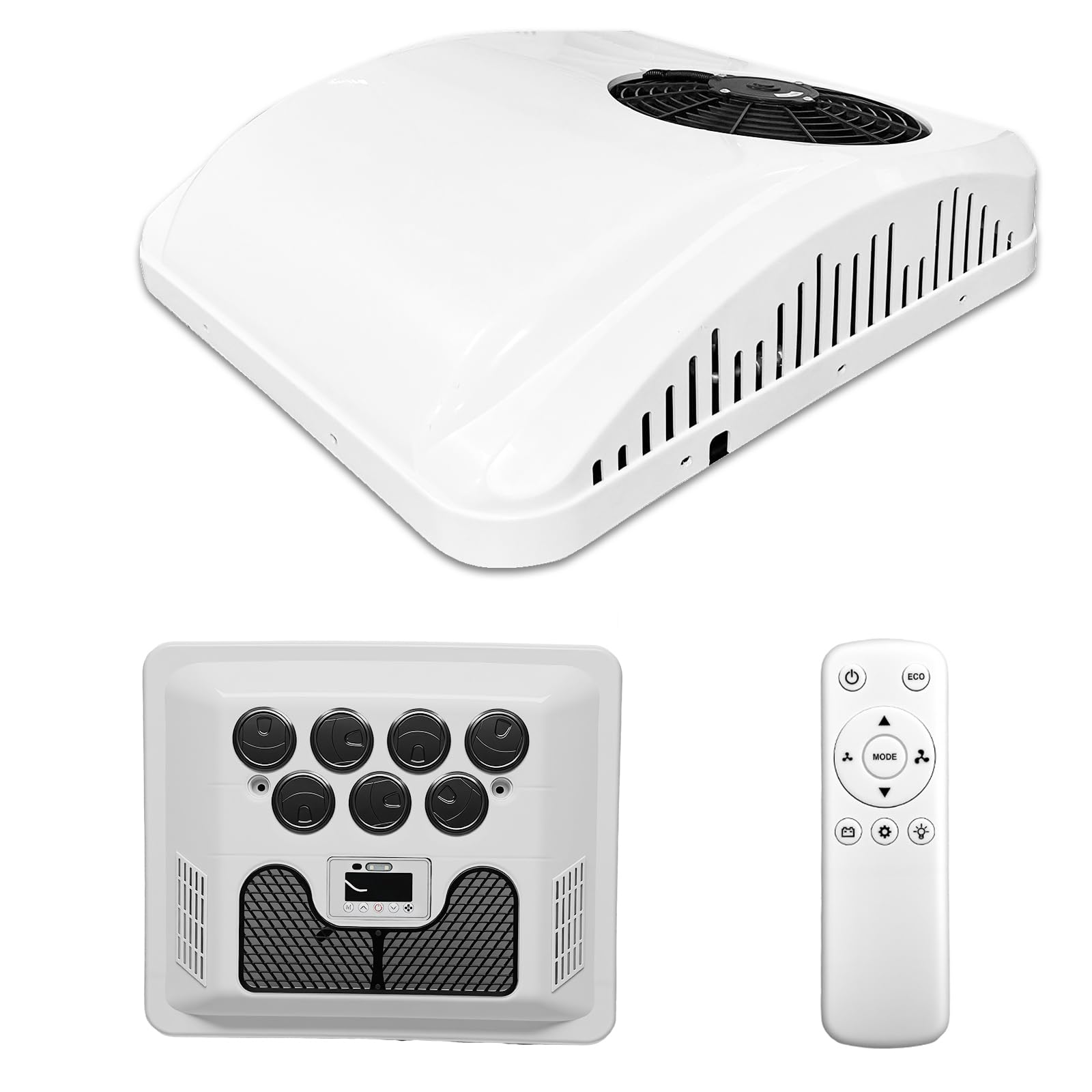
The largest cooling-plus-heating combo here — 11,000 BTU both ways on pure 12V power.
Treeligo brings the biggest dual-purpose number in this group: 11,000 BTU of cooling and heating, with a claim of rapid temperature change within 5 minutes. That 11,000 BTU figure beats the 7,000 BTU of the Aspligo ultra-thin entry unit below, a gap of roughly 57%. Three fan speeds and a digital display let you dial it in, and it runs on RV batteries with no generator or fuel needed.
Operating power scales from 330W to 1000W depending on mode, so you can run it gently on battery or push maximum cooling when AC power is available. Noise stays below 45 decibels, which keeps highway driving and overnight stays calm. It is also fully FCC and UL certified, with multi-layer circuit protection against surges and vibration. Note the weight: 50 pounds, versus 59 pounds for the Aspligo split below.
The honest part is the owner evidence. This listing has a smaller and less consistent review base than the Outequip models, and the low-star share is higher. The spec sheet and certifications are solid, but it is the pick where you lean hardest on the manufacturer’s claims. If year-round dual function on 12V is non-negotiable, it is the strongest fit here.
heat pump combo: 11,000 BTU of cooling and heat from a single 12V source.
pricey unit: thinner and more divided owner feedback than the top picks — buy it for the year-round capability, not for a proven track record.
year-round trips: four-season travelers who want both cooling and heating from one 12V rooftop unit.
budget builds: buyers who prioritize a long, uniformly positive review history.
8. Bailigo 12V RV Air Conditioner Heater Combo 9500 BTU
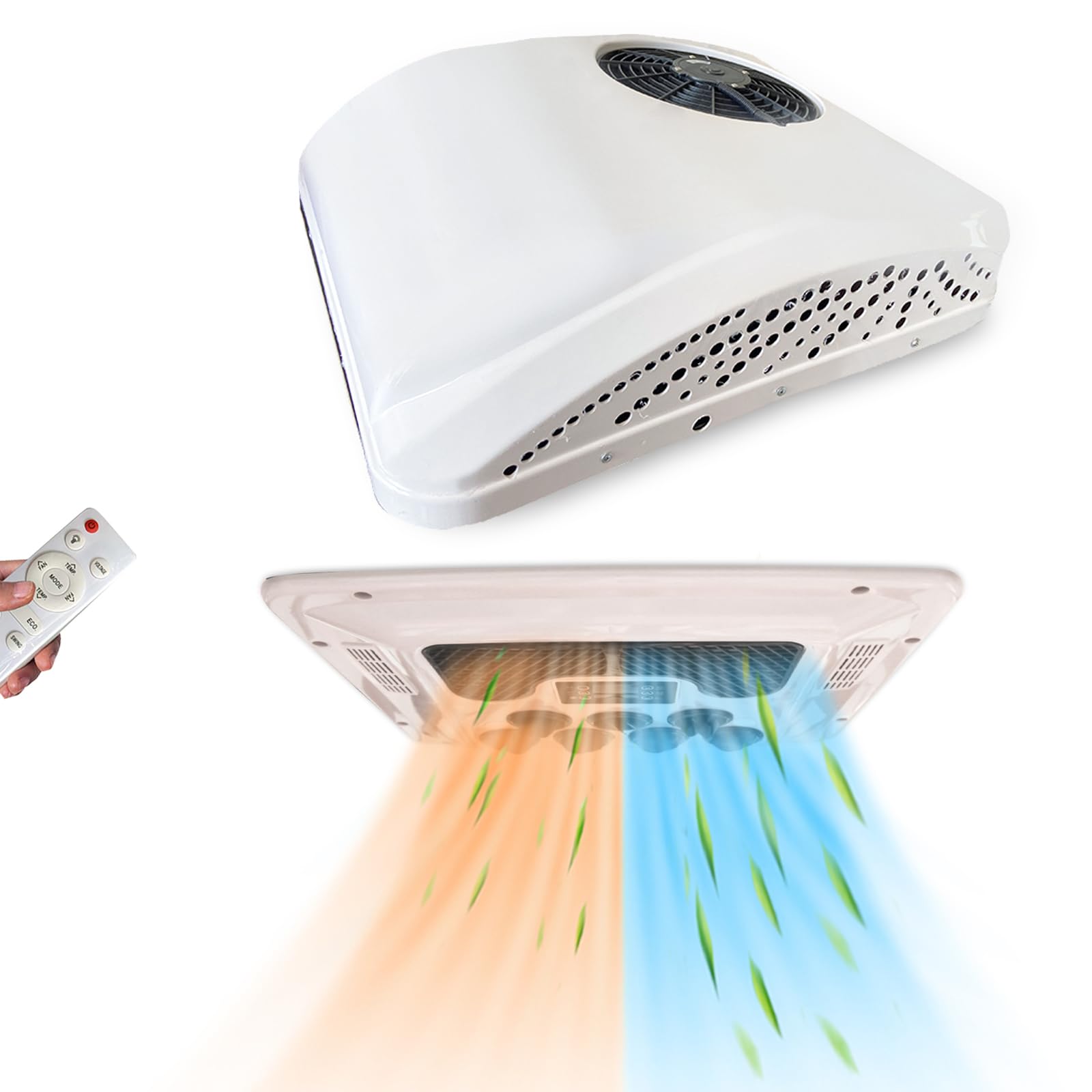
A heating-and-cooling combo for truck cabs that need both, on a tighter budget.
This Bailigo is aimed squarely at long-haul truckers who want cab comfort with the engine off. It runs from your vehicle battery or external power and regulates temperature in as little as 8 minutes. The ABS housing resists impact and corrosion, and the unit ships with a full accessory set and instructions.
Cooling is 9,000 BTU with a frequency-adjusting inverter compressor, and the floor-area coverage is stated at 130 square feet. Noise is under 50dB, so it is quiet enough for a rest stop. You get a remote and dual heating-and-cooling function. It is also built for wide vehicle fit — trucks, trailers, motorhomes, tractors, and buses all appear on the compatibility list.
Where this needs a reality check: the cooling figure sits below the 10,000 BTU units here, so very large or very hot cabins will want more headroom. Owner feedback on this listing is also less settled than on the top picks — it is a value-oriented combo rather than a proven performer. For a smaller cab or a moderate climate, it is a sensible dual-purpose option.
small campers: truckers and van owners who want heat and cool in one unit without a premium outlay.
large spaces: you need maximum BTU or a stronger review history.
9. Aspligo Truck Air Conditioner 12V 10,000 BTU Electric Split
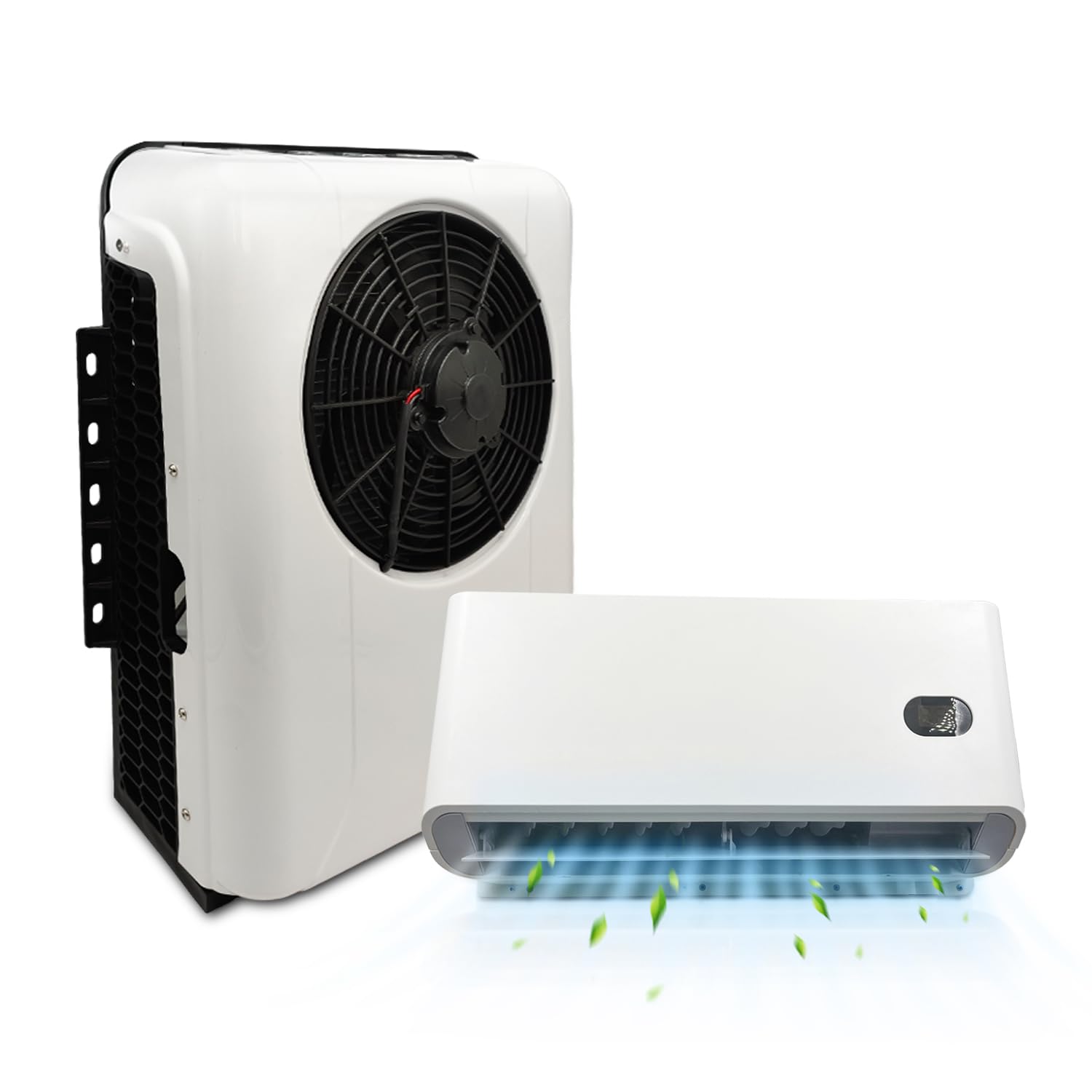
A split system for trucks that do not have roof room — 10,000 BTU with battery protection built in.
Split systems matter when a rooftop unit will not fit. This Aspligo separates the condenser and evaporator, which suits semi trucks and cabs where roof space or height is a constraint. Cooling is 10,000 BTU, and it uses a silent brushless evaporator at 50dB — quiet enough for sleeping at night.
Low voltage protection is the standout feature: it prevents excessive power draw and lets the unit start smoothly without stressing the battery. The remote with an LED display can adjust temperature from the driver’s seat. Weight is 59 pounds, versus 50 pounds for the Treeligo rooftop above — the split layout trades a little portability for flexible mounting. Energy consumption is 960W.
Here is the caution worth knowing up front: the maker states it needs a battery over 350Ah to cool for 3 hours in the day or 6 hours at night, and refrigerant is not included. Cooling performance feedback is also divided, with some reporting the compressor stops working. If your truck needs cooling where a rooftop will not fit, the split format is the reason to look here.
sleeper cabs: semi truck and cab owners who cannot mount a rooftop unit.
rv rooftops: you have roof space — a rooftop unit is the simpler and more proven route.
10. Aspligo 12V RV Rooftop DC Air Conditioner 8,000 BTU Ultra-thin

The slim, lowest-cost entry into rooftop 12V cooling — easy to install and light on draw.
This is the value entry point for anyone testing whether 12V rooftop cooling works for their rig. Its 7-inch body is thin enough to leave wind resistance almost unchanged, which keeps your clearance and fuel use close to stock. Cooling is 8,000 BTU, and the air-outlet temperature drops noticeably within 3-5 minutes. It is rated at 750W consumption, well under the 960W the Aspligo split above draws.
Battery life is the selling point: paired with a 200Ah lithium battery it runs continuously in ECO mode for 8-10 hours at night, and 5 hours in high daytime heat. The installation is an all-in-one design with pre-assembled parts, no specialized tools, and clear instructions — the easiest install in this lineup. Noise is 50dB, and a remote with an LED display makes it easy to adjust.
Installation feedback is genuinely split, though — plenty find it easy, while others report the instructions could be clearer. Cooling is also the lowest here at 8,000 BTU, so large or very hot cabins will want more output. For a compact van or a first-time setup, it is a practical, budget-friendly way in.
small vans: smaller rigs and first-timers wanting the simplest install and lowest draw.
desert summers: big cabins or extreme heat — step up to a 10,000 BTU or 12,000 BTU unit.
Understanding the Specs
BTU (Cooling Capacity)
BTU stands for British Thermal Units — a measure of how much heat the unit removes per hour. Higher BTU means more cooling power and faster cooldowns in a larger space. A 10,000 BTU rooftop suits a camper van or small trailer; 12,000 BTU gives more headroom for bigger cabins and hotter climates, while 8,000 BTU fits compact spaces.
Power Draw and Battery Sizing
These units run on 12V DC and pull a substantial amount of current, so your battery bank decides your runtime. The maker figures tell the story: 480Ah delivers about 8 hours of cooling, and 600Ah pushes it to 10 hours. Inverter compressors adjust speed to demand, which often means a lower average draw and longer nights.
Noise Level (Decibels)
Decibels measure how loud the unit runs. Around 40dB is library-quiet — easy to sleep next to. 45-55dB is closer to a light breeze. Above that and you start noticing the compressor. If you sleep light or boondock near neighbors, the lower the decibel number the better.
Mounting and Fitment
Most rooftop models drop into the standard 14″ x 14″ roof opening your vent already uses, and slim bodies keep wind resistance and height down. Split systems separate the parts for trucks with no roof room. Check your roof thickness and opening size before ordering — one model here covers 1.5″ to 3.5″ thickness.
FAQ
Will a 12V RV AC run all night on my lithium battery?
Can I run a 12V RV AC while driving?
How long does installation take on a rooftop unit?
Do I need an inverter for a 12V DC air conditioner?
What size roof opening do these units need?
How quiet is a 12V RV air conditioner at night?
Is a 12V RV AC better than idling my engine for cooling?
Can a 12V RV AC also heat my camper?
Will a split system fit where a rooftop unit will not?
What is the difference between 8,000 and 12,000 BTU in real use?
Final Thoughts: The Verdict
For most buyers, the 12v rv ac winner is the Outequip 10,000 BTU Rooftop because it nails the fundamentals — 15-minute cooling, honest 8-to-10-hour battery runtimes, and a weather-tough build with the strongest owner track record on this list. Its 4.5+ stars across 100+ ratings and published 480Ah/600Ah runtime figures make it the low-risk pick. If you want phone control and the lowest night-time draw, grab the Gidrox 10,000 BTU at about 350W. And for four-season travelers who need both cooling and heating from one 12V unit, the Treeligo 11,000 BTU is the one to reach for. Whichever you choose, size your battery bank first — that is the decision that determines how cool you actually sleep.
How We Picked
We do not accept paid placement. Every pick is matched to a real buyer and a real use-case; we do not hands-on test units.
Sources & Methodology
Specifications: manufacturer listings and product documentation. Review insights: verified customer reviews, as of November 2026. Pricing: not shown on this page (it changes often); check the current price via the retailer link.
As an Amazon Associate, Gadgets Feed earns from qualifying purchases. This does not affect which products we feature.