
The quiet hum of an inverter is a good sound—until it isn’t. Deep-cycle lead-acid battery owners know the drill: checking water levels, worrying about sulfation, and accepting that half your rated capacity is all you can safely use. Stepping up to a modern 12V solar battery changes the math entirely, giving you usable amp-hours, lighter weight, and cycle counts that outlast your camping season.
I’m Min — the co-founder and writer behind Gadgets Feed. I’ve spent weeks cross-referencing discharge curves, cycle-life claims, and real-world BMS behavior to separate marketing fluff from actual performance in the 12V solar battery category.
Whether you’re powering an RV fridge, a cabin lighting system, or an off-grid tool shed, this guide ranks the best 12v solar battery options by capacity, chemistry, and internal protection—so your install only happens once.
How To Choose The Best 12V Solar Battery
Picking the right battery for your solar setup means understanding your daily load, your charging source, and the environment the battery will live in. The chemistry you choose dictates weight, cycle life, and how much of that rated capacity you can actually use without damaging the cells.
Chemistry: LiFePO4 vs. AGM vs. Gel
Lithium iron phosphate (LiFePO4) batteries offer 80% to 100% usable depth-of-discharge, weigh about one-third of lead-acid, and deliver 3,000 to 15,000 cycles. AGM and Gel batteries are cheaper upfront, but you can only safely consume 50% of their rated amp-hours, and their cycle count sits around 500 to 1,000 before capacity degrades noticeably.
Capacity and Depth-of-Discharge
A 100Ah LiFePO4 battery gives you around 100Ah of actual usable energy, while a 100Ah AGM battery gives you about 50Ah. When shopping, multiply the amp-hour rating by the usable percentage for a true comparison. For most off-grid scenarios, 200Ah of LiFePO4 storage is a solid baseline for a small RV or cabin.
BMS and Continuous Discharge Rating
The Battery Management System (BMS) is the brain of any lithium battery. It sets the maximum continuous discharge current—usually 100A to 200A. A 100A BMS can handle a 1000W inverter at full load, while a 200A BMS supports a 2000W inverter. Ensure the BMS rating matches your inverter’s continuous wattage draw.
Temperature Protection
If your battery lives in a van, shed, or boat that sees freezing temperatures, look for low-temperature charging cutoff. Some LiFePO4 batteries automatically stop accepting a charge below 32°F (0°C) to prevent cell damage. AGM and Gel batteries are more tolerant of cold, but their capacity drops sharply in low temperatures.
Quick Comparison
On smaller screens, swipe sideways to see the full table.
| Model | Category | Best For | Key Spec | Amazon |
|---|---|---|---|---|
| Battle Born 100Ah | LiFePO4 | Premium RV/Residential Backup | 3,000–5,000 cycles | Amazon |
| Litime 200Ah Mini Bluetooth | LiFePO4 | Compact RV/Marine with Monitoring | 200A BMS / 6,000 cycles | Amazon |
| ECO-WORTHY 280Ah Metal Case | LiFePO4 | Large Off-Grid Storage | 280Ah / 200A BMS | Amazon |
| Dumfume 12V 200Ah | LiFePO4 | High-Capacity Solar Systems | 200A BMS / 15,000 cycles | Amazon |
| Power Queen 100Ah | LiFePO4 | Mid-Range RV/Trolling Motor | 100A BMS / 15,000 cycles | Amazon |
| VMAX SLR125 125Ah AGM (2-Pack) | AGM | Long-Life AGM Bank | 99% recombination | Amazon |
| WEIZE 100Ah AGM | AGM | Budget-Conscious Backup Power | Group 31 / 3% self-discharge | Amazon |
| ExpertPower 35Ah Gel (2-Pack) | Gel | Small Mobility/Solar | Sealed Gel / No Maintenance | Amazon |
| Topsolar 100W Panel Kit | Solar Kit | Entry-Level Battery Charging | 100W Monocrystalline | Amazon |
In‑Depth Reviews
1. Battle Born 100Ah LiFePO4
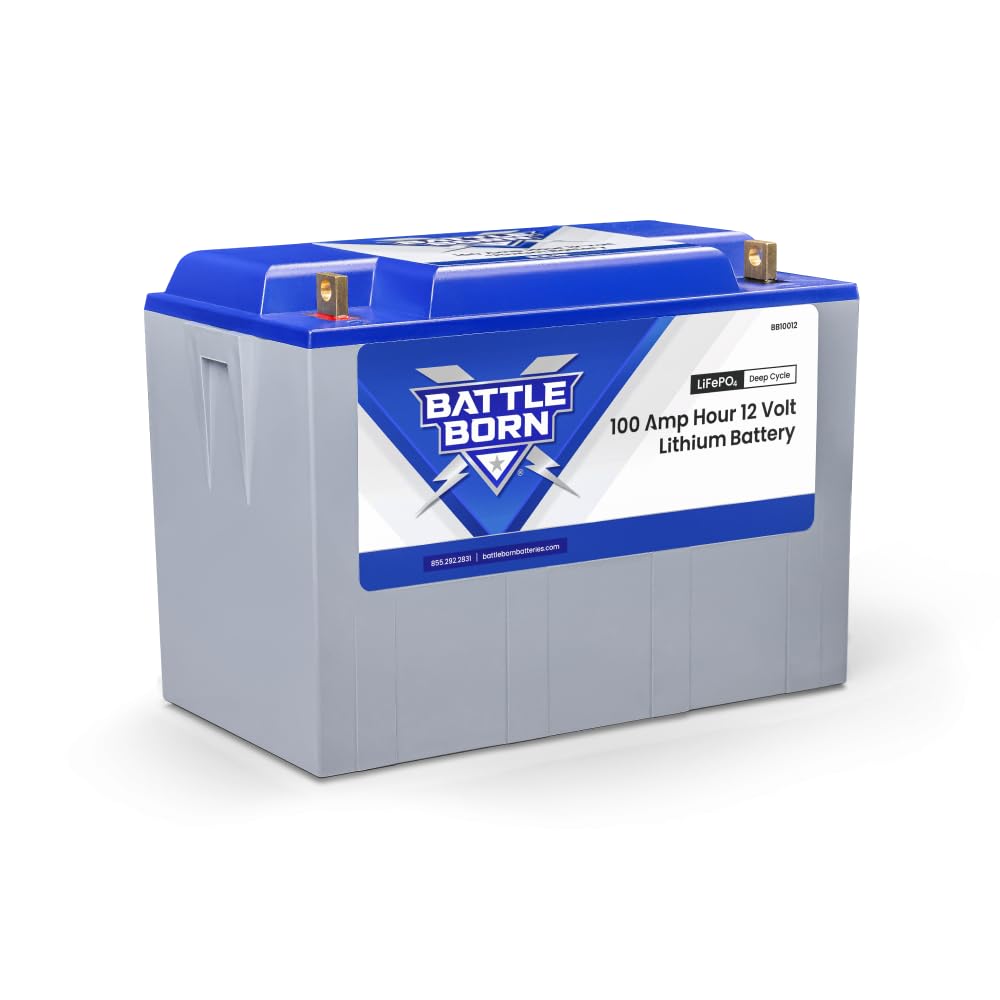
The Battle Born BB10012 is the benchmark for drop-in LiFePO4 replacement. Its 100Ah capacity is fully usable thanks to a 100% depth-of-discharge design, and the internal BMS handles high and low temperature protection, short circuits, and voltage spikes. Weighing just 31 pounds, it shaves roughly 30 pounds off a comparable AGM bank while delivering 3,000 to 5,000 deep cycles over a 10- to 15-year lifespan.
Multiple real-world installations confirm this battery powers an RV fridge, lights, and electronics for over 28 hours on a single charge—roughly three times the runtime of a lead-acid equivalent. The side-post connectors make parallel expansion straightforward, and the built-in BMS eliminates the need for external monitoring shunts in basic setups.
Battle Born backs the BB10012 with a 10-year warranty and US-based technical support. The upfront investment is higher than mid-range competition, but the combination of usable capacity, longevity, and safety certifications makes it the most reliable option for full-time RVers and off-grid homeowners who want zero maintenance.
Why it’s great
- 100% usable capacity from 100Ah rating
- Internal low-temperature charging cutoff
- 10-year manufacturer warranty
- Drop-in replacement for Group 27/31 trays
Good to know
- Premium price point requires commitment
- BMS cut-off may need MPPT re-wake sequence
- No Bluetooth monitoring built in
2. Litime 12V 200Ah Mini Bluetooth
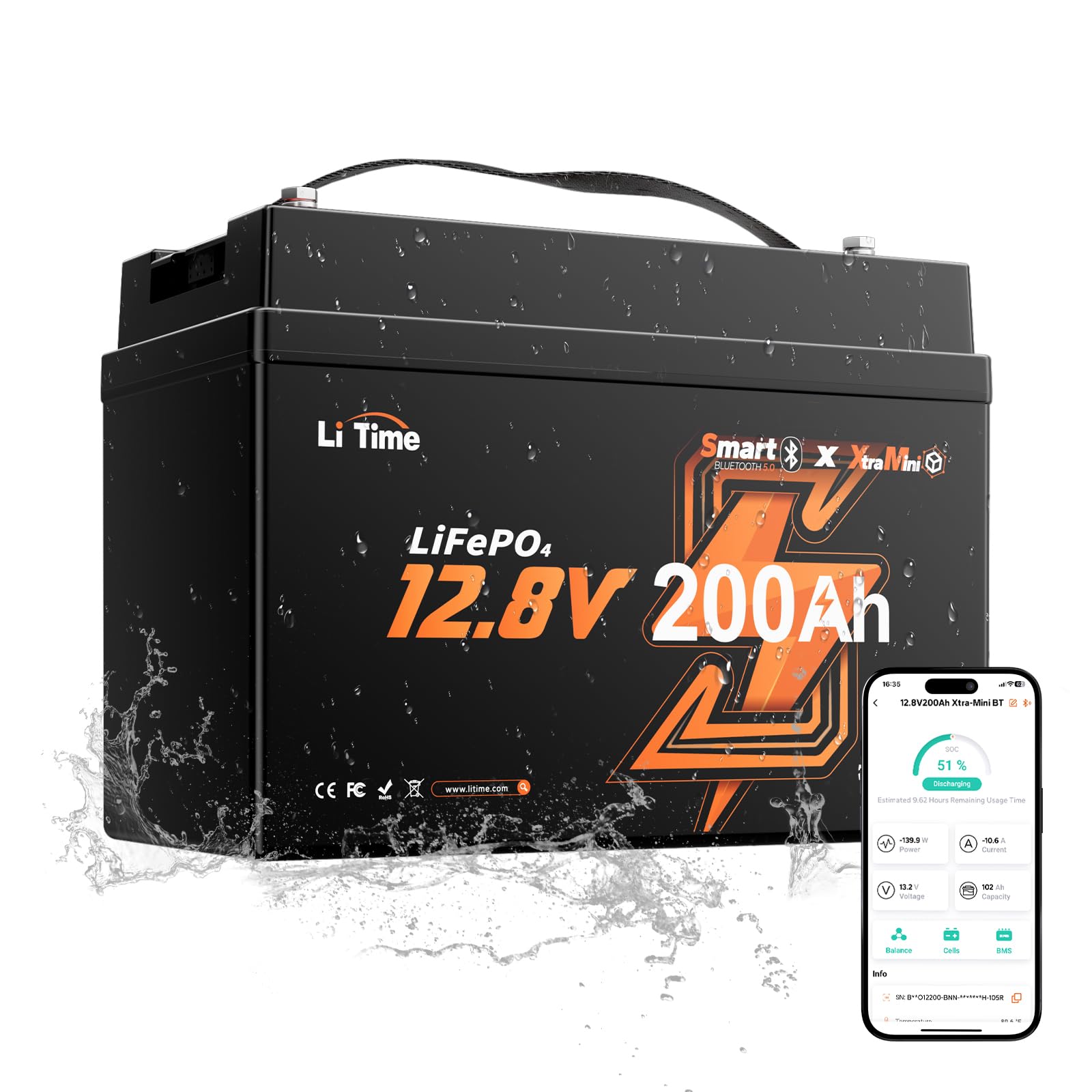
The Litime 12V 200Ah Mini shrinks a 200Ah lithium battery into a Group 31+ footprint that is 40% smaller than standard 200Ah units. This physical density makes it a top pick for RV compartments and marine battery trays where every inch of space matters. The 200A continuous BMS supports 2000W inverters comfortably, and the surge rating hits 1000A for brief high-load events.
Bluetooth 5.0 pairs instantly with the LiTime app for live SOC, voltage, and cycle tracking—no external shunt required. The built-in low-temperature cut-off prevents charging below freezing, and the 6,000+ cycles at 100% DoD dramatically outlast standard lithium chemistry. Owners report running a 25 cubic-foot refrigerator for three days straight on a single full charge with modest solar input.
At 44.5 pounds, it is 65% lighter than an equivalent AGM bank and comes with UL 1973 compliance for safety certification. The 4P4S expandability lets you build a 51.2V 800Ah system down the road, making this a battery that scales with your power needs.
Why it’s great
- Group 31+ size fits tight trays
- 200A continuous BMS for high loads
- Bluetooth monitoring without external hardware
- 40.96kWh max expansion via 4P4S
Good to know
- Higher per-amp cost than bare-bones 200Ah
- Wake-up may need full sun on PV panels
- Metal case not included
3. ECO-WORTHY 12V 280Ah Metal Case
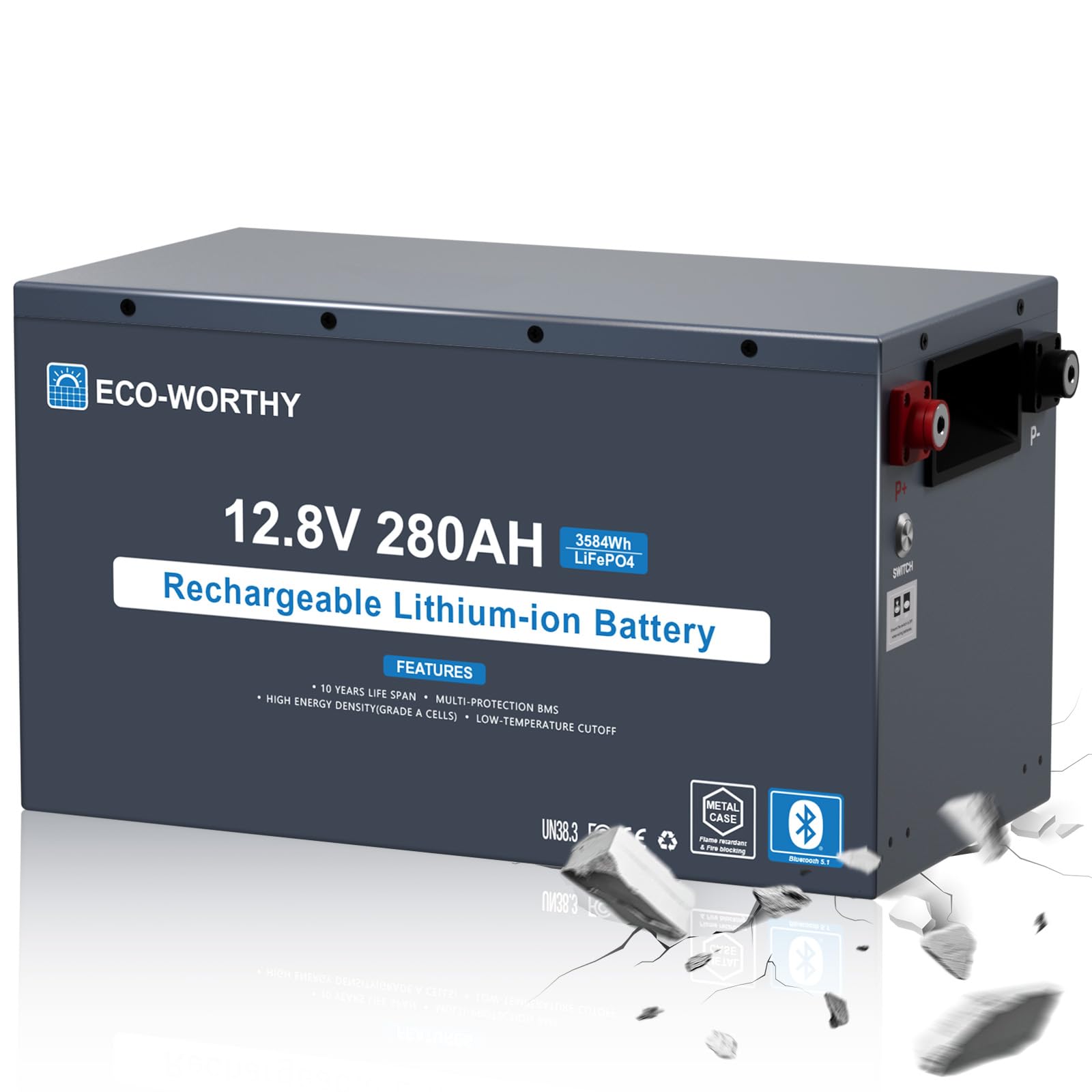
The ECO-WORTHY 280Ah LiFePO4 pushes capacity boundaries with a heavy-duty metal enclosure that doubles as a fire shield and mounting platform. The 200A BMS uses a JBD-DP04S007 controller on an isolated metal frame, keeping thermal management separate from the cells. Real-world capacity testing shows this battery often exceeds its 280Ah rating by a small margin.
Built-in Bluetooth monitoring pairs with the Overkill Solar app for cell-level voltage data, SOC, and temperature tracking. Low-temperature cut-off engages at 20°F to protect the cells during winter charging. The integrated on/off switch simplifies maintenance disconnects, and the four mounting feet let you bolt the battery directly to the RV floor without an external box.
Owners report running microwaves, instant pots, and induction cooktops through a 2000W inverter off a single 280Ah unit. The 68.5-pound weight is comparable to a 110Ah AGM, yet delivers over double the usable capacity—a strong argument for upgrading if space is tight but energy demand is high.
Why it’s great
- 280Ah in a single metal-cased unit
- Fire-safe enclosure with mounting feet
- Cell-level Bluetooth monitoring
- 200A BMS handles large inverters
Good to know
- Heaviest unit at 68.5 pounds
- Requires lithium-capable converter
- May ship in multiple packages
4. Dumfume 12V 200Ah LiFePO4
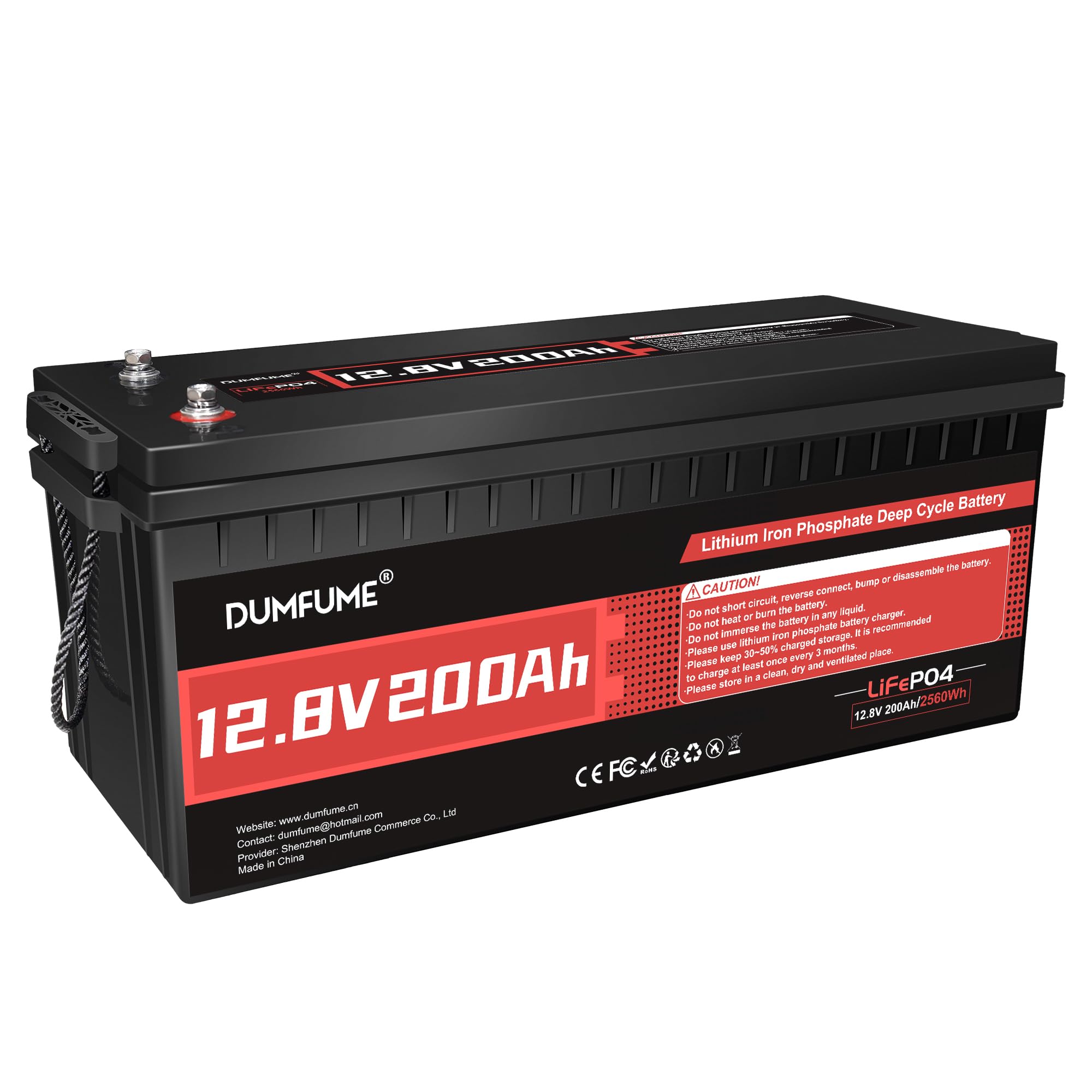
The Dumfume 200Ah LiFePO4 packs 2,560Wh of energy into a 45.2-pound case, making it a direct competitor to mid-range lithium batteries with a higher cycle-life claim of up to 15,000 cycles under optimal conditions. The 200A BMS supports continuous discharge for 2000W inverters and provides over-current, short-circuit, and temperature protection.
This is a “non-smart” battery with no Bluetooth or display—pure storage for users who already have a shunt or inverter with monitoring. The 12.8V nominal voltage keeps compatibility with standard charge controllers. Owners report these batteries test above rated capacity, arriving with a mild charge ready for top-off before installation.
Packaging has been a minor pain point in some shipments—despite individual cell protection—but customer service from Dumfume is responsive for replacements. For budget-focused buyers building large multi-battery banks, the Dumfume 200Ah offers one of the lowest costs per amp-hour in the lithium tier.
Why it’s great
- Very low cost per amp-hour in LiFePO4
- Lightweight at 45.2 lbs for 200Ah
- 200A BMS handles high inverter loads
- Compact footprint for its capacity
Good to know
- No Bluetooth or display monitoring
- Some units arrive needing a jump start to wake BMS
- Warranty may be limited for Amazon purchases
5. Power Queen 12V 100Ah LiFePO4
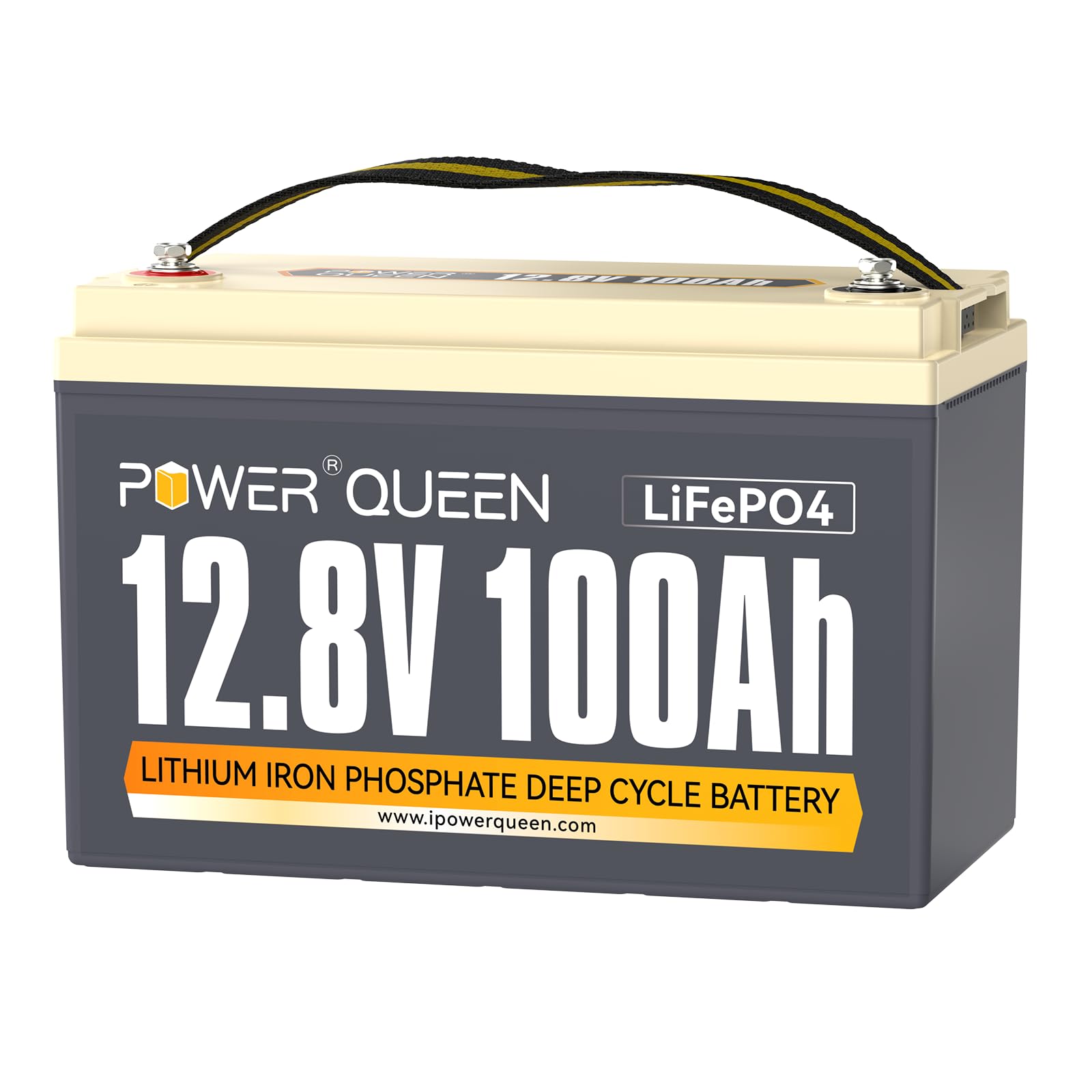
The Power Queen 100Ah LiFePO4 hits the sweet spot between price and performance for mid-range solar setups. Grade-A LiFePO4 cells and a 100A BMS deliver reliable 100Ah usable capacity at just 24 pounds—roughly one-third the weight of a lead-acid equivalent. The BMS handles overcharge, over-discharge, short circuits, and overheat protection.
This battery supports series and parallel wiring up to 4S4P, giving you the flexibility to build a 51.2V 400Ah system (20.48kWh) for larger off-grid builds. Owners report running trolling motors for up to six miles across three fishing trips on a single charge, with enough headroom to power fish finders and livewells simultaneously.
At 24 pounds, it is one of the lightest 100Ah lithium batteries on the market, which matters for marine and portable solar users who reposition their battery bank seasonally. The 5-year warranty provides a solid safety net for a mid-range investment.
Why it’s great
- Very light at 24 lbs for 100Ah
- Grade-A LiFePO4 cells
- 4S4P expandable to 20.48kWh
- 5-year warranty included
Good to know
- 100A BMS limits inverter to 1000W continuous
- 6mm bolts feel delicate for multi-lug connections
- No Bluetooth monitoring
6. VMAX SLR125 AGM 125Ah (2-Pack)

The VMAX SLR125 AGM is a classic deep-cycle battery that floats at 99% recombination efficiency, meaning no water top-offs or gas venting. The 2-pack delivers 250Ah total (125Ah each), though the usable capacity sits around 125Ah total at 50% DoD. The float service life of 8 to 10 years matches some lithium warranties when properly maintained.
Multiple long-term owners report these batteries lasting 7 years or more in 5th wheel and solar setups, even with occasional over-discharge abuse. The AGM construction handles vibration well for mobile RV and marine installations. The marine terminals accept standard ring connectors without adapter plates.
VMAX recommends a specific 8-stage smart charger (the BC8S1215) to maximize cycle life. Third-party chargers and alternators with incorrect voltage setpoints can shorten AGM life considerably, so matching the charging profile is essential.
Why it’s great
- 8-10 year float service life
- 99% recombination—no maintenance
- Proven 7-year real-world longevity
- Handles vibration well for mobile use
Good to know
- Only 50% usable capacity per 125Ah
- Heavy at 60 lbs per battery
- Requires specific 8-stage charger
7. WEIZE 12V 100Ah Deep Cycle AGM

The WEIZE 100Ah AGM is a budget-friendly deep-cycle option for users who want a maintenance-free sealed battery without moving to lithium. The 3% monthly self-discharge rate makes it suitable for seasonal equipment like hunting gear, emergency lighting, and standby UPS systems where regular charging isn’t guaranteed.
Real-world AGM performance shows roughly 50Ah usable capacity from the 100Ah rating, which many owners find adequate for small solar setups running LED lighting, a 12V cooler, and device charging. The 1150A max discharge current handles starter motor demands that lithium batteries cannot always meet due to BMS limits.
The WEIZE includes no wire harness or mounting bracket—just the battery and screws. It is best as a drop-in replacement for equipment that originally used Group 31 lead-acid batteries. For users transitioning from flooded lead-acid, the AGM design eliminates acid spill and water maintenance.
Why it’s great
- Affordable entry into deep-cycle AGM
- Very low 3% monthly self-discharge
- 1150A max discharge for starter duties
- No maintenance or water checks
Good to know
- Only 50Ah usable from 100Ah rating
- Heavy at 60 pounds
- No lithium cycle life or depth-of-discharge
8. ExpertPower 12V 35Ah Gel (2-Pack)
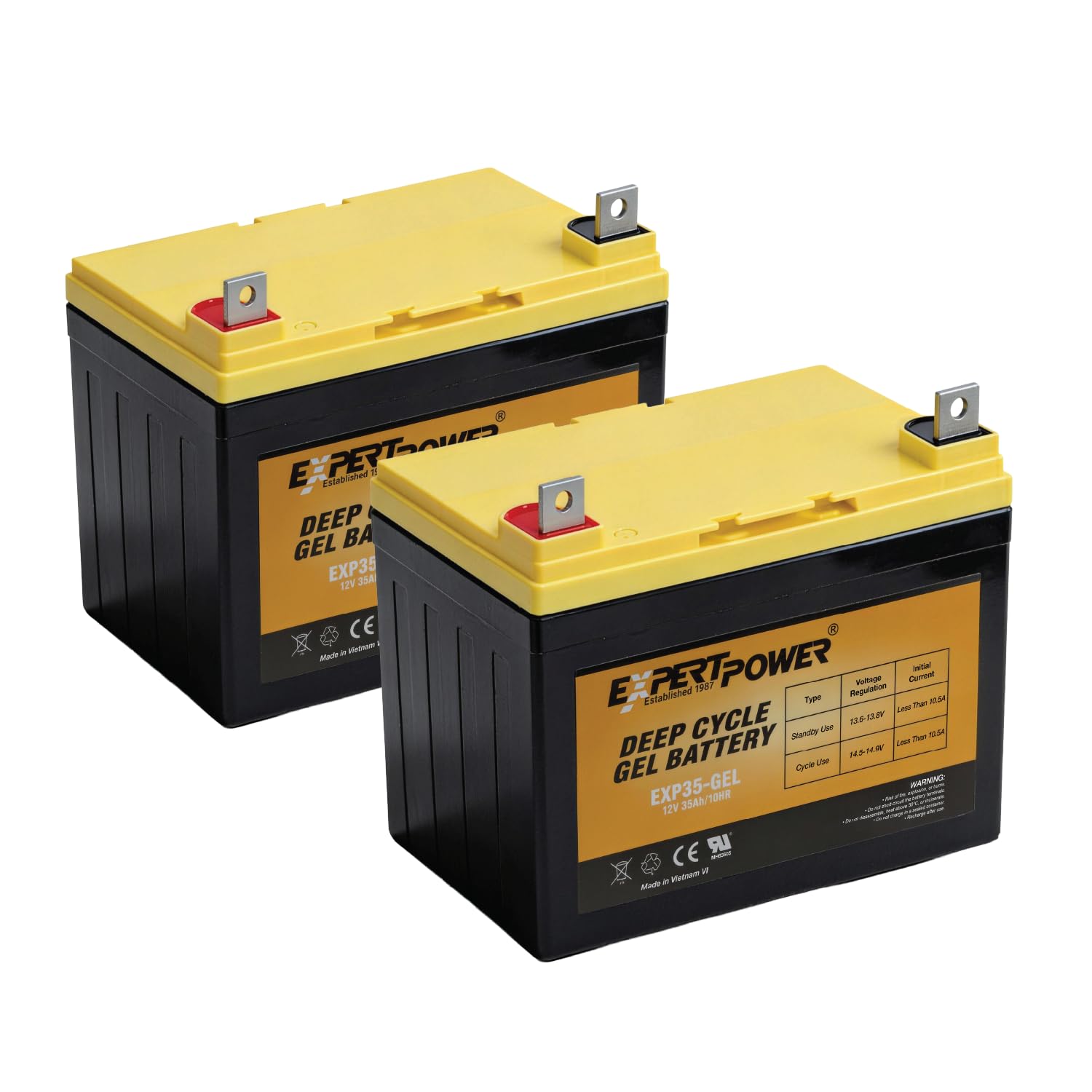
The ExpertPower 35Ah Gel 2-pack provides 70Ah total capacity for small-scale solar systems, mobility scooters, and gate openers. Gel chemistry offers the best vibration resistance among lead-acid types and can be mounted in any orientation without leakage. The sealed case is rugged enough for marine environments.
Each battery measures just 7.64 x 5.20 x 6.69 inches and weighs 24 pounds total for the pair, making them easy to fit into tight equipment compartments. Owners report improved speed and range in electric wheelchairs compared to standard AGM batteries, with gel handling deeper discharges more gracefully.
These batteries arrive fully charged and require no acid filling or maintenance. The stud terminals simplify connections. For users with modest power demands who prioritize a small physical footprint and spill-proof safety, the ExpertPower gel 2-pack delivers reliable performance at an approachable cost.
Why it’s great
- Small footprint for tight compartments
- Gel chemistry resists vibration
- No maintenance or water filling
- Bulletproof for mobility scooters
Good to know
- Limited 70Ah total capacity
- Slower charging than AGM or lithium
- Not ideal for high inverter loads
9. Topsolar 100W 12V Solar Panel Kit

The Topsolar 100W kit is a turnkey solar charging solution for entry-level 12V battery systems. It includes a 100W monocrystalline panel with a V-shaped aluminum bracket mount, a 30A PWM charge controller, two 16-foot MC4 cables, and two 5-foot battery cables with O-ring terminals. Everything connects out of the box for a basic 12V charging circuit.
The 30A controller supports both 12V and 24V battery banks, with protection against overcharge, over-discharge, over-voltage, and short circuits. Owners report easy wiring on RVs, tractors, and sheds—most installations complete within an hour. The panel measures 46.5 x 21.8 x 1.37 inches and weighs 15.8 pounds, manageable for a single person to mount on a roof or ground frame.
While the 100W panel output is modest—roughly 30Ah of daily harvest in good sun—it is sufficient for maintaining batteries in storage, trickle-charging gate openers, and running small 12V loads. This is a practical add-on for users who already own a battery and want a reliable charging source without piecemeal component buying.
Why it’s great
- All-in-one kit with controller and cables
- 30A PWM controller handles 12V/24V
- Adjustable mount bracket for angle tuning
- Easy single-person installation
Good to know
- 100W output is low for daily charging of large banks
- PWM controller less efficient than MPPT
- Bracket holes may not match all roof rails
FAQ
Can I replace my RV’s lead-acid battery with a LiFePO4 battery without changing my charger?
What size solar panel do I need to charge a 100Ah 12V battery in one day?
Final Thoughts: The Verdict
For most users, the best 12v solar battery winner is the Battle Born 100Ah because its combination of 100% usable capacity, 10-year warranty, and proven real-world longevity makes it a one-and-done purchase for any RV, cabin, or off-grid system. If you need Bluetooth monitoring and a compact Group 31+ footprint, grab the Litime 200Ah Mini. And for massive off-grid storage with a fire-safe metal case, nothing beats the ECO-WORTHY 280Ah.