
A 12x magnification binocular delivers a unique tension: twice the reach of a typical 8x model, but every tremor in your hand is magnified just as much. The real challenge isn’t finding a 12x binocular; it’s finding one that balances enough light-gathering objective lens diameter, prism quality, and physical stability so that 12x works for you, not against you.
I’m Min — the co-founder and writer behind Gadgets Feed. I’ve spent countless hours dissecting specification sheets, cross-referencing exit pupil diameters, field-of-view angles, and coating stacks to identify which 12x models actually deliver usable image brightness and sharpness without forcing you into tripod-only territory.
Below, you’ll find a carefully curated selection of the finest 12x options available, from budget-conscious entries to premium optical instruments, so you can confidently choose your ideal 12x binoculars.
How To Choose The Best 12X Binoculars
Choosing a 12x binocular is a different equation than picking an 8x or 10x. The higher magnification amplifies both the view and every optical flaw—shake, poor coatings, and low light falloff. You need to balance four critical factors to ensure your 12x experience is exhilarating, not frustrating.
Objective Lens Diameter & Exit Pupil
The number after the ‘x’ — 50mm or 60mm — determines how much light the binocular gathers. Divide that number by 12 to get the exit pupil. A 50mm objective gives a 4.17mm exit pupil, which is adequate for dawn and dusk use. A 60mm objective yields a 5mm exit pupil, which is far more forgiving for astronomy or deep-woods viewing. A smaller diameter (like 42mm) at 12x drops to a 3.5mm exit pupil, which can feel dim in anything less than bright daylight.
Prism Quality: BaK-4 vs. BK-7
BaK-4 glass is denser and delivers a round, fully illuminated exit pupil. BK-7 glass produces a clipped, square-ish exit pupil that loses light at the edges. At 12x where every photon counts, BaK-4 prisms are strongly preferred, especially when paired with phase coating (for roof prism models) to maintain contrast and sharpness.
Stability and Tripod Compatibility
12x magnification amplifies hand shake noticeably. Look for a binocular with a tripod adapter socket built into the center hinge, even if you plan to handhold most of the time. A magnesium or aluminum chassis can help reduce weight, but a lighter binocular at 12x can paradoxically be harder to hold steady than a slightly heavier one that dampens vibration better.
Quick Comparison
On smaller screens, swipe sideways to see the full table.
| Model | Category | Best For | Key Spec | Amazon |
|---|---|---|---|---|
| Leupold BX-4 Pro Guide HD 12x50mm | Premium Roof Prism | Long-range observation & hunting | 65.2° Apparent FOV | Amazon |
| Nikon PROSTAFF 5 12x50mm | Mid-Range Roof Prism | All-around outdoor & birding | 15.5mm Eye Relief | Amazon |
| Athlon Midas G2 UHD 12×50 | Premium Roof Prism | Birding with high color fidelity | UHD ED Objective Glass | Amazon |
| Celestron Nature DX ED 12×50 | Mid-Range Roof Prism | Entry-level ED glass performance | Fully Multi-Coated Optics | Amazon |
| Celestron SkyMaster 12×60 | Value Porro Prism | Astronomy & dawn/dusk viewing | 5mm Exit Pupil | Amazon |
| Bushnell Powerview 12×50 | Budget Porro Prism | General casual use | BK-7 Prism Glass | Amazon |
| Occer 12×50 | Budget Porro Prism | Entry-level birding/travel | 800g Weight | Amazon |
In‑Depth Reviews
1. Leupold BX-4 Pro Guide HD 12x50mm Gen 2

Leupold’s BX-4 Pro Guide HD delivers a stunningly wide 65.2° apparent field of view—rare for a 12×50 roof prism—which makes target acquisition significantly easier than narrower competitors. The Elite Optical System pairs with hydrophobic Guard-ion lens coatings that repel water, dirt, and fingerprints, keeping the view clear in wet conditions. At just 1.83 pounds with an open-bridge magnesium chassis, it balances the weight well enough for extended handheld sessions when using a proper stance.
The dielectric prism coating reflects over 99% of light, resulting in an image that remains bright and contrasty even as ambient light fades toward dusk. Reviewers consistently note that the clarity at distances beyond 400 yards rivals models costing twice as much. The Gen 2 iteration refines the focus mechanism and adds a more secure tripod adapter thread in the center hinge for steady long-duration observation.
Made in Japan with Leupold’s legendary lifetime warranty, this binocular is built for a decade-plus of serious use. The only trade-off is the price—it commands a significant investment—and the fixed 12x magnification will never have the panoramic field of an 8x. But for discerning hunters and nature observers who prioritize sheer resolving power, this is the reference standard.
Why it’s great
- Exceptionally wide apparent FOV for a 12×50 roof prism
- Guard-ion coating sheds water and smudges effortlessly
- Lightweight magnesium chassis with comfortable ergonomics
Good to know
- Premium pricing places it above budget constraints
- Handheld stability still requires practice at 12x
2. Nikon PROSTAFF 5 12x50mm
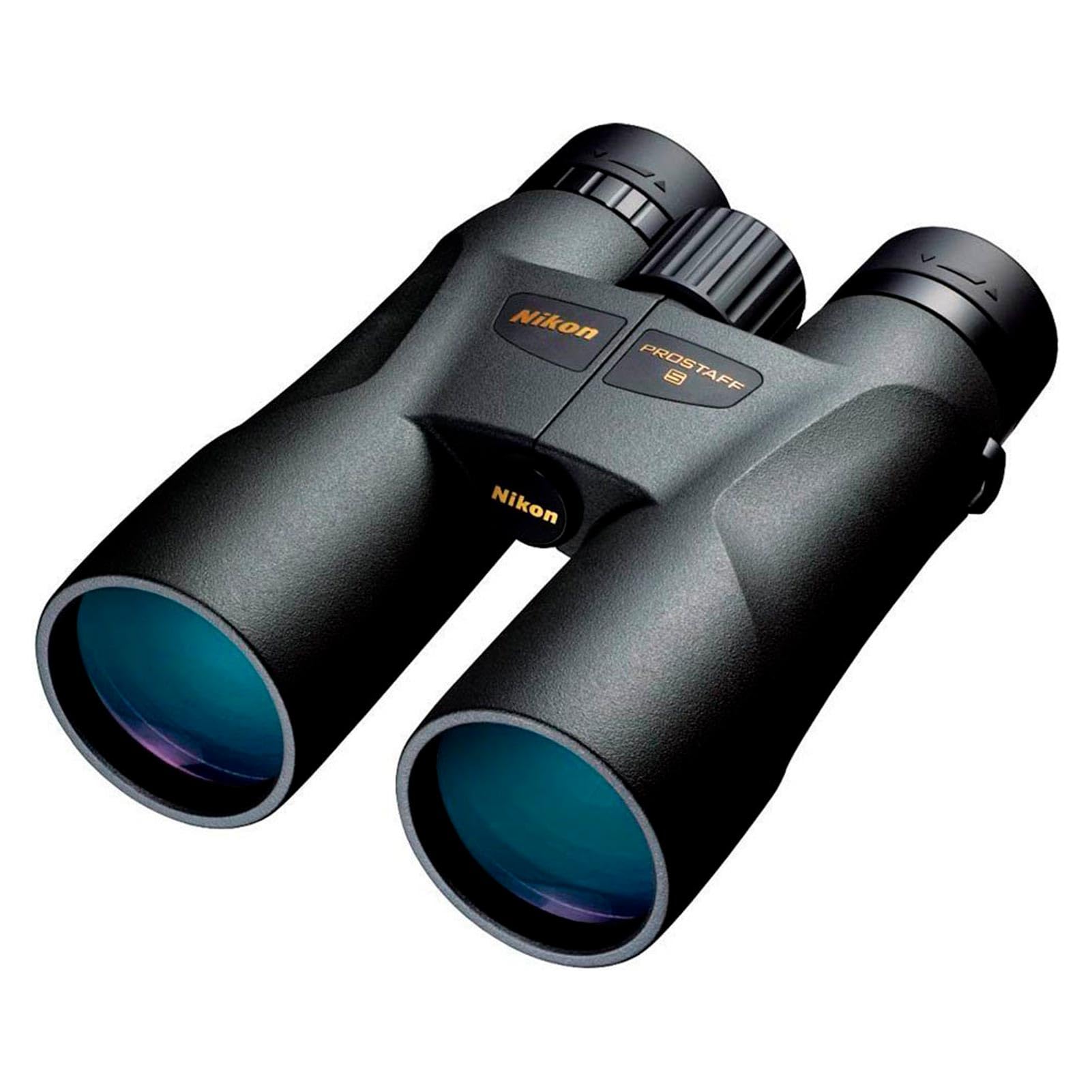
The Nikon PROSTAFF 5 12×50 strikes an exceptional balance between optical performance and portability. Its fiberglass-reinforced polycarbonate resin body keeps weight significantly lower than full-metal competitors, making it one of the most packable 12×50 binoculars available. The multilayer-coated optics and standard BaK-4 prisms deliver a bright, color-accurate image that handles glare well, with a useful 246-foot field of view at 1000 yards that feels natural for birding and scanning lakeshores.
Generous 15.5mm of eye relief, combined with turn-and-slide multi-click rubber eyecups, makes this model exceptionally comfortable for eyeglass wearers. The nitrogen-filled, O-ring sealed chassis is fully waterproof and fog-proof—no concerns about sudden rain or humidity during a long hike. The central focus knob has a smooth, damped action that allows precise adjustments between close foreground subjects and distant treelines.
Where the PROSTAFF 5 truly excels is in its peerless package efficiency: you get Nikon’s reliable optical heritage, a robust weatherproof build, and a manageable weight in one mid-range price tier. The compromise is that it uses standard glass, not ED glass, so some chromatic aberration may be visible on high-contrast edges in bright sunlight.
Why it’s great
- Lightweight for a 12×50 at under 3 pounds
- Excellent eye relief for eyeglass wearers
- Fully waterproof and fogproof with reliable Nikon build
Good to know
- Standard glass shows some color fringing in harsh light
- Field of view is slightly narrower than premium peers
3. Athlon Optics Midas G2 UHD 12×50

Athlon’s Midas G2 UHD uses Extra-Low Dispersion (ED) glass—rebranded as UHD—that virtually eliminates chromatic aberration, delivering a crisp, color-fringing-free image across the entire field. The ESP dielectric coating on the prism reflects over 99% of light, so even in shaded forest understory or at twilight, the view retains impressive brightness. A magnesium chassis reduces weight by roughly 35% compared to an aluminum frame, resulting in a 12×50 that feels well-balanced in the hand.
The XPL coating on the exterior lenses provides robust protection against scratches, oil, and dirt—a practical feature for field use where lens cleaning isn’t always immediate. With 15mm of eye relief and twist-up eyecups, it accommodates eyeglass wearers comfortably. The 54° apparent field of view is adequate for a 12x, and the flat-field design ensures sharp edges rather than the soft corners common in cheaper optics.
Birders will appreciate the precise color reproduction that helps distinguish subtle plumage differences, while the included padded neck strap and soft-sided case offer solid carry protection. The Athlon VIP lifetime warranty is transferable, adding long-term value. The only real drawback is the weight—still noticeable during extended handheld glassing sessions—but that’s inherent to the 50mm class.
Why it’s great
- UHD ED glass eliminates color fringing
- ESP dielectric coating for outstanding light transmission
- Magnesium chassis reduces weight significantly
Good to know
- Heavier than smaller objectives; tripod recommended for long sessions
- Apparent FOV is moderate compared to wider designs
4. Celestron Nature DX ED 12×50
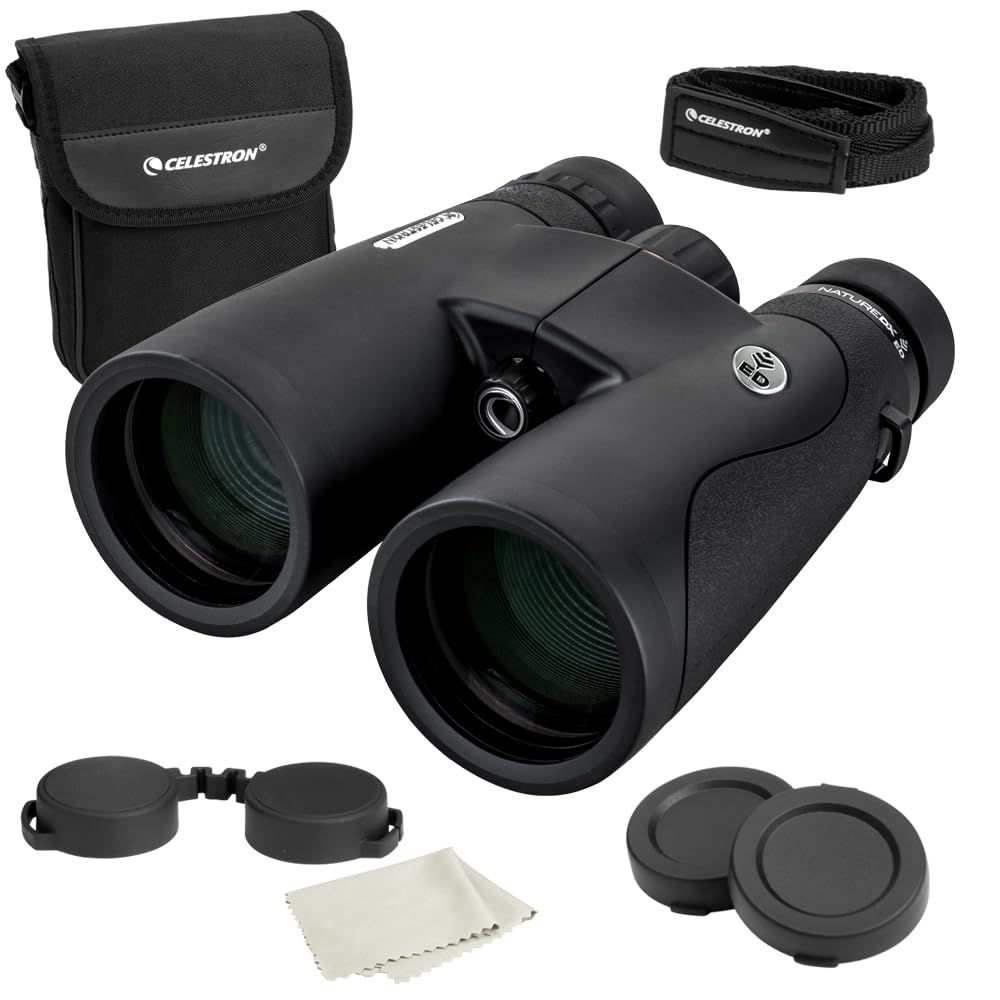
Celestron’s Nature DX ED brings Extra-Low Dispersion glass to a price point that undercuts most ED-equipped competitors, making it the entry point for anyone wanting to eliminate chromatic aberration without spending premium money. The fully multi-coated optics and phase-coated BaK-4 prisms deliver a bright, detailed image that easily resolves distant birds and landscape features. The 4.1mm exit pupil is decent for a 12×50, and the 14.3mm eye relief is sufficient for eyeglass wearers.
The rubber-armored polycarbonate housing is nitrogen-purged and sealed against water intrusion, so rain, mist, and humidity won’t fog the internal optics. A tripod adapter socket is built into the center hinge, allowing stable long-duration viewing for astronomy or wildlife observation. At 896 grams (roughly 2 pounds), it’s moderately heavy but manageable for shorter handheld sessions.
The main observation from users is that the twist-up eyecups lack a positive locking detent, and the focus wheel, while smooth, has a bit of backlash on some units. The included case and neck strap are functional but basic. However, considering the ED glass performance and Celestron’s lifetime warranty, this binocular represents a remarkable value-to-optical-quality ratio.
Why it’s great
- ED glass at a near-entry-level price point
- Fully multi-coated with phase-coated BaK-4 prisms
- Waterproof and fogproof with tripod socket
Good to know
- Eyecups don’t lock in extended position
- Focus wheel may have slight backlash
5. Celestron SkyMaster 12×60

The SkyMaster 12×60 is the largest objective lens in this lineup, capturing 44% more light than a 50mm binocular. This massive 60mm aperture, combined with a 5mm exit pupil, delivers noticeably brighter images at dawn, dusk, and under the night sky—making it a favorite among casual astronomers who want to see Jupiter’s moons, the Andromeda Galaxy, or lunar craters without investing in a telescope. The BaK-4 prisms maximize that light throughput, and the multi-coated optics help control glare.
At 2.4 pounds and with a long 8.25-inch body, this binocular is definitely too heavy for long handheld sessions—mounting on a standard photo tripod is strongly recommended for steady views. The water-resistant rubber armor provides a secure grip and basic protection, though it’s not fully submersible. Users report that the included neck strap is too thin for the weight; a wider aftermarket strap is a wise upgrade.
Collimation quality from the factory is generally good, and the 5.3° actual field of view is reasonable for a 12×60. Some chromatic aberration is visible on bright objects like the moon, but the sheer light-gathering capability makes this a thrilling option for anyone wanting to explore the night sky. The absence of ED glass is the only real optical compromise at this price tier.
Why it’s great
- Largest 60mm objective for superior low-light gathering
- 5mm exit pupil ideal for astronomy and twilight use
- Excellent value for wide-field stargazing
Good to know
- Heavy and bulky—tripod mounting is essential for comfort
- Chromatic aberration visible on bright lunar edges
6. Bushnell Powerview 12×50 Wide Angle
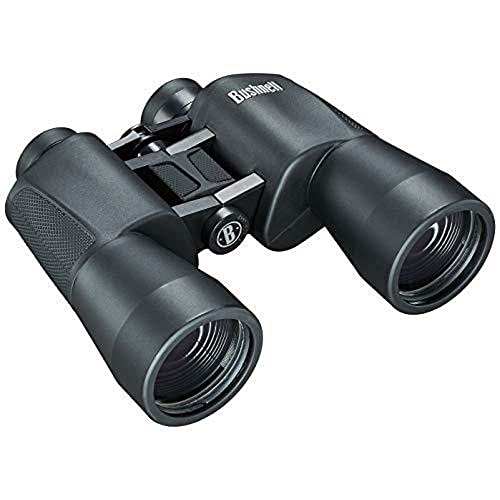
Bushnell’s Powerview 12×50 is a classic porro prism design that uses multi-coated optics and BK-7 prisms to deliver a bright image that exceeds expectations for its price point. The “InstaFocus” lever allows rapid one-finger focusing, which is genuinely useful when tracking moving subjects. The wide-angle design provides a generous field of view for a 12x, making scanning wider areas less tedious.
The rubber-armored housing is rugged enough for field use, and the included carrying case and strap are functional basics. Users consistently report good center resolution and the ability to see detail at 5-7 miles in open terrain. The BK-7 prism glass does produce a slightly clipped exit pupil shape compared to BaK-4, but at this price tier the optical compromise is expected and acceptable for casual birdwatching, sporting events, or general sightseeing.
The main trade-off is that the center focus wheel on some units can feel stiff, and edge sharpness is noticeably softer than premium models. The Bushnell lifetime warranty provides peace of mind. For someone who wants 12x magnification on a tight budget and doesn’t need ED glass or phase coatings, the Powerview is a reliable, no-frills entry.
Why it’s great
- Very affordable entry point for 12x magnification
- Wide-angle view for a porro design
- Rugged build with lifetime warranty
Good to know
- BK-7 prisms and stiff focus wheel on some units
- Edge sharpness falls off noticeably
7. Occer 12×50 Bird Watching Binoculars

The Occer 12×50 stands out in the entry-level segment with a larger-than-typical 18mm prism that helps maximize light transmission through the porro design. The 8.3° field of view (435 feet at 1000 yards) is genuinely wide for a 12x, making it easier to locate and track birds in motion. Users report surprisingly good clarity in low-light conditions for the price, crediting the 50mm objective and the fully multi-coated optics.
At 800 grams, it’s among the lighter 12×50 porro designs, making it comfortable for travel and day hikes. The kit includes a carrying case, neck strap, lens cleaning cloth, and eyepiece cover. The ABS body with rubber armoring provides adequate protection, and the center focus knob is easy to operate even with gloves on. The foldable design further enhances portability for backpacks.
Image quality is of course a step below ED-glass models when it comes to chromatic aberration, and the build quality uses more plastic than metal competitors. However, for the price tier, the Occer delivers a compelling balance of magnification, light gathering, and wide field of view. It’s an ideal first 12x binocular for a beginner birdwatcher or outdoor enthusiast.
Why it’s great
- Wide 8.3° field of view for a 12x binocular
- Lightweight and portable with full kit included
- Good low-light performance for the price tier
Good to know
- Plastic chassis lacks the heft of premium builds
- Some chromatic aberration on high-contrast edges
FAQ
Are 12x binoculars too shaky to use without a tripod?
Is a 12×60 or 12×50 better for stargazing?
Final Thoughts: The Verdict
For most users, the 12x binoculars winner is the Leupold BX-4 Pro Guide HD 12x50mm Gen 2 because it combines an exceptionally wide apparent FOV, premium HD glass, and a lightweight magnesium chassis in a rugged, fully weatherproof package. If you want ED glass performance without the premium investment, grab the Celestron Nature DX ED 12×50. And for deep twilight and astronomy work where light gathering is king, nothing beats the Celestron SkyMaster 12×60.