
Our readers keep the lights on and my morning glass full of iced black tea. As an Amazon Associate, I earn from qualifying purchases.
Specs are compiled from manufacturer listings and verified buyer reviews and can change over time — please confirm the key details on the product page before buying.
If you are building a rig with an RTX 4090 or 5090, or running multiple GPUs for work or gaming, the power supply is the one part you cannot cheap out on. A weak or unreliable unit causes crashes, random shutdowns, and in the worst cases, can take your expensive components out with it. This guide breaks down the best 1300W PSU options — from silent premium units to feature-packed mid-range picks — so you know exactly which one keeps your system stable without draining your wallet.
I’m Min — the founder and writer behind Gadgets Feed. This guide is built by comparing the manufacturers’ published specifications and the patterns across verified customer reviews, so you get each pick’s real strengths and trade-offs instead of marketing spin.
Whether you are chasing high frame rates in 4K or running a workstation that pulls serious wattage, finding the right 1300w psu means balancing efficiency certification, cable compatibility with modern GPUs, and long-term reliability you can count on for years.
Our Picks at a Glance


How To Choose The Best 1300W PSU
Choosing a 1300W PSU for a high-end build requires matching connectors to your GPU, selecting an efficiency tier, and deciding on modularity for clean cable management. You need to match connectors with your GPU, choose an efficiency tier that saves heat and electricity, and decide how much modularity you want for a clean case layout.
Efficiency Certification: Gold, Platinum, or Titanium
The 80 Plus rating tells you how much of the AC power from your wall gets turned into usable DC power for your components. Gold units run at 87% efficiency or higher under typical loads, Platinum pushes past 89%, and Titanium reaches over 90% at light loads and up to 94% at full load. Higher efficiency means less heat, quieter fans, and lower electric bills over the long run — but you pay more upfront for Titanium.
ATX 3.1 and PCIe 5.1 Compatibility
Modern high-power GPUs like the RTX 4090 and 5090 can pull sudden spikes of double their rated wattage for milliseconds. An ATX 3.1 certified PSU is designed to handle these transient surges without tripping a protection circuit. The new 12V-2×6 connector replaces the older 12VHPWR standard and includes better safety monitoring for a more secure and cooler connection at the GPU terminal.
Modular Cabling and Build Quality
A fully modular power supply lets you attach only the cables you need, which cuts down clutter inside your case and improves airflow. Premium units use Japanese capacitors (rated for higher temperature endurance) and Fluid Dynamic Bearing fans that stay quiet under load. The physical size of the unit also matters — some high-wattage supplies are 180mm deep and may not fit in compact cases, so always check your chassis clearance.
Quick Comparison
| Model | Best For | Wattage | Efficiency | Form Factor | Amazon |
|---|---|---|---|---|---|
| HIGH POWER 1300W★ Best Overall | Budget gold efficiency | 1300W | 80+ Gold | ATX | Amazon |
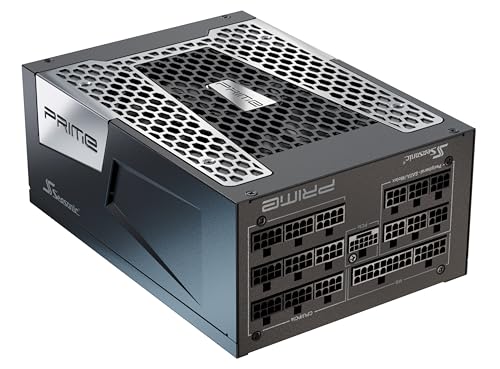
| Seasonic Prime TX-1300Premium Pick | Ultimate stability | 1300W | 80+ Titanium | ATX | Amazon |
| be quiet! Dark Power Pro 13 1600WTop Performer | Extreme multi-GPU | 1600W | 80+ Titanium | ATX | Amazon |
| be quiet! Dark Power Pro 13 1300W | Near-silent premium | 1300W | 80+ Titanium | ATX | Amazon |
| ASRock Phantom Gaming PG-1600G | Future-proof power | 1600W | 80+ Gold / Cybenetics Platinum | ATX | Amazon |
| ASRock Phantom Gaming PG-1300G | Safety features | 1300W | 80+ Gold / Cybenetics Platinum | ATX | Amazon |
| Super Flower Leadex VII XG 1300W | Reliable OEM quality | 1300W | 80+ Gold / Cybenetics Platinum | ATX | Amazon |
| GAMEMAX RGB-1300 | RGB aesthetics | 1300W | 80+ Platinum | ATX | Amazon |
In‑Depth Reviews
1. HIGH POWER 1300W 80 Plus Gold
Our pick — over 4★ from 150+ verified ratings; the strongest balance of quality and price.
An affordable entry into 1300W ATX 3.0 — but longevity reviews are mixed at best.
The HIGH POWER 1300W unit is the most budget-friendly fully modular 1300W option here. It carries an 80 PLUS Gold certification for decent efficiency (up to 87% at typical loads), supports ATX 3.0 standards, and includes protections like over-voltage, under-voltage, over-current, short-circuit, and over-temperature protection. It measures 8 x 5 x 4 inches — notably shorter than the 7.09-inch ASRock units, so it fits more easily in standard ATX cases. Some buyers found it “almost silent when running” and noted it fixed their computer crash problems.
However, the reliability track record is concerning. One reviewer noted the unit “barely lasted 2 months” as a replacement for an original that “barely lasted 3 years,” calling the PSUs “garbage.” This is a pattern across several reviews: the unit works fine when new, but durability seems questionable compared to more established brands like Seasonic or Super Flower. It also operates on a minimum input voltage of 110 Volts, which is standard for North America but may limit use in regions with lower mains voltage.
The HIGH POWER 1300W offers 1300W of Gold-rated power at a low price. But if you are building a system with expensive components, the savings may not be worth the risk. Reserve this unit for budget builds where you can afford to replace it, or as a temporary solution.
The affordability angle
- Cheapest fully modular 1300W unit in the list
- 80+ Gold efficiency keeps heat manageable
- Compact 8-inch depth fits most cases easily
Risk factors
- Multiple reports of failure within 2 months to 3 years
- Long-term reliability does not match the price savings
Works for: A secondary or budget build where you need 1300W but can accept a shorter lifespan.
Not for: Any build with expensive GPUs or where downtime is costly — the failure rate is too high.
2. Seasonic Prime TX-1300
The gold standard for rock-solid power delivery that keeps an overclocked 14900K and dual 4090s happy.
This is the unit you buy when you want zero worries about power stability. The Seasonic Prime TX-1300 carries an 80 PLUS Titanium certification (ultra-high efficiency) and a Micro Tolerance Load Regulation of just 0.5%, which means the voltage on the 12V rail barely moves even under heavy load swings. Clean, steady power from the Seasonic Prime TX-1300 reduces crashes and improves overclocking headroom. It uses a 135mm Fluid Dynamic Bearing fan that stays quiet during normal use, and the fully modular cabling means you only plug in the cables your build actually needs.
Buyers report running heavily overclocked 14900K builds with dual 4090 GPUs, water cooling, and nine fans without a hiccup. One owner used a Fluke tester and described the DC output as “very stable.” The unit comes with a 12V-2×6 connector (the updated ATX 3.1 / PCIe 5.1 standard), so it is ready for RTX 50-series cards right from the start. The included PSU tester is a nice touch — you can verify the unit works before installing everything.
The catch is the sheer size: at 8.3 x 6 x 3.4 inches, it needs a roomy case, and most full towers will fit it fine. It is also the most expensive option here, but the 12-year spare part availability duration and the build quality make this a “buy once, use for a decade” component.
What makes it the king
- 80+ Titanium efficiency reduces heat and electricity waste
- Micro Tolerance Load Regulation (±0.5%) means nearly perfect voltage stability
- Includes a 12V-2×6 connector for RTX 50-series GPUs
- Comes with a handy PSU tester for pre-install verification
The price of perfection
- Premium price tag — this is the most expensive 1300W unit in the list
- Large physical footprint may not fit compact or mid-tower cases
Who it’s for: Enthusiasts running overclocked flagship CPUs and dual high-end GPUs who demand absolute stability and are willing to pay for the best.
The one catch: Make sure your case can handle the 8.3-inch depth before ordering — this is a big unit.
3. be quiet! Dark Power Pro 13 1600W
A 1600W Titanium powerhouse that runs completely silent while handling the most extreme multi-GPU loads.
If you are building a system that will push well beyond 1300W — think dual RTX 5090s and a Ryzen 9 9950X — the Dark Power Pro 13 1600W delivers up to 94.5% efficiency (80 PLUS Titanium) and uses fully digital control with full bridge LLC technology for class-leading signal stability. The overclocking key lets you switch between six separate 12V rails and one massive single rail, giving you flexibility for either safety or raw power. Owners mention powering two RTX 5090s and a Ryzen 9 9950X under heavy LLM loads without any instability — one owner used it in 83 custom builds in 2023.
The full mesh front with a funnel-shaped air inlet improves airflow even when the unit is under sustained high load. It also ships with two 12VHPWR cables, so you can connect multiple modern GPUs without adapter shenanigans. The build quality feels premium, with well-braided cables and a solid metal chassis.
On the downside, some buyers experienced violent system resets under heavy GPU loads (like ComfyUI or DaVinci Resolve with an RTX Pro 6000), and a few had to reduce TDP to 70% to stabilize. This indicates some units may have compatibility quirks with certain professional GPU configurations. The price is also near the top of the market — but if you need the extra 300W headroom over a 1300W unit, this is the most capable option here.
The raw power edge
- 1600W continuous output with 80+ Titanium efficiency (up to 94.5%)
- Dual 12VHPWR cables for multi-GPU setups straight from the start
- Overclocking key for switching between 6-rail and single-rail mode
- Fully digital regulation for tight voltage control
Watch out for
- Some units cause system resets under extreme GPU loads with certain professional cards
- Premium price — this is among the most expensive PSUs on the list
Best suited for: Builders who need 1600W of clean power for dual flagship GPUs and are comfortable with the top-tier price.
Potential issue: If you use professional RTX Pro cards, check recent reviews — some users had stability problems at full load.
4. be quiet! Dark Power Pro 13 1300W

Near-silent Titanium efficiency with an overclocking key that handles power excursions up to double its rated wattage.
This is the 1300W version of be quiet!’s flagship Dark Power Pro 13 line, and it shares the same DNA as its bigger 1600W sibling: 80 PLUS Titanium efficiency (up to 94.4%), fully digital control, and an overclocking key that lets you choose between six 12V rails or one massive single rail. It includes a native 12VHPWR connector for PCIe 5.0 graphics cards and 6+2-pin connectors for current-gen GPUs. Buyers describe the build quality as “aircraft aluminum” grade, with well-machined parts and braided cables that feel premium.
One owner reported using it for a year with a 9800X3D and RTX 5090, noting it stayed silent even under stress tests. The funnel-shaped air inlet and mesh front improve cooling efficiency, and the digital full-bridge LLC technology provides world-class signal stability. It handles power excursions up to double its rated power — so it can absorb the sudden spikes a high-end GPU throws at it without tripping.
However, there are some concerning reports. One buyer had Kernel Power 41 errors and code 77 issues on the motherboard when running an RTX 5090 at 4K; switching to a Corsair unit fixed the problem. Another had random power-offs during spikes. A few owners also mentioned the RMA process cost in shipping, which is frustrating for a premium product. The 1300W version seems to have slightly more compatibility complaints than the 1600W model, so pair it carefully with your specific GPU.
What you pay for
- 80+ Titanium efficiency (up to 94.4%) for cool, quiet operation
- Overclocking key for rail mode switching
- Handles up to 2x power excursions for transient spike safety
- Premium build with braided cables and aircraft-grade aluminum feel
Compatibility caveat
- Some RTX 5090 users experienced random crashes and Kernel Power 41 errors
- High price without the universal compatibility you would expect at this tier
Ideal for: Silent-build enthusiasts who want Titanium efficiency and are using a well-tested GPU pairing.
Check before buying: Look at recent reviews for your specific GPU model — some RTX 4090 and 5090 combos had issues.
5. ASRock Phantom Gaming PG-1600G

A 1600W beast that gives you premium safety features and a 10-year warranty without the Titanium price tag.
The ASRock PG-1600G outperforms pricier rivals. It is certified 80 PLUS Gold and Cybenetics Platinum, achieving up to 90% efficiency with a Cybenetics Lambda A noise rating (meaning it stays whisper-quiet under load). It delivers 1600W of continuous power with 133.3A on the +12V rail, which is enough for even extreme multi-GPU setups. It uses 100% Japanese capacitors for long-term reliability and has a 135mm Striped Axial Fluid Dynamic Bearing fan with iCool intelligent fan control — the fan stays off entirely during low to medium loads for dead-silent operation.
It is fully ATX 3.1 and PCIe 5.1 compliant, with dual native 12V-2×6 connectors that feature TempGuard technology. TempGuard monitors the temperature at the GPU terminal point and can shut down the system if things get too hot — a critical safety feature for anyone worried about melting connectors on high-power GPUs. The included 5V BOOST function compensates for voltage drops on the +5V rail, which helps keep ARGB lighting consistent and prevents flicker.
Customers note it runs silent at 900W and powers multi-GPU setups without issues. One owner using it with a Ryzen 7 9850X3D and RTX 5080 called it “completely stable under heavy gaming and stress testing.” The catch: this is a large 180mm depth PSU (180mm x 150mm x 86mm), so you absolutely must check your case clearance before buying. A few units also shipped with bad PCIe 5.0 cables, though this seems to be an exception rather than the rule. For the price, you get a lot of power and safety features that normally cost hundreds more.
The value proposition
- 1600W output for the price of many 1300W premium units
- TempGuard temperature monitoring on GPU cables adds real safety
- Dual native 12V-2×6 connectors for multi-GPU builds
- Fan stays off at low/medium loads for silent operation
Size and QC notes
- 180mm depth may not fit in many mid-tower cases
- A few buyers received units with a bad PCIe 5.0 cable
Grab it if: You want 1600W of clean power, TempGuard safety, and a 10-year warranty without paying Titanium prices.
Double-check: Measure your PSU clearance — 180mm depth is longer than most standard ATX units.
6. ASRock Phantom Gaming PG-1300G

the balance of safety, efficiency, and price — with TempGuard GPU cable monitoring that no other 1300W unit at this price offers.
If you want the latest safety technology without spending Titanium-level money, the ASRock PG-1300G is your answer. It is certified 80 PLUS Gold and Cybenetics Platinum (dual certification is rare at this price), built with 100% Japanese capacitors, and fully ATX 3.1 / PCIe 5.1 compliant with two native 12V-2×6 connectors. The headline feature is TempGuard — temperature sensors built into the GPU power cables that monitor the connector terminal and shut down the system if it exceeds around 100°C, protecting your expensive graphics card from meltdown. One buyer who uses it with an RTX 5090 said the TempGuard gives “tremendous confidence.”
The 135mm Striped Axial FDB fan with iCool intelligent control stays off at low to medium loads, making this unit practically silent during everyday use. The 5V BOOST mode is a thoughtful addition — it compensates for voltage drops on the +5V rail to keep ARGB lighting bright and flicker-free. Compared to the Seasonic TX-1300, the ASRock gives you similar safety and efficiency for significantly less money, though it is Gold-rated while the Seasonic is Titanium. Buyers running RTX 5090s report the PSU runs “super quiet” and has all the connectors needed for modern builds.
The main downside is that some units ship with a faulty 12V-2×6 cable. One buyer described a bad cable that caused hard system shutoffs under GPU load after 1-2 minutes — swapping to the second included cable fixed it immediately. This QC variance is annoying, but the dual cable design at least gives you a backup option. The 180mm depth also means you need a roomy case. For the price, this is the best-balanced 1300W PSU on the market in 2025.
Why it wins
- TempGuard temperature sensors on GPU cables prevent melting damage
- Dual certification: 80+ Gold and Cybenetics Platinum for real-world efficiency
- Two native 12V-2×6 connectors for multi-GPU or backup flexibility
- iCool fan control keeps it silent during low/medium loads
The trade-off
- Some units have a faulty 12V-2×6 cable (use the second cable as fallback)
- 180mm depth — verify your case can accommodate it
The recommendation: Buy this if you want the best blend of safety features, efficiency, and value for a modern RTX 50-series build.
One tip: Test both 12V-2×6 cables before fully assembling your build — swap immediately if you see shutdowns.
7. Super Flower Leadex VII XG 1300W

The OEM behind many top-tier brands — a no-nonsense 1300W Gold unit with tight voltage regulation and proven reliability.
Super Flower is one of the largest PSU manufacturers in the world, supplying units to brands you already trust. The Leadex VII XG 1300W carries an 80 PLUS Gold certification, Cybenetics Platinum certification, and boasts tight voltage regulation on the 12V, 5V, and 3.3V rails at ±0.5% — that is unusually precise for a Gold-rated unit. It is ATX 3.1 compliant and PCIe Gen 5 ready, with a native 16-pin PCIe Gen 5 cable (12V-2×6) that resists transient power spikes from modern GPUs. The fully modular design uses all ribbon cables for clean routing.
Buyers who have used it for a year with a 9800X3D and RTX 5090 report it is “silent even under stress tests” and call it a reliable workhorse. One owner mentioned that Super Flower is a “top PSU OEM” and that this unit delivers power reliably without any RGB or gimmicks — just solid performance. Compared to the ASRock PG-1300G, the Super Flower is slightly smaller at 5.9 x 5.9 x 3.4 inches, making it easier to fit in mid-tower cases. It also feels surprisingly light for its power rating due to the nice metal casing.
The main con is that the 12VHPWR cable is a 2×8 PCIe adapter rather than a native single-cable solution, which limits custom cable options for enthusiasts. Some buyers also reported receiving units that appeared “used” when purchased new, which is a packaging concern. If you want a straightforward, proven PSU from a manufacturer that other brands rely on, this is a solid pick.
Why trust it
- Super Flower is a major OEM — this is the same engineering behind premium brands
- Voltage regulation at ±0.5% on all major rails is excellent for a Gold unit
- Compact dimensions (5.9 x 5.9 x 3.4 inches) fit most cases
- Cybenetics Platinum certified despite carrying an 80+ Gold label
Minor drawbacks
- 12VHPWR cable is a 2×8 PCIe adapter, not a native single cable
- Some units arrived appearing used or repackaged
Choose this if: You value proven OEM engineering and compact size over flashy features, and trust a manufacturer that builds for other top brands.
skip it if: You want native single-cable 12V-2×6 or insist on a brand-new sealed box.
8. GAMEMAX RGB-1300 1300W

Surprisingly high efficiency (80+ Platinum) at a low price, with RGB sync — but reliability is a major gamble.
The GAMEMAX RGB-1300 is an oddity: it packs an 80 PLUS Platinum certification (92% efficiency under typical loads) into a budget-friendly fully modular unit. It is ATX 3.0 and PCIe 5.0 ready with a 12VHPWR 16-pin connector that can deliver up to 600W to a graphics card, and it can handle up to 2x total power excursions and 3x GPU power excursions. The addressable RGB with 5V motherboard sync (Aura Sync compatible) gives you 25 lighting modes, which is rare at this wattage and price. It measures 6.69 x 5.91 x 3.39 inches — even smaller than the ASRock units — so it fits in most cases.
However, buyer reports paint a troubling picture. One reviewer wrote: “Delivered 9/3/2025 failed 11/19/2025. If you purchase this for PSU I wish you the best, with that said while playing a video game which doesn’t even use my raid array, poof.” The failure took RAID drives with it, meaning the PSU did not just shut down — it damaged connected hardware. Another buyer had their EVGA 1000W die and replaced it with this GAMEMAX, noting the cables are not sleeved like most premium units and the CPU cables are too short to route outside the motherboard bay.
The GAMEMAX RGB-1300 mirrors the HIGH POWER unit’s short lifespan pattern but with higher stakes due to reported component damage. It has a minimum input voltage of 100 Volts (AC), while the ASRock PG-1300G has a minimum of 120 Volts (AC), which helps in regions with unstable power. But the fundamental reliability concern overshadows the attractive specs. Only consider the GAMEMAX RGB-1300 if you need RGB at 1300W and accept the risk of early failure.
What stands out
- 80+ Platinum certification at a near-budget price
- Addressable RGB with 25 lighting modes and Aura Sync
- Small physical footprint fits most cases easily
- 3x GPU power excursion handling for transient spikes
Dealbreaker risks
- Multiple verified reports of failure within 3 months
- One failure reportedly took RAID drives with it
- Cables are not sleeved and CPU cables are short
Only consider if: You want 1300W Platinum efficiency with RGB and are prepared for the possibility of early failure or component damage.
Serious warning: Do not use the GAMEMAX RGB-1300 in a build with expensive components due to its failure pattern.
Understanding the Specs
80 Plus Efficiency Tiers
The 80 Plus certification tells you how efficiently a PSU converts AC power from your wall into DC power for your components. Gold (87% at typical load) is the standard for mid-range builds. Platinum (89-92%) adds efficiency that reduces heat and fan noise. Titanium (90-94%) is the top tier — it saves the most electricity and runs coolest, but costs significantly more. The ASRock PG-1300G and Super Flower Leadex VII are examples of units that carry dual certification (Gold + Cybenetics Platinum), meaning they perform closer to Platinum in real-world testing despite the Gold label.
ATX 3.1 and PCIe 5.1 Standards
ATX 3.1 is the latest power supply standard designed to handle the extreme transient power spikes that modern GPUs (like the RTX 4090 and 5090) can pull — sometimes up to double the rated wattage for milliseconds. It replaces the older ATX 3.0 and brings the 12V-2×6 connector, which has shorter sense pins and deeper conductor engagement for a safer, cooler connection than the earlier 12VHPWR. The ASRock PG-1300G and Seasonic TX-1300 both support ATX 3.1, making them the safest choices for current and next-gen graphics cards.
FAQ
Do I really need a 1300W PSU for gaming?
What is the difference between a modular and non-modular PSU?
Will a 1300W PSU fit in my mid-tower case?
Does 80 Plus Gold vs Platinum really matter for electricity bills?
What does the 12V-2×6 connector do that the old 12VHPWR does not?
Can I use a 1300W PSU with a 300W system?
How long should a 1300W PSU last?
Is the be quiet! Dark Power Pro 13 1300W worth the high price?
What should I do if my PSU arrives with a bad cable?
Final Thoughts: The Verdict
Across the board, the 1300w psu winner is the ASRock Phantom Gaming PG-1300G because it combines TempGuard safety, dual 12V-2×6 connectors, and Cybenetics Platinum efficiency at a mid-range price that undercuts premium rivals. If you want the absolute best stability and a 12-year support window, grab the Seasonic Prime TX-1300. And for extreme multi-GPU builds where 1300W is not enough, the be quiet! Dark Power Pro 13 1600W delivers Titanium efficiency and dual 12VHPWR cables for the most demanding workstations.
How We Picked
We do not accept paid placement. Every pick is matched to a real buyer and a real use-case; we do not hands-on test units.
Sources & Methodology
Specifications: manufacturer listings and product documentation. Review insights: verified customer reviews, as of July 2026. Pricing: not shown on this page (it changes often); check the current price via the retailer link.
As an Amazon Associate, Gadgets Feed earns from qualifying purchases. This does not affect which products we feature.