
That 14.4-volt cordless tool battery sitting in your garage refuses to take a charge, and you’re about to toss it. Before you do, understand that the charger itself may be the weak link — a sub-1.5-amp trickle unit can take six hours and still leave a Ni-Cd pack with memory issues. The right 14.4 volt battery charger delivers the correct absorption voltage and current regulation to revive tired packs and keep lithium cells balanced.
I’m Min — the co-founder and writer behind Gadgets Feed. I’ve spent countless hours analyzing charger specifications, cross-referencing compatibility claims against real customer voltage measurements, and filtering through the noise of generic “multi-voltage” listings to find the units that actually terminate charge at the correct 14.4-14.6V threshold.
Whether you’re maintaining a LiFePO4 deep-cycle battery or powering up a Milwaukee 48-11-1840 pack, this guide isolates the chargers that handle the 14.4V band correctly without overvolting or cutting off prematurely. That’s the service it provides: a curated shortlist of the absolute best 14.4 volt battery charger options for your specific chemistry and connector.
How To Choose The Best 14.4 Volt Battery Charger
Selecting a charger for a 14.4V system is not a one-size-fits-all decision. The chemistry of your battery pack dictates the required charging algorithm. A Ni-Cd pack from an old cordless drill needs a constant-current topping profile, while a LiFePO4 deep-cycle battery demands a precise constant-voltage absorption stage at 14.6V. Mismatch the two, and you either leave capacity on the table or risk swelling cells.
Chemistry Compatibility Is Non-Negotiable
The most common mistake is assuming a “14.4V” label covers all subtypes. LiFePO4 cells charge to 14.6V (3.65V per cell), while standard lithium-ion (Li-ion) tops at 16.8V for a 4S pack. Ni-Cd and Ni-MH packs use a delta-peak detection method. If your charger lacks a selectable chemistry mode, confirm it explicitly lists the battery type you own — especially for 14.4V lithium packs used in Milwaukee and Makita tools.
Charge Current and Time Considerations
Amperage determines how quickly the charger replenishes capacity. A 1.5-amp unit is adequate for 2.0Ah tool packs, taking roughly 80 minutes for a full charge. A 4-amp charger halves that time and is better suited to larger 5.0Ah or 100Ah deep-cycle batteries. Higher current also helps “wake up” a deeply discharged battery by pushing enough electrons to kick the internal protection circuit back to life.
Connector and Form Factor
Tool-brand chargers use proprietary slide-on docks (Makita pod-style, Milwaukee M18, Black+Decker FSMVC). Universal LiFePO4 chargers typically ship with SAE quick-disconnect pigtails, ring terminals, and alligator clips. Decide whether you need a dedicated bay charger that clicks onto a tool battery or a universal unit with interchangeable leads that can clamp onto a battery terminal.
Quick Comparison
On smaller screens, swipe sideways to see the full table.
| Model | Category | Best For | Key Spec | Amazon |
|---|---|---|---|---|
| Tenergy TB6-B | Premium | Hobby packs & multi-chem | 0.1-5.0A, LiPo bag, 8 ports | Amazon |
| TANKPOW 14.6V 4A | Top Pick | LiFePO4 deep-cycle | 4A, 4-stage charge, ETL listed | Amazon |
| ULTRA POWER 14.6V 4A | Value | Compact LiFePO4 top-up | 4A, 5-LED display, fanless | Amazon |
| Gonocop 4-Port | Worksite | Milwaukee 14.4-18V fleet | 4 ports, 3A per bay, USB | Amazon |
| Bosch C80-Li | Pro-Grade | Automotive & heavy-duty | 20A fast mode, IP65 | Amazon |
| SSEHCWAN DC18 | Budget | Makita 14.4V Ni-MH/Ni-Cd | 1.5A, 7.2-18V auto-switch | Amazon |
| ANOITD BDFC240 | Budget | Black+Decker 14.4V/18V | Multi-volt, 60-min rapid | Amazon |
In‑Depth Reviews
1. Tenergy TB6-B Balance Charger

The Tenergy TB6-B is the only unit on this list that offers full balance-charging and discharge functionality for 1S through 6S packs. Its adjustable 0.1-5.0 amp current window means you can trickle-charge a small 2S 500mAh drone pack one day and bulk-charge a 4S 5000mAh LiFePO4 pack the next. The included multi-connector harness — Tamiya, JST, EC3, Deans, XT60, bare leads — eliminates adapter hunting, and the bundled LiPo bag adds a crucial safety layer for flammable chemistries.
Programming is menu-driven via a backlit LCD that reports individual cell voltages, cumulative capacity fed, and internal resistance. The TB6-B can store up to five battery profiles, so returning to a favorite setpoint requires three button presses. It also supports storage-discharge mode, which brings lithium packs to a safe 3.8V per cell for long-term shelf storage — a feature absent from most single-chemistry chargers.
The learning curve is real: first-time users should watch a tutorial on setting charge current limits and selecting the correct cell count. Once configured, the charger runs cool thanks to an internal fan, and audible alerts signal cycle completion. If you own multiple battery chemistries and form factors, this is the single device that covers them all without needing a second charger.
Why it’s great
- Balances each cell individually, prolonging pack lifespan
- Wide connector compatibility from Tamiya to XT60
- Storage mode prevents cell degradation during downtime
Good to know
- Requires learning menu navigation before first use
- LiPo bag is designed for 2S-3S; larger packs may not fit easily
2. TANKPOW 14.6V 4A LiFePO4 Charger
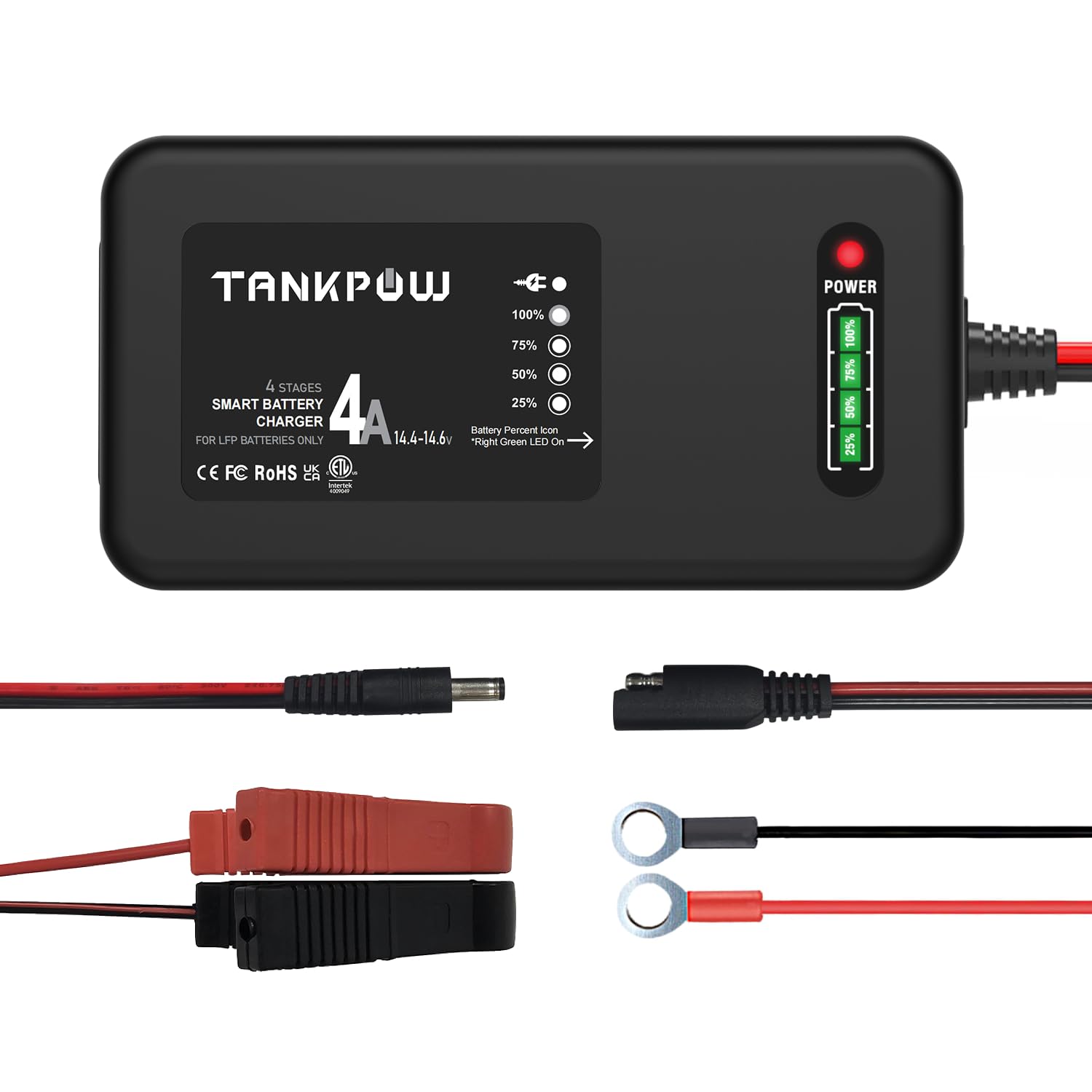
The TANKPOW is purpose-built for 12.8V (14.6V absorption) LiFePO4 batteries, making it the ideal charger for golf trolleys, trolling motors, and solar storage banks. Its 4-amp output delivers a meaningful charge rate for 50-100Ah batteries without the risk of over-spec charging that smaller 1.5A units cannot sustain. The four-LED indicator provides a rough state-of-charge readout, and the automatic cut-off prevents overvoltage damage when the pack reaches full capacity.
A standout feature is its ability to activate a BMS-protected battery that has dropped to 0V — the charger applies a gentle pre-charge pulse that wakes the protection circuit before ramping to full current. This capability alone can salvage a lithium pack that a standard lead-acid charger would reject as “dead.” The included SAE quick-disconnect cable makes permanent vehicle mounting straightforward, and the ring-terminal/clamp adapters cover both bolt-on and clamp-on connections.
Some users note the LED behavior described in the manual does not always match observed operation — full charge may show only the power LED active. Verified with a multimeter, the charger does terminate at 14.6V. It is fanless, so it operates silently, though the plastic housing can become warm to the touch during extended 4-amp cycles on large batteries.
Why it’s great
- Wakes deeply discharged LiFePO4 batteries with 0V pre-charge
- ETL safety certified with multi-protection circuits
- Fanless and compact for marine/outdoor use
Good to know
- LED indicator logic may differ from printed manual
- 4A is adequate for 50-100Ah; 300Ah packs charge very slowly
3. ULTRA POWER 14.6V 4A LiFePO4 Charger
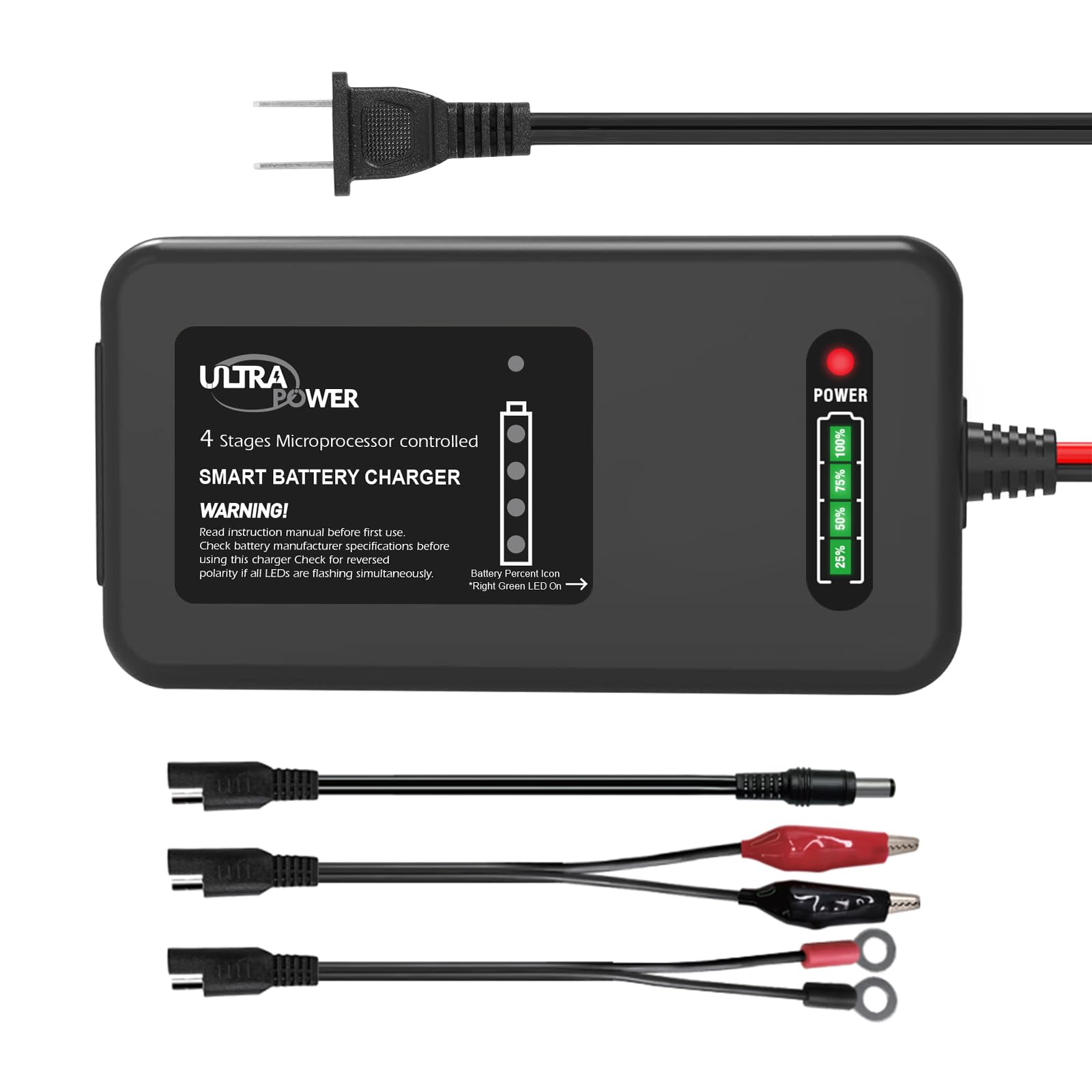
The ULTRA POWER charger mirrors the TANKPOW’s 4-amp, 14.6V output but elevates the user interface with five LEDs instead of four — a dedicated power-on light plus four bars for 25-100% state of charge. This extra resolution helps you gauge progress at a glance without squinting. It shares the same 4-stage charge algorithm (pre-charge, bulk, absorption, cut-off) and can revive a 0V BMS-locked battery with pulse activation.
The physical footprint is pocket-sized at 4.95 x 2.69 x 1.65 inches, making it the easiest unit to keep in a glovebox or tackle box. The fanless design eliminates the risk of dust ingress or noise complaints, though the housing does dissipate heat via natural convection — keep it in open air during a full 8-hour charge cycle. The included three lead types (5525 barrel jack, 6mm ring terminals, alligator clips) cover the majority of small-to-medium LiFePO4 battery terminals.
A practical limitation: at 4A continuous, charging a 300Ah battery bank takes over 70 hours from empty. This charger is optimized for maintenance and top-up of 20-100Ah packs, not bulk charging large solar arrays. The 1-year warranty and responsive customer service give reasonable peace of mind for everyday use.
Why it’s great
- Five-LED display gives clearer state-of-charge feedback
- Extremely compact — fits any vehicle storage compartment
- Includes three connector types for flexible installation
Good to know
- 4A charge rate is slow for batteries over 200Ah
- Fanless design can get warm during extended use
4. Gonocop 4-Port 14.4-18V Charger

The Gonocop charges four Milwaukee-style 14.4V to 18V batteries simultaneously, each at 3 amps, so a full fleet of 2.0Ah and 5.0Ah packs can be rotated through in under 75 minutes. It accepts the 48-59-1802/1804/1806 models and their lithium equivalents (48-11-1850, 48-11-1840), making it a direct drop-in replacement for a lost or slow OEM single-bay charger.
Each bay has its own LED indicator that communicates charging, fully charged, and temperature fault states. The addition of dual USB-A ports lets you charge a phone or Bluetooth speaker while batteries top up — a minor convenience that becomes appreciated on a job site or in a workshop with limited outlets. The AC input handles 100-240V, so international travel or generator power does not require a step-down transformer.
The unit lacks an on/off switch, meaning it draws standby power any time it is plugged in, and the included AC cord is shorter than ideal for wall-mounted setups. It also does not support Milwaukee M12 (12V) batteries — strictly the 14.4V and 18V M18 form factor. Given the time savings of charging four batteries at once, the trade-off is acceptable for daily tool users.
Why it’s great
- Charges four MILWAUKEE-pattern batteries concurrently
- USB ports add practical charging for personal devices
- 75-minute charge time for compact packs keeps tools running
Good to know
- Not compatible with M12 or other battery platforms
- No power switch and a short AC cord
5. Bosch C80-Li Battery Charger
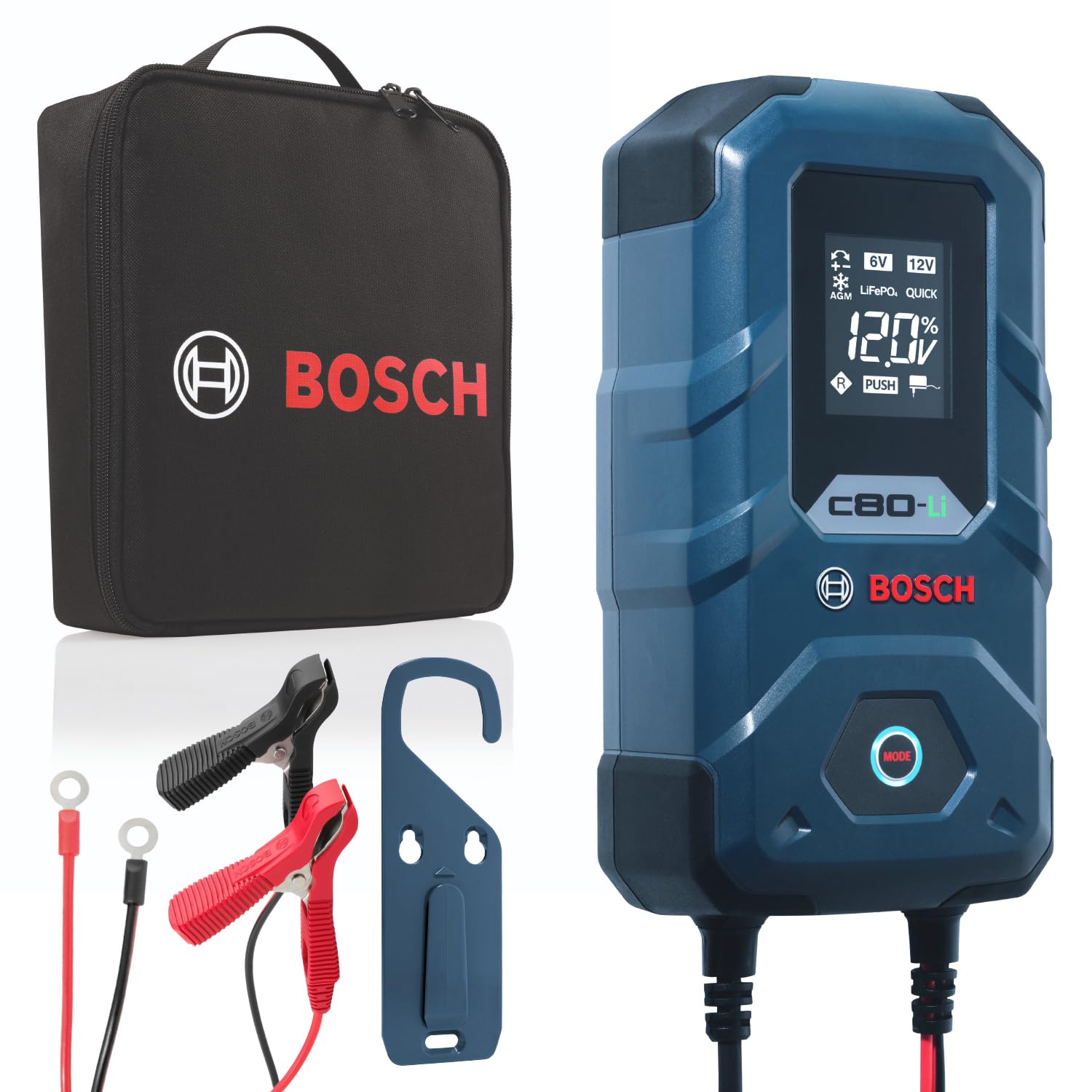
The Bosch C80-Li is a 20-amp fast charger that handles 6V and 12V lead-acid, AGM, EFB, GEL, SLI, and LiFePO4 batteries — but its 20-amp mode is designed for 12V automotive batteries, not 14.4V tool packs. For 14.4V applications, it operates in a standard current mode that maintains correct absorption voltage for lithium cells. The integrated microprocessor remembers the last selected mode, so repeat users do not have to reconfigure settings on each connection.
Its IP65 rating means it can survive rain splashes and dust — a genuine asset for truck-bed or garage-floor mounting. The maintenance charge mode extends the life of seasonal batteries (motorcycles, lawn tractors, classic cars) by holding the voltage at the correct float level without overcharging. The power supply mode is particularly useful: it provides a steady 13.8V output so you can swap a car battery without losing radio presets or ECU settings.
At 3.3 pounds and with relatively short output cables, the C80-Li is less portable than the TANKPOW or ULTRA POWER units. The clamps and eyelet connectors are well-made but may not fit M8 stud terminals without an adapter. For a user who needs one charger to maintain both a 14.4V LiFePO4 trolling motor battery and a 12V automotive starter battery, the Bosch delivers that versatility.
Why it’s great
- 20A fast mode crips through large automotive batteries
- IP65 dust/water resistance for exposed environments
- Power supply mode preserves car settings during battery swaps
Good to know
- Output cables are short and clamps may not fit large M8 terminals
- Heavier and larger than dedicated 4A lithium chargers
6. SSEHCWAN DC1804T Charger

The SSEHCWAN DC1804T replaces Makita’s DC1804T charger, supporting 7.2V, 14.4V, and 18V Ni-MH and Ni-Cd stick and pod-style batteries. It outputs 1.5 amps, which is the standard rate for Makita packs of that era — sufficient for a 2.0Ah battery in about 80 minutes. The LED indicator has a useful diagnostic feature: solid green means full, solid red means charging, alternating flash signals a defective battery, and red flashing alone indicates a short circuit.
Compatibility spans a broad list of Makita battery model numbers (6010D, 6261D, 6270D, 6280D, 4331DWD, etc.), and the charger automatically selects the correct voltage from the inserted battery pack. It runs on 100-240V AC input, so it works with step-down travel adapters. The turquoise casing differentiates it visually from the original Makita black, reducing confusion if both chargers are present in a shop.
The critical limitation is that it does not charge lithium-ion batteries — only Ni-MH and Ni-Cd chemistries. Attempting to charge a modern Makita 18V LXT lithium pack will result in a battery-fault flashing LED. Some users also report that the battery dock is slightly less snug than the OEM unit, causing intermittent contact if the pack is jostled during charging.
Why it’s great
- Direct replacement for Makita DC1804T at a very low cost
- LED diagnosis distinguishes bad battery vs. short circuit
- Automatic voltage detection from 7.2V to 18V
Good to know
- Only charges Ni-MH/Ni-Cd — not lithium packs
- Battery dock fit can be looser than OEM
7. ANOITD BDFC240 Multi-Volt Charger

The ANOITD BDFC240 covers a wider voltage range than any other charger in this guide — 9.6V, 12V, 14.4V, 18V, and 24V — for Black+Decker Ni-Cd and Ni-MH batteries. It also claims compatibility with the Black+Decker 18V lithium HPB18 packs, making it a rare hybrid that spans both chemistries for this platform. The 1.5-hour quoted charge time is consistent with the 1.5A-2A current range typical of this form factor.
A green LED indicates full charge, but experienced users note that the battery must be fully seated in the dock; a partial insertion causes the green light to illuminate prematurely even when the pack is not making full contact. Pressing the battery down firmly ensures the charging circuit engages correctly. The cooling fan runs during the bulk phase and keeps internal temperatures moderate.
It does not support the Black+Decker 20V MAX lithium line (which uses a different voltage curve and connector geometry). If you have an older Firestorm or Matrix collection with 14.4V Ni-Cd packs, this charger restores them to service without hunting for discontinued OEM parts. The FCC, RoHS, and CE certifications provide safety baseline confidence, and the 1-year warranty is standard for this price tier.
Why it’s great
- Covers the widest voltage range of any charger evaluated
- Compatible with both Ni-MH and 18V lithium Black+Decker packs
- Rapid charge completes most batteries under 1.5 hours
Good to know
- Partial battery insertion can produce false “full” LED
- Does not support Black+Decker 20V MAX batteries
FAQ
Can a 14.4V Ni-Cd charger damage a LiFePO4 battery?
How do I revive a 14.4V battery that shows zero voltage?
What is the difference between a 4A and 1.5A charger for 14.4V tool batteries?
Final Thoughts: The Verdict
For most users, the best 14.4 volt battery charger winner is the Tenergy TB6-B because it balances every cell, supports multiple chemistries, and delivers adjustable 0.1-5.0A current. If you want a dedicated plug-and-play unit for LiFePO4 deep-cycle batteries, grab the TANKPOW 14.6V 4A. And for charging a fleet of Milwaukee-pattern tool packs on a jobsite, nothing beats the Gonocop 4-Port Rapid Charger.