
An EV charger pulling 40 amps continuously for hours isn’t a gentle load — it’s a brutal, sustained thermal test for every connection in the path. The NEMA 14-50 receptacle is the single point where a melted terminal, a loose wire, or an undersized contact blade turns a convenient home charge into a fire hazard. Treating this outlet like a standard dryer receptacle is the most expensive mistake a new EV owner can make.
I’m Min — the co-founder and writer behind Gadgets Feed. I’ve spent hundreds of hours analyzing the thermal performance, terminal design, and manufacturer QC of 14-50R receptacles to separate the safe, long-term solutions from the fire risks hiding in plain sight.
After evaluating seven models for their ability to handle sustained 40-amp charging loads, the 14-50 ev receptacle that balances safety, durability, and cost is the Leviton 1450R, but the industrial-grade Bryant and Hubbell units are the true champions for daily use.
How To Choose The Best 14-50 EV Receptacle
Every NEMA 14-50 receptacle looks the same on the outside, but the internal construction, terminal metal thickness, and UL listing for continuous use separate the safe options from the dangerous ones. You need a product engineered for the thermal cycle of EV charging, not a 30-year-old dryer outlet design.
Continuous Load Rating vs. Intermittent Rating
A standard 50-amp receptacle is tested for loads that last minutes, not hours. An EV charger draws 40 amps continuously — 80% of the receptacle’s rated capacity — for 4-8 hours straight. This sustained current generates heat that can soften cheap thermoplastic bodies, loosen screw terminals, and increase resistance. A receptacle explicitly rated for continuous use at 50 amps, like industrial-grade units from Hubbell and Bryant, uses heavier internal contacts and higher-temperature thermoplastics that resist thermal creep.
Terminal Design and Torque Specifications
The connection between the wire and the receptacle is the most common failure point. Back-wire clamps (insertion holes with set screws) and side-screw terminals are both used, but compression-style lugs found on industrial models apply even clamping force across the entire conductor. Every quality 14-50R receptacle has a printed torque spec — typically 75 in-lbs for the terminal screws. Failing to use a torque screwdriver on these connections is the leading cause of terminal overheating, regardless of the receptacle brand.
Quick Comparison
On smaller screens, swipe sideways to see the full table.
| Model | Category | Best For | Key Spec | Amazon |
|---|---|---|---|---|
| Hubbell HBL9450A | Industrial | Maximum safety & continuous load | 50A continuous rated, 75°C termination | Amazon |
| Bryant 9450FR | Industrial | Industrial build without Hubbell premium | Compression connectors, UL/CSA listed | Amazon |
| Leviton 1450R | Residential EV | Best value for dedicated EV circuit | Heavy-duty nylon, 75 in-lbs torque | Amazon |
| EXCELFU 50A Box | Enclosed Outlet | All-in-one outdoor EV/RV solution | NEMA 3R, 6 AWG wire capacity | Amazon |
| VEVOR 50A Box | Enclosed Outlet | Outdoor weatherproof with lock | Alloy steel, NEMA 3R, password lock | Amazon |
| RVMATE 50A Box | Enclosed Outlet | Budget-friendly outdoor box | Pre-drilled, powder-coated steel | Amazon |
| RVINGPRO 50A Box | Enclosed Outlet | Entry-level enclosed receptacle | ETL listed, 3 pre-drilled holes | Amazon |
In‑Depth Reviews
1. Hubbell HBL9450A

The Hubbell HBL9450A is the gold standard for 14-50R receptacles in EV charging applications. Its internal contact blades are thicker and wider than any residential-grade unit, which directly reduces electrical resistance and heat generation at the plug interface. The terminal screws are machined from solid brass and accept #6 AWG copper wire without modification, and the 75°C termination rating means the plastic body won’t soften under sustained 40-amp loads.
Electricians consistently recommend this receptacle over cheaper alternatives because of its superior QC and torque consistency. The compression-style wire clamps provide even clamping pressure across the entire conductor, eliminating the uneven contact that causes hot spots. It requires a deeper 4-11/16″ square box to accommodate its larger body and the #6 wire bend radius, but that extra depth is a small price for preventing terminal creep.
Multiple verified buyers report replacing melted dryer outlets with this Hubbell and seeing zero temperature increase on thermal imaging after months of daily 40-amp charging. It ships in plain packaging with no frills, but the internal engineering makes it the safest choice for anyone who plugs their EV in every night. The only reason it isn’t the universal pick is its premium cost.
Why it’s great
- Thick internal blades resist heat warping under continuous load
- 75°C termination rating prevents thermal creep over years of use
- Torque-spec terminals with compression clamps for secure connections
Good to know
- Requires a deep 4-11/16″ electrical box for proper fitment
- Premium price point compared to residential receptacles
2. Bryant 9450FR
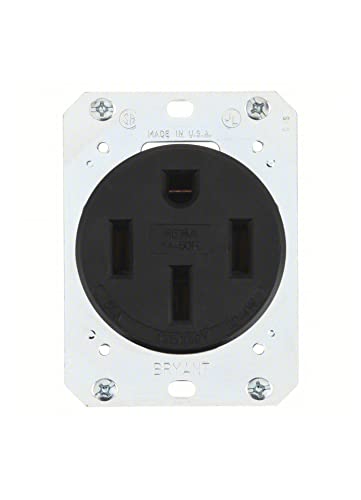
The Bryant 9450FR is manufactured by the same parent company as Hubbell and shares the same industrial-grade DNA at a slightly lower price point. It uses the same heavy-duty nylon body and full-width brass contact blades that are rated for continuous 50-amp service. The compression-style wire connectors accept #6 AWG stranded copper and provide a gas-tight connection that prevents oxidation and resistance buildup over time.
Buyers who replaced failing residential-grade receptacles with this Bryant model report that thermal imaging shows no temperature rise at the plug face even after full 40-amp charging sessions. The terminal screws require a 75 in-lb torque specification and use a hex-head design that ensures consistent clamping force without stripping. The body is notably larger than a standard 14-50R, so it requires an oversized wall plate, but the extra material is what gives it the thermal mass to dissipate heat.
One common point from verified purchasers is that the Bryant 9450FR and the Hubbell HBL9450A are functionally interchangeable, with the Bryant often being -40 less. Both are made in the USA and carry UL and CSA listings. For those who want industrial reliability without paying the full Hubbell tax, this is the optimal compromise.
Why it’s great
- Compression connectors provide secure, gas-tight terminations
- Virtually identical construction to Hubbell at a lower price
- Rated for continuous 50A load with 75°C termination
Good to know
- Larger body requires an oversized wall plate and deep box
- May not fit standard 2-gang or single-gang boxes without adapter
3. Leviton 1450R

Leviton designed the 1450R specifically for the EV market, not as a repurposed dryer outlet. The body is made from high-impact nylon that withstands the sustained thermal cycling of 40-amp Level 2 charging better than standard thermoplastic. The internal contacts are wider than the base 14-50R model and the pressure-wire terminal connections require a 75 in-lb torque spec, which is twice the requirement of many budget receptacles.
The faceplate is slightly larger than a standard 14-50R, requiring a model 5370 or equivalent wall plate, but this is clearly documented in the instructions. The hex-head terminal screws allow precise torquing with a standard torque screwdriver, eliminating the risk of overtightening and stripping the threads. Verified buyers report consistent temperatures at the plug face after months of daily charging, with several upgrading from overheated builder-grade outlets.
There are isolated reports of the 1450R overheating after 7-8 months, but these appear to be related to improper installation torque or undersized wiring, not a design flaw. The consensus among EV owner forums is that the Leviton 1450R is a massive improvement over generic 14-50R receptacles and is the safest choice for homeowners who cannot justify the industrial-grade price of Hubbell or Bryant.
Why it’s great
- Explicitly designed for plug-in EV charging applications
- High-impact nylon body resists thermal creep
- Torque-spec terminals with hex-head screws for secure installation
Good to know
- Slightly larger faceplate requires a specific wall plate
- Some users report long-term overheating at continuous 40A load
4. EXCELFU 50A RV Power Outlet Box

The EXCELFU 50 Amp Power Outlet Box is a complete NEMA 3R weatherproof enclosure that comes with a 14-50R receptacle pre-installed. Professional electricians reviewing this unit note that the internal wiring space is generous enough to accommodate 6 AWG conductors without excessive crowding, and the terminal lugs are clearly labeled for L1, L2, N, and G. The heavy-gauge steel construction and powder-coated finish provide genuine weather resistance for outdoor installations.
Multiple verified buyers use this box for Level 2 EV charging, reporting that the cover closes completely even with large-handled EV plugs. The lid stays open while working on connections, which is a thoughtful detail during installation. The included 10-month warranty from EXCELFU is shorter than some competitors, but the unit’s robust build quality compensates for this.
The main limitation is that there are no pre-installed side or bottom knockouts; users must drill their own conduit holes, which requires a knockout tool rather than just a hole saw for clean results. The ground wire is short and some users recommend replacing it with an 8 AWG wire for better flexibility. Despite these minor installation quirks, the EXCELFU box offers excellent value for an all-in-one outdoor 14-50R solution.
Why it’s great
- Generous interior wiring space for 6 AWG conductors
- NEMA 3R weatherproof rating for outdoor use
- ETL listed for safety compliance
Good to know
- No side or bottom knockouts require drilling
- Short ground wire may need replacement for flexible routing
5. VEVOR 50 Amp RV Power Outlet Box

The VEVOR 50 Amp Power Outlet Box stands out for its heavy-duty alloy steel construction that weighs significantly more than comparable budget boxes, indicating thicker gauge metal and better corrosion resistance. The NEMA 3R rating ensures it can handle rain and dust exposure, and the integrated password lock provides a layer of security against power theft or cord tampering in public-facing installations.
The pre-knocked holes come with three different aperture sizes (1/2 inch, 3/4 inch, 1 inch) to accommodate various conduit sizes, which is a thoughtful inclusion for professional installations. The grounding wire is extended to 15cm, giving installers more flexibility in routing compared to the shorter wires found on some competitor boxes. Multiple users confirm that it works perfectly for plugging in both RV shore power cords and Level 2 EV chargers.
The main drawback is shipping damage — the box is heavy and some units arrive with dents in the steel enclosure or holes in the outer shipping box. This is a packaging issue rather than a design flaw, but it’s worth considering if you need a pristine installation. Once mounted, the box is solid and the 14-50R receptacle provides reliable power for continuous charging applications.
Why it’s great
- Heavy-gauge alloy steel for maximum durability and corrosion resistance
- Password lock for added security in outdoor installations
- 15cm extended ground wire for flexible routing
Good to know
- Shipping damage reported by some users due to weight
- Receptacle quality is typical of budget-level enclosures
6. RVMATE 50 Amp Power Outlet Box

The RVMATE 50 Amp Power Outlet Box is a straightforward, no-frills enclosure that gets the job done without breaking the bank. Its powder-coated steel shell provides basic weather resistance, and the three removable panels with pre-drilled holes make wiring straightforward. The M8 x 10mm terminal screws are sturdy enough to secure #6 AWG wires firmly, and the 10-inch grounding wire provides adequate length for most installations.
Buyers note that the box is heavy-duty for its price point and the lid stays open while working, which simplifies the wiring process. Some users have upgraded the internal receptacle to a higher-quality Hubbell unit while keeping the RVMATE box as the housing, which is a cost-effective strategy if you want industrial-grade contacts but don’t need an industrial-grade enclosure. The ETL listing provides a basic safety assurance for the complete assembly.
The main annoyance is the cap lock cover that cannot be removed during installation — it swings down and gets in the way while you’re trying to feed wires into the box. Additionally, the quality of the included 14-50R receptacle is not designed for continuous 40-amp EV charging; users who plan to charge their EV daily should strongly consider replacing it with a Leviton 1450R or better. For occasional RV use or generator backup, it works fine out of the box.
Why it’s great
- Low cost for a complete weatherproof enclosure solution
- Pre-drilled holes simplify installation
- Sturdy M8 terminal screws provide secure wire connections
Good to know
- Included receptacle is not suitable for continuous EV charging
- Cap lock cover obstructs wiring access during installation
7. RVINGPRO 50 Amp RV Outlet Box
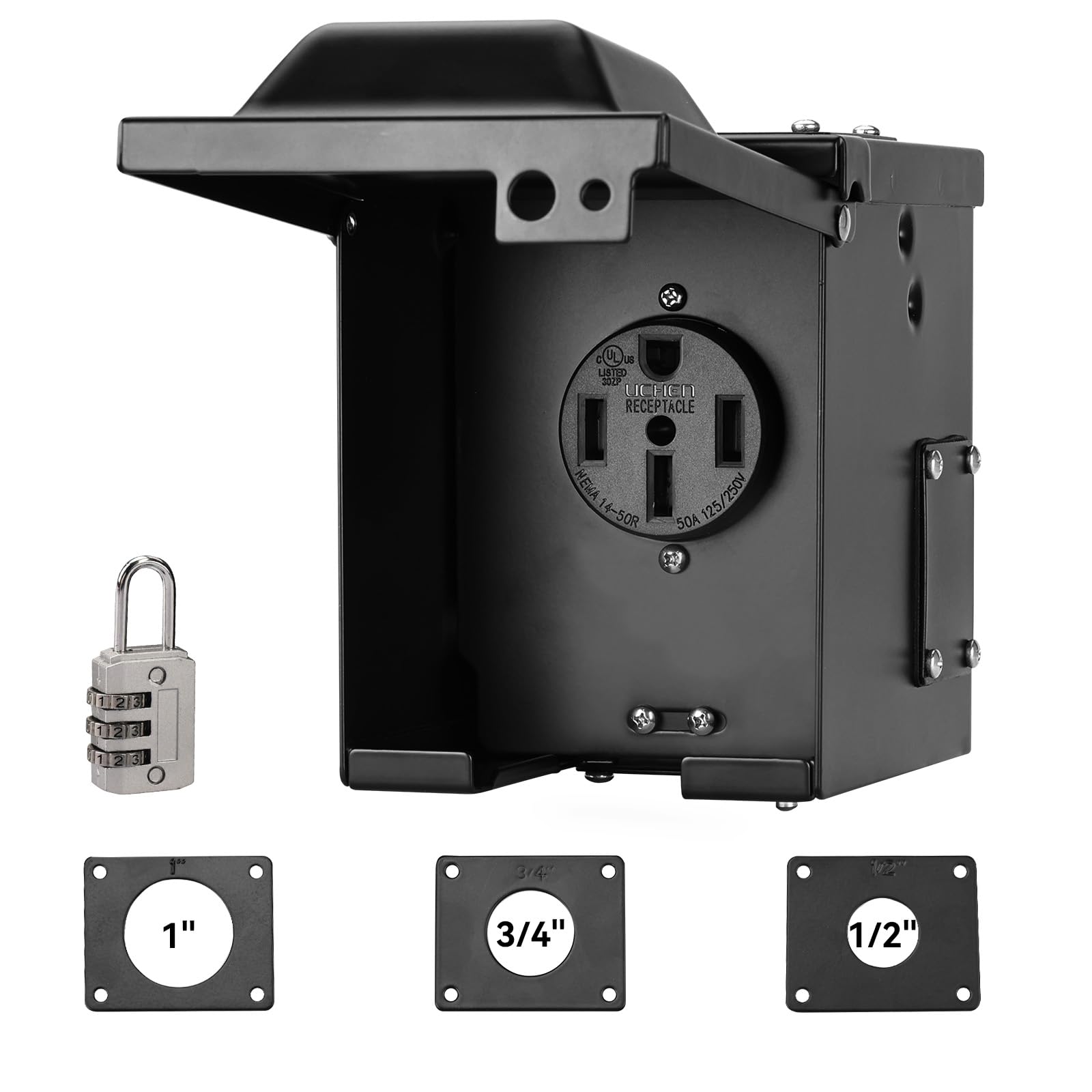
The RVINGPRO 50 Amp RV Outlet Box is the most affordable entry point into a weatherproof 14-50R enclosure. It features three pre-drilled holes distributed in three different directions, which means you have wiring flexibility without needing to drill your own knockouts. The galvanized steel shell provides basic rust protection for outdoor use, and the included padlock adds a layer of theft deterrence.
The interior space is large enough to accommodate an oversized RV plug with a handle, and the cover closes completely to protect the connection from rain and dust. The unit includes three different aperture gaskets (1/2 inch, 3/4 inch, 1 inch) to match different conduit sizes, which is a thoughtful touch at this price point. Verified buyers confirm it works well for both RV and EV charging applications in outdoor settings.
The main limitation revealed in user reviews is that the included 14-50R receptacle is not designed for sustained high-current loads. One electrician noted that the receptacle is better suited for 30-amp loads than 50-amp continuous draws, and the ground wire should be upgraded to #8 or #10 AWG for proper capacity. This box is best used as a housing for a higher-quality replacement receptacle if you plan to charge an EV daily.
Why it’s great
- Most affordable complete weatherproof enclosure option
- Three pre-drilled holes in different directions for wiring flexibility
- Includes three gasket sizes and a padlock
Good to know
- Included receptacle is not rated for continuous 50A EV loads
- Ground wire is undersized for 50A and should be upgraded
FAQ
Can I use a standard dryer outlet for EV charging?
What gauge wire do I need for a 50A EV circuit?
Final Thoughts: The Verdict
For most users, the 14-50 ev receptacle winner is the Bryant 9450FR because it delivers industrial-grade construction and continuous-load safety at a price that’s within reach of serious DIY homeowners. If you want absolute maximum safety and don’t mind paying the premium, grab the Hubbell HBL9450A for its unmatched thermal performance and verified long-term reliability. And for a complete outdoor enclosure solution, nothing beats the EXCELFU 50A Power Outlet Box, which provides a NEMA 3R weatherproof housing with enough interior space for industrial-grade wiring.