
Our readers keep the lights on and my morning glass full of iced black tea. As an Amazon Associate, I earn from qualifying purchases.
Specs are compiled from manufacturer listings and verified buyer reviews and can change over time — please confirm the key details on the product page before buying.
If you are slicing thick hardwood into thin panels, the saw that earns its floor space is the one whose motor does not fade halfway through the slab. Everything else — stand, fence, light — is fixable later. The motor and the resaw height are not. This guide covers nine 14-inch band saws, sorted by how much honest cutting power and vertical clearance each one actually gives you.
I’m Min — the founder and writer behind Gadgets Feed. This guide is built by comparing the manufacturers’ published specifications and the patterns across verified customer reviews, so you get each pick’s real strengths and trade-offs instead of marketing spin.
One thing to know before you read: this list uses flexible, human-like matching for 14-inch throat and wheel size, so not every pick is the exact number you searched — the nearest same-class size serves the same purpose, and I flag where that matters. Read on for the breakdown of the best 14” band saws, sorted by resaw capacity and motor power.
Our Picks at a Glance


How To Choose The Best 14” Band Saw
The 14-inch class is the workhorse size for a home or small production wood shop. It is large enough to resaw boards into thin stock and small enough to fit a garage bay. What separates one 14-inch saw from another is not the wheel diameter — it is how much height the saw gives you above the table, how hard the motor pulls, and how well the guides keep the blade tracking.
Resaw capacity is the number to check first
Resaw capacity is the maximum height of stock the saw can slice in one pass. A saw with 6 inches of clearance handles most furniture parts. A saw with 12 to 13 inches lets you turn a thick slab into bookmatched panels or your own veneer without a second machine. If you plan to resaw at all, resaw capacity matters more than wheel size or table dimensions.
Motor power and amp draw tell you how it will cut
Horsepower is the headline, but the amp rating shows what the motor actually draws from your wall circuit. A 14-amp motor pulls harder than a 9.5-amp motor, and that difference shows up when the blade meets wet oak. A motor that bogs will burn the blade and leave a rippled cut. Match the motor’s amp draw to the stock you cut, and wire it to the circuit its maker calls for.
Single-speed versus two-speed
A two-speed saw gives you a slow range for dense hardwoods and a fast range for softer stock and smoother finishes. A single-speed woodworking saw is set for one belt position and keeps things simple. If you only cut softwood and sheet goods, single-speed is fine. If you are resawing hardwood, the low range reduces load on the motor.
Blade length and blade width range
Every saw runs one specific blade length, and that length is not interchangeable across machines. A 1/8-inch blade makes tight scroll cuts. A 3/4-inch blade resaws straight and fast. Check the width range the saw supports before you buy blades, because a saw that only runs narrow blades cannot resaw efficiently.
Quick Comparison
| Model | Best For | Motor | Resaw Capacity | Blade Length | Amazon |
|---|---|---|---|---|---|
| QD-KYOHO 14″ Dual-Speed★ Best Overall | Best Overall | 2 HP / 14 A | — | 111 in | Amazon |
| WEN BA1487 14-InchDeep Resaw Value | Deep resaw on a budget | 9.5 A | 8.85 in | 100-3/4 in | Amazon |
| WEN BA1411 IndustrialDual-Voltage Pick | Dual voltage flexibility | 1 HP / 11 A | 6 in | 93.5 in | Amazon |
| JET JWBS-14CS | Closed cabinet stand | 1 HP / 10 A | 6 in (12 in with riser) | 93.5 in | Amazon |
| JET JWBS-14SFX | Best for heavy resaw | 1.75 HP | 13 in | 116 in | Amazon |
| Laguna 14|12 | Ceramic guides and precision | 1-3/4 HP | 13 in | 115 in | Amazon |
| Powermatic PWBS-14CS | Quiet shop companion | 1-1/2 HP | 6 in | 93.5 in | Amazon |
| Laguna MBAND14BX110-175 | Foot brake and dust control | 1.75 HP | 13 in | 115 in | Amazon |
| Grizzly G0555XH | Cast iron frame and heavy stand | 1.75 HP | 12 in | — | Amazon |
In‑Depth Reviews
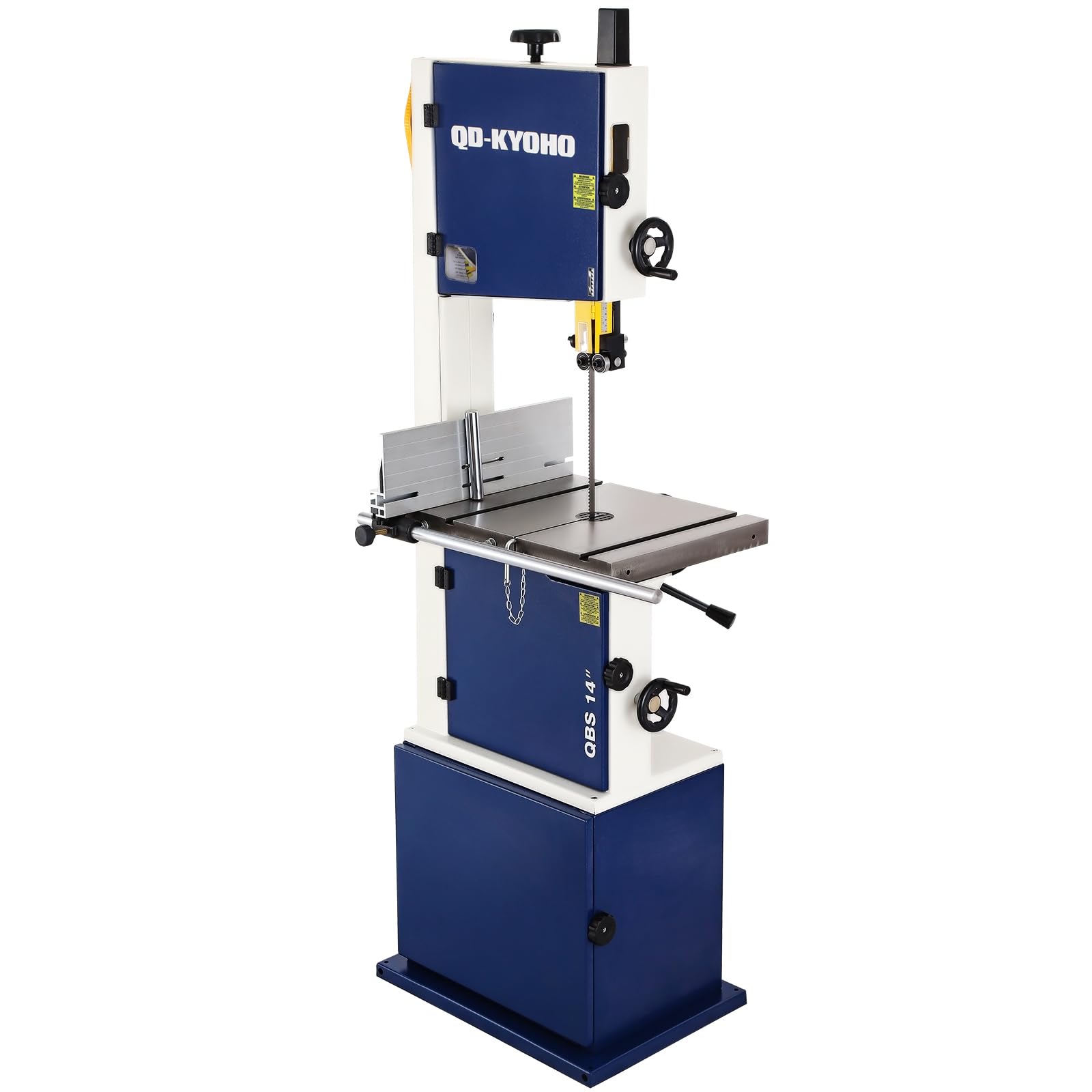
1. QD-KYOHO 14 Inch Dual-Speed Bandsaw, 2 HP
Our pick — 4.5+★ from 100+ verified ratings; the strongest balance of quality and price.
The dual-speed motor that shifts gears for hardwood and softwood on the same blade.
The first thing to look at here is the motor: a 2 HP unit drawing 14 amps. If you have ever watched a band saw stall halfway through a wet oak slab, this is the fix. The saw runs at 1445 FPM (feet per minute, the blade speed) for hardwoods and 2950 FPM for softer stock where you want a smoother finish. That 2 HP rating is double the 1 HP in the WEN BA1411 further down this list — a real working difference when the stock gets dense.
The table is a genuinely large cast iron surface, 21-1/2 inches by 15-3/4 inches. It tilts 45 degrees to the right and 5 degrees to the left, so angled cuts and compound shapes are within reach. The blade runs 111 inches long. The frame is welded steel plate with dynamically balanced cast aluminum wheels, and the upper and lower guides adjust both vertically and horizontally. Setup is where this saw wins people over — clear, well-done instructions that walk you through blade tension and tracking without guesswork.
Two honest caveats. The adjustability earns mixed reports — the guide system gives you control, but it takes patience to dial in, so budget an evening for the first setup. Vibration also draws mixed comments. 100+ owners have rated this saw, and the 4.5+ star average is the strongest on this list; what wins them over is raw performance. As owners put it, this saw “works great on wood and soft metals” — worth knowing if you cut aluminum too.
Where it earns its keep
- 2 HP / 14 A motor holds speed through dense hardwood
- Two speeds: 1445 FPM for hardwood, 2950 FPM for softwood
- 21-1/2″ x 15-3/4″ cast iron table tilts 45° right
- Overload protection and a work light socket built in
What to plan around
- Guide adjustment takes patience to dial in
- Vibration gets mixed reports
- Ships as a bare tool — no stand in the box
Reach for this if: you resaw hardwood and want the strongest motor and top rating on this list.
Look elsewhere if: you need a stand included, since this arrives as a bare tool.
2. WEN BA1487 14-Inch Two-Speed Band Saw with Stand
Nearly nine inches of resaw depth and a stand in the box, without the premium-tier outlay.
Here is the number that matters for anyone who resaws: 8.85 inches. That is how tall a board this saw can slice in one pass. Compare it to the WEN BA1411’s 6 inches and you get 47% more resaw height — enough to turn a thick slab into panels instead of flipping and re-cutting. The 9.5-amp motor moves a blade up to 1 inch wide through that depth. A 21-1/2 by 15-3/4-inch work table bevels to 45 degrees, and the two speeds are 1480 and 3280 FPM.
The package is unusually complete. You get a blade tension gauge, a circle cutting guide, a flexible work light, a 3-in-1 dust port, a fence, a miter gauge, and a 1/2-inch blade already in the box. It also runs on 100-3/4-inch blades from 1/8 to 1 inch wide, which covers scroll cuts and heavy resaw work on one machine. The thing everyone raves about is blade quality, followed by the power on tap.
The catch is the base and blade adjustment, both of which draw mixed feedback. If you keep the saw parked and tuned, that is a minor gripe. If you roll it around a shop and change blades weekly, expect to fuss with it. Assembly earns praise, so the build itself goes together cleanly — the tuning is where the patience goes.
Workhorse read: For a home shop that resaws on weekends, the 8.85-inch depth and included stand and fence cover the whole job without stretching to premium-tier money.
Tuning note: Blade adjustment and the base are the two spots that split opinion — plan a careful setup session before your first real cut.
The smart-money pick: weekend resawing at home, with the stand and fence already included.
Think twice if: you are constantly swapping blades — this is not the saw for a blade-change-heavy workflow.
3. WEN BA1411 14-Inch Industrial Band Saw, 1 HP Dual-Voltage
A cast iron frame and dual-voltage wiring for the shop that plans to grow.
This one is for the buyer with a 240V outlet in the wall and the intention to use it. The 1 HP, 11-amp motor can be wired for 120V or 240V, and it runs two speeds — 1700 or 3000 FPM. That 1 HP is half the 2 HP in the QD-KYOHO at the top, so this is the saw you pick for flexibility, not brute force. It cuts up to 6 inches deep and 13.5 inches wide, which covers most furniture work but stops short of the deeper resaw saws above.
The frame and wheels are cast iron, and cast iron is the quiet answer to vibration. Ball bearing blade guides and thrust bearings keep the blade tracking, and a quick-release tension lever makes blade changes a two-second job. The 14-by-14-inch cast iron table bevels 15 degrees left and 45 degrees right. It ships with a heavy-duty steel stand, a 4-inch dust port, a T-fence, a sliding miter gauge, and a 93.5 by 3/8-inch blade.
The trade-off is the shallow 6-inch resaw ceiling and the modest 1 HP. If your project list is flat work, joinery, and curves, you will never notice. If you want to slice veneer from thick stock, look up the list instead. This is a shop saw that keeps its composure, not a resaw machine.
Shop-flexibility verdict: Dual voltage, two speeds, and a cast iron frame make this a long-service pick for a small shop that may rewire later.
The real limit: 6 inches of cut depth and 1 HP cap the resaw work you can do — flat work and curves are its home turf.
Built for: the shop with 240V service that wants cast iron stability and quick blade changes.
Not your saw if: you need to resaw thick slabs — 6 inches will hold you back.
4. JET 14″ Woodworking Band Saw with Enclosed Cabinet Stand, 1 HP

The saw that hides its motor behind a latching door and grows to 12 inches later.
Most 14-inch saws leave the motor and belt exposed on an open stand. This JET puts both behind a latching cabinet door, which keeps dust off the drive and makes the machine feel like a piece of shop furniture. from the start it cuts 6 inches tall. Add the optional JET JRB-14 Riser Block Kit (708717, sold separately) and that depth of cut goes to 12 inches — so you can buy a modest saw now and grow it later without replacing it.
The frame and 15-by-15-inch offset cast iron table give you more work area in front of the blade, and the six-spoke 14-inch wheels are computer-balanced for smooth tracking. Blade tracking sets with a single knob and a wing-nut lock. It runs 1/8 to 3/4-inch blades at 93-1/2 inches long, and the table tilts 45 degrees right and 10 degrees left. A 4-inch dust port and a 3/8-by-3/4-inch miter slot round it out, and it comes prewired 115V with conversion to 230V. JET backs it with a 5-year warranty.
Be clear on one thing: this is a wood-only single-speed saw at 3,000 SFPM. It is built for hardwood, softwood, and manufactured board — not metal, bone, or meat. The recurring gripe is table alignment, which occasionally needs attention on arrival. Quality earns the most praise here by a wide margin, and assembly is the runner-up. For a home shop that wants a lifetime machine with a warranty behind it, that is a fair trade.
Solid long-haul choice: a home shop that wants an enclosed, warranty-backed saw it can riser up to 12 inches later.
Know before you buy: alignment can need a check on arrival, and this is wood-only — no metal cutting.
5. JET 14″ Woodworking Band Saw, 1.75 HP, 13″ Deep-Cut Resaw

Thirteen inches of resaw height and a 272-pound frame that stays put while you push.
This is the resaw specialist of the JET family. A 1.75 HP capacitor-run motor drives a 116-inch blade loop, and the saw slices stock up to 13 inches tall in a single pass. That means bookmatched panels and shop-cut veneer from one machine, no second saw needed. The 116-inch blade length is longer than the JET cabinet saw above at 93.5 inches, and it runs blades from 1/8 inch for scroll cuts up to 3/4 inch for fast resawing.
The table is a 360-square-inch ground cast iron surface that tilts 0 to 45 degrees right on a diecast-and-steel trunnion. A machined-aluminum resaw fence with an easy-read scale comes in the box — though the saw blade is sold separately, so plan for that first blade purchase. Weight is 272 pounds, which is where the mass pays off: heavy saws damp vibration, and vibration is what ripples a cut. The comparable WEN BA1487 weighs 138.9 pounds, roughly half.
The recurring gripe is blade alignment, which some owners have to chase after setup. Weight and bearing quality also draw mixed notes. Performance is the undisputed strength — it is praised far more than anything else on this saw, with value and cut quality right behind. For a dedicated resaw machine that doubles as a general shop saw, it holds its ground.
Why resawers pick it
- 13″ resaw capacity in one pass
- 1.75 HP motor on a 116″ blade loop
- 360 sq. in. ground cast iron table, 0–45° right tilt
- Machined-aluminum resaw fence with easy-read scale included
Budget these in
- Saw blade sold separately
- Blade alignment can need chasing after setup
- 272 pounds of machine to move into place
Purpose-built for: veneer and bookmatched panel work up to 13 inches tall.
One honest caveat: the blade is not included, so factor that into your first trip to the shop.
6. Laguna Tools MBAND1412-175 14 x 12 Bandsaw
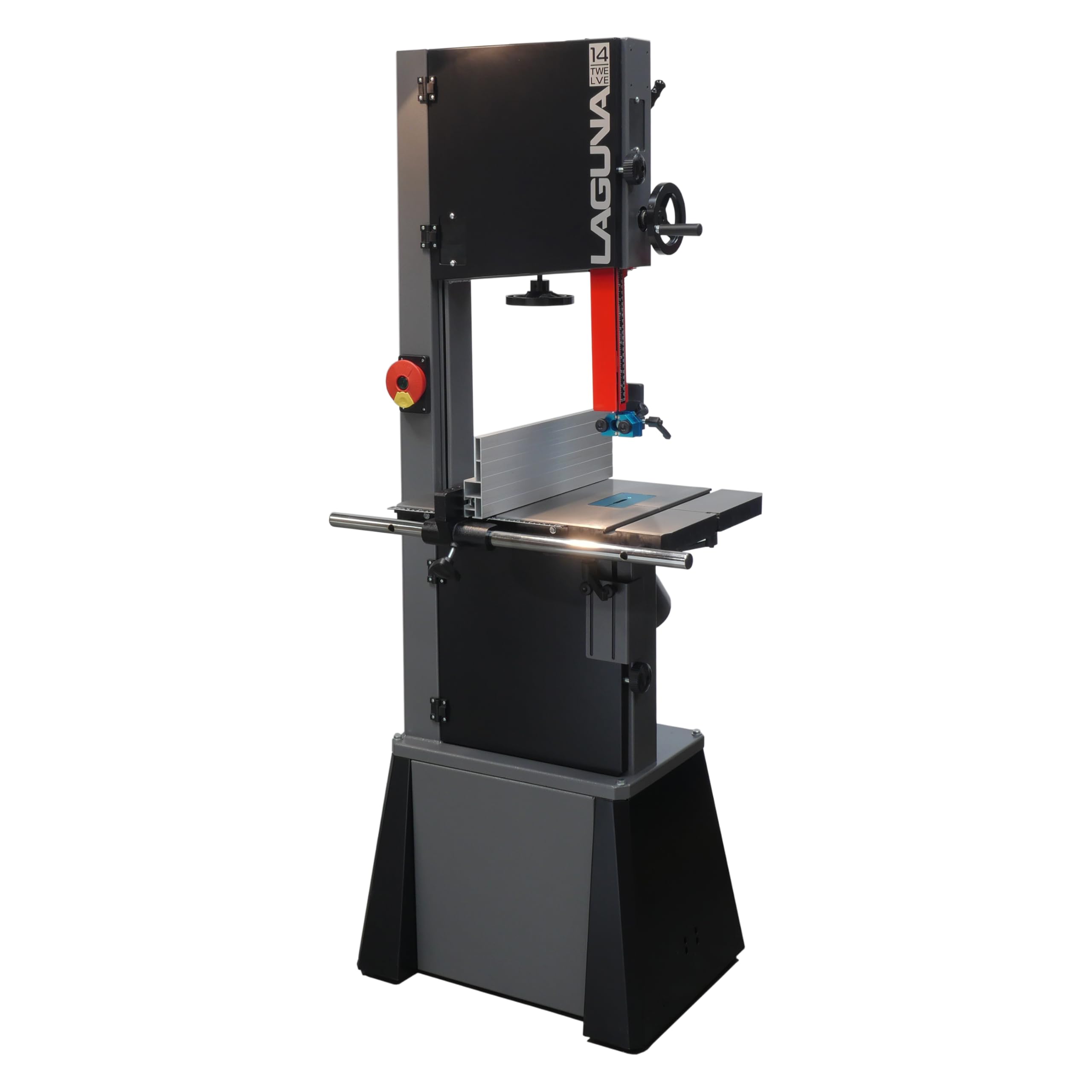
Ceramic guides and dual viewing windows — the saw builder’s saw.
Laguna’s signature part is the guides: ceramic blocks that wrap the blade and hold it steady, paired with a rack-and-pinion upper guide system. That is the difference between a blade that wanders and one that tracks. The motor is a 1-3/4 HP TEFC (totally enclosed fan-cooled — sealed against dust) dual-voltage unit, pre-wired 115V with 230V capability. Resaw capacity is 13 inches, and it accepts blades from 1/8 to 3/4 inch wide.
The table is a micro-polished 21-1/2 by 16-inch cast surface on a heavy-duty cast trunnion, tilting 45 degrees right and 7 degrees left with a positive stop at 90 degrees. The wheels are electronically and dynamically balanced cast iron with one-piece polyurethane tires that run cooler than rubber. Quick-release tension, a tension indicator, and dual viewing windows let you check tension and tracking while the saw runs — that is a real convenience when you are dialing in a new blade. The 31.5 by 27 by 70.25-inch footprint needs floor space, and at 258 pounds it stays put.
Two things to weigh. Blade adjustment and the instructions both split opinion — some find the process intuitive, others do not. Ceramic guide replacement is a running cost you should know about going in, and it is the priciest of the consumables here. The build itself earns steady praise, and it cuts cleanly once dialed in.
Precision angle: Ceramic guides plus viewing windows make blade tracking a visible, adjustable process instead of guesswork.
Cost to know: Ceramic guide replacements are an ongoing expense — budget for them alongside blades.
Worth it for: the woodworker who wants ceramic guide control and checks tracking without stopping the blade.
Not ideal for: anyone put off by ongoing consumable costs or a heavy, fixed-footprint machine.
7. Powermatic 14-Inch Woodworking Bandsaw, 1-1/2 HP

Quiet enough for a basement shop, with a nine-spoke wheel that damps vibration.
If your shop shares a wall with the house, noise is the spec nobody lists. This Powermatic runs quietly enough that owners single out the low noise. The 1-1/2 HP motor is a step down from the 1.75 HP saws above but still more than enough for the 6-inch stock this saw handles. A Carter quick-tension lever speeds blade changes, and the detension setting lets you relax the blade between sessions to extend blade life. A 60-watt adjustable lamp lights the blade and workpiece while you cut.
The nine-spoke cast iron wheels are precision-balanced, and the dual-bearing blade guide system above and below the table is micro-adjustable. The quick-release T-square rip fence includes a 4-inch resaw attachment, which is a real bonus for the money. It ships with a main table, extension table, miter gauge, and a 6-inch riser block, so the capacity ceiling is higher than the 6-inch stock cut suggests. Blade length is 93.5 inches, and it weighs 178 pounds.
The known annoyance is assembly, which takes real work — some buyers report no trouble at all, others find it fiddly. The instructions are the weak spot, and the manual is not great at walking you through it. The build itself earns praise, and the tables are described as machined to near perfection. Plan a full afternoon for assembly and you will be happy with the saw underneath.
An easy recommendation for: noise-sensitive shops that want a quiet saw with a quick-tension lever and riser block included.
Clear the calendar: assembly takes real effort and the manual will not hold your hand.
8. Laguna Tools 110V 1.75 HP Bandsaw with 13″ Resaw

A foot brake that stops the blade fast — the safety detail most saws skip.
The standout feature is the foot-operated disc brake with a micro-switch. Step on it and the blade stops quickly, which matters when your hands are near the table. That is a real difference from the other Laguna saw above, which relies on the standard motor stop. The rest of the machine is built heavy: a solid one-piece frame with heavier-gauge construction for stability and less vibration. Motor is 1.75 HP, pre-wired for 110V. Resaw capacity is 13 inches, with a maximum blade width of 3/4 inch.
The table is 21-1/2 by 16 inches of cast iron, tilting 7 degrees left and 45 degrees right. Ceramic guides make multiple contact points around the blade for controlled cuts. You also get quick-release blade tension, a magnetic blade guard, an aluminum hi/low fence, and worm-gear rack-and-pinion adjustment for precise positioning. Dual 4-inch dust ports pull dust from two spots so the cut line stays visible. It weighs 260 pounds, so bring help moving it into place.
The obvious question is whether the brake and dual dust ports justify stepping up over the other Laguna. If you cut with gloves off and want fast stops, yes. If not, the extra spend may not pay back for you. At 1.75 HP and 13 inches of resaw, it sits in the same performance class as the JET and Laguna saws above — the safety feature is what you are buying.
Safety-first read: the foot disc brake with micro-switch is the practical standout — a fast blade stop when your hands are close to the work.
Dust angle: dual 4-inch ports pull from two points, keeping the cut line visible on long rips.
Choose this when: fast blade stops and strong dust control top your list.
Pass it by if: you would rather put the extra spend into more motor or deeper resaw instead of a brake.
9. Grizzly Industrial G0555XH 14″ 1-3/4 HP Extreme Series Resaw Bandsaw

A cast iron frame built for resaw duty, with the fence and miter gauge already in the box.
Cast iron frame is the phrase to focus on here. Most 14-inch saws use a steel plate frame, which is fine — cast iron is heavier and stiffer, and stiffer frames resist flex when you push a wide blade through thick stock. The 1.75 HP motor resaws up to 12 inches. It runs 110V or 220V and ships prewired for 120V. An extruded aluminum resaw fence and miter gauge come included, so the resaw jigs you would otherwise buy are covered.
The saw sits on a heavy-duty stand, and the whole machine is CSA certified and built in an ISO 9001 factory. That last point is a quality-system certification on the factory’s process, not a claim about any single saw, but it is the kind of detail that matters when you are comparing shops. The blade material is high speed steel. Power source is corded electric.
The honest read is that this is a resaw machine first and a general shop saw second. If your work is curves and joinery, the 12-inch resaw ceiling is more than you need and the cast iron mass is just weight to move. The real draw is the stiff frame and the resaw fence package for buyers who cut thick stock regularly.
The resaw-first pick: thick-stock cutting with a cast iron frame, included resaw fence, and 12 inches of capacity.
skip it if: your work is curves and flat joinery — you would be carrying cast iron mass you do not need.
Understanding the Specs
Resaw capacity (inches of stock height)
This is the maximum height of board the saw will slice in a single pass, measured from the table to the upper guide. It is the first spec serious buyers check, because it decides whether you can cut your own veneer and bookmatched panels or have to buy from the mill. A saw with 6 inches handles furniture joinery. A saw with 12 or 13 inches turns thick slabs into thin stock. Check resaw capacity before any other spec.
Motor horsepower and amp draw
Horsepower is the headline, but amps show the real pull. A 14-amp motor draws more current than a 9.5-amp motor, and that shows up when a wide blade meets a dense board. Undersized motors bog, and a bogging blade burns and ripples the cut. Match the motor’s amp draw to the stock you cut, and wire it to the circuit its maker specifies — some saws call for 240V wiring.
Blade length and blade width range
Each saw takes one blade length, and it is not interchangeable across models — 93.5 inches, 100-3/4 inches, 111 inches, 115 inches, and 116 inches all appear on this list. Blade width range matters too: 1/8-inch blades cut tight curves, 3/4-inch blades resaw straight and fast. A saw capped at narrow blades cannot resaw efficiently. Buy blades that match both the length and width range.
Table size, tilt, and material
A cast iron table gives you a flat, heavy surface that dampens vibration and keeps stock sliding. Larger tables give more support in front of the blade. Tilt range decides your bevel cuts — 45 degrees right is common, and a few saws add tilt left. A miter slot lets you run a miter gauge for crosscuts. Tape a note to check the table for alignment when the saw arrives.
FAQ
What resaw capacity do I need for cutting my own veneer?
Can I run a 14-inch band saw on a normal household outlet?
Is a two-speed band saw better than a single-speed?
How long does a band saw blade last?
What blade width should I use for resawing versus scroll cuts?
Can a 14-inch band saw cut metal?
Why do band saw blades wander or go out of alignment?
How heavy is a 14-inch band saw and will it fit my shop?
Do I need a dust collector for a 14-inch band saw?
What does a riser block do on a 14-inch band saw?
Final Thoughts: The Verdict
For most woodworkers who resaw, the 14” band saw winner is the QD-KYOHO 14 Inch Dual-Speed — its 2 HP, 14-amp motor and two speeds are the strongest motor on this list, and 4.5+ stars across 100+ ratings backs it up. If you want deep resaw depth with a stand and fence included, grab the WEN BA1487 and its 8.85-inch cut. And for the buyer who needs a cast iron frame and a 13-inch resaw ceiling, the JET 14SFX is the one to reach for. One honest nudge: if your work is mostly flat joinery and curves, the 6-inch WEN BA1411 or the JET cabinet saw will serve you well and save the floor space.
How We Picked
We do not accept paid placement. Every pick is matched to a real buyer and a real use-case; we do not hands-on test units.
Sources & Methodology
Specifications: manufacturer listings and product documentation. Review insights: verified customer reviews, as of November 2026. Pricing: not shown on this page (it changes often); check the current price via the retailer link.
As an Amazon Associate, Gadgets Feed earns from qualifying purchases. This does not affect which products we feature.