
Our readers keep the lights on and my morning glass full of iced black tea. As an Amazon Associate, I earn from qualifying purchases.
Specs are compiled from manufacturer listings and verified buyer reviews and can change over time — please confirm the key details on the product page before buying.
You want a wire that carries enough current without overheating, stays flexible enough to route through tight engine bays, and resists the corrosion that kills connections over time. The right 14 gauge automotive wire makes the difference between a clean, reliable electrical system and a frustrating tangle of voltage drops and shorts. Whether you are wiring a car stereo, trailer lights, or an auxiliary fuse box, the best 14 gauge automotive wire for your project balances conductivity, insulation quality, and cost per foot to give you a low-maintenance install.
I’m Min — the founder and writer behind Gadgets Feed. This guide is built by comparing the manufacturers’ published specifications and the patterns across verified customer reviews, so you get each pick’s real strengths and trade-offs instead of marketing spin.
The wire inside your vehicle needs to handle vibration, temperature swings, and moisture—sometimes all at once. This guide breaks down the best 14 gauge automotive wire options currently available on Amazon based on their conductor material, strand count, and voltage rating so you can make a confident choice.
Our Picks at a Glance

How To Choose The Best 14 Gauge Automotive Wire
Picking the right wire is not just about the thickness—it is about how the wire is built and what it is designed to handle. Here is what you need to know before buying.
Conductor Material: CCA vs Pure or Tinned Copper
The conductor is the heart of the wire. Copper Clad Aluminum (CCA) is lighter and cheaper than pure copper, making it a popular choice for car audio and general 12V wiring where the current draw is moderate. Oxygen-free tinned copper, on the other hand, offers superior conductivity and outstanding corrosion resistance, which is critical in marine environments or any place moisture is a threat. You pay a premium for tinned copper, but you get a wire that stays flexible and conductive for longer.
Strand Count and Flexibility
A wire is made up of many tiny strands of metal twisted together. A higher strand count—like 400 strands per conductor—makes the wire incredibly flexible. This is a big deal when you are routing the wire around sharp corners, through rubber grommets, or into tight amplifier racks. Fewer, thicker strands (like 54 or 65 strands) are stiffer but still flexible enough for most general-purpose wiring, and they are often paired with thicker PVC jackets for extra durability.
Insulation Jacket and Temperature Rating
The jacket protects the wire from heat, oil, and abrasion. Standard PVC is fine for most interior car wiring. Silicone jackets handle much higher temperatures, from -60°C up to 200°C, making them ideal for wiring near engines or exhaust components. Always check the voltage rating too—wires rated for 600V give a massive safety margin compared to a standard 12V or 80V rating, even if you only need 12V.
Quick Comparison
| Model | Best For | Conductor Material | Strands | Voltage | Amazon |
|---|---|---|---|---|---|
| Haerkn 6-Color Kit★ Best Overall | Flexible Hookup & Repair | Tinned Copper | 400 | 600V | Amazon |
| NAOEVO 60FTTop Performer | Marine & Harsh Environments | Tinned Copper | 65 | 600V | Amazon |
| Haerkn 2-Conductor 50ft | Parallel Wiring Runs | Tinned Copper | 400 | 600V | Amazon |
| BEST CONNECTIONS 350ft | Multi-Color Bulk Projects | CCA | — | 80 V (DC) | Amazon |
| GS Power 300ft | Budget Multi-Roll Assortment | CCA | 54 | 12V | Amazon |
| GEARit 200ft Pair | Organized Power & Ground Runs | CCA | — | 12V | Amazon |
| GS Power 1000ft | Large-Scale Installations | CCA | 54 | 12V | Amazon |
In‑Depth Reviews
1. Haerkn 14 AWG Silicone Wire Kit (6 Colors, 30ft)
Our pick — over 4.5★ from 850+ verified ratings; the strongest balance of quality and price.
The ultra-supple wire that bends like string, perfect for tight engine bay nooks.
This Haerkn kit is the wire you grab when you need to snake a connection through a space where a stiffer PVC wire simply will not go. It uses 400 strands of 0.08 mm tinned copper per conductor—400 strands versus the NAOEVO’s 65 strands—which makes it feel almost fabric-like in flexibility. Its silicone jacket is rated from -60°C to 200°C, so it will not melt against an exhaust manifold or crack in a freezing garage. Each of the six colors comes in a 5-foot length, giving you 30 total feet of 600-volt-rated wire.
The trade-off for extreme flexibility is that silicone is softer than PVC. It can be nicked more easily by sharp metal edges if you do not protect it with a grommet or loom. Buyers on Amazon praise how easily it strips and solders, noting that the tinned copper takes solder almost instantly without corrosion fighting back. If your project is a car stereo install inside the cabin or a custom gauge cluster, this is one of the easiest wires to work with in this list.
easy to Route
- 400 strands make it the most flexible wire in this guide
- Silicone jacket handles extreme heat (-60°C to 200°C)
- 600V rating with 20A current capacity
- Comes in 6 colors for easy circuit identification
Softer Jacket Needs Care
- Silicone is less abrasion-resistant than PVC; use wire loom in high-rub areas
- Short 5ft per color limits long runs—not for a trailer harness
- Higher cost per foot than bulk CCA spools
Reach for this if: You need to fit wire into a cramped dash, console, or engine bay where stiffness is your biggest enemy. The extreme flexibility and high strand count make routing a breeze.
Skip it for: Any long single run, like from the battery to the trunk. The 5-foot per color length will force you to splice multiple pieces together.
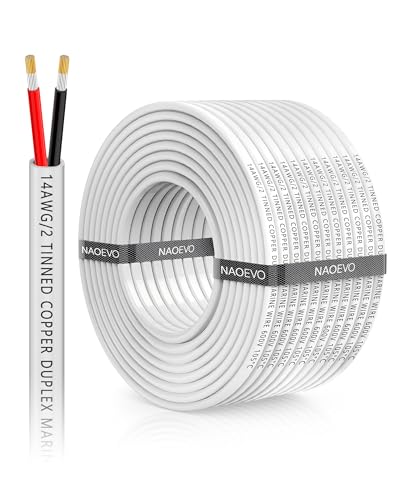
2. NAOEVO 14 Gauge Marine Wire Duplex (60FT)
The corrosion-resistant specialist that thrives where moisture and salt are constant threats.
If your wiring runs under a boat deck, near a truck’s wheel well, or anywhere water finds its way in, you want the NAOEVO. It uses high-precision oxygen-free tinned copper with 65 strands of 0.2 mm wire per circuit. That tinning (a thin layer of solder-like coating on each strand) is what stops green corrosion from forming, keeping your connection clean for years. It is rated for 600 volts—a voltage rating of 600V compared to the 12V typical of automotive systems—and its PVC jacket is thicker than standard wire, earning an IP68 waterproof rating and a VW-1 flame retardant grade.
Buyers report the jacket is noticeably thicker than regular automotive wire, which makes it slightly less flexible than a silicone wire but much more resistant to chafing against metal edges. The duplex design (two conductors bonded side-by-side) simplifies running power and ground together, and at 60 feet you have plenty for a boat rewiring or a camper van auxiliary setup. The catch is the price: you pay a premium for tinned copper, and with 65 strands it is stiffer than ultra-flexible silicone wire options.
Built for the Worst Conditions
- Oxygen-free tinned copper resists corrosion far better than bare copper or CCA
- 600V rating gives you an enormous safety margin for any 12V or 24V system
- IP68 waterproof jacket with VW-1 flame retardant rating
- Passed a 10,000 bend test for flexibility
Stiffer Feel, Higher Cost
- Thicker PVC jacket is less flexible than silicone alternatives
- Premium price compared to CCA-based wires
- 65 strands are fewer than the 400-strand silicone wires, so it bends less easily
Best for wet & harsh installs: If your wire will face moisture, salt, or constant vibration—like in boats, off-road vehicles, or exterior trailer wiring—the NAOEVO’s tinned copper and thick PVC jacketing is the most reliable choice here.
Look elsewhere if: You need maximum flexibility for routing in cramped interior spaces. A silicone wire with 400 strands will be easier to wrestle through tight dashboards.
3. Haerkn 14 AWG Silicone 2-Conductor Parallel Wire (50ft)

The parallel duplex that saves an hour of cable management on any two-wire circuit.
This is essentially the same high-flexibility silicone wire as the Haerkn kit above, but in a bonded parallel design. You get 25 feet of black and 25 feet of red in one run, making it the ideal pick for a long power-and-ground circuit. It shares the same 400 strands of 0.08 mm tinned copper and the same -60°C to 200°C silicone jacket, so it is incredibly flexible and heat-resistant. The wire diameter is listed as 0.08 millimeters per strand..
Where this picks up over the separate 5-foot rolls is the sheer convenience of 50 continuous feet. Owners mention this is perfect for wiring LED light bars on a truck or running a fused accessory line from the battery to the cabin—having both conductors in one jacket keeps your install tidy. The only downside is that parallel wire is a little harder to split for custom routing compared to two individual spools, but the time saved on pulling two wires simultaneously is worth it for straight runs.
Clean & Long
- 50ft total gives you enough for long vehicle runs
- Same 400-strand flexibility and 600V rating as the Haerkn kit
- Bonded parallel design keeps your wiring neat and reduces zip-tie work
- High-purity oxygen-free tinned copper for corrosion resistance
Limited Color Choice
- Only black and red—no other colors for multi-circuit systems
- Parallel jacket makes it harder to split the two conductors for separate paths
- Silicone is still soft; grommet recommended for metal passthroughs
Best for point-A-to-point-B runs: If you are wiring a simple power-and-ground circuit like a fuse box to a distribution block or a solar panel to a charge controller, this duplex wire cuts your install time roughly in half.
Not for you if: You need three or more colors for complex wiring diagrams. This is a two-color wire only.
4. BEST CONNECTIONS 14 Gauge Automotive Primary Wire (350ft Bundle)
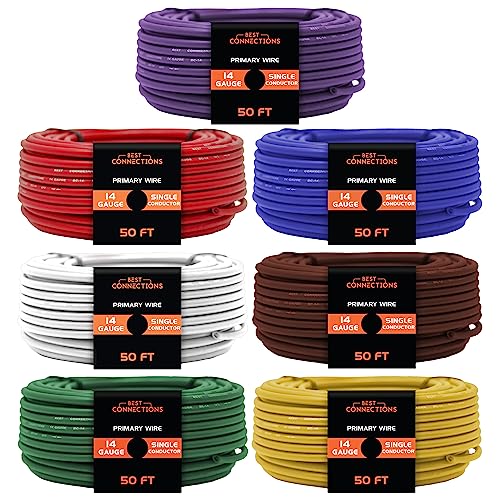
The rainbow-colored bulk spool set that makes complex wiring diagrams easy to follow.
When you are running multiple circuits—like a car stereo with speakers, amplifiers, and a subwoofer—color coding is your best friend. The BEST CONNECTIONS bundle gives you seven different colors of 14 gauge CCA wire, each on a 50-foot roll for 350 total feet. It is designed for 12V automotive use, with a maximum voltage rating of 80 volts DC, and uses a durable PVC jacket that is stiffer than silicone but much tougher against cuts. Unlike the Haerkn wire’s 600V rating, this is built for standard automotive voltages only, so do not use it for high-voltage solar or industrial equipment.
Customers note the PVC jacket strips cleanly with standard wire strippers, and the seven-color assortment helps them avoid the headache of label-makers. The CCA conductor makes it lighter and cheaper than pure copper, but it does have slightly higher resistance over very long runs. Reviewers still praise it as a “great value” for the total footage. The weight is 3.1 pounds for the entire set, making it a manageable kit to keep in a workshop drawer.
Organized by Sight
- Seven colors on 50ft rolls let you color-code every circuit
- 350 total feet is a massive amount for most DIY car projects
- Durable PVC jacket resists abrasion better than silicone
- Strips cleanly with standard tools
CCA Limitations
- CCA is not as conductive as pure tinned copper for high-current amps
- 80-volt max rating means it is strictly for low-voltage automotive use, not 600V applications
- PVC is stiffer than silicone, making tight bends more work
Grab this for stereo & lighting jobs: If you are wiring a complete car audio system with separate power, ground, speaker, and remote wires, having seven colors on hand saves you from buying four separate spools.
Pass on it for marine use: CCA will corrode faster than tinned copper in a wet environment. Stick with the NAOEVO or Haerkn tinned copper options for boats.
5. GS Power 300ft CCA 14 Gauge Wire (6 Colors, 50ft Rolls)
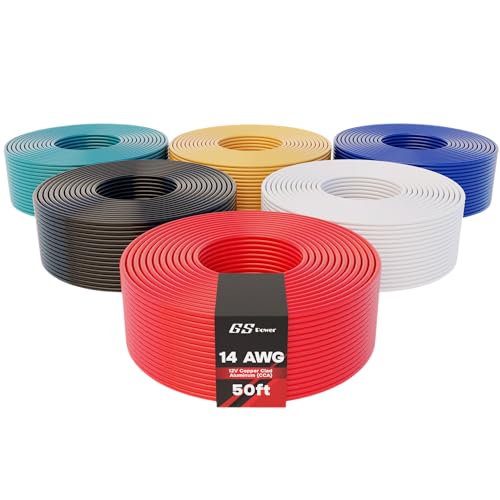
The economical six-pack that covers the essentials without emptying your wallet.
The GS Power 300ft set puts six 50-foot rolls in your hands for a very accessible price point. Each color is a single conductor made from Copper Clad Aluminum with 54 strands (0.2 mm diameter per strand). It is rated for 12V (6 to 80V range), so keep it to automotive and low-voltage projects only. The PVC jacket is rated at 221°F (105°C), which is fine for interior wiring but not for direct engine-bay contact. Compared to the BEST CONNECTIONS 350ft bundle, this has one less color but comes at a noticeably lower price point per foot.
The catch is clearly stated by the manufacturer: this wire is not for household 110V or 220V AC wiring. Buyers mention that the CCA strands are fine for car speakers and LED light bars but recommend upgrading to pure copper for amplifiers pulling high continuous current. At 54 strands, it is less flexible than the 400-strand silicone wires, so plan for a bit more resistance when rounding tight corners. Still, for a basic car stereo or trailer harness, this is a solid runner-up to the pricier bundles.
Cheap Per Foot
- 300 feet total across six common colors
- 50ft per roll means less waste than shorter kits
- PVC jacket rated to 221°F is fine for interior and trunk wiring
- Works for 12V speaker, trailer, and LED strip projects
Not for High-Current
- CCA is less conductive than copper; not ideal for large subwoofer amps
- Only 54 strands make it stiffer than a silicone wire
- Do not use this for any household AC wiring
Best for the budget-conscious: If you need a variety of colors for a few small 12V projects and you want to keep the cost low, the GS Power 300ft set gives you the most wire for your money.
Upgrade to copper for serious audio: If you are wiring a high-wattage amplifier, the resistance of CCA adds up. Spend a bit more on a tinned copper wire for the main power run.
6. GEARit 14 Gauge Primary Wire CCA (200ft Pair, Black & Red)
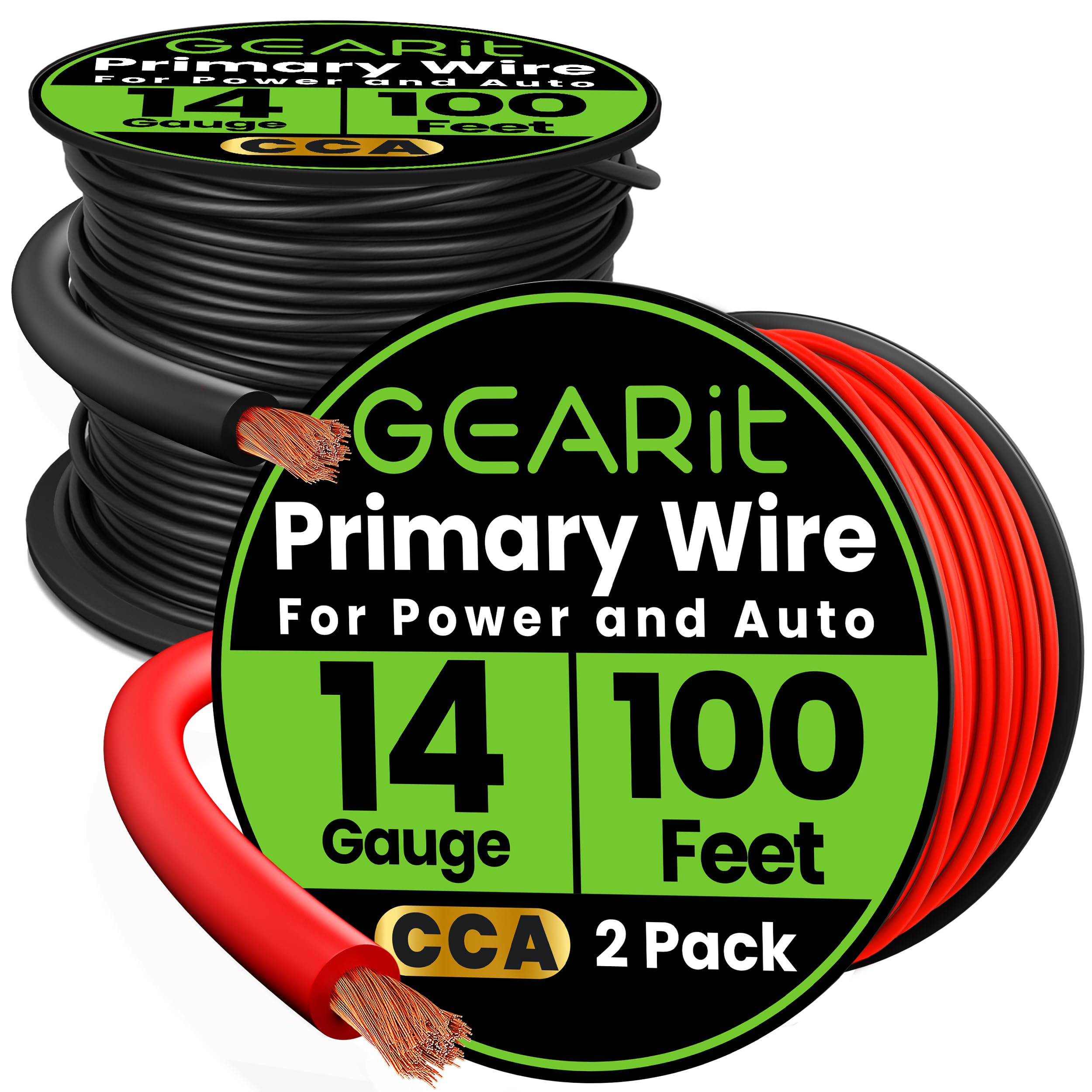
The classic black-and-red combo that simplifies power and ground runs with 200 feet to spare.
Sometimes you just need a lot of one color for power and another for ground. The GEARit pair gives you 100 feet of black and 100 feet of red—200 feet total. It uses a 14 AWG Copper Clad Aluminum conductor with a 1.63mm overall wire diameter.. This CCA wire is designed specifically for 12V systems, so it is rated at 12 volts, not the 600V of the tinned copper options.
Reviewers highlight how well the PVC jacket strips and how the wire does not kink easily. The 2.6-pound total weight makes it a light spool to handle. The biggest limitation is the 12-volt rating—you cannot use this for solar panel wiring or any 48V system without risking insulation breakdown. It also only comes in two colors, so you will need a different source for the rest of your color-coded circuits. For a straightforward amp power kit or a trailer light harness, it gets the job done.
Simple & Abundant
- 100 feet each of black and red gives you plenty for long battery runs
- PVC strips cleanly without nicking the conductor
- Light at 2.6 pounds for 200 feet of wire
- Good for automotive, car audio, trailer, and marine (non-saltwater) use
Low Voltage Limit
- Rated for only 12 volts; not compatible with higher-voltage systems
- Only two colors mean you need other spools for multi-circuit jobs
- CCA is more prone to corrosion than tinned copper in wet environments
Grab this for simple installations: If your project is a straightforward power-and-ground setup (like an amplifier kit or a secondary fuse box), 200 feet of matching wire is more than enough.
Not for marine saltwater use: The CCA conductor will rust in a boat environment. Choose the NAOEVO tinned copper of the exact same gauge instead.
7. GS Power 1000ft CCA 14 Gauge Wire (10 Colors, 100ft Spools)
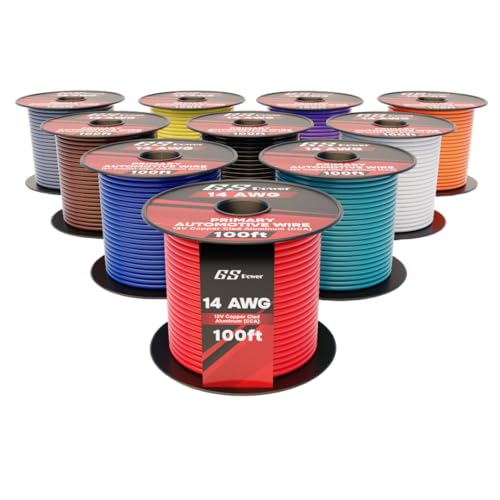
The ultimate bulk spool rainbow that prevents “I ran out of wire” mid-project forever.
This is the endgame for anyone who wires vehicles regularly. GS Power packs 1,000 feet of 14 gauge CCA wire across ten separate 100-foot spools. You get Red, Black, Blue, Yellow, White, Green, Purple, Grey, Orange, and Brown. Each spool is single-conductor CCA with 54 strands (0.2 mm diameter per strand), wrapped in a flexible PVC jacket rated to 221°F (105°C). It works for 12V automotive circuits (6 to 80V range) and is perfect for car audio, trailer harnesses, and custom restorations.
The main difference between this and the 300ft GS Power set is scale: ten spools instead of six, and 100 feet per spool instead of 50 feet. Compared to the BEST CONNECTIONS 350ft bundle, this gives you over triple the total footage and three extra colors. The catch is the upfront cost and the space needed to store ten 100-foot spools. Reviewers point out that the CCA (copper-clad aluminum, a wire with an aluminum core and a thin copper coating) is perfectly fine for alarm systems, light bars, and door speakers, but for high-current subwoofer power lines, some upgrade to a thicker gauge. If you run a shop or plan multiple big builds, the cost per foot here is tough to top.
Pro-Level Quantity
- 1,000 feet total across ten colors—enough for multiple vehicles
- 100-foot spools per color give you long uninterrupted runs
- 10-color assortment covers almost any circuit identification need
- Flexible PVC is easier to pull through door sills and conduits
Storage Commitment
- Ten spools take up drawer space; not a grab-and-go purchase
- CCA has higher resistance than copper; not for high-amp main leads
- Only 54 strands makes it stiffer than a silicone wire
Best for the busy DIYer or shop: If you wire multiple projects a year and want every common color on hand, the 1,000-foot set saves trips to the store and restocking costs.
Overkill for one-time projects: A single car audio install will barely touch 100 feet. A smaller bundle like the BEST CONNECTIONS 350ft set is more practical for a single build.
Understanding the Specs
Strand Count & Flexibility
The number of individual metal strands twisted together to make one wire directly determines how easily it bends. A wire with 400 strands (like the Haerkn silicone wires) is almost as flexible as string and can be bent around tight corners hundreds of times without snapping. A wire with 54 to 65 strands (like the GS Power or NAOEVO) is stiffer but still flexible enough for most automotive runs and has thicker individual strands that resist breakage from vibration.
Conductor Material: CCA vs Tinned Copper
Copper Clad Aluminum (CCA) uses an aluminum core coated with a thin copper layer. It is lighter and cheaper than solid copper, making it popular for budget-friendly bulk wire. Tinned copper (like in the NAOEVO and Haerkn wires) is pure copper coated with a layer of solder-like tin. This prevents the green oxidation that can increase resistance over time, making it the choice for marine, off-road, or any damp environment. The trade-off is a higher cost per foot.
FAQ
Can I use CCA 14 gauge wire for my car amplifier?
What is the difference between 12V-rated and 600V-rated automotive wire?
Does a higher strand count always mean a better wire?
Can I use 14 gauge automotive wire for household 120V wiring?
How much current can 14 gauge automotive wire safely carry?
What is “tinned copper” and why would I pay more for it?
Is silicone wire better than PVC wire for cars?
How do I know which color wire is for which circuit?
Can I use 14 gauge wire for a trailer wiring harness?
What does “2 Conductor Parallel Wire” mean for my install?
Final Thoughts: The Verdict
If you want one dependable pick, the best 14 gauge automotive wire is the NAOEVO Marine Wire because it offers the best long-term reliability with tinned copper conductors (copper strands coated in tin to resist corrosion) and a 600V-rated waterproof jacket that handles the worst conditions cars and boats throw at it. If you need maximum flexibility for tight interior routing, grab the Haerkn Silicone Wire Kit. And for the biggest bang for your buck on a large multi-color project, the BEST CONNECTIONS 350ft Bundle is the most versatile value pick in this guide.
How We Picked
We do not accept paid placement. Every pick is matched to a real buyer and a real use-case; we do not hands-on test units.
Sources & Methodology
Specifications: manufacturer listings and product documentation. Review insights: verified customer reviews, as of July 2026. Pricing: not shown on this page (it changes often); check the current price via the retailer link.
As an Amazon Associate, Gadgets Feed earns from qualifying purchases. This does not affect which products we feature.