
Our readers keep the lights on and my morning glass full of iced black tea. As an Amazon Associate, I earn from qualifying purchases.
Specs are compiled from manufacturer listings and verified buyer reviews and can change over time — please confirm the key details on the product page before buying.
Get it right and the run stays cool, the strands stay put under the screw terminal, and the job is done in one afternoon. Get it wrong and you are re-pulling wire through a wall or a fender because the jacket cracked or the copper was not what the listing promised.
I’m Min — the founder and writer behind Gadgets Feed. This guide is built by comparing the manufacturers’ published specifications and the patterns across verified customer reviews, so you get each pick’s real strengths and trade-offs instead of marketing spin.
Wire is one of the few purchases where the spec sheet actually tells you the truth, as long as you know which numbers to read. This breakdown of the best 14 gauge cable covers strand counts, jacket material, voltage ratings, and the real-world jobs each spool handles best.
Our Picks at a Glance


How To Choose The Best 14 Gauge Cable
Fourteen gauge is the workhorse size for anything pulling moderate current over a short-to-medium run — a surround-sound speaker, a set of fog lights, an amplifier feed, a trailer harness. It carries more current than 16 gauge with less voltage drop, and it stays flexible enough to fish through a door boot or a ceiling cavity. The trick is matching the jacket, the conductor, and the strand count to where the wire is actually going.
Conductor: solid copper vs. copper-clad aluminum
Pure copper conducts best, but it is heavier and costs more. Copper-clad aluminum (CCA) puts a thin copper skin over an aluminum core — lighter, cheaper, and flexible enough for most 12-volt and low-voltage audio jobs. CCA is the right call for a budget speaker run or a trailer rewire. If the wire will sit in damp air for years, or you need the lowest possible resistance, pure copper or tinned copper is the safer long-term pick. Some builders also reach for CCA simply because it weighs less in a long run across a vehicle.
Strand count and jacket material
Strand count decides how flexible the wire feels in your hand. A spool with a few hundred fine strands — like the 400-strand silicone tinned copper on the Haerkn pick — bends into tight curves without fighting back, so it handles repeated flexing far better than a stiff low-strand build. The jacket material decides where you can safely run the wire: silicone shrugs off extreme heat and cold, PVC is tougher against scrapes and moisture, and a CL2-rated jacket (a fire-safety rating for in-wall wiring) is the one to buy when the run disappears inside a wall or ceiling for good.
How to size the run before you buy
Measure twice, buy once — add the vertical drops, the slack at each end, and any service loop before you order. For speaker runs in the 20-to-50-foot range, 14 gauge is a comfortable choice for most home setups. If a run stretches much longer than that, a heavier gauge lowers resistance further. Long automotive runs to a remote battery or amplifier benefit from the same logic.
Quick Comparison
| Model | Best For | Gauge | Conductor | Length | Amazon |
|---|---|---|---|---|---|
| InstallGear 14 Gauge Speaker Wire★ Best Overall | Everyday speaker runs | 14 AWG | Aluminum | 100 ft | Amazon |
| GEARit 14 Gauge Primary Wire CCABest Value | Automotive and trailer wiring | 14 AWG | Copper Clad Aluminum | 200 ft (pair) | Amazon |
| Mygatti 14 Gauge Wire 6-PackMost Versatile | Multi-circuit color coding | 14 AWG | Copper Clad Aluminum | 150 ft (6 rolls) | Amazon |
| Haerkn 14 awg Silicone Wire | Heat and flex-heavy projects | 14 AWG | Tinned Copper | 50 ft (pair) | Amazon |
| NAOEVO 14 Gauge Wire 2 Conductor | Marine and low-voltage installs | 14 AWG | Tinned Copper | 30 ft | Amazon |
| GEARit 14 Gauge In-Wall Speaker Wire CL2 | In-wall and in-ceiling audio | 14 AWG | Copper Clad Aluminum | 100 ft | Amazon |
| Energeaster Solid 14/2 NMB Cable | Residential branch circuits | 14 AWG | Copper | 50 ft | Amazon |
| BABOOM 14 Gauge Wire Combo 6 Pack | Big multi-color spool jobs | 14 AWG | Copper Clad Aluminum | 600 ft (6 rolls) | Amazon |
In‑Depth Reviews
1. InstallGear 14 Gauge Speaker Wire 100 ft Cable, 14 AWG
Our pick — over 4.5★ from 29,000+ verified ratings; the strongest balance of quality and price.
A four-figure review count and the highest score in this line-up for a plain, honest speaker spool.
The first thing to notice is the sheer depth of ownership behind this one — 4.8 stars from a huge base of buyers who have lived with it through stereo upgrades, garage builds, and head-unit swaps. The single number that carries the run is the 100-foot length, which is enough for a full surround-sound install with plenty of slack at both ends. Two conductors, 14 AWG, blue jacket, one spool. That is the whole product.
What owners praise most is the install experience: the jacket strips clean, the conductors are easy to keep separated, and the polarity reads at a glance. The softness gets its own following too — the wire takes a bend and holds it without springing back, which is exactly what you want when you are fishing it behind trim or under carpet. Buyers report 20-foot under-flooring runs with no surround-sound issues, still working a year later. In a direct measure against the BABOOM 6-pack, this spool runs 100 ft as a single roll versus BABOOM’s 600 ft across six — the InstallGear is the right call for one clean stereo, not a shelf stock-up.
Two words of caution. First, the material is aluminum, not copper — perfectly fine for typical speaker loads, but if you are chasing the lowest-resistance build possible, a tinned copper spool is the stronger technical pick. Second, the length is generous but finite; long multi-room runs will eat 100 feet faster than you expect. Measure the full path before you commit, including any service loops at the amp end.
What earns its place
- 100 ft on a single spool covers most home-theater runs in one purchase
- Soft, pliable jacket that strips cleanly and holds a bend
- Color-coded polarity that reads instantly at the connector
- 4.8 stars from a deep, long-standing base of verified buyers
Where it has limits
- Aluminum conductor, not copper — good for most speaker loads, less ideal if you want the lowest resistance available
- Durability is the one mixed note — treat the jacket with reasonable care and it holds up well
The pick for most homes: any standard stereo or surround install at speaker-level lengths where a single 100-foot roll and easy stripping matter more than exotic conductor material.
Think twice if: you are chasing the absolute lowest-resistance build or need to wire multiple rooms from one purchase — a tinned-copper spool or a six-color combo pack suits those jobs better.
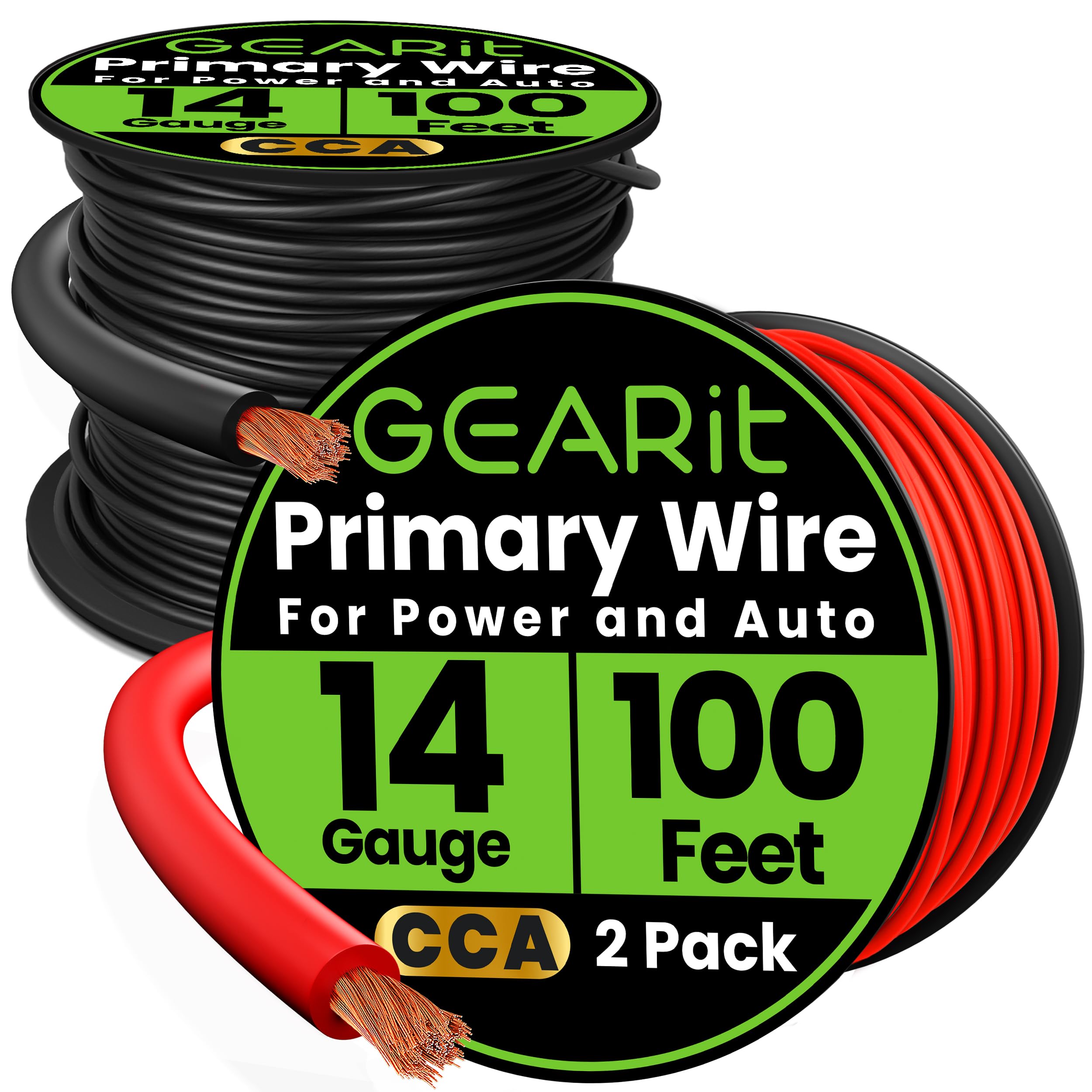
2. GEARit 14 Gauge Primary Wire CCA, 14 AWG Copper Clad Aluminum Power & Ground Battery Cable
Two 100-foot rolls in the colors you actually need for a 12-volt power and ground run.
For anyone wiring a trailer harness, a car audio feed, or a dedicated ground path, the black-and-red pairing here is the practical detail that earns its keep. Instead of buying two spools separately, you get 100 ft of black plus 100 ft of red — 200 ft total. The CCA (copper-clad aluminum) construction keeps the roll light, and the PVC jacket bends through dashboards, amp racks, and door boots without cracking. That flexibility is the thing buyers keep coming back to.
The application story is unusually wide. Owners are using it as trailer wiring, boat re-wiring, robotic mower boundary replacement, and a fog-light feed on an old Cherokee — pulling it through the engine bay without kinking. In the mower case the wire sits outside year-round and resists the moisture-and-temperature swings that trigger boundary errors on the OEM green wire. Compared with the Haerkn silicone spool, this one is a 200 ft two-roll pair versus Haerkn’s 50 ft two-core single — GEARit wins clearly on total length for anyone running power and ground circuits in parallel.
The honest caveat is durability. This is a solid, cost-conscious spool, and its lifespan depends on how it is routed — keep it off hot surfaces, protect the ends with heat shrink, and it does its job. The CCA core also means it is not the wire to choose if your install is high-vibration or expects decades of flexing on the same strand bundle. For a routine trailer rewire or accessory lead, it is more than enough.
What buyers lean on it for: low-voltage automotive runs where you want both power and ground on the same order, in two separate colors, without hunting down a second spool. The 100 ft per color means you can pull a long pair down the length of a vehicle and still have tail left over.
The trade-off worth knowing: as a lighter, budget-tier conductor, it wants to be routed thoughtfully — away from hot components, ends sealed, no sharp turns. Do that and it performs like a wire that costs noticeably more.
Choose this for: trailer rewires, fog-light leads, amp feeds, and any 12-volt project where a matched black-and-red pair in a long length saves you a second purchase.
Keep looking if: your run will flex constantly or sit in punishing conditions for years — a tinned-copper spool survives that environment with more margin.
3. Mygatti 14 Gauge Wire 6-Pack (Black/Red/Grey/Blue/Green/Brown, Each 25 FT)
Six separate colors on six 25-foot rolls — the tidy way to keep multiple circuits from getting tangled.
If your project has more than two circuits, buying one color of wire gets messy fast. This pack solves that with six rolls of 25 ft — black, red, grey, blue, green, and brown — for 150 ft total. That is 2.4 times the length of the GEARit CL2 single-roll (100 ft) split across double the color variety, so you can dedicate a distinct color to each circuit and stop guessing what you wired where.
This wire is built from stranded CCA (copper-clad aluminum — copper coating over a lighter aluminum core) with an ultra-flexible PVC jacket that shrugs off heat and keeps its shape when bent. Each conductor has ten strands, and the six-roll format fits comfortably in tight spaces — wiring a fog-light circuit on one bike, a set of alarm sensors on the next rack over, a set of low-voltage lamps on a third. The stranded format also strips cleanly for crimp connectors and terminal blocks. The six colors map cleanly onto car audio, model cars and ships, meters and instruments, alarms, and electric toys.
What the pack gives up is total length per color. Twenty-five feet is enough for one circuit, but not a long single run — if you have a 40-foot path to cover in one color, you are buying two packs or looking at a different spool. Treat this as the multi-circuit organizer, not the long-haul reel.
The case for six rolls
- Distinct color per circuit kills cross-wiring guesswork
- Stranded CCA core that stays flexible and strips cleanly
- 150 ft total across six rolls covers more separate jobs than one long spool
The honest limitations
- 25 ft per color is short for a single long run
- CCA conductor is fine for low-voltage but a step behind pure copper for maximum conductivity
Reach for this if: your dashboard, model, or alarm panel has three or more circuits that need to stay separate, and you want the color-coding solved in one order.
Look elsewhere if: your priority is a single 50-foot-plus run in one uniform color — a long spool is the better tool.
4. Haerkn 14 awg Silicone Electrical Wire Cables 2 Cores 25ft Spool

Four hundred fine tinned strands inside a silicone jacket — this is the flex king of the group.
The headline number here is 400 strands of 0.08 mm tinned copper inside each conductor, wrapped in a silicone jacket rated from -60 °C up to +200 °C. That combination makes the wire almost unnaturally soft in hand and able to bend into tight radiuses without springing back — critical for engine-bay runs, van builds, and anything that moves. The parallel two-core format — one spool with both conductors joined — makes it fast to strip and route as a single cable. If your project calls for the wire itself to be a structural non-issue, this is the spool that delivers.
The tinned copper core also carries real advantages for outdoor use. Tinned strands resist corrosion better than bare copper, so the marine and under-hood crowd gets a wire that holds up against humidity and salt air. Owners mention a van rewire still working perfectly three years on, with the silicone jacket taking solder, crimps, and cuts without issue. The silicone jacket also shrugs off soldering heat without melting back — a small detail that matters when you are tinning ends in tight spots.
The one honest trade-off is price-to-length. You get 50 ft total (25 ft of each color) at a price that feels higher than a plain CCA spool of the same length — you are paying for the strand count, the silicone, and the tinned copper. The jacket is also softer than PVC, so it can snag on sharp edges during a pull; feed it through tubing or sleeving if the path has burrs.
What you are really paying for: 400 strands of tinned copper — a strand density you will not find on a budget CCA spool — inside a silicone jacket that stays flexible at both altitude-cold and engine-bay-hot temperatures.
Where it is not the right fit: simple living-room speaker runs and long straight pulls through tight conduit. The soft jacket and premium strand count are overkill for a job a plain PVC spool handles fine.
Built for: engine-bay wiring, van and marine builds, and any project where the wire has to flex thousands of times without fatigue.
Not the pick for: a straight ceiling drop or a simple speaker run — a stiff PVC spool does the same job with less spend.
5. NAOEVO 14 Gauge Wire 2 Conductor, 14 Gauge Automotive Wire 12V Cable, 30FT
An IP68-rated 14/2 cable that laughs at bilge water, road spray, and coastal air.
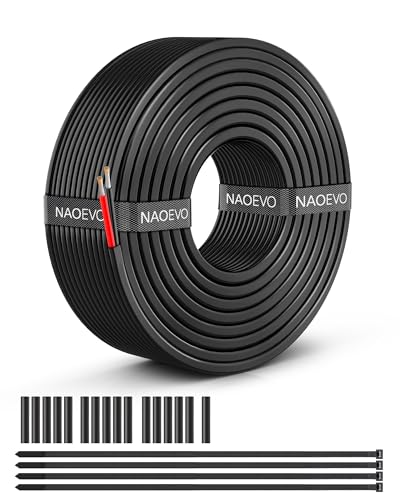
A waterproof rating matters when your wiring lives in a place that gets splashed, rained on, or sits in a boat hull. This cable carries IP68 — meaning fully dust-tight and rated for continuous immersion under defined conditions — and a 600V / 20A nominal capacity that covers essentially every low-voltage job it will ever see. Inside the jacket, each circuit is built from 41 strands of 0.24 mm tinned copper, which keeps corrosion-prone bare copper away from the marine environment while still conducting cleanly. The flame-retardant PVC jacket carries a VW-1 rating, and the run is rated down to -22°F and up to 221°F.
Owners use it for light-bar extensions, roof-rail runs, and 12-volt marine circuits. The flat (rather than round) profile makes a real difference when you are threading wire through a frame rail or behind roof trim — a nice piece of design that shows up in how buyers describe the routing. The kit also ships with 16 heat-shrink tubes and 4 cable ties, so the finish work is covered without a second order. In a straight length comparison against the GEARit in-wall spool, this one gets you 30 ft versus 100 ft — NAOEVO wins on environmental protection, GEARit wins on sheer footage.
The catch is total length. Thirty feet is enough for a light-bar run or a peer-to-peer circuit, but it will not cover a full vehicle pull end-to-end. Buy two if your project runs long. The other note: the jacket is thick, which is great for protection but means it needs a slightly stricter bend radius than a thin PVC spool.
Why marine and truck builders reach for it
- IP68 waterproof rating for wet and splash zones
- Tinned copper strands resist corrosion in humid and salty air
- Flat profile threads cleanly through frame rails and roof channels
- Ships with heat-shrink tubes and cable ties to finish the job
What to plan around
- 30 ft total runs out quickly on a full-length vehicle circuit
- Thick jacket needs care on very tight bends
Reach for this if: your wiring lives near water, road spray, or weather — the IP68 jacket and tinned copper strands are built for exposed installs.
Skip if: you need a single-spool solution for a long straight run — 30 ft is one circuit, not a whole vehicle.
6. GEARit 14 Gauge In-Wall Speaker Wire 100FT, CL2 Rated 14/2 CCA Wire, White

CL2-rated, foot-marked, two color-coded conductors — the wire that disappears behind drywall and does its job in silence.
When speaker wire goes inside a wall or ceiling, the jacket rating stops being optional. CL2 means the cable meets the standard for in-wall residential audio installs — a flame-retardant jacket that resists fraying and holds up against the environment inside a cavity. This spool carries that rating, runs 100 ft, uses two color-coded conductors (red and black), and prints sequential foot markers along the jacket so you can measure exactly how much you have pulled before cutting. The white PVC jacket blends with drywall if any part is exposed at a wall plate or ceiling box.
Customers note that the foot markings are the install detail they notice most — when you are fishing wire through a joist bay and need to hit a specific length without a tape measure, those numbers save real time on a ladder. The polarity markings at each end are also clean, so matching receiver terminal to speaker terminal is a non-issue. The lightweight CCA construction keeps the run manageable overhead; the trade-off is the same CCA caveat named across the category — fine for typical speaker loads, less ideal if you want the absolute lowest possible resistance over a very long run.
The honest note here is application fit. The CL2 rating is a real cost premium, and if your wire is never going inside a wall, you are paying for protection you will not use. Route it free-standing or under carpet and a plain PVC spool at the same gauge does the job without the surcharge.
What makes it the in-wall pick: the CL2 flame-retardant jacket plus 100 ft of run and printed foot markers. Those three things together are the difference between a wall that passes inspection and one that does not.
Who should pass on it: anyone running speaker wire along baseboards, under area rugs, or between shelves — no walls, no CL2 need, cheaper spools win.
Built for: home theater, whole-home audio, in-ceiling speakers, and any install where the wire will be sealed behind drywall for good.
Not the tool for: open-air or under-rug speaker runs — the CL2 premium buys you nothing there.
7. Energeaster Solid Indoor 14/2 W/G NMB Cable 50ft
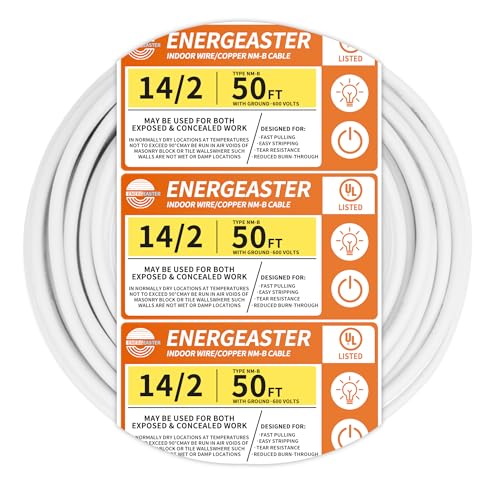
Solid 14/2 NM-B building wire — the standard coil you would grab at the hardware store for adding a receptacle.
This is a different animal from the stranded hook-up wire above it. It is 14/2 NM-B cable — the sheathed solid-copper wire that goes inside wall cavities to feed switches and outlets, rated 600 volts, in a 50-foot coil. Two insulated conductors (black and white) sit parallel with a bare ground wire wrapped in fire-retardant paper between them, all inside a white jacket. If you are adding a receptacle to a garage wall or extending a branch circuit, this is the wire type that belongs there — and the solid construction makes it stiff and easy to pull straight down a wall cavity, unlike a soft stranded spool that curls on itself.
Reviewers point out that it compares directly to the branded coils from the big-box stores and comes away fine — the quality reads on par, the price point is generally better, and the jacket slices clean with a box knife when you need to expose the conductors. The rigid feel that makes stranded wire tedious on a long straight run becomes an advantage here; the cable pushes neatly from box to box without a fish tape in shorter gaps. It also carries the 600-volt rating this application relies on.
The trade-offs are specific: some coils run a touch shorter than advertised and the outer jacket can be stubborn to strip, so keep a sharp blade and a spare foot of slack on hand. This is also not the right wire for tight-bend low-voltage work — solid 14 gauge does not want to be bent repeatedly, and forcing it into tight radiuses is asking for a nick. Route it through walls and staple it properly, and it works exactly as intended.
Where this coil earns its keep
- Solid copper construction pulls neatly through wall cavities
- 600V rating suits residential branch circuits
- Quality reads on par with branded hardware-store coil
- Jacket cuts cleanly with a box knife and brightens easily to size
Notes for the buyer
- Jacket can be stubborn to strip — sharp blade and patience help
- Some coils run slightly short of advertised length; plan slack accordingly
- Solid core is not built for repeated flexing in tight low-voltage bends
Right call for: adding outlets, switches, or a branch circuit inside wall cavities where the code-compliant wire type is 14/2 NM-B.
Wrong call for: under-dash or under-hood low-voltage work — solid building wire is too stiff and does not belong in a flexing harness.
8. BABOOM 14 Gauge Wire Combo 6 Pack (600ft Total), 12V Low Voltage Automotive Cable

Six 100-foot rolls in six colors — the shelf-stock-up spool set for anyone with a long project list.
Sheer volume is the argument here. Six rolls, 100 ft each, in black, blue, green, red, white, and yellow — 600 feet total. That is six times the footage of the GEARit CL2 in-wall spool at 100 ft, and 4 times the 150 ft of the Mygatti six-pack. For a project list that includes car audio, home theatre, trailer work, and household 12-volt jobs, one purchase covers the color variety you would otherwise hunt down across half a dozen orders. The stranded CCA core keeps the wire flexible, the PVC jacket is rated 158 °F and 6 to 80 volts, and the color coding on six discrete circuits stops cross-wiring mistakes before they happen.
Shoppers say rewiring a classic car and keeping accessory circuits separated by color. The combo-pack format takes the “do I have enough left?” question out of the equation — grab a fresh roll and go. Repeat buyers report reordering the same six-roll set for each new project. The price-to-color variety is the piece buyers keep coming back to, and the sheer footage means one purchase carries across multiple jobs.
The catch is the one printed right on the listing: the wire is copper-clad aluminum, not solid copper, and buyers who expected solid copper have flagged that clearly. CCA is perfectly suitable for 12-volt home and auto work at this gauge, but if a job needs the lowest-resistance conductor available, this is not it. The lightweight gauge is also note — owners mention it feels noticeably lighter than the 14 gauge it replaced and recommend ordering a size up for higher-current applications. Know what you are buying and it delivers exactly what it says.
Why the combo format works
- 600 ft total across six single-color rolls covers a full project list
- Distinct colors per circuit for clean harness layouts
- Flexible stranded CCA strands and PVC jacket rated for typical 12-volt work
What to plan for
- CCA conductor, not solid copper — clearly stated in the listing, worth confirming against your job
- Lightweight gauge feel compared to higher-current 14 gauge wire; order a size up when current draw is high
The pick for builders with a backlog: anyone running multiple 12-volt circuits, with different jobs stacked up, who wants a whole color library on the shelf in one order.
Look elsewhere if: you only need one clean run, or your job calls for solid copper rather than copper-clad aluminum — a single-color copper spool fits those better.
Understanding the Specs
What 14 AWG actually means
AWG stands for American Wire Gauge — a sizing scale where lower numbers mean thicker wire. Fourteen gauge sits in the middle of the common range: thicker than 16 gauge, thinner than 12. That middle position is why it shows up everywhere — it carries enough current for a home speaker run or a 12-volt accessory and stays flexible enough to snake through a wall cavity or a vehicle panel. The “14/2” you will see on some listings means two 14-gauge conductors in the same cable — one positive, one negative.
When to step up: any run noticeably longer than about 50 feet, or any circuit pulling high current, benefits from a heavier gauge. When to step down: an LED strip or low-current accessory is fine on 16 gauge, and there is no reason to pay for 14 if you do not need the current capacity.
Copper, CCA, and tinned copper
The conductor material changes how the wire behaves. Pure copper conducts best and handles corrosion well at the cost of weight and price. Copper-clad aluminum (CCA) wraps a thin copper skin over an aluminum core — lighter, cheaper, and fine for typical low-voltage and speaker work, but slower to conduct and less tolerant of long-term exposure than copper. Tinned copper takes pure copper strands and coats them in a thin layer of tin, which gives you copper-level conductivity plus strong corrosion resistance — the standard choice for marine, automotive, and any outdoor installation.
Strand count matters too. A few thick strands make a stiff wire that resists bending; hundreds of fine strands — like the 400-strand silicone spool in this line-up — make a wire that flexes hundreds of thousands of times without breaking. For fixed installs, strand count barely matters. For anything that moves, it matters a lot.
FAQ
Is 14 gauge wire good for speakers?
What is the difference between 14 gauge CCA and 14 gauge copper wire?
How long can I run 14 gauge wire before I should step up a size?
Do I need a CL2 rating for speaker wire inside a wall?
What does IP68 mean on wire?
Can I use 14 gauge automotive wire for household projects?
Will a 14/2 cable work with my existing connectors and banana plugs?
How many strands should 14 gauge wire have?
What temperature can silicone-jacketed 14 gauge wire handle?
Is it worth buying a 6-roll wire combo pack over a single 100 ft spool?
Final Thoughts: The Verdict
For most buyers, the 14 gauge cable winner is the InstallGear 14 Gauge Speaker Wire — a 100-foot spool at 4.8 stars from a very deep ownership base that simply works. It strips clean, holds a bend, and covers a typical home-theater run in one purchase. If you need low-voltage automotive power and ground in matched colors, the GEARit 14 Gauge Primary Wire CCA pair gives you 200 feet total in black and red, ready to route. And if you are wiring through a wall where a rating matters, the GEARit 14 Gauge In-Wall Speaker Wire CL2 is the spool to reach for. For heat, flex, and marine exposure, the tinned-copper spools — the Haerkn silicone and the NAOEVO IP68 — carry the durability and IP ratings that exposed installs demand.
How We Picked
We do not accept paid placement. Every pick is matched to a real buyer and a real use-case; we do not hands-on test units.
Sources & Methodology
Specifications: manufacturer listings and product documentation. Review insights: verified customer reviews, as of September 2026. Pricing: not shown on this page (it changes often); check the current price via the retailer link.
As an Amazon Associate, Gadgets Feed earns from qualifying purchases. This does not affect which products we feature.