
Our readers keep the lights on and my morning glass full of iced black tea. As an Amazon Associate, I earn from qualifying purchases.
Specs are compiled from manufacturer listings and verified buyer reviews and can change over time — please confirm the key details on the product page before buying.
Most 14 gauge wire gets bought in a hurry, matched to whatever job is on the bench that weekend — and the wrong jacket or the wrong conductor is what sends you back to the store. This guide sorts the eight options worth knowing by what they are actually built to do: marine runs, RC and 3D printer power, in-wall speaker drops, landscape lighting buried under the sod, and standard indoor branch circuits.
I’m Min — the founder and writer behind Gadgets Feed. This guide is built by comparing the manufacturers’ published specifications and the patterns across verified customer reviews, so you get each pick’s real strengths and trade-offs instead of marketing spin.
You will see why a 100 ft marine spool and a 25 ft indoor cable can never be swapped for one another, and why stranding count decides whether a wire survives vibration. The short answer sits below: these are the 14 gauge wires that hold up under the job they were sold for. Read the 14 gauge wire picks in order and match the jacket to your run.
Our Picks at a Glance


How To Choose The Best 14 Gauge Wire
The gauge number only tells you the wire is 14 AWG — the thickness of the copper inside. Everything else about a spool is decided by the jacket, the conductor type, and how the wire is meant to be installed. Pick those three correctly and the wire disappears into the job.
Solid or stranded, and why it changes the whole job
Solid wire is one thick copper core per conductor.
It holds a shape once bent, which makes it the normal choice for pulling through wall cavities and terminating behind an outlet or switch — the wire stays where you put it.
Stranded wire bundles many thin copper strands into each conductor.
It bends far more easily and shrugs off vibration, so it suits vehicle runs, RC models, motors, and anything that moves or shakes.
Do not substitute one for the other. Solid wire fractures if you flex it repeatedly, and stranded wire is awkward to push down a long wall cavity.
Read the jacket rating before anything else
The jacket is the outer sheath, and its rating tells you where the wire is legally and practically allowed to live.
A CL2 rating means the cable is intended for in-wall and in-ceiling audio runs. NM-B sheathed cable is for indoor residential branch circuits. A direct-burial jacket is built for underground landscape lighting without conduit.
Buying the wrong jacket is the most common and most expensive mistake in this category, because a wire that is perfect on the bench can be wrong inside a wall.
Copper, tinned copper, or CCA
Pure bare copper carries current with the least resistance.
Tinned copper has a thin tin coating over each strand, which slows corrosion in damp and marine settings and makes soldering easier. Copper-clad aluminum (CCA) uses an aluminum core with a copper skin — it is lighter and less costly than pure copper, and it belongs in supported indoor audio runs, not in wet or high-vibration jobs.
Check the material line in the listing rather than assuming everything labelled 14 gauge is the same metal inside.
Length and current: match the spool to the run
Long runs and short runs are sold in different lengths for good reason.
A 25 ft spool is a repair-and-extension length. A 100 ft spool is a whole-project length. Measure your actual run, add slack for routing and terminations, and buy once.
How much power the wire can carry matters too. Fourteen gauge wire usually goes on 15 amp circuits (a 15 amp circuit is a standard household lighting and outlet circuit). Some silicone spools in this class are listed with a 20 A current rating (amps measure current flow). Check the listing’s own figure rather than guessing, because the number changes with insulation and stranding.
Quick Comparison
| Model | Best For | Length | Conductor | Jacket / Material | Amazon |
|---|---|---|---|---|---|
| Ancor Tinned Copper Primary Wire, 14 AWG, Red, 100 ft★ Best Overall | Boat and marine runs | 100 ft | Tinned copper, single conductor | Premium vinyl, 600V | Amazon |
| 14 AWG Silicone Wire 40ft SpoolMost Flexible | RC, 3D printers, high heat | 40 ft (20 ft black / 20 ft red) | 400 strands tinned copper | Silicone, 600V | Amazon |
| Haerkn 14 awg Silicone Electrical Wire Cables 2 Cores 25ft SpoolBest for Amperage | Power supplies and vehicle mods | 50 ft total (25 ft per color) | 400 strands tinned copper | Silicone, 600V, 20 A | Amazon |
| NAOEVO 14 Gauge Wire 2 Conductor, 30FT | Automotive and low-voltage outdoor | 30 ft | 41 strands tinned copper | PVC, 600V, IP68 | Amazon |
| 25 Ft 14/2 NM-B Copper Wire with Ground | Short indoor circuit repairs | 25 ft | Solid copper, 2 conductor + ground | NM-B sheath, 600V, 15 A | Amazon |
| GEARit 14 Gauge in-Wall Speaker Wire 100FT | In-wall speaker and audio runs | 100 ft | CCA, 2 conductor | CL2-rated PVC | Amazon |
| 14/2 Landscape Wire 100ft Pure Copper Direct Burial | Buried and outdoor lighting | 100 ft | 41 strands bare copper | Direct-burial jacket, ETL listed | Amazon |
| Solid Indoor 14/2 W/G NMB Cable 100ft | Full residential rewire runs | 100 ft | Solid copper, 2 conductor + ground | NM-B sheath, 600V, UL listed | Amazon |
In‑Depth Reviews
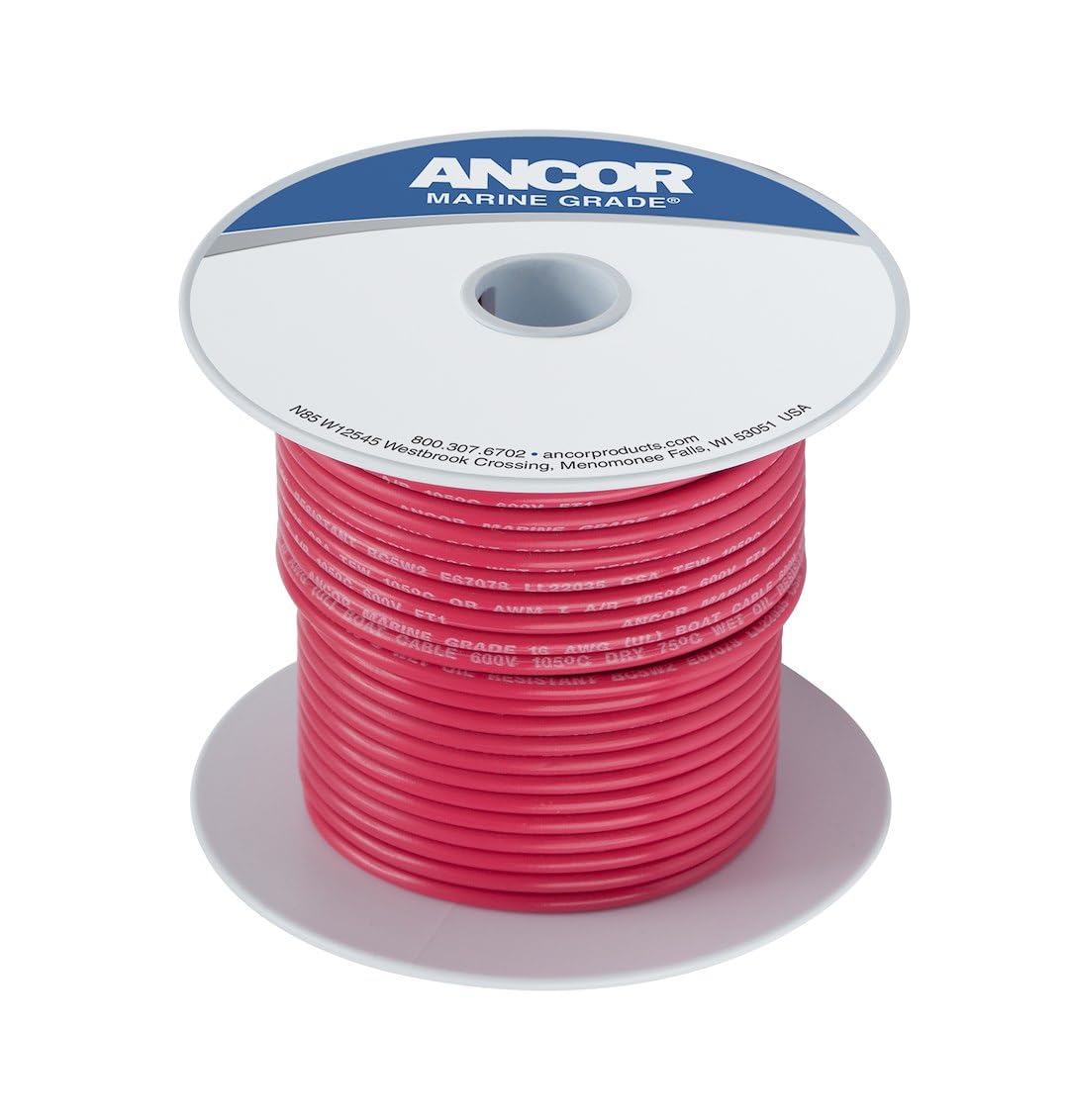
1. Ancor Tinned Copper Primary Wire, 14 AWG, Red, 100 ft
Our pick — 4.5+★ from 400+ verified ratings; the strongest balance of quality and price.
The marine spool you buy when the run has to survive salt spray, engine heat, and constant vibration below deck.
Here is the number that settles it: 100 feet in a single red spool. That is four times the length of the 25 ft NM-B indoor cable in this list, and it means one spool covers a full accessory run down a boat rather than stopping at a junction box.
What is inside matters more. Each conductor is tinned copper — individual copper strands with a thin tin coating — and the wire uses Ultra-flexible Type 3 stranding, which resists fatigue from vibration and adds corrosion protection. The jacket is premium vinyl rated at 600 volts, 105 deg C dry and 75 deg C wet, and stays flexible down to minus 40 deg F/C. It also resists salt water, battery acid, oil, gasoline, heat, abrasion, and ultra-violet radiation, and it is built to exceed UL 1426, US Coast Guard Charter boat (CFR title 46) and ABYC standards.
The weight lands at 2 pounds for the whole spool, so it is very much a stay-on-the-boat item rather than a pocket carry.
The review pages sum it up: buyers treat this as a genuine marine-grade conductor, and the recurring theme is how workable it is in the hand — easy to route, easy to terminate. Somebody adding lights and accessories to a boat is the classic use, and the corrosion resistance gets called out again and again. Quality is the aspect buyers come back to most.
Where it earns its reputation
- 100 ft of tinned copper in one spool — plenty for a long accessory run
- Rated 600V and specified to exceed UL 1426, US Coast Guard Charter boat, and ABYC standards
- Stays flexible to minus 40 deg F/C, so cold-weather runs do not crack
- Resists salt water, battery acid, oil, gasoline, heat, abrasion, and UV radiation
What to weigh first
- Single conductor and one color — you buy two spools for a red and black pair
- Marine-grade tinned copper costs more than the commodity spools here
- 2 pounds per spool makes it a bench-and-boat item, not a travel one
Buy it for: a boat, a dock, or any wet, vibrating, sun-beaten installation where corrosion is the real enemy.
Think twice if: you only need one color pair for a short indoor run — a two-conductor spool gets you there with less spent.
2. 14 AWG Silicone Wire 40ft Spool, 20ft Black/20ft Red, 200°C 600V
Four hundred strands of 0.08 mm tinned copper is the whole pitch — this wire bends around a motor mount without kinking.
Try bending this and something 41-strand is the difference you feel immediately in your fingers. The MILAPEAK spool packs 400 strands of 0.08 mm tinned copper into each conductor, which is what delivers that ultra-soft feel and the super low impedance the listing claims.
The silicone jacket (the outer insulation layer) is the other half of the story. It is rated 600 volts and handles temperatures from minus 140F up to plus 392F. That upper figure is what makes it a natural fit for model planes, model cars, model ships, batteries, lamps, electric heating appliances, meters, instruments, motor lead wire, and 3D printer work — so a hot 3D printer hotend run won’t melt the insulation. The tin coating on each strand slows corrosion and makes soldering genuinely easier.
You get 40 feet total, split into a 20 ft black section and a 20 ft red section, wound on one hard spool for easy dispensing. The catch worth knowing up front: those are two separate wires sharing a spool, not a bonded pair. The red and black are not connected to each other, so if you were expecting a zip-cord style two-conductor cable, this is not it.
What wins people over is the quality of the conductor itself, closely followed by the value for money and the flexibility. Soldering, crimping, and tucking it into tight cavities are the jobs it keeps getting handed.
The honest read: 400 strands of 0.08 mm tinned copper with an outside diameter of 3.5mm (+/- 0.1 mm) puts this among the most pliable spools in this list — it bends around tight corners where stiffer wire kinks. The 600V rating keeps it usable well beyond RC toys. At 40 ft total it is a hobby-bench length, not a household rewire length, so plan on a small project.
Reach for it when: vibration, tight routing, or high heat is the problem — RC models, printer hot ends, motor leads.
Look elsewhere if: you need a bonded two-conductor cable for a single clean run; the two colors here are independent wires.
3. Haerkn 14 awg Silicone Electrical Wire Cables 2 Cores 25ft Spool
A two-core silicone spool that carries more current than the indoor NM-B cable — 20 A against 15 A.
That current rating is the reason to look here first. Haerkn lists this wire at a nominal 600V and a 20 A bear current, while the 14/2 NM-B indoor cable in this guide is a 15 A circuit cable. If you are running a power supply, a pump, or a vehicle mod that pulls hard, that extra headroom (spare current capacity) matters.
The build backs it up. Each conductor is 400 strands of 0.08 mm high-purity oxygen-free tinned copper, which gives the wire its soft, highly flexible feel and low impedance. The silicone jacket handles minus 60 degrees Celsius up to plus 200 degrees Celsius. You get black and red at 25 ft per color, 50 feet total.
The trade-off is real and worth naming plainly. Some owners find the insulation tears too easily when stripping, and durability feedback splits both ways. Treat the jacket gently, use sharp strippers, and score the sheath lightly rather than cutting deep — that is the difference between a clean termination and a nick.
Functionality and flexibility are what buyers go out of their way to praise, with power supplies and vehicular modifications showing up as the typical jobs. Quality is the aspect that gets the most appreciation by a clear margin.
Pick this one if: your run needs current headroom and the wire will be bent, tucked, and routed tight.
Not the one for you if: you want a jacket that shrugs off rough stripping — this silicone demands a light hand.
4. NAOEVO 14 Gauge Wire 2 Conductor, 14 Gauge Automotive Wire 12V Cable, 30FT
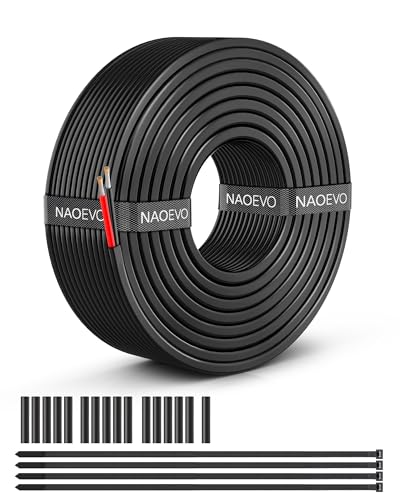
An IP68 two-conductor cable that comes with its own heat-shrink and cable ties.
The water rating is the headline — IP68 means the jacket is sealed against dust and against water immersion. For a wire heading under a frame rail or along a landscape run, that is not a marketing line, it is the permission you need to install it outdoors at all.
Inside, each circuit carries 41 strands of 0.24 mm oxygen-free tinned copper. That is a far coarser stranding than the 400-strand silicone spools, but it matches the 3.5 millimeters jacket diameter and gives this cable a stiffer, more pull-through friendly feel. Rated voltage is 600V — it works just as happily at 5V, 12V, or 24V as it does at the top of that range. Working temperature runs from minus 22°F up to 221°F, and the flame retardant grade is VW-1.
Weight is 1.5 pounds for the 30 ft length, which puts it noticeably lighter than the Ancor marine spool at 2 pounds — a comparison that tells you the two are built for different jobs rather than one being better. If you are wiring a boat or a dock, the Ancor’s heavier build is the point; for a bench project you carry around, this spool is the easier one to tote.
The kit is where the value shows. Sixteen packs of heat-shrinkable tubes and four packs of cable ties come in the box, so a weekend install does not stall waiting on connectors. Versatility gets steady praise too, with automotive and marine at the top of the list. The jacket’s protective coating and consistent insulation thickness are what buyers notice in the hand.
Why it stands out: IP68 sealing plus a supplied heat-shrink kit makes this the most self-contained outdoor cable here, and the 30 ft length covers a typical vehicle accessory run without excess coiled on the shelf.
The follow-up question: with only 41 strands it is stiffer than the silicone options, so plan your bends before you commit the run.
Best fit: automotive wiring, roof-rail accessory runs, and low-voltage outdoor cable where water is part of the job.
Skip the upgrade if: you already own heat-shrink and cable ties — the bundled parts are a chunk of what you are paying for.
5. 25 Ft 14/2 NM-B Copper Wire, 14 AWG 2 Conductor with Ground, 600V White
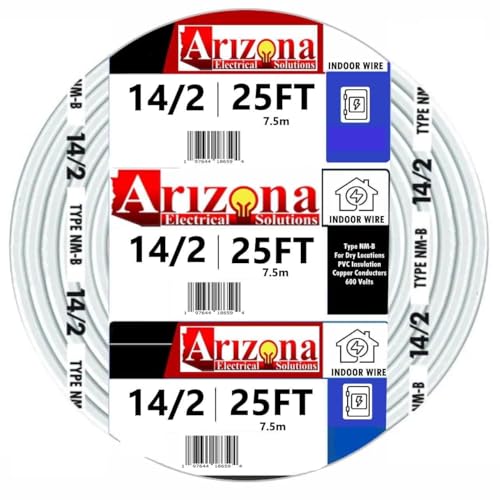
Twenty-five feet is exactly enough to add one outlet without buying a full spool.
Most indoor electrical jobs are small — an extra receptacle, a relocated switch, a ceiling fan. This is the cable sold for precisely that size of job, and at 25 ft it is a quarter of the length of the Ancor marine spool in this list.
The construction is standard residential NM-B: two insulated 14 AWG conductors plus a bare copper ground, rated 600 volts, ready for 15 amp branch circuits. It is solid copper, not stranded, so it holds its shape once pulled. The white outer jacket follows the familiar color code for 14 gauge cable, which means anyone inspecting the work reads the size at a glance.
Wire diameter is listed at 1.63 millimeters, which tells you this is a slim jacket profile — the flat sheath pulls through studs and joists during rough-in and strips cleanly at the box. Sold copper conductors run lighting, wall outlets, switches, ceiling fans, and small appliance circuits in homes, garages, and workshops.
Owners use it exactly as intended: one noted it handled wiring high hats without drama. Quality and value for money are what the feedback keeps coming back to, which fits a cable that is bought to finish a job rather than to show off.
Right choice for: a single-outlet addition or a switch move where a full spool would be waste.
Wrong choice for: wet or outdoor locations — this sheath is specified for indoor dry use only.
6. GEARit 14 Gauge in-Wall Speaker Wire 100FT, CL2 Rated 14/2 CCA Wire, White

The CL2 spool with sequential foot markers printed down the jacket, so a ceiling run gets measured and cut without guesswork.
Anyone who has pulled speaker cable through a ceiling knows the problem: you measure, you run, and you come up short. This cable prints sequential foot markers on the jacket, so a 100 ft run gets measured and cut accurately instead of estimated.
The CL2 rating is the other reason to choose it. CL2 is the in-wall and in-ceiling cable classification for audio, and this jacket is flame-retardant while staying soft and flexible enough to thread through studs, corners, and tight cavities. Red and black color-coded conductors make positive and negative obvious at both ends.
Read the material line carefully, because this one differs from the pure-copper picks. The conductors are copper-clad aluminum, or CCA — an aluminum core with a copper skin. That makes the cable lighter and less costly than pure copper, and it is the honest trade for a long indoor audio run. It is not the wire for a damp location or a high-vibration install.
Weight lands at 3.2 pounds for the 100 ft coil, and the 1,200-inch length figure matches the 100 ft measurement. What buyers appreciate most is the value, then how easy it is to run and install, then the sound quality it delivers in ordinary home theater and whole-home audio setups.
The practical wins
- CL2 rating clears it for in-wall and in-ceiling audio installation
- Sequential foot markers on the jacket remove the measure-and-hope problem
- Red and black conductors keep polarity straight at both terminations
- 100 ft covers a full home theater or whole-home audio drop
The honest trade
- Copper-clad aluminum, not pure copper — lighter and cheaper, but not for wet or vibrating runs
- 3.2 pounds on a coil is bulkier to handle than a small silicone spool
- Only inside-wall rated, so outdoor speaker runs need a different jacket
Go with this: if the job is speakers inside a wall or ceiling and you want the run done in one pull with accurate cuts.
Hold off if: your speakers live outdoors or the cable will flex — pure copper or a sealed jacket serves those better.
7. 14/2 Landscape Wire 100ft Pure Copper Direct Burial ETL Listed
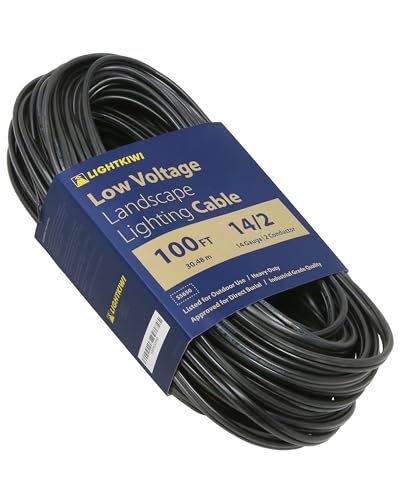
Pure copper, stranded for flexibility, and rated to go straight into the ground without conduit.
This is a deliberately different animal from the CCA speaker cable above. The conductors here are 100% pure bare copper, 41 strands per side, which the maker positions directly against copper-clad aluminum on conductivity and long-term reliability. For a run that will sit under soil for years, that choice is the whole argument.
The jacket is built for above-ground or underground installation without conduit, and it resists sunlight, moisture, dirt, and harsh outdoor conditions. It carries an ETL listing to North American safety standards, which is the credential a contractor or an inspector wants to see on a landscape job.
Applications cover the usual garden lighting spread: LED spotlights, pathway lights, deck lights, step lights, flood lights, hardscape lighting, in-ground and well lights. Each color is 100 ft, so a full garden loop is a realistic single-spool job.
Functionality is what the feedback returns to — long lighting runs work, the wire takes multiple voltage taps, and the ends strip easily for connections. The one thing to plan for: this cable is stiffer in the hand than a soft silicone spool, so give yourself room on tight turns rather than forcing a sharp bend.
The value case: pure bare copper plus an ETL listing plus a direct-burial jacket is exactly the combination a garden lighting run needs, and the 100 ft length means no mid-run splice in the dirt.
Made for: anyone running low-voltage path, deck, or step lights who wants to bury the cable and forget it.
Not ideal for: indoor speaker or branch-circuit work — you are paying for outdoor credentials you will not use.
8. Solid Indoor 14/2 W/G NMB Cable 100ft, Electrical Wire, White
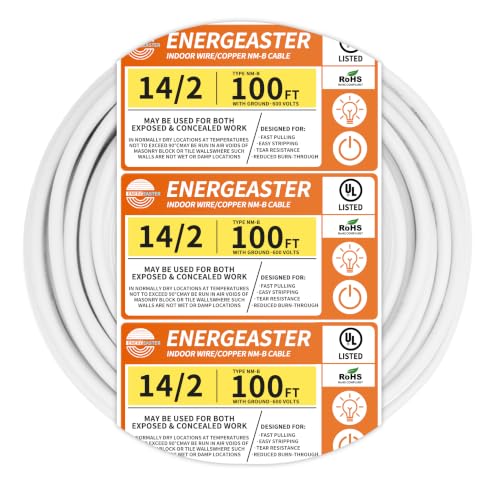
The 100 ft coil of solid 14/2 NM-B — enough to rough in several circuits across more than one room.
Take the 25 ft NM-B spool above and stretch it to 100 ft, and you have this. Same construction philosophy, four times the length, sized for a job that runs multiple outlets rather than finishing one.
The build is 2 conductor, 14 gauge solid copper with the insulated conductors in black and white laid parallel. Between them sits a 14 gauge solid bare ground, wrapped in fire-retardant paper and run parallel to the current-carrying conductors — that is the safety path back to the panel. The jacket is white, the familiar 14 gauge color code, and the voltage rating is 600 volts.
Energeaster lists this as UL listed NM-B, commonly used for branch circuits to switches and outlets and for indoor runs inside wall cavities and attics. The listing also notes NM-B cable may be run in air voids of masonry block or tile walls where those walls are not wet or damp.
One practical heads-up, and it is the recurring theme in the feedback: this cable is described as difficult to strip, even by people who find running it up and down walls a breeze. A proper NM-B stripping tool pays for itself once you’re stripping dozens of terminations on a 100 ft rough-in.
Choose it if: you are roughing in a whole room or adding several circuits indoors and want one UL listed coil to work from.
Consider a smaller spool if: the job is one outlet — you will be storing leftovers and fighting that stiff sheath for no reason.
Understanding the Specs
Stranding: what 41 strands versus 400 strands means
Stranding is how many individual thin copper wires are bundled into one conductor. A 400-strand conductor like the silicone spools here bends like rope and handles repeated flex without work-hardening. A coarser stranded conductor, such as the 41-strand cables, is stiffer but easier to push through a long run. And a solid conductor — the NM-B cables — is a single core that holds its shape and stays put inside a wall. Pick the stranding that matches the movement the wire will see: 400-strand silicone for flex, 41-strand for pull-through, solid for walls.
Jacket and location ratings: CL2, NM-B, IP68, direct burial
The jacket rating tells you the places the wire is allowed to live. CL2 marks a cable intended for in-wall and in-ceiling audio installations. NM-B is non-metallic sheathed indoor building cable for branch circuits. IP68 is a sealing rating against dust and water immersion. Direct burial means no conduit is required underground. Matching the jacket to the location is the one decision you cannot correct later without pulling the wire back out of the wall or the ground.
Conductor material: bare copper, tinned copper, and CCA
Bare copper carries current with the least resistance and suits most general wiring. Tinned copper adds a thin tin coating to each strand, which slows corrosion in damp and marine settings and makes solder flow more easily. CCA, or copper-clad aluminum, uses an aluminum core under a copper skin — lighter and less expensive, and fine for supported indoor audio runs, but not meant for moisture or heavy vibration.
Voltage, current, and temperature ratings
A voltage rating states the highest circuit voltage the insulation is built to handle — most options here are rated 600 volts, which comfortably covers low-voltage accessory work. A current rating, in amps, states how much current the conductor is intended to carry; 15 A is the typical figure for 14 gauge branch circuits, while some silicone spools are listed higher. Temperature range tells you the extremes the jacket survives, which is why silicone spools list figures like minus 140F to plus 392F while indoor NM-B cable is specified for dry locations.
FAQ
Can I use 14 gauge speaker wire for regular household outlets?
What is the difference between solid and stranded 14 gauge wire?
Can I bury the NAOEVO 14 gauge wire in the ground?
How much current can 14 gauge wire safely carry?
Why are the red and black wires on the MILAPEAK spool not connected?
Is tinned copper better than bare copper for a boat?
What does CL2 rated mean on speaker wire?
Does 14 gauge wire work for a 15 amp circuit?
Why do some 14 gauge spools cost so much more than others?
How do I strip silicone wire without tearing the insulation?
Final Thoughts: The Verdict
Match the wire to the job and the choice stops being hard. For anything wet, vibrating, or exposed — a boat, a dock, a sun-baked accessory run — the Ancor Tinned Copper Primary Wire is the pick, with tinned copper conductors and a jacket rated for salt water, oil, and UV (ultraviolet light, which breaks down ordinary insulation). If your problem is heat and tight routing rather than water, the MILAPEAK silicone spool folds into places the stiffer cables will not go.
For an outdoor lighting project that ends underground, reach for the Lightkiwi direct-burial landscape wire — pure bare copper with an ETL listing (ETL is a safety-testing mark, like UL) — so it can go straight into the ground without conduit. If you are inside the walls instead, the GEARit CL2 speaker cable or the energeaster solid NM-B coil covers audio and branch circuits respectively. Buy the jacket rating that matches where the wire will live — CL2 in a wall, direct burial underground, NM-B indoors — and the 14 gauge takes care of itself.
How We Picked
We do not accept paid placement. Every pick is matched to a real buyer and a real use-case; we do not hands-on test units.
Sources & Methodology
Specifications: manufacturer listings and product documentation. Review insights: verified customer reviews, as of November 2026. Pricing: not shown on this page (it changes often); check the current price via the retailer link.
As an Amazon Associate, Gadgets Feed earns from qualifying purchases. This does not affect which products we feature.