
Our readers keep the lights on and my morning glass full of iced black tea. As an Amazon Associate, I earn from qualifying purchases.
Specs are compiled from manufacturer listings and verified buyer reviews and can change over time — please confirm the key details on the product page before buying.
Cutting dense masonry—concrete pavers, retaining wall blocks, thick flagstone—is the toughest test a saw blade can face. Too many blades overheat mid-cut, lose their edge after a few passes, or wobble dangerously at high RPM. The right 14-inch abrasive blade cuts through dense masonry with clean edges and minimal strain on your saw.
I’m Min — the founder and writer behind Gadgets Feed. This guide is built by comparing the manufacturers’ published specifications and the patterns across verified customer reviews, so you get each pick’s real strengths and trade-offs instead of marketing spin.
After sorting through cutting performance, durability, and value across seven models, one blade stands clearly above the rest — and that winner is the 14 inch masonry abrasive blade you will find at the top of this list.
Our Picks at a Glance


How To Choose The Best 14 Inch Masonry Abrasive Blade
A 14-inch masonry blade is a significant investment in both time and material. Choosing the wrong blade leads to slower cuts, more dust, and premature wear. Focus on these three factors when choosing.
Blade thickness and bond matrix
Thicker blades, around 0.13 inches, resist warping when you hit steel rebar or dense natural stone. A thinner blade, like 0.11 inches, cuts faster but is more susceptible to wobble in tough material. The bond matrix—how tightly the diamond particles are held—determines whether the blade self-sharpens or glazes over. A soft bond works best on hard stone; a hard bond lasts longer on soft brick.
Arbor compatibility and segment design
Most 14-inch blades come with a 1-inch arbor and include a 20mm bushing. Some also include a 5/8-inch reducer ring for smaller saws. Check your saw’s arbor nut before buying. Segmented rims—where the diamond rim is divided by slots—clear debris faster and run cooler in deep cuts, making them the standard for masonry work.
Wet vs dry cutting and max RPM
A blade labeled for both wet and dry cutting gives you flexibility. Dry cutting generates more dust and heat, so the blade needs cooling slots to survive. The maximum safe operating speed is printed on every blade—5,500 RPM is typical for 14-inch diameter. Never exceed it. Running a blade too fast can cause the core to crack.
Quick Comparison
| Model | Best For | Thickness | Weight | Arbor | Amazon |
|---|---|---|---|---|---|
| Delta Diamond Boss Hog★ Best Overall | Hard stone endurance | 0.11 Inches | 1.97 kg | 1″-20mm | Amazon |
| KimiBEE LSS14Budget Champion | Budget value | 0.125 Inches | 2 lb | 5/8″ | Amazon |
| RHAPSODY 14 | Versatile daily driver | 0.13 Inches | 1.84 kg | 1″-20mm | Amazon |
| FEWELL 14 | Mid-range all-rounder | 3.2 mm | — | 1″-20mm | Amazon |
| ORIXTREME SSG12350 | High-volume pro cutting | 0.13 Inches | 1.75 kg | 1″-20mm | Amazon |
| Trabo TB140SM | Light & tough rebar work | 0.12 Inches | 1.88 kg | 1″ + 7/8″ ring | Amazon |
| Diablo DMADS1400 | Premium clean finish | 3.2 mm kerf | 4.4 lb | 1″-20mm | Amazon |
In‑Depth Reviews
1. Delta Diamond Boss Hog 14 Inch Turbo Premium Diamond Blade
Our pick — over 4.5★ from 550+ verified ratings; the strongest balance of quality and price.
The 14-inch blade that survived 6 straight hours on hard stone where two others died in 1.
The Boss Hog excels on granite, thick retaining blocks, and extended high-speed cutting. It is a continuous-rim turbo blade, meaning it leaves a remarkably smooth finish—no ragged edges—yet still moves fast thanks to its turbo-segment design. Buyers report it “outlasted two other brands (1 hour) by cutting hard stone for 6 hours straight,” which explains why cutting performance is what owners praise most. The blade runs wet or dry, and the cooling holes are positioned to handle continuous construction use without warping. At 0.11 inches thick, it is slimmer than some rivals, but the premium bond matrix keeps it stable up to 5,460 RPM.
One thing worth noting: the Boss Hog is heavier than the RHAPSODY 14 below—1.97 kilograms versus 1.84 kilograms—so you feel the extra heft on a handheld saw. That weight is also a sign of a dense, durable core that resists deflection. The lifetime warranty covers warping and cracking, which takes the sting out of the premium price tag. For the sheer number of praise mentions—cutting performance leads by a wide margin, followed closely by quality—this is the crowd favorite. If you are cutting hard stone daily, the Boss Hog earns its keep.
Continuous-rim advantage
- Cuts hard granite dry like butter with zero deflection — novice users succeed on first try
- Cools effectively during long runs thanks to dedicated cooling holes
- Lifetime warranty against warping, cracking, and material defects
- Works on a wide range of materials: masonry, brick, block, pavers, concrete, stone
Heft and stone limits
- At 1.97 kg, it is noticeably heavier than comparable blades, tiring on long handheld cuts
- Thinner at 0.11 inches versus 0.13 inches on some rivals, which may wobble in inexperienced hands on very thick slabs
- Premium pricing puts it above the mid-range tier
Reach for this if: you cut hard stone, thick granite, or concrete daily and want a blade that outlasts cheaper options by hours.
Second-guess if: a lighter blade for occasional paver work is all you need, or your saw runs at a lower RPM.
2. KimiBEE 14 Inch Diamond Concrete Saw Blade with 5/8″ Arbor
A 0.13-inch thick blade that chews through 3,000 psi concrete with minimal wear.
The KimiBEE is the top value pick for concrete and paver work. Its critical difference is the 5/8-inch arbor, which makes it a direct fit for many smaller circular and miter saws without needing a bushing. The blade is laser-welded—diamond particles are fused, not sintered—which keeps segments attached under heavy side loads. Buyers consistently report that a single blade handles dozens of cuts on pavers and concrete block molds, and that “cut well and minimal wear on 3000 psi concrete” is a recurring scene. At 0.13 inches thick, it is actually thicker than the Boss Hog above, giving it extra stability when you lean into a cut.
The trade-off is that the KimiBEE is noticeably lighter at just 2 pounds, and its diamond concentration is geared toward general masonry rather than hard stone. It is excellent for pro and DIY owners working with brick, block, and standard concrete, but if you need a blade for reinforced concrete or thick granite, the Boss Hog is the stronger choice. Performance is the aspect owners praise most, with cutting performance a close second—both solid positives that confirm this blade delivers exactly what it promises at the lower end of the price range.
Thick & fast
- 0.13-inch thickness resists wobble and binding on long cuts
- 5/8-inch arbor fits circular saws and miter saws directly—no adapter needed
- Laser-welded segments hold firm through dozens of pavers and concrete block cuts
Stone limitations
- Not recommended for cutting thick granite or reinforced concrete with large rebar
- At 2 lb, the lighter core may flex under heavy continuous duty
Great for: budget-conscious buyers cutting pavers, brick, and standard concrete up to 3,000 psi.
Skip for: dense natural stone or high-volume daily professional use where a heavier blade lasts longer.
3. RHAPSODY 14 Inch Diamond Concrete Saw Blade, Segmented General Purpose

A 24-segment blade that cuts 16-inch cement sill plates with crisp 45-degree miters.
The RHAPSODY is the everyday workhorse for miter saws and masonry saws, handling angled cuts on dense material with ease. It has 24 segments with a tall 15mm segment height (the cutting portion is deeper, so the blade lasts longer before wearing out). Buyers describe cutting eight 4-inch x 16-inch cement sill plates with a 45-degree miter at each end, and the blade “cut beautifully with no problems.” At 1.84 kilograms, it is a lightweight blade, so your arms feel less tired during long sessions. The blade works both wet and dry, and includes a 1-inch to 20mm bushing (a metal ring that adapts the arbor hole to fit different saws). If you need a blade that stays sharp through heavy miter work, this is your pick; skip it if you mostly cut straight lines on soft materials, where a cheaper blade would do.
The catch here is mixed feedback on durability. While most owners see great lifespan on general concrete and block, a few note that segments can break off during heavy use, particularly on saws that run at very high RPM. One buyer running a Stihl TS420 noted the blade “becomes wobbly/jelly-like at full throttle,” which may point to balance QC issues on some units. That said, cutting performance and blade quality are the two most-praised aspects, and the chorus of 5-star reviews outweighs the occasional caution. This blade suits the owner who needs one reliable disc for a mix of materials—concrete, brick, block, ceramic tile—but should inspect the first few cuts for wobble at full speed.
Tall-segment cutting
- Tall 15mm segments give extra cutting material before the blade wears flat
- Handles 45-degree miters on dense cement without chipping
- Light at 1.84 kg, reducing fatigue on extended miter-saw work
Wobble caution
- Some units may exhibit wobble at very high RPM on full-size masonry saws
- Durability is rated mixed, with occasional segment breakage reported
Ideal for: miter-saw users doing mixed concrete, brick, and block cuts with clean angles.
Not ideal for: utility saws running at max throttle where a perfectly balanced blade is critical.
4. FEWELL 14 Inch Diamond Concrete Saw Blade with 15mm Segment
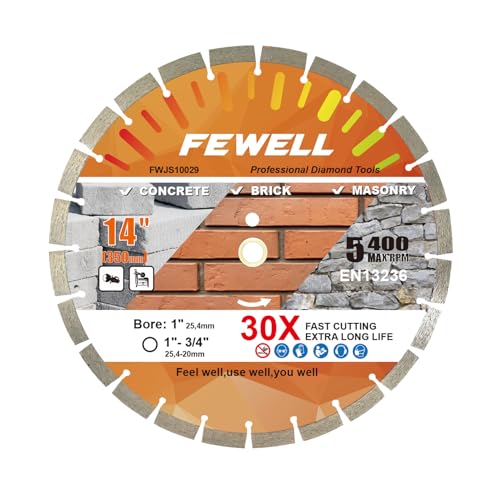
A decked-out blade that sliced through 2 dozen pavers on an old 7-inch circular saw.
The FEWELL 14-inch blade hits the balance between price and capability, giving you clean cuts on concrete steps, bricks, and landscape blocks without the premium price of the RHAPSODY. It is made with high-concentration diamonds and a high-strength steel core, with a 350mm diameter, 3.2mm thickness, 24 segments, and a 15mm segment height. Buyers with 25 years of masonry experience rate it “one of the best blades I ever used especially for the money.” One owner confirmed it “went through 2 dozen pavers with a clean cut and little pressure.” The trade-off: it is heavier than the RHAPSODY, so your arms may tire faster on long jobs.
The main thing to know: this blade is thicker at 3.2mm, so it produces a wider kerf. That means you displace more material per cut, which also means more dust. Buyers advise having an N95 respirator and a leaf blower on hand. The thick kerf is predictable once you know it is coming, and the blade comes with a 1-inch to 20mm adapter for broad compatibility. Cutting performance leads the praise by a good margin, with blade quality and value for money following close behind. If you need one blade for a long weekend of patio or retaining-wall work, the FEWELL is tough to beat at its price tier.
Thick steel build
- High-concentration diamonds and high-strength steel deliver consistent cuts on concrete and brick
- 24 segments with 15mm height provide solid lifespan for medium-scale projects
- Includes 1″-20mm adapter for most circular and masonry saws
Wider kerf trade-off
- Thick 3.2mm kerf creates more dust than thinner blades on dense concrete
- Heavy on a 7-inch grinder for precision brick cutting—a smaller grinder helps
Good fit for: DIYers and pros handling medium-volume paver and block jobs who want a sturdy blade without overspending.
Less suitable for: tight miter-saw angles where a thinner blade leaves a cleaner kerf.
5. ORIXTREME 14 Inch Diamond Concrete Saw Blade, Segmented General Purpose

A 0.13-inch general-purpose blade that burned through 80 cuts of thick paving brick in one day.
The ORIXTREME is the high-volume pick for construction workers and serious DIYers who run through a lot of block and brick. It measures 14 inches by 0.125 inches with a 15mm segment height, and is rated for both wet and dry cutting on concrete, brick, block, granite, and reinforced concrete. Cutting performance is the most-praised aspect by a wide margin, with owners reporting fast, clean cuts through concrete, brick, and block with minimal chipping. One owner counted “maybe 80 or so cuts of 2 5/8” brick before getting dull and cutting slower”—a number that rivals far more expensive blades. The blade runs cooler than many competitors and stays sharp from the start.
The catch is that cutting speed receives mixed feedback. Some owners find the blade cuts slower than expected and feels slightly dull on the first use. ORIXTREME specifically notes the blade is “not recommended for cutting asphalt and green concrete,” so if your job involves fresh or soft surfaces, this is not the right pick. At 1.75 kilograms, it is one of the lighter blades here, which helps with fatigue on handheld saws but may indicate a thinner steel core. Sharpness is a mixed aspect, so expect consistent cutting rather than lightning-fast aggression. For the price, the volume of work it handles per blade is exceptional.
High-cut capacity
- Lasts through roughly 80 cuts on 2 5/8″ brick before slowing—proven volume for the price
- Runs cooler than rival blades, reducing heat damage during long sessions
- Covers concrete, brick, block, granite, and stone with low vibration
Speed trade-offs
- Cutting speed draws mixed feedback—some owners find it slower than expected on first use
- Not recommended for asphalt or green concrete, limiting one common job site material
- At 1.75 kg, the lightest diamond blade here; may not handle rebar as well as heavier models
Excellent for: pros who cut blocks, bricks, and pavers all day and want a blade that lasts many cuts without breaking the budget.
Might not satisfy: anyone needing an aggressive, super-fast first cut through extra-hard stone or reinforced concrete.
6. Trabo 14 Inch Masonry Segmented Rim Diamond Bond Blade
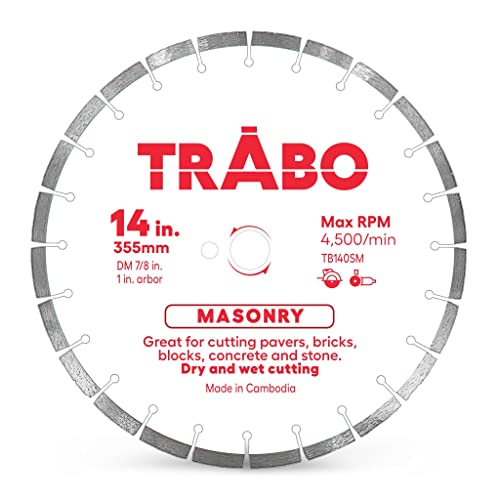
A segmented rim blade that cut 80 feet of asphalt like butter with zero wear.
The Trabo segmented blade is built for tough, unusual cuts—think engineered quartz, 20-year-old asphalt, and landscape blocks. Its carbon steel core gives a different vibration feel than the hardened steel cores on the RHAPSODY and FEWELL blades. It has a 1-inch arbor and includes a 7/8-inch brass reducer ring (a bushing to fit smaller saw shafts). Owners mention using it on a 7 1/4-inch circular saw to cut 80 feet of aged asphalt 1 to 1.75 inches deep with “no binding at max depth, no noticeable wear.” At 0.12 inches thick, it sits between thin premium blades and thick mid-range ones, balancing speed and stability. Choose this if you cut mixed or aged materials; pass on it if you only cut standard concrete, where the RHAPSODY or FEWELL will cut faster.
The honest limitation: this is not a blade for 4-inch thick concrete. As one owner put it, “Don’t plan on going through 4″ thick concrete with this.” The blade is best for light structural work—bricks, small mortar jobs, hardie backer boards, and the occasional rebar encounter. Cutting performance is what owners praise most, followed by overall performance and quality. The Trabo is a specialist: light enough for a circular saw, tough enough for rebar, but not a substitute for a heavy masonry blade on deep concrete cuts. If your projects involve weird materials—trimmed quartz slabs, old asphalt, stone veneer—this is the blade.
Unusual material master
- Cuts engineered quartz and asphalt smoothly with clean edges and no chipping
- Includes a 7/8-inch brass reducer ring for tight arbor fit on older saws
- Carbon steel core absorbs vibration differently, reducing kickback on light saws
Not built for depth
- Not suitable for cutting 4-inch thick concrete slabs—best for light to medium work
- Some buyers find it leaves a wider kerf than expected on thinner materials
Who it fits: anyone cutting mixed materials—quartz, asphalt, landscape block, stone veneer—on a circular saw or angle grinder.
Who it doesn’t: a day-long concrete cutting job where a full masonry blade handles thick slabs without binding.
7. Diablo Diamond Segmented Masonry Cut-Off Blade DMADS1400
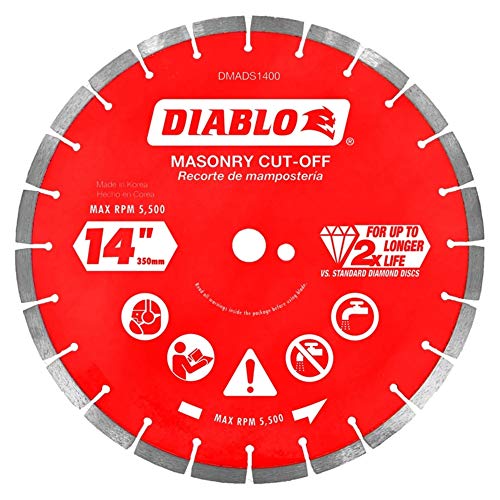
The Diablo that cut concrete cast pavers with zero effort and zero kickback.
The Diablo DMADS1400 is the brand that many pros trust on sight. This segmented blade features taller diamond segments and a strong bond that Diablo claims provides up to 2X longer life compared to standard blades. The disc body is hardened to absorb vibration and increase impact resistance. Buyers running it on a 7 1/4-inch worm drive saw report it “cut cement block like butter” with no kickback or binding. The blade has a 3.2mm kerf and a max safe operating speed of 5,500 RPM, making it suitable for high-speed electric and gas saws. It includes a 20mm bushing for broad compatibility.
The main trade-off is the arbor adapter. Customers note that the brass inserts that come with the blade “kept falling out and didn’t align too good,” requiring a few minutes of trial and error to seat properly. Once seated, though, the reviews are uniformly positive—cutting performance, functionality, and blade quality are the top aspects mentioned. Diablo is also the biggest household name on this list, which gives confidence in availability and support. If you want a brand that is stocked in every hardware store and has a reputation for reliability, the DMADS1400 is your pick. The slightly higher price reflects that brand trust and the taller segments that genuinely do extend usable life through concrete block and cast pavers.
Brand-backed endurance
- Taller segments with premium diamonds provide up to 2X longer life per blade
- Hardened disc body absorbs shock and vibration for smooth, safe cuts
- Widely available and trusted by pros for concrete, brick, and cinder block
Arbor adapter fuss
- Brass arbor inserts can fall out or misalign during installation, requiring adjustment
- At 4.4 lb, it is the heaviest blade here, tiring on extended overhead or handheld work
Reach for it: if you want a name-brand blade with proven impact resistance and longer segment life for heavy block-cutting days.
Think twice: if weight is a concern for handheld saws, or you want a plug-and-play arbor fit from the start.
Understanding the Specs
Blade thickness (0.11 to 0.13 inches)
Thicker blades resist warping when you hit reinforcement steel or dense stone. A 0.13-inch blade like the KimiBEE offers more stability on long cuts through concrete, while a 0.11-inch blade like the Boss Hog cuts faster but demands steadier hands. The 0.12-inch Trabo sits in the middle—a decent compromise for mixed materials.
Segment height and count
Segment height—measured in millimeters—tells you how much diamond material sits above the steel core. Taller segments (15mm in most picks here) last longer before the blade goes blunt. The count (24 segments in most models) determines how many cutting edges engage the material. More segments generally mean a smoother cut on hard stone; fewer segments clear debris faster on soft block.
FAQ
Will a 14-inch masonry blade fit my standard circular saw?
What does 1-inch to 20mm arbor mean for compatibility?
Can I use a dry-cut blade wet, or vice versa?
How do I know a blade is worn out and needs replacing?
What is the difference between a segmented rim and a continuous rim?
Is a heavier blade always better for masonry cutting?
Why does my blade wobble even when tightened correctly?
Can I sharpen a masonry blade when it gets dull?
What safety gear do I need for cutting masonry with a 14-inch blade?
How do I store a diamond masonry blade between jobs?
Final Thoughts: The Verdict
For most buyers, the 14 inch masonry abrasive blade winner is the Delta Diamond Boss Hog because it outlasts two rivals on hard stone while leaving a continuous-rim finish that cheaper blades cannot match. If you need a budget-friendly blade for standard concrete and pavers, the KimiBEE with 5/8-inch arbor is the smart pick. And for high-volume cutting of blocks and bricks all day long, the ORIXTREME SSG12350 delivers consistent lifespan at a price that beats the big-box store options.
How We Picked
We do not accept paid placement. Every pick is matched to a real buyer and a real use-case; we do not hands-on test units.
Sources & Methodology
Specifications: manufacturer listings and product documentation. Review insights: verified customer reviews, as of July 2026. Pricing: not shown on this page (it changes often); check the current price via the retailer link.
As an Amazon Associate, Gadgets Feed earns from qualifying purchases. This does not affect which products we feature.