
Our readers keep the lights on and my morning glass full of iced black tea. As an Amazon Associate, I earn from qualifying purchases.
Specs are compiled from manufacturer listings and verified buyer reviews and can change over time — please confirm the key details on the product page before buying.
You plug a 140W power bank into your laptop, and the charge icon barely moves. That happens because most banks that claim 140W actually deliver much less. This guide isolates the real contenders — the ones that give your MacBook Pro or Dell XPS the full USB-C Power Delivery 3.1 speed (the newest fast-charging standard that goes up to 140W through one cable) so you stay productive without a wall outlet. We focus on the battery capacity in watt-hours, the actual output wattage from a single port, and real-world build quality as reported by buyers.
I’m Min, founder of Gadgets Feed. This guide compares manufacturers’ published specs with patterns from verified customer reviews, so you get each pick’s true strengths and trade-offs.
The Anker Prime Power Bank leads the list for its reliable 220W total output and smart app controls, but several other strong options compete closely in the 140 watt power bank category. We ranked every pick by real charging performance, portability, and long-term reliability to help you choose the right one for your gear.
Our Picks at a Glance
How To Choose The Best 140 Watt Power Bank
When you need to charge a laptop on the go, the power bank’s output wattage and battery capacity are the two numbers that matter most. A 140W bank can keep a 16-inch MacBook Pro running at full speed, while lower-watt banks will only slowly drain the laptop. Here are the key specs to check before you buy.
USB-C Power Delivery 3.1 (PD 3.1)
PD 3.1 is the fast-charging standard (a set of rules that lets the charger and device talk to each other to deliver the right amount of power) that allows a power bank to send up to 140W through a single USB-C port. Without it, your laptop will charge much slower. Make sure the bank lists PD 3.1 support for the USB-C port you plan to use for your laptop.
Battery Capacity in Watt-hours (Wh)
Battery capacity is measured in milliamp-hours (mAh) and watt-hours (Wh). For airline travel, the TSA limits you to 100Wh (about 27,000mAh at 3.7V) for carry-on luggage. Any bank above 100Wh is not allowed on a flight. the balance is between 20,000mAh (about 72Wh) and 27,000mAh (about 99Wh) — enough for a full laptop charge plus several phone charges.
Total Output vs. Single-Port Output
Manufacturers often list a high total output — like 220W — which is the sum of all ports running at once. What matters for your laptop is the maximum single-port output. If a bank says “140W total” but only delivers 60W through one USB-C port, your laptop will charge slowly. Look for the single-port wattage first.
Quick Comparison
| Model | Best For | Capacity | Single-Port Max | Weight | Amazon |
|---|---|---|---|---|---|
| AsperX 25,000mAh★ Best Overall | Budget-friendly 140W | 25,000mAh | 140W | 621g | Amazon |
| Anker Prime Power BankPremium Pick | Premium versatility | 20,100mAh | 140W | 510g | Amazon |
| AsperX 27,600mAh | Aluminum build & capacity | 27,600mAh | 140W | 790g | Amazon |
| CUKTECH 15 Ultra | Ultra-fast recharging | 20,000mAh | 140W | 590g | Amazon |
| SIXTHGU PowerTower P1 | 200W total output | 20,000mAh | 140W | 320g | Amazon |
| GrnOas.E 27,000mAh | Best value capacity | 27,000mAh | 100W (shared) | 636g | Amazon |
| Ansody 25,000mAh | Entry-level 140W | 25,000mAh | 140W | 489g | Amazon |
In-Depth Reviews
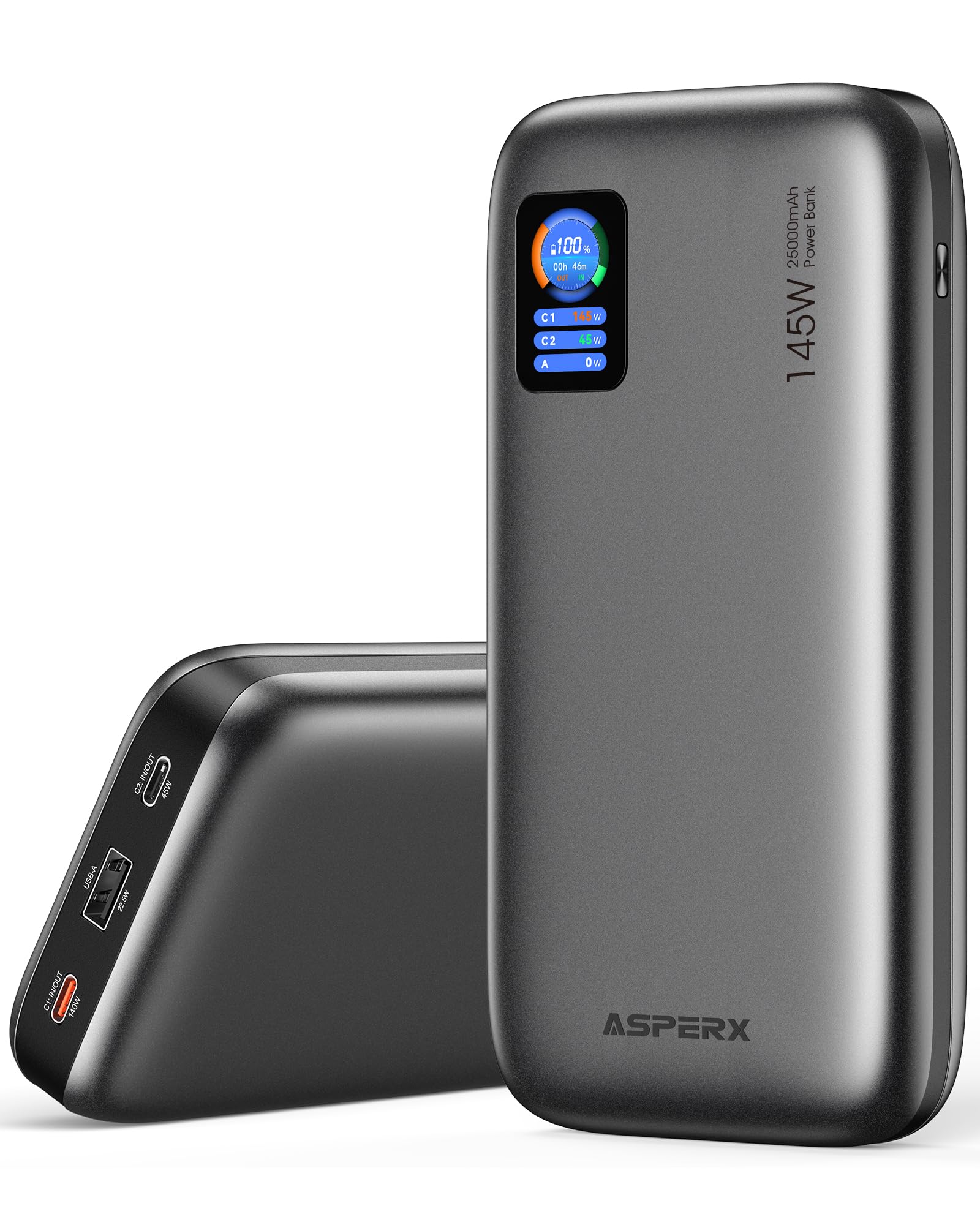
1. AsperX 25,000mAh Power Bank
Our pick — over 4★ from 900+ verified ratings; the strongest balance of quality and price.
A solid 25,000mAh bank with a smart display at a friendly entry price.
This AsperX model delivers 145W total output with a single USB-C port capable of 140W. The 25,000mAh capacity (92.5Wh) stays under the 100Wh TSA limit, so you can take it on flights. It can charge a MacBook Pro 1.3 times and an iPhone 16 4.5 times — plenty for a full day of work or travel. The TFT smart display shows real-time battery level, remaining usage time, and input/output wattage, a feature usually found on pricier models.
At 621 grams and 6.56 x 3.21 x 1.08 inches, it is slightly heavier than the Ansody below (489g) but less heavy than the AsperX 27,600mAh (790g). One owner reported it is “moderately bulky” but praised how well it holds a charge. The charging input is 65W, so the bank itself recharges in about 1.8 hours — slower than the CUKTECH’s 40-minute beast mode but still reasonable.
The main catch is some buyer reports mention reliability concerns. One customer observed the battery self-discharged from 50% to dead within a month, the display stopped working, and it caused erratic charging. Many other users report positive experiences, but this is a risk to weigh against the budget price.
Pros at this price
- 25,000mAh capacity gives good runtime for the cost
- TFT smart display with real-time status is a premium touch
- 145W total output with 140W single-port for laptops
Potential issues
- Mixed reliability reports — some units fail within weeks
- Heavier and bulkier than some competitors
Choose this if: you are on a tight budget but still need 140W laptop charging and a smart display.
Be cautious if: you need a long-term reliable device — consider the Anker or CUKTECH for better consistency.
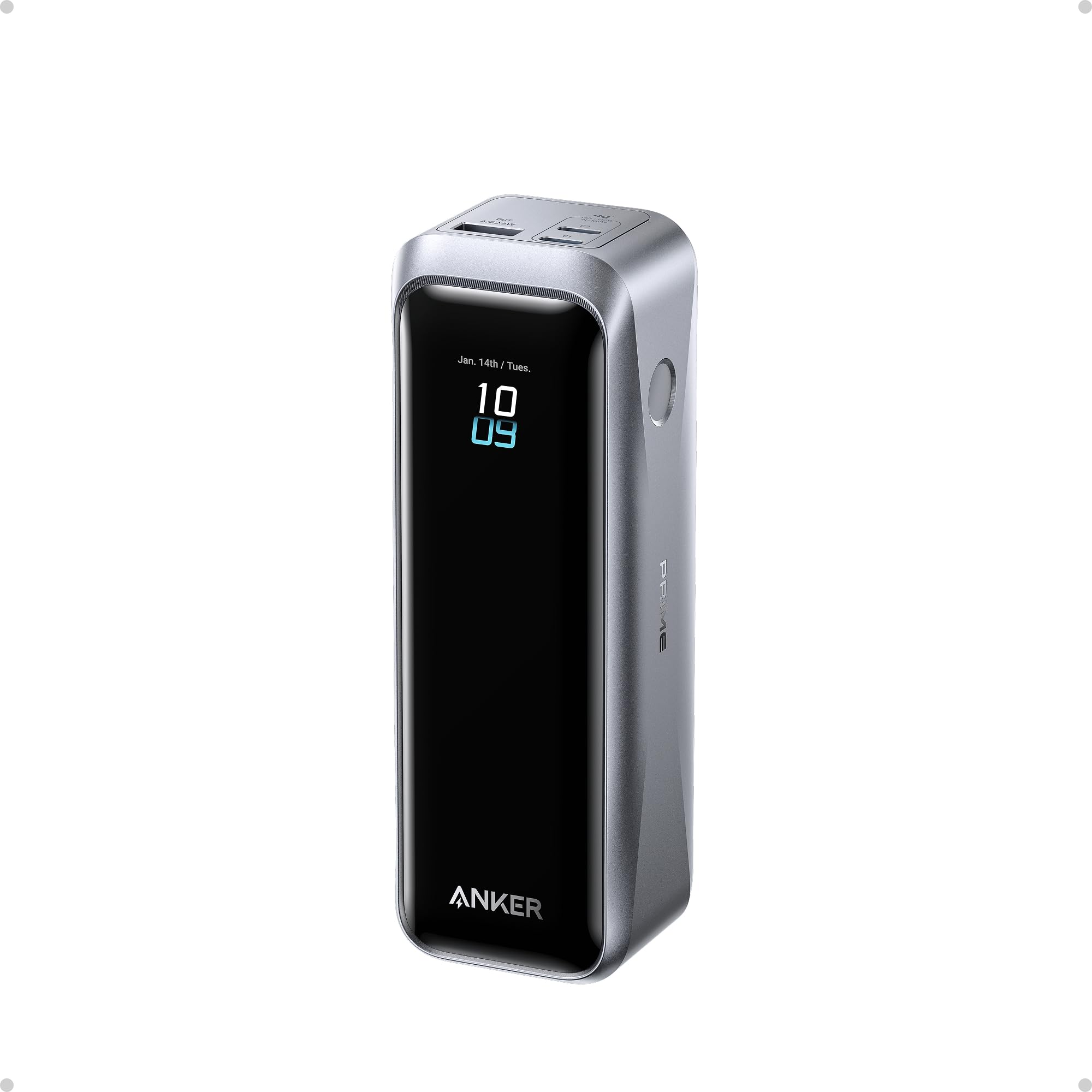
2. Anker Prime Power Bank
This power bank negotiates properly with picky laptops and looks premium doing it.
You get the most reliable charging across different devices. The Anker Prime delivers a total 220W across three ports (two USB-C and one USB-A) with a 140W max single-port output. That means you can plug a 16-inch MacBook Pro into the USB-C port and get it to 50% in 28 minutes. Buyers report it handled a “picky” work laptop that other power banks failed to charge consistently, a strong sign its PD negotiation (the handshake between charger and device) is spot-on.
At 510 grams and 1.75 inches thick, it is fairly compact for its 20,100mAh capacity. The real standout is the 100W max input, which lets you recharge the bank itself to 50% in 25 minutes. You can also pair it with the optional magnetic base (sold separately) to keep it topped up on a desk. Reviewers consistently praise the solid build and the smart display that shows real-time power flow and estimated charge time. The trade-off is capacity — at 72.36Wh, it falls short of the 99Wh limit, so you get less total juice than the 27,000mAh options below.
For TSA approval, it is well under the 100Wh limit, so it is safe for carry-on. The included 3.3-foot USB-C cable supports the full 240W spec, so you are ready for future devices too.
Reasons to go with it
- 220W total output handles laptop, phone, and tablet at once
- Reliable PD handshake — no failed connections with finicky laptops
- Fast self-recharging: 50% in 25 minutes at 100W input
The trade-offs
- 20,100mAh is lower than the 27,000mAh competitors
- Premium price reflects the brand and build quality
Your best bet if: you need a reliable, premium power bank that charges your laptop fast and handles multiple devices without negotiating issues.
Consider a different pick if: you want maximum runtime on a single charge — the 27,000mAh options offer significantly more capacity.
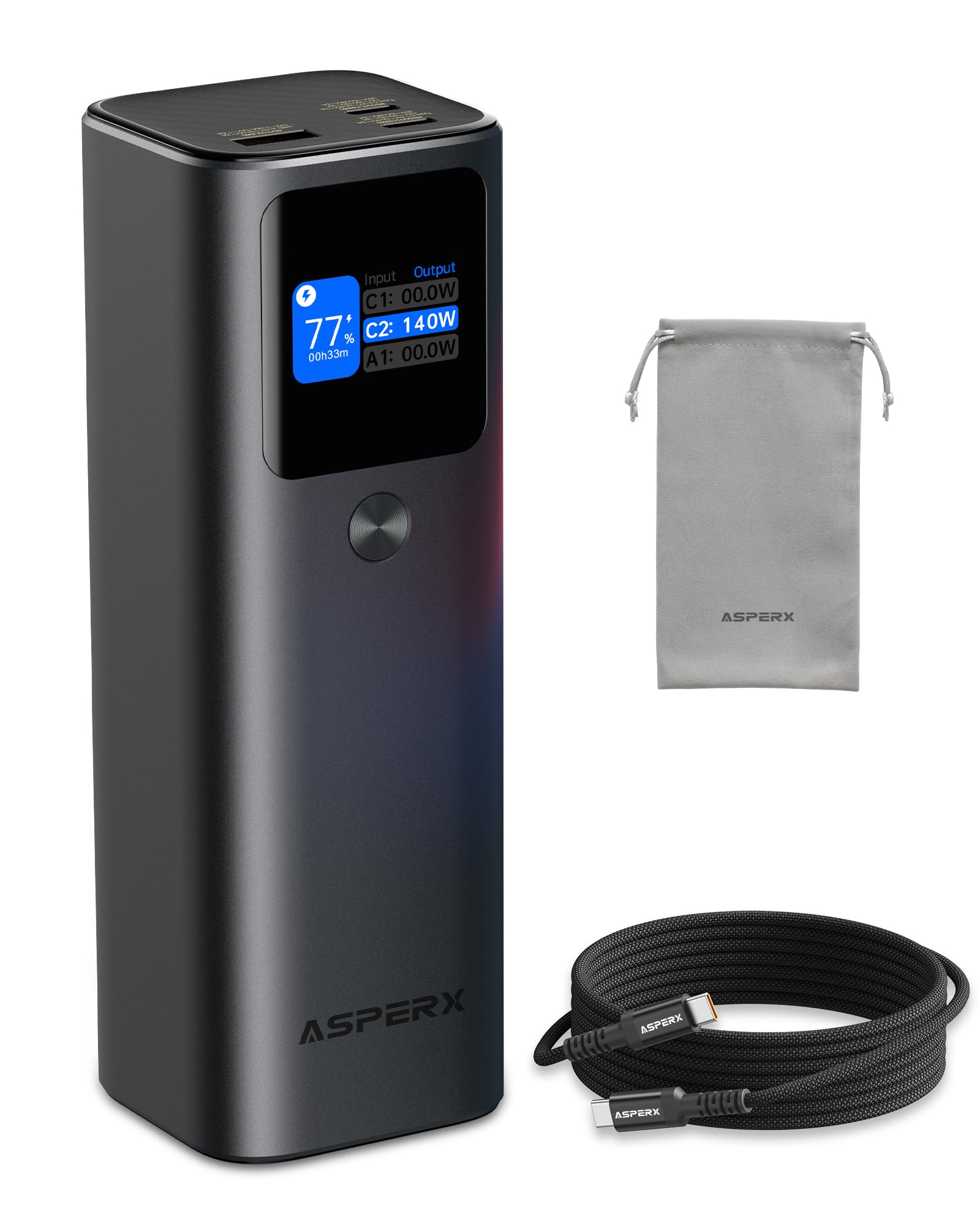
3. AsperX 27,600mAh Power Bank
Huge capacity meets a premium aluminum body that stays cool under load.
If your priority is raw capacity without going over the 100Wh airline limit, this AsperX hits 27,600mAh (99.36Wh) — right at the TSA ceiling. That gives you enough juice to charge a laptop plus a phone multiple times across a full travel day. The single USB-C port delivers 140W, and the bank can pump out a total of 162.5W to all ports simultaneously. Unlike many plastic-shell competitors, the aluminum unibody casing helps dissipate heat 40% better, which keeps charging stable. This makes it a better choice than the Anker if you need maximum runtime, because its 27,600mAh capacity is 37% higher than the Anker’s 20,100mAh.
At 790 grams, this is the heaviest pick on the list — noticeably heavier than the Anker’s 510g or the CUKTECH’s 590g. You will feel it in a backpack pocket. The trade-off is a larger TFT (thin-film transistor) display that shows battery level, remaining charge time, and input/output power at a glance. Owners mention the retractable USB-C cable on the unit is handy for preventing tangles in a bag. One reviewer noted the 99.36Wh rating means it is approved for carry-on flights.
The included 240W USB-C cable is future-proof for upcoming laptops. A 24-month warranty adds confidence.
Why it stands out
- Highest capacity (27,600mAh) while staying under 100Wh for flights
- Aluminum body improves heat dissipation and feels premium
- Retractable USB-C cable reduces cable mess in a bag
Downsides to note
- Heavy at 790g — one of the heaviest power banks in this class
- Battery drains faster when charging high-power laptops
Reach for this if: you need maximum portable power for long trips and want a durable premium build that won’t overheat.
Look elsewhere if: weight and pocket portability are your main concerns — the Anker is significantly lighter.
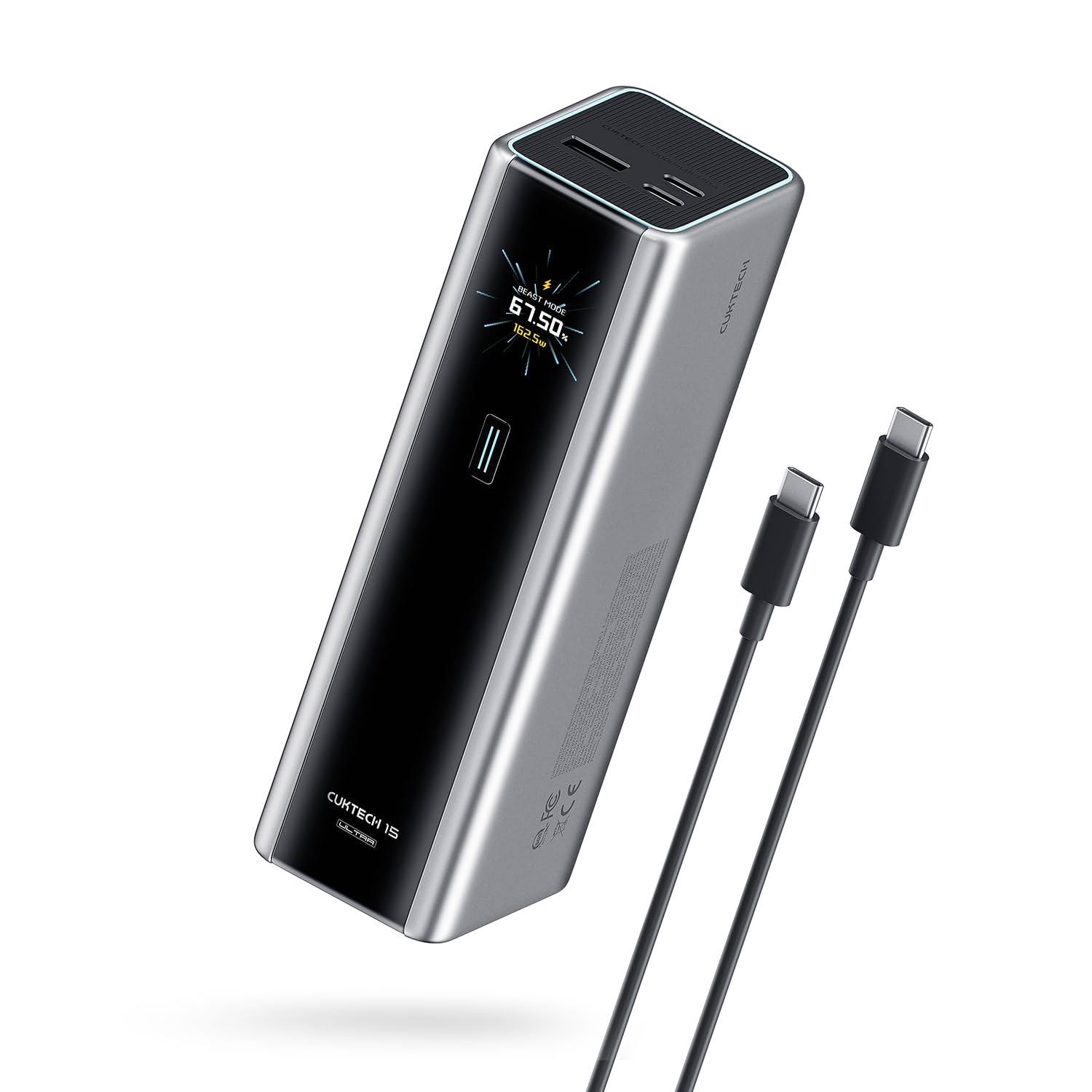
4. CUKTECH 15 Ultra Power Bank
It recharges itself from flat to full in 40 minutes — that is genuinely fast.
This is the pick for anyone who hates waiting for their power bank to recharge. The CUKTECH 15 Ultra supports what reviewers call “Beast Mode” charging: you plug it into two USB-C inputs simultaneously (100W + 65W) and it goes from 0% to 50% in 10 minutes, 80% in 30 minutes, and full in 40 minutes. That is dramatically faster than the Anker Prime (which takes about 50 minutes to full). It delivers a total 165W output across ports with a max 140W single-port charge for your laptop.
At 20,000mAh and 590 grams, it is in the middle for weight but below the capacity of the AsperX 27,600mAh. The TFT smart display shows real-time power flow and temperature warnings. Reviewers praise its build quality as on par with Anker. One buyer mentioned it is “super fast charge and discharge” and that the quality is better than Ugreen. The wide device compatibility list includes most major laptops, tablets, phones, and gaming handhelds like the Steam Deck and ASUS ROG Ally.
The main downside is the 20,000mAh capacity — that is 28% less than the 27,600mAh AsperX. You will get fewer full laptop charges before needing to recharge the bank itself. But if you are often near a wall outlet, the fast self-recharge makes that trade-off worthwhile.
Where it excels
- Ultra-fast self-recharging: 0% to full in 40 minutes
- High build quality — buyers compare it favorably to Anker
- Compact size for a 20,000mAh bank at 5.98 x 2.25 inches
Where it falls short
- 20,000mAh is lower than the 27,000mAh options by a 28% margin
- Heavier than the SIXTHGU at 590g vs. 320g
Get this if: you value fast self-recharging and want a bank that tops up in under an hour for daily use.
skip it if: you need maximum runtime for multi-day trips — the 27,000mAh banks give you much more staying power.
5. SIXTHGU PowerTower P1

A 200W output bank that weighs only 320 grams — that is half the weight of most competitors.
This is the lightest power bank on the list by a wide margin. At 320 grams, it is roughly half the weight of the AsperX 27,600mAh (790g) and 190g lighter than the Anker (510g). Despite the low weight, the SIXTHGU still delivers a true 200W total output and 140W single-port max, so you can charge a 16-inch MacBook Pro (M4 Pro) to 50% in 28 minutes. The 20,000mAh capacity is the same as the CUKTECH, so runtime is comparable.
Customers note it is not pocket-sized — one buyer commented “it’s not very compact” — but the trade-off in size is worth it for the weight savings. You can charge three devices at once, and the smart digital display shows real-time input/output power and estimated charge time. A buyer mentioned charging a MacBook fully and still having 62% battery left after also charging two phones. The included 240W USB-C cable supports the high-speed charging.
Build quality feels solid despite the low weight. The only real limitation is the 20,000mAh capacity — if you need to charge multiple laptops in a day, the 27,000mAh options will last longer before needing a recharge.
The strongest points
- Ultra-light at 320g — half the weight of many competitors
- 200W total output with 140W single-port charging
- Good real-world capacity — charges a MacBook and two phones with power left over
What to keep in mind
- 20,000mAh capacity is not the largest available
- Not compact enough for a pocket despite the weight advantage
Best suited for: travelers and commuters who want high output without lugging around a heavy brick.
Consider a heavier option if: you need the maximum runtime for multi-day camping or extended work trips.
6. GrnOas.E 27,000mAh Power Bank

The biggest battery capacity for the money, but be careful with the shared port output.
The GrnOas.E offers 27,000mAh (99.9Wh) — tied with the AsperX 27,600mAh for the most juice. That is 35% more capacity than the 20,000mAh options. The USB-C1 port can output up to 140W, so it will charge your laptop at full speed. However, when you use all three ports simultaneously, the power distribution drops to 100W on USB-C1 and 15W shared across the other two ports. That means if you need to charge a laptop and two phones at once, your laptop gets only 100W instead of 140W.
At 636 grams, it is only 15g heavier than the AsperX 25,000mAh — a negligible 2% gap — but it packs 2,000mAh more capacity. Reviewers praise the build quality and the smart display. One user highlighted it “barely decreases in charge” after days of use, suggesting good self-discharge performance. The aluminum alloy body improves heat dissipation and feels sturdy. A 24-month warranty adds security.
The biggest drawback is the shared output limitation. If you typically charge only your laptop or only a phone, this is great value. But if you regularly need to charge a laptop plus multiple devices at full speed, the Anker or SIXTHGU handle multi-device distribution better.
Strengths
- 27,000mAh capacity provides the most runtime per charge
- Very little self-discharge — holds charge well between uses
- Aluminum build feels durable and helps with heat
Weaknesses
- Shared port output caps laptop charging at 100W with multi-device use
- Heavier than most 20,000mAh competitors
Reach for it when: you want maximum capacity on a budget and usually charge one device at a time.
pass on it if: you often charge a laptop plus multiple other devices at full speed simultaneously.
7. Ansody 25,000mAh Power Bank
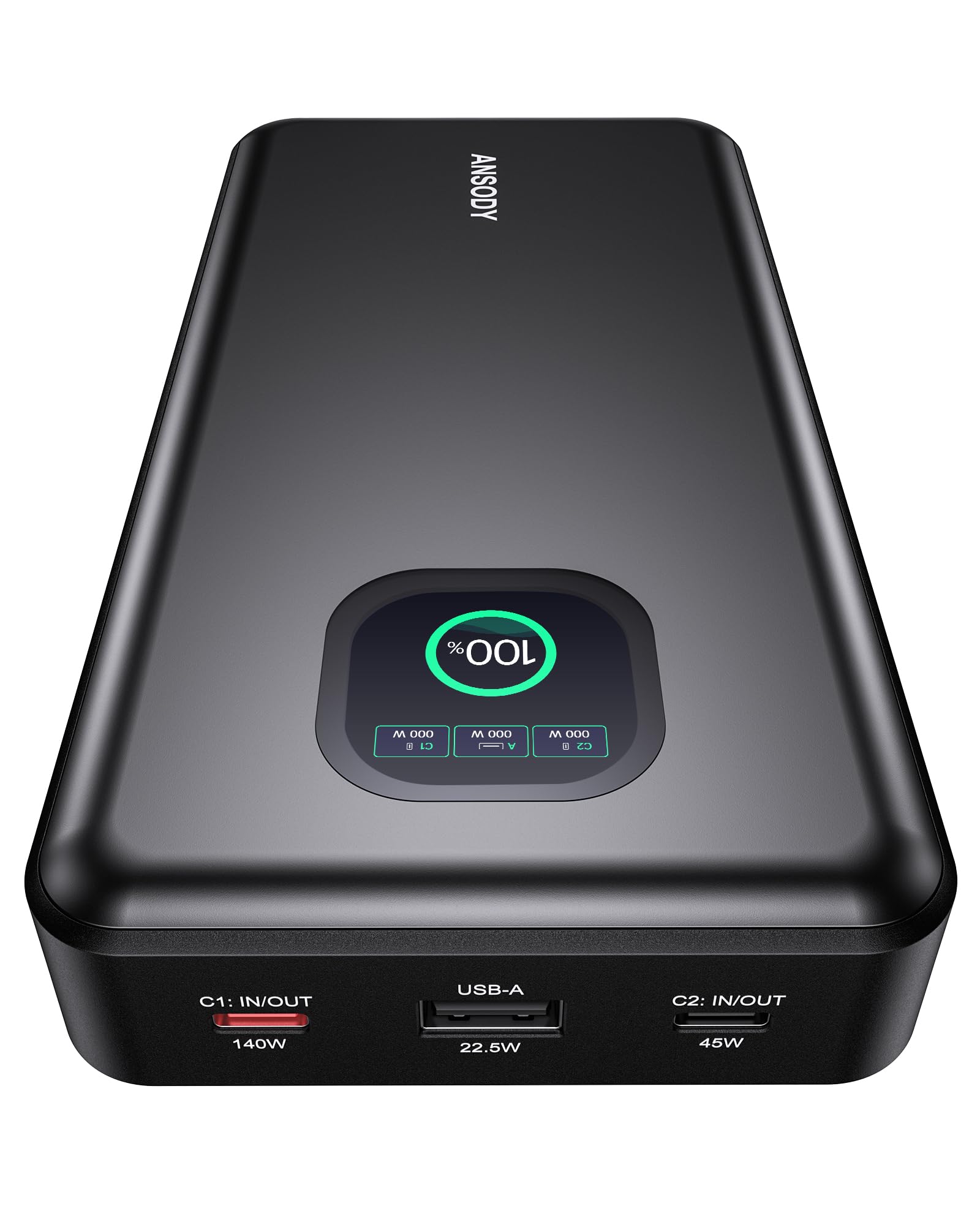
An affordable 25,000mAh option that gets the job done, but with some caveats.
The Ansody is the most budget-friendly pick for 25,000mAh capacity with 140W single-port charging. It delivers 145W total across two USB-C ports and one USB-A. It can charge a 14-inch MacBook Pro to 50% in under 40 minutes, and the 25,000mAh capacity means you can charge an iPhone 15 about 4.3 times. At 489 grams, it is lighter than the AsperX 25,000mAh (621g) and close to the Anker (510g), so it is reasonably portable for a large-capacity bank.
The build uses lithium polymer cells (LiPo), which are generally safer and have a longer lifespan than the lithium ion cells in some competitors. The smart display shows remaining power and input/output wattage. One shopper added it worked well with a Dell laptop and purchased a second unit. However, the manufacturer states that due to energy conversion efficiency and circuit losses, the effective capacity is about 65% of the 25,000mAh rating — roughly 16,250mAh usable. That is common for power banks, but not every brand is this honest.
A few reviewers reported units that arrived defective or could not be charged. One called it “misleading” due to the weight (it is heavy) and returned it. A 24-month warranty and lifetime technical support offer some protection, but mixed early reviews suggest some quality control variance.
Positives
- Affordable entry into 140W charging with 25,000mAh capacity
- Lighter than the AsperX 25,000mAh at 489g vs. 621g
- Honest about efficiency — clear on 65% usable capacity
Negatives
- Mixed reliability reviews — some units arrive defective
- Usable capacity is only ~16,250mAh after efficiency losses
Worth it for: budget-conscious buyers who need 140W output and know real-world capacity is lower than the sticker.
Not ideal if: you need a proven reliable device from a more established brand with consistent quality.
Understanding the Specs
Power Delivery (PD) and PD 3.1
USB-C Power Delivery (PD) is the fast-charging standard that lets power banks communicate with your devices to deliver the right amount of power quickly. PD 3.1 is the latest version, supporting up to 140W via a single USB-C cable. Without it, your laptop might only get 60W or less, which means it will charge slowly or even lose battery while you use it. For any 140W power bank, make sure the USB-C port explicitly lists PD 3.1 support.
Watt-hours (Wh) and the 100Wh Airline Rule
Watt-hours (Wh) measure the total energy a power bank can store. The TSA limits you to a 100Wh battery in carry-on luggage — that includes power banks. A 20,000mAh bank is roughly 72Wh, a 25,000mAh bank is about 92.5Wh, and a 27,000mAh bank hits around 99.9Wh. All of these are allowed. Anything above 100Wh — like a 30,000mAh or larger — will be confiscated at security. Always check the Wh rating, not just the mAh number.
Pass-Through Charging
Pass-through charging lets you plug the power bank into a wall outlet while it simultaneously charges your phone or laptop. This is a huge convenience for overnight travel — you wake up with both the bank and your devices at 100%. Not all power banks support this, so check the product details. The AsperX 27,600mAh specifically mentions pass-through charging support.
Smart Display
A smart display (often called a TFT display) shows real-time information like battery capacity, input and output wattage, and estimated remaining charge time. This is better than guessing based on a row of four LED dots. Most premium 140W power banks include this feature, but quality varies — some show just a percentage, while others show live power flow and temperature warnings. It helps you know exactly when to recharge the bank.
FAQ
Can a 140W power bank charge a MacBook Pro at full speed?
What is the difference between total output and single-port output?
Will a 27,000mAh power bank fit in my carry-on luggage?
How long does it take to recharge a 140W power bank?
Can I charge my phone and laptop at the same time with a 140W power bank?
What does 99Wh mean and why is it the limit?
Is a 20,000mAh power bank enough for a full day of laptop work?
Do I need a special cable for 140W charging?
Can an iPhone 16 charge at 140W with a power bank?
What is the difference between lithium ion and lithium polymer batteries in power banks?
Final Thoughts: The Verdict
For most buyers, the 140 watt power bank winner is the Anker Prime Power Bank because it delivers reliable 140W single-port charging, excellent multi-device distribution, and the fastest self-recharging speed in a compact premium build. If you want maximum raw capacity for long travel days, grab the AsperX 27,600mAh. And for the best balance of high output and ultra-light portability, the SIXTHGU PowerTower P1 stands out at half the weight of most competitors