
Our readers keep the lights on and my morning glass full of iced black tea. As an Amazon Associate, I earn from qualifying purchases.
Specs are compiled from manufacturer listings and verified buyer reviews and can change over time — please confirm the key details on the product page before buying.
You want a room that actually gets cold, not a box with a big number on it. That is the trap with a 14000 BTU portable air conditioner: the number on the box is often ASHRAE-rated (a generous, old-school lab score), while the cooling you actually feel is the SACC figure (a stricter, government-set number that reflects real room performance). A unit advertising 14,000 BTU might deliver only 10,000 BTU of real cooling. This list cuts through that confusion by focusing on what actually keeps a room cold: dual-hose design, inverter compressors, and honest SACC ratings. One important note upfront: this guide uses flexible matching for the 14000 BTU cooling class — accepting same-class units roughly in the 13,000 to 15,000 BTU range — so not every pick carries the exact number you searched, but each delivers comparable cooling for the same job.
I’m Min — the founder and writer behind Gadgets Feed. This guide is built by comparing the manufacturers’ published specifications and the patterns across verified customer reviews, so you get each pick’s real strengths and trade-offs instead of marketing spin.
Whether you are cooling a sweltering bedroom or a converted garage, the right unit is the difference between a room you can sleep in and one you cannot. The picks below reflect real owner experience with each unit, covering the quietest and most efficient 14000 BTU portable air conditioning unit options available now.
Our Picks at a Glance

How To Choose The Best 14000 BTU Portable Air Conditioning Unit
The single biggest mistake buyers make is trusting the headline BTU number alone. Here is what actually matters when you are standing in the store aisle or scrolling through listings.
ASHRAE vs SACC: The Number That Actually Matters
ASHRAE BTU is the older, more generous lab rating. SACC (Seasonal Adjusted Cooling Capacity) is the stricter Department of Energy figure that reflects how the unit performs in a real, hot room. A unit rated 14,000 BTU ASHRAE might be only 10,000 BTU SACC. Always look for the SACC number if you want to know how cold your room will actually get on a 95°F afternoon.
Dual Hose vs Single Hose: Why It Changes Everything
A single-hose portable AC pulls air from inside your room, cools it, and exhausts it outside. That creates negative pressure — a slight vacuum that sucks hot outdoor air back in through every gap. A dual-hose system pulls intake air from outside and exhausts hot air outside separately, so your room pressure stays balanced and the unit cools faster without fighting itself.
Inverter Compressors: Steadier Temps, Lower Bills
A traditional fixed-speed compressor clicks on at full blast, cools until it overshoots your set temperature, then shuts off completely. An inverter compressor varies its speed continuously, holding a steadier temperature and using less electricity in the process. Inverter units also run significantly quieter because they avoid the hard on-off cycling.
Room Size, Sun Exposure, and Ceiling Height
Manufacturers rate coverage under ideal conditions — shaded room, standard 8-foot ceiling, moderate climate. If your room has vaulted ceilings, west-facing windows, or sits on a top floor, treat the rated square footage as optimistic. Buy one size up, or accept that the unit will run longer to hit your target temperature.
Quick Comparison
| Model | Best For | SACC BTU | Coverage | Noise Level | Amazon |
|---|---|---|---|---|---|
| Gasbye Dual Hose 14,000 BTU★ Best Overall | Best Overall | 10,500 | Up to 500 sq. ft. | 45 dB | Amazon |
| Air Future 14,000 BTU SmartBest Value | Best Value | 10,000 | Up to 750 sq. ft. | 45 dB | Amazon |
| KAMLAM 14,000 BTUBudget Champion | Budget Champion | 10,000 | Up to 700 sq. ft. | 52 dB (48 sleep) | Amazon |
| Comfort Zone 14,000 BTU with Heat | Best 4-in-1 | 10,200 | Up to 750 sq. ft. | — | Amazon |
| Westinghouse 14,000 BTU | Best for Humid Rooms | 8,150 | Up to 700 sq. ft. | 52 dBA | Amazon |
| Temprium 14,000 BTU 4-in-1 | Quietest Sleep Mode | — | Up to 750 sq. ft. | 41 dB | Amazon |
| Westinghouse 14,000 BTU with Heat | Best for Year-Round Use | 8,150 | Up to 700 sq. ft. | 52 dBA | Amazon |
| ZAFRO Smart Inverter 14,000 BTU | Best Dual Hose Value | 10,000 | Up to 700 sq. ft. | 42 dB | Amazon |
| DREO 516S 14,000 BTU | Best for Bedrooms | 10,000 | Up to 200 sq. ft. | 45 dB | Amazon |
| Whynter ARC-1230WN 14,000 BTU | Best Large-Room Coverage | — | Up to 600 sq. ft. | — | Amazon |
| Midea Duo 14,000 BTU with Heat | Best Heat Pump | 12,000 | Up to 550 sq. ft. | — | Amazon |
In‑Depth Reviews
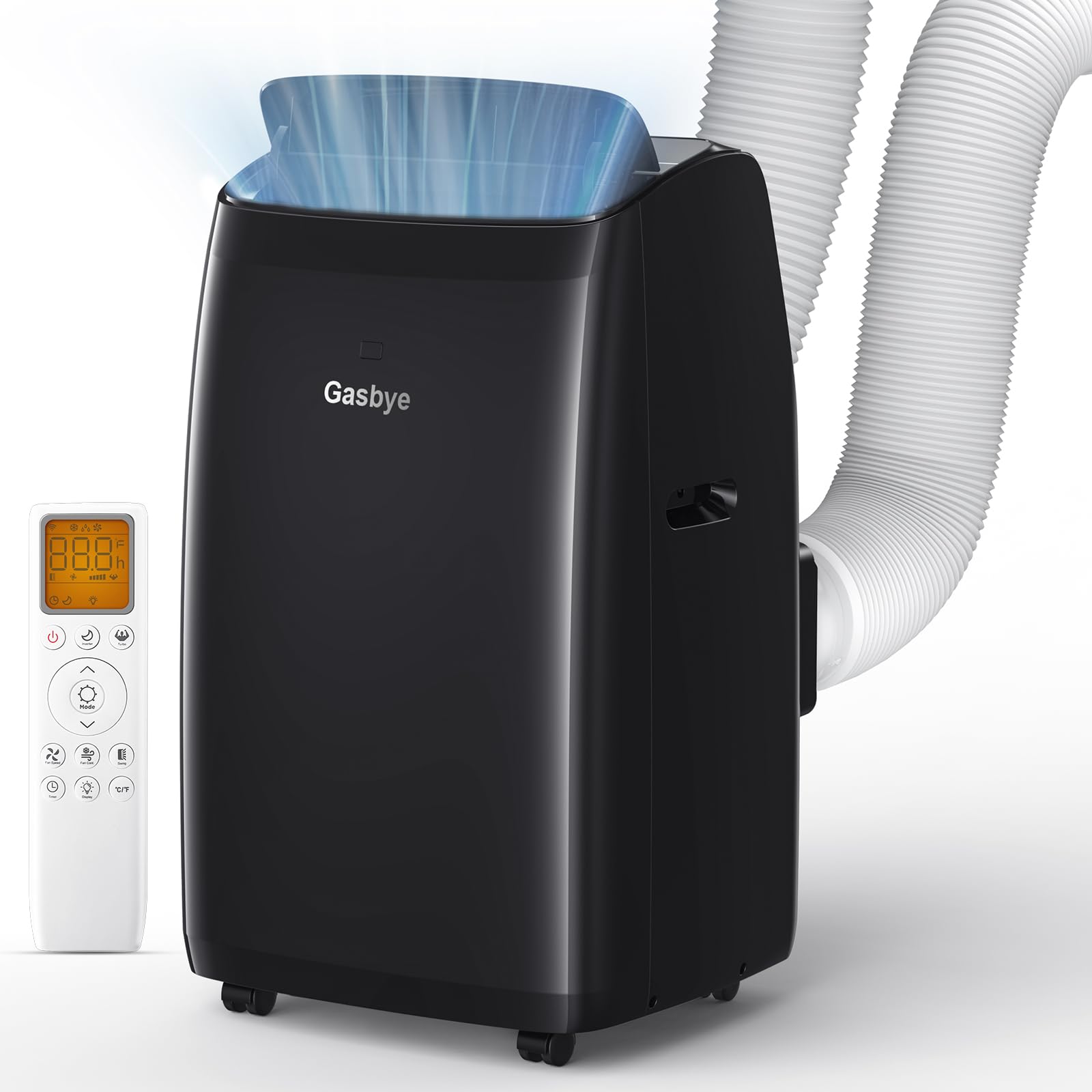
1. Gasbye Dual Hose Portable Air Conditioner
Our pick — over 4.5★ from 450+ verified ratings; the strongest balance of quality and price.
The dual-hose inverter that cools a third-floor bedroom at 95°F without breaking a sweat or the bank.
The Gasbye runs a genuine full DC inverter compressor — the kind that varies its speed instead of clacking on and off — and it is honest about its numbers. The unit claims 10,500 BTU SACC (the real-world rating) against 14,000 BTU ASHRAE, and its 13.6 CEER energy-efficiency score means it squeezes more cooling out of every watt than most competitors. That matters because a typical 10,500 BTU SACC portable AC draws around 1,300 watts at full power, while this one can drop to roughly 500–800 watts in Inverter Mode once your room hits the target temperature.
What wins people over is the cooling performance itself. Buyers report it handles a large 14’x16′ third-floor bedroom with vaulted ceilings plus a 16’x4′ loft, even at 95°F+, and the dual-hose design means it is not fighting negative pressure the way single-hose units do. At 45 dB the compressor is quieter than a normal conversation. The backlit remote and display-off feature make it genuinely sleep-friendly, and the extra drainage outlet high on the back makes manual draining far easier than bottom-outlet units when humidity climbs past 85% RH.
The honest catch: temperature control can drift. Owners note the thermostat can be off by 2–4°F from the setpoint, and in high humidity you may need to drain it every 12 hours. The included hoses are 5.9 inches in diameter and 59 inches long, so if your window sits high you should raise the unit on a stand rather than buy extension hoses, which reduce cooling performance. The 3-year quality coverage with free replacement units, and Gasbye’s reputation for replying within 12 hours, softens those edges considerably.
The Case for Gasbye
- Full DC inverter compressor with 13.6 CEER — runs at 500–800 watts in Inverter Mode instead of a constant 1,300 watts
- Dual-hose design eliminates negative pressure and the hot-air influx of single-hose units
- 45 dB operation and display-off feature for genuinely undisturbed sleep
- 3-year coverage with free brand-new replacement units and fast support response
Where It Falls Short
- Thermostat accuracy can drift 2–4°F from your setpoint
- Requires manual draining every 12 hours in high humidity
- The 5.9-inch hoses may need the unit raised on a stand in taller windows
Go here if: You want the most efficient, quietest dual-hose unit with honest SACC ratings and strong warranty backing.
Think twice if: You need pinpoint thermostat accuracy or live somewhere with extreme summer humidity that demands constant draining.
2. Air Future 14000 BTU Smart Portable Air Conditioner
A budget-friendly smart AC that punches above its class with R32 refrigerant, self-evaporation, and a 750-square-foot claim.
The Air Future cools a room with 14,000 BTU ASHRAE (10,000 BTU SACC) and uses R32 refrigerant — the newer, lower-impact coolant that replaced the older R410A in most current units. It plugs into standard 115V/60Hz household power and carries ETL certification, which is the safety listing that tells you the unit passed independent electrical testing. The 24-hour programmable timer and auto-swing louver handle scheduling and airflow, and the self-evaporation system recycles condensate to cool the condenser coils, so you are not emptying a bucket every few hours below 90% humidity.
Owners mention this unit cools a 300-square-foot top-floor room in about an hour. One owner noted it kept a room at 70°F during the day and 67°F at night, which is solid performance for a unit in this tier. The four 360° swivel casters and recessed side handles make it genuinely easy to roll between rooms. Setup is tool-free with the included window seal plate and telescopic exhaust hose, fitting both vertical and horizontal sliding windows.
Two things to know. The noise level gets mixed feedback — some owners find it surprisingly quiet, others say it is on the noisy side, so it lands in the middle ground rather than being a genuinely silent unit. And the exhaust hose connection can pop loose over time, a small flaw that a strip of duct tape solves permanently. The control panel sits on top of the unit rather than the front, which takes a moment to get used to but is easy once you know where to look.
Straight talk: At this price tier, the R32 refrigerant and 45 dB sleep mode are genuinely competitive features that usually cost more elsewhere.
One honest note: The looseness in the exhaust hose fitting is a recurring small annoyance, not a performance killer — five minutes with duct tape fixes it.
Pick this one if: You want smart features, eco-friendly refrigerant, and self-evaporation at a budget-friendly tier.
Consider alternatives if: Whisper-quiet operation is your absolute top priority, since noise feedback on this model is mixed.
3. KAMLAM 14000 BTU Portable Air Conditioner
An entry-level unit that brings 400 m³/h airflow and a 95-pint daily dehumidifier to the table for the price-conscious buyer.
For buyers who need serious airflow without stretching their budget, the KAMLAM delivers 400 cubic meters per hour through a wide 75° air outlet. That is above-average airflow for this price tier and it shows in practice — the unit cools rooms up to 700 square feet quickly. It packs 14,000 BTU ASHRAE (10,000 BTU SACC) and four modes: Cool, Fan, Dehumidify, and Auto. Cooling mode adjusts between 61°F and 86°F, and the dehumidifier pulls 95 pints of moisture per day, which is a real benefit if you are dealing with a damp basement or laundry room. The remote reaches up to 23 feet so you can adjust settings from the sofa.
User feedback highlights the speed of setup — about an hour start-to-finish — and the value for the cooling power delivered. The unit stands on four swivel casters for easy repositioning, and the LED front display is easy to read. Sleep Mode drops the fan to reduce noise to about 48 dB, down from roughly 52 dB in normal cooling mode. The 0.5-to-24-hour timer lets you preset on/off cycles to avoid cooling an empty room.
The trade-offs are worth knowing before you commit. Noise feedback is mixed — some owners find it surprisingly quiet while others say it is fairly noisy, so it is not a silent unit. And in genuinely humid conditions like a basement, you may need to drain it every 8 hours, though the unit will trigger a shutdown reminder rather than overflow. If you skip maintenance, that shutdown protection kicks in as a safety net, which is better than a soaked rug.
The value angle: 95 pints/day of dehumidification at this tier is the standout number — most budget units do not list a dehumidifier capacity this high.
Plan for this: If you live in a high-humidity region, budget for a drain hose setup or set a reminder to empty the tank every 8 hours during peak summer.
Reach for this if: You want strong airflow and above-average dehumidifying power at an entry-level tier.
Look elsewhere if: You need a verified ultra-quiet unit for a bedroom — this one performs well but its noise level divides opinion.
4. Comfort Zone Smart Portable Air Conditioner 14,000 BTU with Heat
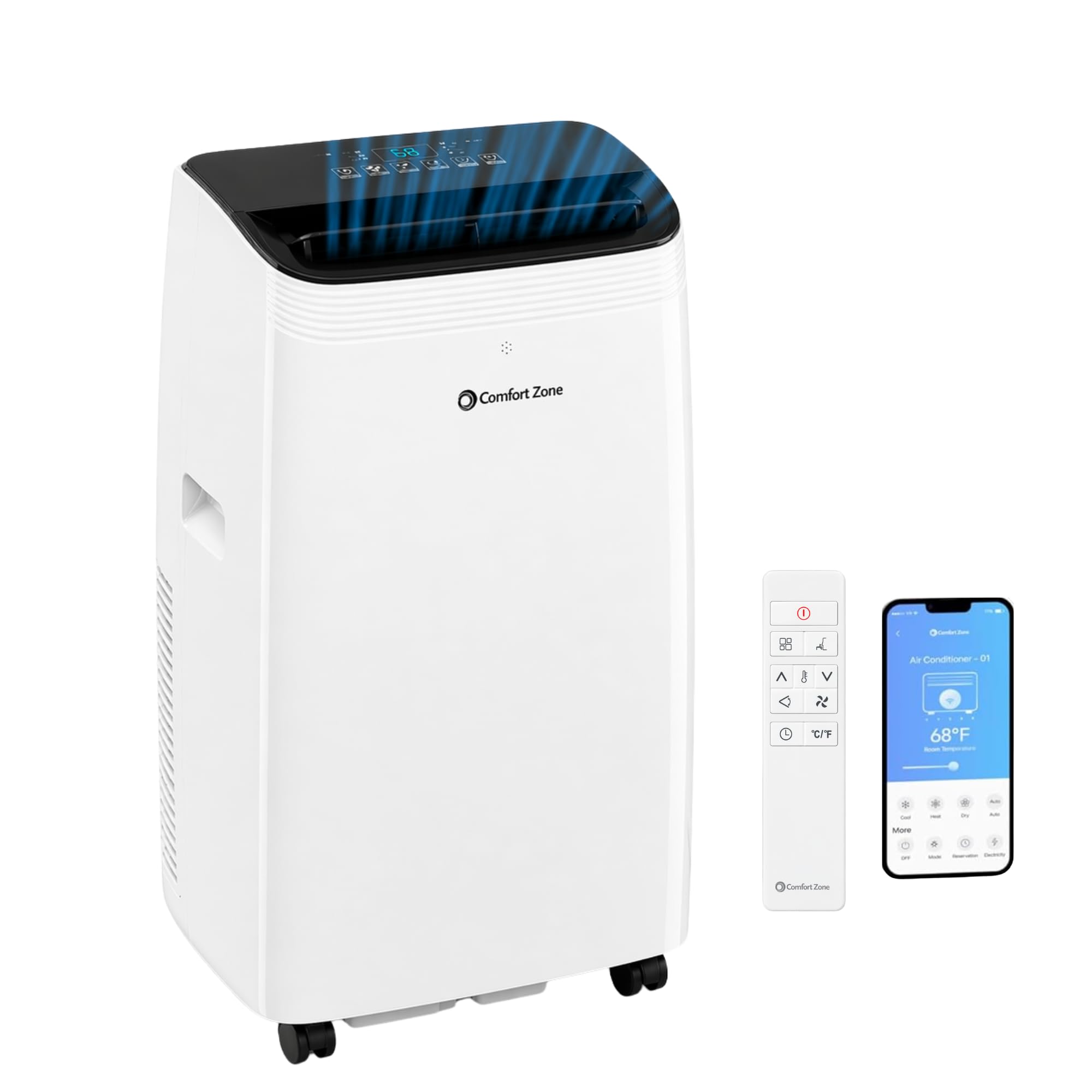
The year-round 4-in-1 that heats and cools, with WiFi app control thrown in for good measure.
The Comfort Zone brings four modes in one chassis: Cool, Heat, Dry, and Fan. That is genuinely useful for a garage, attic office, or any space that gets hot in July and cold in January. The 14,000 BTU ASHRAE (10,200 BTU SACC) rating covers up to 750 square feet, and the thermostat adjusts between 55°F and 81°F — a wider range than most units in this class. The hose-free Fan Mode is a nice touch because you can circulate air without venting anything out the window.
One owner used it in a garage, reporting easy setup, immediate cold air, and the wheels making it easy to reposition. Another noted it brought a 400-square-foot attic loft down to temperature in about 15 minutes. The Sleep Function maintains a steady temperature through the night and the 24-hour programmable timer (adjustable in 0.5-hour increments) means you can schedule cooling to start before you get home. WiFi connectivity via the app lets you adjust settings remotely.
There is one important caveat: a 14,000 BTU unit can draw enough power to trip a standard shared breaker. A buyer specifically warned that this unit needs a dedicated outlet or circuit — if your room shares a circuit with a space heater, microwave, or other high-draw appliance, you will pop the breaker. Also, the top-mounted display means you cannot see it from across the room, so the remote becomes more of a necessity than a convenience. A buyer also noted the window panel plastic arrived cracked, a shipping issue rather than a design flaw.
What Earns It a Spot
- True 4-in-1: Cool, Heat, Dehumidify, and Fan without swapping units seasonally
- Wide 55°F–81°F thermostat range — broader than most competitors
- WiFi app control for remote adjustments from anywhere on your home network
- Hose-free Fan Mode for air circulation without window venting
Before You Commit
- May trip a shared breaker — needs a dedicated outlet, especially alongside other appliances
- Top-mounted display is not visible when using the remote across the room
- Very limited owner data relative to more established models
Best matched to: Someone who needs heating and cooling from one unit year-round, especially in a garage or workshop.
Skip this one if: You cannot dedicate a circuit to it, since tripping the breaker on a shared line is a real and reported downside.
5. Westinghouse 14,000 BTU Portable Air Conditioner

The Westinghouse name backed by a dehumidifier that pulls 90 pints a day — ideal for damp basements and humid climates.
What sets this unit apart is not just the cooling. The 14,000 BTU ASHRAE (8,150 BTU DOE) rating covers up to 700 square feet, but the dehumidifier mode pulls 90 pints of moisture from the air per day in spaces up to 4,000 square feet. That is a serious moisture-removal capability rare in a portable AC. The 3-in-1 design handles Cool, Fan, and Dry modes, and the unit has a 3-speed fan with multiple features to circulate air efficiently. It is as quiet as 52 dBA — roughly the level of a normal conversation.
Functionality is the aspect that buyers value most — the unit works exactly as described for a 1-bedroom, 1-bathroom rental. It cools large upstairs areas quickly, the auto function holds temperature well, and setup takes about 5 minutes with the quick-adjust window panel. The smart app and remote give you three ways to control it, plus the top-panel touch controls. A washable air filter means no recurring filter purchases.
Two things to be aware of. The window kit requires some rigging for horizontal double-pane windows — the standard panel was designed for double-hung and sliding frames, so horizontal sliders may need a custom adapter like a piece of wood. And the compressor can produce a knocking noise in some units, which not everyone finds quiet. The overall volume lands in the middle — not silent, but not disruptive in the room.
Standout feature: The 90-pint/day dehumidifier validated for spaces up to 4,000 square feet is genuinely above-average for a portable AC, and it is the main reason to pick this model.
Practical note: If your windows are horizontal sliders, plan on a custom adapter — this unit’s window kit fits double-hung and sliding windows best.
For you if: You have a damp basement, humid climate, or a space that needs moisture removal as much as cooling.
Skip if: Horizontal window installation would require modification you are not prepared to make.
6. Temprium 14,000 BTU 4-in-1 Smart AC with WiFi

At 41 dB, this is measurably quieter than a library whisper — the pick for people who cannot sleep over a noisy compressor.
The Temprium’s headline number is its 41 decibel Silent Mode. To put that in context, a library whisper is around 45 dB, so this unit runs softer than that. It is the quietest claimed rating on this list. The 14,000 BTU unit cools up to 750 square feet and runs a dual motor compressor with 400 CFM airflow. The 7.8 CEER rating puts it in reasonable territory for energy efficiency, though not the top of this list.
Setup takes about 10 minutes and the no-drill window kit fits frames from 20.5 to 50 inches, which makes it apartment-friendly. Four control methods — the TEMPRIUM App, Alexa and Google voice, the remote, and the LED touch panel — mean you never need to get up to adjust anything. The 4-in-1 design covers Cool, Dry, Fan, and Dehumidify. The self-evaporating system reduces how often you need to drain the unit, and the washable mesh filter pops out for a quick rinse. The 24-hour timer rounds out the feature set.
Two caveats worth knowing. Reliability feedback is mixed — some units exhibit a habit of cycling on and off repeatedly, so if you receive one with that behavior, use the warranty. And Google Home connectivity specifically gets flagged as unreliable — one owner noted the device does not work with Google Home, so if you are relying on that ecosystem, this unit may disappoint. The app and Alexa reportedly work better.
Why It Ranks Here
- 41 dB Silent Mode — the lowest claimed noise rating on this list
- Four control methods: app, voice (Alexa and Google), remote, touch panel
- 10-minute no-drill window kit fits 20.5–50 inch frames, apartment-friendly
- Self-evaporating system reduces annoying manual draining
Fair Warnings
- Mixed reliability — a small number of units cycle on and off repeatedly
- Google Home connectivity flagged as unreliable by owners
- 7.8 CEER is reasonable but not top-tier efficiency
The pick for: Light sleepers who need genuinely quiet operation and want app plus voice control without the top-tier price.
skip it if: You rely on Google Home for smart control or need the highest efficiency rating available.
7. Westinghouse 14,000 BTU Air Conditioner with Heat Mode

The supplement heater that doubles as a summer AC — a lifeline when the furnace fails in January.
This Westinghouse model carries the 14,000 BTU cooling rating with heat pump capability for year-round comfort. It runs four modes — Cool, Fan, Dry, and Heat. The dehumidifier removes 90 pints per day in spaces up to 4,000 square feet. The 3-speed fan circulates air efficiently, and the programmable timer handles automatic on/off cycles. WiFi connectivity and a remote give you control from up to 20 feet away.
Customers note it heats better than they expected. One owner used it as a supplemental heat source in a 240-square-foot upstairs room, noting the heat works well and the unit can be left running with the door open to warm the rest of the house except on the coldest days. Another buyer used it as a furnace replacement after their heat went out over winter and it heated a mobile home effectively. That kind of versatility is why it earns a spot here despite its 4.0-rating.
The recurring gripe is the internal water tank. It fills fast in high humidity, and one owner had to bore a hole in the floor to run a proper drainage hose because the collector is too small for continuous use. Others report the WiFi setup is finicky and that Alexa integration requires the app plus a skill rather than working directly. Some owners also find it noisier than hoped, especially in heat mode. It is a solid supplemental unit, but if you plan to run it continuously in summer, set up the drain hose from day one.
The reason to buy: A heat pump that runs 4 modes in one chassis is genuinely useful for shops, garages, and rentals where you cannot install separate heating and cooling.
The honest catch: The small internal tank requires either frequent emptying or a permanent drain hose — plan for the hose setup from day one, especially in humid climates.
Worth it for: Buyers who need supplemental heat in winter and AC in summer from a single unit, especially in small cabins or shops.
Look elsewhere if: You plan continuous summer operation without running a permanent drain hose — the tank fills quickly.
8. ZAFRO Smart Inverter Portable Air Conditioner 14000 BTU
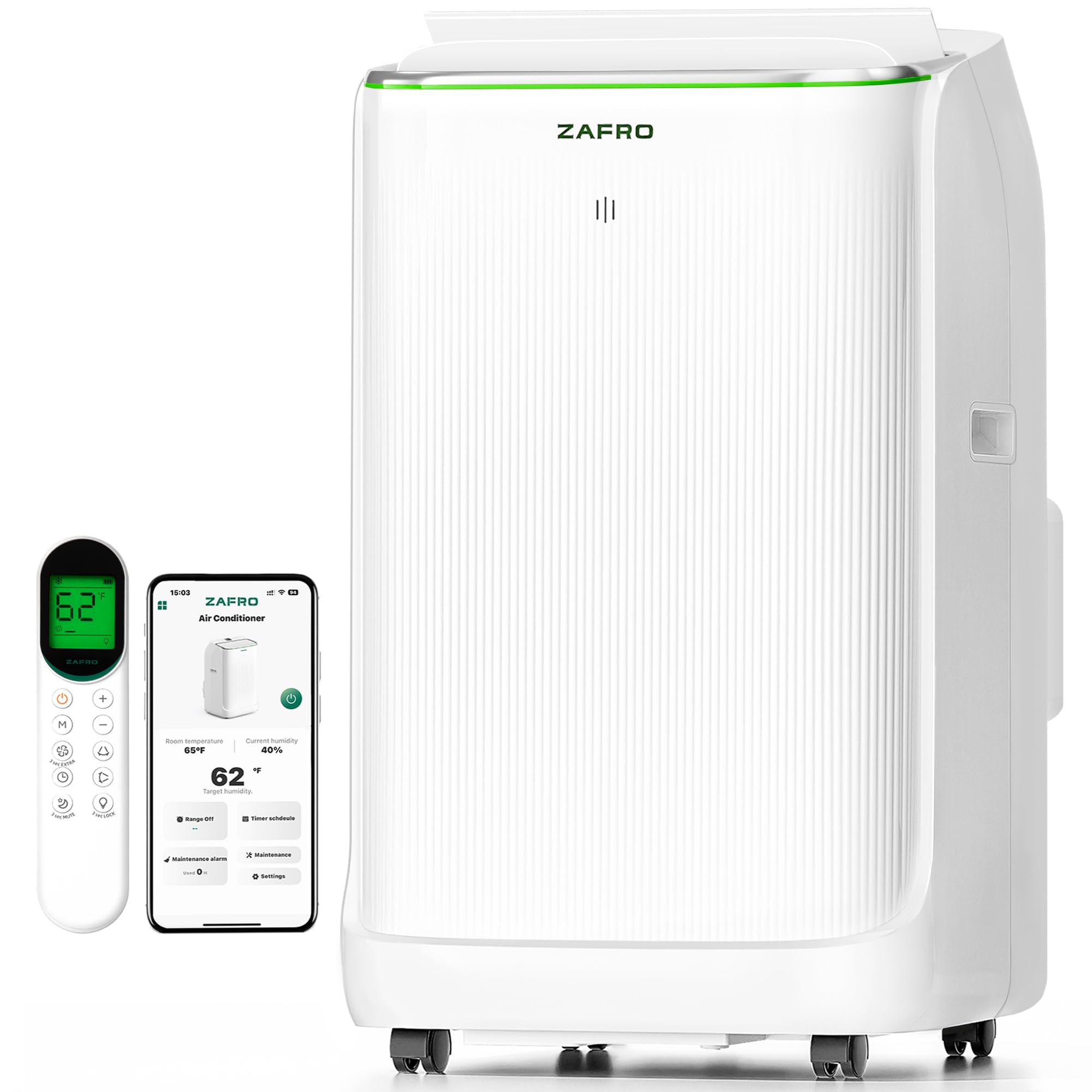
A dual-hose inverter with a 12.8 CEER rating — the efficiency balance that delivers premium cooling without the flagship markup.
ZAFRO’s 12.8 CEER rating is the standout number here. CEER measures how efficiently a unit converts electricity into cooling — higher is better — and 12.8 is well above the 7.83 baseline that most traditional fixed-speed units land at. The unit pairs an inverter compressor with a dual-hose system for 480 cubic meters per hour of airflow. Its Extra Mode locks the temperature at 61°F and runs at full power, which is genuinely useful during a heatwave when you want maximum cooling fast.
Dual-hose systems matter because they pull intake air from outside rather than from your room, avoiding the negative pressure that makes single-hose units work harder. Reviewers point out the difference is noticeable — cooled 600 square feet of basement and office space in hot, humid New York, with no draining needed even after weeks at 12 hours a day. The self-evaporating system handles moisture below 90% humidity for up to 72 hours without manual draining. Six modes (Cool, Dry, Fan, Sleep, Extra, Eco) cover every scenario. Four-way oscillation spreads airflow across the whole room rather than blasting one spot.
At 42 dB in Sleep Mode it is nearly as quiet as the quietest unit on this list, and the inverter design avoids the annoying on-off cycling of fixed-speed models. The ZAFRO app and remote give you control from anywhere, and features like power-off memory and filter-clean reminders add polish. One caveat: only one [Review] notes mention occasional performance inconsistencies at extreme temperatures, so while most owners find this reliable, it is worth keeping an eye on an unusual unit if you buy one.
Signals of Quality
- 12.8 CEER efficiency, well above the 7.83 baseline standard
- Dual-hose inverter design combined with 480 m³/h airflow for rapid room cooling
- Up to 72-hour drainage-free operation below 90% humidity
- 42 dB Sleep Mode and six operating modes for every scenario
Things to Weigh
- Very hot extreme-temperature performance can be less consistent in some units
- Big list of included components means a slightly longer unpacking process
The one to grab if: You want flagship-level dual-hose inverter performance with a 12.8 CEER rating at a mid-range tier.
Consider the Gasbye instead if: You want the lowest claimed noise rating and 13.6 CEER, or you prefer a longer-established warranty support track record.
9. DREO Portable Air Conditioner 516S 14000 BTU

A bedroom-focused 14K unit that works with all three major voice assistants and skips draining entirely under 90% humidity.
The DREO 516S leans into bedroom comfort — 45 dB operation via DREO’s patented noise isolation system, three-in-one Cool/Fan/Dry modes, and a sleep curve you can customize through the app. It reaches up to 16 feet of cooling coverage with the main fan assist. The 14,000 BTU ASHRAE (10,000 BTU SACC) rating puts it squarely in this class. The self-evaporating system is genuinely drainage-free in environments under 90% humidity, which removes one of the more tedious parts of portable AC ownership.
The app control is where the DREO pulls ahead for many buyers. It works with Siri, Amazon Alexa, and Google Home — not many units on this list support all three. You can monitor temperature and humidity through the app, and the sleep curve function lets you customize how the temperature changes through the night rather than holding one setting. Shoppers say it cools fast, holds temperature well, and is quieter than previous portables they have owned. The build quality and modern compact design get consistent praise.
A few caveats are worth your attention. The advertised 45 dB is measured at a distance — up close, thermostatic readings suggest the compressor runs louder than the number alone implies. Owners also note temperature accuracy can drift 2–5°F from the setpoint, and one buyer found the unit weighs more than advertised. There was also a rare report of a chemical-odor failure months into ownership, which DREO refunded in full — an outlier rather than a pattern, but worth knowing if you prioritize confidence above all else.
The bedroom advantage: Support for Siri, Alexa, and Google Home plus the app’s sleep curve function makes this the most voice-flexible pick for a bedroom setup.
The one honest caveat: Thermostat accuracy varies 2–5°F from the setpoint, so if you want precisely held temperatures, expect to adjust the target up or down to compensate.
Great fit for: Bedroom users who want voice control flexibility, app-driven sleep customization, and drainage-free operation.
Worth considering alternatives if: You need precise thermostat accuracy or want a heavier-duty unit for spaces larger than a large bedroom.
10. Whynter Portable Air Conditioner Inverter ARC-1230WN

The award-winning Whynter runs its dual-hose system through a single hose-in-hose design for 20% more cooling with 40% more efficiency.
The Whynter ARC-1230WN has a legitimate claim to credibility — it was named Forbes Vetted’s “Best Portable Air Conditioner Overall” in 2024. The unit delivers 14,000 BTU cooling across up to 600 square feet using an innovative dual-hose “hose-in-hose” design that combines intake and exhaust into one compact 47-inch extendable line. That design keeps the footprint tight while still delivering balanced air circulation without heat leakage from the dual-hose setup.
What makes the Whynter tick is its inverter technology: the manufacturer claims 20% more cooling and 40% more efficiency compared to non-inverter units, and its 244 CFM-per-watt airflow efficiency supports that. The 3 operational modes (Cool, Dehumidify, Fan with 3 speeds) and full thermostatic control (60°F–86°F) cover the essentials. The patented auto-drain function handles up to 87 pints of condensate per day, and the smart NetHome Plus app works with Alexa and Google Home.
Owner reports confirm it cools entire living and dining areas quickly and quietly, with one owner measuring a room dropping by 8 degrees. It fits closer to the window than traditional dual-hose units thanks to the compact hose design, and it handles Florida triple-digit heat. One important warning, though — a buyer found rainwater can enter through the window hose, so you need to disconnect or protect the hose when it rains. Also, Alexa functionality reports that the assistant can turn the unit off but not on — worth knowing before you rely on voice control alone.
Where it wins: The hose-in-hose design is compact enough to sit closer to the window, and the smart features plus 87-pint auto-drain capacity make this a genuinely low-maintenance pick for large rooms.
What to plan for: Rainwater can leak through the window hose, so either disconnect the outdoor hose during storms or install a rain guard.
Right for you if: You have a large living space (up to 600 sq. ft.) and want the compact, award-credentialed design with strong smart features.
Not the best match if: You depend heavily on Alexa voice control (it turns off but does not turn on) or you cannot manage the outdoor hose during rain.
11. Midea Duo 14,000 BTU Portable Air Conditioner with Heat

The Midea Duo combines a dual hose-in-hose design with a heat pump — the premium option for whole-apartment climate control.
Midea’s Duo line is famous for its hose-in-hose design — a single cable that carries both intake and exhaust air, eliminating the heat seepage commonto dual-hose setups. The variable-speed inverter compressor cools more with less electricity than traditional portable units — Midea claims it saves more than 40% energy compared to the U.S. federal standard. The unit also doubles as a heat pump, operating between 41°F and 86°F for winter warmth, making it genuinely useful year-round. Cooling capacity is 14,000 BTU with a 12,000 BTU SACC rating (higher than most units on this list) and coverage up to 550 square feet.
Buyers report the Midea holds up in serious heat: it cooled a 500-square-foot two-story garage loft to 72°F when it was 100°F outside. The dual hose-in-hose design keeps the room consistently comfortable, and the inverter compressor keeps noise low and electricity use down. Setup takes about 30 minutes with the secure window kit. The SmartHome app and remote round out the control options, and the unit moves on wheels despite its heft.
Two honest issues come up. Midea advertises “2X faster and stronger cooling” — a manufacturer claim worth treating as marketing rather than a verified number. More importantly, a few buyers have noticed leakage around the hose connections — light visible through gaps that let outside air in, which undercuts efficiency and, in one case, pulled wildfire smoke into a home. Another owner notes the heat mode overshoots the setpoint by 6–8°F and never cycles off cleanly, so if heating is your primary reason for buying, keep that in mind.
Why It Earns Premium Status
- Dual hose-in-hose design that carries intake and exhaust together for balanced airflow
- 12,000 BTU SACC — the highest verified SACC rating in this group
- Genuine heat pump functionality from 41°F to 86°F for year-round use
- Variable-speed inverter technology delivering substantial energy savings over fixed-speed units
The Real-World Note
- A few owners mention hose-connection leaks that let outside air (and smoke) seep in — a silicone seal solves it
- Heat mode reportedly overshoots setpoint by 6–8°F in some units
- Heavier than average for a portable unit, though wheels help
- The “2X faster cooling” claim is manufacturer marketing, not a verified benchmark
Best for: Buyers who want authentic heat pump capability, the highest SACC rating in this group, and the compact hose-in-hose design for a no-clutter install.
Trade-off to accept: The hose-connection leak report is worth sealing with silicone right away if you want to avoid outside air and smoke entering your home.
Understanding the Specs
BTU Ratings and What They Actually Tell You
BTU stands for British Thermal Unit — a measure of cooling power. A 14,000 BTU ASHRAE unit is the headline number on the box, but the cooler-in-practice rating is SACC (Seasonal Adjusted Cooling Capacity), which is stricter. The gap between them can be significant — a 14,000 BTU ASHRAE unit often delivers only around 10,000 BTU SACC. If you want to know how cold a specific room will get, look for the SACC figure.
CEER: The Energy-Efficiency Score That Affects Your Bill
CEER is the efficiency rating for portable ACs — think of it as miles-per-gallon for cooling. Higher is better. Most fixed-speed units land around 7.83. Inverter units can push well above that. The higher the CEER, the less electricity the unit needs to deliver the same cooling, so a higher score means lower summer bills for the same room comfort.
Inverter Compressors vs Fixed-Speed
A fixed-speed compressor runs at one setting, clacking on and off to hold temperature. An inverter compressor varies its speed continuously, matching the cooling output to what the room actually needs. Inverters hold steadier temperatures, use meaningfully less power at part load, and run quieter because they are not constantly starting and stopping.
Dual Hose vs Single Hose
A single-hose portable AC pulls air from the room, cools it, and exhausts it outside, creating negative pressure that sucks hot outdoor air back in. A dual-hose system keeps intake and exhaust separate, so room pressure stays balanced and the unit cools faster without wasting energy fighting itself.
Drainage and Self-Evaporation
As a portable AC cools, it pulls moisture from the air. Self-evaporating systems recycle that moisture to help cool the condenser coils and push it out through the exhaust hose. That keeps you from emptying a bucket every few hours. Below around 90% humidity most units handle the moisture themselves; in higher humidity, a drain hose is the reliable setup.
Noise Rating in Decibels
Portable AC noise is measured in decibels (dB). Standard conversation runs about 60 dB, a library whisper about 45 dB, and a genuinely quiet unit runs between 41–48 dB on its sleep setting. Inverter compressors and manufacturer noise-isolation designs are what make the quieter numbers possible. Two factors matter most — compressor noise and fan speed noise.
FAQ
Does a 14,000 BTU portable AC really cool the square footage advertised?
Is a dual-hose portable AC worth the extra cost over a single-hose?
How loud is a 14,000 BTU portable AC at night?
Do portable air conditioners need to be drained every day?
Can a 14,000 BTU portable AC trip my circuit breaker?
What is the difference between ASHRAE BTU and SACC BTU?
Do I need a window for these units, or can I use a sliding door?
Do portable air conditioners need to be leveled or left to settle after shipping?
How much does it cost to run a 14,000 BTU portable AC all summer?
Do portable AC units with heat pumps actually work for winter heating?
Final Thoughts: The Verdict
For most buyers, the 14000 btu portable air conditioning unit winner is the Gasbye Dual Hose Portable Air Conditioner because its full DC inverter compressor, dual-hose design, and honest SACC rating deliver real cooling without the inflated specs common in this category. The Gasbye also earns its place with a 13.6 CEER efficiency score and 45 dB operation, making it the balanced pick across performance, quietness, and running cost. If you want a dual-hose inverter with an even higher efficiency rating, grab the ZAFRO Smart Inverter at its 12.8 CEER. And for a bedroom setup where quiet and voice control matter most, the DREO 516S is the one to reach for.
How We Picked
We do not accept paid placement. Every pick is matched to a real buyer and a real use-case; we do not hands-on test units.
Sources & Methodology
Specifications: manufacturer listings and product documentation. Review insights: verified customer reviews, as of September 2026. Pricing: not shown on this page (it changes often); check the current price via the retailer link.
As an Amazon Associate, Gadgets Feed earns from qualifying purchases. This does not affect which products we feature.