
Our readers keep the lights on and my morning glass full of iced black tea. As an Amazon Associate, I earn from qualifying purchases.
Specs are compiled from manufacturer listings and verified buyer reviews and can change over time — please confirm the key details on the product page before buying.
Buying a 150 amp circuit breaker feels simple until you realize the “150 amp” rating can be a polite fiction. Cheap units trip at 80 or 90 amps, leaving your solar array or RV inverter dark well before you are asking for anything near the limit. This guide separates the parts that actually carry their rated load from the ones that give up early, across nine of the most-bought 150 amp breakers on the market.
I’m Min — the founder and writer behind Gadgets Feed. This guide is built by comparing the manufacturers’ published specifications and the patterns across verified customer reviews, so you get each pick’s real strengths and trade-offs instead of marketing spin.
Whether you are protecting a home load center, a solar battery bank, or a vehicle’s electrical system, the right 150 amp circuit breaker holds its rated current without nuisance trips and clears a fault fast.
Our Picks at a Glance


How To Choose The Best 150 Amp Circuit Breaker
Start with voltage: a 240V AC home breaker won’t protect a 48V DC marine system, and a DC solar breaker won’t fit a residential panel. A breaker built for a 240-volt home panel will not protect a 48-volt DC marine system, and a DC solar breaker will not fit a residential load center.
Know Your System Voltage
Household panels run on 120/240 volts AC. Solar arrays and battery banks often run on 48 to 550 volts DC. Marine and RV electrical systems are typically 12 to 48 volts DC. Picking a breaker rated for the wrong voltage can cause arcing that the unit cannot extinguish, which is a fire risk, not just a performance issue.
Poles Tell You What It Protects
A 2-pole breaker protects both hot legs of a 240-volt home circuit at once. A 3-pole version does the same for three-phase equipment. A single-pole unit handles one line, which is why the surface-mount DC breakers for marine and solar use are usually 1-pole. Match the pole count to your panel’s bus bar slots, because a breaker that does not physically fit is useless.
Interrupting Capacity Is Your Safety Margin
Interrupting capacity, sometimes written as AIR or kAIC, is the maximum fault current the breaker can safely stop. A 22,000 AIR breaker can clear a massive short circuit that would destroy a 10kA unit. Home main breakers need high AIR because utility faults can be violent; a solar disconnect can get by with less, but more margin is always safer.
Quick Comparison
| Model | Best For | Voltage | Poles | Mounting | Amazon |
|---|---|---|---|---|---|
| Square D QOM2150VH★ Best Overall | Home load center main | 120/240 VAC | 2 | Panel Mount | Amazon |
| Heschen HSM1PV-250Premium Pick | Solar PV disconnect | 550 VDC | 2 | Wall Mount | Amazon |
| Bussmann CB285-150Best Value | Marine & RV battery | 48 VDC | 1 | Surface Mount | Amazon |
| Blue Sea 7189 | Marine switch & protection | 48 VDC | 1 | Surface Mount | Amazon |
| Siemens SIEMBK150A | Siemens panel main | — | 3 | Panel Mount | Amazon |
| Siemens QN2150R | Horizontal mount QNR | 120/240 VAC | 2 | Plug-In Mount | Amazon |
| Siemens MBK150 | EQ load center main | 240 VAC | 3 | Panel Mount | Amazon |
| Eaton CCV2150 | Eaton tenant main | 120/240 VAC | 2 | Bolt-On Mount | Amazon |
| Homeline HOM2150BB | Homeline plug-on branch | 240 VAC | 2 | Plug-In Mount | Amazon |
In‑Depth Reviews
1. Square D QOM2150VH
Our pick — over 4.5★ from 150+ verified ratings; the strongest balance of quality and price.
The drop-in main breaker that clicks into QO and Homeline panels like it was born there.
You want a main breaker you can install and forget, and this one earns that trust with a 22,000 AIR rating — meaning it can safely interrupt a massive 22,000-amp short circuit. That is a wide safety margin for a residential main, and buyers confirm it handles real fault conditions without drama. At 2.6 pounds and roughly 5.59″H x 3.58″W x 5.08″D, it fits the same footprint as the panel’s original main, so there is no wrestling with a mismatched frame.
The recurring theme across owner experiences is how well it slides into both QO and Homeline load centers, and how cleanly it pairs with a generator interlock kit. Buyers report that the breaker also works as a solid foundation for a generator circuit interlock setup — the thing everyone raves about is the OEM-grade replacement quality. The one honest note: swapping a main breaker is not a typical DIY task, since you usually have to pull the service meter first. Owners mention, “Had meter pulled by electric provider and changed this out easily,” which is the right way to approach it.
You get the highest-rated breaker in this lineup, with a 4.7-star average across more than 150 owner ratings. It is the right pick if you want a genuine Square D part, not a generic stand-in, for a panel that already runs QO or Homeline gear.
Why It Wins
- Genuine OEM replacement for QO and Homeline panels
- 22,000 AIR rating handles severe home faults
- Customers note a perfect fit every time
What To Know
- Usually requires the utility to pull the meter first
- Panel-specific — only fits QO and Homeline load centers
The call: If you own a QO or Homeline panel, this is the main breaker to buy — genuine fit, top safety margin, and proven by hundreds of happy owners.
The trade-off: It only fits those two panel families, so it is not for Siemens or Eaton panels.
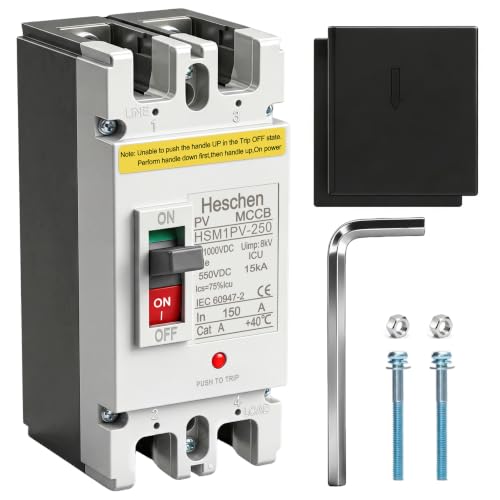
2. Heschen HSM1PV-250
The solar disconnect built to swallow 550 DC volts without breaking a sweat.
Solar arrays run on DC power at voltages that would destroy a residential AC breaker, so this molded-case breaker is rated for DC 550 volts — a full 11.5 times the 48-volt rating of the surface-mount marine units below. It works as a main isolator for solar panels, off-grid PV arrays, and home battery storage, where a bad connection can ignite inverters or charge controllers. Inside, pure copper braided straps and silver-plated contacts keep resistance low and heat down, so it holds up in continuous sun-hour duty.
The safety story here is the 15kA rated breaking capacity (Icu), the maximum short-circuit current it can stop, backed by an 8-blade arc extinguishing matrix that snuffs out severe faults. Owners pushed 60 amps through it and reported no rise in temperature at all, which tracks with a unit that runs cool at a fraction of its rating. Reviewers point out the terminals are massive with solid contact, though they also note the lever takes a firm hand. At 6.50″H x 2.94″W x 3.38″D, it is taller and slimmer than the Square D main above, so plan your enclosure layout around that footprint.
Buyers praise the industrial build quality at an accessible price, calling it “built very sturdy.” Reach for this breaker when your equipment lives outdoors in a PV combiner box or battery cabinet, not inside a wall panel.
Built for DC: Rated for 550 VDC and 15kA breaking, with a cool-running design that owners verified at 60 amps.
Know the catch: It requires a Top-Feed connection with LINE on top and LOAD on the bottom to keep the full 15kA rating.
Reach for this if: You are disconnecting solar panels, off-grid PV, or battery banks, and you need a breaker that handles DC voltage safely.
Look elsewhere if: You need a residential AC main — this unit is DC-only at 550 volts.
3. Bussmann CB285-150
The marine-rated workhorse that refuses to trip early on a 48-volt DC system.
On a boat or an RV, a breaker that trips at 80 amps when it says 150 is worse than useless — it leaves you stranded mid-trip. The Bussmann CB285-150 is a Type III breaker, meaning it resets with the slide of a lever instead of needing a new fuse, and it is rated for 48 volts DC. That single-pole design is the standard footprint for battery protection between an alternator and batteries, and buyers confirm it holds the line where cheaper units fold.
The reliability here is the whole story. One owner swapped out off-brand units that tripped well before their rating, then tested this one at roughly 120 amps for about 30 minutes with no failure. That is the difference between a part that merely carries a label and one that actually does the job. It can also serve as a master disconnect — just push the button for a manual shutoff, which is handy for service work.
Buyers use it on a 2001 Dodge Ram for battery protection, and another on a 5th wheel RV with a 1500-watt inverter, specifically because a reset is cheaper than replacing a blown fuse. The recurring praise centers on easy installation and reliability, with a solid 4.7-star average across over 100 ratings. At 48 volts and 1 pole, it is the wrong tool for a home panel — but for a 12-volt or 24-volt vehicle system, it is the right call at a friendly price.
Proven at the bench: Tested at 120A for 30 minutes without tripping, where off-brand units failed early.
The fit note: This is a 1-pole, 48V DC breaker for vehicles and boats — not for household 120/240V panels.
Buy it for: Battery protection on a truck, RV, or boat where you want a reset-able breaker that actually holds its 150A rating.
skip it if: You are working inside a residential load center — that needs a 2-pole AC main instead.
4. Blue Sea Systems 7189
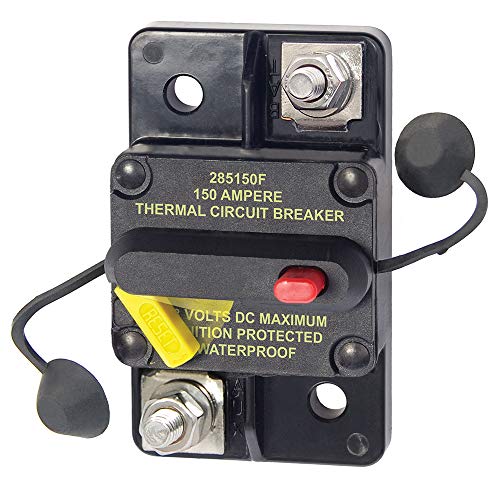
The marine breaker that doubles as a switch and passes the 120-amp bench test with ease.
This 285-series thermal breaker from Blue Sea Systems is a drop-in replacement for the older 185 series, and it packs both switching and circuit protection into a single surface-mounted unit. Rated for 48 volts DC at 150 amps, it is built for the harsh environment of a boat’s engine room — it is ignition protected, meaning it can be installed around gasoline fumes without sparking a fire. At just 5.6 ounces, it is featherweight compared to the 2.6-pound residential main, but do not let that fool you; the construction is what owners rave about.
The standout feature is Trip-Free operation — if a fault is detected, the switch cannot be held in the ON position, so you cannot override a real problem with brute force. Owners tested the 150-amp version and found it ran 120 amps for a full 45 minutes until their test gear overheated, while cheaper brands tripped at just 80-90 amps. That on-resistance of roughly 0.0005 ohms is what keeps it cool and lets it carry current without the voltage drop that weakens a system.
Buyers love that it works as a manual shutoff switch, with a red button for quick disconnects, and that it pairs cleanly with a Blue Sea fuse block for accessories. The quality and construction get the most mentions, and the five-year warranty backs the brand’s confidence. This is the breaker for a serious marine or vehicle setup where a nuisance trip could leave you dead in the water.
Why It Shines
- Ignition protected for gasoline engine rooms
- Trip-Free design blocks holding the switch on during a fault
- Verified to carry 120A for 45 minutes in a bench test
Consider This
- Single-pole design limits it to 48V DC systems
- Premium price over basic surface-mount breakers
Choose this when: You want a marine-grade breaker that also works as a master switch, with fault protection you cannot override.
Think twice if: You just need a cheap fuse-replacement on a budget — the Bussmann above does that for less.
5. Siemens SIEMBK150A

The 3-pole main that turns a bare Siemens panel into a complete load center.
Here is a budget-smart move: buy a Siemens main lug panel and add your own main breaker, which is often cheaper than buying a factory-built load center. That is exactly the play this 3-pole SIEMBK150A enables, and it is why owners call it a breeze to install on a Siemens breaker panel that did not originally ship with a main. At 150 amps and 3 poles, it handles the two hot legs plus the neutral in a three-phase or split-phase arrangement, depending on your panel’s configuration.
The fit is the headline — shoppers say it slips into a Siemens panel with no modification and trips “when it is supposed to,” no early cutoffs, no intermittent faults. It is a genuine OEM part, so you are not gambling on a generic knockoff’s internal tolerance. One reviewer had a unit arrive with a broken switch, but the replacement came quickly and worked flawlessly, which is worth knowing as a quality-control note rather than a systemic flaw.
This one is strictly for Siemens panels — owners are clear that mixing brands is not a good idea, since breaker-to-bus-bar interfaces differ. If you are building out a Siemens load center from scratch or replacing a failed main in one, this is the part that makes the assembly complete.
For the builder: The smart buy if you are assembling a Siemens load center from a main lug panel and want a genuine, reliable 3-pole main.
Not for: Any non-Siemens panel — the physical fit is brand-locked.
6. Siemens QN2150R
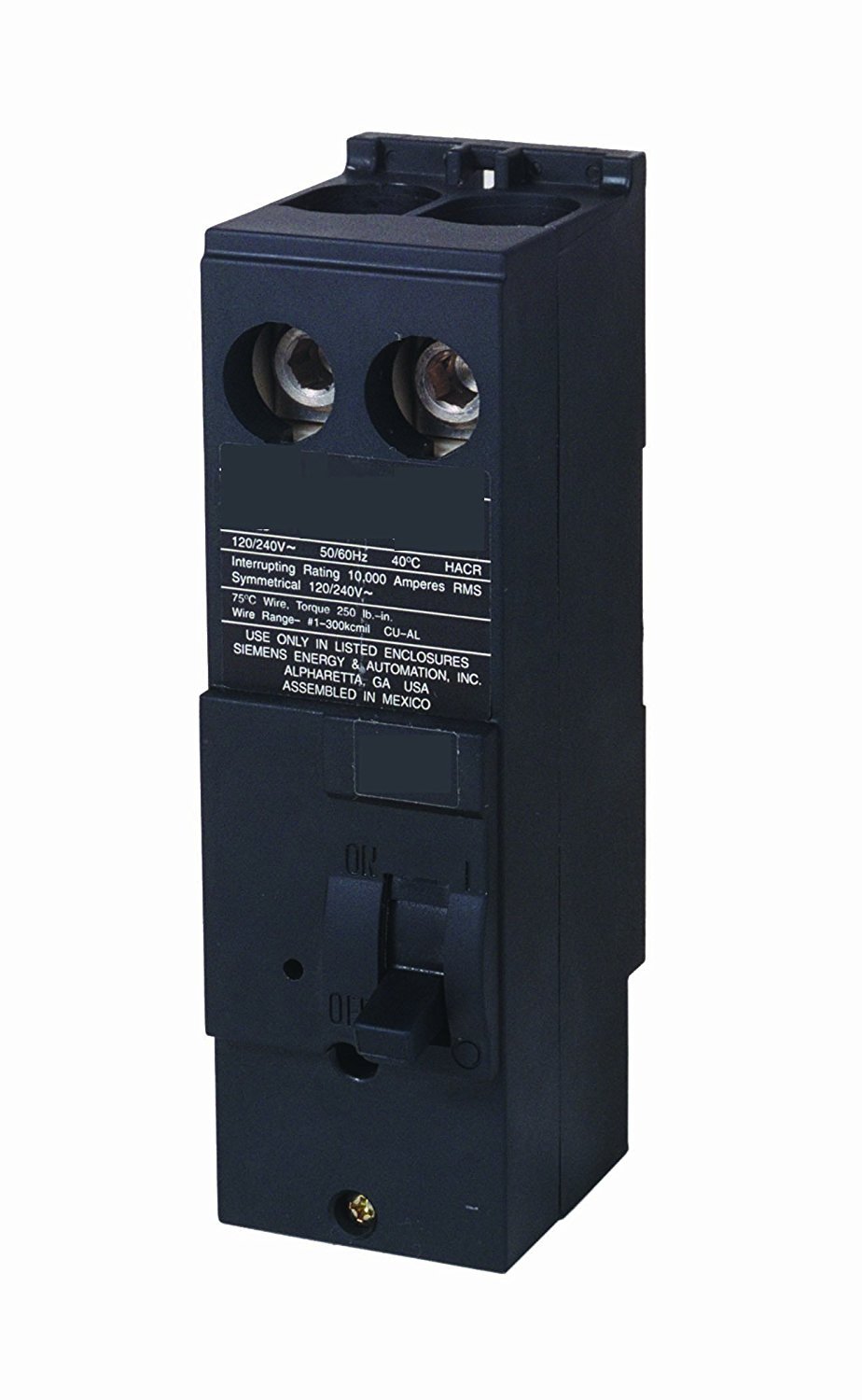
The UL-listed 10kA breaker that is happy lying on its side in a tight panel.
Most breakers are installed upright, but some panels, especially mobile home or certain sub-panel setups, demand a horizontal mount. The Siemens QN2150R is a UL Type QNR breaker, meaning it is specifically certified for use when mounted horizontally — a niche but critical distinction. It is a 2-pole, 150-amp, 120/240-volt breaker with a 10 KAIC rating, which is the standard for most residential branch and main applications.
Owners call it a clean, precise install, and it works as a drop-in for the specific QNR slot it is designed for. One reviewer noted the lugs were on the bottom rather than the top as shown in photos, so check your panel’s wiring orientation before you commit. The 10 kAIC interrupting rating is lower than the Square D’s 22,000 AIR, but it is plenty for a typical home service where the available fault current is well under 10,000 amps.
This is the right part when your panel forces a horizontal breaker, and it carries UL listing for confidence on a safety-critical component. If your panel mounts breakers vertically, you do not need the “R” version — a standard QN breaker would be the match.
Pick this for: Horizontal-mount QNR slots in Siemens panels where a standard vertical breaker will not fit or is not certified.
Keep in mind: Confirm lug orientation at the top versus bottom against your panel’s wiring before buying.
7. Siemens MBK150

The exact-match replacement that revives a decades-old EQ load center.
Older homes run on electrical panels that the big-box stores stopped stocking years ago, which is where this Siemens MBK150 shines. It is a UL-listed replacement main breaker designed for use only on EQ Series Siemens main breaker load centers, and it is a drop-in for the old EQ9683 breaker. At 3 poles and 240 volts, it restores a 44-year-old Gould/ITE load center to full working order — a job that would otherwise mean a full panel upgrade.
The owner stories are all about the direct swap: the breaker slides in as a 1:1 replacement for the original, with no modification needed. Buyers report it feels solid and works exactly as intended, turning an aging panel back into a safe, code-compliant setup. At 6.08 ounces, it is lightweight, but the build quality is the thing owners highlight — “you can feel the quality” is the refrain.
The catch is scope: this is only for EQ Series panels. If your panel is a Siemens plug-on type or a different brand, this is not your part. But if you have an aging EQ load center, this is the single most useful breaker on the list for keeping it alive.
Old-panel lifesaver: A genuine exact replacement for the EQ9683 that fits without modification.
Strictly limited: It works only in EQ Series Siemens load centers — nothing else.
Perfect for: Homeowners with an older Siemens EQ or Gould/ITE panel who want to avoid a costly full-panel replacement.
Not for: Plug-on QN-type panels, which use a different breaker form factor.
8. Eaton CCV2150
The bolt-on main for Eaton tenant panels that big-box stores cannot keep in stock.
Some breakers are nearly impossible to find locally, and the Eaton CCV2150 is one of them — a 2-pole, 150-amp, 120/240-volt tenant main breaker with a bolt-on mount. Instead of clipping onto a bus bar, this one bolts directly to the panel, which is the design Eaton uses in many service interrupt and tenant metering setups. It is the part supply houses and big-box stores rarely carry, which drives electricians and DIYers to Amazon for a genuine replacement.
The build uses a thermal-magnetic trip mechanism with indirectly heated bimetal elements, calibrated and sealed after assembly. In plain terms, it detects both slow overheating and sudden spikes, tripping whoever comes first, and it is trip-free — meaning the handle resets past the OFF position before the breaker will latch again after a fault. That is a deliberate safety feature, not a bug.
Owners mention it is a perfect fit for an Eaton service interrupt panel, delivered fast, and it saved one homeowner after their original breaker arc-welded shut during Hurricane Ian’s power surges. At 16 ounces, it is a solid unit, and the direct-swap experience is why buyers keep recommending it to their customers. This is the bolt-on breaker to reach for when your Eaton panel demands that specific mounting style.
What You Get
- Genuine Eaton bolt-on fit for tenant panels
- Thermal-magnetic trip protects against heat and spikes
- Owners confirm perfect fit and fast delivery
The Headache
- Bolt-on mount only works in compatible Eaton panels
- Hard to source locally, which is why it sells out
Grab this for: An Eaton service interrupt or tenant panel that needs a genuine bolt-on 150A main.
Check first: Your panel must be bolt-on style — plug-on panels will not accept this unit.
9. Homeline HOM2150BB
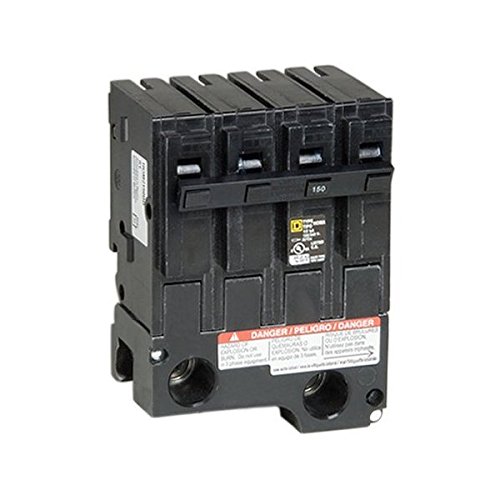
The plug-on Homeline branch that powers a tiny home when no local store has it.
When a specific breaker is hard to find, the online marketplace becomes the only option, and that is the role this Homeline HOM2150BB fills. It is a 2-pole, 150-amp, 240-volt plug-on branch breaker from Square D’s Homeline line, UL-approved, and designed for the plug-on style panels that dominate residential construction. It includes grounding lugs, which some users need and others can simply ignore, depending on the setup.
Customers note it is a perfect fit for Homeline panels and takes less than 10 minutes to swap, popping the old one out and snapping the new one in — plug-on mounting means no screws or bolts. One owner specifically bought it to power a tiny home, calling it “expensive, but worth it” because the part was simply unavailable elsewhere. That is the real value here: availability and genuine Square D compatibility.
The honest caveats are a mixed install experience — one unit arrived looking like it had been mounted before, with cable marks on the lugs, though the contact grease looked intact. And the price carries a premium because the replacement market for this specific part is thin. If you need a HOM2150BB and cannot find one locally, this is the stop.
Availability first: A genuine Homeline plug-on unit for panels that need this exact part, with grounding lugs included.
The fine print: Check the unit on arrival — a rare one shows signs of prior handling, and the price reflects scarcity.
Buy it when: You own a Homeline panel, need a 150A plug-on branch, and the local supply chain came up empty.
pass on it if: Your panel is a QO or Siemens type — this breaker fits Homeline bus bars only.
Understanding the Specs
Voltage Rating (VAC vs VDC)
This is the first thing to match, because AC and DC breakers are not interchangeable. Household panels run on 120/240 volts AC, marine and RV systems use 12-48 volts DC, and solar arrays often hit 550 volts DC. A breaker rated for the wrong voltage cannot reliably extinguish the arc when it trips, which is a genuine fire hazard.
Interrupting Capacity (AIR / kAIC)
This is the maximum short-circuit current a breaker can safely stop. A 22,000 AIR main can clear a violent utility fault; a 10 kAIC unit stops 10,000 amps. Match this to your panel’s available fault current, and know that more margin is always safer — it is the difference between a breaker that saves your panel and one that welds itself shut.
Pole Count
Poles are the number of separate circuits the breaker can interrupt at once. A 2-pole breaker protects both hot legs of a 240-volt home circuit; a 3-pole handles three-phase gear; a 1-pole unit protects a single line. Your panel’s bus bar slots dictate what physically fits, so the pole count is both an electrical and a mechanical spec.
Mounting Style
Plug-on breakers clip onto a bus bar and are swappable in minutes. Bolt-on units require screws for a more rigid connection. Surface-mount breakers sit on a flat panel or wall, common in marine, RV, and solar gear. Getting the mount wrong means the breaker will not seat in your panel, no matter how well it is rated.
FAQ
Will a 150 amp circuit breaker work in my home panel?
What is the difference between AC and DC circuit breakers?
How many poles do I need for a 150 amp main breaker?
What does 22k AIR mean on a circuit breaker?
Is it safe to replace a 150 amp main breaker myself?
Why does my 150 amp breaker trip before reaching 150 amps?
Can I use a 150 amp breaker for a solar panel system?
What is a Trip-Free circuit breaker?
Final Thoughts: The Verdict
For most buyers, the 150 amp circuit breaker winner is the Square D QOM2150VH because it pairs a genuine OEM fit for the two most common home panels with a 22,000 AIR safety margin, and hundreds of owners confirm it is a perfect drop-in. If your setup runs on solar or battery DC power, the Heschen HSM1PV-250 handles 550 volts of direct current that would destroy a residential breaker. And for a boat, truck, or RV on a 48-volt system, the Bussmann CB285-150 is the budget-friendly pick that actually holds its 150-amp rating instead of tripping early.
How We Picked
We do not accept paid placement. Every pick is matched to a real buyer and a real use-case; we do not hands-on test units.
Sources & Methodology
Specifications: manufacturer listings and product documentation. Review insights: verified customer reviews, as of August 2026. Pricing: not shown on this page (it changes often); check the current price via the retailer link.
As an Amazon Associate, Gadgets Feed earns from qualifying purchases. This does not affect which products we feature.