
Our readers keep the lights on and my morning glass full of iced black tea. As an Amazon Associate, I earn from qualifying purchases.
Specs are compiled from manufacturer listings and verified buyer reviews and can change over time — please confirm the key details on the product page before buying.
A 150A fuse is the single point of protection between your battery bank or amplifier and a costly short circuit. Pick the wrong holder or fuse type, and you risk melted wiring or a fire that a few dollars and the right install could have prevented. This guide cuts through the confusion to show you three real options that actually carry a 150A rating — no guesses, no mismatched parts.
I’m Min — the founder and writer behind Gadgets Feed. This guide is built by comparing the manufacturers’ published specifications and the patterns across verified customer reviews, so you get each pick’s real strengths and trade-offs instead of marketing spin.
Whether you are wiring a car audio system, a solar setup, or a marine battery bank, the right 150 amp fuse holder keeps your gear safe and your installation clean without guesswork.
Quick Picks
- SIGANDG ANL Fuse Holder 150A — Best Overall
- WindyNation ANL Fuse Holder + 2 Fuses (150A) — Best Value
- ZOOKOTO Class T Fuse Block 150A — Premium Pick
How To Choose The Best 150 Amp Fuse
A 150A fuse is not just a single part — it is a system of holder, fuse type, and wire size that must match your setup. Pick the wrong combination and you get either nuisance blows or no protection at all.
Fuse Type: ANL vs Class T
ANL fuses (a blade-style, compact, and affordable fuse) are the standard for car audio and general 12V DC circuits. Class T fuses handle higher DC voltage (up to 150VDC) and have a much higher interrupting rating (10KA for the ZOOKOTO model here), which means they can safely stop a massive short circuit from a large inverter or battery bank without exploding. If you are protecting a high-power inverter in an RV or solar system, go Class T. For a car audio amp or a moderate 12V accessory, an ANL fuse works perfectly.
Wire Gauge Acceptance
The holder must physically accept the thickness of your cable. The ANL holders here handle up to 2/0 gauge cable (the fattest common size for high-current DC runs). If your wire is thinner, like 4 AWG or 2 AWG, they still work because you can match the terminal ring size. Always check that the holder’s stud size — typically 5/16-inch (8mm) — matches your ring terminals before you begin the install.
Build Quality and Materials
Look for a holder with a solid metal interior (not a thin stamped plate) and a clear plastic cover that lets you inspect the fuse without disassembly. A satin-nickel plated base resists corrosion in marine or engine-bay environments. Reviewers consistently praise holders that feel heavy in the hand — one called the SIGANDG unit “very heavy duty” and noted its “solid metal fuse quality.” That weight correlates directly with low resistance and reliable current flow at 150 amps.
Quick Comparison
| Model | Best For | Fuse Type | Max Wire Gauge | Max Voltage | Amazon |
|---|---|---|---|---|---|
| SIGANDG ANL Fuse Holder | Car Audio / 12V Accessories | ANL (Single) | 2/0 AWG | 32V (typical ANL) | Amazon |
| WindyNation ANL Fuse Holder + 2 Fuses | Multi-Project / Spares Kit | ANL (Dual Fuses) | 2/0 AWG | 32V (typical ANL) | Amazon |
| ZOOKOTO Class T Fuse Block | Solar / Inverter / High-Voltage DC | Class T | 5/16″ Stud (Large Lugs) | 150VDC | Amazon |
In‑Depth Reviews
1. SIGANDG ANL Fuse Holder 150A
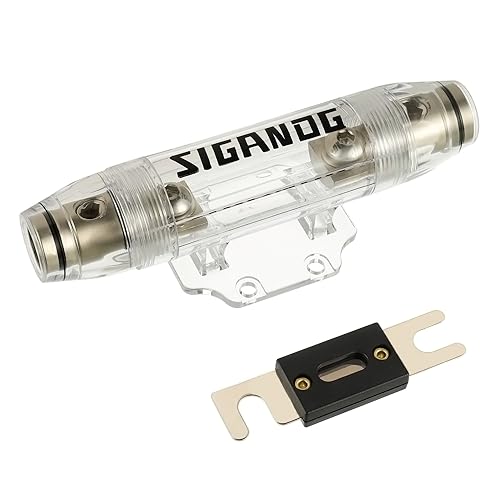
A heavy-duty ANL holder that buyers report feels like it weighs two pounds — built to clamp down on your 150A circuit.
This SIGANDG holder gives you a satin-nickel plated fuse holder and a clear plastic cover so you can spot a blown fuse without pulling the whole assembly apart. The hexagon socket head cap screws (the screws that take an Allen key) clamp your cable and the fuse itself for the best possible conductivity — no loose connections that cause heat buildup at 150 amps. The unit accepts 0, 2, or 4 gauge wire (up to 2/0 AWG) which covers the heavy cable most high-power car audio builds need.
Owners mention the thing is “very heavy duty” and note the interior uses “solid metal fuse quality” — they specifically compare it favorably against big-brand holders. The 3-piece design means you can disassemble it without tools for cleaning or wire swaps, and multiple verified owners say it “feels high quality” and works exactly as expected.
One trade-off: the cover is not hinged, so if you are frequently accessing the fuse, you will need somewhere to set the removable cap. This is a minor workflow detail, not a durability concern — the screws are the real mechanical connection.
Why It Earns Top Spot
- Satin-nickel plated base resists corrosion better than bare metal holders
- Hex socket screws provide strong clamping force for high-current reliability
- Handles up to 2/0 gauge cable — fits most large-diameter battery and amp wire
The Practical Catch
- Cover is a separate piece, not attached to the base — easy to misplace during install
Grab this if: you are wiring a car audio amp or 12V accessory and want a solid, corrosion-resistant ANL holder with real metal internals and room for thick cable.
Look elsewhere if: you need a holder that also includes spare fuses or one rated for 48V+ DC solar/inverter circuits.
2. WindyNation ANL Fuse Holder + 2 Fuses (150A)

A copper ANL set that gives you a spare fuse in the box — perfect for tucking into a battery compartment and forgetting about.
WindyNation packs one ANL holder plus two 150A fuses, so you have a backup the moment a fuse blows on a remote project. The holder uses copper construction (not plated steel) which keeps resistance lower at high current — a real benefit if you are pushing that 150A ceiling. The mounting bolts are 8mm diameter (5/16-inch), a standard size that matches most ring terminals you will find at auto parts stores. Up to 2/0 gauge cable fits here, same as the SIGANDG holder above.
Customers note it is “easy to install” and one owner used it to replace a fusible link on a custom battery cable project — that is exactly the kind of retrofit this holder handles well. A few reviewers wish the cover had a hinge or screw-down feature; the clips are small and can be fiddly to re-seat. But once they are on, the cover stays secure.
Compared to the SIGANDG holder, the WindyNation saves you from having to buy a second fuse separately — but it does not have the same satin-nickel corrosion plating on the base. That matters less for indoor or dry-vehicle installations and more for marine or exposed engine-bay use.
The Package Advantage
- Includes two 150A ANL fuses — immediate spare on hand
- Copper material for solid conductivity at full 150A load
- Standard 8mm studs fit common ring terminals without adapters
One Friction Point
- Cover clips are small and take a few tries to snap closed securely
Reach for this if: you want a fuse holder that arrives with a spare fuse in the bag, and you are working in a dry environment like a car interior or garage project.
Pass it by if: corrosion resistance is a top priority — the unplated copper base benefits from a dab of dielectric grease in wet locations.
3. ZOOKOTO Class T Fuse Block 150A
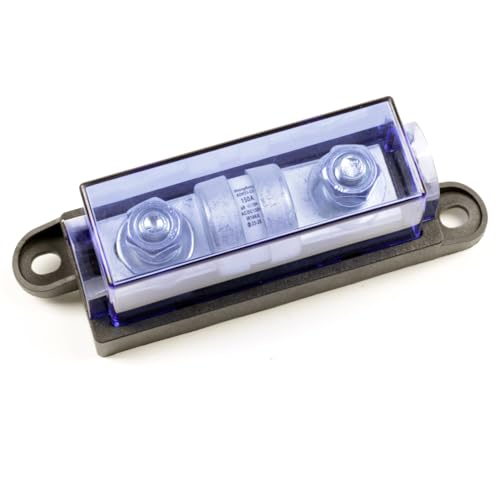
A Class T block for high-voltage DC systems — the 150VDC rating and 10KA interrupting capacity set it apart from ANL holders.
The ZOOKOTO fuse block is a different breed from the ANL holders above. It uses a Class T fuse — a slow-blow design that handles the inrush current of large inverters without nuisance trips. The block is rated for 150VDC and carries an interrupting rating of 10KA (10,000 amps of fault current it can safely extinguish — critical for solar arrays and big battery banks where a short can dump enormous energy). The housing is made from ABS polymer with a V0 fire rating (meaning the plastic self-extinguishes if it catches fire).
Buyers confirm it works “great for solar and new line from your alternator to battery” and one specifically said it was “a great pickup” that had “no issues installing into my solar setup.” The fuse block has breakouts on the cover so you can route wire in any direction, and there is generous interior space around the studs to fit large cable lugs. The terminal size is 5/16-inch (M8) — the same as the ANL holders, so no surprises if you already have ring terminals.
The trade-off compared to an ANL holder: Class T fuses are physically larger and cost more to replace. But for any system running above 32V — 48V solar, 72V golf cart, or a high-power inverter in an RV — this block is the right level of protection.
Why It Earns “Premium”
- 150VDC rating — works on 12V, 24V, 48V, and even 72V battery banks
- 10KA interrupting rating handles massive fault currents safely
- V0 fire-rated ABS shell and large interior space for fat cable lugs
What to Know Before Buying
- Class T fuses are less common and more expensive per replacement than ANL fuses
Best for: solar installations, RV inverter protection, or any circuit where the voltage exceeds 32V and you need a slow-blow fuse with real fault-clearing power.
Not ideal for: a simple 12V car audio amp — an ANL holder does the same job at lower cost and with readily available replacement fuses.
Understanding the Specs
Interrupting Rating (IR)
This number — measured in amps like 10KA (10,000 amps) — tells you the maximum fault current the fuse can safely break without exploding or sustaining an arc. A fuse that is not rated for the potential short-circuit current of your battery bank can fail catastrophically and not clear the fault. For big inverters and lithium battery banks, look for an IR of at least 5KA to 10KA. Car audio systems on a single 12V battery typically do not need that high an IR because the battery itself cannot deliver that level of fault current.
ANL vs Class T
ANL fuses are rectangular blade-style fuses with a low profile, designed for 32V to 80V DC circuits in car audio and mid-power DC applications. Class T fuses are cylindrical or rectangular with a sand-filled body that extinguishes arcs faster — they are rated for up to 150VDC or 300VDC and have a much higher interrupting rating. If your system runs at 48V or more — solar, golf cart, RV inverter — choose Class T. For a 12V or 24V car stereo, ANL is more compact and cheaper to replace.
FAQ
Can I use an ANL fuse with a 150A rating on a 48V solar system?
What gauge wire do I need for a 150A fuse?
How close to the battery should I install a 150A fuse?
Can I use a 150A Class T fuse in place of an ANL fuse?
What does the “10KA” interrupting rating mean on the ZOOKOTO fuse block?
Will a 150A fuse blow at exactly 150 amps?
Can I use a 150A fuse for a 2000W inverter?
How do I clean corrosion off a fuse holder?
Can I mount a fuse holder upside down or sideways?
What is the difference between the WindyNation and SIGANDG ANL holders?
Final Thoughts: The Verdict
Across the board, the 150 amp fuse winner is the SIGANDG ANL Fuse Holder because it combines a corrosion-resistant satin-nickel base, solid metal internals, and the ability to fit up to 2/0 gauge cable — everything a standard car audio or 12V build needs. If you want a kit with a spare fuse in the bag, grab the WindyNation ANL Fuse Holder + 2 Fuses. And for a high-voltage solar or inverter setup, the ZOOKOTO Class T Fuse Block is the safer choice with its 150VDC rating and 10KA interrupting capacity.
How We Picked
We do not accept paid placement. Every pick is matched to a real buyer and a real use-case; we do not hands-on test units.
Sources & Methodology
Specifications: manufacturer listings and product documentation. Review insights: verified customer reviews, as of July 2026. Pricing: not shown on this page (it changes often); check the current price via the retailer link.
As an Amazon Associate, Gadgets Feed earns from qualifying purchases. This does not affect which products we feature.
Product prices and availability are accurate as of the date/time indicated and are subject to change. Any price and availability information displayed on Amazon at the time of purchase will apply to the purchase of this product. As an Amazon Associate I earn from qualifying purchases.
CERTAIN CONTENT THAT APPEARS ON THIS SITE COMES FROM AMAZON. THIS CONTENT IS PROVIDED "AS IS" AND IS SUBJECT TO CHANGE OR REMOVAL AT ANY TIME.
Amazon and the Amazon logo are trademarks of Amazon.com, Inc. or its affiliates.