
Our readers keep the lights on and my morning glass full of iced black tea. As an Amazon Associate, I earn from qualifying purchases.
Specs are compiled from manufacturer listings and verified buyer reviews and can change over time — please confirm the key details on the product page before buying.
A power outage doesn’t just turn off your lights — it can corrupt a file you have been working on for hours, ruin a gaming save you cannot get back, or shut down a NAS drive mid-transfer. A 1500VA UPS gives you time to save work and shut down safely while protecting gear from surges. This guide cuts through spec sheets to find models that deliver real protection without hidden compromises.
I’m Min — the founder and writer behind Gadgets Feed. This guide is built by comparing the manufacturers’ published specifications and the patterns across verified customer reviews, so you get each pick’s real strengths and trade-offs instead of marketing spin.
Here you can find a no-fluff breakdown of the best 1500va battery backup models for home offices, gaming rigs, and network closets, with every spec explained in plain language.
Our Picks at a Glance


How To Choose The Best 1500VA Battery Backup
Comparing UPS models is confusing when each lists different wattage, outlets, and waveform. Here is what matters for your setup.
Wattage Over VA — The Real Capacity
VA (volt-amps) is a theoretical number, but the wattage tells you how much actual load the unit can handle. A 1500VA unit can range from 810W all the way to 1000W. A high-end desktop PC plus a monitor can easily draw 400-600W, so aim for at least 900W of real output to keep your system running.
Pure Sinewave vs. Simulated Sinewave
Cheaper UPS units output a stepped approximation of a power wave — fine for simple PSUs, but risky for Active PFC power supplies found in modern PCs and gaming consoles. Pure sinewave mimics the utility grid exactly, so your gear runs cooler and sees no glitches.
Outlets and Ports — Plan Your Desk
You need enough battery-backup outlets for your PC, monitor, router, and modem. Surge-only outlets handle peripherals like printers and speakers. Look for USB-A and USB-C charging ports on the front so you don’t waste a protected outlet on your phone.
Quick Comparison
| Model | Best For | Output Wattage | Outlets | Waveform | Amazon |
|---|---|---|---|---|---|
| CyberPower CP1500PFCLCD★ Best Overall | Active PFC computers | 1000W | 12 | Pure Sinewave | Amazon |
| CyberPower BRG1500AVRLCD2Network Ready | High-end networking setups | 900W | 12 | Simulated Sinewave | Amazon |
| GOLDENMATE Lithium UPSLithium Future | 10-year long-term investment | 1000W | 8 | Pure Sinewave | Amazon |
| Eaton Tripp Lite OMNI1500LCDT | Budget conscious offices | 810W | 10 | Simulated Sinewave | Amazon |
| APC BR1500MS2 | Home offices with PC + monitors | 900W | 10 | Pure Sinewave | Amazon |
| APC BGM1500B-US | Gaming PCs and consoles | 900W | 10 | Pure Sinewave | Amazon |
| Tripp Lite OMNIVS1500 | Network equipment uptime | 940W | 8 | Simulated Sinewave | Amazon |
| Amazon Basics UPS | Entry level protection | 900W | 10 | Simulated Sinewave | Amazon |
| SKE SK1500 | Rack-style budget build | 900W | 8 | Simulated Sinewave | Amazon |
In‑Depth Reviews
1. CyberPower CP1500PFCLCD PFC Sinewave UPS
Our pick — over 4.5★ from 11,000+ verified ratings; the strongest balance of quality and price.
The pure sinewave king that keeps your modern PC from glitching out.
If you have a desktop with an Active PFC power supply — and most high-wattage PSUs today are — a simulated sinewave UPS can actually cause the supply to shut down or hum loudly. You get 12 NEMA 5-15R outlets total, with six on battery backup and six for surge protection only.
The color LCD panel tilts up to 22 degrees, so you can read the input voltage and load capacity at a glance from your desk chair. Automatic Voltage Regulation (AVR — it corrects small voltage dips without draining the battery) handles those mini brownouts without switching to battery, and the five-foot right-angle plug keeps the unit flat against the wall. Buyers report the 3-year warranty and the connected equipment guarantee give real confidence for expensive gear.
The 24.9-pound weight is noticeable, and the USB-C port is charge-only at unspecified speed — fine for a phone, not a laptop.
Why it leads the pack
- 1000W of pure sinewave output — highest rated power in this comparison
- 12 outlets total give plenty of room for a full desk and network gear
- Color LCD tilts for easy viewing; AVR extends battery life
Things to watch
- USB-C port is charge-only; no data passthrough
- At 24.9 pounds, it is not light to reposition
Your best match if: you run a modern desktop PC or workstation with an Active PFC power supply and want the most wattage headroom you can get.
Look elsewhere if: you need a user-replaceable battery or want a lithium pack for a longer lifespan.
2. CyberPower BRG1500AVRLCD2 Intelligent LCD UPS
Twelve outlets and remote management for the gear-heavy home office.
This model takes the same 12-outlet layout as the CP1500 but steps down to a simulated sinewave at 900W. That makes it a better fit for standard office PCs, servers, and networking gear that do not need pure sinewave.
The color LCD panel is the same tilt design, and the six-foot right-angle input plug gives you more reach to an under-desk outlet. Buyers who own it note that the remote management slot is a big deal — you can add an optional RMCARD205 for network-based shutdown and monitoring. The 5-year warranty (including the battery) is the longest standard coverage in this roundup, and it still carries the connected equipment guarantee.
At 23.8 pounds it is marginally lighter than the CP1500, but the simulated sinewave is not ideal for Active PFC power supplies — stick to the pure sinewave unit above for recent gaming or workstation builds.
Who it wins over: if you have a lot of peripherals and want 12 outlets plus the option for remote management, this is the most versatile mid-range pick.
Where it falls short: skip this if your PC has a modern Active PFC power supply — the simulated sinewave can cause compatibility issues.
3. GOLDENMATE 1500VA/1000W Lithium UPS
A 10-year battery that actually lasts longer than the rest of your desk.
Standard lead-acid UPS batteries start losing capacity after three years, and replacing them is a hassle. This GOLDENMATE unit uses a Lithium Iron Phosphate (LiFePO4) battery pack rated for more than 3,000 charge cycles and an average life of 10 years. You never have to crack it open for a battery swap — the system is maintenance-free for that entire decade. It outputs pure sinewave at 1000W, tying the CyberPower CP1500 for highest wattage headroom.
The 8 NEMA 5-15P outlets all offer both battery backup and surge protection, and the outlet panel is spaced wider than usual to fit bulky power bricks side by side. The front panel includes a communication port with a USB cable, plus one USB-C and one USB-A port delivering a total of 10W for charging phones. Buyers mention the white metal enclosure stands out visually under a desk and that the 33-pound weight is a sign of the larger transformer required for the 51.2V lithium system.
The physical footprint (16.73 x 6.3 x 11.81 inches) is larger than almost any other unit here, and the price sits at the premium end of the range. But if you hate the idea of buying a new UPS every few years, this one pays you back in saved hassle.
Why it stands apart
- LiFePO4 battery lasts 10+ years with 3,000+ charge cycles; no replacement needed
- Pure sinewave at 1000W for modern PFC power supplies
- Wider outlet spacing fits bulky power adapters easily
Trade-offs to know
- Larger footprint than comparable lead-acid units
- Heavier at ~33 pounds (15 kg) due to the 51.2V transformer
Reach for this if: you plan to keep the same UPS for a decade and want zero battery maintenance over that time.
Steer clear if: you need a compact, lightweight unit or are on a budget — the upfront cost and size of this lithium UPS are significant.
4. APC UPS 1500VA/900W Pure Sinewave BR1500MS2

APC’s pure sinewave option that offers a massive runtime headroom for a full home office.
Most UPS units give you just enough time to save a document and shut down. This APC (model BR1500MS2) provides up to 73 minutes of runtime at a 100W load — enough to keep your router and a laptop running through a short outage completely, or let you finish rendering a file without rushing. At a 900W full load, that drops to a few minutes, but the headroom at partial load is the best among the pure sinewave options here.
You get 10 outlets total: six provide battery backup and surge protection for your PC, monitor, and router, and four are surge-only for printers and speakers. It also includes coax and Ethernet surge protection on the data lines, so a lightning strike on your cable line does not fry the router. The LCD shows minutes of runtime remaining, current watt draw, and battery health. Owners mention the user-replaceable battery (APCRBC163) is a big plus — you can swap it yourself after the 3-year warranty without replacing the whole unit.
The main downside is the 16-hour battery charge time, which is slow compared to competitors that top up in 8 hours. If your power goes out frequently, you may find the unit still recharging when the next flicker hits.
Best for the home office: long runtime at low loads and pure sinewave safety for sensitive gear, all from a household name.
The trade-off: the 16-hour charge time means it is slow to recover between multiple outages.
5. APC Back-Ups Pro Gaming UPS BGM1500B-US

Customizable RGB and pure sinewave keep your gaming rig running and looking good.
This is a rare UPS that understands a gaming setup is as much about the vibe as the uptime. It delivers 1500VA/900W of pure sinewave power, which means your expensive PS5, Xbox Series X, or desktop PC with an Active PFC power supply gets clean, grid-like power — no glitches, no power supply hum. It also has Auto Voltage Regulation that boosts low voltage or trims high voltage automatically. The “Reactor Circle” LCD display is tilted at 160 degrees, so you can read your remaining runtime and load wattage from your gaming chair without leaning forward.
You can choose from 12 customizable RGB LED colors to match the rest of your battle station. The 10 outlets include six on battery backup for your PC and console and four surge-only for speakers and monitors. Customers note that the 30.9-pound weight is heavy, but the plastic tower form factor sits stable on the floor under a desk.
The catch? The battery is not user-replaceable like on some other APC models, so when the cells wear out (typically after 3-5 years), you replace the whole unit. At this price point, that is a notable long-term cost to consider against the GOLDENMATE lithium option.
What makes it unique
- 12 customizable RGB LED colors to sync with a gaming setup
- Pure sinewave protects modern gaming consoles and PFC power supplies
- 160-degree tilted LCD is readable from a seated position
Before you buy
- Battery is not user-replaceable — whole unit replacement at end of life
- At 30.9 pounds, it is a heavy UPS
Your pick if: you want RGB integration for a gaming setup and need pure sinewave for a console or PC.
Look elsewhere if: you want a user-replaceable battery or a lighter, smaller unit.
6. Tripp Lite 1500VA Smart UPS OMNIVS1500
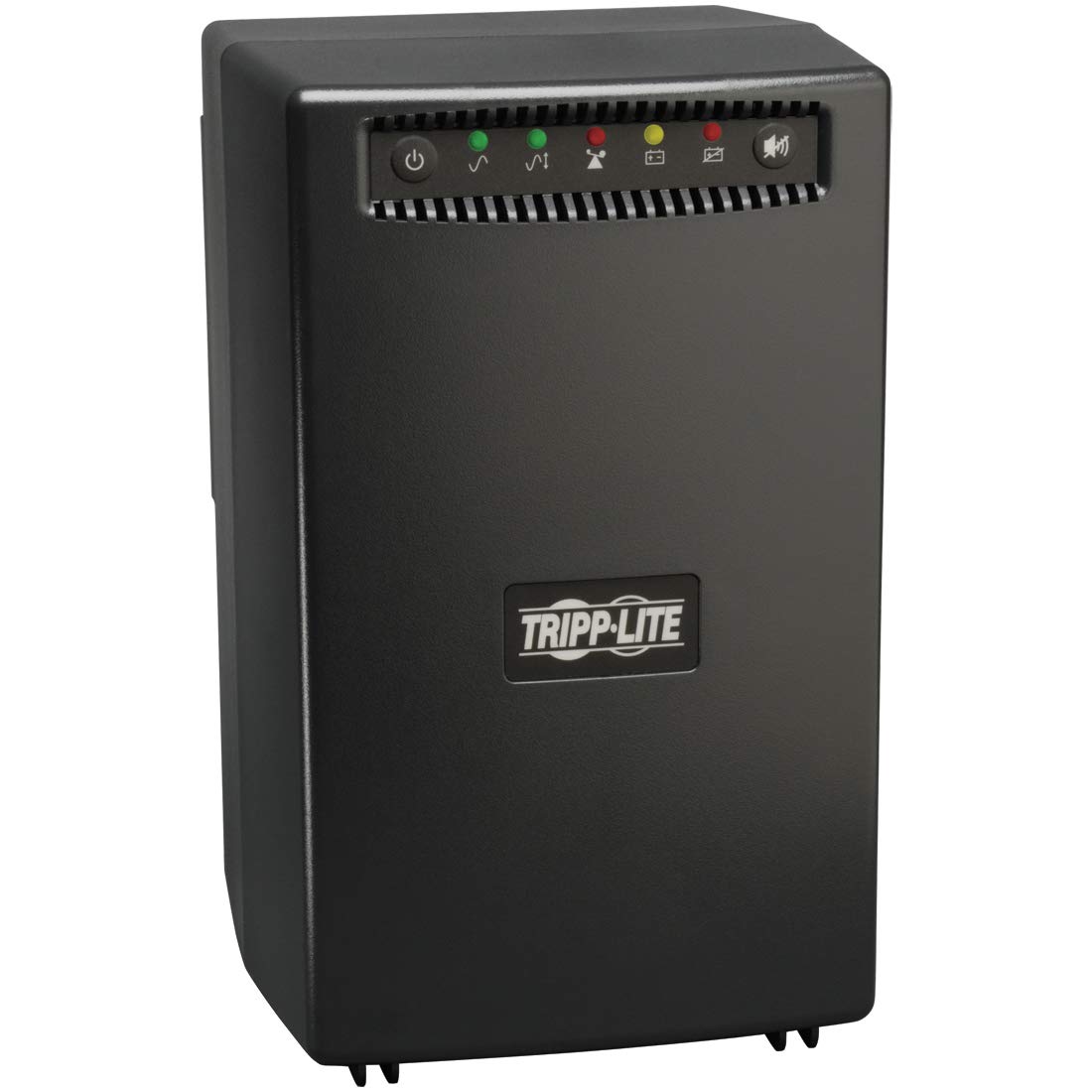
A 940W workhorse with built-in protection for your phone and internet lines.
Most UPS units forget that a surge can come through your phone line or Ethernet cable, not just the power outlet. This Tripp Lite model includes TEL/DSL (RJ11) and 10/100Base-T Ethernet surge protection, so your modem and router stay safe from a hit on the data line. It delivers 940W at 1500VA, making it the second-highest wattage after the 1000W pure sinewave units, but it uses a simulated sinewave output — fine for standard desktop PCs and networking gear.
You get 8 outlets total: five provide battery backup and surge protection for your essential gear, while three are surge-only for peripherals. AVR corrects brownouts and over-voltages between 92V and 150V back to 120V without draining the battery. Reviewers point out the 75 minutes of runtime at half load is enough to finish a work session, and the hot-swappable, user-replaceable battery means you can extend the life of the unit after the 3-year warranty. The free PowerPanel management software enables unattended shutdown.
The biggest trade-off is the simulated sinewave — not ideal for Active PFC power supplies. Also, at 8 outlets total, it offers less expansion than the 12-outlet CyberPower units above.
Who this fits: home users who want the high wattage (940W) and need surge protection on their phone and Ethernet lines too.
Who should skip: anyone with a modern Active PFC power supply — the simulated sinewave is not compatible.
7. Eaton Tripp Lite Series OMNI1500LCDT

An old reliable with easy battery swaps and a tangible weight advantage over its rivals.
This Eaton Tripp Lite unit (the OMNI1500LCDT) has been around for years for a good reason — it works, it is reliable, and when the battery dies you can replace it yourself with the RBC51 cartridge. It runs at 810W of output, which is the lowest wattage among the 1500VA units here but still enough for a typical PC + monitor setup. The 10 outlets provide full battery backup and surge protection for all of them.
The unit measures 19.29 x 9 x 11 inches, while the Amazon Basics UPS measures 13.7 x 3.9 x 9.8 inches, so plan for desk or floor space. However, at 810W versus the CyberPower CP1500PFCLCD at 1000W — a meaningful gap if you have a power-hungry workstation. AVR corrects voltages from 92V to 150V back to 120V, and the LCD screen shows battery runtime, load, and input voltage. Shoppers say the 8-hour charge time is faster than the APC BR1500MS2’s 16-hour charge time, so it recovers quickly between flickers.
The main limitation? 810W is relatively low, and the simulated sinewave output means it is not the best choice for advanced PC power supplies. But for a basic office PC or a network closet, it is a solid, serviceable pick.
What keeps it relevant
- User-replaceable battery (RBC51) extends the unit’s lifespan
- 8-hour charge time is fast for a lead-acid UPS
- 650 joules of surge protection across 10 outlets
Where it lags
- 810W output is the lowest wattage among the 1500VA units
- Simulated sinewave — not for Active PFC power supplies
Consider this if: you want a fast-charging, user-serviceable UPS for a basic desktop or network gear, and you are on a budget.
Pass on this if: you need more than 810W of output or have a modern PC with an Active PFC PSU.
8. Amazon Basics UPS Battery Backup, 1500VA/900W

The entry-level 1500VA that keeps your desk running while staying affordable.
If you just need basic battery backup for a standard desktop PC, monitor, and router, this Amazon Basics unit is the most straightforward way to get it. It delivers 900W of simulated sinewave power through 10 outlets (five battery backup, five surge-only). At half load (750VA/450W) it provides approximately 10 minutes of runtime, and at full load (1500VA/900W) it gives about 1.5 minutes — enough to save work and shut down.
The mini tower design with a 6-foot power cord fits easily under a desk, and the plastic enclosure keeps it light at 22.9 pounds. At 22.9 pounds versus the SKE SK1500 at 26 pounds, it is easier to move around. AVR is included to handle minor fluctuations without draining battery life. Buyers report the simulated sinewave works fine with standard desktop PSUs and home entertainment systems, and the price makes it a low-risk entry point into UPS ownership.
The big limitation is the runtime — at full load you only have about 90 seconds to save and shut down. That is fine for a quick flicker, but not enough for extended outages. Also, simulated sinewave means it is not ideal for modern gaming PCs or any equipment with an Active PFC power supply.
Best for the cautious buyer: a low-cost way to protect a standard work-from-home desk setup from surges and short blackouts.
Not the right fit for: high-end PC builds or anyone needing more than a minute or two of runtime at full load.
9. SKE SK1500 1500VA/900W UPS

A budget-friendly rack-mount UPS with all the basics but a heavy chassis.
This SKE unit brings an unusual form factor to the 1500VA category — a metal rack enclosure at 26 pounds, versus the Amazon Basics UPS at 22.9 pounds. It outputs 900W of simulated sinewave power through 8 outlets (6 with battery backup, 2 with surge protection only). The multi-function LCD displays input voltage, output voltage, battery capacity, and load percentage, and it auto-dims the screen after 30 seconds to save power.
An interesting feature is the silent mode: when the UPS switches to battery, you get a beep after 6-10 seconds, but one tap on the switch silences it completely. The cooling fan keeps the unit running at higher loads without overheating. The included free management software can perform an unattended shutdown. Owners mention that the rack-mount design is rare at this price tier, making it a good fit for someone building out a small network rack on a budget.
The weight (26 pounds) makes it cumbersome to move around despite its metal build quality.
what separates it
- Rack-mount form factor is rare at the entry price level
- Silent mode with one-tap alarm dimming
- Metal enclosure for durability in a network rack
Areas to consider
- 8 outlets are the fewest among the 1500VA units here
- Simulated sinewave and heavy 26-pound chassis
Grab this if: you want a rack-mountable UPS for a small network cabinet and are on a tight budget.
skip it if: you need a desktop-friendly tower design, more outlets, or pure sinewave output.
Understanding the Specs
Wattage vs. VA
The volt-amp (VA) rating is a measure of apparent power — it tells you how much current the UPS can handle. The wattage (W) is the real power available to your devices. A 1500VA battery backup can range from 810W to 1000W depending on the unit’s power factor. You want the wattage to comfortably exceed the draw of everything plugged into the battery-backup outlets. A typical desktop PC plus monitor draws 300-500W, so a 900W UPS gives you headroom for a router and external drives.
Pure vs. Simulated Sinewave
Simulated sinewave (also called stepped approximation) is a blocky wave shape that is fine for basic electronics and older power supplies. Pure sinewave produces a smooth, grid-like wave that modern Active PFC power supplies (found in most high-end PCs, gaming consoles, and NAS drives) need to run quietly and efficiently. If your gear has a power factor correction circuit, you need a pure sinewave UPS to prevent shutdowns, buzzing, or even component damage.
Automatic Voltage Regulation (AVR)
AVR is a feature that boosts or trims incoming voltage when it strays from the 120V standard, without switching to the battery. This extends battery life and keeps your equipment running through brownouts and over-voltages. Most of the units on this list include AVR, but the correction range varies — look for models that handle dips as low as 92V or spikes up to 150V.
Runtime and Battery Type
Runtime is always quoted at a specific load — a UPS that runs 70+ minutes at 100W may last only 90 seconds at 900W. Lead-acid batteries (SLA) are standard in most units and last 3-5 years before needing replacement. LiFePO4 (lithium iron phosphate) batteries last 10+ years and 3,000+ charge cycles, but add significantly to the upfront cost and weight. If your power flickers frequently, lithium quickly wins on total cost of ownership.
FAQ
Can a 1500VA UPS power a gaming PC?
How many minutes will a 1500VA UPS run my desktop PC?
What is the difference between pure sinewave and simulated sinewave?
Can I replace the battery in a 1500VA UPS?
Will a 1500VA UPS fit under my desk?
Do I need AVR on my UPS?
Can I plug my router and modem into the same UPS as my computer?
What do the USB ports on a UPS do?
How long will a lead-acid UPS battery last before needing replacement?
Can I use a 1500VA UPS for a home theater system?
Final Thoughts: The Verdict
If you want one dependable pick, the 1500va battery backup winner is the CyberPower CP1500PFCLCD because its pure sinewave output, 1000W capacity, and 12 outlets cover everything a modern home office or gaming PC needs without compromise. If you want a long-term investment with zero battery maintenance, grab the GOLDENMATE Lithium UPS. And for a no-nonsense value pick that protects your essential desk setup, the Amazon Basics UPS delivers reliable protection at a lower price.
How We Picked
We do not accept paid placement. Every pick is matched to a real buyer and a real use-case; we do not hands-on test units.
Sources & Methodology
Specifications: manufacturer listings and product documentation. Review insights: verified customer reviews, as of July 2026. Pricing: not shown on this page (it changes often); check the current price via the retailer link.
As an Amazon Associate, Gadgets Feed earns from qualifying purchases. This does not affect which products we feature.