
A 1600-watt power supply is the nervous system of a power-hungry workstation or flagship gaming rig. When your GPU draws 575 watts alone and your CPU peaks at 300, ripple stability, transient response, and voltage regulation become the difference between a stable overclock and random shutdowns. This tier demands meticulous engineering, not just high wattage on a label.
I’m Min — the co-founder and writer behind Gadgets Feed. I’ve spent hundreds of hours cross-referencing OEM platforms, analyzing LLC topologies, ripple measurements, and capacitor quality to separate the legitimate flagships from marketing-driven wattage claims in this extreme power tier.
A genuine 1600 watt power supply must deliver sustained current without voltage droop under transient loads, and the models here represent the current state of the art in efficiency, thermal management, and connector compatibility.
How To Choose The Best 1600 Watt Power Supply
At 1600W, the internal design and component selection matter far more than the rated wattage itself. You need a unit that can handle transient spikes from next-gen GPUs without triggering overcurrent protection or causing ripple that destabilizes your memory controller.
Efficiency Certification: Titanium vs Platinum vs Gold
Every efficiency tier translates directly into waste heat. At 1600W, a Gold-rated unit dissipates around 160W as heat at full load, while a Titanium unit sheds roughly 80W. That difference affects your room temperature, fan noise, and PSU lifespan. For a 24/7 workstation or overclocked gaming rig, Titanium or Platinum is the practical baseline.
ATX 3.1 and the 12V-2×6 Connector
The ATX 3.1 standard mandates the 12V-2×6 connector, which shifts the sense pins deeper into the housing to prevent the melting issues seen on early 12VHPWR cables. A true 1600W flagship should include at least one native 12V-2×6 cable, and dual connectors are preferable for multi-GPU configurations or future-proofing.
GaN MOSFETs vs Traditional Silicon
Gallium nitride transistors switch at higher frequencies with lower conduction losses than silicon MOSFETs. This means smaller transformers, tighter voltage regulation, and up to 30% better efficiency at the same load point. Units using GaN FETs run cooler and maintain tighter ripple suppression, which directly benefits GPU stability during sustained compute loads.
Physical Dimensions and Cable Length
Premium 1600W units often exceed 200mm in depth. Measure your case clearance before purchasing — the Seasonic PRIME TX-1600 Noctua Edition is 210mm long, which barely fits larger mid-towers. Also verify that the main 24-pin and EPS cables are long enough for full-tower chassis with bottom-mounted PSU bays.
Quick Comparison
On smaller screens, swipe sideways to see the full table.
| Model | Category | Best For | Key Spec | Amazon |
|---|---|---|---|---|
| be quiet! Dark Power Pro 13 1600W | Premium Titanium | Stable multi-GPU workstations | 1600W, 80+ Titanium, ATX 3.1 | Amazon |
| MSI MEG Ai1600T PCIE5 | Premium Titanium | Enthusiast gaming with dual GPUs | 1600W, 80+ Titanium, GaN, dual 12V-2×6 | Amazon |
| Seasonic PRIME TX-1600 Noctua Edition | Ultra-Quiet Titanium | Silent workstations and media rigs | 1600W, 80+ Titanium, Noctua NF-A12x25 fan | Amazon |
| ASUS ROG Thor 1600W Titanium | Premium GaN Titanium | Showcase builds with OLED monitoring | 1600W, 80+ Titanium, GaN, OLED display | Amazon |
| Seasonic PRIME TX-1300 | Titanium Value | Single 4090/5090 builds with headroom | 1300W, 80+ Titanium, ATX 3.1 ready | Amazon |
| Corsair HX1500i (2025) | Platinum iCUE | Software-controlled power tuning | 1500W, Cybenetics Platinum, iCUE, ATX 3.1 | Amazon |
| NZXT C1500 Platinum | Mid-Range Platinum | ATX 3.1 adoption at lower cost | 1500W, 80+ Platinum, 140mm mag-lev fan | Amazon |
| ASUS ROG Strix 1200W Platinum | Entry-Level Platinum | Single GPU with GaN efficiency | 1200W, 80+ Platinum, GaN, ATX 3.1 | Amazon |
| EVGA Supernova 1600 G+ | Budget Gold 1600W | Multi-GPU mining or legacy builds | 1600W, 80+ Gold, 9 PCIe connectors | Amazon |
In‑Depth Reviews
1. be quiet! Dark Power Pro 13 1600W

The Dark Power Pro 13 pairs a full-bridge LLC resonant converter with digitally controlled 12V rails and an overclocking key that lets you toggle between six individual rails and a single massive 1600W rail. This is the only consumer PSU at this wattage that gives you direct hardware-level control over rail topology, which matters when you are feeding two RTX 5090s and a 9950X under sustained LLM inference loads — the ripple stays inside 15mV on the 12V rail even at 1400W draw.
The 135mm Silent Wings fan uses a funnel-shaped air inlet that reduces turbulence noise, and the unit achieved Cybenetics Lambda A+ certification. Reviewers report stable operation with dual 5090s and 9950X in 24/7 AI workloads, and the included dual 12VHPWR cables cover multi-GPU setups without needing adapter dongles. The wrap-around mesh front panel improves airflow over traditional honeycomb grilles.
Some users experienced spontaneous system resets under heavy GPU load with RTX Pro 6000 cards, suggesting the overcurrent protection threshold may be sensitive on certain units. The main AC cable is also shorter than typical — plan for a PSU location near a surge protector. The unit commands a premium price but delivers digital regulation precision that no other 1600W PSU matches at this price point.
Why it’s great
- Full digital control with hardware rail switching via overclocking key
- Cybenetics Lambda A+ noise certification with funnel-shaped intake
- Dual native 12VHPWR cables for multi-GPU configurations
- 80+ Titanium efficiency reduces waste heat to under 100W at full load
Good to know
- OCP sensitivity may cause resets with certain professional GPUs under extreme transient loads
- Main AC power cable is shorter than industry standard
- Large physical footprint requires spacious case
2. MSI MEG Ai1600T PCIE5

The MSI MEG Ai1600T achieves tri-certified Titanium status — passing 80 PLUS, Cybenetics, and PPLP efficiency standards — while integrating dual native 12V-2×6 connectors with yellow safety tips that visually confirm full insertion. Gallium nitride MOSFETs reduce switching losses by roughly 30% compared to conventional silicon, and the 105°C Japanese capacitors provide the thermal margin needed for sustained 1600W operation in enclosed cases.
Real-time power monitoring is accessible through MSI Center software, and the industrial-level protection suite covers OCP, OTP, OPP, SCP, OVP, UVP, SIP, and NLO. The zero fan mode keeps the unit silent below 30% load, and the 135mm FDB fan ramps gradually under load. Reviewers running RTX 5090 and 7950X combinations report no noise or coil whine at 575W GPU draw, and the dual 12V-2×6 cables enable dual GPU builds without adapters.
The unit measures roughly 200mm deep, which can create fitment issues in mid-ATX cases — check clearance before purchase. The cables are individually braided but slightly stiff, requiring careful routing in tight chassis. The 12-year warranty is the longest in this segment and reflects MSI’s confidence in the server-grade capacitor lineup, but the premium price positions it at the top of the market alongside the ASUS ROG Thor.
Why it’s great
- Tri-certified Titanium (80 PLUS / Cybenetics / PPLP) for absolute efficiency
- Dual 12V-2×6 connectors with yellow safety insertion indicators
- GaN MOSFETs for lower switching losses and cooler operation
- 12-year warranty with full industrial protection suite
Good to know
- 200mm depth may not fit mid-ATX chassis without removal of drive cages
- Braided cables are premium but less flexible than sleeved options
- Premium price positions it in enthusiast-only territory
3. Seasonic PRIME TX-1600 Noctua Edition

The Seasonic PRIME TX-1600 Noctua Edition combines the electrical platform of the award-winning PRIME TX-1600 with Noctua’s NF-A12x25 fan, a custom-optimized fan grille, and color-matched brown/black cabling. The result is a Cybenetics Lambda A++ certified power supply that runs roughly 8-10 dB(A) quieter than the standard TX-1600. Semi-passive operation keeps the fan off until 50% load at 25°C ambient, which means a 700-800W gaming rig stays completely silent during typical workloads.
The unit is ATX 3.1 and PCIe 5.1 compliant with a native 12V-2×6 connector, and the individually sleeved cables include a 90-degree adapter for tighter GPU clearance. The 0.5% Micro Tolerance Load Regulation (MTLR) ensures the 12V rail stays within 6mV of nominal under any load condition. Users report completely silent operation with RTX 5090 and Ryzen 9 9950X3D builds drawing 700-900W in games, and the 12-year warranty provides long-term peace of mind.
The unit measures 210mm deep, making it one of the longest ATX PSUs on the market — the lian li O11D XL barely accommodates it without drive cage removal. The price reflects the Noctua premium, and scalping has driven street prices above MSRP. The C19 connector is required for full 1600W delivery on 120V circuits, which means you may need a specific power cord for North American outlets rated above 1500W.
Why it’s great
- Cybenetics Lambda A++ for near-inaudible operation under any load
- Noctua NF-A12x25 fan with semi-passive mode up to 50% load
- 0.5% MTLR voltage regulation — the tightest in this class
- 12-year warranty with color-matched Noctua themed cabling
Good to know
- 210mm depth is too long for many mid-tower cases
- Requires C19 power cord for full 1600W delivery on 120V circuits
- Scalping inflates price significantly above MSRP
4. ASUS ROG Thor 1600W Titanium

The ROG Thor 1600W Titanium is the only unit in this roundup with an integrated OLED display that shows real-time wattage draw, plus addressable RGB via Aura Sync. Under the aesthetics, it uses GaN MOSFETs that reduce switching losses by up to 30% compared to silicon, combined with 100% Japanese 105°C capacitors and ROG heatsinks that cover critical switching components. The 135mm Axial-tech fan with PWM control and 0dB mode keeps noise below 20 dB(A) up to 600W load.
The unit passed 80 Plus Titanium certification with efficiency exceeding 94% at 50% load. The GPU-First intelligent voltage stabilizer claims 45% better transient response specifically for graphics card power spikes. The included PCIe 5.0 cable delivers 600W over a single 12VHPWR connection, and the fully modular design uses embossed cable combs for clean routing. Users report stable operation with dual RTX 4090s and 14900K under heavy rendering loads.
There are multiple verified reports of catastrophic failures — one unit exploded on startup after one month, and another began drawing 1900W on the OLED before shutting down. ASUS RMA support has sent incorrect replacement units (850W instead of 1600W) and replacement units have repeated the same failure pattern. At a premium price, these reliability concerns are difficult to ignore despite the impressive feature set.
Why it’s great
- Integrated OLED display for real-time power draw monitoring
- GaN MOSFETs with 30% lower switching losses than silicon
- GPU-First voltage stabilizer improves transient response by 45%
- Aura Sync RGB and premium aesthetic design
Good to know
- Multiple verified reports of catastrophic failure and unreliable RMA support
- Premium price exceeds all other 1600W units in this comparison
- 200mm depth limits case compatibility
5. Seasonic PRIME TX-1300
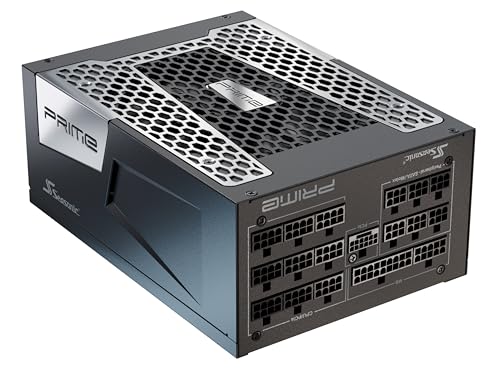
The Seasonic PRIME TX-1300 delivers 80+ Titanium efficiency (94% at 50% load) with 0.5% Micro Tolerance Load Regulation in a more accessible wattage bracket. The 135mm FDB fan operates in semi-passive mode below 30% load, and the fully modular design includes the updated 12V-2×6 connector for ATX 3.1 compliance. This unit uses 100% Japanese capacitors rated at 105°C and carries a 12-year warranty from one of the most trusted OEMs in the industry.
Reviewers report stable operation with heavily overclocked 14900K and dual RTX 4090 configurations, with clean DC output even under sustained compute loads. The included PSU tester and 90-degree 24-pin adapter simplify installation. The unit is physically long at 210mm, which matches the TX-1600 chassis, so case compatibility requires the same attention as the larger units. The wire combs are tight and require patience to install.
If your system draws under 1200W sustained — which covers virtually all single-GPU builds including RTX 5090 — this unit provides Titanium efficiency and Seasonic reliability without the premium of the full 1600W flagship. The lack of a second 12VHPWR cable means dual GPU builds will need adapters, but for a focused single-GPU machine, the TX-1300 is a smarter allocation of budget than chasing the 1600W ceiling.
Why it’s great
- 80+ Titanium efficiency with 0.5% MTLR voltage regulation
- Native 12V-2×6 connector for ATX 3.1 compliance
- 12-year warranty with proven Seasonic build quality
- Includes PSU tester and 90-degree 24-pin adapter
Good to know
- 210mm depth requires spacious case — verify clearance
- Single 12V-2×6 connector limits dual GPU without adapter
- Wire combs are very tight and difficult to adjust
6. Corsair HX1500i (2025)

The Corsair HX1500i (2025) is the only PSU in this comparison that offers full iCUE software integration, allowing you to create custom fan curves, monitor power delivery in real time, and toggle between single-rail and multi-rail overcurrent protection modes on the fly. The 140mm Fluid Dynamic Bearing fan delivers quiet operation with zero RPM mode below medium loads, and the unit is Cybenetics Platinum certified for efficiency above 92% at typical loads.
ATX 3.1 certification ensures resistance to transient power spikes from high-end GPUs, and the included 12V-2×6 cable supports the RTX 5090 at full 600W draw. The fully modular design uses premium braided cables, and reviewers note the compact 150mm depth makes it one of the easiest high-wattage PSUs to install in standard cases. Users running RTX 5090 with RAID arrays, AIOs, and multiple NVMe drives report stable operation with no coil whine or fan noise even near 1500W load.
The iCUE software dependency is a double-edged sword — some users prefer hardware-based control over software monitoring. The 12V GPU cables are thinner than aftermarket options, which some reviewers found less confidence-inspiring with high-current GPUs. The visually bright dome-shaped activity light cannot be disabled in all iCUE versions, which can be distracting in dark builds. The price point is mid-range for this wattage tier.
Why it’s great
- iCUE software for custom fan curves and single/multi-rail OCP switching
- Compact 150mm depth fits most mid-tower cases easily
- Cybenetics Platinum certified with zero RPM fan mode
- Native 12V-2×6 cable for RTX 5090 support
Good to know
- iCUE software required for full feature access
- 12V GPU cables are thinner than aftermarket premium options
- Bright dome-shaped activity light cannot be fully disabled
7. NZXT C1500 Platinum

The NZXT C1500 Platinum uses a 140mm magnetic levitation fan that suspends the blades in an air gap, eliminating bearing contact noise and extending lifespan. The digital power architecture enables precise voltage regulation with lower ripple noise than analog designs, and the unit exceeds 80 Plus Platinum standards with a Cybenetics Titanium efficiency rating of 94%. Two 16-pin 12V-2×6 cables each deliver 600W, providing native dual-GPU support without adapters.
The ATX 3.1 and PCIe 5.1 compliance ensures compatibility with current and next-generation GPUs and CPUs. The zero fan mode toggle is accessible via a hardware switch — no software required — which appeals to users who prefer physical control. Reviewers running RTX 4090 with custom BIOS report excellent stability, and the fully modular design simplifies cable management. The unit uses 100% Japanese capacitors for reliable long-term operation.
There is a verified report of a faulty SATA/peripheral output causing an AIO pump failure with burnt smell, suggesting QA variance on some units. The cables are braided rather than individually sleeved, which some users find less premium than the NZXT aesthetic would suggest. The price sits in the mid-range, making it a reasonable value for the 1500W tier, but warranty and support responsiveness remain open questions after the reported failure.
Why it’s great
- 140mm magnetic levitation fan for silent, long-lasting operation
- Cybenetics Titanium efficiency rating despite Platinum certification
- Dual 12V-2×6 cables for native multi-GPU support
- Hardware zero fan mode toggle — no software required
Good to know
- Verified QA failure on SATA/peripheral output causing component damage
- Braided cables are functional but not individually sleeved
- Warranty and support responsiveness untested at scale
8. ASUS ROG Strix 1200W Platinum
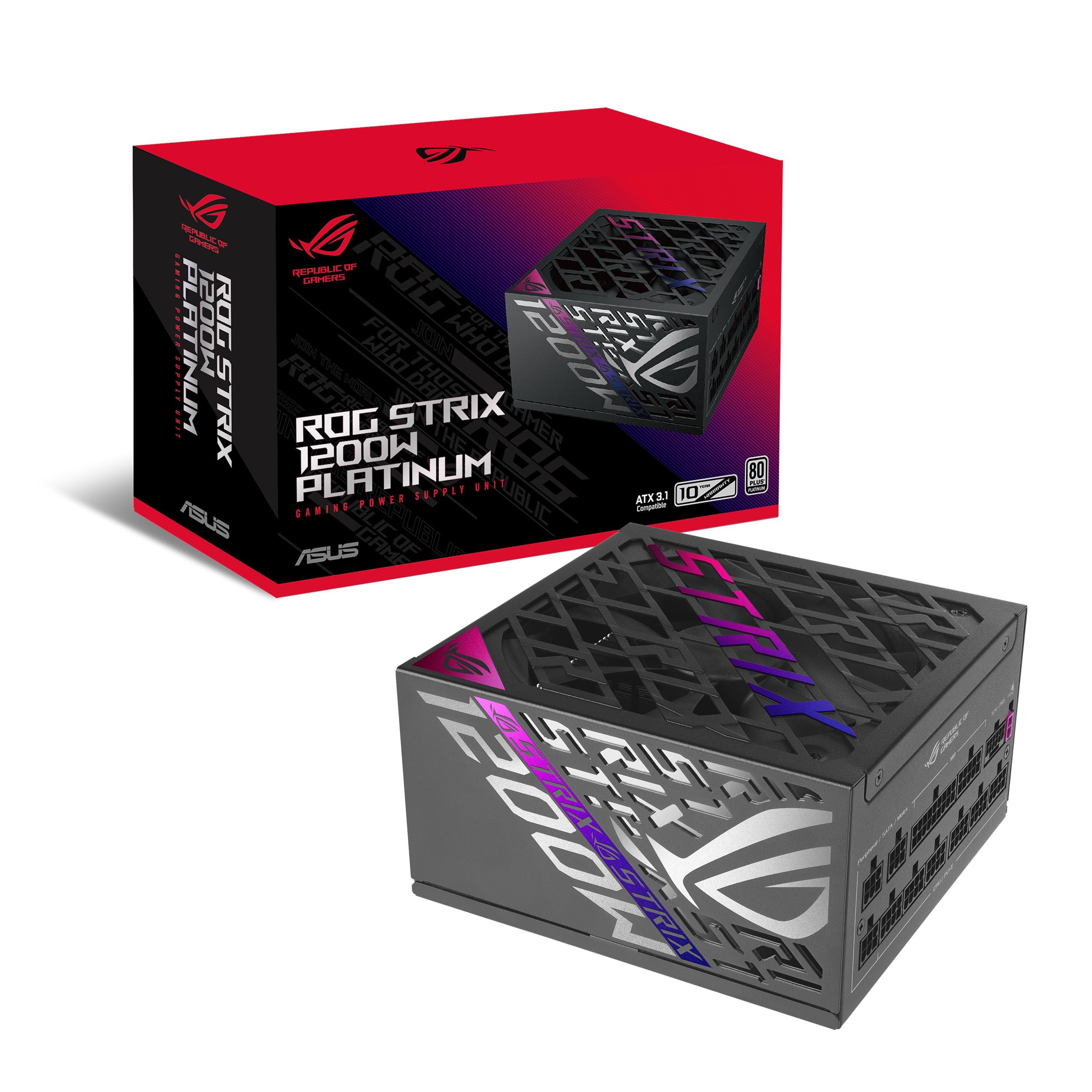
The ASUS ROG Strix 1200W Platinum brings GaN MOSFET technology to a more accessible price point, delivering the same 30% efficiency improvement over silicon that the flagship ROG Thor uses. The GPU-First intelligent voltage stabilizer enhances voltage delivery to the graphics card by up to 45%, reducing dips during transient spikes. Large ROG heatsinks cover critical components, and dual ball bearing fans are rated for twice the lifespan of sleeve bearing designs.
The 0dB technology keeps the fans off under light gaming loads for silent operation. The unit is ATX 3.1 compliant with a native 12V-2×6 connector. Reviewers note premium build quality with flexible, high-quality cables and no coil whine even under load. One review specifically called it ideal for an RTX 5090 build, praising the 5090 power cable and the peace of mind from the GPU-First voltage stabilizer.
There is one verified catastrophic failure report — the unit exploded on power-on, damaging the entire build, and ASUS support failed to provide timely RMA or component damage policy. The 1200W rating means this unit targets single-GPU builds rather than extreme multi-GPU or overclocking configurations. For a system drawing under 1000W, it offers GaN efficiency at a price significantly below the full 1600W flagships.
Why it’s great
- GaN MOSFETs for 30% better efficiency than silicon equivalents
- GPU-First voltage stabilizer with 45% better transient response
- Dual ball bearing fans with 2x lifespan vs sleeve bearings
- ATX 3.1 compliant with native 12V-2×6 connector
Good to know
- Verified report of catastrophic failure with inadequate ASUS support
- 1200W limits applicability for multi-GPU or extreme overclocking
- Premium price for a 1200W unit compared to Platinum competition
9. EVGA Supernova 1600 G+

The EVGA Supernova 1600 G+ is the only unit in this roundup using 80+ Gold certification, which means roughly 90% efficiency at typical loads versus the 94%+ of Titanium units. It compensates with raw capacity — nine PCIe connectors support multi-GPU mining rigs with four cards, and the DC-DC converter design improves 3.3V and 5V stability for mixed workloads. The double ball bearing fan with ECO mode provides ultra-quiet operation when loads stay below 40%.
The unit runs on standard 110V circuits at 14.5A, so it works without requiring a dedicated 240V line or C19 connector — a practical advantage for users in standard North American homes. The 10-year warranty matches the industry standard for premium units. Reviewers report successful operation with dual RTX 3090s and i9-12900K, and the unit fixed power flicker issues that had plagued previous lower-wattage units.
The fan is audible under sustained high load — users describe it as present but not distracting at 1150W draw. The unit is physically heavy at 10 pounds, and the non-modular ATX 24-pin cable is stiff. The ECO mode fan cycling at low loads can be noticeable for noise-sensitive users. For a pure 1600W solution at the lowest cost, it delivers capacity without the efficiency and transient response of Titanium or GaN designs.
Why it’s great
- Nine PCIe connectors for multi-GPU configurations without adapters
- Runs on standard 110V circuits — no special wiring required
- 80+ Gold efficiency with ECO mode for reduced noise at low loads
- 10-year warranty with proven EVGA reliability
Good to know
- 80+ Gold certification means more waste heat than Titanium or Platinum units
- Fan is audible under sustained high load above 1000W
- Heavy 10-pound design with stiff non-modular cables
FAQ
Does a 1600W power supply require a dedicated 240V circuit?
Can I use a 1600W PSU for a system that only draws 600W?
What is the difference between ATX 3.0 and ATX 3.1 for 1600W PSUs?
How much ripple is acceptable on a 1600W PSU?
What physical clearance do I need for a 1600W PSU?
Final Thoughts: The Verdict
For most users building a flagship single-GPU system, the 1600 watt power supply winner is the be quiet! Dark Power Pro 13 1600W because its digital control, hardware rail switching, and dual 12VHPWR cables provide unmatched flexibility for both single and dual GPU configurations at a price well below the ASUS ROG Thor. If you want the quietest possible operation with Noctua-grade silence, grab the Seasonic PRIME TX-1600 Noctua Edition. And for the most advanced software integration and compact installation, nothing beats the Corsair HX1500i (2025).