
Filling a 16TB pool with SATA SSDs means confronting a wall of spinning rust that drones, vibrates, and punishes every seek operation. The real battle isn’t capacity — it’s the moment you realize mechanical latency is silently throttling your entire workflow. True 16TB SATA SSD arrays deliver zero noise, near-instant access times, and thermal profiles that won’t cook your server room.
I’m Min — the co-founder and writer behind Gadgets Feed. I’ve spent hundreds of hours dissecting SATA SSD endurance ratings, TBW ceilings, and controller architectures to separate genuine enterprise-grade drives from repackaged consumer silicon.
Whether you are building a dense NAS, a silent media server, or a RAID array that can survive 24/7 writes, this guide to the best 16tb sata ssd options delivers the raw specs and real-world trade-offs you need to make the right call.
How To Choose The Best 16TB SATA SSD
A 16TB SATA SSD is a serious investment, and the wrong choice can mean premature drive failure, silent data corruption, or crippling write amplification. You need to focus on endurance, controller intelligence, and workload alignment — not just the sequential read speed that looks impressive on the box.
Endurance Rating (TBW) — Your Drive’s Lifespan Clock
Every SATA SSD has a limited number of terabytes it can write before the NAND cells wear out. For a 16TB drive, you want a TBW rating that matches your workload. Enterprise drives in this capacity class often exceed 10,000 TBW, while consumer models might offer a fraction of that. If you plan to run databases, surveillance recording, or heavy file synchronization, never compromise on TBW — check the datasheet, not the marketing copy.
NAND Flash Type — TLC vs. QLC vs. SLC Mode
Triple-Level Cell (TLC) NAND typically offers better endurance and sustained write performance than Quad-Level Cell (QLC) at the same capacity point. Many modern drives use SLC caching to boost burst speeds, but the true indicator of long-term consistency is the native write speed once the cache fills. For a 16TB SATA SSD used in a NAS or RAID array, TLC with a generous SLC cache is the safer bet for mixed read/write environments.
Power-Loss Protection (PLP) and Thermal Throttling
A sudden power cut can corrupt the mapping table of a drive without PLP, leading to data loss or drive failure. Enterprise SATA SSDs integrate dedicated capacitors to flush in-flight data safely. Additionally, sustained writes in a dense array generate heat — check the operating temperature range and whether the drive aggressively throttles under load. A drive that drops to 50 MB/s when hot defeats the purpose of an SSD upgrade.
Quick Comparison
On smaller screens, swipe sideways to see the full table.
| Model | Category | Best For | Key Spec | Amazon |
|---|---|---|---|---|
| WD Red Pro 16TB (WD161KFGX) | NAS HDD | RAID arrays with 550TB/yr workload | 512 MB Cache, CMR | Amazon |
| Seagate IronWolf Pro 16TB (ST16000NT001) | NAS HDD | Multi-bay NAS with RV sensors | 256 MB Cache, 7200 RPM | Amazon |
| Toshiba MG08ACA16TE | Enterprise HDD | Dense server arrays 24/7 | 512 MB Cache, Helium | Amazon |
| Seagate Exos X24 16TB (ST16000NM002H) | Enterprise HDD | Hyperscale data centers | 512 MB Cache, SAS 6Gb/s | Amazon |
| LaCie 2big RAID 16TB | External RAID | Creative pros needing speed + redundancy | 440 MB/s, RAID 0/1 | Amazon |
| Intel D3-S4510 1.92TB | Enterprise SSD | Read-intensive server workloads | TLC NAND, 550MB/s | Amazon |
| WD Blue SA510 4TB | Consumer SSD | Everyday PC storage upgrade | 560 MB/s Sequential Read | Amazon |
| SanDisk Ultra 3D 2TB | Consumer SSD | Laptop speed upgrade | 560 MB/s, nCache 2.0 | Amazon |
| Gigastone NAS 2TB (2-Pack) | NAS SSD | Synology/QNAP cache drives | TLC + SLC cache, 550MB/s | Amazon |
| WD Elements 16TB External | External HDD | Plug-and-play bulk backup | USB 3.0, 5 Gb/s | Amazon |
| Seagate Exos X16 16TB Renewed | Enterprise HDD Renewed | Budget-friendly enterprise storage | 7200 RPM, 256 MB Cache | Amazon |
In‑Depth Reviews
1. Western Digital 16TB WD Red Pro NAS Internal Hard Drive HDD – 7200 RPM, SATA 6 Gb/s, CMR, 512 MB Cache, 3.5″ – WD161KFGX

WD’s Red Pro family is the default recommendation for any serious NAS builder, and the 16TB WD161KFGX justifies that reputation with a 512 MB cache and CMR recording that guarantees consistent write performance under RAID stress. Rated for a 550 TB annual workload, this drive is built for multi-user environments where simultaneous reads and writes are the norm, not the exception. The 7200 RPM spindle keeps access times competitive for a mechanical drive, and the helium-sealed design reduces power draw and operating temperatures compared to air-filled predecessors.
Users report reliable 24/7 operation in enclosures from Synology to TrueNAS, and the 5-year limited warranty backs the endurance claim. Some units arrive in soft packaging, so inspect the anti-static bag on arrival, but the drive itself is a known quantity in the NAS community. The noise level is present during active seek operations, though it stays well below the threshold of older enterprise models — you won’t hear it in a closet or server room.
If you are populating a multi-bay RAID 5 or RAID 6 array and need a drive that won’t drop out of the pool after sustained writes, this is the anchor for your build. The 512 MB cache helps smooth burst transfers, and the RV sensors ensure the drive compensates for vibration in dense chassis. Pair it with a Synology DS1823xs+ or a QNAP TS-h1886XU-RP for the best result.
Why it’s great
- 512 MB cache improves sustained write throughput in RAID
- CMR recording prevents write amplification in parity arrays
- 5-year warranty with data recovery service option
Good to know
- Audible seek noise in quiet environments
- Some units arrive in thin protective packaging
2. Seagate IronWolf Pro, 16 TB, Enterprise NAS Internal HDD – CMR 3.5 Inch, SATA 6 Gb/s, 7,200 RPM, 256 MB Cache (ST16000NT001)
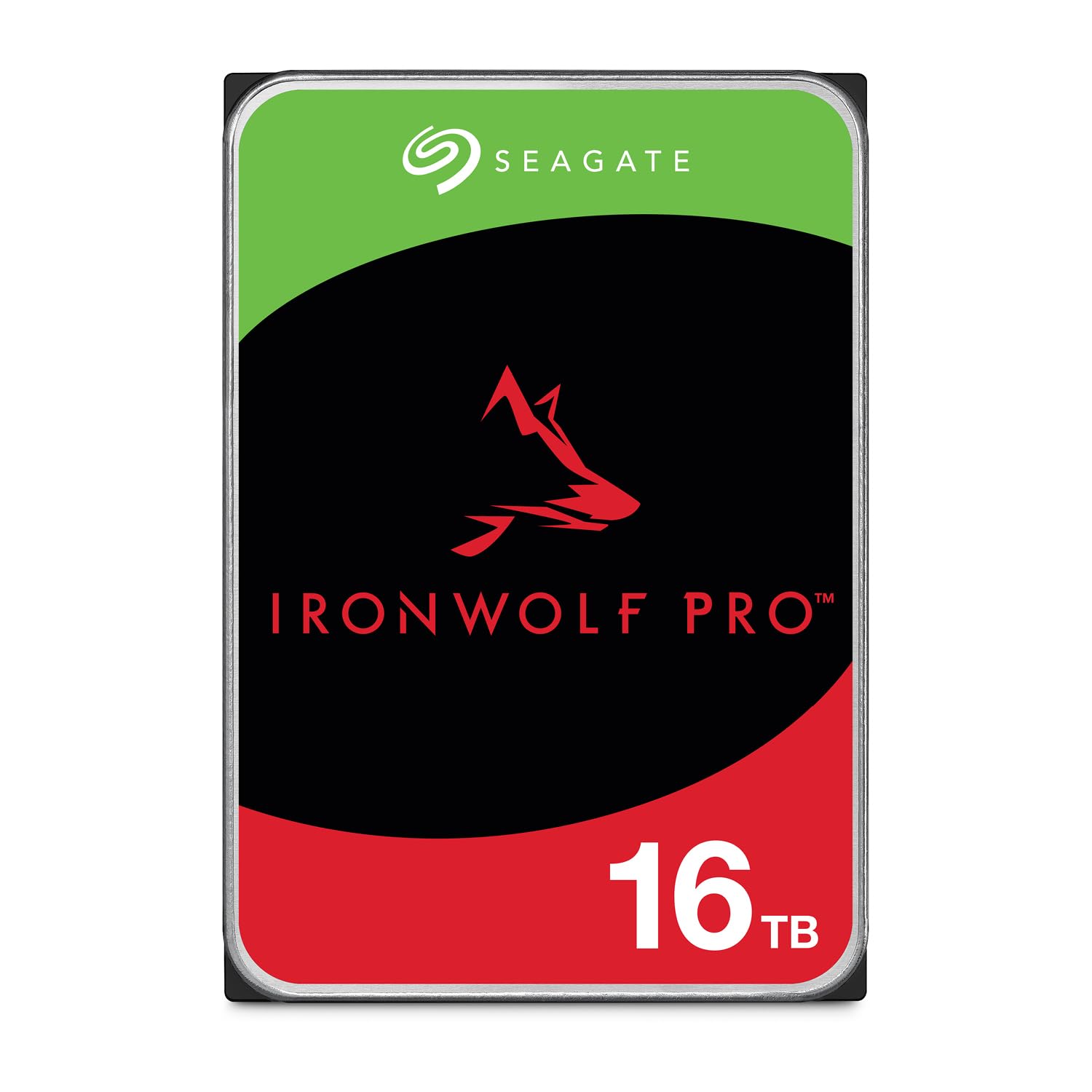
Seagate’s IronWolf Pro line is engineered from the ground up for NAS environments, and the 16TB ST16000NT001 includes rotational vibration sensors, time-limited error recovery (TLER), and dual-plane actuator balancing — features that directly reduce drive dropouts in multi-bay arrays. The 256 MB cache and 7200 RPM spindle deliver read/write speeds that comfortably saturate a Gigabit Ethernet link, and the CMR recording ensures predictable performance during RAID rebuilds. The 2.5 million hour MTBF rating is backed by a 5-year warranty and 3-year Rescue Data Recovery service, which adds a safety net that WD charges extra for.
Customer feedback is generally strong, noting quiet operation and consistent speeds in Synology and QNAP systems. A minority of users have encountered RMA delays with Seagate’s support team, but the drive itself rarely fails within the warranty period. The IronWolf Health Management (IHM) feature provides proactive alerts through compatible NAS firmware, letting you catch surface-level issues before they escalate. In a 4-bay or 8-bay RAID 5 array, this drive delivers the lowest latency for mixed workloads like Plex transcoding and file server operations.
If you prioritize data recovery peace of mind and want a NAS drive with integrated health monitoring, the IronWolf Pro is the stronger ecosystem choice over WD’s Red Pro for equivalent capacity. The 550 TB/year workload rating matches WD’s spec, so the tiebreaker is the bundled Rescue service and the more mature IHM integration across major NAS brands.
Why it’s great
- 3-year complimentary Rescue Data Recovery included
- RV sensors improve reliability in multi-bay chassis
- IronWolf Health Management for proactive monitoring
Good to know
- Seagate RMA process can be slow for replacements
- 256 MB cache is smaller than WD Red Pro’s 512 MB
3. Toshiba Enterprise MG Series 3.5″ 16TB SATA 3 (MG08ACA16TE)

Toshiba’s MG08ACA16TE brings helium-sealed enterprise architecture to the 16TB SATA market at a price point that undercuts both Seagate and WD equivalent offerings. The 512 MB cache and 7200 RPM spindle are standard flagships, but the helium fill reduces power consumption to approximately 5.3W idle, which compounds into significant savings across a 24-drive rack. The drive is designed for 24/7 operation with a workload rating of 550 TB/year and supports extended error recovery for RAID environments — though it lacks TLER branding, Toshiba’s own error recovery control works similarly in practice.
User reports describe the drive as noticeably noisier during active seeks compared to Seagate’s IronWolf Pro, with some citing a persistent hum that is audible in quiet home office setups. The usable capacity after formatting lands at around 14.5 TB, which is standard for this class. A few early failures have been documented, primarily DOA units or drives that failed within the first month, which suggests quality control can be inconsistent despite the enterprise pedigree.
For IT managers building cold storage servers or backup targets where raw capacity per dollar matters more than absolute silence, the Toshiba MG08 is a compelling value. It pairs well with LSI HBA controllers or Supermicro chassis where the drive’s higher noise floor is masked by server fans.
Why it’s great
- Helium-sealed for lower power and vibration
- 512 MB cache improves burst write performance
- Competitive price per TB in enterprise class
Good to know
- Noticeably louder than IronWolf Pro under load
- Inconsistent quality control on some batches
4. Seagate Exos X24 16TB Enterprise Internal Hard Drive HDD – 6GB/s SAS 7200RPM 2.5M MTBF (ST16000NM002H)
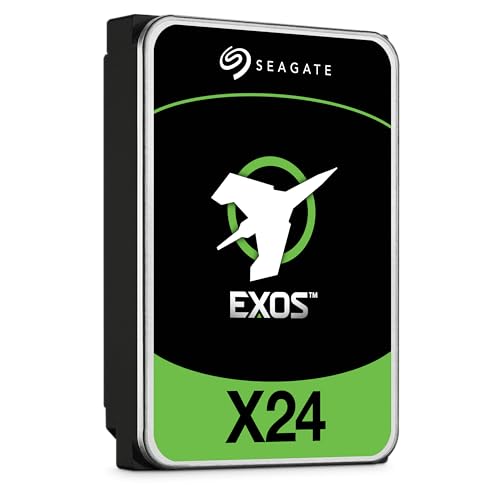
The Exos X24 is Seagate’s hyperscale-grade drive, and the 16TB ST16000NM002H variant uses the SAS 6Gb/s interface rather than SATA, which makes it the right choice for enterprise arrays and server backplanes that require dual-port connectivity. The 512 MB cache and 7200 RPM spindle are paired with enhanced caching algorithms that Seagate calls “fast format” — the drive delivers consistent sub-10ms average latency even under sustained sequential write loads. The 2.5 million hour MTBF and 5-year limited warranty are standard for the Exos line, but the SAS interface adds support for dual-port failover and higher queue depths compared to SATA equivalents.
Customer reviews highlight excellent thermal behavior when airflow is adequate, with some users running these drives in Supermicro and Dell PowerEdge servers for months without a single reallocated sector. However, a notable subset received DOA units — clicking noise on power-up — which points to rough handling during shipping rather than design flaws. The SAS controller requirement means you cannot plug this into a standard desktop motherboard without an HBA or RAID card.
If you own a server-class chassis with SAS backplane support and need the highest reliability tier for a production database or virtualization host, the Exos X24 delivers class-leading vibration tolerance and latency consistency. It is overkill for a home NAS but exactly what a colocation rack demands.
Why it’s great
- SAS dual-port for failover in enterprise arrays
- Enhanced caching for consistent low latency
- 2.5 million hours MTBF rating
Good to know
- Requires SAS controller — not SATA compatible
- Some DOA units reported from shipping
5. LaCie 2big RAID 16TB External Hard Drive Desktop HDD – USB-C, 7200 RPM Enterprise Class Drives (STHJ16000800)

LaCie’s 2big RAID is an all-in-one workstation solution that ships with two 8TB IronWolf Pro enterprise drives pre-installed in a hot-swappable RAID enclosure. The USB-C 3.1 interface delivers up to 440 MB/s in RAID 0 mode, which is fast enough for 4K video editing timelines and large photo catalogs in Lightroom and Capture One. The drive ships configurable to RAID 0 (performance) or RAID 1 (mirroring), and the step-by-step wizard in LaCie RAID Manager makes the process painless even for non-technical creative professionals.
User feedback splits sharply: professionals who use this as a working drive praise the speed and quiet idle operation, while some desktop users report loud fan noise and audible drive seek chatter during backups. The included 5-year warranty with Rescue Data Recovery is a strong value-add, though the connectivity limitation to USB 3.x (no Thunderbolt) means it cannot saturate a Thunderbolt 3 bus. After three years of light weekly use, a small number of units have experienced connectivity errors (0x80070015 on Windows), which suggests the onboard controller may degrade faster than the drives themselves.
If you need a turnkey 16TB RAID solution for your Mac Studio or Windows workstation and you value design aesthetics and bundled recovery services, the LaCie 2big saves you the assembly hassle. Just be prepared to route the power brick away from your desk if fan noise bothers you.
Why it’s great
- Pre-configured RAID 0/1 with enterprise drives inside
- USB-C connectivity works with modern laptops
- 5-year warranty including data recovery
Good to know
- Fan and drive noise noticeable in quiet rooms
- USB 3.0 only — no Thunderbolt support
6. Intel Solid State Drive SSDSC2KB019T801 D3-S4510 1.9TB 2.5 inch SATA 6GB/S 3D2 TLC

The Intel D3-S4510 is a read-intensive enterprise SATA SSD that delivers 550 MB/s sequential read and a TBW rating far beyond any consumer drive at this capacity point. Built on 144-layer 3D TLC NAND with a fourth-generation controller, it includes AES 256-bit encryption, full power-loss data protection, and temperature monitoring — features that make it suitable for boot pools in production databases and virtualization hosts. The 1.92 TB capacity means you need eight of these to reach 16 TB, but the endurance per drive (over 1.4 PBW for the 1.92 TB model) ensures years of heavy write workloads without degradation.
Users running Proxmox and vSphere report zero failures over multiple years of 24/7 operation, with the drives maintaining consistent latency even under sustained random-write loads. Some units arrive with seals broken or manufacture dates over a year old, which eats into the warranty window that starts from production rather than purchase. For critical infrastructure, pay attention to the manufacture date on the label and consider returning any unit that looks tampered or aged.
If you need a SATA SSD for a hardware RAID array handling database logs, VM boot volumes, or caching tiers, the Intel D3-S4510 is an investment in predictable performance and data integrity that consumer drives cannot match. It has been replaced by the D5 series in Intel’s lineup, but the S4510 remains widely available and proven in production.
Why it’s great
- 1.4+ PBW endurance for read-intensive workloads
- Power-loss protection with dedicated capacitors
- Enterprise firmware calibrated for RAID arrays
Good to know
- Warranty starts from manufacture date, not purchase
- Small capacity per drive requires multiple units for 16TB
7. Western Digital 4TB WD Blue SA510 Internal Solid State Drive SSD – SATA III 6 Gb/s, 2.5″/7mm, Up to 560 MB/s – WDS400T3B0A

WD’s Blue SA510 is the go-to SATA SSD for casual desktop and laptop upgrades, and the 4TB variant gives you enough room for modern game libraries, media collections, and application data without breaking the bank per terabyte. Sequential reads hit 560 MB/s and writes reach 520 MB/s, which is the practical ceiling for SATA III. The drive uses TLC NAND with a small SLC cache for burst write acceleration, and the 2.5-inch 7mm form factor fits both Ultrabooks and desktop hot-swap bays.
User reviews emphasize the noticeable boot speed improvement over HDDs, and the drive runs cool even under sustained writes. However, some units fail within 30 months of use — a failure rate higher than enterprise drives but typical of consumer SSDs at this price point. The Acronis cloning software bundled with the drive has caused boot corruption for several users, so a tool like Macrium Reflect is a safer choice for migration.
If you need a large-capacity SATA SSD for a home PC, media server cache, or secondary game drive, the SA510 offers the best price-to-capacity ratio in WD’s consumer lineup. Just maintain a backup routine — the 30-month failure examples are not isolated.
Why it’s great
- 4TB capacity at a consumer-friendly price point
- 7mm slim profile fits all standard 2.5-inch bays
- Cool operation even during extended writes
Good to know
- Higher failure rate than enterprise SSDs after 2 years
- Bundled Acronis cloning software causes boot issues
8. SanDisk Ultra 3D NAND 2TB Internal SSD – SATA III 6 Gb/s, 2.5″/7mm, Up to 560 MB/s – SDSSDH3-2T00-G26

SanDisk’s Ultra 3D line is essentially a WD Blue in different branding — same 3D TLC NAND, same SATA III controller, and identical sequential speeds of 560/520 MB/s. The 2TB capacity is ideal for laptops that have a single drive bay but need enough room for AAA games, creative suites, and the OS. The nCache 2.0 technology uses an SLC write cache to absorb burst writes before flushing to TLC, which makes everyday booting and file transfer feel snappier than raw NAND speeds suggest.
Long-term users with over a year of usage report silent operation, cool temperatures even inside SFF mini-PCs, and no failures. The drive is shock-resistant and supports DevSleep for lower power draw in laptops. On sale, this drive delivers excellent value, though the 2TB ceiling means you need eight of them to reach 16TB, which quickly becomes impractical for dense storage.
For a single-system upgrade where you need reliable SATA III performance and silent operation, the SanDisk Ultra 3D is a proven workhorse. It works best as a primary OS drive in a desktop or as a game drive in an external USB 3.0 enclosure.
Why it’s great
- nCache 2.0 acceleration for fast burst writes
- Silent and cool in enclosed laptop chassis
- Proven long-term reliability from user reports
Good to know
- 2TB max capacity limits large-scale deployment
- Price per TB higher than WD Blue SA510
9. Gigastone 【NAS Certified】 2TB High Endurance SSD (2-Pack) Up to 550MB/s TLC Flash with SLC Caching (B0CR5QTMS9)

Gigastone’s 2TB High Endurance NAS SSD two-pack is a targeted solution for users who want SSD caching in Synology or QNAP without buying enterprise-priced drives. The 550 MB/s sequential speed is standard for SATA III, but the inclusion of TLC NAND with SLC caching and power-loss protection makes it more suitable for 24/7 operation than a typical consumer SSD. The drive is certified for NAS RAID configurations and tested with major brands like Synology, QNAP, and Asustor.
A notable incompatibility report with TeraMaster D8 enclosures suggests that controller-to-SSD compatibility should be verified before purchase. The plastic enclosure feels less premium than aluminum-shelled SSDs but does not affect thermal performance.
If you need 2TB of SATA SSD cache for a Synology NAS and want to stay on a budget, this pack delivers solid value — but prioritize a return-friendly vendor in case of early failure.
Why it’s great
- Two drives in a single pack for RAID mirror builds
- TLC flash with SLC cache for sustained writes
- Power-loss protection for NAS environments
Good to know
- Early failure rate higher than enterprise SSDs
- Warranty process is slow and documentation-heavy
10. WD 16TB Elements Desktop External Hard Drive, USB 3.0 for plug-and-play storage – WDBWLG0160HBK-NESN

WD’s Elements 16TB external drive is the simplest way to add bulk backup capacity — it ships with a USB 3.0 interface, an AC power adapter, and a 5 Gb/s transfer ceiling that delivers around 180 MB/s in real-world file copies. The drive uses a 3.5-inch mechanical HDD inside (typically a WD Ultrastar or Red-class drive in recent batches), which makes it shuckable for users who want to install the bare drive into a NAS enclosure. The aluminum shell keeps temperatures reasonable, and the upright design saves desk footprint.
Users consistently praise the reliability of the Elements line, noting that error rates are lower than Seagate equivalents in consumer surveys. The drive is NTFS-formatted out of the box, which means Mac users need to reformat to ExFAT or APFS for write access. During active backup operations, the drive produces noticeable seek and spin noise, though it remains quiet during idle periods. Some units have arrived with minor cosmetic damage from shipping.
If you need a simple, large external drive for Time Machine, media archiving, or PC backups and you want maximum capacity without assembly, the WD Elements 16TB is the most trusted entry point in this capacity class.
Why it’s great
- Shuckable for installation into a NAS or server
- Proven lower failure rates than consumer Seagate drives
- Plug-and-play simplicity for Windows PCs
Good to know
- USB 3.0 limits speed to ~180 MB/s
- NTFS only — requires reformat for Mac
11. ST16000NM001G 16TB HDD Exos X16 7200 RPM 512e/4Kn SATA 6Gb/s 256MB Cache 3.5-Inch Enterprise Hard Drive (Renewed)

This renewed Exos X16 16TB drive from Seagate offers enterprise-grade CMR recording and helium-sealed efficiency at roughly half the price of a new unit. The 7200 RPM spindle and 256 MB cache are carryovers from Seagate’s data-center Exos line, with a 2.5 million hour MTBF and 550 TB/year workload rating that matches new stock. The drive is factory-reconditioned with a 5-year warranty card included in the box, and most units arrive with low power-on hours and pristine SMART data.
Customer feedback is overwhelmingly positive: users report fast delivery, secure packaging with tamper-proof seals, and drives that perform identically to new units in RAID and DAS configurations. The helium-sealed design keeps temperatures low even in enclosures with limited airflow. A small number of users experienced total failure on the second boot — a risk that comes with any refurbished hardware, but the included warranty mitigates the downside. Some users note the drive is louder than consumer drives, which is expected given its enterprise derivation.
If you need 16TB of enterprise-grade storage for backups or a RAID pool and are comfortable with renewed hardware, this Exos X16 delivers the best value in the capacity class. The 5-year warranty makes the risk manageable.
Why it’s great
- Enterprise Exos pedigree at a fraction of new cost
- Helium-sealed for low power and vibration
- 5-year warranty card included despite renewed status
Good to know
- Small risk of DOA or early failure inherent to renews
- Audible seek noise typical of enterprise drives
FAQ
Can I use a 16TB SATA SSD as a direct replacement for a mechanical hard drive in my NAS?
What is the real-world usable capacity of a 16TB SATA SSD after formatting?
How does power-loss protection affect the price of a 16TB SATA SSD?
Is a 16TB SATA SSD faster than a 16TB SATA HDD in a RAID 5 array?
Final Thoughts: The Verdict
For most users, the best 16tb sata ssd winner is the Western Digital 16TB WD Red Pro (WD161KFGX) because it combines the highest cache buffer in its class, 550 TB/year endurance, and CMR reliability that NAS RAID arrays demand. If you want instant data access and zero seek latency in a pre-built external package, grab the LaCie 2big RAID 16TB. And for pure capacity-per-dollar with enterprise-grade specs, nothing beats the cost efficiency of the Seagate Exos X16 16TB Renewed.