
An 18-200mm lens is the ultimate all-in-one solution for photographers who refuse to choose between capturing sweeping landscapes and distant wildlife with a single optic. Instead of lugging three separate lenses or frantically swapping glass during critical moments, a superzoom like this covers everything from 18mm wide-angle to 200mm telephoto in one twist of the zoom ring. The pain it solves is real: missed shots because you had the wrong lens mounted and the extra weight of a multi-lens kit.
I’m Min — the co-founder and writer behind Gadgets Feed. I’ve spent countless hours researching interchangeable lenses, analyzing MTF charts, comparing optical formulas, and reading through thousands of user experiences to understand exactly which superzoom delivers real-world performance and which ones cut corners you’ll regret at 200mm.
This buying guide will help you identify the right balance of reach, image stabilization, and optical quality in a 18-200mm lens, whether you shoot Nikon DX, Canon EF-S, Sony E, or Panasonic L‑mount systems.
How To Choose The Best 18-200mm Lens
Choosing an 18-200mm superzoom means accepting optical compromises in exchange for unmatched versatility. The best lens for you depends on your camera mount, your tolerance for soft corners at 200mm, and whether you prioritize wider apertures or lighter weight.
Image Stabilization: VR vs IS vs OIS
At 200mm on an APS-C body, the effective field of view reaches about 300mm full-frame equivalent. That focal length amplifies every hand tremor. A lens with built-in Vibration Reduction (VR on Nikon, IS on Canon, OIS on Panasonic) rated for 4 stops of stabilization lets you shoot handheld at 1/30s instead of 1/250s. Without it, you’ll toss a lot of telephoto shots into the trash.
Aperture Range and Light Gathering
Most 18-200mm lenses open to f/3.5 at the wide end and close to f/5.6 at 200mm. That’s roughly one stop slower than a typical f/2.8 telephoto zoom, which means you’ll need higher ISO or slower shutter speeds indoors. The Tamron 28-200mm f/2.8-5.6 is an exception — its f/2.8 starting aperture gives you significantly better low-light performance before you even zoom.
Lens Creep and Zoom Lock
When you point the camera downward, gravity can extend a heavy superzoom barrel — that’s called lens creep. Many Nikon 18-200mm owners report this issue after extended use. A zoom lock switch at the 18mm position prevents the barrel from sliding, which matters if you hike with your camera hanging from a Peak Design clip.
Quick Comparison
On smaller screens, swipe sideways to see the full table.
| Model | Category | Best For | Key Spec | Amazon |
|---|---|---|---|---|
| Nikon AF-S DX 18-200mm f/3.5-5.6G ED VR II (Renewed) | Nikon DX | Nikon DSLR all-in-one | VR II — 4-stop stabilization | Amazon |
| Nikon G ED-IF AF-S DX VR 18-200mm f/3.5-5.6 (New Bulk) | Nikon DX | New old-stock VR performance | 7-blade rounded diaphragm | Amazon |
| Nikon G ED-IF AF-S DX VR 18-200mm f/3.5-5.6 (Renewed) | Nikon DX | Budget-friendly Nikon option | AF-S Silent Wave Motor | Amazon |
| Canon EF-S 18-200mm f/3.5-5.6 IS | Canon EF-S | Canon APS-C walkaround | 4-stop Optical Image Stabilizer | Amazon |
| Panasonic LUMIX S 28-200mm f/4-7.1 Macro O.I.S. | L‑Mount | Full-frame compact travel | 413g, 0.5x macro at 28mm | Amazon |
| Tamron 28-200mm f/2.8-5.6 Di III RXD (A071SF) | Sony E | Fast aperture all-in-one | f/2.8 at wide end | Amazon |
| Tamron 28-200mm f/2.8-5.6 Di III RXD (AFA071S700) | Sony E | High-end travel superzoom | Moisture-Resistant Construction | Amazon |
| Nikon NIKKOR Z 24-200mm f/4-6.3 VR | Nikon Z | Z-mirrorless all-in-one | Built-in VR + ARNEO Coat | Amazon |
| Canon RF 200-800mm f/6.3-9 IS USM | Canon RF | Super-telephoto wildlife | 800mm reach at f/9 | Amazon |
In‑Depth Reviews
1. Nikon NIKKOR Z 24-200mm f/4-6.3 VR

The Nikon Z 24-200mm f/4-6.3 VR stands out as the premier all-in-one zoom for Nikon’s mirrorless system. Its 24mm wide end is noticeably wider than older 18-200mm designs when used on full-frame Z bodies, and the built-in Vibration Reduction gives you the equivalent of about 4.5 stops of shake compensation. The lens uses two ED glass elements and two aspherical elements to control chromatic aberration and distortion across the entire zoom range — results are sharp in the center even at 200mm wide open.
At 570g, this Z-mount lens feels balanced on bodies like the Z5, Z6 III, and Z8. The customizable control ring can be set to adjust aperture, ISO, or exposure compensation silently — a feature video shooters will appreciate. Reviewers consistently highlight its reliable autofocus in continuous tracking mode and the fact that it nearly eliminates the need to carry a second lens for most day trips.
Some softness is detectable at the extreme edges at 200mm, and the f/6.3 maximum aperture at the long end pushes you toward higher ISO in overcast conditions. But for a single-lens travel kit on a Z camera, the sheer versatility and optical consistency make this the top recommendation for most photographers.
Why it’s great
- Excellent VR with smooth viewfinder stabilization
- 24mm wide end is genuinely useful for landscapes
- Compact for the zoom range — fits in smaller camera bags
Good to know
- f/6.3 at 200mm limits low-light performance
- Edge sharpness drops off noticeably at telephoto end
- Zoom ring resistance varies between units
2. Tamron 28-200mm f/2.8-5.6 Di III RXD (AFA071S700)

The Tamron 28-200mm f/2.8-5.6 blows a hole in the superzoom compromise. Unlike every other all-in-one that starts at f/3.5, this lens opens at f/2.8 at 28mm, giving you roughly two-thirds of a stop more light at the wide end. On a Sony A7 IV or A7R V with IBIS, that means you can comfortably shoot indoors at ISO 3200 without flash and still get clean files.
Weighing just 575g (20.3 oz) and measuring 4.6 inches retracted, the Tamron is easy to pack for hiking or climbing trips. Its RXD stepping motor is near-silent for video, and the moisture-resistant construction with fluorine coating gives you confidence in light rain or dusty environments. The minimum focus distance of 7.5 inches at 28mm enables semi-macro shots with 1:3.1 magnification — usable for flowers or tabletop product detail.
Autofocus is generally snappy, though a handful of users report inconsistent acquisition on distant subjects like clouds or fast-moving birds. The lens lacks optical stabilization, so you’re entirely dependent on your Sony body’s IBIS. At 200mm, IBIS alone may not match the steadiness of in-lens VR, especially during panning shots.
Why it’s great
- f/2.8 starting aperture is unique among superzooms
- Sharp center resolution even at 200mm
- Weather-sealed for outdoor adventure photography
Good to know
- No in-lens stabilization — relies on IBIS
- AF can struggle with very distant or low-contrast subjects
- 28mm not as wide as 24mm alternatives
3. Tamron 28-200mm f/2.8-5.6 Di III RXD (A071SF)

This version of the Tamron 28-200mm f/2.8-5.6 offers the same exceptional optical formula as the AFA071S700 but is often priced as a slightly different stock-keeping unit. The core performance is identical: the same f/2.8-5.6 aperture range, the same BBAR-G2 coating for flare resistance, and the same compact external dimensions. Users pairing it with a Sony A7 III report that the lens feels well-balanced and that autofocus is fast enough for street portraiture and general travel.
Image quality is surprisingly good for a superzoom. Chromatic aberration is well-controlled through the mid-range, and the bokeh at f/2.8 on the wide end shows smooth transitions. At 200mm the lens does get a bit soft in the corners, but central sharpness remains competitive with kit lenses that cost half as much.
The zoom lock switch prevents creep when you’re hiking with the camera pointing down. The included lens hood is effective at reducing flare, though direct sunlight into the front element will still produce ghosting at 28mm. Consider pairing this with a UV filter to protect the front element during outdoor trips.
Why it’s great
- Excellent center sharpness from 28-100mm
- Light enough for gimbal work
- Fast, quiet autofocus for video use
Good to know
- Vignetting noticeable at f/2.8 wide open
- No in-lens image stabilization
- Plastic lens mount on some early batches
4. Canon EF-S 18-200mm f/3.5-5.6 IS

Canon’s EF-S 18-200mm f/3.5-5.6 IS remains the go-to all-in-one for Canon APS-C shooters on a mid-range budget. The optical Image Stabilizer delivers four stops of correction, letting you shoot at 200mm as slow as 1/30s with decent keeper rates. Two UD (Ultra-low Dispersion) elements and two aspherical elements reduce chromatic aberration and distortion to acceptable levels for a superzoom of this class.
Weighing 595g, this lens is lighter than carrying an 18-55mm and 55-250mm combo, though it still feels front-heavy on smaller bodies like the Rebel T7 or 250D. The DC Micro Motor autofocus is noticeably slower than ultrasonic or stepping motor alternatives — not ideal for fast-moving subjects. But for travel, portraits, and general walkaround use, it produces clean 18-55mm kit-replacing results with extra reach.
Lens creep is a known issue: at around 24mm pointing downward, the barrel extends on its own. A lock switch at 18mm solves this entirely. The 6-blade rounded diaphragm produces decent bokeh for portraits, though background highlights can appear slightly hexagonal at smaller apertures. Overall, it’s a reliable, single-lens solution for Canon users who value convenience over ultimate sharpness.
Why it’s great
- Effective 4-stop image stabilization
- Sharper than Canon’s 18-55mm kit lens at equivalent ranges
- Wide compatibility with all Canon EF-S bodies
Good to know
- AF motor is slow and audible
- Lens creep requires use of the lock switch
- Softness in the corners beyond 135mm
5. Panasonic LUMIX S 28-200mm f/4-7.1 Macro O.I.S.

The Panasonic LUMIX S 28-200mm f/4-7.1 Macro O.I.S. is one of the most travel-friendly full-frame superzooms on the market, tipping the scale at just 413g. It collapses to 93.4mm when retracted, making it easy to slide into a small messenger bag with a Leica SL3 or Panasonic S5 II attached. The 0.5x maximum magnification at 28mm (14cm minimum focus) gives you real macro capability — useful for capturing food details, flowers, or watch dials.
Optical quality is respectable for a 7.1x zoom. The Dual I.S. 2 (5-axis) works with Panasonic’s in-body stabilization to keep handheld video smooth even at the 200mm end. Chromatic aberration is visible in high-contrast situations — purple fringing along tree branches against a bright sky — but it’s correctable in Lightroom. The aperture does close to f/7.1 at 200mm, which demands bright daylight or a tripod for crisp results.
Build quality feels solid, with a metal lens mount and weather-sealing that protects against dust and light rain. The electronic zoom-by-wire implementation is smooth for video but some stills shooters prefer a mechanical linkage. It’s slower to focus than Panasonic’s S Pro lenses, but perfectly adequate for landscape, travel, and casual portraiture.
Why it’s great
- Incredibly light at 413g — best for hiking all day
- 0.5x macro capability at 28mm is genuinely useful
- Dual I.S. 2 keeps video stable at long focal lengths
Good to know
- f/7.1 at 200mm requires good light
- Chromatic aberration visible in high-contrast edges
- Zoom-by-wire isn’t as fast to adjust as mechanical rings
6. Nikon AF-S DX 18-200mm f/3.5-5.6G ED VR II (Renewed)

Nikon’s AF-S DX 18-200mm f/3.5-5.6G ED VR II is the gold standard for Nikon DSLR owners who want one lens that does everything from group shots at 18mm to compressed portraits at 200mm. The VR II system provides up to 4 stops of shake correction — enough to shoot handheld at 1/15s at the wide end if you brace properly. Two ED elements and three aspherical elements keep the optical quality respectable even at the extremes of the zoom range.
Renewed units typically arrive in excellent condition, and the lens feels quality in hand despite being about 15 years old in design. The Silent Wave Motor (SWM) is fast and quiet, making it suitable for discreet shooting at events. Reviewers consistently note that this single lens eliminates the need to swap between 18-55mm and 55-200mm kit lenses, and the larger front element (72mm filter thread) lets in more light than the kit alternatives at the 55mm overlap point.
The big tradeoffs are lens creep (the barrel extends when pointed down) and softness at 200mm wide open. At f/5.6 on the long end, you’ll notice corner softness that improves when stopped down to f/8. Some renewed copies may have minor cosmetic wear, but the optical performance is generally solid for the price.
Why it’s great
- Proven VR II stabilization is dependable for handheld use
- Silent Wave Motor for fast, quiet autofocus
- One-lens solution for travel and event photography
Good to know
- Lens creep is common — use the lock at 18mm
- Soft corners at 200mm wide open
- Renewed units may have cosmetic imperfections
7. Nikon G ED-IF AF-S DX VR 18-200mm f/3.5-5.6 (New Bulk)

This bulk-packaged new version of the Nikon 18-200mm f/3.5-5.6 VR offers the same optical formula as the VR II but in a fresh, never-used condition. It covers an 11x zoom range that translates to 27-300mm in full-frame terms — a genuine do-everything range for Nikon DX shooters. The Super Integrated Coating does an excellent job suppressing flare and ghosting, even when shooting directly toward the sun.
Close-focus performance down to 50cm (20 inches) across the entire zoom range is handy for product and food shots. The 7-blade rounded diaphragm produces smooth, natural-looking bokeh that surpasses the older 6-blade designs found on some kit lenses. VR is effective for handheld shooting, though it requires about a quarter-second to stabilize after you half-press the shutter.
Long-term owners note that lens creep does develop over time. The locking zoom at 18mm helps, but it’s a minor annoyance on a lens that otherwise delivers consistent results. The f/3.5-5.6 aperture means you’ll be pushing ISO indoors, but paired with a Nikon D7500 or D5600, you can comfortably shoot at ISO 1600 and get usable images even in dimly lit museums.
Why it’s great
- New condition with full VR performance
- Excellent flare resistance with Super Integrated Coating
- Close focusing at 50cm across the zoom range
Good to know
- Bulk packaging — no retail box or accessories
- Lens creep may develop with regular use
- Not as sharp as prime lenses at any focal length
8. Nikon G ED-IF AF-S DX VR 18-200mm f/3.5-5.6 (Renewed)
If you need the 18-200mm focal range on a Nikon DSLR without spending above your budget, this renewed version of the original VR model delivers reliable performance at a fraction of the retail cost. The first-generation VR still provides approximately three stops of stabilization — enough to reduce camera shake at 200mm when you brace against a wall or use a monopod. The AF-S motor is identical to the VR II version, so autofocus speed is consistent.
Condition varies by unit, but most renewed copies from reputable sellers show only minor cosmetic wear. The lens covers 18-200mm with a 72mm filter thread, and the Super Integrated Coating handles flare well. Buyers report that the lens produces sharp, colorful images on Nikon D3500, D5600, and D7500 bodies — easily good enough for vacation photos, family events, and hobbyist wildlife.
The biggest downside is the older VR system: it’s a bit noisier when engaging and doesn’t offer the Active mode found on VR II lenses. If you shoot from moving vehicles or boats, this can matter. Also, the lens barrel extends noticeably when zoomed to 200mm, making the lens feel longer than its collapsed length suggests.
Why it’s great
- Most affordable way to get full 18-200mm coverage
- Same SWM autofocus motor as newer versions
- Good flare control and color reproduction
Good to know
- First-gen VR is noisier and less effective than VR II
- Renewed condition can be unpredictable
- No zoom lock — lens creep is more noticeable
9. Canon RF 200-800mm f/6.3-9 IS USM
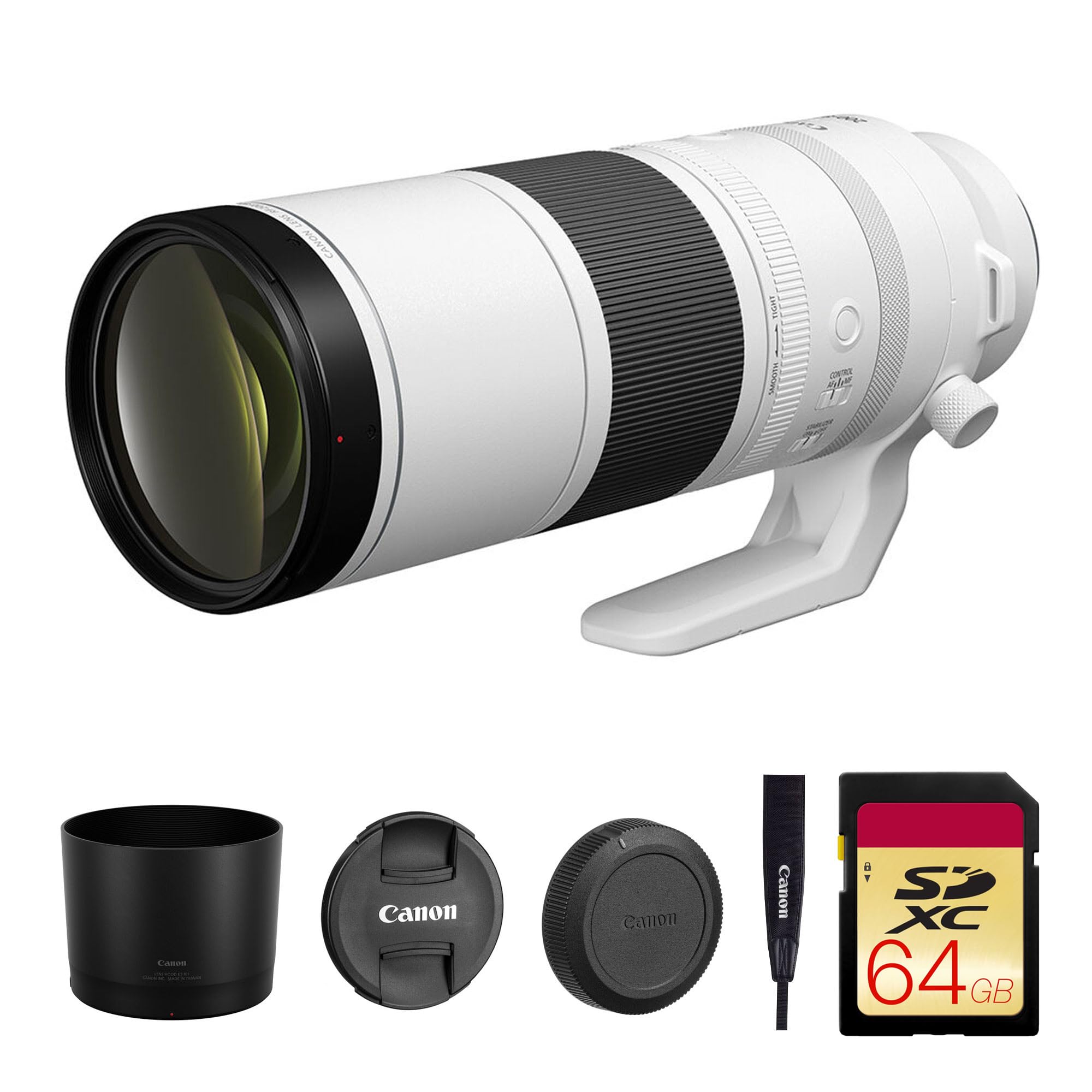
The Canon RF 200-800mm f/6.3-9 IS USM pushes beyond the typical 18-200mm range into dedicated super-telephoto territory for wildlife, birding, and sports shooters. Its 4x zoom span is enormous for a lens with autofocus and stabilization in a relatively portable package — approximately 7 pounds, which is light enough for handholding during extended sessions if you brace properly.
Image stabilization built into the lens supports handheld shooting even at 800mm, which is crucial given that f/9 aperture requires bright conditions or a very clean high ISO. The USM autofocus is near-silent and fast enough to track birds in flight when paired with a Canon R5 or R6 II. The optical quality is impressive for such a long zoom — center sharpness holds up well even wide open at 800mm.
This lens is not an 18-200mm replacement but rather a specialist tool that serves the extreme reach end. It’s included here because some buyers consider super-telephoto zooms alongside standard superzooms for nature travel. The bundled 64GB memory card is a minor bonus. If your primary subject is birds or motor sports beyond 200mm, this lens is the best choice among these nine for pure reach.
Why it’s great
- Unmatched 800mm reach for wildlife without a tripod
- USM autofocus is quick, quiet, and accurate
- Effective image stabilization at the long end
Good to know
- f/9 at 800mm forces high ISO in overcast conditions
- Heavy at 7 pounds — better with a monopod for long sessions
- Narrow use case compared to standard 18-200mm options
FAQ
Does an 18-200mm lens work on full-frame cameras?
Why does my 18-200mm lens have lens creep and how do I fix it?
How many stops of VR/IS do I actually need for an 18-200mm lens?
Is the Tamron 28-200mm f/2.8-5.6 sharp enough for professional use?
Final Thoughts: The Verdict
For most users, the 18-200mm lens winner is the Nikon NIKKOR Z 24-200mm f/4-6.3 VR because it combines modern optical coatings, reliable VR, and a genuinely useful 24mm wide end in a compact package purpose-built for Z-mount mirrorless cameras. If you want a faster aperture for better low-light versatility, grab the Tamron 28-200mm f/2.8-5.6. And for budget-conscious Nikon DSLR shooters who still need the full 18-200mm range, nothing beats the Nikon AF-S DX 18-200mm VR II.