
Picking the wrong wire means you fight to strip it, you get shaky connections, and you might need to rip it out and start over. You need one that strips cleanly without nicking the insulation underneath, conducts a reliable signal for years, and comes long enough to reach your HVAC unit without a splice. This guide matches each wire to the job it fits best, based on the specs on the box and what buyers actually say.
I’m Min — the co-founder and writer behind Gadgets Feed. This guide is built by comparing the manufacturers’ published specifications and the patterns across verified customer reviews, so you get each pick’s real strengths and trade-offs instead of marketing spin.
After comparing more than a dozen spools by their gauge (wire thickness), conductor count, jacket quality, and buyer feedback, this guide has picked the top options for any install. You will know exactly which 18/5 thermostat wire is ready for your drywall and crawlspace.
How To Choose The Best 18/5 Thermostat Wire
You need a wire that fits your system’s wiring spots, meets local electrical codes, and lasts as long as your equipment does. Here are the three most important factors to check before you buy.
Solid Copper vs. Copper-Clad Aluminum (CCA)
The conductor material is the backbone of your wire’s performance. Solid copper offers the best conductivity (it lets electrical current flow with the least resistance) and resists corrosion over decades of use, making it the standard for professional HVAC installations. Buyers report that solid copper strips cleanly for clean connections, whereas copper-clad aluminum (CCA — an aluminum core with a thin copper coating) can be brittle, harder to terminate, and more likely to corrode over time in damp environments.
Jacket Rating: CL2, CL3, and Riser Ratings
The jacket is not just for protection against scrapes — it determines where the wire is legally allowed to be installed. CL2-rated cables (Class 2 — the minimum standard for in-wall low-voltage wiring like thermostats) are the baseline. CL3 and CMR (riser-rated) cables add a thicker, flame-retardant jacket that limits the spread of fire between floors, which is often required by building codes for multi-story homes. Always match or exceed the rating of the existing wire you are replacing.
Length and True Gauge
Buy more length than you think you need — having to splice two shorter runs adds a point of failure and is a hassle inside a wall. For the gauge (the thickness of the wire), “18 AWG” (American Wire Gauge — a standard way to measure wire diameter) should measure roughly 1.02mm in diameter. Some budget spools use under-spec wire (closer to 19 AWG) that can cause voltage drop over long runs, leading to a thermostat that loses its connection. Stick to brands that state “true gauge” to avoid this issue.
Quick Comparison
On smaller screens, swipe sideways to see the full table.
| Model | Category | Best For | Key Spec | Amazon |
|---|---|---|---|---|
| Voltic Stone 18/5 (100 ft) | Premium | Long runs with code compliance | 100 ft, CL3R/CMR riser-rated | Amazon |
| Southwire 18/5 (250 ft) | High-Volume | Whole-house multi-thermostat installs | 250 ft, CL2 rated | Amazon |
| FRUDRIK 18/5 (25 ft) | Mid-Range | Simple thermostat replacement | 25 ft, solid copper | Amazon |
| Syston 18/5 (10 ft) | Entry-Level | Short patch or doorbell runs | 10 ft, 300V rated | Amazon |
| XRDS-RF 18/5 (20 ft) | Budget | Short, indoor-only jobs | 20 ft, color-coded | Amazon |
In‑Depth Reviews
1. Voltic Stone 18/5 Thermostat Wire (100 ft)
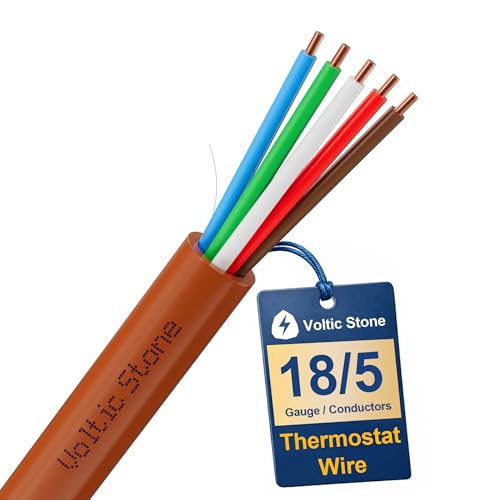
100 feet of ETL Listed, CL3R/CMR riser-rated 18/5 thermostat wire makes this the top pick for anyone running cable through walls, floors, or vertical riser spaces where building codes and fire safety matter.
This spool holds ten times the length of the Syston 10-foot option, giving you enough cable to reach from a basement furnace to a second-floor thermostat without splicing. Owners mention that the solid copper conductors strip cleanly and the included installation kit (electrical tape and 10 wire nuts) saves a separate trip to the hardware store. The UV-resistant PVC jacket is built to meet UL 1581 sunlight resistance, so it holds up in protected outdoor applications like running to an AC condenser unit.
The honest trade-off is that this spool is thicker and slightly stiffer than standard CL2 wire, which makes it harder to maneuver through tight spaces but necessary for code compliance in air-handling spaces. For a finished, inspection-ready installation, this is the most reliable 18/5 thermostat wire you can buy.
Why it’s great
- ETL Listed to UL 13 with CL3R/CMR riser-rated jacket for code-compliant in-wall installation
- 100-foot length is 10x the Syston 10-foot option, eliminating the need for a splice
- Includes electrical tape and 10 UL 486C wire nuts for a complete installation kit
Good to know
- Stiffer jacket than standard CL2 wire, requiring more care during routing through tight spaces
- Rated for Class 3 low-voltage control (0-300V), not for high-voltage power wiring
2. Southwire 18/5 Thermostat Wire (250 ft)
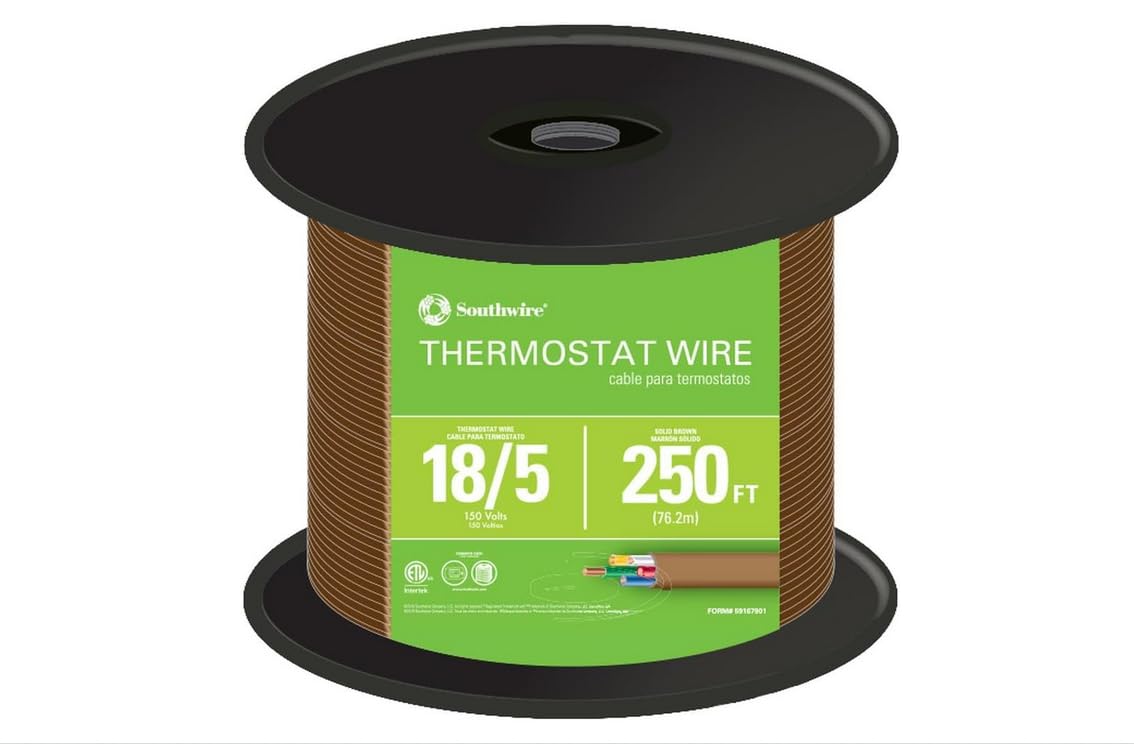
When you are wiring an entire house with multiple smart thermostats, the Southwire 250-foot spool beats the Voltic Stone on sheer volume — it holds 2.5 times more wire, which saves you from buying a second spool mid-project. Its CL2 rating is sufficient for standard in-wall thermostat runs if your local code does not demand riser-rated cable.
The standout feature here is the jacket: customers note that it strips easily, resists tearing when stapled, and reduces burn-through during installation. One reviewer noted it was great for replacing old 2-wire with 5-wire for Wi-Fi thermostats needing a C-wire (common wire — the wire that supplies constant power to the thermostat). The solid copper conductors are stiff but provide reliable connections, and the 18-gauge construction meets UL Standard 13 for power-limited circuit cable.
Some buyers mention the outer insulation feels thinner and looser compared to more premium brands, and that the wire might be closer to 18.5 AWG than a full 18 gauge. If you need the stiffer, code-grade jacket of the Voltic Stone for riser spaces, choose that instead. But for sheer value per foot on a large project, choose this Southwire spool over the top pick.
Where it shines
- 250-foot spool provides 2.5x the length of the Voltic Stone 100-foot option for whole-house projects
- Strips easily and resists tearing when stapled, saving installation time
- Meets UL Standard 13 and is sunlight-resistant for outdoor use
Worth noting
- Some reviewers point out the outer insulation feels thinner than premium alternatives
- CL2 rating, not CL3R/CMR, so not suitable for plenum or riser spaces in strict code areas
3. FRUDRIK 18/5 Thermostat Wire (25 ft)
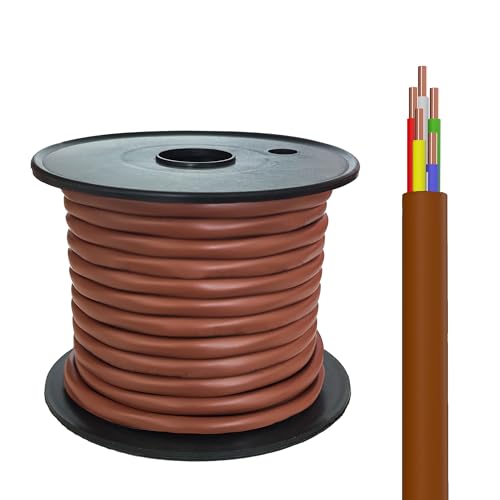
For a straightforward thermostat replacement — say, swapping an old 4-wire unit with a new smart thermostat within 25 feet of your furnace — this FRUDRIK spool is the smart value pick. It delivers solid copper conductors in a 25-foot run that is plenty for most single-floor installations.
Buyers consistently praise how easy the wire is to strip and note that the gauge feels sturdier than the original wire it replaced. One reviewer specifically called out that the outer coating is “very tuff to cut thru without nicking the inner wire insulation,” which means the PVC jacket provides strong physical protection during pulls, but you must be careful with your stripping tool to avoid exposing the copper. The CL2 rating makes it suitable for in-wall residential use in most areas.
This is a no-frills spool that focuses on doing one thing well: delivering 18 AWG solid copper wire at a reasonable length for a focused job. For a 25-foot run where you need 5 conductors for a heat pump or a C-wire, this is the wire that gets the job done without overspending.
What stands out
- Solid copper conductors for reliable conductivity and clean terminations
- 25 feet is the ideal length for a single-floor thermostat replacement
- Tough PVC jacket resists cuts and abrasions during installation
The trade-offs
- Tough outer jacket requires careful stripping technique to avoid nicking the inner insulation
- CL2 rating, so not suitable for plenum or riser-rated applications
4. Syston 18/5 Thermostat Wire (10 ft)
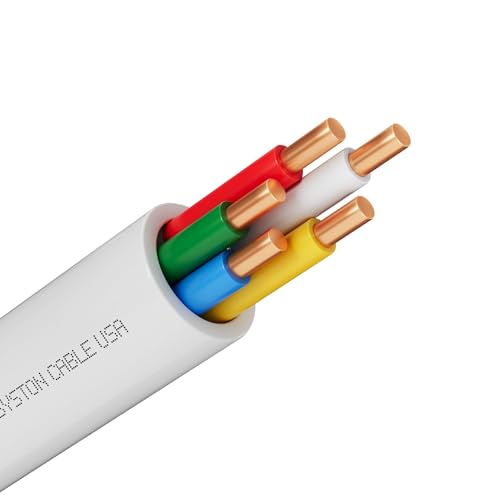
The single number that matters most in this category is voltage rating, and the Syston 18/5 scores a 300V rating, which provides a higher safety margin than the 150V rating on the FRUDRIK spool for low-voltage control circuits. Despite its short 10-foot length, it carries a CL3R/CMR riser rating that many longer budget spools lack.
The catch is obvious: at 10 feet, this is the shortest spool in the lineup, holding only a tenth of the length of the Voltic Stone 100-foot option. It is designed for a very specific, short job — like replacing a doorbell transformer or extending a wire by a few feet inside an equipment closet. Shoppers say the “round, slick jacket” pulls easily through tight corners and has a built-in rip cord that makes stripping fast and frustration-free. One reviewer used it to replace a 65-foot run plus a 10-foot extension for a remote pressure switch, calling it a quality cable at a good price.
For a short, code-compliant run where you need the peace of mind of a CL3R jacket, this Syston spool is a perfectly targeted tool. It is not a whole-house solution, but it is exactly the right answer for a specific problem, offering a strong price-to-value read for that niche job.
The upsides
- 300V rating provides a higher safety margin than standard 150V thermostat wire
- CL3R/CMR riser rating allows use in plenum and between-floor spaces
- Rip cord and slick jacket make for easy stripping and pulling through tight spaces
Keep in mind
- Only 10 feet — a tenth of the length of the Voltic Stone 100-foot spool
- At this short length, it costs more per foot than larger spools
5. XRDS-RF 18/5 Thermostat Wire (20 ft)
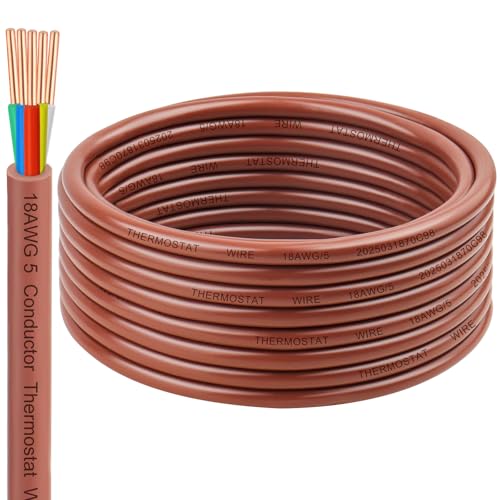
At a 20-foot length, this XRDS-RF spool gives you double the reach of the Syston 10-foot option at a similar entry-level cost, making it a better pick for short indoor runs that need a bit of extra slack. It uses solid copper conductors and a durable PVC jacket for indoor routing.
The downside is a color-coding quirk that could frustrate a tidy installer. One buyer pointed out that “instead of a yellow wire, which is a thermostat standard, it’s an orange wire,” which means you will need to wrap the ends of the orange wire with yellow electrical tape to avoid confusion with the red wire during connection. For a professional-looking install where you want the standard color scheme for quick troubleshooting, this is an annoyance you should factor in.
If you need a short, affordable spool for a simple indoor thermostat swap and you are fine using a bit of tape to mark the wires, this XRDS-RF wire gets the job done. It is the perfect budget-friendly option for a focused, no-fuss project where price is the first concern.
Why we’d pick it
- 20 feet gives you double the length of the Syston 10-foot option for similar cost
- Solid copper conductors for reliable signal transmission
- Durable PVC jacket is flexible and easy to route indoors
A few caveats
- Uses an orange conductor instead of the standard yellow, requiring tape-marking to avoid confusion
- No CL2 or higher jacket rating listed, so intended for indoor use only
Understanding the Specs
CL2 vs. CL3 vs. CMR Jacket Ratings
These ratings define where the wire can legally run inside your walls. CL2 (Class 2) is the minimum for in-wall low-voltage wiring in most homes — suitable for thermostats and doorbells. CL3 (Class 3) adds a thicker insulation with a higher safety margin, while CMR (riser-rated) means the jacket is flame-retardant and tested to limit fire spread between floors, which some local building codes require for any wire that passes through a floor-ceiling assembly.
Solid Copper vs. Copper-Clad Aluminum (CCA)
The conductor’s core metal controls conductivity and long-term reliability. 100% solid copper provides the lowest electrical resistance and the best corrosion resistance, meaning your thermostat will receive a clean signal for decades. CCA wire uses an aluminum core with a thin copper coating; it is lighter and cheaper, but it is more brittle, harder to strip cleanly, and more likely to corrode at the connection point over time if moisture is present.
FAQ
Can I use 18/5 thermostat wire for a doorbell?
What is the difference between 18/5 and 18/8 thermostat wire?
Final Thoughts: The Verdict
For the majority of shoppers, the 18/5 thermostat wire winner is the Voltic Stone 100-foot spool because its ETL-listed CL3R riser-rated jacket, UV resistance, and included installation kit make a single-code-compliant purchase that handles long runs safely. If you want the highest value per foot for a whole-house project, grab the Southwire 250-foot spool. And for a focused, single-floor thermostat replacement where simplicity matters most, the standout is the FRUDRIK 25-foot spool.