
Our readers keep the lights on and my morning glass full of iced black tea. As an Amazon Associate, I earn from qualifying purchases.
Specs are compiled from manufacturer listings and verified buyer reviews and can change over time — please confirm the key details on the product page before buying.
An 18/6 thermostat wire is the nervous system of your smart home’s climate — it carries the tiny signals between your thermostat, furnace, air conditioner, and heat pump. Get the wrong one — flimsy copper, thin insulation, or a gauge that’s not true — and your equipment can glitch, drop communication, or simply refuse to turn on.
I’m Min — the founder and writer behind Gadgets Feed. This guide is built by comparing the manufacturers’ published specifications and the patterns across verified customer reviews, so you get each pick’s real strengths and trade-offs instead of marketing spin.
Whether you are replacing a tangled old two-wire setup or wiring a new HVAC system from scratch, choosing the right 18/6 thermostat wire means matching conductor quality, voltage rating, jacket rating, and length to your specific installation.
Our Picks at a Glance
How To Choose The Best 18/6 Thermostat Wire
Thermostat wire is a simple product with a huge impact — the wrong spec can brick a new smart thermostat or fail a home-inspection. Here is what actually matters when you are standing in the aisle or scrolling listings.
Solid vs Stranded Conductors
Solid copper is the standard for thermostat wiring because it holds its shape inside screw terminals and resists corrosion. Stranded copper is more flexible and survives repeated bending, which makes it a better choice inside an equipment cabinet or when you thread wire through tight corners.
Voltage Rating: 150V vs 300V
All thermostat wire carries low-voltage signals — typically 24V from your furnace transformer. A 150V-rated cable is adequate for standard residential control wiring. A 300V-rated cable adds a safety margin and is required by code in some Class 3 low-voltage installations. Never exceed the wire’s voltage rating.
Jacket Rating: CL2, CL3, Riser, Plenum
The jacket rating tells you where the wire is allowed to run inside a building. CL2 is the minimum for in-wall residential thermostat wiring. CL3R / CMR is riser-rated for vertical runs between floors. CL3P / CMP is plenum-rated for air-handling spaces like drop ceilings; it uses flame-retardant materials that produce minimal smoke. Using the wrong jacket rating can fail a fire inspection.
Quick Comparison
| Model | Best For | Conductor Type | Voltage Rating | Jacket Rating | Amazon |
|---|---|---|---|---|---|
| Eastwire 18/6 50ft★ Best Overall | Reliable standard thermostat replacement | Solid Copper | 150V | CL2 | Amazon |
| Voltic Stone 18/6 10ft | Short-run precision & code compliance | Solid Copper | 300V | CL3R/CMR Riser | Amazon |
| Syston 18/6 50ft | Long residential runs with high safety margin | Solid Copper | 300V | CL3R/CMR Riser | Amazon |
| MOOKEERF 18/6 Shielded 200ft | Large-scale shielded low-voltage installs | Stranded Copper | 300V | CMP/CL3P Plenum | Amazon |
In‑Depth Reviews
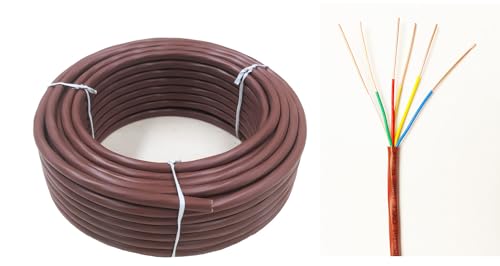
1. Eastwire 18/6 50ft Thermostat Wire
Our pick — over 4.5★ from 100+ verified ratings; the strongest balance of quality and price.
The straightforward 50-foot run that just works for most thermostat upgrades.
This is the cable people reach for when they need to replace an old two-wire setup with a modern six-wire thermostat. It is built with solid copper 18-gauge conductors and a CL2 brown PVC jacket that resists heat, moisture, and sunlight — rated for work across -20°C up to 60°C. The 150V rating covers standard 24V thermostat circuits with room to spare.
Owners highlight the build quality most of all — the insulation strips cleanly and resists tearing, which saves time and aggravation when you are fishing wire through a wall. Buyers report it is “Perfect for upgrading my thermostat wired to the furnace” and that it handles thermostat-to-furnace connections without a hitch.
Trusted 50ft spool: If you have a standard 50-foot residential thermostat job and want solid copper that arrives on time and works as described, this wire fits without overthinking. The 150V rating and CL2 jacket are fine for any in-wall run — just know it is not plenum-rated, so it does not belong in air-handling spaces.
Best overall: You are swapping an old thermostat wire in a single-story home or small office and want 50 feet of known-good solid copper with easy-strip insulation.
Skip for short runs: Your run goes through a plenum ceiling, past high-EMI equipment, or calls for a 300V-rated safety margin — those jobs need one of the picks below.
2. Voltic Stone 18/6 Thermostat Doorbell HVAC Wire — 10FT
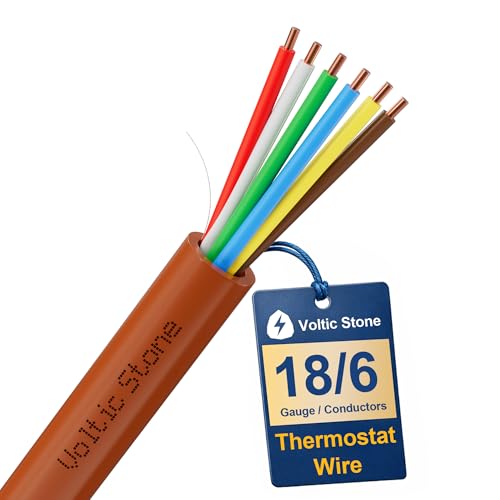
A short, code-friendly kit that arrives ready to install with tape and wire nuts.
This 10-foot spool punches above its size with a true-gauge 18 AWG solid copper conductor (about 1.02mm in diameter) and a 300V CL3R/CMR riser-rated jacket that limits flame spread in vertical spaces. It also includes premium electrical tape and 10 wire nuts, so you can open the box and start wiring without a trip to the hardware store.
The UV-resistant PVC jacket meets UL 1581 sunlight-resistance requirements, making it suitable for protected outdoor low-voltage installations like an air-conditioner disconnect. Owners mention the wire is “High-quality 18 AWG solid copper 8-conductor wire” (the 18/6 version follows the same build) and that the color-coded conductors strip easily without kinking.
Compact 10ft roll: At 10 feet this is not your whole-house spool, but it is perfect for wiring a new thermostat that sits right next to the furnace, replacing a doorbell transformer, or running a signal wire to a heat pump outside. The 300V rating (the maximum voltage it can safely handle) exceeds most thermostat needs, and the riser rating (a fire-safety standard for vertical in-wall wiring) meets code for in-wall vertical runs, so you can install it safely inside finished walls.
Best short run: You need a short length, want a riser-rated cable, and appreciate a kit that includes the small accessories you always forget to buy.
Skip for long runs: Your project needs more than 10 feet of continuous wire — you will want a longer spool like the Eastwire or Syston options above.
3. Syston 18/6 Thermostat Doorbell HVAC Heating Control Cable Wire — 50FT
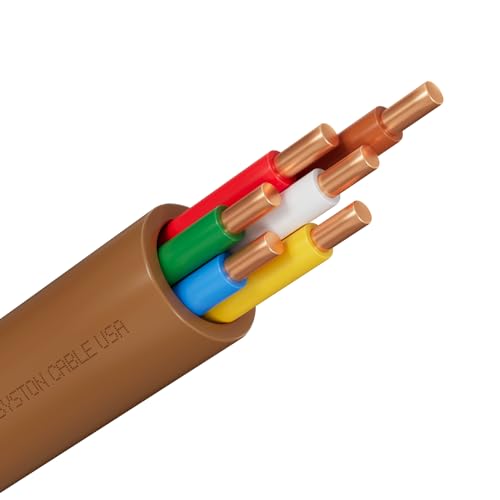
A 300-volt 50-footer with a slick jacket that pulls through walls without snagging.
This Syston cable is built with solid pure copper conductors and a 300V CL3-rated jacket that provides a high safety margin for low-voltage control wiring — way beyond the 150V of the Eastwire pick. The round, slick PVC jacket has a smooth surface and a built-in rip cord, so stripping and pulling around corners is noticeably easier than budget twisted-pair alternatives.
It is sunlight-resistant per UL 1581 and RoHS compliant, which means it can handle an outdoor run to a condenser unit. Customers note it “Replaces an old 2 wire set up. Works perfect” and that the six conductors let them wire fan-only modes on modern smart thermostats — something a two- or four-wire cable cannot do. A handful of owners note the insulation may measure closer to 22 gauge than 18, though none report performance problems.
Easy-pull jacket: If you have ever wrestled with cable that sticks to drywall or refuses to strip evenly, the rip cord and slick jacket on this Syston will save you 20 minutes and a scraped knuckle. The 300V rating and solid copper give it a long, reliable life on any low-voltage circuit.
Best install: You are pulling wire through finished walls, want a 50-foot run with a 300V safety margin (so it handles surges without overheating), and need a jacket that slides and strips low-maintenance — reviewers point out it pulls easily through tight spaces.
Skip for tight spaces: You are running cable in a plenum air space — this is riser-rated (CL3R), not plenum. For plenum, step to the MOOKEERF below.
4. MOOKEERF 18/6 Shielded Wire 18AWG 6 Conductor 200FT Shielded Plenum Cable
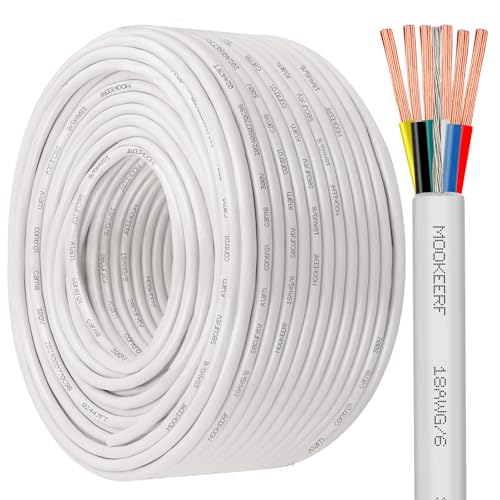
The 200-foot shielded behemoth for plenum spaces and signal-noise protection.
This is the only cable in the lineup with a foil shield — it wraps each of the six stranded pure-copper conductors in a layer that blocks electromagnetic interference from motors, fluorescent ballasts, and power cables. That makes it the right call for fire alarm loops, security panels, and any run near noisy gear. The 300V rating and CMP/CL3P plenum-rated jacket are also inspection-ready for air-handling ceilings.
At 200 feet, it covers large houses or commercial zones in a single spool; the Eastwire gives you 50 feet, and the Syston also gives you 50. The stranded construction (10-strand per conductor) is noticeably more flexible than solid-core wire and fits comfortably into tight corners without taking a set. Shoppers say “the quality of this wire” exceeded expectations and that it “works great” for communication wiring between an air handler and outside unit.
Shielded 200ft: If you have ever had a thermostat drop connection near a transformer or wanted to sleep better about a plenum installation, this wire solves both problems in one pull. The trade-off — stranded wire is slightly harder to cleanly terminate on push-in thermostat connectors than solid-core wire — is worth it for the flexibility and noise rejection.
Best shielded: You are wiring a fire alarm, running cable through a plenum ceiling, or need a massive 200-foot spool with shielded stranded copper for noise-sensitive low-voltage circuits.
Skip for short jobs: You only need a 50-foot standard thermostat run — the Eastwire or Syston will save you money and are easier to terminate on push-in terminals.
Understanding the Specs
18 AWG — The Gauge
18 AWG (American Wire Gauge — a standard wire-thickness scale where a lower number means thicker wire) is the standard thickness for low-voltage thermostat wire. It is thick enough to carry 24V power over 50 to 200 feet without significant voltage drop (so your thermostat gets consistent power even at the far end of a long run), but thin enough to fit snugly into thermostat screw terminals and push-in connectors. Never substitute a thinner gauge (20 AWG or higher number) for an 18 AWG requirement — it will cause signal loss and overheating over long runs, which can damage your equipment.
6 Conductors — Why You Need Six
A modern smart thermostat typically needs at least four wires: R (power), W (heat), Y (cool), and G (fan). A sixth conductor adds a C (common) wire that keeps the thermostat powered without battery drain, plus a spare for future expansion like a heat pump reversing valve or dehumidifier control. Pulling a 6-conductor cable now saves you from re-wiring later.
FAQ
Can I use 18/6 thermostat wire for a doorbell?
What is the difference between CL2 and CL3 thermostat wire?
Is solid copper better than stranded copper for thermostat wire?
How long can I run 18/6 thermostat wire?
Can I run 18/6 thermostat wire outside?
What does plenum-rated mean for thermostat wire?
Do I need shielded thermostat wire?
Can I use 18/6 wire for a heat pump or mini-split?
What happens if I use the wrong gauge thermostat wire?
Is thermostat wire polarity sensitive?
Final Thoughts: The Verdict
For most homeowners replacing a thermostat or running a new cable through one floor, the Eastwire 18/6 50ft is the pick — solid copper, easy-strip jacket, and the 50-foot length covers nearly every single-story run. If code compliance or a 300V safety margin matters for your project, the Syston 18/6 50ft adds riser rating and a slick jacket at a fair price. And if you need a 200-foot shielded plenum cable for a large installation or signal-noise protection, the MOOKEERF 18/6 Shielded is the wire that does not cut corners.
How We Picked
We do not accept paid placement. Every pick is matched to a real buyer and a real use-case; we do not hands-on test units.
Sources & Methodology
Specifications: manufacturer listings and product documentation. Review insights: verified customer reviews, as of July 2026. Pricing: not shown on this page (it changes often); check the current price via the retailer link.
As an Amazon Associate, Gadgets Feed earns from qualifying purchases. This does not affect which products we feature.