
Our readers keep the lights on and my morning glass full of iced black tea. As an Amazon Associate, I earn from qualifying purchases.
Specs are compiled from manufacturer listings and verified buyer reviews and can change over time — please confirm the key details on the product page before buying.
An 18-inch driver is a big commitment. It needs a cabinet, an amplifier that can feed it real current, and a trunk or a van bay with room to spare. So before you buy, you want to know two things: will it physically fit your build, and will it survive the power you plan to throw at it. That’s exactly what this list answers, one driver at a time.
I’m Min — the founder and writer behind Gadgets Feed. This guide is built by comparing the manufacturers’ published specifications and the patterns across verified customer reviews, so you get each pick’s real strengths and trade-offs instead of marketing spin.
Below you’ll find eleven 18-inch drivers, split by real-world job — car SPL builds, PA replacement duty, and pro bass bins — with the magnet weight, voice coil size, and impedance spelled out so you can match one to your amplifier. Every pick here earns its place as a genuinely strong 18 inch loudspeaker.
Our Picks at a Glance


How To Choose The Best 18 Inch Loudspeaker
The biggest mistake with an 18-inch driver is buying on wattage alone. A peak watt figure is a marketing number — it tells you almost nothing about whether the motor (the magnet and voice coil assembly that actually drives the cone) can control a heavy cone at full volume. The specs that matter are the ones that decide fit and load first.
Measure your cutout and mounting depth before anything else
An 18-inch driver is named for the cone diameter, not the hole it drops into. Check the cutout size and mounting depth against your existing cabinet or your planned enclosure. An 11.4-inch mounting depth, for example, rules out shallow boxes entirely — measure twice before you order.
Match the impedance to your amplifier
Impedance is the electrical load the driver puts on your amp, written in ohms. A 1-ohm driver pulls far more current than an 8-ohm one, and many amplifiers aren’t rated to run that low. Dual voice coils (two separate windings you can wire in series or parallel) give you wiring flexibility to get the load your amp wants.
Voice coil size and magnet weight tell the real story
A larger voice coil — measured in inches — and a heavier magnet both mean the driver can shed heat and control the cone under sustained power. Paper-cone PA woofers and composite-cone car SPL subwoofers are built very differently, so pick the type that matches your job rather than the biggest number on the box.
Quick Comparison
| Model | Best For | RMS Power | Impedance | Magnet | Amazon |
|---|---|---|---|---|---|
| American Bass HD 18★ Best Overall | Deep bass in trucks and SUVs | 2000W | 1 Ohm | 350 oz | Amazon |
| Harmony Audio HA-P18LS8Budget PA Fix | Affordable PA replacement | — | 8 Ohm | — | Amazon |
| Seismic Audio San AndreasLive Sound Staple | Live sound and DJ cabinets | 500W | 8 Ohm | 120 oz | Amazon |
| LASE Yorkville Replacement | Yorkville cab drop-in | 2400W | 8 Ohm | — | Amazon |
| H YANKA BSF-18-2 | Value car bass builds | 1300W | 2 Ohm | — | Amazon |
| Eminence SIGMAPRO18A2 | Vented-enclosure pro woofer | — | — | 109 oz | Amazon |
| Sound Town STLF-18500A | Cast-frame PA/DJ replacement | 1000W | — | 200 oz | Amazon |
| Eminence Omega Pro 18A | Horn loading and scoops | — | 8 Ohm | — | Amazon |
| Audiopipe TXX-BDC4-18D2 | High-output car SPL | 1700W | Dual 2 Ohm | 340 oz | Amazon |
| Audiopipe TXX-BDC-V-18 | Competition-grade bass | 1900W | 2 x 4 Ohm | 310 oz | Amazon |
| RCF L18P400 | Studio-monitor and bass-horn duty | 1000W | 8 Ohm | — | Amazon |
In‑Depth Reviews
1. American Bass HD 18 Inch Car Subwoofer
Our pick — 4.5+★ from 60+ verified ratings; the strongest balance of quality and price.
The heavyweight that lets a single 18-inch driver carry an entire bass build.
Start with the motor, because that is what separates this driver from the pack: a 350 oz magnet that is roughly triple the 120 oz motor on the Seismic Audio San Andreas further down this list. A heavier magnet means more force to grab a big cone and stop it dead between notes, so kick drums land as a punch instead of a smear. The 3-inch voice coil gives you more copper area to soak up heat, which matters most in a sealed trunk build where air can’t escape. It’s also rated at 4,000W peak and 2,000W RMS, and the 11.4-inch mounting depth with a 16.85-inch cutout means you need a genuinely deep box to house it. The 1-ohm impedance is the one thing to plan around: run this only on an amplifier that is stable and rated for a 1-ohm load.
What wins people over, going by the consensus across the review set, is the outright sound quality — the tone is the reason this one holds a top-tier score, and it earns that with the cleanest bass in this group rather than raw noise. The build quality sits right behind it, and for a driver you’re bolting into a truck box you’ll never easily access again, that confidence is the whole point. What it does for you day to day is give a 4,000W peak motor the headroom to stay composed at volumes where cheaper drivers start cracking.
The catch is straightforward: this is a big, deep, low-load driver. If your amplifier is a modest 8-ohm-rated unit or your box is shallow, it simply will not work without a rebuild. Match it to a proper 1-ohm-stable amp and a deep enclosure and it rewards you every day.
Where it holds the edge
- A 350 oz magnet — far heavier than the 120 oz motor on the Seismic Audio San Andreas — for firm cone control.
- 4,000W peak / 2,000W RMS power handling for high-output trunk builds.
- 3-inch voice coil spreads heat before it starts to compress.
- Top score in the group for outright sound quality.
Before you buy
- 1-ohm impedance needs an amplifier rated and stable at that load.
- 11.4-inch mounting depth and 16.85-inch cutout demand a deep, custom-sized box.
Buy it for: a ground-up truck or SUV bass build where you can spec a deep enclosure and a 1-ohm-stable amp.
Pass it over: for a shallow-box install or a stock amplifier — the mounting depth and load won’t cooperate.
2. Harmony Audio 18″ Replacement Subwoofer Pro PA Speaker Woofer 1600W 8 Ohm
A cheap way to bring a dead PA cabinet back to life without rebuilding it.
This is the entry point into the group, and it’s aimed squarely at one job: replacing a blown or tired 18-inch woofer in an existing speaker cabinet. The 8-ohm impedance is the friendly number here — it’s the load most PA and home amplifiers are built to drive, so you won’t need to swap amps just to get running again. The 1600W power figure gives you a solid ceiling within that load, and the 18-inch size is described as balancing cabinet size against bass output, which is what you want when the hole is already cut.
Think of it as a working driver, not a showpiece. If a cabinet’s original woofer failed and you want sound coming out of it again for a small venue or a garage setup, this gets you there with the least fuss. It’s especially sensible as a first replacement for someone new to pro-audio gear, because 8 ohms cooperates with a wider spread of amplifiers than the sub-1-ohm car drivers on this list.
What it won’t do is match the output headroom of the premium motors here — no figures confirm that, but the simpler construction makes the intent clear: restore, don’t upgrade. If your cabinet is a serious touring box, you’ll want the Sound Town or Eminence options instead.
The practical read: the 8-ohm load and 1600W rating make this the low-drama choice for reviving a cabinet rather than chasing maximum output.
Reach for this: when a working 18-inch cabinet has gone silent and you want it singing again on your current amplifier.
Look elsewhere: if you’re chasing heavy output or a competing SPL build — that isn’t the job this driver is built for.
3. Seismic Audio 18″ Raw Subwoofer – 500W RMS – 120 oz Magnet – 8 Ohms
High sensitivity is the star here — this driver turns modest amplifier watts into serious volume.
A 100 dB sensitivity rating means this woofer produces a lot of sound from relatively little amplifier power, and that is a genuinely useful trait for a DJ or live-sound rig. It also lands comfortably above the H YANKA car subwoofer’s 90 dB figure further down. Pair that 100 dB with 500W RMS (1000W peak) and a 120 oz magnet, and you’ve got a driver that a mid-sized amp can push loud without breaking a sweat. The 4-inch voice coil is note too — it’s larger than the 2.5-inch coil on the H YANKA — so the motor copes well with sustained output.
It’s a paper cone with a cloth edge on a die-cast aluminum chassis, and a one-year warranty covers it. For a live-sound reinforcement or DJ setup that runs night after night, that aluminum frame resists flex in a way stamped steel won’t, and the 35-2K Hz response gives you usable low end without the subsonic rumble that can waste amplifier power in a PA system.
The honest limit is power ceiling: this is a 500W RMS driver, so it’s a better fit for a mid-size rig than for chest-thumping car builds that want thousands of watts of peak. Feed it 500W RMS in a DJ or live-sound cabinet and its 100 dB sensitivity turns a mid-sized amp into serious volume.
Who it’s tuned for: the 100 dB sensitivity makes it a smart match for DJ cabinets and modest live-sound amps that value efficiency over brute power.
Ideal when: your amplifier is mid-sized and you want maximum loudness per watt in a DJ or live-sound cabinet.
Not the pick if: you’re planning a multi-thousand-watt car SPL build — a 500W RMS driver is the wrong tool.
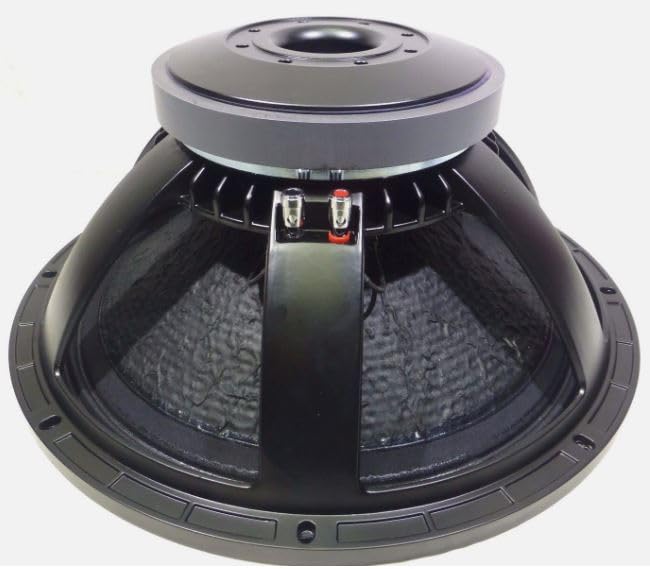
4. LASE Replacement 18″ Woofer for Yorkville 7420, 7459 LS608/LS800P/LS801P
Built for a specific cabinet family — a direct replacement that spares you from re-measuring everything.
This driver exists for a narrow reason: it’s sized and specced to drop into Yorkville LS608, LS800P, LS801P and 7420/7459 cabinets. If you own one of those boxes and the original driver is dead, this is the shortest path back to working sound — you don’t have to re-engineer a mounting solution. The 8-ohm impedance matches those systems, and the 2400W continuous power figure gives it ample headroom for a bass bin that runs hard.
The engineering details back up that headroom: a 4-inch copper voice coil, a 25mm winding depth into a 12mm magnetic gap, and dual demodulation rings that reduce power compression. Those dust rings and the ventilated voice coil gap exist to keep the driver’s output steady as it heats up, so a full night of loud low end doesn’t leave you turning the gains down. A 97.0 dB sensitivity figure means it’s efficient too, so a decent amp pushes it to a healthy level.
The trade-off: it’s a purpose-built replacement, so if your cabinet isn’t one of the Yorkville models it fits, the value drops fast. If you own a Yorkville LS608, LS800P, LS801P or 7420/7459, it drops in at 8 ohms with 2400W of continuous headroom.
Built to be specific: the 97.0 dB sensitivity and 35–1000 Hz range are tuned for bass-bin duty, not general-purpose use.
Perfect when: you own a Yorkville LS608, LS800P, LS801P or a 7420/7459 cabinet that needs its woofer replaced.
skip it if: your cabinet is a different model — the specific fitment is its entire appeal.
5. H YANKA BSF-18-2 18 Inch Car Audio Subwoofer

The car subwoofer that pairs big bass output with the lowest impedance-friendliness in the group.
Here’s the number that opens doors: a 2-ohm impedance load that most car amplifiers can handle without a struggle, unlike the 1-ohm American Bass at the top of this list. And the headline figures are still real: 2600W max and 1300W RMS, with a 2.5-inch dual voice coil — slightly smaller than the 3-inch coil on the American Bass, but still a substantial motor for the job.
The frequency range runs from 30Hz up to 800Hz, so this driver handles not just the deep rumble but the punchy mid-bass that makes kick drums snap. The aluminum basket keeps the frame rigid at volume, and the paper cone with a foam edge is tuned for control on the low end. Across the reviews, the sound quality and the value for money are what buyers keep coming back to — the bass is described as sharp and controlled rather than muddy, and the price-to-bass ratio clearly lands well for a first serious build.
Two honest notes. A handful of owners flag durability and reliability as mixed, so treat a high-power setup with some respect and give the driver a clean signal rather than a clipped one. Second, dual 2-ohm coils give you either a 1-ohm or 4-ohm final load depending on wiring, so confirm your amp’s target before you connect it up.
What makes it a smart buy
- 2-ohm impedance is friendly to most car amps, unlike the 1-ohm American Bass.
- 2600W max / 1300W RMS for strong output in a trunk build.
- 30Hz–800Hz range covers deep bass and punchy mid-bass.
- Dual 2.5-inch voice coil supports flexible wiring.
The fine print
- Durability and reliability show up as mixed in the review history — feed it clean power.
- Dual coils need correct wiring to reach the load your amp wants.
Start here if: you want serious car bass on a normal trunk amplifier without rewiring for a extreme low load.
Think twice if: you’re chasing competition-level durability at sustained full power — give this one a clean signal and reasonable gain.
6. Eminence SIGMAPRO18A2 18-Inch Professional Series Speaker

A pro woofer engineered for vented cabinets and front-of-house duty, not trunk rattling.
Eminence builds this one for the stage: it’s recommended for professional audio as a woofer in vented enclosures and rated to handle 1300W across 41Hz to 2.4kHz. That range covers the low end and well into the low mids, so it can carry a full-range PA cabinet rather than just the sub-bass band. The 109 oz ferrite magnet sits behind a 4-inch polyamide-imide-coated two-layer copper voice coil on a Kapton former — the coating and the former are there to survive heat and hard use.
A vented and extended core plus a paper cone with a cloth edge round out the build, and the package weight of 27.3 pounds tells you this is a substantial piece of hardware. If you run a DJ rig or front-of-house system where the boxes are on stands and the drivers take a beating, this is the kind of workhorse component that’s built to be part of a modular system.
The one thing to be clear about: this is a pro-audio driver, so it wants a vented enclosure sized for it, not a sealed car box. Build or buy a vented cabinet sized for its 41Hz–2.4kHz range and it holds up night after night in a PA stack.
The engineer’s note: a 4-inch two-layer copper voice coil on a Kapton former is the detail that signals this driver is meant for sustained pro use.
A natural fit for: DJs and live-sound rigs running vented PA cabinets that need a durable, full-range professional woofer.
Overkill for: a simple sealed car sub box — this driver is designed around vented enclosure use.
7. Sound Town 18″ 1000W Cast Aluminum Frame Woofer (STLF-18500A)

A 5-inch voice coil and 200 ounces of magnet doing the heavy lifting for PA and DJ replacement duty.
Few drivers in this group carry a bigger voice coil than this one — 5 inches, paired with 200 ounces of magnet, and that combination is what produces the low-end authority Sound Town is aiming for. More coil and magnet area means better heat dissipation and stronger cone control under load, which is exactly what a PA or DJ cabinet needs when it’s pushing bass all night. The 1000W RMS power handling gives you a solid ceiling, and the cast aluminum frame adds rigidity that a stamped steel basket can’t match.
What owners respond to is the sound: the low end earns top billing in the feedback, and the overall performance gets consistent praise for getting the job done. As a replacement woofer for PA or DJ subwoofer cabinets, it slots into the role without drama. The one note worth raising honestly: fit comes up as a mixed point in the feedback, so measure your cabinet’s cutout and depth carefully against the 18-inch frame before you commit. A perfect fit is confirmed for some buyers; for others it needed adjustment.
Beyond that, this is a strong value in a cast-frame driver, and the voice coil size is genuinely the standout spec. For a PA or DJ cabinet rebuild that needs a rigid cast frame and a 5-inch voice coil, it’s the strongest motor here.
Where the value sits: a 5-inch voice coil and 200 oz magnet in a cast aluminum frame give you a lot of motor for PA and DJ replacement work.
Pick it for: a PA or DJ cabinet rebuild that needs real low-end output and a rigid cast frame.
Measure first if: your cabinet’s cutout and depth aren’t already confirmed — fit is the one variable to verify.
8. Eminence Professional Series Omega Pro 18A 18″ Speaker, 800W at 8 Ohms

Made for horn loading and scoops — the woofer for a cabinet that already knows what it wants.
The 800W rating at 8 ohms describes a driver designed to be both extremely accurate and able to handle a lot of power — two things that don’t always go together in a big woofer. It’s built for pro-audio use in vented enclosures, but the more telling detail is that it’s also ideal for horn loading and scoops. Those are the cabinet designs where a driver has to be tightly matched to the enclosure, so if your rig is a horn-loaded bass bin or a scoop design, this driver is aimed directly at you.
Where the Omega Pro earns its keep is in accuracy under load: if you’re running a front-of-house system where bass has to stay clean and controlled rather than just loud, the 8-ohm, 800W spec is a stable, predictable choice. It’s a professional-series Eminence driver, so the intent is modular system building rather than a one-off car install.
The trade-off is that its 800W rating is the lowest in the premium tier here — if you want thousands of watts of peak power handling, the Audiopipe drivers above deliver more. But for a horn-loaded or vented enclosure that values control, this is a finely judged component.
The design story: horn loading and scoops are picky cabinet types, and this driver is explicitly built to work inside them alongside accuracy and power handling.
The right choice when: you’re loading a horn or scoop cabinet and need a driver matched for controlled, accurate low end.
Keep looking if: your build is a high-wattage car SPL setup — 800W at 8 ohms is a pro-audio ceiling, not a car-audio one.
9. Audiopipe 18″ Quad Stack Composite Cone Subwoofer (TXX-BDC4-18D2)

A quad-stack magnet and composite cone built to take serious power without losing control.
The 340 oz magnet motor structure is the headline, and it earns its place: a quad stack of magnets gives you the magnetic strength to control a big cone and keep low frequencies tight at high volume. Its 3400W max and 1700W RMS power handling back that up, and a 4-inch BASV dual voice coil with a 90dB sensitivity figure rounds out a driver that’s clearly built for high-output car audio. The dual 2-ohm coils mean you can wire it for flexibility to match your amplifier’s target load.
The build details matter here too. A powdered black paint aluminum basket keeps the frame rigid and helps shed heat, while the composite cone is designed to stay stiff so bass stays punchy rather than floppy. Audiopipe’s multi-connect pipe terminals let you wire series or parallel cleanly, which is what you want on a dual-coil driver. Frequency response stretches from 15Hz to 800Hz, so you get genuine sub-bass and usable mid-bass from one driver.
One physical spec to plan around: a 9-5/8-inch mounting depth means this needs a deep enclosure, so measure your trunk or box before you order. Clear 9-5/8 inches of depth and feed it 1700W RMS, and the quad-stack motor delivers tight, high-output sub-bass.
Motor muscle: a 340 oz quad-stack magnet and 4-inch BASV voice coil are what make this a high-output driver worth matching to a serious amplifier.
Built for: an ambitious car audio build with a deep box and an amplifier that can feed 1700W RMS.
Check your space first if: your enclosure is shallow — the 9-5/8-inch mounting depth won’t fit everywhere.
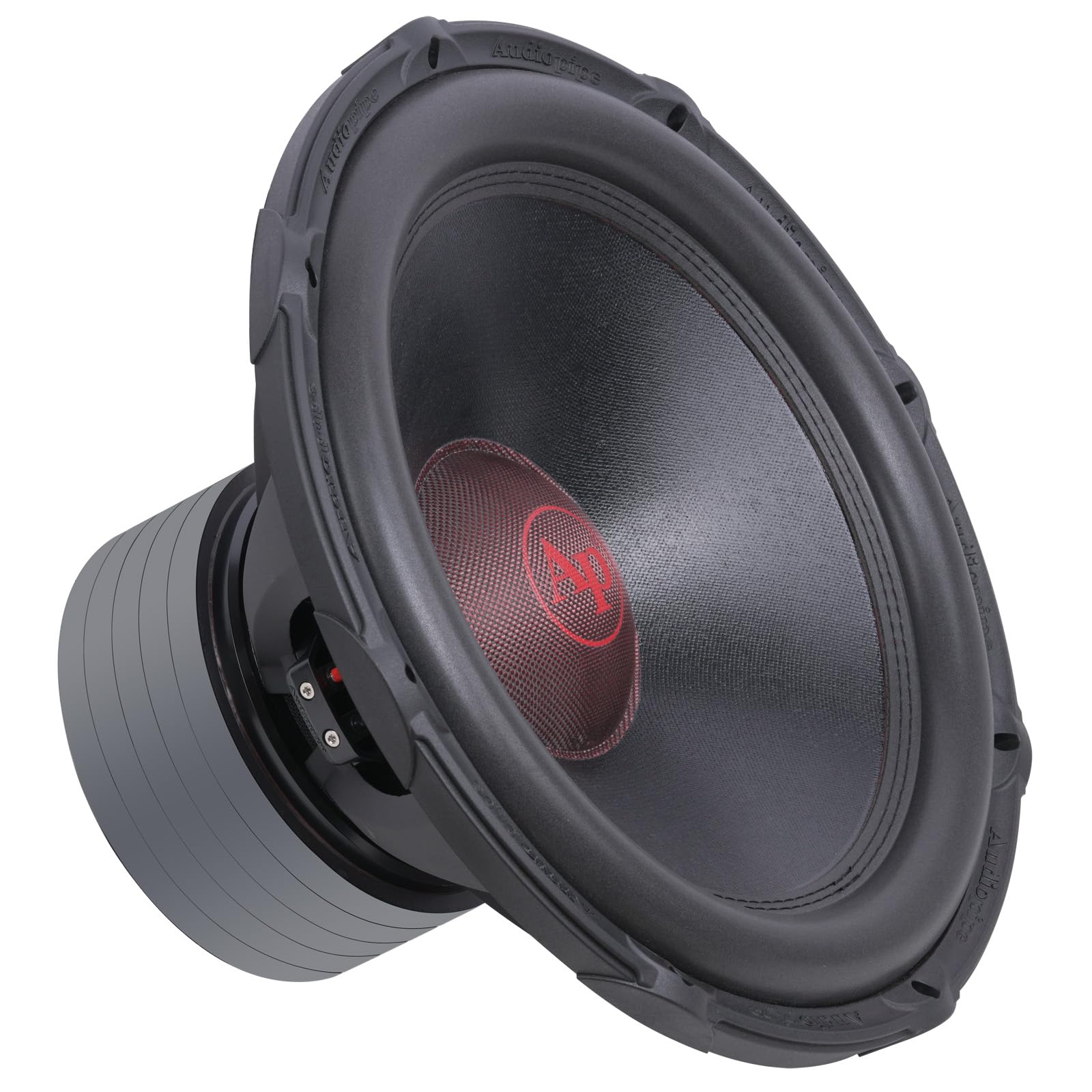
10. Audiopipe 18″ Quinta Stack Composite Cone Subwoofer (TXX-BDC-V-18)
Five magnets and a Kevlar-blend cone make this the endurance pick for competition-grade bass.
Where the quad-stack Audiopipe above uses four magnets, this one steps up to five — a 310 oz motor designed for strong power handling with improved voice coil ventilation for endurance. The peak power climbs to 3800W, with 1900W RMS under it, and the 4-inch BASV dual 4-ohm voice coil is built for sustained output. Dual 4-ohm coils wire to either a 2-ohm or 8-ohm final load depending on how you connect them, so match that to your amplifier before buying.
The build is unusually detailed for a car subwoofer: a Kevlar fiber composite non-press paper cone for rigidity, quad weaved tinsel leads for durability, and a powdered black aluminum basket with a heat-sink design to keep the motor cooler under abuse. The multi-connect terminals accept up to 8 gauge speaker wire, which is helpful when you’re pushing this much power through the coils. Frequency response spans 25Hz to 1,500Hz with 90dB sensitivity, so it covers deep bass plus a wide band above it.
The catch to plan around is that 10-3/16-inch mounting depth — this wants a big, deep enclosure and a serious amplifier to justify it. For a purpose-built competition car, that’s not a problem; for a quick weekend install, it may be too much driver.
The standouts
- 5 magnets and a 310 oz motor for strong control at high output.
- 3800W peak / 1900W RMS for competition-level demands.
- Kevlar fiber composite cone holds rigidity under load.
- Ventilated voice coil and heat-sink basket help with endurance.
Plan ahead for
- 10-3/16-inch mounting depth needs a deep, custom enclosure.
- Dual 4-ohm coils require deliberate wiring to hit your amp’s load.
Choose this for: a competition-style build where you can commit to a deep box and the amplifier to match.
Not for you if: you’re fitting a standard trunk — the mounting depth will likely be the blocker.
11. RCF L18P400 Professional Low Frequency 18-Inch Transducer

A studio-grade transducer whose low distortion and 97.5 dB efficiency mark it out for critical listening.
The 2000W program power handling and 97.5 dB sensitivity together describe a driver that gets loud on modest power while staying composed. RCF builds this for pro bass reflex and bass-horn systems, and its combination of low-frequency extension with an extremely low generation of harmonic distortion is why it’s also recommended for critical listening, such as a studio monitoring subwoofer. That’s an unusual dual mandate — touring-grade output without the smearing that heavy PA drivers can produce.
Look at the engineering and the reason for that accuracy becomes clear: a 4-inch fiberglass inside/outside copper voice coil, an aluminum demodulation ring, forced air ventilation and a 15mm top plate for minimum power compression, plus a dual spider design with silicon-based dampening. Those parts exist to keep the driver linear and cool, so what you hear at low volume stays consistent when you push it. The 25Hz–1kHz range gives it real sub-bass extension too.
The honest caveat is that this is a specialized pro-audio transducer — it belongs behind a properly designed bass reflex or bass-horn cabinet, not thrown into a random car box. In a bass-reflex or bass-horn cabinet, its 4-inch voice coil and aluminum demodulation ring keep distortion low at 97.5 dB efficiency.
Why it’s here: a 4-inch voice coil plus 97.5 dB sensitivity and a 25Hz–1kHz range make this a reference-grade choice for critical low-frequency reproduction.
Made for: studio monitoring subs and serious bass-reflex or bass-horn systems where low distortion matters as much as output.
Not intended for: a quick car sub install — this transducer wants a purpose-built pro cabinet.
Understanding the Specs
Impedance (ohms)
Impedance is the electrical load a driver puts on your amplifier, written in ohms. A lower number is a harder load — a 1-ohm driver demands more current than an 8-ohm one, and many amps aren’t rated to run that low. Dual voice coils give you wiring options, so check your amplifier’s rated load before you connect the coils. A 1-ohm driver on an amp rated only for 4 ohms will overheat or shut down; a matched pair runs cool and loud.
Voice Coil Diameter
The voice coil is the coil of wire that moves inside the magnet gap, and its diameter matters for heat. A larger coil — 4-inch or 5-inch versus 2.5-inch — spreads and sheds heat better, so the driver keeps its output when you push it for a long set. It’s one of the clearest indicators of how much real power a driver can take beyond the printed watt figure.
Power Handling (RMS vs max)
RMS is the power a driver can take continuously, while the max or peak figure is a short-burst number. A driver rated 2000W RMS and 4000W peak is a different animal from one rated 500W RMS and 1000W peak. Size your amplifier to the RMS figure for a sensible long-term match, and remember that clipping a clean amp does more damage than a well-fed one.
Sensitivity (dB)
Sensitivity measures how loud a driver plays for a given amount of power. A higher figure — like 100 dB — means you get more volume per watt, which suits a mid-power amp. Lower figures need more power to reach the same level. For a DJ or live rig where efficiency matters, a high-sensitivity driver lets a smaller amp do more work.
FAQ
Will an 18-inch loudspeaker fit my existing cabinet?
What impedance do I need, and will it match my amp?
What is the difference between a PA woofer and a car subwoofer?
What does RMS power mean compared with max power?
Do I need a custom enclosure for an 18-inch driver?
Is a larger voice coil always better?
What sensitivity rating should I look for if my amplifier is modest?
Can a car subwoofer work in a home audio setup?
How do I wire a dual voice coil subwoofer to my amplifier?
Is a cast aluminum frame better than a stamped steel one?
Final Thoughts: The Verdict
For a deep-bass car build where you can fit the box and run a 1-ohm-stable amplifier, the American Bass HD 18 is the one to beat — a 350 oz magnet and 3-inch voice coil hand you the most motor control on this list, and it’s the crowd favourite at 4.5+ stars across 60+ ratings. If you want serious car bass on a friendlier 2-ohm load, grab the H YANKA BSF-18-2. And if your money goes toward PA or DJ cabinets, the Sound Town STLF-18500A with its 5-inch voice coil is the low-end muscle to reach for. Measure your cutout and mounting depth, confirm your amp’s rated ohm load, then buy the driver that matches both.
How We Picked
We do not accept paid placement. Every pick is matched to a real buyer and a real use-case; we do not hands-on test units.
Sources & Methodology
Specifications: manufacturer listings and product documentation. Review insights: verified customer reviews, as of November 2026. Pricing: not shown on this page (it changes often); check the current price via the retailer link.
As an Amazon Associate, Gadgets Feed earns from qualifying purchases. This does not affect which products we feature.