
Our readers keep the lights on and my morning glass full of iced black tea. As an Amazon Associate, I earn from qualifying purchases.
Specs are compiled from manufacturer listings and verified buyer reviews and can change over time — please confirm the key details on the product page before buying.
An 1800-watt-class inverter is the bridge between a 12-volt battery and the everyday 120-volt appliances you already own — coffee makers, power tools, a microwave. The real buying decision isn’t about peak wattage; it’s about continuous wattage and the type of power wave it produces. Pure sine wave models run sensitive electronics without hum, while modified sine wave units handle simpler loads for less money.
I’m Min — the founder and writer behind Gadgets Feed. This guide is built by comparing the manufacturers’ published specifications and the patterns across verified customer reviews, so you get each pick’s real strengths and trade-offs instead of marketing spin.
This list focuses on the 1500–2000 watt class, so the nearest same-type size serves the same purpose as a literal 1800-watt unit. Here are the best 1800 watt inverter options that actually deliver steady power for tools, fridges, and emergency backup.
Our Picks at a Glance


How To Choose The Best 1800 Watt Inverter
Before you buy, match the inverter to the appliances you plan to run, the battery you already have, and the space you can give it. The two biggest mistakes are buying on surge power alone and ignoring the cable requirements.
Continuous watts are the real number
Continuous wattage is the sustained power an inverter delivers hour after hour, determining whether your coffee maker or fridge actually runs. Surge wattage handles the brief start-up spike of motors and compressors, lasting only a few seconds. For this class, look for a unit rated 1500W to 2000W continuous, with a surge capacity roughly double that.
Pure sine vs modified sine wave
Pure sine wave inverters produce grid-matching power, safe for laptops, TVs, CPAP machines, and any appliance with a digital display or motor. Modified sine wave units are cheaper and handle simple resistive loads like heaters and basic tools, but they can cause hum in audio gear or make some induction devices refuse to start. If you plan to run a microwave or a fridge, the clean wave matters.
Battery protection and low-voltage cutoff
A good inverter watches your battery’s voltage and shuts down before it drops low enough to cause damage. An adjustable low-voltage cutoff is a strong feature if you use lithium batteries, since their ideal cutoff point differs from lead-acid. This protects your investment in the battery itself, not just the inverter.
Quick Comparison
| Model | Best For | Continuous Power | Waveform | Weight | Amazon |
|---|---|---|---|---|---|
| BELTTT 2000W★ Best Overall | Overall performance plus remote control | 2000W | Pure Sine Wave | 7.7 lb | Amazon |
| VOLTWORKS 2000WQuiet Workhorse | Quiet operation, reliable cabin power | 2000W | Pure Sine Wave | 9.9 lb | Amazon |
| Ampeak 2000WEfficiency Pick | High efficiency on a budget | 2000W | Modified Sine Wave | 7.1 lb | Amazon |
| GIANDEL 2000W | ETL-listed value with simple installation | 2000W | Modified Sine Wave | 5 lb | Amazon |
| BESTEK 2000W | Reliable build with fast USB-C charging | 2000W | Pure Sine Wave | — | Amazon |
| OLTEANP 2200W | Extra headroom for tool-heavy work | 2200W | Pure Sine Wave | 11 lb | Amazon |
| VOLTWORKS VS-2000SCR | Long-term reliability, adjustable input | 2000W | Pure Sine Wave | — | Amazon |
| ZETAWALE 2000W | Quality build, four AC outlets | 2000W | Pure Sine Wave | 8.2 lb | Amazon |
| LiTime 2000W | Compact and efficient off-grid setup | 2000W | Pure Sine Wave | 9 lb | Amazon |
In-Depth Reviews
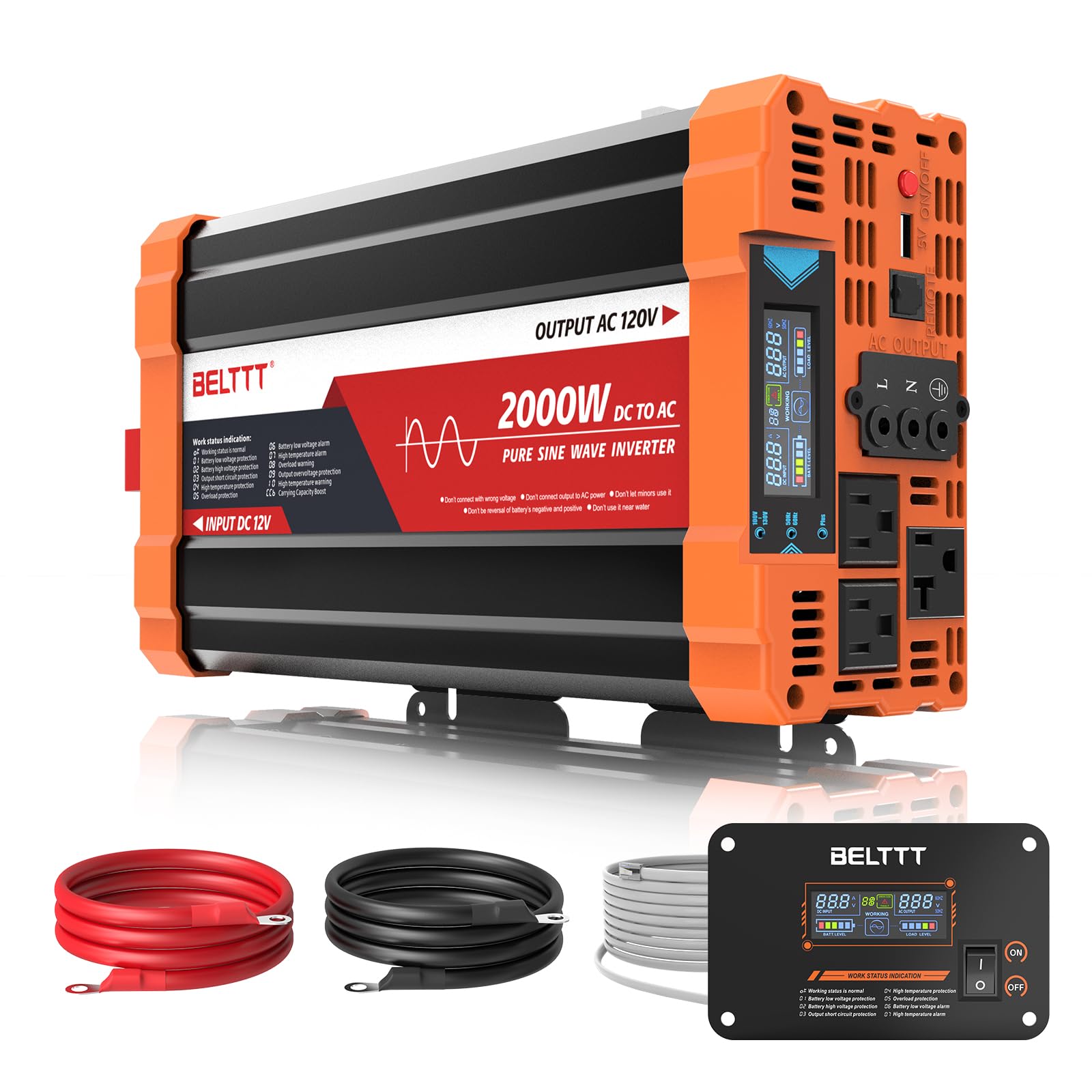
1. BELTTT 2000W Pure Sine Wave Inverter
Our pick — 4.5★ from 600+ verified ratings; the strongest balance of quality and price.
The balanced all-rounder that handles sensitive loads, a remote, and heavy surge demands in one unit.
This pick delivers 2000W of continuous power with up to 4000W of peak surge, which means a startup-hungry refrigerator or a 10,000 BTU air conditioner is within reach. The pure sine wave output matches the utility grid, so televisions, home theaters, and other sensitive equipment run cleanly without the buzzing that cheaper inverters produce. At 7.7 pounds, it also happens to be noticeably lighter than the VOLTWORKS unit at 9.9 pounds — a 29% gap that matters if you’re moving it between a truck cab and a campsite.
What wins people over is the real-world performance — buyers report it powered a 10,000 BTU AC for an hour, and the high-brightness smart screen shows input and output voltages plus fault codes for easy troubleshooting. Buyers also note the boards use soldered tabs rather than loose bolted lugs, which reduces fire risk at high current. It draws zero power when off, and the dual AC sockets, 20A outlet, and 5V2.1A USB port cover most hookups from the start.
Some owners found the included battery cables undersized and swapped in heavier 2AWG wire for confidence. A few report steady power, while others say it handles closer to 1000 watts in practice. This crowd favorite earns a proven 4.5-star rating across hundreds of owners, praised most for performance and value.
What owners rave about
- Running a 10,000 BTU AC for a full hour without strain
- Zero power draw when switched off saves battery
- Remote controller with a 23-foot cable fits cab or cabin installs
The honest trade-offs
- Stock cables may be thinner than advertised; heavier wire is a smart upgrade
- Power output gets mixed feedback at the very top of the range
Reach for this if: you want a pure sine wave workhorse with remote control and enough surge to start a window AC.
Think twice if: you plan to run sustained 1900W+ loads — the real-world ceiling sits closer to 1000W for many owners.
2. VOLTWORKS 2000W Pure Sine Wave Inverter
The silent operator that earned its keep in motorhomes and off-grid cabins.
This inverter produces 2000 watts of continuous pure sine wave power with a built-in cooling fan that stays off until the temperature reaches 104°F — which is exactly why owners describe it as ultra-silent in daily use. At 9.9 pounds and measuring 15″L x 8″W x 3.9″H, it’s the heavier and slightly larger of the two top picks, sized for a permanent install rather than a carry-on. A real buyer report notes it “tested 900W at 120V easily,” and the quiet fan earns consistent praise.
The 15-foot remote controller uses an RJ10 4P4C connection, so you can turn the unit on and off from the cab or cabin without walking to the battery bay. Owners mention it runs a 1100W coffee maker plus fans and a foot massager all at once in a Class C motorhome. The durable aluminum housing shrugs off drops and bumps, and the safety list covers short circuit, over-voltage, under-voltage, overload, over-current, and over-temperature protection.
One honest note: the idle draw sits around 0.7A, which adds up to about 24Ah a day if you leave it on — worth flipping off when unused. A few owners also noted this unit has a bonded neutral, so connecting a ground is essential for safety.
Site vibe: If silence and a no-fuss remote matter most, this is the one — the fan barely spins, and the included cables would cost around on their own.
Who it misses: RV owners who need a unit to carry between locations should note it outweighs the BELTTT by 29%.
3. Ampeak 2000W Power Inverter
A budget-friendly modified sine wave unit that squeezes extended run time from every battery amp.
This Ampeak leads with an 89.37% conversion efficiency, which means less battery power wasted as heat and longer run times for your gear on the road. At a library-quiet 52dB, it’s a good match for overnight RV trips and peaceful campsites. It delivers 2000W continuous and 4000W peak to handle power tools, kitchen appliances, and emergency home backup loads.
Customers note running an 1800W heat gun, 1500W vacuums, and a 12k BTU AC successfully, and the mobile locksmith crowd praises it for powering drills, grinders, and laptops all day. The 3 AC outlets plus dual 5V/3.1A USB ports make it a genuine charging station, and the bright LED display shows input voltage, output power, and fault codes in real time. The intelligent cooling fan only spins up when internal temperature exceeds 122°F, cutting both noise and dust intake.
The notable trade-off is the modified sine wave output — the maker itself notes it’s compatible with about 99% of equipment, but induction ovens are out of scope. Durability gets mixed feedback, with a few reporting it lasts around nine months under hard use. The cooling fan can emit a high-pitched sound for some, so test it near your sleeping area before committing.
Best angle: For the price, the efficiency and quiet operation are hard to argue with — a strong value pick for basic tools and appliances.
Watch out: If you own an induction cooktop or highly sensitive electronics, step up to a pure sine wave model.
4. GIANDEL 2000W Power Inverter

An ETL-listed modified sine wave unit that’s featherlight and simple to wire into a truck or RV.
This GIANDEL carries ETL UL 458 Standard approval, a serious certification that assures buyers it meets recognized safety standards — and it does so at just 5 pounds, the lightest unit in this lineup. It provides 2000W continuous and 4000W peak through dual AC outlets and a 2.4A USB port. The wired remote with a 15-foot cable makes on/off control convenient from the cab or campsite.
Owners describe the quality as excellent and setup as straightforward, and the aluminum alloy housing protects against drops and bumps. It’s compatible with lithium, LiFePO4, deep-cycle, AGM, and lead-acid batteries, with 200AH recommended for sustained use. The integrated cooling fan helps manage heat, and the full safety list covers over-voltage, overload, over-current, under-voltage, overheating, and short circuit protection.
The honest limits: power output gets mixed feedback, with some finding it won’t start a 1000-watt coffee pot or microwave, and induction ovens are explicitly noted as incompatible with modified sine wave. One owner reported shutoff at around 560W when charging scooter batteries — a reminder that real-world capacity depends heavily on your wiring and battery setup.
Why it works: Certification plus an ultra-light chassis make this a trustworthy entry point for simple loads and emergency backup.
Who it’s not for: Anyone needing to start a microwave or induction cooktop — this is a modified sine wave unit with limits.
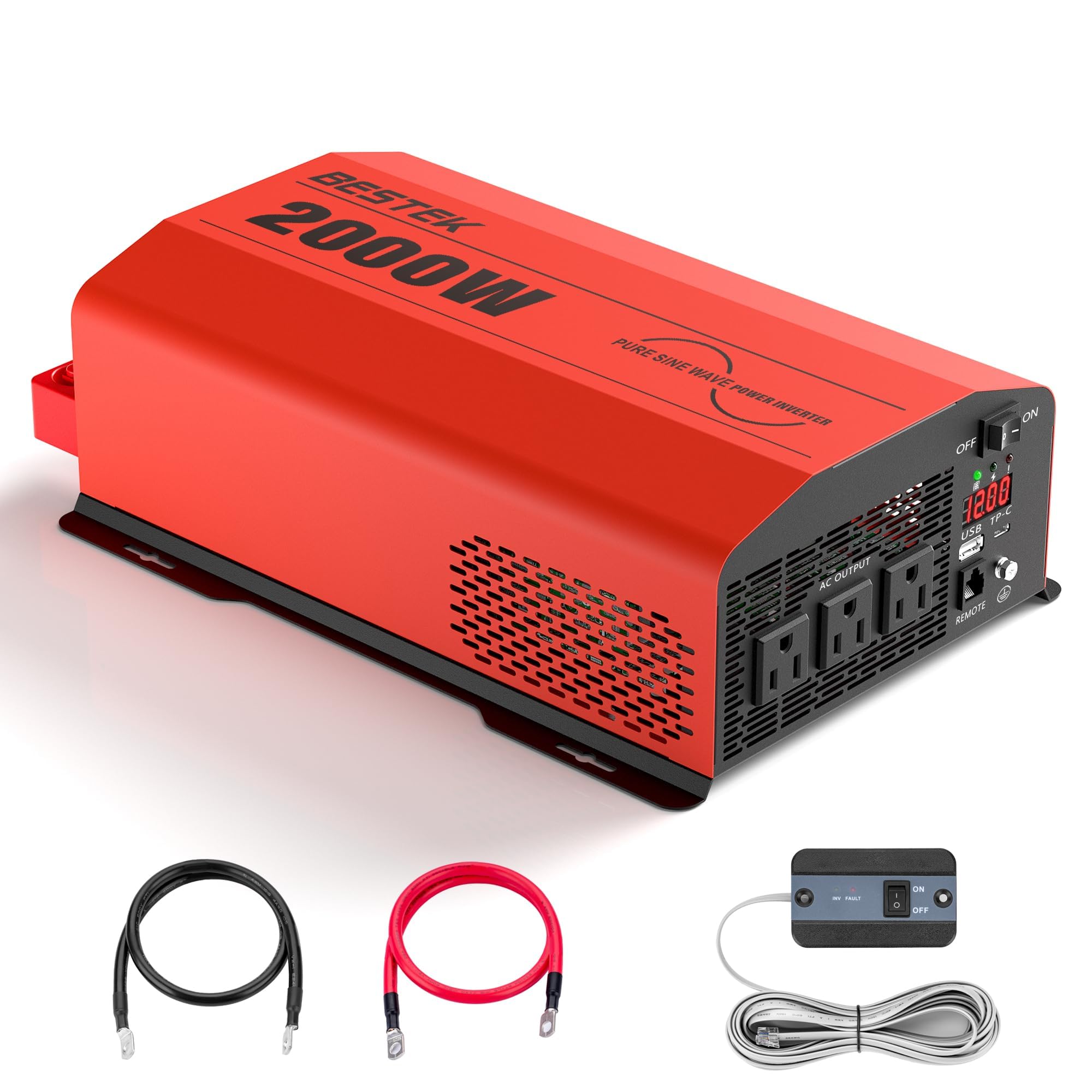
5. BESTEK 2000W Pure Sine Wave Inverter
The compact, clean-wave unit one owner used to run an entire home with no complaints.
This BESTEK converts 12V DC to clean 110V/120V AC at 2000 watts continuous, and it’s earned a reputation for reliability — one owner pulls 1600 watts from an EV battery with zero struggle. The pure sine wave output protects laptops, TVs, and other sensitive electronics from damage, extending their lifespan. It packs 3 AC outlets plus one 2-port USB hub with Type-C, giving you a genuine charging center for phones, tablets, and a camera.
The ETL-certified metal housing and high-speed ventilation fans keep temperatures in check, while the wired remote control adds convenience for truck or RV installs. Buyers praise the 4 AWG cables as genuinely good quality, and the build feels sturdy enough for daily driving use. It draws about 18W idle (just over 1Ah), so leaving it on overnight is a consideration but not a dealbreaker.
A couple of owners landed defective first units, but the support team responded immediately and shipped replacements the next day — strong after-sales service. The screen can be hard to read in direct sunlight, and a few note the included cables are really only sufficient for about 50% continuous load.
Standout feature: The Type-C port plus 3 AC outlets make this the most versatile charging hub on the list.
The catch: For sustained 2000W draws, plan on upgrading the battery cables to something heavier than the included 4 AWG set.
6. OLTEANP 2200W Pure Sine Wave Inverter

The toolshed hero that runs a Skilsaw and a chainsaw without breaking a sweat.
This OLTEANP steps up to 2200W continuous and 4400W peak, giving it real headroom above the 2000W crowd — enough that an owner ran a 7 1/4″ Skilsaw (1800W start, 1000W constant) and 120V compressors without the fans even spinning up. The pure sine wave output keeps TVs, refrigerators, and CPAP machines humming without buzzing or interference. At 5 kg (about 11 pounds), it’s built like a tank with plate steel construction.
The standout feature is the adjustable low-voltage shutdown (9.5V–11V), which makes it perfect for lithium batteries that need a different cutoff point than lead-acid. The 15-foot LCD remote shows input voltage, output voltage, load wattage, and battery level in real time, plus warning alerts. It also offers 4 AC outlets, a USB port, and a Type-C port for fast charging — a full toolbox for camping or off-grid work.
Reviewers point out stable 118-120V AC under load, quick recovery, and a deep freeze, 1000W pump, and even small welding jobs all run fine. The recurring gripe is the fan programming — it cycles on high, off, high, off, which is more annoying than a steady medium hum. Battery life and heat control get mixed reviews, so pairing it with a properly sized battery bank is essential for sustained 1500W loads.
Why pick it: The extra 200W of continuous headroom is the difference between a tool that barely starts and one that runs comfortably.
The trade-off: The cycling fan can be irritating in a quiet cabin — plan the install spot accordingly.
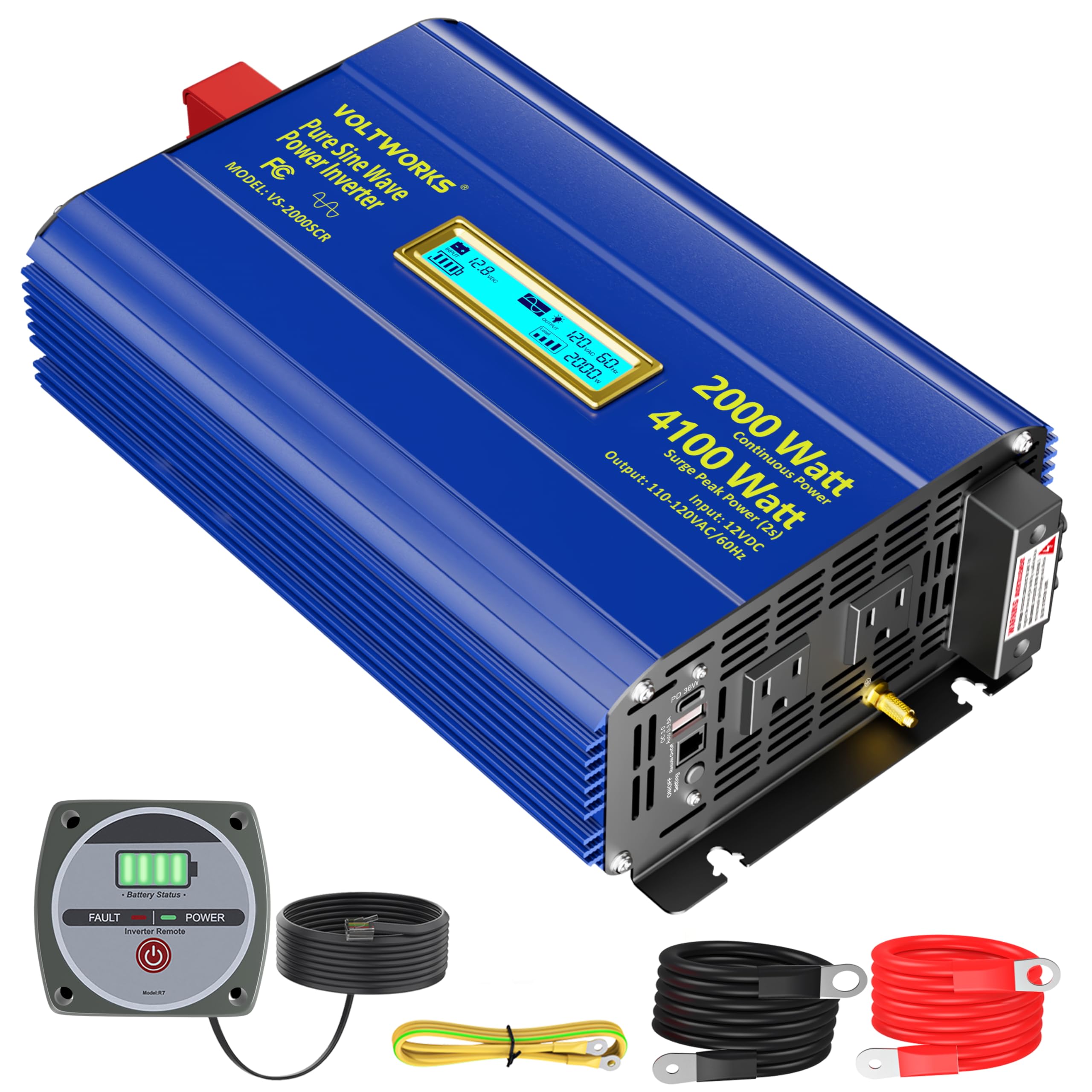
7. VOLTWORKS VS-2000SCR Pure Sine Wave Inverter
The proven long-hauler that kept a modem and a 55-inch TV running off-grid for two years straight.
This premium VOLTWORKS delivers 2000W continuous with a 4100W surge peak for 2 seconds, and its new upgraded adjustable input voltage makes it genuinely lithium-battery friendly. The LCD display shows battery status, input DC voltage, output AC voltage, and load watts, then shuts down after a minute of no operation to save power. It also packs a PD36W USB-C port and a 3.6A USB-A port for fast charging of phones, tablets, and starlink gear.
Real-world endurance is the story here — an owner powered a modem and a 55″ TV off-grid for two years straight with a quiet fan and reliable efficiency, drawing just 200W/16A and lasting 4 days on a 400Ah lithium bank. It runs two TVs, a PlayStation, and a floor fan at once while showing under half load. The 8 advanced protections include reverse polarity, over-voltage, under-voltage, short-circuit, overload, over-temperature, low-input alarm, and upgraded low-output voltage protection.
The 15ft 4P4C RJ10 remote makes on/off control and battery monitoring easy from the cab. A few owners note the display readings can be inaccurate, and the size doesn’t fit smaller install spaces. It can’t handle a large refrigerator drawing 7.1A at initial startup, so know your appliance’s surge draw before relying on it for a full-size fridge.
The verdict: For someone who wants proven multi-year reliability and clean power for sensitive electronics, this is the one to reach for.
Keep in mind: The display accuracy is a common nitpick, and a big fridge’s startup surge is beyond its reach.
8. ZETAWALE 2000W Pure Sine Wave Inverter

The quality-heavy unit with four AC outlets that one owner rates as better than the Honda EU series.
This ZETAWALE pushes 2000W continuous and 4000W peak through four AC outlets, plus a USB port and Type-C fast charging — the most outlet capacity on this list. Shoppers say it powers a 65″ TV, the largest fridge, two computers, and more simultaneously. One review page sums it up: “Been running full time for a few months now in a off grid shop and has been flawless.” A tester noted it’s 90% efficient at a 900W load.
The 14.76-foot wired remote with LCD display lets you monitor battery voltage, AC output voltage, and load wattage in real time — ideal for RV installs where the inverter is out of reach. The dual intelligent cooling fans maintain stable operation under heavier loads while keeping noise down. It auto-switches on power outage with an ATS, connecting a PC, router, TV, and cable box so nothing reboots when the grid blips.
The honest trade-offs: the fan is 2-speed and can be noisy, the battery percentage reads inaccurately on LiFePO4 batteries, and the included DC cables are considered worthless by some — heavy 2/0 AWG wire is the recommended upgrade. An occasional unit arrives with battery terminals too close together, a minor spacing issue.
The claim to fame: Four AC outlets plus a remote panel you can actually read at a glance make this the easiest multi-device setup here.
Plan for it: Budget for proper battery cables — the stock ones won’t do full-load duty.
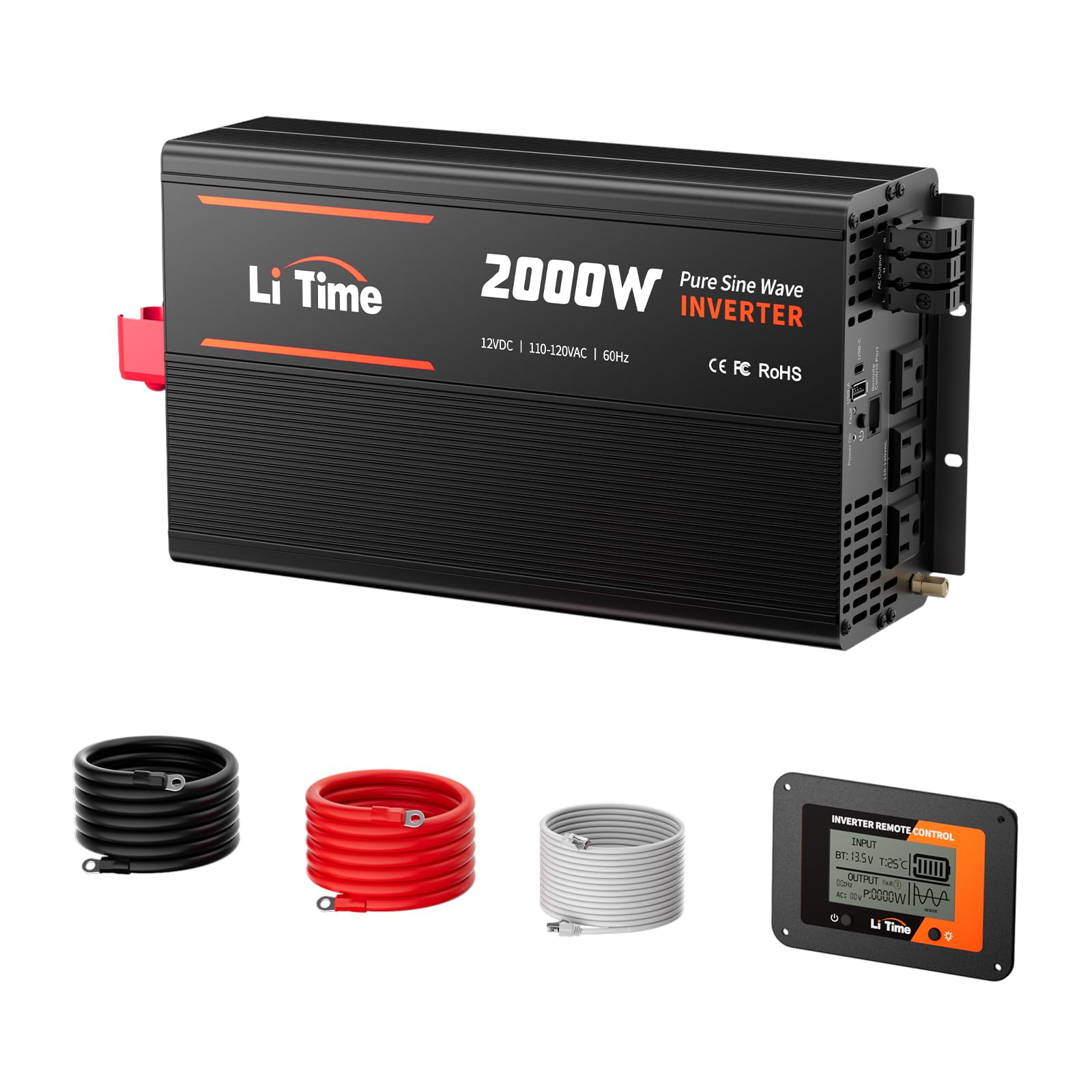
9. LiTime 2000W Pure Sine Wave Inverter
The efficient 90% converter that starts a 15A air compressor without tripping its alarms.
LiTime brings trusted battery-brand engineering to inverters, with a conversion efficiency above 90% — meaning less power lost as heat and more run time for your gear. The CE/FCC/RoHS certified unit provides 2000W continuous with a 4000W surge for clean, stable operation. It runs smoothly even in extreme environments from -20°C to 40°C, which covers most camper and cabin scenarios.
The defining owner story: “Starts & Runs 15A (1800W) air compressor” — handling the 13.4V to 10.6V voltage drop from a hard-starting compressor without alarming or cutting out. It also runs a microwave with no issues, and the LCD readout shows your draw percentage clearly. The ground comes with a nice alligator clip for quick, convenient hookup, and the unit is compact at 14.17″L x 7.42″W x 4″H while weighing 9 pounds.
All-round safety protections include over-voltage, low-voltage, overheat, overload, and short-circuit, with dual cooling fans that regulate temperature intelligently. The noted weakness is the on/off switch on one unit needing repeated presses after a year of use. The high-volt alarm also sits close to fast-charge voltages, which can trigger unnecessarily during active charging.
Why it stands out: The 90%+ efficiency plus the ability to start a real 1800W compressor makes this a serious value for off-grid users.
The nitpick: The switch durability and alarm thresholds are the two spots where a year of hard use shows.
Understanding the Specs
Continuous vs. Surge Watts
Continuous watts is the steady power an inverter delivers hour after hour, deciding whether your coffee maker runs all morning. Surge watts covers the brief startup spike of motors and compressors, lasting only a few seconds. In the 1800-watt class, look for continuous output around 2000W with surge capacity roughly double that.
Pure Sine vs. Modified Sine Wave
Pure sine wave produces grid-quality power that’s safe for laptops, TVs, CPAP machines, and any appliance with a digital display — no hum, no interference. Modified sine wave is cheaper and fine for simple resistive loads like heaters and basic tools, but it can make some devices buzz or refuse to start. Almost every pick on this list is pure sine wave for good reason.
FAQ
Can a 2000W inverter run a microwave?
What is the difference between pure sine wave and modified sine wave inverters?
What size battery do I need for a 2000W inverter?
How long will a 2000W inverter run a refrigerator?
Can I use an inverter with a lithium battery?
What size cables do I need for a 2000W inverter?
Why does my inverter shut off or alarm under load?
How much power does an inverter draw when idle?
Can an inverter run a power tool like a Skilsaw or air compressor?
Is a pure sine wave inverter worth the extra cost?
Final Thoughts: The Verdict
Across the board, the 1800 watt inverter winner is the BELTTT 2000W because it pairs a proven pure sine wave output with a real 4000W surge, a 23-foot remote, and soldered board tabs that reduce fire risk — the best balance of performance and value in this class. If you want the quietest operation and don’t mind a heavier chassis, grab the VOLTWORKS 2000W. And for tool-heavy work where extra headroom matters, the OLTEANP 2200W is the one to reach for — the crowd favorite across 600+ owners gives you confidence that whichever you choose, a steady 2000W of clean power is genuinely within reach.
How We Picked
We do not accept paid placement. Every pick is matched to a real buyer and a real use-case; we do not hands-on test units.
Sources & Methodology
Specifications: manufacturer listings and product documentation. Review insights: verified customer reviews, as of August 2026. Pricing: not shown on this page (it changes often); check the current price via the retailer link.
As an Amazon Associate, Gadgets Feed earns from qualifying purchases. This does not affect which products we feature.