
Our readers keep the lights on and my morning glass full of iced black tea. As an Amazon Associate, I earn from qualifying purchases.
Specs are compiled from manufacturer listings and verified buyer reviews and can change over time — please confirm the key details on the product page before buying.
When the grid goes down, the real question is simple: can you still run your fridge, keep your router alive, and power your CPAP through the night? An 1800 Watt Power Station answers that with a silent bank of lithium cells instead of a tank of gasoline, and the right one for you depends on capacity, recharge speed, and how many things you need to plug in at once.
I’m Min — the founder and writer behind Gadgets Feed. This guide is built by comparing the manufacturers’ published specifications and the patterns across verified customer reviews, so you get each pick’s real strengths and trade-offs instead of marketing spin.
This list flexes to include stations rated 1800W and above — the nearest same-size units that serve the same purpose — so you can compare genuinely. The best 1800 watt power station for your home, RV, or campsite balances raw output with how fast it refills and how long the battery truly lasts.
Our Picks at a Glance

How To Choose The Best 1800 Watt Power Station
An 1800W station is a serious mid-to-large purchase, so a few minutes of planning saves you from buying too little power or too much weight. Focus on the battery’s total capacity in watt-hours (Wh), how fast it recharges, and the number and type of ports you will actually use.
Match capacity to your appliances
The wattage (1800W) tells you how much power it can push at once, but the watt-hours (Wh) tell you how long it lasts. A 1024Wh unit runs a 60W fridge for many hours, while a 2073Wh unit doubles that runtime before needing a refill. List the devices you want to run, add up their wattage, and check that your shortlist holds enough total energy for the full outage window.
Recharge speed changes everything
A station that takes 8 hours to refill ties you to the wall, while one that hits 80% in under an hour keeps your backup plan flexible. Check the AC input wattage — 1500W or 1800W input fills the battery much faster than a standard 200W wall charger. Solar input matters too if you plan to top up off-grid.
Check the battery chemistry and lifespan
Nearly every serious modern station uses LiFePO4 (a stable lithium-iron-phosphate chemistry that holds up to far more charge cycles than older lithium-ion cells). This chemistry is why a station can claim 4000 cycles and a decade of daily use. For a multi-year purchase, that cycle rating is your real durability metric.
Quick Comparison
| Model | Best For | Capacity | AC Output | Weight | Amazon |
|---|---|---|---|---|---|
| BLUETTI Elite 200 V2★ Best Overall | Whole-home back-up | 2073.6Wh | 2600W | 53.4 lb | Amazon |
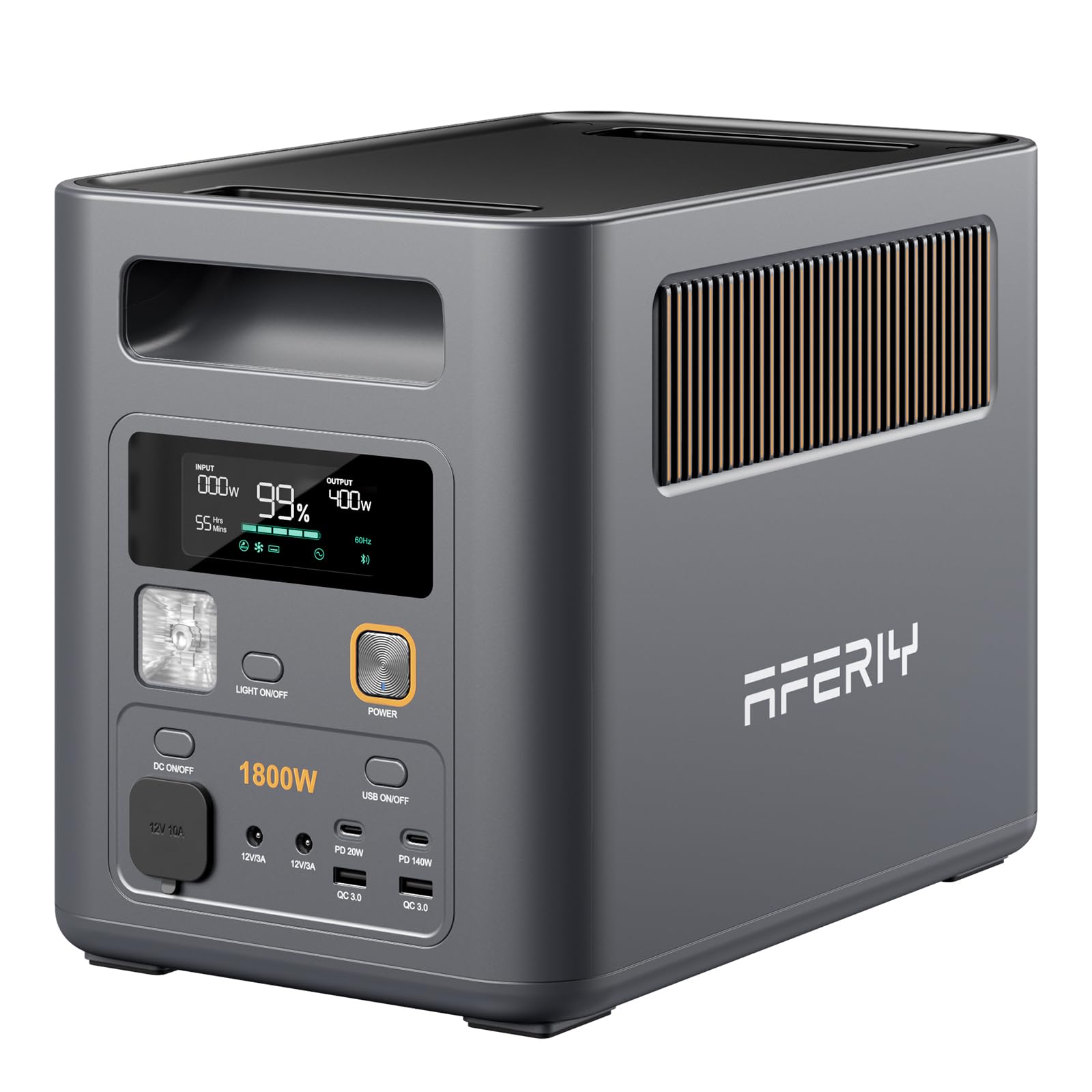
| AFERIY Nomad1800 ProBest Value | Expandable value | 1024Wh | 1800W | ~25 lb | Amazon |
| EF ECOFLOW DELTA 3 Plus | Fast recharge + portability | 1024Wh | 1800W | 27 lb | Amazon |
| AFERIY P280 | RV & high-wattage gear | 2048Wh | 2800W | 44 lb | Amazon |
| PECRON F3000LFP | Massive capacity camping | 3072Wh | 3600W | 63.3 lb | Amazon |
In‑Depth Reviews
1. BLUETTI Elite 200 V2
Our pick — over 4.5★ from 650+ verified ratings; the strongest balance of quality and price.
The powerhouse that runs a house through an outage and still has headroom for a hair dryer.
The defining trait here is capacity: 2073.6Wh — literally double the 1024Wh of the AFERIY Nomad1800 Pro in a similar footprint. That is the margin between powering your essentials for a night and powering them for two. The 2600W continuous AC output (with a 3900W power-lifting surge for stubborn startup loads) means refrigerators, shop vacs, and coffee makers all start without complaint.
Recharge speed is the second standout. Turbo Mode fills 0–80% in about an hour at 1800W AC input, and combining AC with DC charging drops that to roughly 50 minutes. For solar users, 1000W of panels delivers a full charge in about 2.4 hours. Owners who moved from smaller units note the 2073.6Wh capacity comes at a similar physical size to the older AC180, making this a genuine two-for-one upgrade in energy density.
The LiFePO4 pack is rated for over 6,000 cycles and a claimed 17-year lifespan. Standby draw drops to just 10W, which means less energy wasted when the unit sits idle between outages. Owners consistently praise its reliability and raw power — the two things you need when the grid disappears.
What Wins People Over
- 2073.6Wh capacity runs a 120V 60W diesel heater 10 hours a day for over 3 days
- UPS mode (≤15ms switch) protects Wi-Fi, computers, and TV from dropouts
- Three smart charging modes tune speed vs. noise via the BLUETTI app
- 3900W power-lifting handles high-startup appliances
The Honest Trade-offs
- At 53.4 pounds, it is a two-hand carry, not a tailgate toss
- No 30A RV port, so it is not a direct hookup for larger RVs
- The price sits at the premium end of this class
Reach for this if: you want the best balance of capacity, recharge speed, and long-term durability for whole-home backup or van life.
Look elsewhere if: you need a 30A RV outlet or want something light enough to carry one-handed — this one asks for a cart or a strong grip.
2. AFERIY Nomad1800 Pro
A genuinely light 1800W station that grows with you and refuses to break the bank.
The headline spec is weight: at roughly 25 pounds, this carries like a large tool bag, not a generator. The 1024Wh LiFePO4 battery delivers a stable 1800W AC output (3600W peak) for fridges, coffee makers, and power tools. Owners describe it as light enough to move around easily — the classic “heavy but sturdy” compromise that most stations in this class share.
what separates it is expansion. Start at 1024Wh (watt-hours, a measure of energy storage) and bolt on extra batteries up to 5120Wh total — a cheaper path than replacing the whole unit when your power needs grow. The port selection is the most generous in this lineup: 14 output ports in total, which beats the BLUETTI Elite 200 V2’s 4 AC outlets, 2 USB-C, and 2 USB-A by a wide margin. Charging flexibility is broad too, with AC, solar, car, or combined AC + solar input.
Buyers report a full charge in about 2 hours at half power via a 200W solar panel, with one finding it could run a portable washer for 2 hours using just 30% of the battery. The UL Listed safety rating (a certification from Underwriters Laboratories for electrical safety) and up to 7-year customer support add confidence at this price point. Reliability and charging speed are the aspects owners praise most, with quiet operation a close third.
Why it wins: It is the rare station that pairs a genuinely portable 25-pound frame with 14 ports and a battery you can expand later — a smart buy for campers and first-time buyers who want room to grow.
The catch: The 1024Wh capacity is half the BLUETTI’s 2073.6Wh, so expect roughly half the runtime before a refill. If you need a full day of heavy use, budget for an expansion battery.
The right pick for: RV owners, weekend campers, and anyone who wants a light, versatile station that can scale up later without buying a whole new system.
Think twice if: you need maximum runtime from a single unit — the 1024Wh base capacity is the trade-off for that light weight.
3. EF ECOFLOW DELTA 3 Plus

Refills to full in under an hour and quietly protects your data at the same time.
This is the station for impatient people. With 1500W AC input it charges to 80% in about 40 minutes and hits 100% in roughly 56 minutes via the EcoFlow smart generator — the fastest full recharge in this lineup. Owners regularly report going from 21% to full in about 75 minutes on wall power alone, which makes this a practical choice for back-to-back outages.
The 1024Wh LiFePO4 battery drives a 1800W AC output (with X-Boost handling resistive loads over 2200W), and the IPS65-rated battery pack shrugs off splashes, dust, and oil. Its LiFePO4 pack delivers 4000 cycles to 80% capacity — a 10-year lifespan that’s 25% more durable than the industry baseline. The 10ms UPS switch-over protects NAS drives, servers, and POS systems from data loss during grid flickers.
At 27 pounds, it splits the difference between the 25-pound AFERIY and the 53.4-pound BLUETTI — light enough to carry but sturdy enough for real work. Owners note it ran a fridge for 2.5 hours (100% to 82%) during an outage, projecting about 12.5 hours total on a full battery. The EcoFlow app adds 12-hour storm alerts, low-battery reminders, and a usage dashboard, though some find the app slightly intrusive.
What Stands Out
- Fully recharges in about 56 minutes — far faster than typical overnight charging
- 10ms UPS switch-over keeps computers and servers safe from outages
- Expands up to 5kWh with DELTA 3, DELTA Pro 3, or DELTA 2 Max packs
- IP65 battery pack resists splashes, dust, and oil
Where It Compromises
- 1024Wh capacity is modest for whole-home backup — it’s best for essentials
- 27 pounds is carryable but not exactly light
- The app is feature-rich but some find it a bit much for basic use
Grab this for: home offices with NAS or servers, campers who hate waiting, and anyone who values a 10ms UPS for data safety.
skip it if: you need multi-day whole-home backup — the 1024Wh capacity runs out faster than the higher-capacity picks above.
4. AFERIY P280

Serious wattage with a real RV hookup, packed into a 44-pound workhorse.
The P280 is built for people with actual appliances to feed. Its 2800W AC output (5600W peak) is the highest continuous rating in this article after the PECRON’s 3600W, and it comes with a NEMA TT-30 outlet — the standard RV plug that most stations skip. That single feature makes it the natural pick for RV owners who want to run their rig’s existing wiring without adapters.
Inside sits a 2048Wh LiFePO4 battery — exactly double the 1024Wh units from AFERIY and EcoFlow — expandable to 10.24kWh with extra packs. The 1800W AC input and 1200W solar input combine for a 0–80% charge in about 38 minutes, so a quick lunch stop can top it up meaningfully. Dual PV inputs let you run two solar arrays without extra MPPT hardware, which saves money when you upgrade an RV.
Real-world feedback highlights the pellet grill crowd: startup draws about 130W and steady cooking sits near 30W, letting four hour-long high-heat cooks burn only about 20% of the battery. A CPAP user reports two nights on fan-only using just 30% of capacity. The <10ms UPS response protects sensitive gear, and the pure sine wave output runs audio equipment cleanly. Noise draws mixed reviews — some find it very quiet, others notice the fan under load.
The appeal in one line: 2800W, a 2048Wh base battery, and a genuine RV outlet — an unusual trio for an 44-pound unit that recharges in about 38 minutes.
The honest caveat: durability feedback is mixed, with one owner reporting a unit that died after a single use. That is not a pattern, but it is a reason to verify your warranty coverage with AFERIY’s 7-year support before relying on it daily.
The right owner: RV enthusiasts, pellet grill cooks, and anyone who needs a TT-30 RV hookup and high continuous wattage in one box.
Not for: buyers who need the lightest possible carry — 44 pounds demands a cart or a sturdy grip, and the mixed durability reports warrant a careful look.
5. PECRON F3000LFP
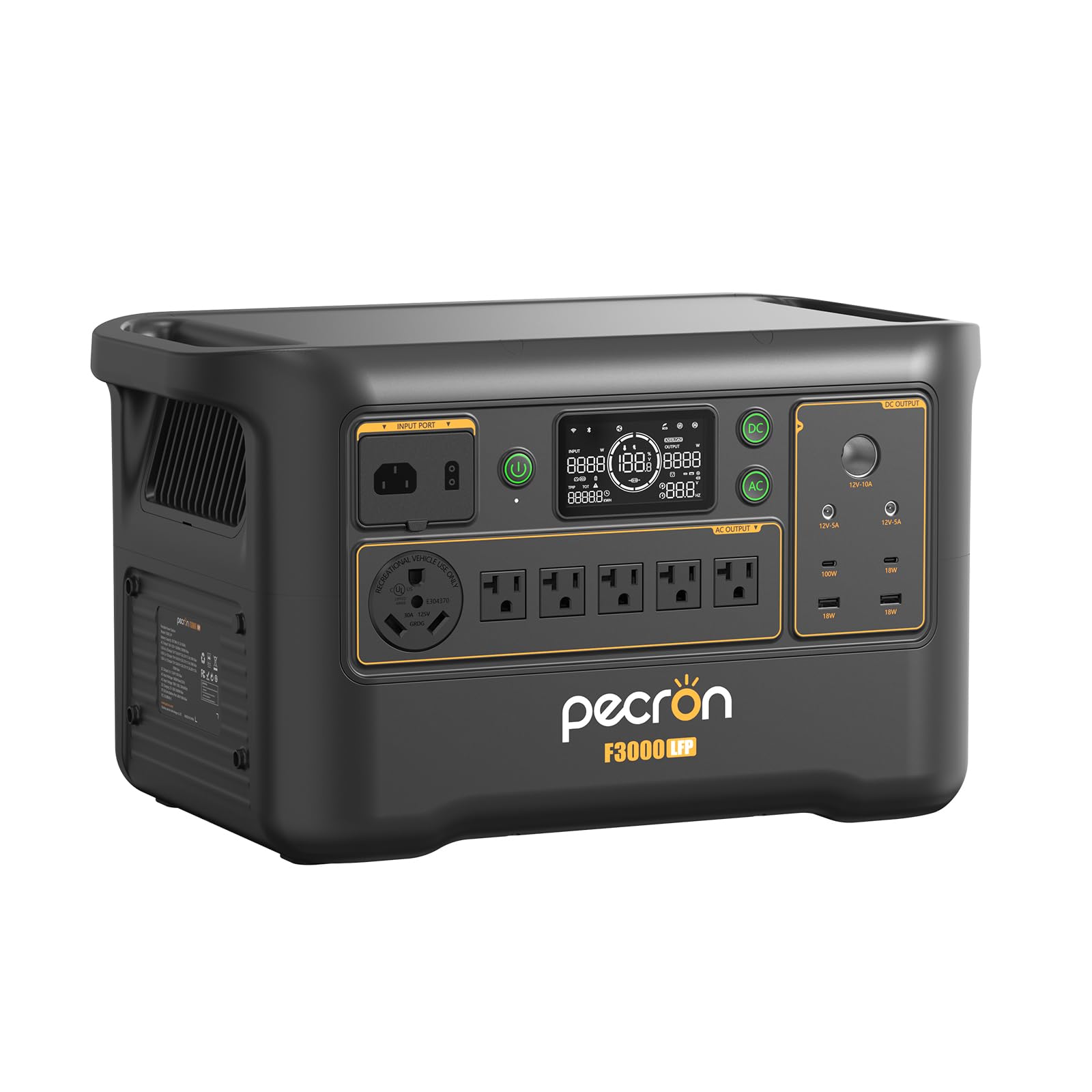
The biggest battery here, ready for multi-day blackouts and heavy shop tools alike.
That translates to 2–3 days of home essentials during an outage, and its 3600W pure sine wave output handles refrigerators, air conditioners, and power tools simultaneously across 13 ports. If your worst-case scenario is a multi-day winter outage, this is the margin that keeps you comfortable.
Recharge is genuinely fast for its size: 1800W AC input refills the whole 3072Wh battery from 0–100% in about 2 hours — roughly 30% faster than comparable large units. Solar input tops out at 1600W (25–120V), and you can combine AC, solar, and car charging for triple input. The 8–20ms UPS switch protects computers and medical devices during flickers. Owners praise the real-world reliability, with one powering an electric tiller without issues and another running a fridge/freezer through multiple blackouts.
The 13-port layout covers six AC outlets, two USB-C (100W PD for laptops), two USB-A, one carport, and two DC 5525 outputs — enough for CPAP machines, drones, cameras, and phones at once. The Bluetooth app works without Wi-Fi, which owners appreciate in remote campsites. The honest trade-off is weight: at 63.3 pounds, this is the heaviest unit here by a clear margin, and the noise level draws mixed feedback.
The Big Wins
- 3072Wh capacity runs home essentials for 2-3 days
- 3600W pure sine wave output powers heavy appliances and tools
- Expands to 10752Wh with extra battery packs
- 1800W AC input refills fully in about 2 hours
The Real Costs
- 63.3 pounds — the heaviest pick here, definitely cart territory
- Charging speed draws mixed feedback; fan noise varies by load
- Expansion battery needs a separate XT120-M cascade cable
Choose this for: whole-home backup, off-grid cabins, and anyone who needs the deepest battery reserve without moving to a permanent install.
Pass if: you need to carry it regularly — 63.3 pounds and mixed noise reports make it a poor camping companion for solo trips.
Understanding the Specs
Watt-hours (Wh) vs Watts (W)
Watts tell you how much power a station can deliver at any instant — enough to start a fridge or not. Watt-hours tell you the total energy store — how long it can deliver that power. A 1024Wh unit and a 3072Wh unit can both output 1800W, but the bigger one runs the same fridge roughly three times longer before needing a refill.
LiFePO4 Battery Chemistry
LiFePO4 (lithium iron phosphate) is the modern standard for power stations because it survives far more charge cycles than older lithium-ion cells. Look for a 4000+ cycle rating — that is the difference between a station that lasts a couple of years and one that comfortably serves a decade of daily use.
FAQ
What can I actually run on an 1800-watt power station?
Is 1024Wh enough for home backup?
How fast do these stations recharge from a wall outlet?
What does UPS mode mean on a power station?
Can I add solar panels to charge these stations?
How long do LiFePO4 power stations last?
What is the difference between 1800W and 2600W output?
What does “Peak” or power-lifting wattage mean?
Final Thoughts: The Verdict
For the majority of shoppers, the 1800 watt power station winner is the BLUETTI Elite 200 V2 because it pairs a massive 2073.6Wh capacity with 2600W output and a 17-year lifespan — the most complete package for whole-home backup. If you want the fastest recharge, grab the EF ECOFLOW DELTA 3 Plus for its 56-minute full charge and server-grade UPS. And for the biggest reserve at the best value-per-watt, the PECRON F3000LFP is the one to reach for — its 3072Wh capacity is the most generous here, and the crowd favorite at 4.5 stars across 100+ owners makes it a low-risk leap for serious off-grid needs.
How We Picked
We do not accept paid placement. Every pick is matched to a real buyer and a real use-case; we do not hands-on test units.
Sources & Methodology
Specifications: manufacturer listings and product documentation. Review insights: verified customer reviews, as of August 2026. Pricing: not shown on this page (it changes often); check the current price via the retailer link.
As an Amazon Associate, Gadgets Feed earns from qualifying purchases. This does not affect which products we feature.