
Our readers keep the lights on and my morning glass full of iced black tea. As an Amazon Associate, I earn from qualifying purchases.
Specs are compiled from manufacturer listings and verified buyer reviews and can change over time — please confirm the key details on the product page before buying.
When the power drops, your whole house can stay running if your generator delivers 18,000 watts or more of peak power. That output is enough to keep your AC, refrigerator, and internet on at the same time. This guide covers two types: permanently installed home standby units and large portable workhorses, each chosen because it clears that 18,000-watt bar and earns real trust from owners.
I’m Min — the founder and writer behind Gadgets Feed. This guide is built by comparing the manufacturers’ published specifications and the patterns across verified customer reviews, so you get each pick’s real strengths and trade-offs instead of marketing spin.
We zero in on what a truly capable 18000 watt generator must deliver, from clean power for your electronics to fuel flexibility and easy starts, so you buy the right backup once.
Our Picks at a Glance
How To Choose The Best 18000 Watt Generator
Buying a generator this large is a serious decision, so it pays to understand a few core ideas before you commit. The biggest trap is confusing peak watts with running watts—peak is the brief surge when a motor starts, while running is what the machine sustains. A generator rated 18,000 peak watts might only sustain 14,500 running watts, which is the number you actually live with.
Decide: portable flexibility or permanent standby
Decide first: do you want to roll a machine out during a storm, or have one bolted down and ready? A portable unit like the Westinghouse tri-fuel runs on multiple fuels, so you can use it at a jobsite or campsite. A home standby unit like the Generac Guardian is installed by an electrician, starts automatically when the power drops, and needs no manual setup in the rain or dark.
Match the fuel to your situation
Fuel choice drives cost and convenience. Gasoline is easy to find but needs to be stored and rotated. Propane and natural gas sit in a tank or a line, so they never go bad. If you already have a large propane tank or a natural gas hookup, a tri-fuel or dual-fuel machine can run for days without a trip to the gas station.
Check the outlets and the transfer switch
Make sure the generator has the right outlet for your home’s inlet. Look for a 50A 14-50R or a 30A L14-30R outlet, which are the standard connections for a transfer switch or interlock kit. The right outlet means you can safely power your home’s circuits instead of running extension cords everywhere.
Quick Comparison
| Model | Best For | Peak Power | Engine Displacement | Item Weight | Amazon |
|---|---|---|---|---|---|
| Generac Guardian 22kW★ Best Overall | Whole-home standby | 22,000 watts | 999 cc | 466 lbs | Amazon |
| Westinghouse 18000 Peak Watt Tri-Fuel | Portable whole-home backup | 18,000 watts | 713 cc | 348.3 lbs | Amazon |
| Westinghouse 28000 Peak Watt | Maximum portable power | 28,000 watts | 999 cc | 541.1 lbs | Amazon |
In‑Depth Reviews
1. Generac Guardian 22kW Home Generator
Our pick — 4.5★ from 250+ verified ratings; the strongest balance of quality and price.
The set-and-forget standby unit that starts itself before you even wake up.
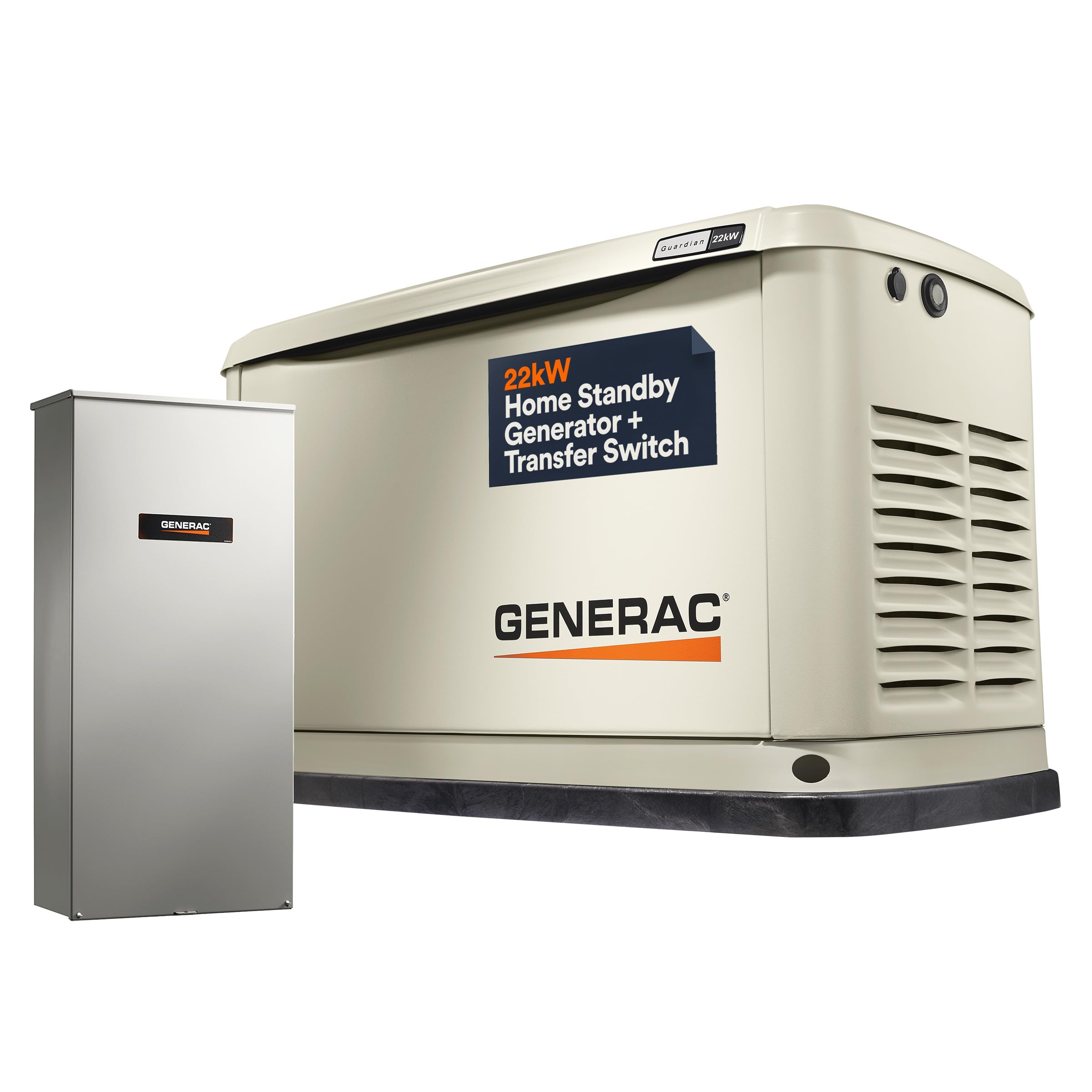
The defining feature here is that this is a permanently installed home standby generator, not something you roll out during a storm. It pairs with a 200 Amp NEMA 3R smart transfer switch in an aluminum enclosure, so the moment your power drops, the generator fires up and switches your house over automatically. Owners who survived three outages report it “starts in 10s, runs flawlessly, auto-shuts off” without any manual work in the dark.
Power delivery is its other headline. Generac’s True Power Technology pushes out a clean, stable 22,000 watts with under 5% harmonic distortion (THD), which is the measure of how smooth the electricity is for your sensitive electronics. That is well above the 18,000-watt bar, and owners note it powers an entire house plus two AC units at once. The 999cc G-Force engine is built for low maintenance, and the whole unit is engineered and assembled in the USA.
You will pay for that convenience in setup and extras. Generac recommends installation by a certified and licensed electrician, and the battery and cold weather kit are not included—owners mention those run roughly and separately. The unit tips the scales at 466 pounds, which is 34% heavier than the tri-fuel Westinghouse portable below, so this is a permanent commitment, not a movable machine. It does carry a 5-Year Limited Warranty and Generac’s Mobile Link WiFi lets you check its status from your phone.
Why Owners Trust It
- Handles the whole house plus two AC units without breaking a sweat
- Starts in seconds and shuts down automatically when power returns
- Remote WiFi monitoring keeps you informed anywhere
What To Plan For
- Requires a licensed electrician for installation
- Battery and cold weather kit sold separately
- Heavy 466-pound unit that stays put once installed
Best for you if: you want true whole-home protection with zero manual effort, and you already have natural gas or propane plus room for a permanent install.
Think twice if: you want a portable unit you can move to a jobsite or campsite—this one is a permanent fixture.
2. Westinghouse 18000 Peak Watt Tri-Fuel Generator
One machine, three fuels, and enough power to back up a larger home.
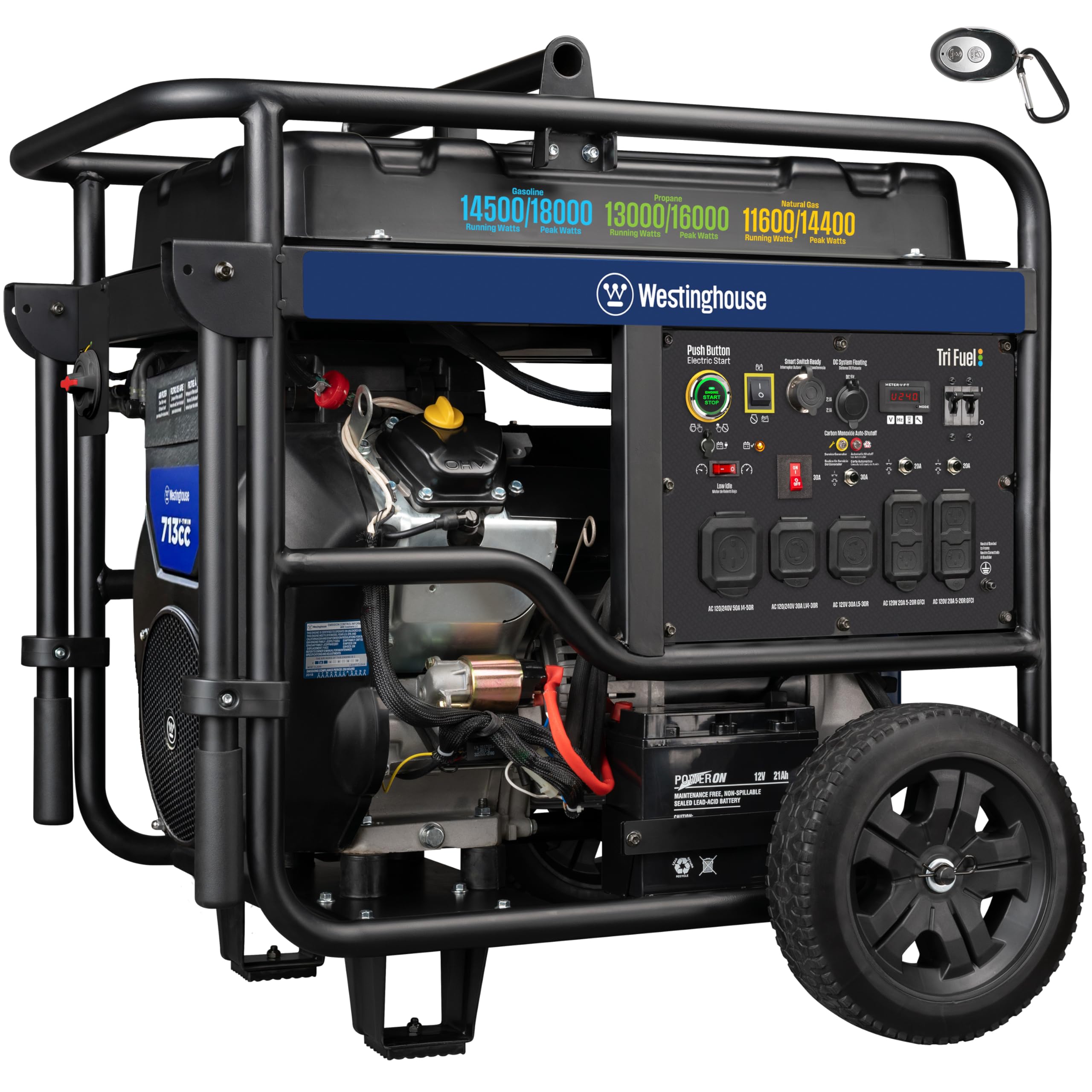
This is the pick for people who want big power but refuse to be locked into one fuel. It is a tri-fuel generator, meaning it runs on gasoline, propane, or natural gas—each with its own ratings. On gas it delivers 18,000 peak watts and 14,500 running watts; on propane that drops to 16,000 peak and 13,000 running; and on natural gas it lands at 14,400 peak and 11,600 running. That flexibility is the entire reason to choose it, and owners confirm it runs their whole house on propane without issues.
The 713cc V-Twin OHV engine is the workhorse behind the watts. It sips fuel efficiently enough to run up to 16 hours at 25% load on a 10.5 gallon gas tank, and features like automatic low oil shutdown and low idle mode protect the engine over long hauls. The VFT data center displays voltage, frequency, and lifetime hours, so you always know the machine’s health at a glance.
Clean power is a real selling point here. The generator holds total harmonic distortion (THD) under 5%, which is the threshold that makes it safe for your phones, computers, and TVs. A buyer running a 5-ton AC plus a dryer on natural gas noted the machine tracked at 4.5% to 4.8% THD under load—smooth enough for sensitive gear. The trade-offs are honest ones: it is loud, it is bulky at 348.3 pounds, and the natural gas hose is not included, so budget for that separately.
Setup is painless: push-button and remote key fob start, plus an included CO shutdown sensor for safety, and it ships with oil, funnel, and a setup guide so you can begin right away.
Plan for the loud: at 74 dBA operating volume, this is not a quiet neighbor unit—treat it as outdoor gear, not a patio appliance.
Reach for this if: you want one portable machine that can burn whatever fuel is cheapest or most available, and you have a 50A inlet to feed your home.
Look elsewhere if: you need true whole-home power on natural gas alone—the 11,600 running watts on NG is the lowest of the three fuels.
3. Westinghouse 28000 Peak Watt Generator

A 28,000-watt rolling powerhouse that out-specs most portable units on the market.
This is the brute-force option for anyone who refuses to compromise on capacity. It pushes a massive 28,000 peak watts and 20,000 running watts on gasoline—a 56% bigger peak than the 18,000-watt tri-fuel above—and it backs that with a 999cc V-Twin OHV engine with a cast iron sleeve for durability. Owners describe it as a unit that “runs my whole house” and powers HVAC plus workshop gear without strain.
Runtime is the second story. The 17 gallon fuel tank with a fuel gauge delivers up to 15 hours of run time at 25% load, so you can sleep through a storm without a 2 a.m. refuel. The start panel is built for convenience too: a remote start key fob, push-button electric start, engine shut off, and a battery charging port all sit right on the easy-access panel. A digital readout shows lifetime run hours, volts, and frequency.
Outlets are plentiful for a whole-home hookup. You get four GFCI 120V standard household outlets, two 50A 120/240V 14-50R outlets, two 30A 120/240V L14-30R outlets, and one 30A 120V L5-30R outlet, all with rubber covers. Like its sibling, it runs low THD for sensitive electronics and includes automatic low oil and carbon monoxide (CO) shutdown. The honest catch is weight: at 541.1 pounds, this is the heaviest pick here, and while owners say the reinforced steel handles with quick-release pins make it reasonably movable, it is still a two-person machine.
Where It Wins
- 28,000 peak watts powers an entire home, workshop included
- 15 hours of runtime on a 17 gallon tank
- Remote key fob start makes cold mornings easy
Where It Costs You
- 541.1 pounds is heavy—plan for two people and a sturdy dolly
- Gasoline only, with no tri-fuel flexibility
- Noise level splits opinions between reasonable and loud
Pick this if: you need the absolute highest portable output to run a big house or a workshop, and you have a 50A transfer switch ready.
skip it if: you want fuel flexibility or a lighter machine—this one is gas-only and the heaviest of the three.
Understanding the Specs
Peak Watts vs. Running Watts
Peak watts is the brief surge of power a generator produces when a motor first starts—like the moment your AC compressor kicks on. Running watts is the steady output the machine sustains over hours of use. The 18,000-watt tri-fuel generator shows the gap clearly: it peaks at 18,000 on gas but runs at 14,500. Size your needs against running watts, not the peak number.
THD (Total Harmonic Distortion)
THD measures how clean and smooth the electricity is. Lower is safer for sensitive electronics like laptops, TVs, and phone chargers. These generators hold under 5% THD, the common threshold for running electronics safely. High THD can stress or damage delicate gear over time, so this number matters if you plan to power more than just lights and a fridge.
Transfer Switch and Outlets
A transfer switch safely connects your generator to your home’s electrical panel so you can power fixed circuits, not just extension cords. For a bigger home, you want a 50A 14-50R or a 30A L14-30R outlet, which match standard transfer switch and interlock kit inputs. The Generac takes this further with a built-in 200 Amp NEMA 3R smart switch that switches over automatically.
Fuel Type and Runtime
Gasoline is easy to find but must be stored and treated. Propane and natural gas never go bad and can run for days if you have a large tank or a line. The tri-fuel Westinghouse gives you all three options, while the 28,000-watt unit is gas-only. Runtime also matters—the 17 gallon tank on the top Westinghouse runs up to 15 hours at 25% load, versus 16 hours on 10.5 gallons for the tri-fuel.
FAQ
What size transfer switch do I need for an 18000 watt generator?
Can an 18000 watt generator power my whole house?
What is the difference between peak watts and running watts?
How long will these generators run on a full tank?
Is it safe to power my TV and computer with these generators?
What is a CO sensor and why does it matter?
Can I hook these generators up to my natural gas line?
How heavy are these generators and can I move them?
Final Thoughts: The Verdict
For most people, the 18000 watt generator winner is the Generac Guardian 22kW because it delivers true whole-home standby power with automatic transfer and WiFi monitoring—no rolling out a machine in the rain. If you want fuel flexibility and portability, grab the Westinghouse 18000 Peak Watt Tri-Fuel, which runs on gas, propane, or natural gas. And for the absolute highest portable output, the Westinghouse 28000 Peak Watt is the one to reach for, with a massive 28,000 peak watts to power an entire home and workshop. All three are heavy-duty investments, so match the fuel and the setup style to your home before you buy.
How We Picked
We do not accept paid placement. Every pick is matched to a real buyer and a real use-case; we do not hands-on test units.
Sources & Methodology
Specifications: manufacturer listings and product documentation. Review insights: verified customer reviews, as of August 2026. Pricing: not shown on this page (it changes often); check the current price via the retailer link.
As an Amazon Associate, Gadgets Feed earns from qualifying purchases. This does not affect which products we feature.