
A dedicated charger transforms loose 18650 cells from unreliable power sources into a dependable energy arsenal. Without one, you are guessing at charge levels, risking over-discharge damage, and relying on the inconsistent built-in circuits of cheap flashlights or vape mods, which often lack the precision to fully or safely top off a lithium-ion cell.
I’m Min — the co-founder and writer behind Gadgets Feed. My analysis for this guide focused on comparing charge current accuracy, termination voltage consistency, and capacity testing repeatability across seven popular chargers to isolate which models actually deliver on their technical claims.
Whether you power high-drain flashlights, vape devices, or portable projects, the data-driven recommendations in this best 18650 charger with batteries guide will help you pick a safe and effective model that matches your specific needs.
How To Choose The Best 18650 Charger With Batteries
Selecting the right charger for your 18650 cells involves more than just matching the physical size. You need to evaluate charge current flexibility, chemistry compatibility, independent bay control, and safety certifications to ensure you get reliable and safe performance every cycle.
Charge Current and Bay Independence
A charger that lets you select the current per bay is essential for safely charging different cells. A 3000mAh high-drain 18650 can tolerate a 2A charge, but an older or low-capacity salvage cell should be charged at 0.5A to prevent excessive heat. Independent bays allow you to mix cell types and charge currents simultaneously.
Chemistry and Size Compatibility
Most standard 18650 chargers handle 3.6V and 3.7V Li-ion cells, but some also support LiFePO4 (3.2V) and Ni-MH/Ni-Cd (1.2V). If you plan to charge batteries like 21700, 26650, or even AA and AAA, look for adjustable contact plates that accommodate both flat-top and button-top cells up to at least 72mm in length.
Safety Protections
Lithium-ion cells operate under strict voltage and temperature limits. A quality charger includes overcharge protection (termination at 4.2V ±0.05V), reverse polarity detection, short-circuit prevention, and temperature control. Look for chargers certified to CE, FCC, UL, or RoHS standards as a baseline for safe design.
Quick Comparison
On smaller screens, swipe sideways to see the full table.
| Model | Category | Best For | Key Spec | Amazon |
|---|---|---|---|---|
| Nitecore UMS4 | Premium | High-speed charging & diagnostics | 4000mA total / 3000mA per slot | Amazon |
| XTAR VC8 | Premium | 8-slot capacity grading | 8 bays / Grading mode for 4 slots | Amazon |
| MIEKLAKE S8 | Mid-Range | Charging 8+ cells at once | 10 bays / 2A per channel max | Amazon |
| XTAR VC4SL | Mid-Range | Accurate capacity testing | 4 bays / Grading (charge-discharge-charge) | Amazon |
| EBL PD4 | Mid-Range | Budget 4-bay with discharge function | 4 bays / 2A max per slot | Amazon |
| Nitecore UMS2 | Mid-Range | Compact travel with detailed display | 2 bays / 3000mA one slot / USB-C | Amazon |
| YSKXOIMA Universal Set | Budget | Entry-level with included 18650 cells | 2 bays / 5V input / includes 4 cells | Amazon |
In‑Depth Reviews
1. Nitecore UMS4

The Nitecore UMS4 is the most balanced high-performance charger on this list, delivering a maximum total output of 4000mA across four independent slots. With QC input support, it can pump 3000mA into a single bay, charging a 3500mAh 18650 to 80% in just 55 minutes — a genuinely useful speed for anyone rotating cells through high-drain flashlights or vape mods.
The intelligent LCD screen cycles through real-time metrics including battery health status (“Good” or “Poor”), internal resistance in milliohms, charged capacity, voltage, and elapsed charging time. It supports 3.6V/3.7V Li-ion, 3.2V LiFePO4, and 1.2V Ni-MH/Ni-Cd chemistries with automatic detection and manual override, so you can fine-tune the charging mode for older or mismatched cells.
Safety is comprehensive here: reverse polarity protection, over-discharged battery activation, and a temperature regulation system built into the fire-retardant PC shell. The USB-C port accepts input from power banks, solar panels, or standard adapters, making this a versatile choice for both benchtop use and field charging.
Why it’s great
- Fast 3000mA single-slot charging with QC input
- Independent bay control supports mixed chemistries
- Informative LCD shows precise internal resistance
- Safe fire-retardant housing with temperature regulation
Good to know
- Does not include a wall adapter
- Internal resistance readings can be inconsistent on some units
2. XTAR VC8

With eight independent slots, it can simultaneously charge eight protected 21700 or 18650 cells, while the left four bays (CH1-CH4) offer a dedicated grading mode that runs a charge-discharge-charge cycle to measure actual milliamp-hours.
It ships with a QC3.0 wall charger and a USB-C cable, supporting up to 3A per slot on CH1 and CH8 when internal resistance is low, with five selectable current levels (3A, 2A, 1A, 0.5A, 0.25A). The high-precision MCU and real-time temperature control prevent over-current and over-voltage, and the patented three-stage charging system automatically terminates at 4.2V for standard Li-ion cells.
Users consistently report that grading reveals the overstated capacity claims from cheaper battery suppliers — a 3000mAh-labeled cell may test at only 1500mAh. The included QC3.0 adapter ensures it runs at full speed out of the box, and the compact footprint takes up less desk space than stacking two four-bay chargers.
Why it’s great
- Grades true capacity with charge-discharge-charge cycle
- Charges up to 8 cells simultaneously
- Comes with a QC3.0 wall adapter and USB-C cable
- Five selectable charge currents for different cell ages
Good to know
- Only left 4 bays support grading mode
- Total power limited to 18W when charging 8 cells
3. MIEKLAKE S8
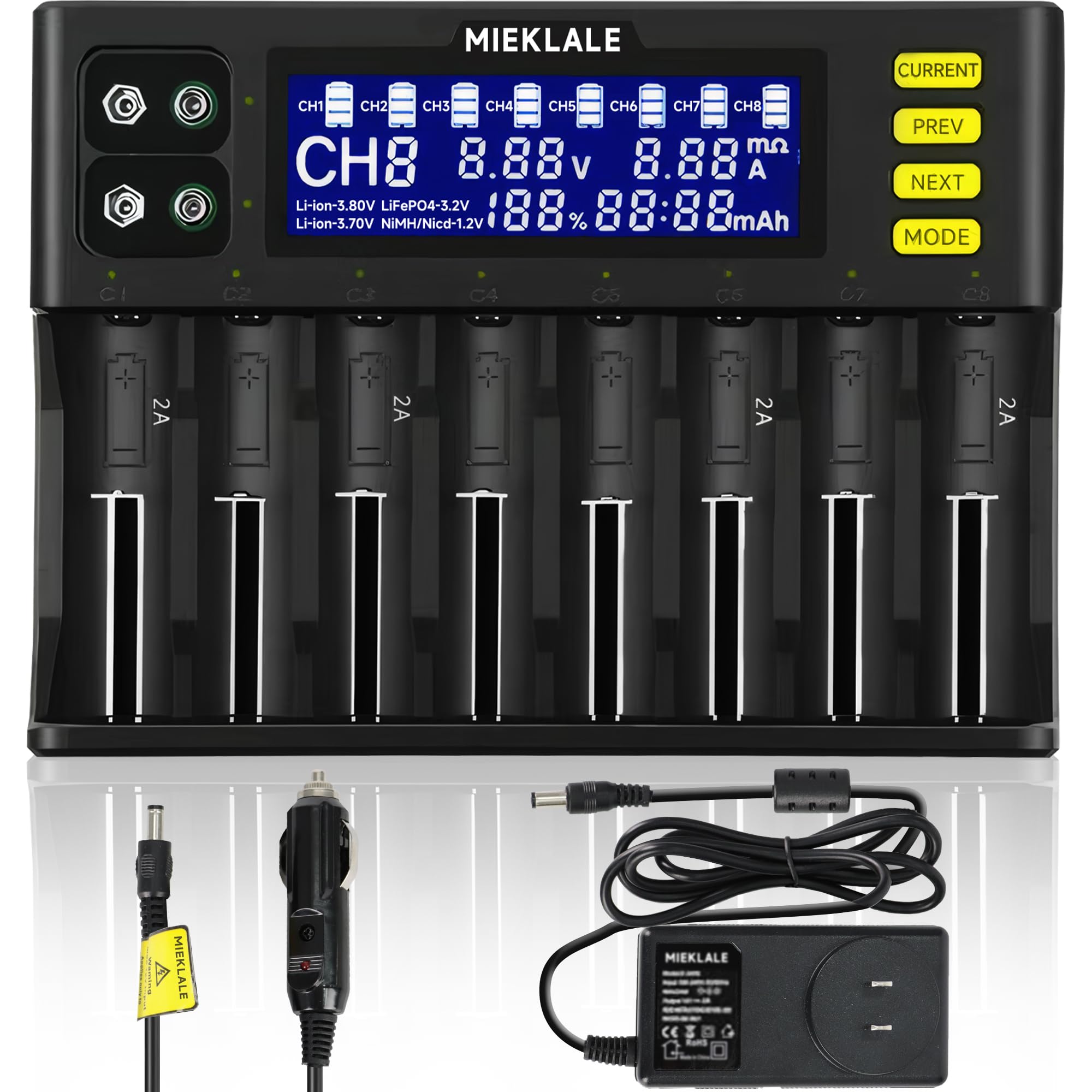
The MIEKLAKE S8 stands apart with its 8+2 bay configuration, offering ten total charging slots that accept cells up to 72mm long, including 26650 and protected 21700 cells. The included 12V/4A power adapter delivers 2A per channel across multiple bays simultaneously, making it one of the fastest options for bulk charging a large battery rotation.
The smart LCD display presents voltage, current, charging time, capacity, energy percentage, and internal resistance on a single screen. Five selectable current levels let you dial down to 0.25A for delicate or old cells, or crank up to 2A for high-drain 18650s. It automatically identifies Li-ion, LiFePO4, NiMH, and NiCd chemistries, though it cannot charge 1.5V Li-ion AA/AAA cells.
Build quality is solid for the price, with independent slot monitoring and overtemperature protection. A handful of users note that the interface takes a few minutes to learn, and the all-plastic body feels a bit lightweight compared to premium models. For sheer slot count and included adapter, however, this is a very capable charger.
Why it’s great
- 10 independent bays for bulk charging
- 12V/4A adapter included for full-speed 2A charging
- Displays internal resistance and capacity in real time
- Accepts long cells up to 72mm
Good to know
- Interface takes a few minutes to master
- Does not support 1.5V Li-ion AA/AAA cells
4. XTAR VC4SL

The XTAR VC4SL is an upgraded four-bay charger designed specifically for users who need to test and grade their 18650 cells. Its grading mode discharges each cell first before recharging it, giving you an accurate read on the true milliamp-hour capacity — a vital function for identifying counterfeit or degraded cells that claim inflated specs.
It accepts 3.6V/3.7V Li-ion, Ni-MH, and Ni-CD cells in sizes from 10440 up to 26650, and the USB-C input supports up to 3A per bay when paired with a QC3.0 adapter. The LCD display is simple and readable, showing voltage, current, and charged capacity for each slot. Independent current selection per bay lets you charge a high-drain 18650 at 2A while trickle-charging a salvage AA cell at 0.25A.
Best results come from using the bundled power adapter, as some users found PC USB ports supply insufficient power. The VC4SL also includes a storage charge mode that brings cells to 3.7V — the ideal voltage for long-term storage. For the price, it delivers highly useful diagnostic features that are usually reserved for much more expensive hobby chargers.
Why it’s great
- Grading mode reveals true cell capacity
- USB-C input with up to 3A per bay
- Independent current selection for mixed cell types
- Storage charge mode preserves battery health
Good to know
- Requires a quality QC3.0 adapter for full speed
- Display shows dial indicator instead of numeric voltage
5. EBL PD4
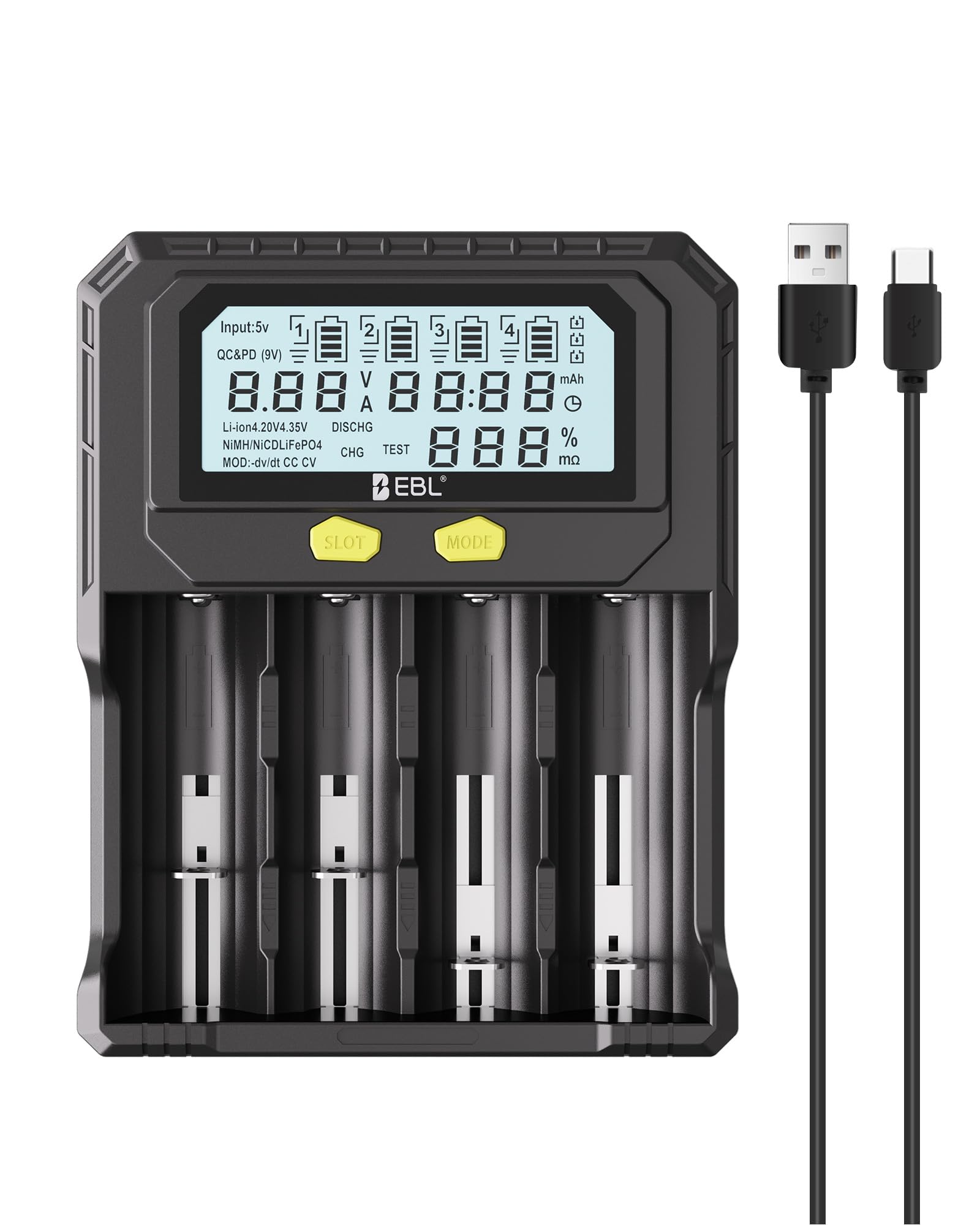
The EBL PD4 brings a four-bay chargers with advanced functions usually found on more expensive units: a dedicated discharge mode, capacity testing, and 0V reactivation technology that can revive deeply discharged Li-ion cells. It supports a wide range of chemistries including 3.6V/3.7V/3.85V Li-ion, LiFePO4, IMR, INR, ICR, and 1.2V Ni-MH/Ni-Cd across sizes from 10440 to 32700.
Channels 1 and 4 deliver a maximum of 2000mA each, making it up to four times faster than a standard 500mA charger. The intelligent LCD display provides real-time feedback on battery type identification, charge progress, and estimated charging duration. Each bay operates independently, so you can mix a high-current 18650 charge with a slow NiMH trickle without conflict.
Safety coverage is thorough with overcharge, overcurrent, thermal control, short-circuit, and reverse polarity detection. A small number of owners report an occasional sudden shutdown that requires a power cycle to resume. For the money, this charger offers a versatile set of features for users who want function over brand prestige.
Why it’s great
- Discharge mode and capacity testing built in
- 0V reactivation revives deeply depleted cells
- Charges at 2A on channels 1 and 4
- Accepts a huge range of battery sizes (10440 to 32700)
Good to know
- Occasional firmware glitch causing shutdown
- Barrel jack input, not USB-C
6. Nitecore UMS2

The Nitecore UMS2 packs intelligent charging into a compact dual-slot body that’s ideal for travel or everyday carry. When paired with a 9V QC2.0+ USB power source, it delivers up to 3000mA in a single slot or 2000mA per slot when both are occupied — significantly faster than most compact chargers on the market.
The LCD display reports battery health, charging status, charging current, voltage, and internal resistance. Automatic detection identifies the cell chemistry and size, selecting the appropriate charging current and termination voltage without user intervention. It supports Li-ion, IMR, LiFePO4, Ni-MH, and Ni-Cd in sizes from 10440 to 26700, as well as rechargeable AA and AAA.
This bundle includes a practical organizer for keeping cells separated when on the go. A few units have been reported to emit an electrical squeal during operation, though this does not affect charging performance. For users who need a reliable, fast dual-bay charger that fits in a pocket, this is a top contender.
Why it’s great
- 3000mA single-slot speeds with QC input
- Auto-detects chemistry and voltage for safe charging
- Compact size fits in a pocket or small pouch
- Wide compatibility from 10440 to 26700 cells
Good to know
- No wall adapter included
- Some units produce slight electronic noise
7. YSKXOIMA Universal Charger Set
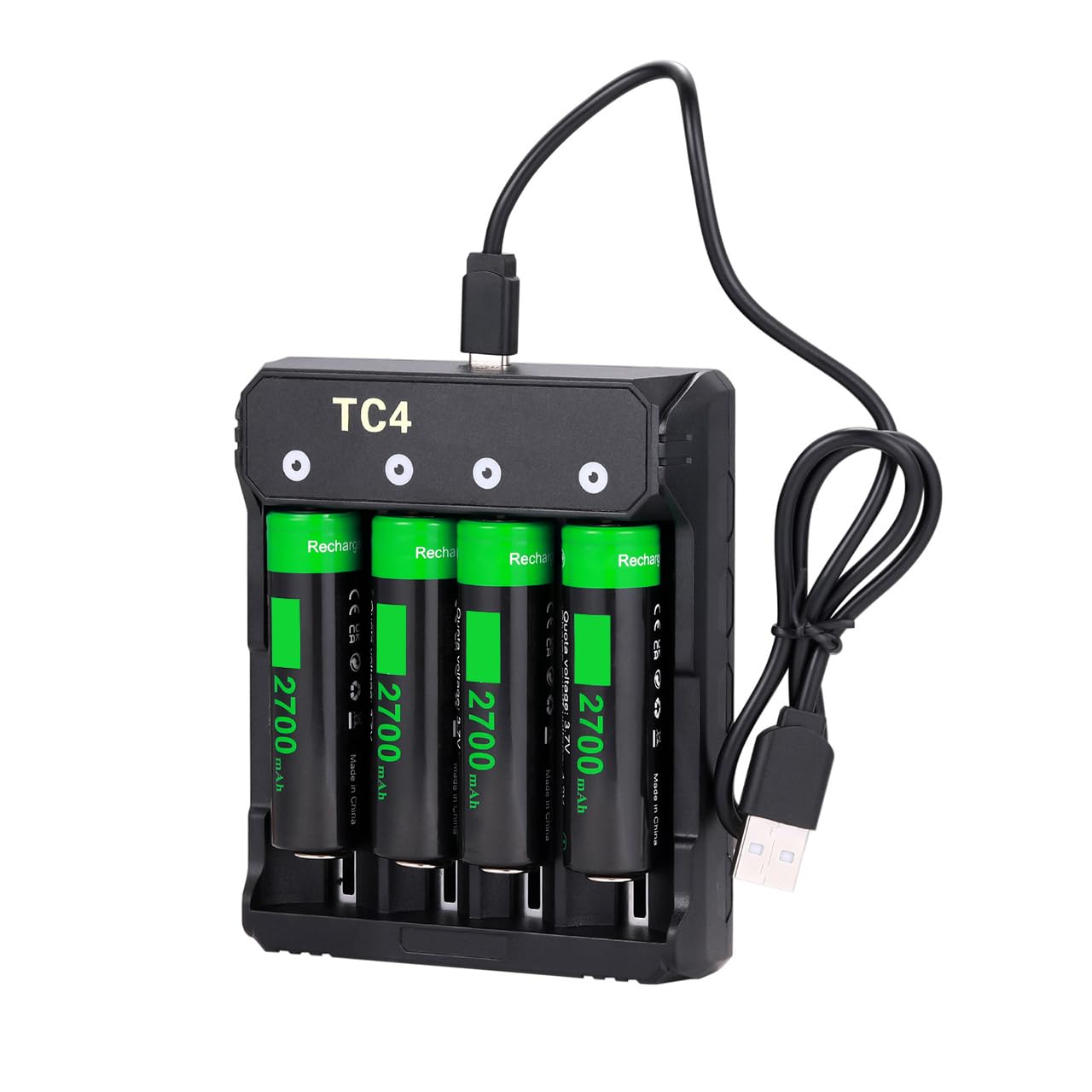
The YSKXOIMA universal set is the most affordable way to get started with 18650 cells if you do not yet own any. It includes two 18650 batteries along with a basic two-bay charger, giving you everything needed to power a flashlight, headlamp, or small fan right out of the box. The charger accepts standard 5V input via a barrel jack connector.
Built-in safeguards include overcharge, short-circuit, and overheat protection, ensuring that the included cells — and any you add later — are charged safely. The compact, lightweight design makes it easy to toss into a camping kit or emergency bag. Users confirm the included batteries hold a charge well and are suitable for medium-drain devices like flashlights and emergency radios.
There is no LCD display, no adjustable current, and the charge rate is slower than premium models, but for its entry-level price, this set delivers dependable basic functionality. Consider it a starter kit for someone who wants to test the waters of rechargeable 18650s without a large upfront investment.
Why it’s great
- Comes with 4 x 18650 cells included
- Basic overcharge and short-circuit protection
- Compact and lightweight for travel or emergency kits
- Incredible value for a complete starter set
Good to know
- Slow charge speed with no current selection
- No charge level indicator or LCD display
FAQ
What is the correct termination voltage for an 18650 cell?
Can I charge different chemistries (Li-ion and Ni-MH) at the same time?
Final Thoughts: The Verdict
For most users, the best 18650 charger with batteries winner is the Nitecore UMS4 because it balances high charging speed, comprehensive diagnostics, and independent bay control at a premium but justifiable price point. If you manage a large collection and need to verify cell health, grab the XTAR VC8 for its eight-bay grading capability. And for a budget-friendly starter kit that includes cells and a basic charger, nothing beats the YSKXOIMA Universal Set.