
A 19-inch rack mixer solves the specific pain of stuffing a full live-sound rig into a single metal frame. Instead of sprawling across a table with snaking cables, you get a unified, tour-ready unit that slides into a standard equipment rack alongside your amps, processors, and wireless gear. The right choice determines whether your next gig sounds polished or messy.
I’m Min — the co-founder and writer behind Gadgets Feed. I’ve spent hundreds of hours cross-referencing channel counts, preamp noise floors, digital routing capabilities, and physical build quality to separate the pro-grade workhorses from the budget compromises in this crowded category.
After analyzing thousands of customer reports and spec sheets, I’ve assembled a definitive guide to the best 19 rack mixer models that balance input density, audio fidelity, and real-world durability for live and studio use.
How To Choose The Best 19 Rack Mixer
Selecting a rack mixer requires balancing physical input/output density with your specific workflow — whether you need analog simplicity for a fixed install or digital flexibility for a touring band. The most common mistake is counting channels without checking whether those channels include usable line inputs, aux sends, or direct outputs.
Channel Count vs. Usable Inputs
A mixer labeled “16-channel” might only offer 8 mic preamps, with the rest being stereo line pairs. For a 5-piece band with 4 vocal mics, 3 DI instruments, and a backing track feed, you actually need at least 10 usable mono inputs. Always verify the number of combo XLR/TRS jacks rather than relying on the headline channel number.
Analog vs. Digital Architecture
Analog mixers like the Mackie VLZ4 series offer instant tactile control and zero latency, but they lack recallable scenes, graphic EQ per monitor mix, or multitrack USB recording. Digital options from Behringer and Allen & Heath provide scene recall, onboard effects, and remote tablet control, at the cost of a steeper learning curve and potential WiFi reliability concerns.
Preamp Quality and EIN Rating
The equivalent input noise (EIN) rating determines how quiet your signal chain starts. Models with Midas-designed preamps typically achieve -127dBu EIN or better, which is critical for acoustic sources and condenser microphones. A noisy preamp introduces a permanent hiss floor that no amount of post-processing can fully remove.
Rack Form Factor and Depth
Not all 19-inch rack mixers fit the same depth. The Behringer XR18 is shallow enough for a 6U case, while the X32 RACK needs 3U with additional space for cable clearance behind the rear panel. Measure your rack’s internal depth before purchasing, especially when using shallow effects units or power conditioners in the same case.
Quick Comparison
On smaller screens, swipe sideways to see the full table.
| Model | Category | Best For | Key Spec | Amazon |
|---|---|---|---|---|
| Behringer XR18 | Digital Stagebox | Tablet-controlled live mixing | 16 Midas preamps / 18×18 USB | Amazon |
| Yamaha MG10XU | Analog Compact | Small studio/podcast setup | 4 D-PRE preamps / 24 effects | Amazon |
| Allen & Heath CQ-20B | Digital Rack | IEM mixes and multitrack recording | 16 preamps / 24×24 USB + SD | Amazon |
| Mackie 802VLZ4 | Analog Compact | Broadcast/fixed install duty | 3 Onyx preamps / 8 channels | Amazon |
| Zoom LiveTrak L-20 | Digital Recorder Mixer | Band rehearsal and live recording | 20 inputs / 22-track SD recorder | Amazon |
| Behringer X32 RACK | Digital Full-Feature | Pro touring and installs | 40 inputs / 32×32 USB audio | Amazon |
| Allen & Heath CQ-18T | Digital Touchscreen | Standalone operation without tablet | 16 preamps / 7″ touchscreen | Amazon |
| Rockville RPM80BT | Powered Analog | Small venue powered setup | 500W RMS / 8 channels | Amazon |
| Mackie 164VLZ4 | Analog Full-Feature | Large analog desk in rack format | 10 Onyx preamps / 16 channels | Amazon |
In‑Depth Reviews
1. Behringer X AIR XR18

The Behringer XR18 represents the sweet spot where input density, preamp quality, and price converge. Its 16 Midas-designed programmable preamps deliver an EIN of -127dBu, giving you a noise floor low enough for classical recordings or quiet acoustic sets. The built-in tri-mode WiFi router lets you control all 18 inputs and 12 buses from a tablet without needing an external router or laptop at FOH.
The 18×18 USB audio interface is genuinely useful for capturing multitrack recordings directly to a DAW during rehearsals. The Analog auto-mixing feature handles gain sharing automatically when multiple microphones are open, which reduces feedback risk in panel discussions or church settings. The metal chassis fits into a compact half-rack width, leaving room in a 3U case for a power conditioner or wireless receiver.
Some users report WiFi dropout in high-RF environments — running a wired Ethernet connection to the tablet bypasses this entirely. The iPad app layout takes a few sessions to memorize, but the depth of DSP effects, parametric EQ per channel, and scene recall make this the most versatile digital stagebox at this entry point.
Why it’s great
- Award-winning Midas preamps deliver studio-grade transparency
- 16 combo inputs with full DSP processing per channel
- Built-in WiFi eliminates the need for extra networking gear
Good to know
- WiFi reliability depends on venue; wired connection recommended for critical shows
- No physical faders — all control via touch screen or laptop
- App learning curve for engineers used to analog layouts
2. Yamaha MG10XU

The MG10XU packs Yamaha’s D-PRE discrete preamps into a compact analog chassis with digital USB connectivity. The preamps use inverted Darlington circuitry to deliver a wide frequency response and low noise — you can hear the difference on condenser mics compared to typical entry-level preamps. The 3-band EQ with sweepable mid on mono channels gives you surgical control over vocal presence and guitar muddiness.
The built-in SPX digital effects engine provides 24 editable presets including reverbs, delays, and choruses that sound surprisingly natural for an onboard processor. The one-knob compressors on channels 1-4 are simple to engage for leveling vocalists or smoothing out acoustic guitar dynamics. The USB 2.0 interface allows direct 2-track recording and playback, making this a complete podcasting or small studio hub.
At just 2.8 inches tall and 9.6 inches wide, this mixer is not a standard 19-inch rack width out of the box, but rack-mount ears are available separately. The physical EQ knobs and channel faders provide the immediate, tactile workflow that digital-only mixers cannot replicate. The trade-off is no scene recall and no individual channel digital routing.
Why it’s great
- D-PRE preamps deliver warm, natural sound for condenser and dynamic mics
- 24 SPX effects cover reverb, delay, chorus with genuine musicality
- 1-knob compressors simplify dynamics control for beginners
Good to know
- Not rack-mountable without optional kit
- Only 4 mono mic preamps, remaining channels are stereo line
- USB audio limited to 2-channel, not multitrack
3. Allen & Heath CQ-20B

The CQ-20B is Allen & Heath’s ultra-compact stagebox mixer that fits into a backpack yet offers 16 inputs with 8 combo jacks. The preamps are remarkably transparent with a warm character that rivals much more expensive consoles — customers consistently note they sound less harsh than competing brands when driving hot signals. The dual-band Wi-Fi (2.4GHz and 5GHz) with auto-channel switching provides a stable connection for tablet control, which is a meaningful upgrade over single-band digital mixers.
The Auto Gain feature is genuinely useful for live sound engineers: engage it, speak or play at performance level, and the mixer automatically sets the optimal gain structure for every channel simultaneously. The 24×24 USB interface supports multitrack recording, and the SD card slot lets you capture a show completely independent of a computer. Six aux outputs support up to six individual monitor mixes for in-ear monitors on stage.
A notable limitation is that mute groups, mute scenes, and DCAs affect all outputs simultaneously rather than being output-specific. This means muting a channel during a song change mutes it from FOH, monitors, and recording all at once rather than selectively. For engineers who need independent mute control for different mixes, the CQ-18T sibling offers more granular control via its touchscreen interface.
Why it’s great
- Auto Gain feature speeds up soundcheck dramatically
- Dual-band WiFi ensures reliable tablet control
- SD card multitrack recording without a laptop
Good to know
- Mute groups affect all outputs, not output-specific
- Only 8 of 16 inputs are combo XLR/TRS jacks
- No built-in touchscreen — requires tablet or phone for control
4. Mackie 802VLZ4
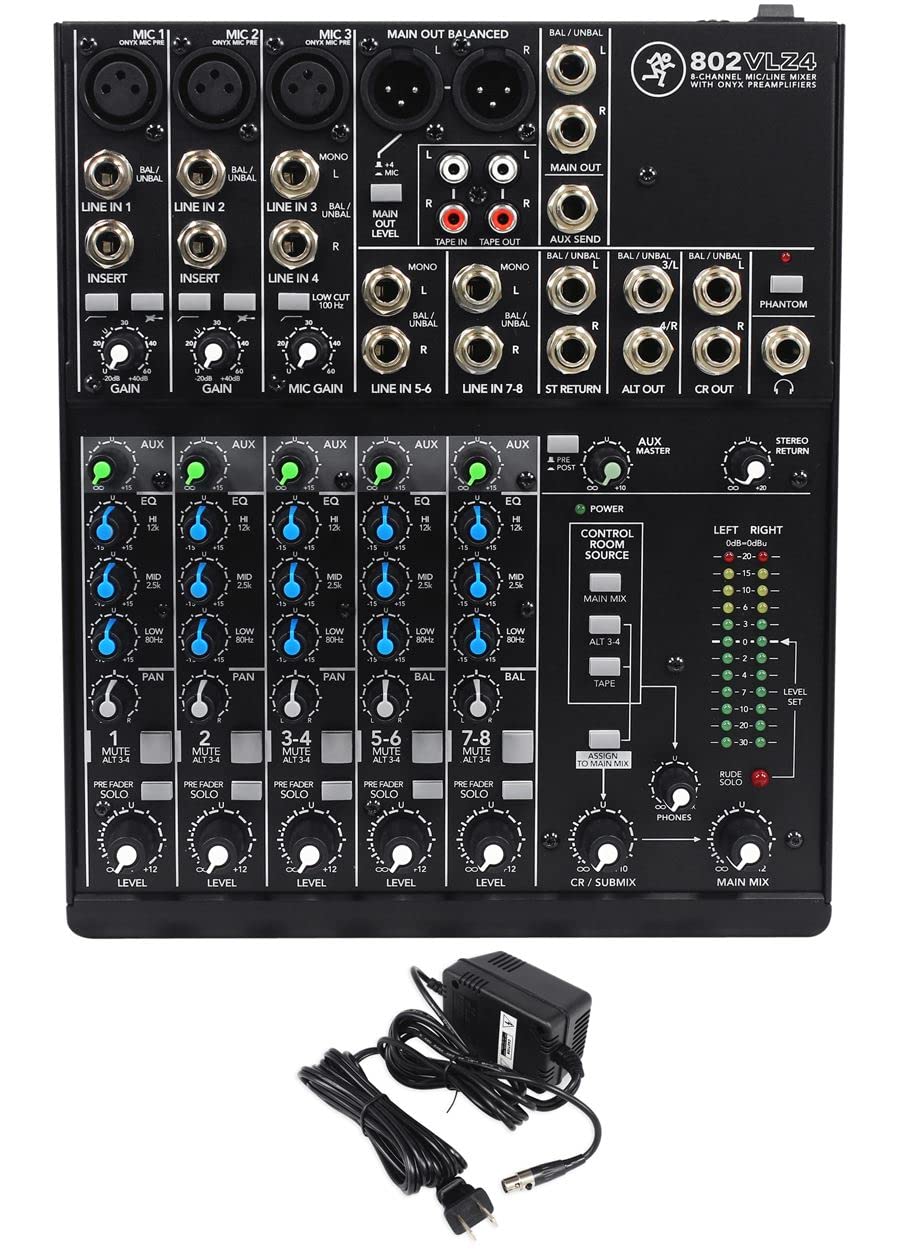
The 802VLZ4 embodies Mackie’s reputation for bombproof build quality in a compact analog format. The all-metal chassis and sealed rotary knobs resist the wear of regular transport, while the Onyx preamps deliver 60dB of gain range with a clean, focused midrange that vocalists and podcasters appreciate. The improved RF rejection on this VLZ4 generation makes it particularly suited for broadcast applications where interference can ruin a take.
With 8 total inputs (3 mono XLR with preamps plus stereo line channels), this mixer offers enough headroom for a duo with backing tracks or a small podcasting setup. The 3-band EQ per channel with a sweepable mid on the mono inputs allows for precise vocal tuning. The aux send with pre/post switching enables flexible monitor routing, and the balanced XLR outputs deliver a clean signal even over long cable runs to powered speakers.
The compact footprint — 12.1 inches wide by 4.3 inches tall — means it fits on a small desk or in a shallow rack case. The outboard power brick keeps heat and noise away from the audio circuitry, but the 12V adapter is specific to this model, so losing it means ordering a direct replacement. Users note that the plastic knobs can feel slippery under sweaty fingers, though the markings remain legible over years of use.
Why it’s great
- Rock-solid all-metal construction survives touring conditions
- Onyx preamps offer wide gain range with low noise
- Improved RF rejection for interference-free broadcast use
Good to know
- Proprietary 12V power adapter must be replaced with genuine part
- Knobs lack center detents on EQ bands
- No USB audio interface built-in
5. Mackie 164VLZ4

The 164VLZ4 is a large-format analog rack mixer designed for venues and installs that demand 16 channels of hands-on control without the complexity of digital menus. Its 10 Onyx mic preamps with the extended 60dB gain range handle everything from quiet acoustic guitar to loud drum overheads with consistent clarity. The three-bus architecture (main mix plus two subgroups) allows grouping of drums or backing vocals for quick level changes.
The channel strips include 3-band EQ with sweepable mid, a mute button, and an instrument input that eliminates the need for external DI boxes when connecting guitars directly. The +4/-10 operating level control on line inputs allows seamless integration with both professional (+4dBu) and consumer (-10dBV) gear. The LED metering is accurate and visible from across a stage, giving you immediate visual feedback on signal levels.
Weighing 18.2 pounds, this mixer is heavy enough that permanent rack installation is more practical than frequent transport. The outboard power supply design means you can rack the mixer without worrying about internal transformer hum, but the power connector is non-standard, so keeping a spare brick in your kit bag is wise. Users consistently note that the build quality exceeds what the price suggests, though the headphone monitoring cannot be set independently of the main mix.
Why it’s great
- 10 Onyx preamps handle a wide range of sources with low noise
- 3-bus architecture enables flexible subgroup routing
- Instrument inputs eliminate DI box clutter on stage
Good to know
- Heavy chassis makes it best suited for permanent rack installs
- No built-in effects or USB audio interface
- Headphone monitoring cannot be decoupled from main mix
6. Behringer X32 RACK

The X32 RACK condenses the full power of the X32 ecosystem into a 3U rack unit that handles 40 input channels with 25 mix buses. The 16 Midas-designed preamps are the same circuits found in the full-sized console, delivering the same sonic quality that has made the X32 a standard in houses of worship, theaters, and touring rigs. This is the unit you choose when you need mixing-board-level routing and processing but lack the physical space for a full console surface.
The 32×32 USB audio interface allows true multitrack recording and playback, making it practical for both front-of-house mixing and streaming simultaneously. The built-in effects suite includes 8 stereo effects slots with high-quality reverbs, delays, and modulation processors that eliminate the need for external rack gear. Remote control via iPad/iPhone apps is responsive and reliable when the built-in WiFi is paired with an external access point.
Setting up the X32 RACK for a production requires a tablet or laptop — there are no physical faders, so you must bring a control surface or learn the mobile app workflow. The fan noise is noticeable in quiet spaces, so locate it away from audience areas or isolate it in a machine room. Engineers who need physical faders can route the X32 RACK via AES50 to a remote digital snake or control surface.
Why it’s great
- Full X32 processing power in a space-saving 3U rack package
- Midas preamps deliver consistently high-quality sound across all 16 channels
- 32×32 USB interface handles multitrack recording for live streams
Good to know
- Fan noise is audible and may require remote mounting in quiet venues
- No physical faders — full reliance on tablet or control surface
- Requires an external WiFi router for reliable remote control
7. Zoom LiveTrak L-20

The Zoom L-20 sits in a unique niche as a rack-mountable mixer that doubles as a 22-track standalone recorder. Recording 20 individual tracks (plus stereo master) directly to an SD card at 24-bit/96kHz means you can capture rehearsals and shows without any computer involved. The preamps achieve -128dBu EIN with up to +60dB of gain, providing enough clean headroom for ribbon microphones and quiet sources.
The six independent monitor mixes with individual headphone outputs are a standout feature for band rehearsals — each musician hears a personalized mix without buying a separate monitoring system. The onboard effects include 20 editable presets covering reverb, delay, chorus, and compression, though the compressor adds a noticeable volume increase when engaged, requiring fader compensation. The USB audio interface supports 20-channel streaming to a DAW for live broadcast setups.
The build quality is road-ready with a metal chassis and recessed connectors, but the weight listed at 0.61 pounds in the specs is clearly a typo — this unit has substantial heft and will fill a 4U rack case. The fader layout works well for seated operation but can be cramped when racked at standing height. Users report that transferring multitrack files to a computer requires renaming folders, adding an extra step to the post-show workflow.
Why it’s great
- 22-track standalone recording to SD card without a computer
- Six independent monitor mixes for band members
- -128dBu EIN preamps deliver clean gain for quiet sources
Good to know
- Compressor gain staging requires active fader compensation
- Multitrack file transfer requires manual folder renaming
- 20 channels include 2 stereo inputs, not 20 individual mono inputs
8. Allen & Heath CQ-18T

The CQ-18T differentiates itself from the CQ-20B by adding a 7-inch capacitive touchscreen and dedicated rotary encoders, enabling standalone operation without a tablet. The color display shows channel metering, EQ curves, and routing all at once, and the auto-mixing algorithm borrowed from its larger siblings manages gain for up to 16 open mics simultaneously. The 4 FX engines run concurrently with separate reverb, delay, modulation, and compression processing.
The three custom SoftKeys and three SoftRotaries can be assigned to any parameter for instant access during a show — useful for calling up a scene, toggling mute groups, or adjusting monitor mixes without diving through menus. The 24×22 USB interface and SD card recording provide redundant capture options, and the built-in dual-band WiFi automatically selects the clearest channel to maintain tablet control. The preamps sound identical to the CQ-20B, which is a high compliment — warm, clean, and reliable.
The 10.3-pound weight and 3.5-inch depth make this one of the most portable full-featured digital mixers on the market. However, the same output-specific mute limitation applies here as on the CQ-20B — muting a group affects all aux sends and main outputs identically. The 7-inch screen is vibrant and responsive, but direct sunlight can make it difficult to read during outdoor gigs.
Why it’s great
- 7-inch touchscreen enables full mixer operation without a tablet
- 4 simultaneous FX engines with independent processing
- Customizable SoftKeys and SoftRotaries for show-specific controls
Good to know
- Mute groups are not output-specific, limiting monitor mix flexibility
- Touchscreen legibility reduces in direct sunlight
- No physical channel faders for quick mixing adjustments
9. Rockville RPM80BT

The RPM80BT is a powered analog mixer that delivers 500W RMS (250W per channel at 8 ohms) directly through its amplifier outputs, making it a complete portable PA solution in a single rack unit. The built-in Bluetooth receiver allows wireless audio streaming from phones or tablets for background music or backing tracks without additional cabling. Eight XLR inputs plus eight 1/4-inch line inputs give you 16 total input sources, matching the channel count of mixers many times its price.
The 5-band master EQ provides broad tonal control over the speaker outputs, and individual channel bass and treble knobs let you shape each source before it hits the master bus. The built-in effects include echo and delay with adjustable parameters, which add vocal ambience without external processors. The MP3 player and USB port provide additional playback options, and the fan-ventilated cooling ensures the amplifier section runs reliably during long rehearsals.
The build quality reflects its entry-level price point — the plastic knobs and lightweight chassis feel less robust than the metal-bodied Mackie or Yamaha units. The amplifier section introduces a slight hiss at idle that becomes audible with efficient speakers. Users report that the Bluetooth range is adequate for a small room but drops out at 30 feet or through walls. This mixer works well for rehearsal spaces, small karaoke setups, or as a budget backup unit, but the noise floor and build quality make it unsuitable for critical recording or professional touring.
Why it’s great
- Integrated 500W amplifier eliminates the need for separate power amp
- Bluetooth streaming for wireless audio from phones or tablets
- 16 total inputs provide ample connectivity for its price class
Good to know
- Amplifier hiss is audible at idle with efficient speakers
- Plastic knobs and lightweight chassis feel less durable
- Bluetooth range drops significantly beyond 30 feet
FAQ
Can a rack mixer replace my full-sized analog board for live shows?
Do I need a separate amplifier with an unpowered rack mixer?
What is the difference between Midas preamps and standard preamps?
How do I connect in-ear monitors to a rack mixer?
Final Thoughts: The Verdict
For most users, the best 19 rack mixer winner is the Behringer XR18 because it packs 16 Midas preamps, 18×18 USB interface, and full digital processing into a compact stagebox form factor at an accessible price. If you need six independent monitor mixes with standalone multitrack recording, grab the Zoom LiveTrak L-20. And for pro touring or install work requiring 40-channel flexibility, nothing beats the Behringer X32 RACK.