
The clunk of a mechanical switch, the glowing amber of a CRT, and the simple challenge of a pixelated bat and ball. That tactile, analog era of gaming is not just nostalgia—it’s a specific technical experience that modern emulators often sanitize. Choosing the right gateway back to this woodgrain-and-joystick frontier means navigating a minefield of emulation accuracy, cartridge compatibility, and controller feel.
I’m Min — the co-founder and writer behind Gadgets Feed. I’ve spent countless hours dissecting the technical specifications, reading hundreds of user reports on emulation quirks like screen tearing and paddle lag, and mapping the real-world compatibility of these retro revival consoles against the authentic 1970s experience.
Whether you want to blow dust off original cartridges or discover the genre-defining games of the first console war, this guide dissects the hardware to help you find the perfect set of 1970s video game systems for your modern entertainment center.
How To Choose The Best 1970s Video Game Systems
The category splits into two distinct camps: original hardware that uses a real cartridge slot and modern re-releases that emulate the games on a chip. Your choice determines everything about the experience, from the weight of the console in your hand to whether your favorite Activision cartridge will even boot up.
Cartridge Compatibility vs. Built-In Libraries
The single biggest decision is whether you own a physical collection of 2600 or 7800 cartridges. Systems like the Atari 2600+ and Hyperkin RetroN 77 require a working cartridge to play a game. This is the purest path but introduces failure points: dirty contacts, dead chips, and finicky slot tolerances. The Atari Flashback 12 Gold and Gamestation Go skip the slot entirely, loading 130 to 200+ games from internal memory—perfect for immediate play but forever locked to the pre-selected library.
Emulation Accuracy and the “Stella” Factor
Nearly all modern retro consoles run the open-source Stella emulator. The specific version of Stella onboard determines which games work. The Hyperkin RetroN 77 allows you to swap the SD card with different Stella builds to fix glitchy paddle games or finicky Parker Brothers titles. The Atari 2600+ and 7800+ rely on firmware updates from Atari to improve compatibility. A console that cannot be firmware-updated runs a real risk of leaving 10–20% of your favorite cartridges unplayable.
Controller Feel: Original vs. Wireless
The CX40 joystick is iconic because of its spongy throw and stiff fire button. The Atari 2600+ includes a recreated CX40+ that nails this feel. The Atari 7800+ ships with a wireless gamepad that reviewers universally found too small for adult hands, requiring a two-finger grip for the dual buttons. The Atari Flashback 12 Gold uses wired sticks with looser tension. If paddle games like Kaboom or Warlords are essential, verify paddle support explicitly—some consoles treat paddles as an afterthought.
Quick Comparison
On smaller screens, swipe sideways to see the full table.
| Model | Category | Best For | Key Spec | Amazon |
|---|---|---|---|---|
| Atari 2600+ | Premium | Cartridge purists | HDMI up to 4K | Amazon |
| Atari 7800+ | Premium | 2600 & 7800 owners | 1080p HDMI output | Amazon |
| Atari Gamestation Go | Mid-Range | Portable & HDMI play | 7-inch built-in display | Amazon |
| Atari Flashback 12 Gold | Mid-Range | Plug-and-play libraries | 130 built-in games | Amazon |
| THE400 Mini | Mid-Range | Computer emulation | 128 MB storage, Wi-Fi | Amazon |
| Hyperkin RetroN 77 | Mid-Range | Cartridge compatibility | 720p upscale, SD slot | Amazon |
| Atari 2600 Renewed | Budget | Authentic vintage feel | Original 4-switch model | Amazon |
In‑Depth Reviews
1. Atari 2600+

The Atari 2600+ nails the balance of modern convenience and authentic hardware behavior. The 4-switch woodgrain shell is slightly smaller than the original but retains the satisfying clunk of the power switch and the glowing red LED. It outputs over HDMI at up to 4K resolution, which dramatically sharpens the pixel grid without introducing smoothing filters that ruin the aesthetic.
Cartridge compatibility is strong for 2600 games out of the box, but the included firmware v1.0.0 is known to block many 7800 titles. The fix is simple: update to v2.0.1.4 via the Atari website using a USB flash drive. Once updated, it plays the vast majority of original cartridges, including Activision and Parker Brothers releases, with accurate emulation based on the Stella core.
The CX40+ joystick is the star—identical size, throw, and button tension to the 1977 original. The 10-in-1 game cartridge included provides a solid starter library including Adventure, Combat, and Missile Command. The only knock is that the wireless CX40+ is sold separately; the wired unit is excellent but tethering limits placement flexibility in a modern living room setup.
Why it’s great
- True-to-original CX40+ joystick feel
- HDMI up to 4K with no smoothing
- Firmware-updateable for broad cart compatibility
Good to know
- Requires immediate firmware update for 7800 games
- No wireless controller included at this tier
- Does not include a USB power adapter
2. Atari 7800+

The Atari 7800+ is essentially the 2600+ with an upgraded emulation core and a wireless controller. It plays both 2600 and 7800 cartridges natively, making it the best single-box solution for collectors with a mixed library. The HDMI output is capped at 1080p, which is perfectly adequate for the 320×200 resolution of most 7800 titles and avoids the blurring that can occur with 4K upscaling on basic hardware.
The pack-in Bentley Bear’s Crystal Quest is a genuinely fun new sequel to Crystal Castles, with power-ups and hidden paths that show the 7800 hardware still has creative legs. However, the included wireless gamepad is a weak point—the button layout forces a two-finger grip that feels cramped for adult hands. The separately sold wireless CX40 joystick is a far better ergonomic choice.
Build quality is solid, matching the 2600+ in weight and premium feel. Emulation accuracy is excellent after firmware updates; reviewers reported that all tested 2600 games worked, including finicky Activision titles like Double Dragon. The new Atari+ platform ensures that future cartridge releases will work across both the 2600+ and 7800+.
Why it’s great
- Plays both 2600 and 7800 cartridges
- Bentley Bear’s Crystal Quest is a strong pack-in
- Wireless out of the box
Good to know
- Included gamepad feels too small for adult hands
- No USB power adapter included
- Some 7800 games require firmware update
3. My Arcade Atari Gamestation Go
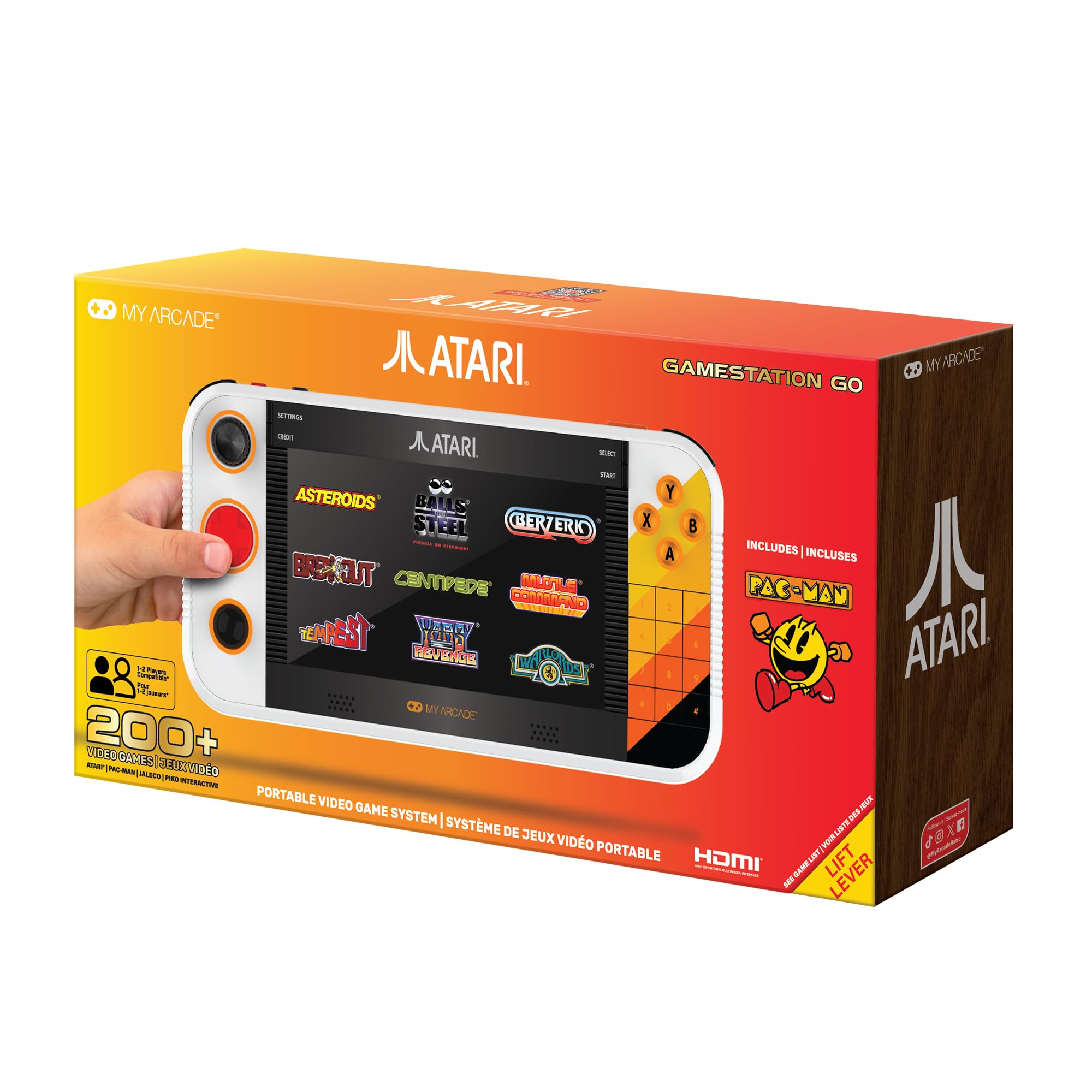
The Gamestation Go is a bold hybrid: a portable handheld with a 7-inch IPS display that also outputs over HDMI to a TV. It packs over 200 licensed games from Atari, Pac-Man, and Jaleco, spanning the 2600, 5200, and 7800 libraries. The built-in controls are unusually comprehensive, including a physical paddle wheel for Tempest, a trackball for Centipede, and a full D-pad and face buttons for platformers.
The SmartGlow technology lights up the specific controls required for each game, which sounds gimmicky but genuinely reduces the learning curve when jumping between a paddle game and a joystick game. The Wi-Fi capability enables over-the-air firmware updates, which have already fixed backlight bleed issues and improved vector game rendering since launch.
The microSD card slot allows for expansion with custom ROMs, though the directory structure must be exact. The rechargeable battery lasts for several hours of play. The biggest downside is the omission of key Activision titles like Pitfall and River Raid from the built-in library, though the SD card expansion provides a workaround for technically inclined users.
Why it’s great
- Large 7-inch screen for portable play
- Multiple control types (paddle, trackball, D-pad)
- TV output via HDMI and firmware-upgradeable
Good to know
- Missing Pitfall and other Activision classics
- SD card expansion requires specific formatting
- Initial firmware had screen ratio bugs
4. Atari Flashback 12 Gold
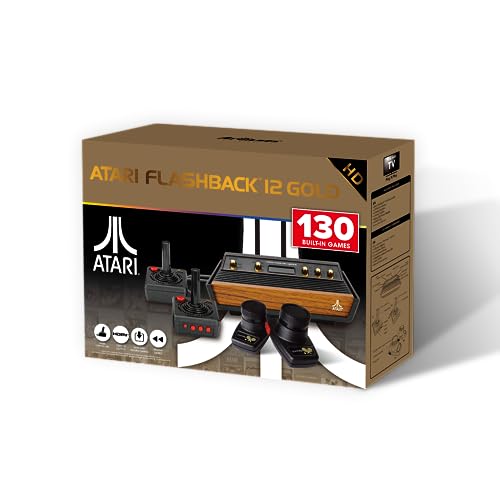
The Atari Flashback 12 Gold is the most straightforward path to retro gaming: plug it into an HDMI TV, connect the included wired joysticks, and play. The 130 built-in games include heavy hitters like Asteroids, Centipede, Missile Command, Pitfall, and River Raid. The Activision library alone makes this a compelling choice for casual players who don’t own cartridges.
The emulation is based on AtGames’ proprietary core, which is generally accurate for 2600 titles. The ability to load additional ROMs via USB is a nice bonus, though some games require the .bin format and may not work. The wired controllers are faithful to the original CX40 shape but have looser tension, which some players prefer for faster movements in games like Kaboom.
The major trade-off is build quality: the console is extremely light and the controller cords can flip it off a table if pulled taut. The paddle controllers are also too tight out of the box, requiring a manual loosening mod to be comfortable. For the price, the game library density is unmatched, making it an ideal entry point for introducing a younger generation to the 1970s arcade-via-living-room experience.
Why it’s great
- 130 games including Activision classics
- USB expansion for additional ROMs
- Wired paddles and joysticks included
Good to know
- Paddles too tight; require manual loosening
- Console is very light and slides with cord tension
- Joystick loose compared to original CX40
5. THE400 Mini
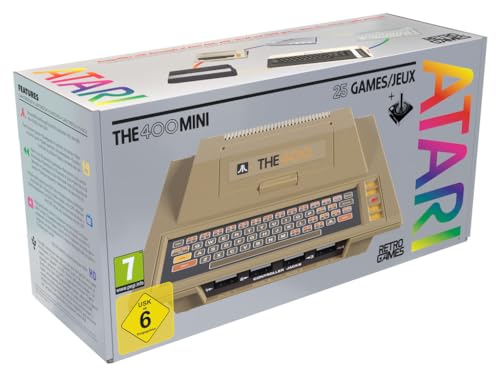
The THE400 Mini targets a specific niche: the Atari 8-bit home computer line (400, 800, 800XL) and the Atari 5200 console. This is not a 2600-focused device. It emulates the computer experience, meaning it can run BASIC programs and disk-based software in addition to cartridge games. The 128 MB of internal storage and Wi-Fi connectivity allow for easy sideloading of game images and homebrew.
Setup takes about 15 minutes, and the emulation is highly accurate—reviewers reported successfully loading old BASIC programs typed from 1980s magazines. The included controller is a replica of the iconic Atari 400 joystick, and the HDMI output at 720p presents the 8-bit graphics clearly. The Wi-Fi enables straightforward firmware updates and game downloads.
The limitation is the number of built-in games: it ships with a modest selection, and adding more requires a USB drive and some technical steps. The lack of a built-in keyboard also limits the authentic computer experience, as the physical membrane keyboard of the original 400 was a defining feature. This is a system for dedicated Atari computer fans, not casual 2600 players.
Why it’s great
- Accurate Atari 8-bit computer emulation
- Wi-Fi for easy updates and sideloading
- Can run BASIC programs and disk software
Good to know
- Small built-in game library
- No physical keyboard for full computer feel
- Does not play Atari 2600 cartridges
6. Hyperkin RetroN 77

The Hyperkin RetroN 77 is the tinkerer’s choice. It runs the open-source Stella emulator, and the included SD card slot allows you to swap Stella versions to fix compatibility issues. Reviewers report that while 80-90% of the 2600 library works out of the box, switching from Stella 6.6 to Stella 6.5.1 resolves paddle game glitches and enables finicky titles like Kaboom to run without screen tearing.
The HDMI output upscales to 720p with a clean picture and a button on the console lets you toggle between 4:3 and 16:9 aspect ratios. The save state feature is a modern blessing—you can create checkpoints in the middle of notoriously hard games like Pitfall II. The included joystick has dual fire buttons and a generous 10-foot cable.
Build quality is the weakest point: the cartridge slot is made of hard plastic that can struggle with some carts, and the overall chassis feels fragile compared to the Atari-branded consoles. Some special chip games won’t load from the cartridge slot at all but can be played as ROMs loaded from the SD card. This is the best console for someone who wants deep control over the emulation environment, not a plug-and-play appliance.
Why it’s great
- Swappable SD card for different Stella builds
- Save state support for checkpoints
- Works with original joysticks and paddles
Good to know
- Brittle cartridge slot can reject some carts
- Requires firmware swapping for full compatibility
- Build quality feels less robust than competitors
7. Atari 2600 Video Computer System (Renewed)

This is the real deal: a renewed, original 4-switch Atari 2600 from the late 1970s/early 1980s. It uses the original hardware, meaning there is zero emulation, zero input lag, and zero digital upscaling. The RF output connects to older TVs or requires an adapter for modern displays. The woodgrain finish and mechanical switches deliver a tactile authenticity no modern reissue can replicate.
The renewal process includes a new power supply and a through cleaning, and reviewers consistently report units arriving in near-mint condition. This is the only option on this list that guarantees 100% compatibility with every 2600 cartridge ever manufactured, because it is the original hardware that those carts were designed for. No firmware updates, no emulation quirks, no Stella version management.
The massive caveat is the video connection. Most modern TVs lack the RF input this console requires. You will need an RF-to-HDMI converter or an old CRT television. The picture quality will be soft, noisy, and authentically 1970s—which is exactly the goal for purists. This is not a convenient daily driver, but it is the only path to the genuine pre-digital gaming experience.
Why it’s great
- 100% original hardware compatibility
- Zero emulation lag or glitches
- Authentic woodgrain and mechanical switches
Good to know
- RF output only; requires adapter for modern TVs
- Picture quality is soft and noisy
- No save states or modern convenience features
FAQ
Will the Atari 2600+ play all my original cartridges?
Can I use original Atari joysticks with a modern HDMI console?
What is the difference between the Atari 2600+ and the Atari 7800+?
Final Thoughts: The Verdict
For most users, the 1970s video game systems winner is the Atari 2600+ because it delivers the most authentic cartridge-playing experience with modern HDMI convenience and upgradeable firmware. If you want a massive built-in library and portable play, grab the My Arcade Atari Gamestation Go. And for the absolute purest vintage experience with zero emulation, nothing beats the renewed Atari 2600 on its original hardware.