
The glow of a CRT monitor, the satisfying click of a joystick gate, and the immediate pick-up-and-play feedback loop defined a generation of arcade and home gaming. That specific tactile and visual signature is what separates the genuine 1980s electronic games experience from modern retro remakes, and finding a faithful recreation of that era requires navigating a minefield of poor emulation and undersized controls. Whether you are hunting the exact feel of an Atari 2600 paddle or the tight D-pad of a classic handheld, the choices today range from micro-sized keychains to full-sized plug-and-play consoles.
I’m Min — the co-founder and writer behind Gadgets Feed. This guide is built on countless hours of market research, comparing build quality across different form factors, and poring over real user feedback to separate the genuine arcade-accurate hardware from the frustratingly undersized alternatives in this specific niche.
If authentic joystick tension, paddle controller accuracy, and crisp pixel-mapped displays define the quality you are after, then this analysis of the best 1980s electronic games will pinpoint the one device that truly delivers the arcade room feeling on your modern TV or in your hands.
How To Choose The Best 1980s Electronic Games
Not all retro hardware is created equal. A unit that nails the visual aesthetic can fail spectacularly on input latency or controller ergonomics. You need to match three specific criteria: the form factor (handheld, mini cabinet, or console), the input method (joystick, paddle, D-pad), and the game library curation (official licensing versus random ROM dumps).
Controller Accuracy and Form Factor Ergonomics
The physical controls are the make-or-break element. A unit that is too small for adult hands will make games unplayable within minutes. Look for joystick throw that mimics the original arcade’s resistance, and avoid paddle controllers that feel too tight or loose. The 4.8-inch tall My Arcade Nano Player is a collectible piece, while a 7-inch device like the Gamestation Go offers proper spacing for adult fingers.
Display Quality and Emulation Fidelity
A 2.4-inch screen on a keychain unit is acceptable for quick bursts, but for serious play you want at least a 2.8-inch IPS panel with 320×240 resolution, or a 720p HDMI output on a TV-connected console. Emulation quality matters more than the raw number of preloaded games. Poor emulation introduces screen tearing, wrong aspect ratios, and missing scanlines that ruin the 240p look of original 1980s titles. Look for units that allow integer scaling or firmware updates to fix early bugs.
Game Library and Expandability
An officially licensed library from Atari or Taito guarantees you get the authentic ROMs with correct sound and behavior. Units that rely on unlicensed ROM dumps often include duplicates, foreign language titles, or games that crash on launch. Consider whether the device supports microSD expansion or USB sideloading to add your own legally obtained ROMs, which dramatically extends its lifespan beyond the preloaded titles.
Quick Comparison
On smaller screens, swipe sideways to see the full table.
| Model | Category | Best For | Key Spec | Amazon |
|---|---|---|---|---|
| My Arcade Atari Gamestation Go | Premium Handheld | Arcane Authenticity | 7-inch IPS Display | Amazon |
| Atari Flashback 12 Gold | TV Console | Atari 2600 Library | 720p HDMI Output | Amazon |
| ANBERNIC RG353V | Dual-Boot Handheld | Expansive Emulation | 640×480 IPS Touchscreen | Amazon |
| Super Pocket Atari Edition | Compact Handheld | Portable Build Quality | 2.8-inch IPS Screen | Amazon |
| Hasbro Power Rangers LCD | Retro LCD Handheld | 90s Nostalgia Packaging | LCD Segment Display | Amazon |
| XEVIOUS 7800 | Cartridge Game | Original Console Owners | Atari 7800 Cartridge | Amazon |
| My Arcade Space Invaders Nano | Keychain Arcade | Desk Display Collectible | 2.4-inch Color Display | Amazon |
In‑Depth Reviews
1. My Arcade Atari Gamestation Go
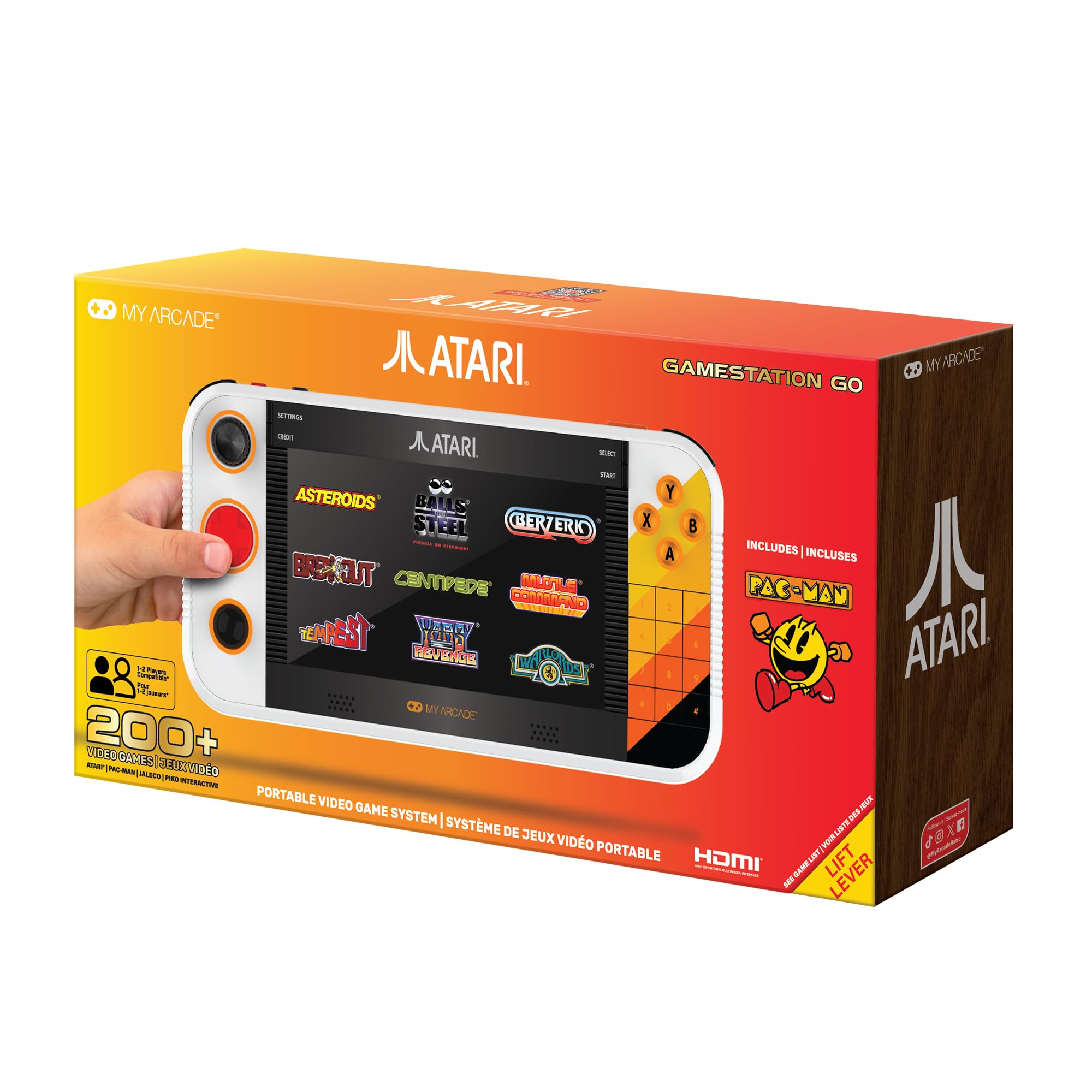
The Gamestation Go is the most ambitious attempt yet to capture the full arcade experience in a portable form. Its 7-inch full-color display dwarfs every other handheld on this list, providing enough real estate to actually read the score digits in Tempest and register enemy movement in Missile Command. The integrated paddle, D-pad, and trackball give you the correct input method for each of the 200+ preloaded games, and the SmartGlow technology illuminates the controls you need for the specific title you are playing.
Under the hood, the unit supports Wi-Fi for firmware updates—which have already fixed early backlight bleed issues and improved vector game emulation—plus HDMI output to a TV at full 720p resolution. The fold-out stand means you can play a round of Pong Video Olympics on a coffee table without holding the device. MicroSD expansion allows sideloading additional ROMs, dramatically extending the library beyond the officially licensed Atari, Jaleco, and PIKO titles.
The main tradeoff is the bulk: this is not a pocket-friendly device. It is also missing a few iconic titles like Pitfall and Frogger from the preloaded list, though firmware updates and SD card expansion mitigate that gap. For the most complete and correct 1980s electronic games experience in one box, this is the device to beat.
Why it’s great
- Genuine paddle, trackball, and D-pad inputs for arcade-accurate play.
- 7-inch IPS display with HDMI output for TV connectivity.
- Active firmware support fixing early emulation bugs.
Good to know
- Missing some major 2600 titles out of the box.
- Requires boot selection between SD card and internal memory.
2. Atari Flashback 12 Gold
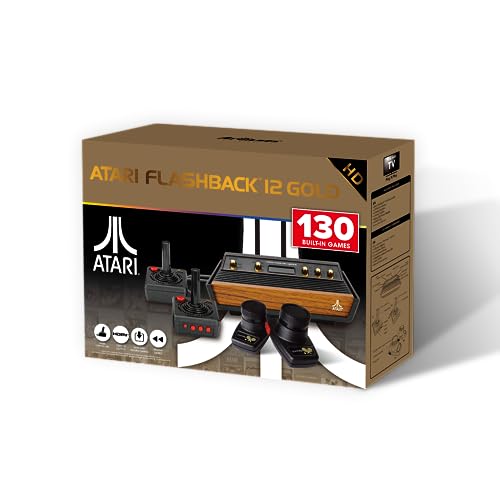
The Flashback 12 Gold is a dedicated mini console built specifically for HDMI TVs, delivering a 720p output that scales Atari 2600 and 7800 classics without the screen tearing or input lag common on cheaper HDMI adapters. It includes 130 built-in games covering Activision titles like Pitfall and River Raid alongside Atari staples Asteroids and Centipede. The wired joystick and paddle controllers are surprisingly faithful to the originals, though the joystick has a slightly looser throw than vintage hardware.
What elevates this above other plug-and-play units is the USB sideloading capability. You can add your own legally acquired ROMs via a USB flash drive, which compensates for any gaps in the curated game list. The save, load, and rewind functions are a genuine quality-of-life improvement for difficult shooters—being able to rewind a mistake in the middle of a Defender run removes the friction that might otherwise frustrate a modern player.
The main drawback is the paddle tension, which some users report as too stiff, causing hand fatigue during extended sessions of Warlords or Breakout. Additionally, the console is extremely lightweight, and the short controller cord can tug it off a shelf if you play at a distance. It remains the best option for someone who wants a dedicated 1980s Atari library on a big screen without fiddling with software configurations.
Why it’s great
- 130 official games including rare Activision titles.
- HDMI output at 720p with save/rewind functionality.
- USB sideloading for expanding the game library.
Good to know
- Paddle controllers are tight and can cause fatigue.
- Lightweight console moves easily with wired controller movements.
3. ANBERNIC RG353V

The RG353V is a dual-boot handheld running both Android 11 and Linux, offering the broadest compatibility of any device here. It emulates systems from the NES up through PlayStation 1, but for 1980s electronic games specifically, its accurate 4:3 aspect ratio 640×480 IPS multi-touch screen reproduces the correct pixel geometry of Atari 2600, ColecoVision, and arcade ROMs without stretching. The 2GB of LPDDR4 RAM ensures smooth performance even for 1980s arcade conversions that demand low latency.
The build quality is the standout feature here. The transparent purple casing has a premium weight and feel, the buttons are tactile and responsive, and the analog sticks are precise enough for games like Asteroids that benefit from subtle directional input. The RK3566 processor supports Moonlight game streaming from a PC, turning the handheld into a versatile multimedia device when you are not playing retro content. HDMI output allows connection to a TV, and Bluetooth 4.2 lets you pair a wireless controller.
The significant catch is the preloaded SD card situation. Many units ship with a 32GB or 64GB card that is loaded with duplicate titles, foreign language games, and sometimes corrupted files. The unit itself is excellent, but you should plan to source your own legally obtained ROMs and replace the included card to avoid crashes and freezes during mid-90s titles. For someone comfortable building their own game library, this is the most powerful 1980s emulation handheld available.
Why it’s great
- Accurate 4:3 IPS touchscreen at 640×480 for correct pixel mapping.
- Dual OS gives flexibility for different emulation frontends.
- Premium build with responsive controls and HDMI output.
Good to know
- Preloaded SD card is unreliable with duplicates and corrupt files.
- Over half the factory games are obscure foreign titles.
4. Super Pocket Atari Edition

The Super Pocket Atari Edition is the goldilocks form factor for portable 1980s gaming—larger than a keychain but smaller than a full tablet, with a 2.8-inch IPS screen at 320×240 resolution that perfectly matches the pixel density of classic 8-bit sprites. It comes preloaded with 15 Technos arcade and console classics including Asteroids, Missile Command, and Berserk, and the 3.5mm headphone jack adds a layer of immersion that most handhelds in this price segment omit.
The standout design choice is the Evercade cartridge slot, making this compatible with over 60 Evercade cartridges that collectively hold more than 600 games. This expandability future-proofs the device far beyond its preloaded library. USB-C charging is standard, and the lithium-ion battery delivers roughly 4 hours of gameplay on a single charge. The red transparent shell has a collectible feel without sacrificing durability, and the button layout is comfortable for adult hands despite the compact profile.
The main limitation is the preloaded count of only 15 games out of the box, which might feel sparse to someone expecting dozens of titles. Additionally, the Evercade ecosystem requires purchasing separate cartridges at roughly each to build a meaningful library. For someone who values build quality and expandability over raw preloaded quantity, this is the most refined portable option in the mid-premium tier.
Why it’s great
- Sharp 2.8-inch IPS screen with correct aspect ratio.
- Evercade cartridge slot for massive library expansion.
- USB-C charging with headphone jack support.
Good to know
- Only 15 games preloaded; extra cartridges sold separately.
- Collectible packaging may arrive damaged.
5. Hasbro Gaming Tiger Electronics Power Rangers LCD

This retro-inspired Tiger Electronics handheld is a deliberate time capsule to the LCD segment-display era of the late 1980s and early 1990s. The screen uses a fixed LCD overlay to display the Red Ranger fighting through five stages against Rita Repulsa’s minions. This is not an emulated experience—it is a faithful recreation of the original Tiger LCD play pattern, with single-button martial arts attacks and Dinozord transformations triggered by pressing the correct inputs at the right time.
The build quality is surprisingly robust for a LCD unit. The white plastic casing has held up against drops, crayon marks, and general wear and tear according to owners. The screen has strong visibility with fresh alkaline batteries, and the single-player focus makes it a great screen-time alternative for kids who want the tactile feel of an old-school handheld without the complexity of modern mobile games. It requires 2 AAA batteries.
The visual limitations are inherent to the LCD segment technology—only specific pre-drawn sprites can appear, so there is none of the pixel freedom of a full LCD screen. The viewing angle is somewhat narrow, and some users find the screen hard to see in direct light. This is a gift for the collector or the parent who wants to share the specific Tiger Electronics experience, not for someone seeking an accurate video game recreation.
Why it’s great
- Faithful recreation of the original Tiger LCD game experience.
- Durable build that withstands drops and rough play.
- Simple single-button controls ideal for young players.
Good to know
- LCD segment screen has narrow viewing angles and limited visibility.
- Only one playable character with no save states.
6. XEVIOUS 7800
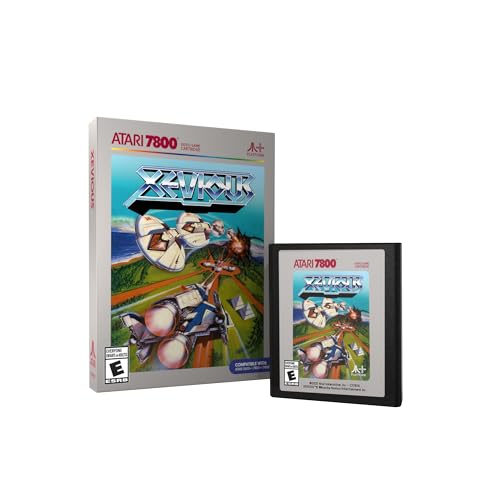
XEVIOUS 7800 is a faithful reproduction of the 1986 launch title for the Atari 7800 console, offering a direct cartridge-only experience for anyone who still owns the original hardware. This is a scrolling shooter where you pilot the Solvalou fighter through airborne and ground-based enemy formations, using the Zapper for air targets and the Blaster bomb for ground forces. The resolution is native 240p, exactly as the original hardware outputs, meaning it will look pixel-perfect on a CRT or through a quality upscaler on a modern display.
The Atari Plus platform ensures backward and forward compatibility, meaning this cartridge works on original 7800 consoles as well as the newer 7800+ hardware with the integer mode firmware update that smooths out scrolling. The packaging includes a full-color manual with the original lore, which adds significant collector value for anyone building a complete 7800 library. It is manufactured by Plaion under the Deep Silver brand, ensuring proper tray plastic and label quality.
This is not a standalone game—it requires an Atari 7800 console to play. It also lacks the save or rewind features that modern mini consoles offer, so you are playing the game exactly as it was in 1986, with no safety net. The difficulty curve is steep, with no continues, making it a challenge even for experienced shooter players. This purchase is for the purist who wants a genuine cartridge in their physical collection or for the 7800+ owner who wants a guaranteed working copy.
Why it’s great
- Official reproduction of a classic 1986 Atari 7800 launch title.
- Full forward/backward compatibility with Atari Plus ecosystem.
- Authentic 240p resolution for CRT or proper upscaling.
Good to know
- Requires a separate Atari 7800 or 7800+ console to play.
- No save states or rewind—purely original difficulty.
7. My Arcade Space Invaders Nano Player

The Space Invaders Nano Player is a 4.8-inch tall mini arcade cabinet that sits in the palm of your hand, featuring officially licensed Taito artwork and a 2.4-inch full-color LCD screen. It runs a single game—Space Invaders—with full-color vector-style graphics that are surprisingly crisp for the screen size. The joystick is a micro-switch style that registers cardinal directions, and the built-in speaker has volume control.
The unit is powered either by 4 AAA batteries or via USB-C, making it a flexible display piece that can sit on a desk for quick pick-up-and-play sessions. The cabinet dimensions are 3.4 x 4.8 x 3 inches, which is genuinely small for an adult’s hands. The controls work reliably for the single game, and the color display adds a modern polish to the pixel art while preserving the original gameplay loop of shooting descending alien formations.
The size is the limiting factor. The joystick can feel imprecise, registering diagonal inputs when you intend a straight direction. This is best understood as a collectible display piece with playable functionality, not a serious gaming device. It captures the aesthetic of a 1980s arcade cabinet in miniature form.
Why it’s great
- Officially licensed Taito artwork on a mini arcade cabinet.
- USB-C power option alongside AAA batteries.
- Full-color display with crisp sprite reproduction.
Good to know
- Too small for comfortable adult-sized hand gameplay.
- Joystick can register unintended diagonal inputs.
FAQ
Will an HDMI retro console look correct on a modern 4K television?
Can I add my own games to these consoles?
Why do the paddle controllers on some retro units feel too tight?
What is the difference between a LCD segment game and an emulated color LCD game?
Final Thoughts: The Verdict
For most users, the best 1980s electronic games winner is the My Arcade Atari Gamestation Go because its 7-inch screen, integrated paddle and trackball controls, and active firmware support deliver the most complete arcade-accurate experience across over 200 officially licensed titles. If you want a dedicated TV console with authentic wired controllers, grab the Atari Flashback 12 Gold. And for portable emulation with unmatched system compatibility, nothing beats the ANBERNIC RG353V.