
Our readers keep the lights on and my morning glass full of iced black tea. As an Amazon Associate, I earn from qualifying purchases.
Specs are compiled from manufacturer listings and verified buyer reviews and can change over time — please confirm the key details on the product page before buying.
If you are looking at 1 HP meat grinders, you probably have a freezer full of venison, a hog to break down, or a serious batch of sausage on the horizon. The real question is which 1 HP grinder can chew through your specific job without bogging down, overheating, or taking forever. This guide cuts through wattage games and marketing labels to reveal which machines actually earn their motor rating.
I’m Min — the founder and writer behind Gadgets Feed. This guide is built by comparing the manufacturers’ published specifications and the patterns across verified customer reviews, so you get each pick’s real strengths and trade-offs instead of marketing spin.
Because the term “1 HP” covers a wide range of real wattage, we matched machines that land in the 750W to 1100W range to find the genuine 1hp meat grinder worth your counter space.
Our Picks at a Glance

How To Choose The Best 1HP Meat Grinder
Before you buy, know that the motor rating alone won’t tell you how well a grinder performs. Two machines can both claim around 1 HP, yet one will tear through a deer while the other struggles with a pork shoulder. The real difference is how power is delivered through the gears, head size, and cutting plate setup.
Match the Grinding Head to Your Volume
The head size (often stamped like #12 or #22) is the real workhorse spec. A #12 head is the standard for home butchering and large family batches, while a #22 head is the territory of serious hunters or small farms and moves meat noticeably faster. A bigger head also means you can feed larger chunks without pre-cutting everything into tiny strips.
Look Past the Advertised Wattage
Motors often list a “max” or “locked” wattage that is far higher than what they use while actually grinding. Look for the rated power — the continuous load the motor can handle — and consider the metal of the gears. A grinder with metal gears and a circuit breaker is built to survive the occasional tough sinew or slightly frozen piece, where a plastic-geared unit might strip or stall.
Factor in Cleaning and Fiddly Bits
Cleaning, not grinding, is the chore that decides if a machine gathers dust. Look for grinding heads and plates that detach without special tools. A foot pedal frees both hands to manage casings during sausage stuffing, making it a small but significant convenience. Reverse clears a jam without disassembling the head, saving you time and frustration mid-batch.
Quick Comparison
| Model | Best For | Motor Power | Feed Rate | Head Size | Amazon |
|---|---|---|---|---|---|
| STX Megaforce 3000★ Best Overall | Big game & sausage kits | 800-1200W under load | 180-240 lbs/hr | #12 | Amazon |
| Sunmile SM-G50Compact Pick | Bone-in dog food prep | 350W rated / 1000W max | 200 lbs/hr | #12 | Amazon |
| Weston #12 (33-1301-W)Best Value | Yearly deer season workhorse | 750W | 4-5 lbs/min | #12 | Amazon |
| VEVOR 1100W | Bootstrapping a small business | 1100W | 550 lbs/hr | Large | Amazon |
| Barton #12 | Commercial-level home use | 1100W | High volume | #12 | Amazon |
| Tangkula 1100W | High-volume processing | 1100W | 551 lbs/hr | #22 | Amazon |
| ARINOO #12C | First-time large batch buyers | 650W rated / 1100W peak | High volume | #12 | Amazon |
| Weston Pro 10-1201-W | Raw dog food & chicken bone | 750W | 6-9 lbs/min | #12 | Amazon |
| Pro-Cut KG-22-W | Daily commercial output | 1 HP | 1,700 lbs/hr | #22 | Amazon |
In‑Depth Reviews
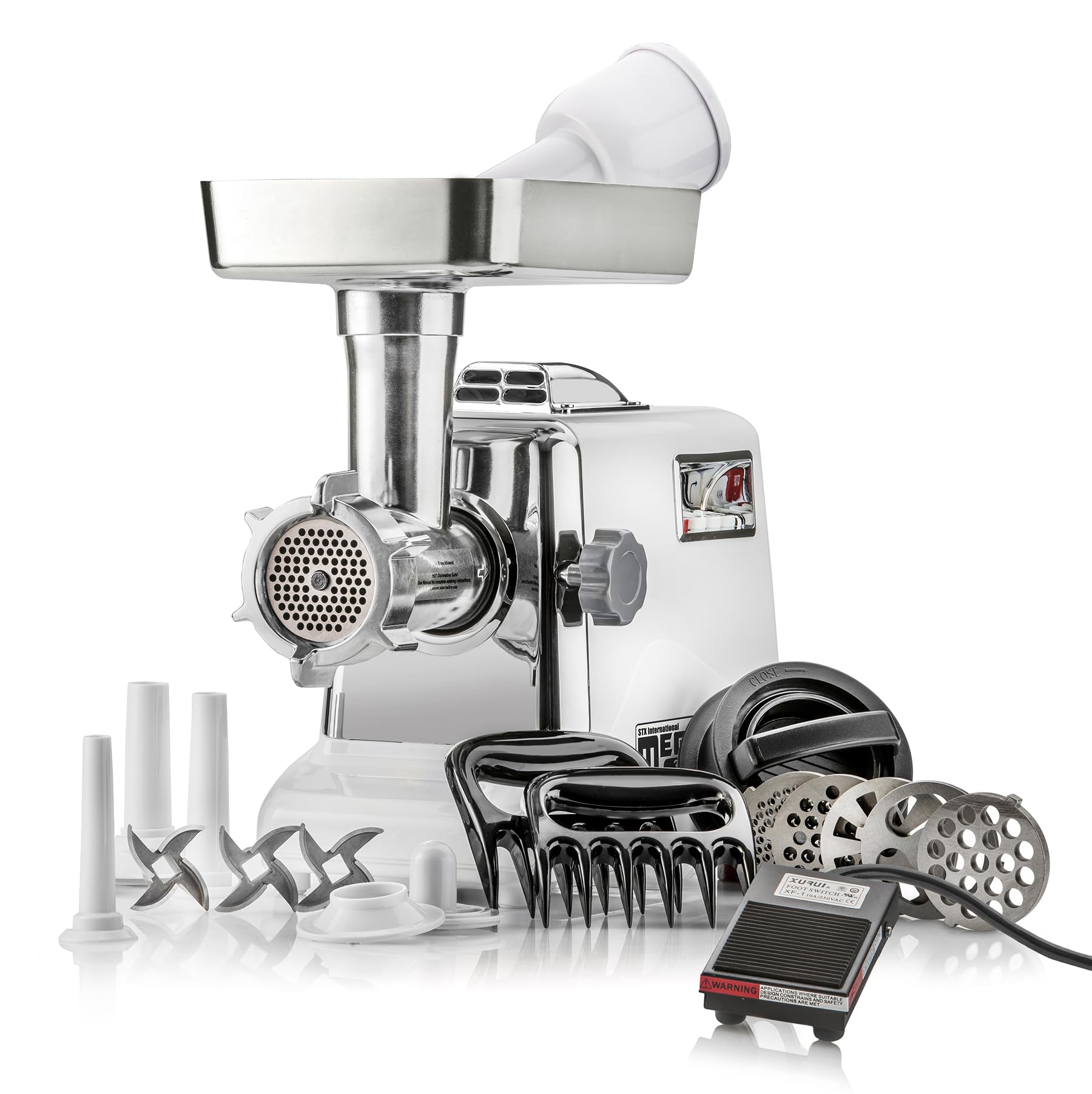
1. STX International Megaforce 3000
Our pick — over 4.5★ from 250+ verified ratings; the strongest balance of quality and price.
The all-accessory self-feeding beast that turns a deer into dinner without breaking a sweat.
The Megaforce 3000’s locked 3000W motor settles into a comfortable 800-1200W under load, which is why it keeps showing up in long-term owner stories. That reserve of power lets it chew through big chunks of meat, and because it self-feeds, you spend less time jamming the auger and more time watching it disappear. The oversized hopper holds about 3 lbs of prepped meat ready to go.
What makes this the top pick is the sheer completeness of the kit. You get a #12 grinding head, three stainless blades, five grinding plates, three sausage stuffing tubes, a kubbe attachment, and a foot pedal that owners say is a standout for one-handed stuffing. Buyers who have put it through years of deer and elk report it just keeps going without issues, and the grinding quality is consistently praised. The 9.75″L x 7.25″W footprint is also noticeably more compact than many rivals, leaving you more counter space.
The recurring gripe is the locking collar that holds the grinding plate — some units arrive with a ring that does not stay put, though customer service does step in to replace it. It is also a noise-level machine, not a quiet one, but owners say it is worth it. Consider it the best pick if you want one machine that grinds, stuffs, makes kubbe, and presses burgers.
The full package: It is hard to find another 1 HP-class grinder that ships with a foot pedal, burger press, and kubbe attachment for this price — and the 3-year warranty with parts and labor backs it up.
The honest catch: Do not feed it bones, tendons, or vegetables; the head is not designed for that and you will damage it.
Reach for this if: you want a single unit that handles the whole butchering day — grinding, stuffing, and pressing — without needing extra purchases.
Look elsewhere if: your plan is grinding through chicken bones for raw pet food; this one is strictly for meat.
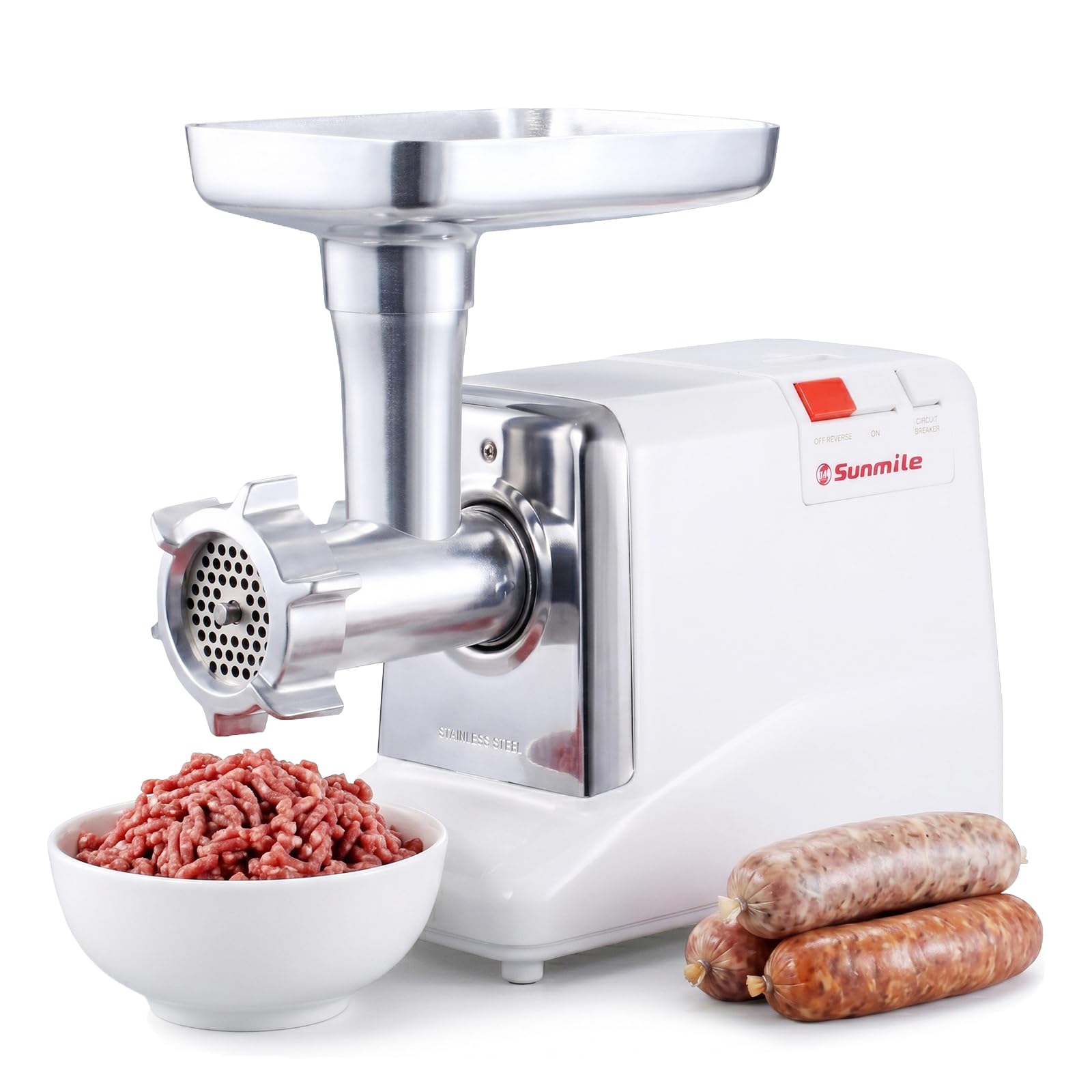
2. Sunmile SM-G50 ETL
The bone-crushing 1000W max that raw-dog-food owners swear by for chicken thighs.
The Sunmile SM-G50 is the machine that raw pet food makers have quietly adopted as their workhorse. Its 350W rated motor peaks at 1000W max locked power — enough to grind chicken thigh bones into a fine paste for cat and dog food without the motor laboring. The metal gearbox is the key durability feature, and buyers report running it for two years straight through chicken wings, legs, and even two whole moose over a six-hour session without overheating.
It is a true #12 head, not a dinky #5 or #8, so the tray and throat hold a generous load of meat. The design is nicely finished with an ON/OFF/Reverse switch, a circuit breaker to prevent motor burnout, and built-in storage for the cord and accessories. At 12.2″L x 11″W x 15.1″H, it is the most compact footprint of the mid-range picks, which matters if your counter doubles as a prep station. Owners who grind about 25 lbs of pork loin every 10 days say it does a great job and never gets bound up.
The trade-off is the size of the pieces you feed it. A regular user notes you have to cut pork into smaller pieces than with an older machine because the tube narrows at the bottom. It is also quite noisy, and the 34 durability mentions are mixed — likely from owners who pushed it past its comfort zone. For raw feeders and weekend batch grinders, though, it is an affordable alternative to the pricier pet-food-specific machines.
Raw food ready: Few grinders in this class will accept chicken bones without complaint, which makes this the pick for pet owners making their own food.
The smaller bite: Plan to pre-cut your meat smaller than you would with a pricier unit, and keep earplugs handy.
Buy it if: you are making raw pet food with bone-in poultry or grinding venison for the family, and you want a compact unit that stores its own parts.
Think twice if: you want to feed large meat chunks straight in without pre-cutting.
3. Weston #12 Electric Meat Grinder (33-1301-W)
A die-cast aluminum tank that handles five pounds of lamb on speed one without flinching.
The Weston #12 is the classic answer for the home butcher who wants a reliable machine that does not cost a fortune. Its 750W, 1 HP motor is paired with a die-cast aluminum body and metal gears, and the cam-action headlock makes connecting the grinding head a one-handed snap rather than a wrestling match. It is rated for 4-5 pounds per minute, which puts it firmly in the yearly-deer-batch class.
The two speeds are the smart feature here. The slow first speed is perfect for stuffing sausages without tearing the casings, while the fast speed handles straight grinding duty. The reverse function catches a jam before you have to disassemble the head. Owners who have used several grinders report it handled five pounds of lamb with ease right from the start on speed one, and the included coarse and medium stainless plates cover burgers and sausage. At 13.5 pounds and 15″L x 10″W x 10″H, it is light enough to haul from the garage to the kitchen sink relatively easily.
The lifespan is where opinions split. Some owners mention long-term reliability and bought a second one as a gift, while a few hit a sheared auger screw after heavy use on lean meat. The other warning is bones — it can mince bone-in chicken, but that is not what it is rated for, and forcing it will break the auger. Think of it as the honest value pick: great for meat, not for a bone-crushing regimen.
Countertop friendly: At just over 13 lbs, this is an easy machine to move around and clean, and the two-speed control makes sausage stuffing genuinely easier.
Not a bone grinder: Treat it to boneless meat and it will last; feed it hard bones and you risk the auger gear.
Choose it for: a straightforward, affordable workhorse for deer season, burger night, and making breakfast links on a countertop.
skip it if: your prep includes grinding through poultry bones on the regular.
4. VEVOR Commercial Meat Grinder

The 550 lb/hour stainless steel grinder that handles whole deer and small chicken bones.
The VEVOR is a serious step up in raw capacity. Its 1100W motor spins the cutting head at 193 r/min and is rated to grind up to 250 kg (550 lbs) of meat per hour, which puts it in a different league from the home-style #12 units. The wide 54 mm (2.1 inch) feeder tube means you do not need to pre-cut meat into small strips — a whole shoulder can go in with minimal prep. The all-stainless construction, from the outer casing to the blades, is rust-proof and wipes down easily.
Owners treating it like a commercial machine report impressive times: 20 lbs of meat processed in under five minutes, and a full 250 lbs of venison handled without the motor overheating or losing power. It is notably quieter than a 300W machine one owner replaced, with no slowdown even on a big Boston Butt. The versatility is also a plus — along with meat, it can grind fish, chili, and vegetables, making it useful beyond butchering day.
The real friction point is disassembly for cleaning. The nose is secured by three 10mm bolts, and some owners find they need an open-end wrench because a socket does not fit without modification. A few units have also arrived with missing parts and unresponsive customer service, so it is worth a careful unboxing inspection. This is a machine for the person who is bootstrapping a small business or processing for several families, not someone grinding two pounds of burger a week.
Serious throughput: With a 550 lbs/hr rating, you can clear a whole deer before the phone rings again.
Prep check: Cleaning requires a wrench and patience — this is a commercial tool, not a quick rinse-and-store appliance.
Built for: hunters processing multiple animals a season, or small food businesses that need consistent, fast output.
Not ideal if: you want a simple machine you can fully take apart with your bare hands for a quick wash.
5. Barton Commercial #12
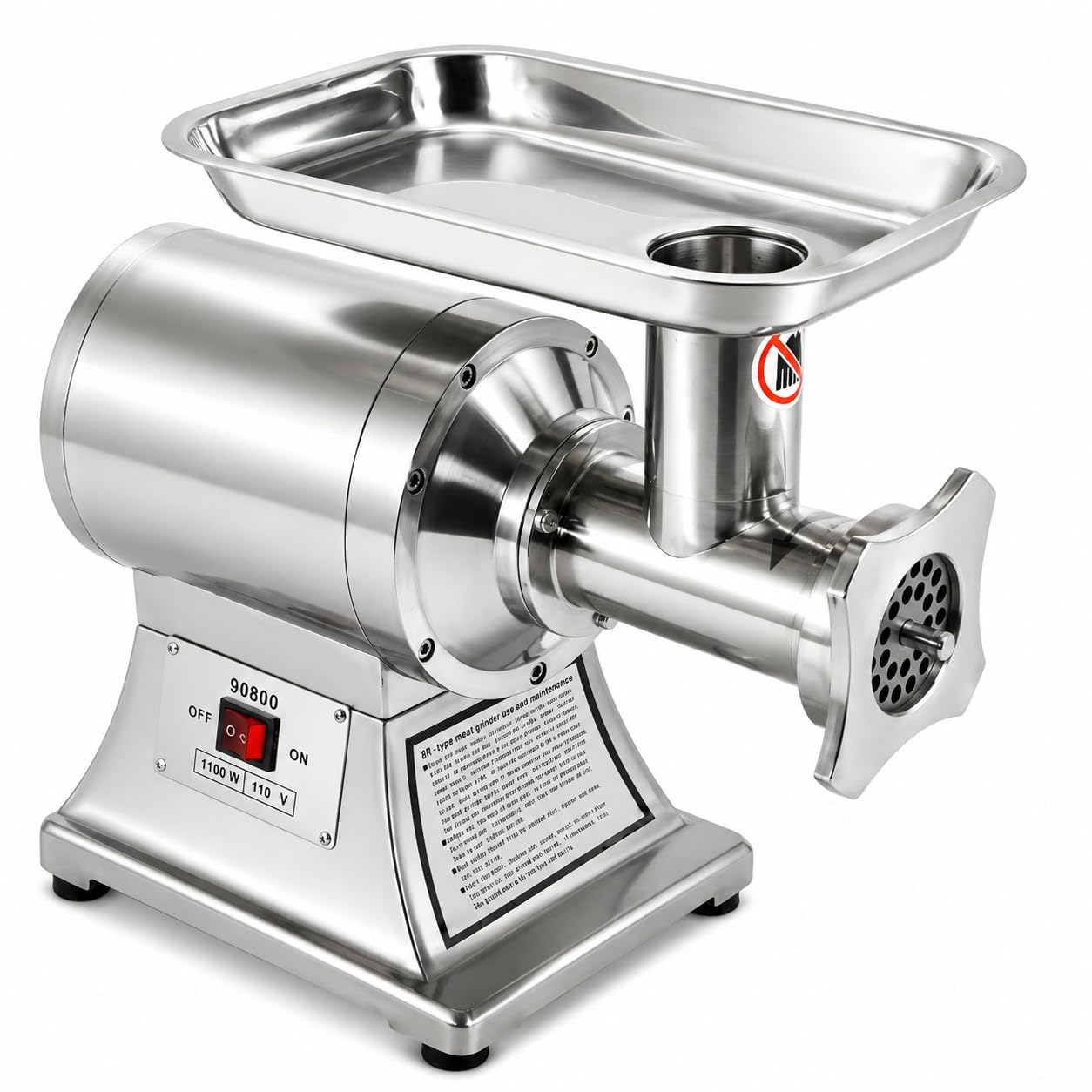
The 47-pound all-stainless workhorse that cuts rabbit bones like butter and never jams.
The Barton #12 leans straight into butcher-shop territory. Weighing in at 47 pounds, it has the heft that tells you exactly where the money went — a heavy-duty stainless steel body and an 1100W motor that owners describe as “lightning fast” processing elk and beef. The build quality is the top praise here, with buyers noting it outperforms grinders that cost twice as much and handles a full double-grind of two deer and a hog without binding. It is designed for home kitchens, restaurants, and butcher shops alike.
Speed is the defining trait. One owner processed 15 pounds of beef in minutes, and others report it chomps through meat at a rate that makes you double-check the clock. The food-grade stainless steel components keep meat quality high, and the whole thing disassembles without tools for a decent clean-up session. The included parts cover sausage stuffing, and the removable grinding head makes it viable for frequent meal prep.
The honest trade-offs are the weight and the cleaning. While the tool-free disassembly is a plus, the 23 mentions of weight are mixed — it is a struggle to lift and store, so it needs a permanent home. A few owners note the bolts thread poorly and can cross-thread if you are not careful, and deep cleaning requires an Allen wrench that is not included. For the serious hunter who wants a machine that feels like it belongs in a professional kitchen, this is it.
Butcher-shop feel: The 47 lbs of stainless steel and 1100W motor make this feel like a piece of professional equipment, not a kitchen gadget.
Permanent placement: You will not want to haul this one up and down from a high shelf — it needs counter or garage space.
Get this if: you process multiple large animals a year and want commercial-level speed and build without the commercial price tag.
Pass if: you are a casual grinder who needs to store the machine between uses; the weight will wear you out.
6. Tangkula Commercial Meat Grinder
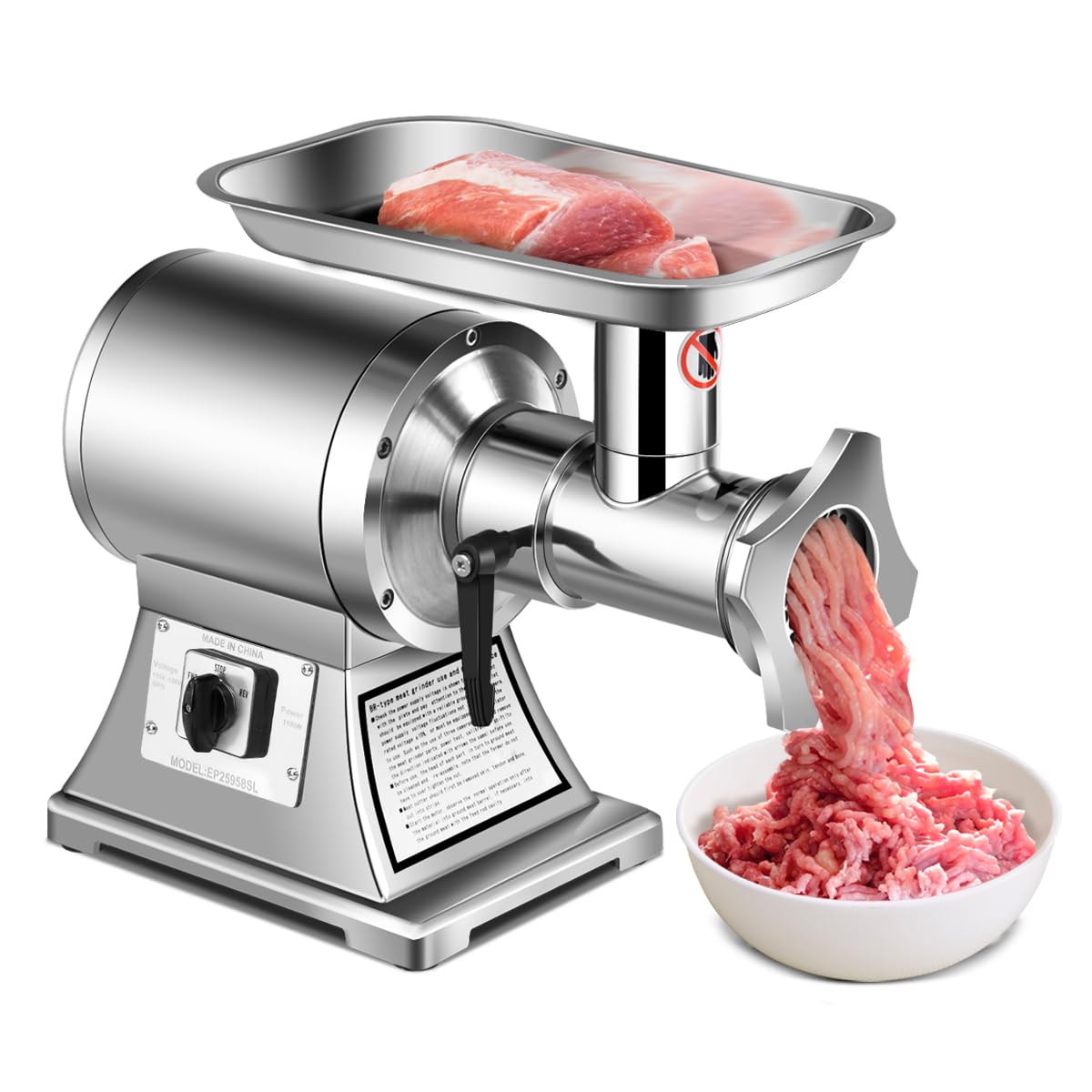
A 225 RPM #22 head that devours 75-85% frozen meat without a hint of slowdown.
The Tangkula is the machine you buy when “a lot of meat” is an understatement. Its 1100W rated motor and #22 grinding head (a step up from the #12) drive a 225 RPM cutting speed that is rated for 551 pounds per hour. That extra head size means it swallows whole chicken legs and massive chunks without the pre-cutting that smaller heads demand. The steel gear-driven mechanism and 1100W across the board make it a legitimately commercial-grade option for a home price.
The standout owner story is a batch of 200-300 lbs of sausage processed in 20-40 lb increments, including meat that was 75-85% frozen, with no slowdown. The machine runs quiet, the motor stays cool on long sessions, and the all-stainless build shows no flex under load. The included accessories cover the bases: 2 grinding plates (6mm and 8mm), 2 blades, a spiral cutting head, and a food pusher, plus a ventilation system that protects the motor from overheating.
There are two small things to know. The durability picture is mixed — a few owners find the machine is not indestructible over years of heavy commercial use, so it is best treated as a powerful home or light-commercial tool. And while the smooth aluminum surface simplifies cleaning, the #22 head is still a big assembly to wash properly. For the serious hobbyist or the person processing for several households, the speed is transformative.
The speed demon: At 225 RPM with a #22 head, this is one of the faster machines on this list — frozen meat does not slow it down.
Heavy mover: At 49 pounds, it is immovable in the best way; you will want a permanent station for it.
Best for: high-volume processors — think 100+ lbs per session — who want #22 head speed without paying commercial-spec prices.
Not for: someone grinding a few pounds of burgers monthly; this is overkill and heavy.
7. ARINOO Commercial #12C
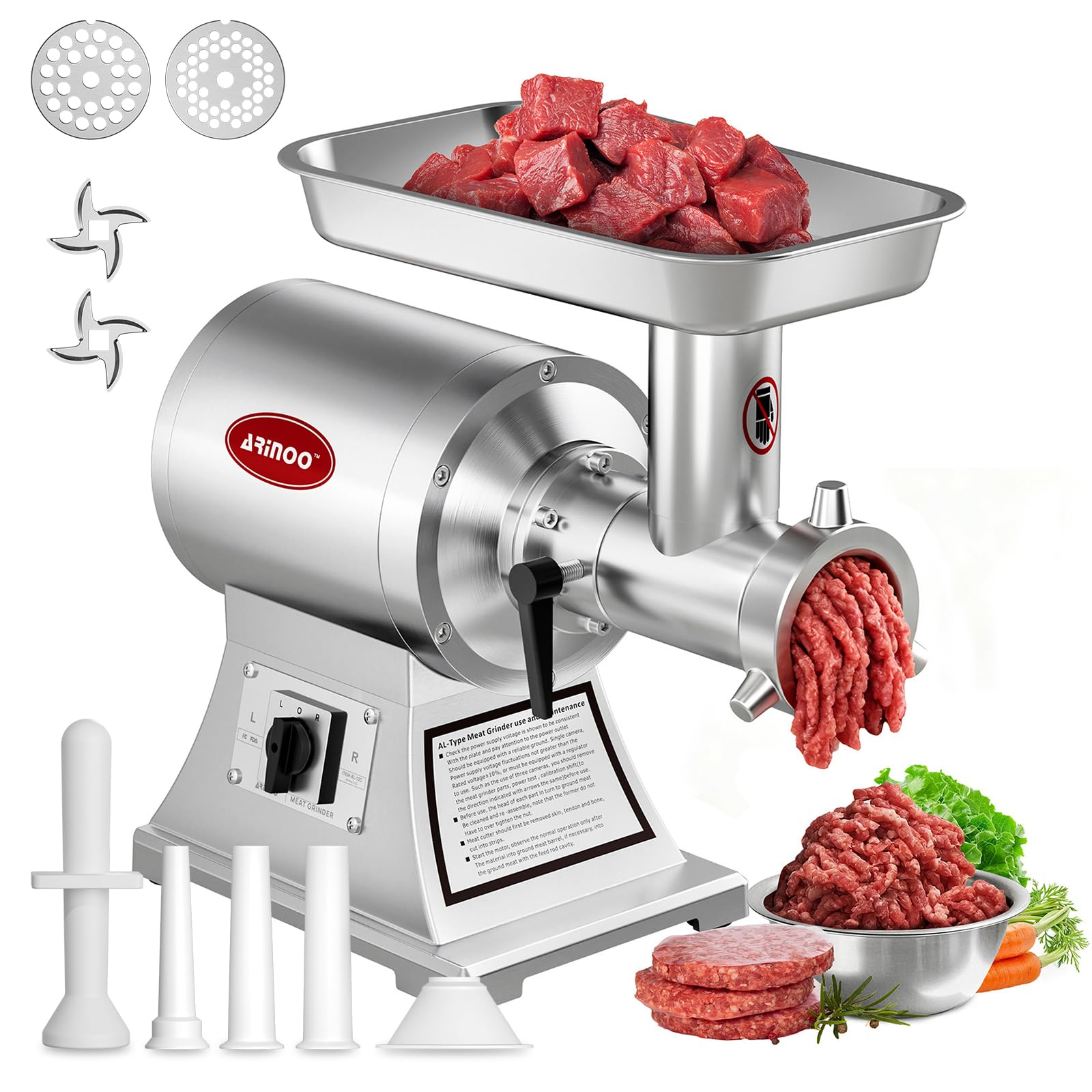
The 1100W peak that never bogs down, backed by a five-year factory warranty.
The ARINOO #12C is the low-maintenance entry into large-batch grinding, so you can process a whole deer without the machine stalling. Its high-torque 1.0HP motor runs a 100% pure copper motor rated at 650W, with a peak of 1100W when you hit something tough. That torque means it never bogs down, even on half-frozen meat, which is the first thing owners mention. It is designed specifically for large-batch home butchering and small-farm processing, and it replaces the experience of cheaper units that smoke out after a couple of uses.
The kit is complete for a start-up: 2 stainless steel plates (6mm and 8mm), 2 stainless knives, a meat stomper, and 3 plastic stuffing tubes for sausage. All parts detach and wash directly with water, which keeps the post-grind chore manageable. The 43-pound weight and stainless construction give it the stable, solid feel you want when a whole deer is going through, and owners describe the build as excellent with low noise levels.
The warranty is the headline feature here — a 5-year factory warranty with lifetime customer support, which is a rarity in this price class. The only real limitation is the plate selection: it ships with 6mm and 8mm, and one owner noted the lack of a finer grind plate, though #12 accessories are widely available to add. If you want the security of a long warranty with serious torque, this is a strong new-comer pick.
confidence: A 5-year factory warranty and lifetime support are nearly unheard of on a 1 HP-class grinder — it changes the risk calculation completely, so you can buy with confidence.
Check your plate needs: With only 6mm and 8mm plates included, you may want to order a finer plate for pâté or fine sausage.
Perfect for: first-time buyers of a serious grinder who want torque and the security of a long warranty over raw accessories.
Consider twice if: you specifically need a very fine grind from the start without buying add-ons.
8. Weston Pro Series 10-1201-W

The sewing-machine-quiet 750W that grinds chicken bones like butter and bags 35 lbs fast.
The Weston Pro Series is the premium answer for raw pet food makers and serious sausage enthusiasts, letting you grind 35 lbs of raw dog food in one session without stopping. Its 1 HP, 750W motor is air-cooled and permanently lubricated, which means it is designed for continuous grinding of bulk loads without needing a rest period — a key distinction for owners making 35 lbs of raw dog food in one session. The rifled-head design and offset throat let it grind 6-9 lbs of meat per minute, and it handles bone-in chicken quarters with no strain at all.
The standout experience is the noise level. Owners describe it as “built like a tank, but quiet as a sewing machine,” which is a rare combination in a machine that will chew through bone. The all-stainless construction explains the 42-pound weight — it is solid metal through and through, and it feels indestructible. The sausage kit is the most complete of any pick here: an adapter, a spacer, and four funnels (10mm, 20mm, 30mm, and 40mm) that cover everything from snack sticks to kielbasa.
The catch is the price — this is a premium machine, and it knows it. The 42 lbs heft and the cost are the two things to weigh. For a family that makes their own raw pet food, processes multiple hogs a year, or wants a commercial-grade tool that will outlast several cheaper grinders, the expense is justified. For a once-a-year deer hunter, it is more machine than the job needs.
Absolute workhorse: Continuous-duty motor, stainless build, and a 4-funnel sausage kit — this is the machine that handles a whole hog without a fuss.
The premium cost: You pay a clear premium over the #12 Weston, and the 42 lbs means it is a permanent fixture, not a stowaway.
Worth it for: raw-feeders who grind bone-in poultry weekly, or anyone who wants a commercial-grade unit that will still be running in a decade.
Overkill for: the occasional burger grinder — a lighter, cheaper unit will do that job fine.
9. Pro-Cut KG-22-W

The 134-pound daily commercial grinder built for restaurants, not countertops.
The Pro-Cut KG-22-W is the end of the line for anyone needing true commercial daily output, so a butcher shop or restaurant can run it all day, every day. This #22 grinder is designed for daily use in a professional kitchen, with a sturdy 1 HP motor and a gear-driven, always-lubricated transmission that produces over 1,700 lbs per hour on the first grind with the included 3/16 plate. It is in a completely different universe from the home grinders above — this is the machine a butcher shop or restaurant buys to run all day, every day. It complies with NSF and UL international standards, which matters for commercial kitchens.
The design is all about durability and uptime. The stainless steel cabinet and easily removable headstock make cleaning fast, and the innovative washerless grinding system reduces maintenance costs by eliminating the washers that wear out on lesser machines. The extra-large feed tray holds a full load of ingredients, cutting down on product transfer time. And it is versatile — with 12 available plates (sold separately), it can grind meat and also prepare salsas, purees, beans, and jellies by just switching the plate.
The reality check is the price and the weight. At 134 pounds, this is not a home appliance — it belongs on a dedicated table in a commercial space. It is also an investment that only makes sense if you are making money with it. While some owners have had great experiences, a few hit a warranty-support wall with a bent shaft issue, so it is worth understanding the 1-year parts and labor warranty terms before buying. For a new restaurant or a serious food business, though, the throughput is class-leading on this list.
All-day output: At 1,700 lbs/hr, this is the only pick here that can keep up with a restaurant line during a busy prep shift.
Real commitment: The 134 lbs and the price tag make this a commercial capital purchase, not a home countertop tool.
Choose it for: a new restaurant, catering business, or serious farm processing operation that needs daily, high-volume output.
Not for: home use — the weight, price, and 1,700 lbs/hr capacity are wasted on a freezer full of deer.
Understanding the Specs
Rated Power vs. Max Power
The most important number on a grinder spec sheet is the rated power — the wattage the motor can sustain continuously while grinding. A motor might claim 1100W max, but if its rated power is 350W, that max is only a brief burst for tough spots. For a 1 HP-class machine, look at the rated wattage (often 500-750W) as the real sustained capability. The max or “locked” wattage tells you the ceiling for clearing a jam, not the day-to-day speed.
Grinding Head Size (#12 vs #22)
The head number is the shorthand for the diameter of the grinding mechanism. A #12 head is the standard for home use — it handles most meat with solid speed and is compact enough to store. A #22 head is a step up in both size and throughput, letting you feed larger chunks and grind faster, which is why it shows up on commercial machines. If you process multiple animals a season, the #22 head will noticeably cut your time at the grinder.
Metal Gears and Gearboxes
The gears transfer motor power to the auger, and their material decides whether the machine survives a tough batch. Metal gears (or a metal gearbox) handle the stress of grinding sinew, bone-in meat, or slightly frozen chunks without stripping. Plastic gears are cheaper but can wear out quickly under the same load. If you plan to push the machine hard, prefer a metal-gear build — it is the difference between a tool and a toy.
Feed Rate in Pounds Per Hour
This is the practical speed spec — how much meat the machine can process in an hour. An entry-level grinder might manage 180-240 lbs/hr, while a commercial machine with a #22 head can hit 551 lbs/hr or more. Match the feed rate to your actual volume: a deer a year is fine with 200 lbs/hr, but a multi-family farm share will make you appreciate a faster machine. Just remember the feed rate assumes the meat is properly cut into strips or cubes first.
FAQ
What does 1 HP actually mean for a meat grinder?
Can a 1 HP grinder handle bones?
What is the difference between a #12 and #22 grinding head?
How much meat can a 1 HP grinder process per hour?
Do I need a grinder with a reverse function?
Is a foot pedal worth it on a meat grinder?
How do I clean a 1 HP meat grinder properly?
Will a 1 HP grinder handle frozen or semi-frozen meat?
Which is better for raw pet food, the Sunmile or the Weston Pro?
What accessories should come with a good 1 HP grinder?
Final Thoughts: The Verdict
For the majority of shoppers, the 1hp meat grinder winner is the STX Megaforce 3000 because it bundles serious power with a foot pedal and a full kit of accessories that no other pick matches — and it is backed by a 3-year warranty with parts and labor. If you are making raw pet food with bone-in poultry, grab the Sunmile SM-G50 at a friendlier price point. And if your yearly haul is measured in whole deer, the Barton #12 is the commercial-grade choice to reach for.
How We Picked
We do not accept paid placement. Every pick is matched to a real buyer and a real use-case; we do not hands-on test units.
Sources & Methodology
Specifications: manufacturer listings and product documentation. Review insights: verified customer reviews, as of August 2026. Pricing: not shown on this page (it changes often); check the current price via the retailer link.
As an Amazon Associate, Gadgets Feed earns from qualifying purchases. This does not affect which products we feature.