
The 1×30 belt sander occupies a sweet spot for the home shop — compact enough to bolt to a benchtop yet powerful enough to shape knife bevels, deburr metal stock, and smooth wood edges with repeatable precision. The challenge isn’t finding a machine; it’s picking the right combination of motor torque, belt speed, and stability to avoid burning thin steel or stalling on harder materials.
I’m Min — the co-founder and writer behind Gadgets Feed. After combing through hours of customer reports and studying the specifications on seven distinct 1×30 models and belt kits, the differences in motor amperage, disc speed, belt tracking mechanisms, and included accessories become the decisive factors separating a frustrating purchase from a long-term shop companion.
Whether you need a dedicated knife sharpening station with a leather strop or a combo disc-belt sander for general woodworking, this guide breaks down the critical specs to help you choose the best 1×30 belt sander for your specific workshop demands.
How To Choose The Best 1×30 Belt Sander
Not every 1×30 machine is built for the same job. A wood-focused combo sander prioritizes disc speed and a tilting table, while a dedicated knife grinder needs low RPM and a solid angle guide. Understanding a few hardware differences prevents wasted money.
Motor Power and Belt Speed
Amperage is the first filter. A 2.3A motor (common on premium combo units like the WEN and Bucktool) delivers consistent torque under load and won’t stall when you push a coarse-grit belt against a hardened steel edge. Entry-level machines with lower amperage struggle with metal removal and overheat faster. For sharpening, you want a belt speed around 1790 RPM — the sweet spot that removes material quickly without drawing the temper from your blade.
Belt Tracking and Platen Support
A belt that walks off the rollers mid-pass ruins your work and wastes belts. Look for a threaded tracking knob that lets you micro-adjust belt position while the machine is running. The platen — the metal plate behind the belt — must be flat and rigid. A bowed or flexible platen creates wavy bevels on knives and uneven surfaces on wood.
Dust Collection and Worktable Versatility
A 35mm or 32mm dust port (ideally a 2-in-1 adapter) is critical for metalworking — fine metal dust is hazardous and messy. For woodworking, a tilting disc worktable (0-45°) with a miter gauge adds precision for end-grain sanding and bevel cuts. If you plan to switch between materials often, a combo machine with both belt and disc saves floor space.
Quick Comparison
On smaller screens, swipe sideways to see the full table.
| Model | Category | Best For | Key Spec | Amazon |
|---|---|---|---|---|
| Bucktool BS130 | Low-Speed Belt Sander | Knife Sharpening & Metalworking | 1790 RPM / 2.3A Motor | Amazon |
| Bucktool MM493C | Belt & Disc Combo | Versatile Shop Use | 3590 RPM / 5″ Disc | Amazon |
| WEN 6515T | Belt & Disc Combo | Home Workshop | 3160 FPM / 2.3A Motor | Amazon |
| VEVOR Combo | Belt & Disc Combo | Budget-Friendly Combo | 250W / 3450 RPM Disc | Amazon |
| Jellas 7Amp | Handheld Belt Sander | Portable Wood Sanding | 7A / Variable Speed | Amazon |
| Pro Sharpening Supply Kit | Belt & Strop Kit | Fine Edge Finishing | 15 Belts + Leather Strop | Amazon |
| SHUTTLE GENIUS 16-Pack | Abrasive Belt Set | Belt Refill Variety | 8 Grits (80-5000) | Amazon |
In‑Depth Reviews
1. Bucktool BS130 Low-Speed Belt Sander
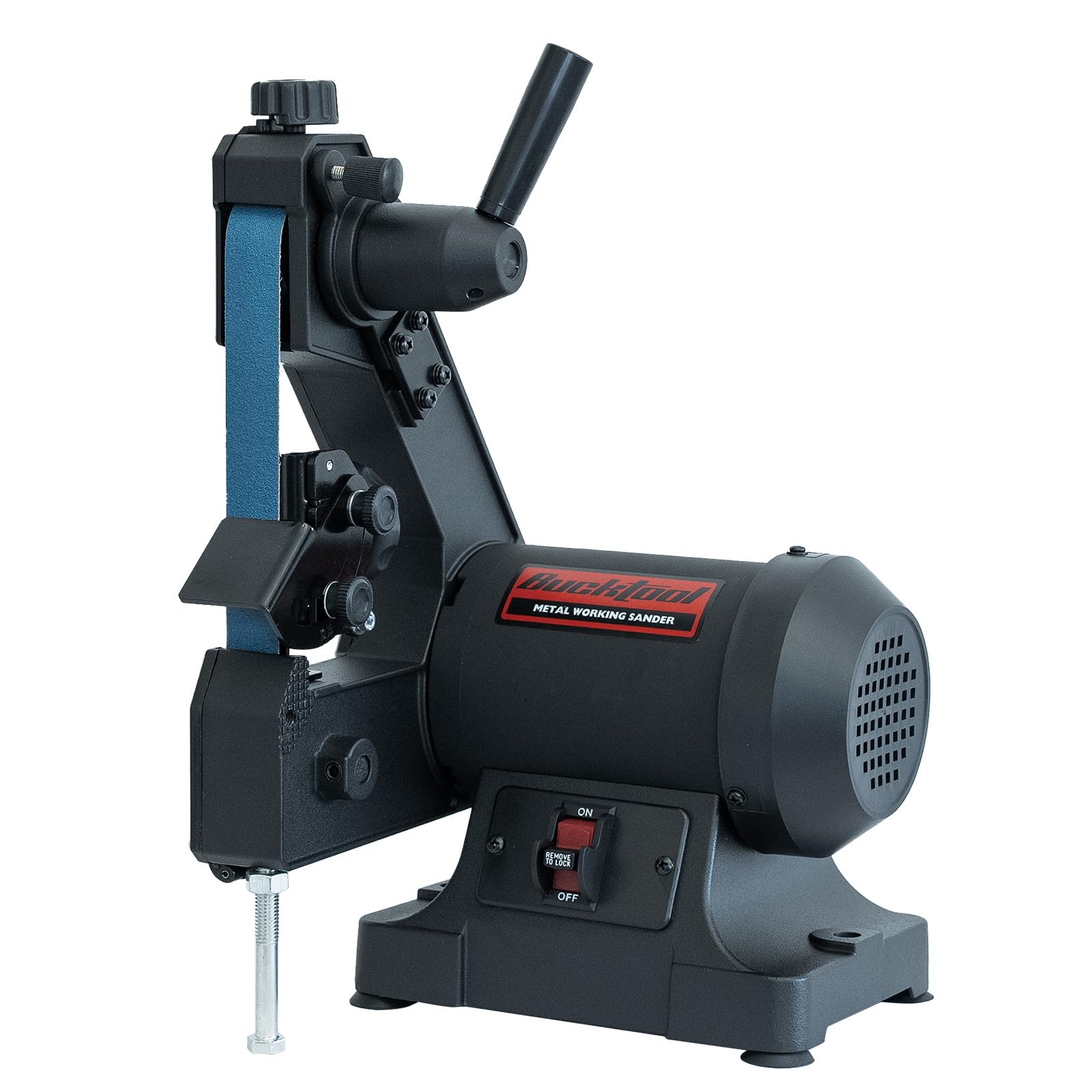
The Bucktool BS130 is built specifically for knife makers and metalworkers who need low belt speed to avoid overheating thin blade stock. Its 1790 RPM induction motor runs cooler and quieter than universal motors found on cheaper machines, and the 2.3A rating provides steady torque under prolonged grinding. The one-button belt cover and quick-release tension system let you swap grits in seconds without tools — a huge advantage when stepping from a 120-grit rough grind to a 400-grit polish.
The integrated knife sharpening guide adjusts from 10° to 45°, giving repeatable bevel angles for everything from pocket knives to chisels. The vacuum port actually works well with a standard shop vac, pulling metal dust away from the work area. The removable safety key switch prevents accidental startup, and the solid metal chassis dampens vibration noticeably better than plastic-bodied alternatives.
One trade-off: the belt only moves in one direction (downward toward the table), which some users find less intuitive for sharpening the opposite edge. A workaround involves flipping the blade or using a slack-belt technique. Overall, this is the most purpose-built 1×30 for serious metal finishing.
Why it’s great
- Low 1790 RPM prevents steel from overheating and losing temper.
- Quick-release belt system allows grit changes in under 10 seconds.
- Built-in angle guide (10-45°) delivers repeatable bevels.
- Vacuum port efficiently collects fine metal dust.
Good to know
- Belt direction is fixed downward; some sharpeners prefer belt movement upward.
- Angle guide is basic and may require modification for very large bevels.
2. Bucktool MM493C Belt & Disc Sander

The Bucktool MM493C combines a 1×30 belt with a 5-inch disc in a compact metal enclosure that weighs just under 20 pounds. It is one of the few combo sanders in this class that uses a solid metal frame rather than stamped sheet metal, which keeps vibration low during extended use. The 2.3A motor spins the disc at 3590 RPM and the belt at an equivalent high speed, making it effective for wood removal and shaping.
The one-button belt cover release and quick-change system mirror the BS130 design, so swapping between grits is frictionless. Worktable tilt adjusts from 0-45° for bevel sanding on the disc side, and the included miter gauge adds accuracy for end-grain work. The dust ports on both belt and disc sections connect to a standard shop vacuum, keeping the bench clean.
The disc table surface may require minor squaring out of the box, and the included 80-grit disc and belt are entry-level consumables. But for a home shop that needs both belt grinding and disc sanding in one footprint, this machine delivers premium build without the premium price.
Why it’s great
- Solid metal chassis with rubber feet minimizes vibration and wobble.
- Quick-release belt system works identically to the premium BS130.
- Two dust ports keep both belt and disc work areas clean.
- Disc table tilts 0-45° with miter gauge for precision sanding.
Good to know
- Disc table may need adjustment out of the box to achieve true 90°.
- Included abrasive disc and belt are basic; upgrading is recommended.
3. WEN 6515T Belt & Disc Sander

The WEN 6515T is a staple in home workshops because of its reliable 2.3A motor that drives the belt at 3160 FPM and the disc at 3450 RPM. The belt runs fast enough for aggressive wood removal but remains manageable for light metal deburring. The heavy-duty base keeps the unit planted, and the two separate dust ports (one for the belt, one for the disc) make vacuum hookup straightforward.
Setting up the belt tracking is simple thanks to a threaded adjustment knob, and the platen offers a flat, rigid backing for consistent sanding. The belt change process is tool-free with a tension lever. The included 100-grit belt and 80-grit disc are adequate for immediate use, and the 2-year warranty provides peace of mind for occasional to moderate use.
The plastic housing on the disc guard and some internal parts feels less durable than the all-metal Bucktool, and the belt table must be squared using a hex screw during initial setup. For light-duty woodworking, sharpening garden tools, and hobby projects, the WEN 6515T offers the best price-to-performance ratio in the combo category.
Why it’s great
- Smooth belt tracking with easy threaded adjustment knob.
- Two separate dust ports for belt and disc maximize vacuum efficiency.
- Includes a 100-grit belt and 80-grit disc out of the box.
- 2-year warranty backs the motor and components.
Good to know
- Plastic disc guard and internal parts feel less robust than metal competitors.
- Belt table requires a hex screw adjustment for perfect square alignment.
4. VEVOR 5″ Disc & 1×30 Belt Sander Combo
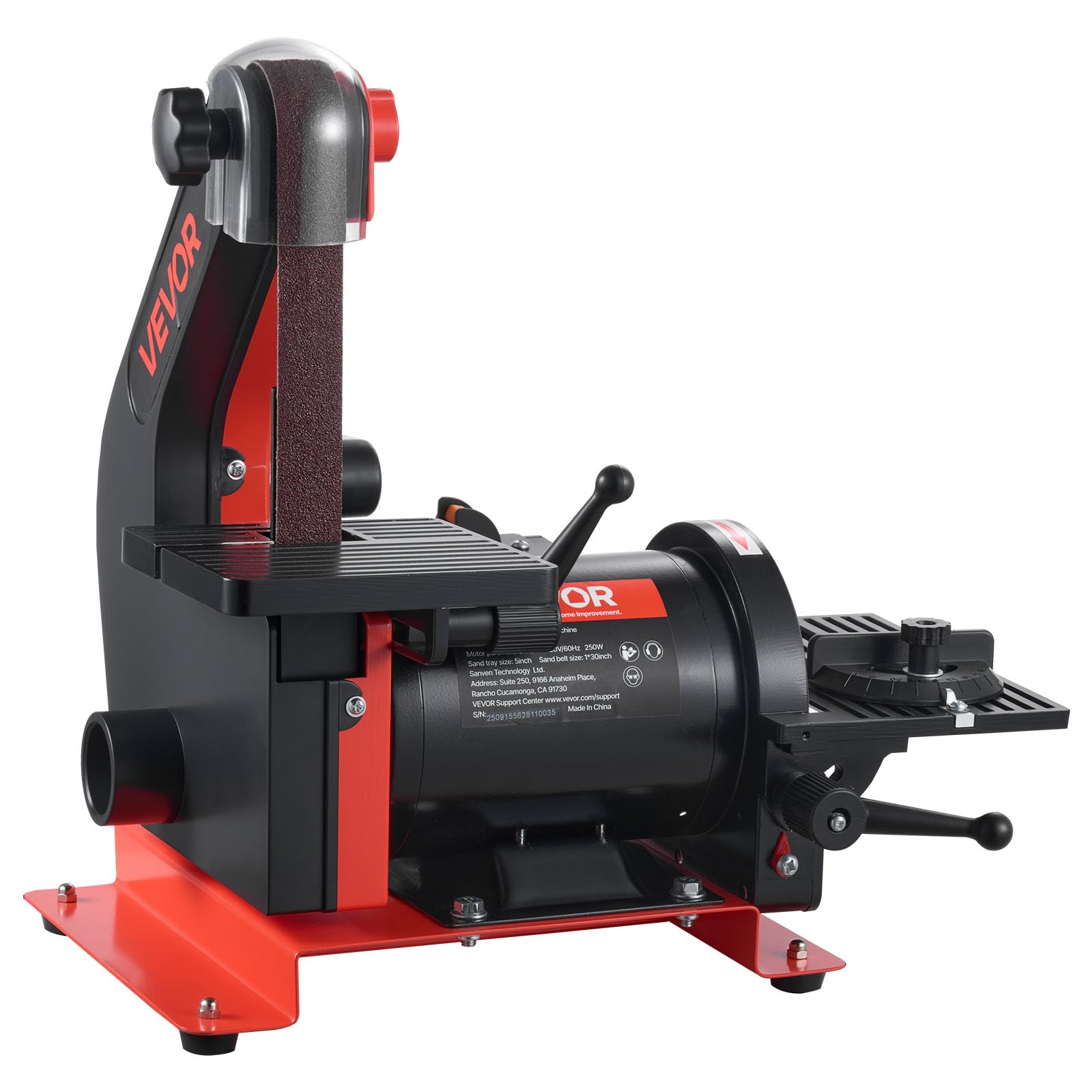
The VEVOR combo packs a 1×30 belt and a 5-inch disc into a single benchtop unit powered by a 250W motor. The disc spins at 3450 RPM while the belt runs at 1350 RPM — a lower belt speed than most combo sanders, which helps control heat generation during light metalwork. The worktable tilts from 0 to 45° and includes a miter gauge, adding decent capability for angled sanding without taking up extra bench space.
The reinforced metal base with rubber feet does a good job damping vibration, and the two dust collection ports allow easy connection to a vacuum. Assembly is straightforward, and the included accessories — belt worktable, disc worktable, miter gauge, and hex wrench — cover the basics. The belt tracking adjustment works reliably after initial setup.
The motor is slightly underpowered compared to 2.3A competitors; heavy pressure on the disc can stall it. One user noted that the shaft threads on one side are reversed, which can loosen the disc wheel during operation without Loctite. For light-duty sanding, sharpening, and DIY refining, the VEVOR provides a functional two-in-one solution at an entry-level price.
Why it’s great
- Two sanding tools in one footprint saves valuable bench space.
- Disc table tilts 0-45° with miter gauge for accurate bevels.
- Reinforced metal base and rubber feet reduce vibration.
- Dust ports on both belt and disc keep the area clean.
Good to know
- 250W motor lacks torque compared to 2.3A models under heavy load.
- Disc wheel may loosen during use due to reverse-threaded shaft.
5. Jellas 7Amp Belt Sander
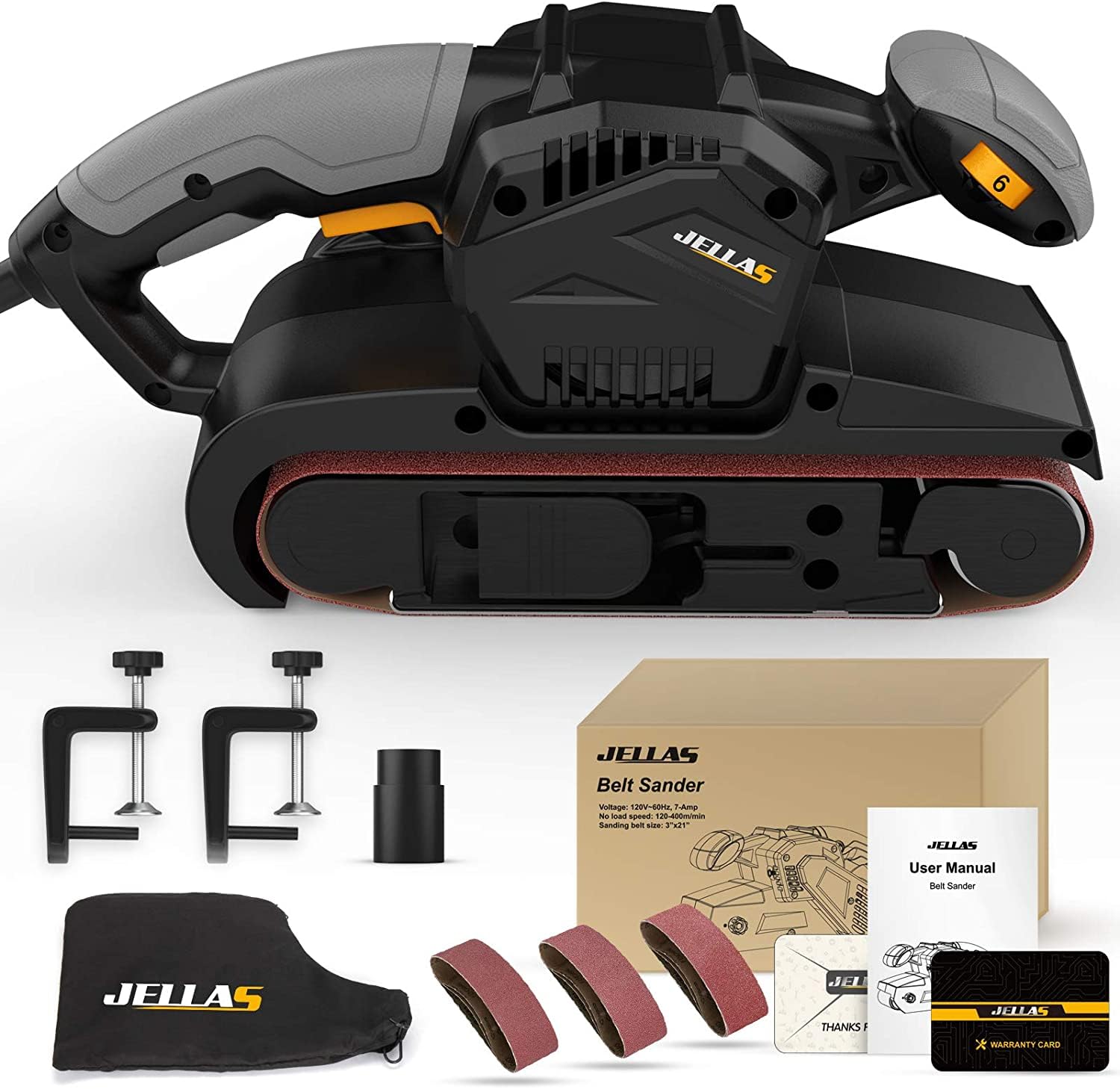
The Jellas 7Amp is a handheld belt sander, not a benchtop unit, making it the only portable option in this lineup. Its 7-amp motor drives the belt at variable speeds controlled by a 6-dial knob, ranging from 120 to 400 RPM. This range lets you dial in a slower speed for finish sanding or crank it up for rapid material removal on wood surfaces.
The 10-foot power cord provides good reach without an extension cable, and the dust bag collects a decent amount of debris for a handheld tool — though hooking up a vacuum via the 2-in-1 adapter (35mm/32mm) is much more effective. The included metal C-clamps let you invert and clamp the sander to a workbench, converting it into a makeshift bench sander. The soft-grip handle and lock-on button reduce hand fatigue during extended use.
This is not a precision tool for knife bevels; the belt is not supported by a platen in the same way as a benchtop sander, so the sanding surface has some give. For woodworking tasks like edge rounding, paint removal, and shape fairing, the Jellas offers versatility and portability that fixed machines cannot match.
Why it’s great
- Variable speed (120-400 RPM) lets you match belt speed to the material.
- 10-foot cord provides excellent reach in the workshop.
- Inverts into a bench sander using included C-clamps.
- Soft-grip handle and lock-on button reduce fatigue.
Good to know
- Handheld format lacks the rigid platen needed for precise knife sharpening.
- Dust bag is adequate but a vacuum connection is far more effective.
6. Pro Sharpening Supply 1×30 Belt & Leather Strop Kit

This kit from Pro Sharpening Supply is an ideal add-on for anyone who already owns a 1×30 benchtop sander and wants to sharpen knives to a shaving edge. It includes 15 silicon carbide belts — five each of 600, 800, and 1000 grit — and one genuine leather strop belt with a 1-2 oz. white diamond buffing compound estimated at 10,000 grit. The progression from 600 to leather strop takes a blade from a dull edge to a polished, hair-shaving finish.
The leather strop stretches after initial use; users report that soaking it in rubbing alcohol and letting it sun-dry shrinks it back to the correct length. The silicon carbide belts cut cleanly on hardened steel without loading up, and the 1000-grit belt is fine enough for a near-mirror finish before hitting the strop. The kit is specifically designed to fit Harbor Freight 1×30 sanders but works with any standard 1×30 machine.
This is a consumable kit, not a machine. If you do not own a 1×30 sander yet, you will need to buy one separately. But for existing owners, this is the most economical path to professional-level knife sharpening at home — achieving 50-80 sharpness scores on common testing scales in about 90 seconds per blade.
Why it’s great
- Leather strop with white diamond compound delivers a true 10,000-grit finish.
- Silicon carbide belts run cool and resist loading on high-hardness steel.
- Complete progression (600, 800, 1000, strop) in one package.
- Compatible with all standard 1×30 benchtop sanders.
Good to know
- Leather strop stretches and may require alcohol shrinking after first use.
- This is a belt and strop kit only — requires a separate 1×30 sander machine.
7. SHUTTLE GENIUS 16-Pack 1×30 Sanding Belts
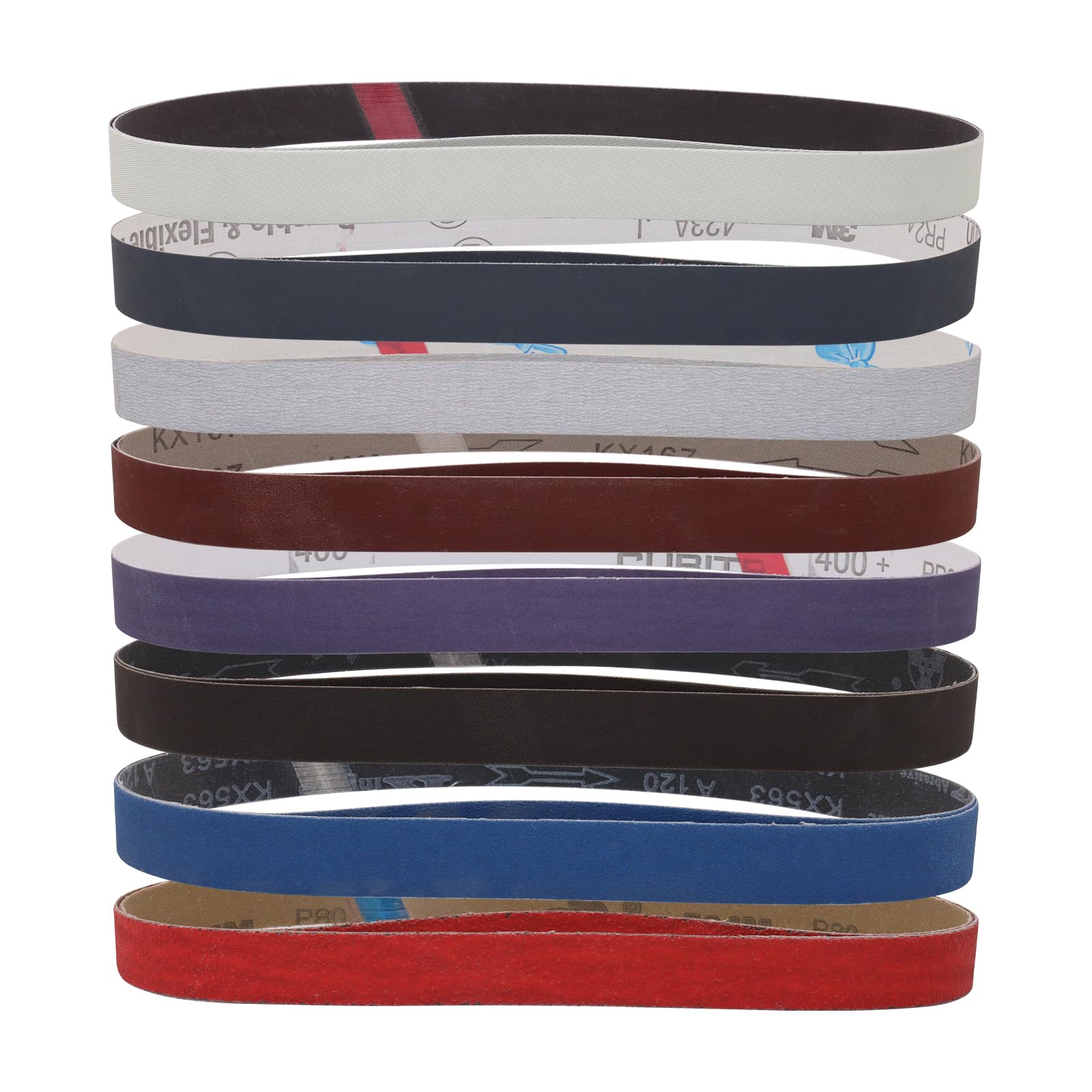
The SHUTTLE GENIUS 16-pack covers a massive grit range from 80 to 5000, with two belts per grit across eight levels. The abrasive materials are tailored to the grit: coarse 80-grit uses ceramic for fast metal removal, 120-grit uses zirconia for medium stock removal, 240-800 grit uses alumina for general shaping, 1000-grit uses silicon carbide for fine finishing, and 5000-grit uses pyramid alumina for ultra-fine polishing. This stratification means each belt is optimized for its specific stage of the sharpening or sanding process.
The joints are smooth and use a dual-directional tape splice that eliminates bumping or jumping during rotation — a critical detail when working on a knife edge where any vibration translates into uneven bevels. The belts hold up well under professional use; one reviewer reported roughly 50 sharpenings per set, which translates to excellent value for money.
The belts run slightly stiff at the finer end (1000-5000 grit), which is normal for high-grit belts, but they still cut effectively. The grit markings on some belts can be hard to read, so keeping them organized is recommended. For anyone with a 1×30 sander who wants a single purchase to cover everything from rough grinding to mirror polishing, this pack is the most versatile consumable option.
Why it’s great
- Eight grit levels (80-5000) cover the full sharpening and polishing spectrum.
- Ceramic, zirconia, alumina, silicon carbide, and pyramid alumina materials matched to grit range.
- Smooth dual-directional tape joints prevent belt jumping during precision work.
- High durability with up to 50 sharpenings reported per set.
Good to know
- Fine grit belts (1000+) are noticeably stiff before break-in.
- Grit markings on some belts can be difficult to read.
FAQ
Can a 1×30 belt sander be used for knife sharpening effectively?
What grit progression should I use for sharpening kitchen knives?
Why does my belt keep walking off the rollers?
Final Thoughts: The Verdict
For most users, the best 1×30 belt sander is the Bucktool BS130 because its low 1790 RPM speed combined with a 2.3A induction motor delivers the control and torque needed for serious knife sharpening without burning edges. If you need a versatile combo sander for both woodworking and metal, the Bucktool MM493C offers outstanding build quality with a belt and disc in one machine. And for the budget-conscious home hobbyist, the WEN 6515T packs reliable performance and a 2-year warranty at a price that leaves room for a good belt assortment and a leather strop.