
Our readers keep the lights on and my morning glass full of iced black tea. As an Amazon Associate, I earn from qualifying purchases.
Specs are compiled from manufacturer listings and verified buyer reviews and can change over time — please confirm the key details on the product page before buying.
A 1×42 belt sander is a specific tool—one that combines a narrow belt with a long surface for grinding bevels, sharpening tools, and shaping metal without burning the workpiece. If you are making a knife or restoring a chisel, the length of the belt gives you more control and keeps the steel cooler than shorter belts do, so you spend less time fighting heat distortion.
I’m Min — the founder and writer behind Gadgets Feed. This guide is built by comparing the manufacturers’ published specifications and the patterns across verified customer reviews, so you get each pick’s real strengths and trade-offs instead of marketing spin.
After digging through the specs and real owner experiences, these are the five machines that actually deliver for the money, all of which pass the test of being a genuine best 1×42 belt sander worth your bench space.
Our Picks at a Glance
How To Choose The Best 1×42 Belt Sander
A 1×42-inch belt is longer than a standard 1×30-inch belt, which means the abrasive stays cooler and cuts more consistently for knife bevels or tool sharpening. But not every machine delivers the build quality needed to handle those tasks day after day.
Motor Speed: 1725 vs. 3450 RPM
Lower speed (1725 RPM) gives you more torque and control for sharpening without overheating the edge, so your chisels and knives keep their temper. Higher speed (3450 RPM) removes material faster, which matters if you are hogging out a bevel on a blank knife. Some machines offer both speeds, letting you switch between rough grinding and finishing without a second tool.
Build Quality and Weight
A heavier sander vibrates less and stays put on the bench during heavy passes. Steel and cast-iron construction outlasts stamped sheet metal, but it also makes the machine harder to move around. If you work in a shared or temporary space, a lighter unit with a rigid frame is a worthwhile trade-off.
Belt Tracking and Platen Flatness
The tracking mechanism keeps the belt centered; the best ones let you adjust while the machine is running. A flat, square platen is critical for crisp bevels and even sharpening. If the platen is warped or not parallel to the belt path, you will fight every grind.
Quick Comparison
| Model | Best For | Motor Speed | Amperage | Weight | Amazon |
|---|---|---|---|---|---|
| Kalamazoo 1SM★ Best Overall | Quiet sharpening, heirloom build | 1725 RPM | 3.3 Amps | 32 lbs | Amazon |
| BUCKTOOL BD1801DS | Dual-speed metalworking, knife making | 1750 / 3450 RPM | 4.8 Amps | — | Amazon |
| Shop Fox W1850 | Budget-friendly belt/disc combo | 1725 RPM | 4 Amps | 59 lbs | Amazon |
| JET J-4002 | Cast-iron stability, included grits | — | 15 Amps | 63 lbs | Amazon |
In‑Depth Reviews
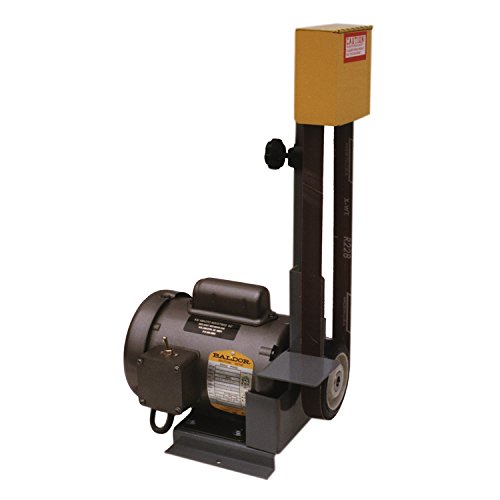
1. Kalamazoo 1SM 1″ Belt Sander
Our pick — 4.5★ from 100+ verified ratings; the strongest balance of quality and price.
The quietest, most stable 1×42 money can buy, built to outlast your workbench.
This machine trades speed for brute torque and silence. At 1725 RPM with a 1/3 HP motor pulling just 3.3 Amps, the Kalamazoo 1SM is the polar opposite of the BUCKTOOL’s dual-speed aggression—it is a dedicated sharpening station that restores edges without screaming about it. The Kalamazoo weighs 32 pounds, while the JET model weighs 63 pounds; yet the cast-iron chassis gives it a planted feel that belies its relatively modest heft.
Buyers report it restored dull and chipped axes to better-than-factory sharpness in minutes. The flat backup plate handles both flat and convex grinds, and the belt changes in ten seconds without tools. One experienced owner notes the motor housing gets in the way for long bevels longer than 4-5 inches, so this is a better fit for small blades, chisels, and axes than for full-size knife blanks. The belt tracking cannot be adjusted while it is running, but owners say you set it once and forget it.
Bench timer: For sharpening only and buyers who prioritize silence and longevity over raw speed, this is the pick that still runs on its original motor when grandchildren ask about it.
Material limit: The 4-inch contact wheel and tight motor clearance make flat bevels on pieces over five inches awkward—reach for the BUCKTOOL if you grind long blades.
Best for: Hobbyists who sharpen axes, chisels, and small knives and want a machine that runs quiet and stays true for decades.
Look elsewhere if: You need to grind long, full-tang blades or want variable speeds; the Kalamazoo is a one-note performer that does that one note perfectly.
2. BUCKTOOL BD1801DS Dual Speed 1×42 Belt Disc Sander Combo

A dual-speed brushless motor that chews steel at 3450 RPM or caresses edges at 1750 RPM.
The BUCKTOOL is the only machine in this lineup with a brushless induction motor and a choice of 1750 or 3450 RPM, which means you can switch from rough grinding a bevel to fine sharpening without swapping machines. At 3450 RPM, compared to the Kalamazoo and Shop Fox’s 1725 RPM, the BUCKTOOL removes material far faster when you are hogging out a blank. The 4.8 Amp motor is a meaningful step up from the 3.3 Amps on the Kalamazoo and the 4 Amps on the Shop Fox, giving it sustained power under load.
One builder reports using theirs to make seven large knives so far, shaping handle materials like micarta and G10 alongside the steel. The quick-release belt lever and hook-and-loop disc system cut changeover time to seconds. Several owners mention the platen is not perfectly square to the belt travel or work rest, which means you may need to shim it for dead-square bevels. The plastic disc guard feels less durable than the cast-iron construction on the JET model, but for a mid-range machine built for active metalworking, the value proposition is very strong.
Speed advantage: At 3450 RPM versus 1725 RPM on the Kalamazoo and Shop Fox, rough bevels happen in minutes not hours.
Small quibble: The belt tracking requires fine-tuning on first setup, and a few owners plastic disc guard may need a 3D-printed replacement over time.
Reach for this if: You are making knives or doing metal polishing and need both a fast grinding speed and a slow sharpening speed in one unit.
skip it if: You need dead-square bevels right from the start or prefer the industrial simplicity of a machine with no plastic parts.
3. Shop Fox (Woodstock W1850) 1×42 Belt with 8-inch Disc Sander

A heavy 59-pound belt and disc combo that offers a lot of metal for not a lot of money.
The Shop Fox is the heavy hitter in the budget tier—at 59 pounds, compared to the Kalamazoo’s 32 pounds, it provides a very stable stance during operation. The 1725 RPM speed and 4 Amp motor are modest, meaning it will not remove material as fast as the BUCKTOOL at 3450 RPM, but it is perfectly adequate for light knife sharpening, deburring, and sanding small parts. The 8-inch disc gives you a second flat sanding surface, which is handy for squaring up small workpieces.
Reviews are mixed: some owners mention an easy setup and a machine that runs true after minor adjustments, while others describe stripped paint on threads, a table that rubs on the disc, and a seized motor right from the start. One frustrated buyer mentioned the screw holding the table at 90 degrees was painted over, making it impossible to run the bolt fully without re-tapping the hole. The two-year warranty covers some of the risk, but the quality control is inconsistent enough that you may need to be ready for a return process.
Stability upside: At 59 pounds it is the second-heaviest sander here, so vibration is minimal even during sustained passes.
QC gamble: Several customers note paint in threads and misaligned tables from the start—plan for potential setup time or a return.
Best for: Budget-conscious DIYers who want a belt and disc in one unit and are comfortable with some setup adjustment.
Look elsewhere if: You need consistent quality from the start or plan to do heavy grinding; the motor and build tolerance may disappoint.
4. JET J-4002 1×42 Belt and 8-inch Disc Sander
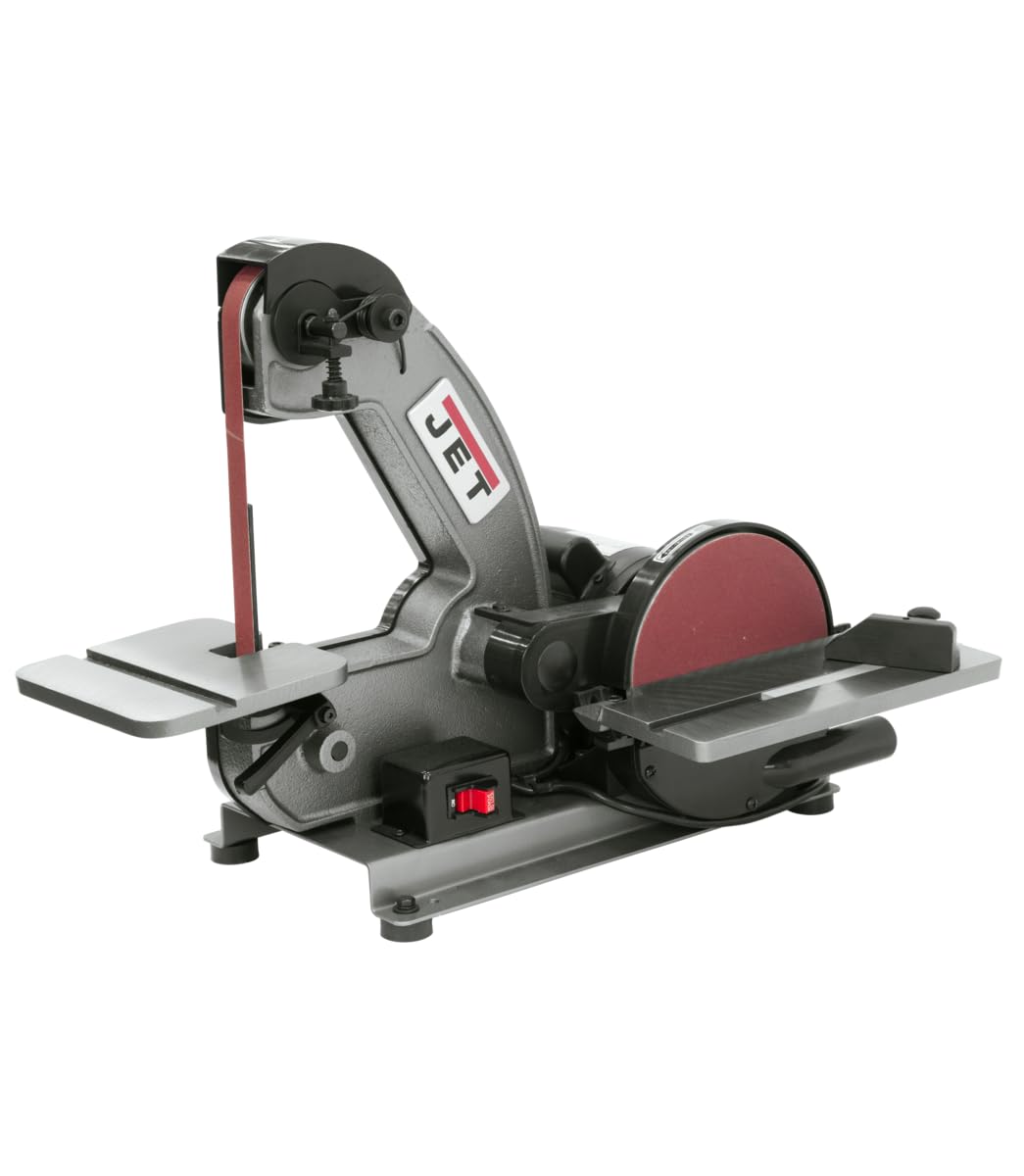
The heaviest, most rigid machine here—cast iron that weighs 63 pounds and pulls 15 Amps.
The JET is built like a stationary tool that happens to sit on a bench. At 63 pounds, with the Kalamazoo at 32 pounds and the Shop Fox at 59 pounds, the JET does not move even under aggressive grinding loads. The 15 Amp motor, compared to the Kalamazoo’s 3.3 Amps, gives it the highest electrical headroom in the group—it simply does not bog down. It ships with five abrasive belts (50, 80, 120, 220, 320 grit) and three abrasive discs, so you have a full range of grits ready on day one.
One reviewer praised the smooth cast-iron frame, reporting less vibration and quieter operation than a comparable Rikon sander, plus larger dust ports that accept a standard shop-vac hose. The disc table uses Allen bolts for adjustment, which some find less convenient than a quick-release handle, and the power switch feels flimsy compared to the rest of the sturdy unit.
Built like a battleship
- 63-pound cast-iron frame with rubber feet for zero vibration
- 15 Amp motor provides more headroom than the Kalamazoo’s 3.3 Amps
- Includes five grit belts and three grit discs right in the box
- Adjustable dust chute and deluxe miter gauge included
Two known weak points
- Motor reliability is a real concern—one owner hit failure at 5 months and the replacement costs more than the unit
- Disc replacement requires partial disassembly; disc table uses Allen bolts, not quick-release
Reach for this if: You want the heaviest, most rigid frame for vibration-free grinding and plan to keep the machine permanently on your bench.
pass on it if: The budget is tight or you cannot afford to absorb a potential motor failure beyond the warranty period.
Understanding the Specs
Motor Speed (RPM)
This is how fast the belt rotates in a minute. 1725 RPM is the standard for sharpening: it runs slower so the steel does not overheat and lose its hardness (its “temper”). 3450 RPM is twice as fast, so it grinds off material in half the time—essential for hogging out a bevel on a knife blank, but it needs a lighter touch to avoid burning the edge. Some machines let you choose between the two.
Amperage (Amps)
Amp draw tells you how much electrical current the motor can pull before it stalls. Higher amperage means the motor can keep spinning under heavy pressure. A 3.3 Amp motor is fine for light sharpening, while a 15 Amp motor provides more capacity, meaning it will not bog down even when you lean into the belt. For metalworking, look for at least 4 Amps.
FAQ
What is the difference between a 1×42 and a 1×30 belt sander?
Can I use a 1×42 belt sander for knife making?
What RPM should I choose for sharpening tools?
How do I change the belt on a 1×42 sander?
Why is my belt tracking off center?
What is the difference between belt-driven and direct-drive motors?
How much weight does a 1×42 belt sander need to be stable?
Can I use a leather belt for polishing on a 1×42 sander?
What does “platen” mean on a belt sander?
Is a 1×42 sander better than a disc sander for sharpening?
Final Thoughts: The Verdict
For the majority of shoppers, the best 1×42 belt sander winner is the BUCKTOOL BD1801DS because it delivers dual-speed versatility, a powerful brushless motor, and a sturdy build for both knife making and sharpening at a price that undercuts the premium options significantly. If you want the absolute quietest sharpening station with heirloom build quality, grab the Kalamazoo 1SM. And for the heaviest, most rigid frame that does not budge under heavy grinding, the standout is the JET J-4002 if you are willing to accept the motor reliability risk.
How We Picked
We do not accept paid placement. Every pick is matched to a real buyer and a real use-case; we do not hands-on test units.
Sources & Methodology
Specifications: manufacturer listings and product documentation. Review insights: verified customer reviews, as of July 2026. Pricing: not shown on this page (it changes often); check the current price via the retailer link.
As an Amazon Associate, Gadgets Feed earns from qualifying purchases. This does not affect which products we feature.