
You want a pair of powered bookshelf speakers that deliver clean, full-range sound without a separate subwoofer cluttering your floor. The challenge is picking a set that does not muddy the mid-range, distort at higher volumes, or lock you into a single wired connection. This guide walks you through five top-tier options that all stick to a true 2.0 channel setup, so you can focus on what matters: clear dialogue, tight bass, and a stereo image that puts you in the room with the music.
I’m Min — the co-founder and writer behind Gadgets Feed. This guide is built by comparing the manufacturers’ published specifications and the patterns across verified customer reviews, so you get each pick’s real strengths and trade-offs instead of marketing spin.
Whether you are building a desktop studio, upgrading your gaming soundstage, or simply want better TV audio, the best 2.0 base stations below offer something for every setup and budget.
How To Choose The Best 2.0 Base Stations
Choosing a pair of 2.0 powered speakers comes down to three key factors: the physical drivers that produce the sound, the inputs you need to connect your gear, and how much clean power the built-in amplifier delivers. Each of these directly affects what you hear and how the speakers fit into your daily routine.
Driver Size and Tweeter Construction
You get deeper bass and louder playback without distortion from a larger woofer, typically 3 to 5 inches, because it moves more air for that physical punch in your chest on kick drums and explosions. The tweeter, often a silk dome or metal diaphragm, handles the high frequencies like cymbals and vocal sibilance. Silk domes tend to sound warmer and less fatiguing for long listening sessions, while metal tweeters like aluminum can sound brighter and more detailed.
Connectivity Options and Bluetooth Version
Look for speakers that offer both wired and wireless connections so you can switch between your TV, computer, turntable, and phone without unplugging cables. Balanced TRS (Tip-Ring-Sleeve) or XLR inputs are important for studio work because they reject electrical noise over longer cable runs. Bluetooth version matters too: V5.3 or V5.4 (two backward-compatible versions of the short-range wireless standard) give you a more stable connection and lower latency than older versions, and support for high-resolution codecs like LDAC or aptX HD preserves detail during wireless streaming.
Amplifier Power and Room Size
Amplifier power is measured in watts RMS (Root Mean Square), which tells you the continuous power the amp can deliver without distortion. For a small desk setup in a 10×10-foot room, 35 to 70 watts total RMS is usually plenty. If you sit farther away or want to fill a larger living room, aim for 70 watts or more. Too little power means the speakers will strain and sound harsh when you turn them up; too much power at high volume can damage the drivers.
Quick Comparison
On smaller screens, swipe sideways to see the full table.
| Model | Category | Best For | Key Spec | Amazon |
|---|---|---|---|---|
| Vanatoo Transparent Zero Plus | Premium | Desktop studio and gaming | 120W RMS | Amazon |
| YAMAHA HS5 | Premium | Professional mixing and mastering | 5″ cone woofer | Amazon |
| Klipsch Reference R-40PM | Mid-Range | Music and movies in small rooms | 4″ copper-spun woofers | Amazon |
| Edifier QR65 | Mid-Range | Gamers who want RGB and USB-C charging | 70W RMS, 65W USB-C | Amazon |
| Edifier MR3 | Budget | Budget desktop monitoring and casual listening | 3.5″ mid-low drivers | Amazon |
In‑Depth Reviews
1. Vanatoo Transparent Zero Plus

120W RMS — nearly double the output of the Edifier QR65’s 70W — makes the Vanatoo Transparent Zero Plus the top pick for anyone who wants distortion-free, bass-heavy playback at high volume in a small room. This speaker is for the multi-device user: connect your PC via USB, TV via Toslink optical, and phone via Bluetooth V5.1, and the speakers automatically switch to whichever source is playing without pressing a button.
One reviewer called it “ideal for desk use” because of this seamless multi-device convenience. The compact cabinet produces bass deep enough that buyers report a subwoofer is “optional but recommended,” and the frequency response remains neutral for accurate monitoring. Reviewers consistently describe the imaging as “exceptional” but note it requires precise positioning to lock in that stereo sweet spot. Skip this if you need the newest Bluetooth version — V5.1 is a step behind the V5.4 found on the Edifier MR3 — but choose it if you want the most adaptable system that grows with your gear without needing extra receivers or switches.
For the most adaptable, multi-source desktop system, the Vanatoo Transparent Zero Plus is the clear top pick.
Why it’s great
- 120W RMS power means loud, clean sound even in larger rooms
- Automatic input switching makes it seamless to use with PC, TV, and phone
- Compact footprint fits easily on a desk or shelf
Good to know
- Bluetooth V5.1 is a step behind the V5.4 found on the Edifier MR3
- Subwoofer output is great, but adding one increases total cost
2. YAMAHA Hs5 Powered Studio Monitor

Compared to the top-pick Vanatoo Zero Plus, the Yamaha HS5 delivers a flatter frequency response (neutral sound that does not boost any range) versus the Vanatoo’s more musical tuning, and its 5-inch cone woofer moves significantly more air than the Edifier MR3’s 3.5-inch driver, translating to tighter bass you can actually feel when editing kick drums or bass guitar.
Reviewers confirm these are “great for mixing/mastering” and “handles guitar well,” with one buyer noting they got a “huge upgrade from Presonus Eris 4.5s” in terms of detail and stereo field width. The bi-amplified system (45W for low frequencies plus 25W for highs at 70W total) keeps each driver running in its cleanest power range. The catch: these require an external audio interface (like a Focusrite) for best results — they have no Bluetooth or USB inputs, so your setup needs a separate source and volume control.
Pick these over the Vanatoo if your work demands transparent sound that reveals flaws rather than flattering them.
Where it shines
- Industry-standard flat response reveals every detail in your mix
- 5-inch woofer delivers punchy, accurate bass without muddiness
- Bi-amplified design keeps each driver in its clean power range
Worth noting
- Requires an external audio interface — no built-in Bluetooth or USB
- Heavier build may need sturdy desk stands
3. Klipsch Reference R-40PM Powered Bookshelf Speakers
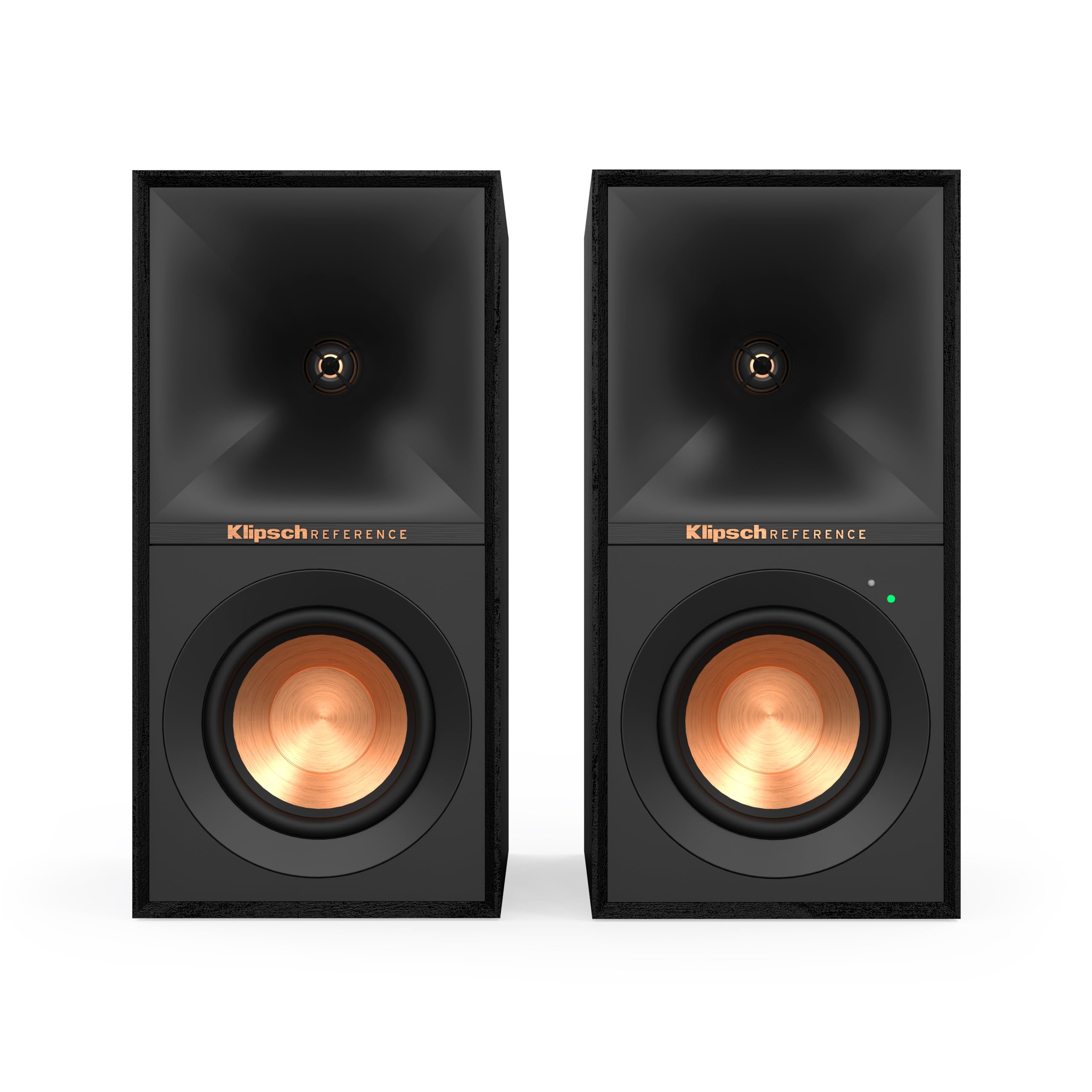
You are setting up a desk in a small den and want speakers that make streaming live jazz or acoustic rock feel like the band is in the room — the Klipsch Reference R-40PM Powered Bookshelf Speakers deliver that with their signature 90-degree by 90-degree Tractrix horn tweeter, a flared waveguide that controls high-frequency sound dispersion and throws a wide, detailed soundstage. The horn design gives you crystal-clear high frequencies that feel more present and immediate than the silk dome tweeter in the Edifier MR3, especially noticeable on cymbals, strings, or vocal sibilance.
Owners mention that the “bass is amazing without a dedicated woofer,” due to the 4-inch copper-spun TCP (Thermoformed Crystalline Polymer) woofers that move air efficiently in a compact cabinet. One reviewer specifically compared them to the Edifier R1850DB and found the Klipsch “better” in clarity and punch. The built-in phono input (for a turntable) with a ground screw means you can connect a vinyl player directly without an extra preamp. Skip these if you want high maximum volume for parties — they are designed for nearfield listening — but choose them if you want a horn-loaded tweeter that makes live recordings feel like you are in the room.
The 90-degree by 90-degree Tractrix horn tweeter is the standout spec that makes live recordings feel like you are in the room.
What stands out
- Tractrix horn tweeter delivers wide, detailed soundstage with crystal clarity
- Built-in phono input for direct turntable connection
- Punchy bass from 4-inch copper-spun woofers without a sub
The trade-offs
- Some reviewers report speakers turning back on after manual shutdown
- Bluetooth range limited to 10 meters indoors
4. Edifier QR65 Desktop Active Monitor

The single number that matters most in this category is total RMS output, and the Edifier QR65 delivers 70W using Class-D amplifier chips, a compact and efficient type that provides enough clean power for detailed listening in a medium-sized room, though customers note the maximum volume is lower than some competitors at a 4/10 rating.
The 2.75-inch aluminum long-throw drivers are significantly smaller than the Yamaha HS5’s 5-inch cones, so bass extension is not as deep, but what is there stays tight and controlled without distortion. The bundled aluminum stands tilt the speakers 10 degrees upward to aim sound directly at your ears, reducing desktop reflections. One reviewer praised the “stunning matte design with subtle RGB,” while another experienced “hour-long initial connectivity issues” with the companion app. You accept a trade-off here: the beautiful design and charging convenience come at the cost of maximum volume — it will not rattle the walls like the Vanatoo or Klipsch.
The Edifier QR65 brings a unique trick other 2.0 speakers cannot match: a 65W TurboGaN USB-C charging port built into the speaker itself, so you can power your laptop or phone directly from your monitor, making this a price-to-value read for a desk that is a command center, not a concert hall.
The upsides
- 65W TurboGaN USB-C charging port on the speaker itself
- Included aluminum stands reduce desktop reflections and improve clarity
- Customizable RGB lighting effects via the app
Keep in mind
- Maximum volume is lower than similarly priced competitors
- App connectivity can be finicky on initial setup
5. Edifier MR3 Powered Studio Monitor Speakers

You get accurate, Hi-Res Audio certified sound with a flat frequency response from 52Hz (low bass) to 40kHz (beyond human hearing range) from the Edifier MR3, all at a fraction of the cost of the Yamaha HS5. Its 3.5-inch mid-low drivers and 1-inch tweeters produce clean, neutral sound that punches well above the price point, with buyers calling it “the best for the budget” and “phenomenal clarity at all levels.”
What you give up is raw output power — at 18W RMS per channel (36W total), these will not fill a large living room or compete with the Vanatoo’s 120W for loud parties. But for a desktop nearfield setup (2 to 3 feet away), the volume is more than sufficient and stays distortion-free even at higher levels. The Bluetooth V5.4 connection is the newest version in this roundup, and reviewers report it is “flawless” with the app’s EQ (equalizer, for adjusting bass and treble) as a “bonus” for fine-tuning the sound. Reviewers point out the “detachable wires for flexible placement” and the “quality build” that does not slide around.
If your budget is the main constraint but you still want clean monitoring for a small room, the MR3 is the cleanest entry point here.
Why we’d pick it
- Hi-Res Audio certified with flat response from 52Hz to 40kHz
- Bluetooth V5.4 is the newest standard for stable wireless streaming
- Compact size with detachable wires for easy placement on any desk
A few caveats
- 36W total RMS is not powerful enough for larger rooms
- Bluetooth pairing mode can be confusing — button may be unresponsive at first
Understanding the Specs
Watts RMS
Watts RMS (Root Mean Square) measures the continuous power the amplifier can deliver without distortion. Higher wattage does not always mean louder — it means cleaner headroom before the sound starts breaking up. For a desktop setup, 35 to 70 watts total RMS is a comfortable target. For a living room or larger space, look at 70 watts and above.
Driver and Tweeter Size
The woofer diameter (in inches) determines how deep and powerful the bass sounds. A 5-inch cone like the Yamaha HS5 moves significantly more air than a 3.5-inch driver, giving you bass you can feel. The tweeter material matters for high-frequency presentation — silk domes sound warm and smooth, while metal tweeters (like aluminum) sound brighter and more detailed.
Bluetooth Version and Codecs
Bluetooth V5.3 and V5.4 offer lower latency, better range, and more stable connections than older versions. For high-resolution wireless audio, look for support of codecs (compression formats) like LDAC or aptX HD, which preserve more of the original recording’s detail than standard AAC or SBC streaming. Most powered speakers here use standard SBC, so wired connections are still the best path for critical listening.
Frequency Response
This specification shows the range of bass to treble the speaker can reproduce, measured in hertz (Hz) for bass and kilohertz (kHz) for treble. A lower number in the bass (like 50Hz) means deeper sub-bass. A higher number in the treble (like 30kHz) means extended air and sparkle, though human hearing typically tops out around 20kHz. The flatness of the response (how even it is across the range) matters more for monitoring accuracy.
FAQ
Do I need an audio interface with my 2.0 base stations?
Can I use a single 2.0 base station for both my computer and TV?
Final Thoughts: The Verdict
For most people, the best all-around choice among best 2.0 base stations is the Vanatoo Transparent Zero Plus because it packs 120W of clean power, seamless auto-input switching, and a compact design that works equally well for gaming, music, and TV. If you need a flat, uncolored sound for audio mixing or mastering, grab the Yamaha HS5. And for a budget-friendly entry point that still delivers Hi-Res Audio certification and the newest Bluetooth V5.4, choose the Edifier MR3.