
Our readers keep the lights on and my morning glass full of iced black tea. As an Amazon Associate, I earn from qualifying purchases.
Specs are compiled from manufacturer listings and verified buyer reviews and can change over time — please confirm the key details on the product page before buying.
Picking a stereo receiver feels more complicated than it should be. You walk in wanting cleaner sound for your turntable or speakers, and you get hit with watts, ohms, and THD numbers that do not tell you what you will actually hear. This guide cuts through that noise to find the receiver that fits your speakers, your room, and your listening habits — no audio engineering degree required.
I’m Min — the founder and writer behind Gadgets Feed. This guide is built by comparing the manufacturers’ published specifications and the patterns across verified customer reviews, so you get each pick’s real strengths and trade-offs instead of marketing spin.
Below, you will find the best 2.0 channel stereo receiver options sorted by what each does best — from a compact desktop powerhouse to a flagship network hub, with honest trade-offs for every price tier.
Our Picks at a Glance


How To Choose The Best 2.0 Channel Stereo Receiver
The right receiver does one thing perfectly: it takes your audio source — a turntable, a phone, a CD player — and drives your speakers with clean power. Here is what to focus on so you do not overpay or under-deliver.
Power Output (Watts) vs Your Speakers
Watts per channel tell you how loud the receiver can get. But what matters more is how your speakers pair with that power. Sensitive speakers (90dB and above — a measure of how efficiently they turn power into sound) hit room-filling volume with just 20-30W, while less sensitive speakers need more juice. A 70W-per-channel receiver, like the Denon PMA-600NE, handles most bookshelf and floorstanding speakers well. Compare your speaker’s impedance (usually 4, 6, or 8 ohms — electrical resistance measured in ohms) to the receiver’s rated power at that same impedance — that is the real volume you will get.
Connectivity: What You Plug In
Look at the sources you actually use. If you own a turntable, you need a receiver with a phono input (a dedicated input for a record player), otherwise you will need to buy a separate phono preamp. A Bluetooth receiver, even an entry-level one like the Fosi Audio BT20A Pro, lets you stream from your phone without any wires. For TV and CD players, check for optical (a digital audio input that uses light), coaxial (a digital audio input that uses an RCA cable), or RCA inputs (standard analog audio inputs using the red and white plugs). Premium options like the Onkyo TX-8470 add Wi-Fi for streaming services and voice control through Apple or Google assistants.
Size and Heat
A full-sized receiver like the Yamaha R-S202 (20″D x 15″W x 8″H) needs a decent shelf or cabinet. The Sony STRDH190 is more compact at 11.25″D x 17″W x 5.25″H (a 78% smaller depth). Class D amplifiers (a high-efficiency type that runs cool), like in the Fosi Audio, run cooler and smaller than traditional Class A/B designs (a less efficient, but classically preferred design), which is important if the receiver sits in a tight, unventilated space.
Quick Comparison
| Model | Best For | Power (W x Ch) | Dimensions (D x W x H) | Connectivity | Amazon |
|---|---|---|---|---|---|
| Fosi Audio BT20A Pro★ Best Overall | Compact desktop & outdoor setups | 300W x 2 | Compact (no dimensions given) | Bluetooth 5.0, RCA | Amazon |
| Denon PMA-600NEAlso Great | Warm, detailed analog sound | 70W x 2 | — | Bluetooth, 2x Optical, 1x Coaxial, Phono | Amazon |
| Yamaha R-S202 | Classic two-speaker stereo with FM/AM | 100W x 2 | 20″D x 15″W x 8″H | Bluetooth, 4x RCA, 1x RCA out | Amazon |
| Sony STRDH190 | Turntable users on a budget | 100W x 2 (approx) | 11.25″D x 17″W x 5.25″H | Bluetooth, Phono, 3.5mm, RCA | Amazon |
| Onkyo TX-8470 | Network streaming & vinyl lovers | — | — | Wi-Fi, Bluetooth, Phono (MM/MC), HDMI | Amazon |
| Technics SA-C100 | All-in-one CD, network & phono hub | 50W (into 4Ω) | 13.39″D x 13.39″W x 3.7″H | Wi-Fi, Bluetooth, USB, Optical, Coaxial, Phono | Amazon |
In‑Depth Reviews
1. Fosi Audio BT20A Pro Bluetooth 5.0 Amplifier
Our pick — 4.5★ from 2,500+ verified ratings; the strongest balance of quality and price.
Desktop-sized, shockingly powerful, and cool-running — the Fosi BT20A Pro redefines what a mini amp can do.
Do not let the size fool you. This little Class D amplifier (a type of amp that stays cool and efficient by pulsing the signal on and off very fast) pushes 300W per channel into your speakers. It uses a Texas Instruments TPA3255 chip and two plug-in NE5532 op-amps (small chips that shape the sound) which you can swap out for different models to tweak the character. Customers note “low power consumption (1.7W idle, 3.7-4W active)” so you can leave it on 24/7 without worrying about the electric bill. The Bluetooth 5.0 range is excellent, and the bass and treble knobs let you fine-tune the sound.
Compared to the Denon PMA-600NE (70W x 2), the Fosi has 4.3x the peak power — but it is a Class D design that some purists find less “musical” than the Denon’s analog circuitry. Also, the gain (the overall volume level the amp can reach) is modest, so you might need a preamp if you are driving inefficient speakers. It works brilliantly as a drop-in replacement for a dead outdoor system or powering vintage speakers on a desk, as long as you do not mind the tiny chassis and visible wiring.
What works
- Extremely compact and runs cool — fits under a monitor or in a cabinet
- Replaceable op-amps let you customize the sound signature
- Very low power usage even when active
What to note
- Gain is not high; may not get loud enough with low-sensitivity speakers without a preamp
- No phono input or optical input — it is purely Bluetooth and analog RCA
Reach for this if: you want a high-powered, wallet-friendly amp for a second room, outdoor speakers, or a desktop setup where space is tight.
Look elsewhere if: you need a built-in turntable preamp or multiple digital inputs — the Sony STRDH190 or Denon PMA-600NE fill those needs far better.
2. Denon PMA-600NE Bluetooth Stereo Amplifier
The Denon PMA-600NE delivers warm, detailed sound that rivals vintage receivers without the fuss.
This integrated amplifier (an amp that combines a preamp and power amp in one box) gives you 70W per channel at 4 ohms, which is enough for most bookshelf and floorstanding speakers. The trick is its Divided Circuitry — you can hit a button to switch off the digital circuits and Bluetooth, leaving you with a pure analog signal path. Buyers report the sound is “warm and tube-like” and that the built-in DAC (a digital-to-analog converter for crisp audio from your TV or CD player) sounds as good as an external one. It also has a phono input for a turntable, a subwoofer output (so you can add a powered sub later), and tone controls for bass and treble.
On the downside, the volume knob on the remote feels a bit coarse and lags behind your finger, according to some owners. The 18-pound weight gives it a solid, vibration-resistant feel, but it also means this receiver sits firmly on a shelf — it is not a toss-in-a-bag portable. Unlike the Fosi Audio BT20A Pro which pumps 300W x2 but in a tiny desktop-friendly case, the Denon goes for finesse over raw output, and most listeners prefer the Denon’s clarity at normal listening levels.
What stands out
- Analog Mode disconnects all digital circuits for pure sound
- Built-in phono input for turntables — no extra box needed
- Runs cool thanks to sturdy, efficient design
What to know
- Volume remote feels laggy and imprecise
- Lacks a front-panel headphone jack — you will need an adapter or separate headphone amp
Grab it if: you want a clear, musical amplifier that sounds as good with vinyl as it does with digital streaming and you do not mind a slight delay on the remote volume.
Look elsewhere if: you need a lightweight portable unit for outdoor speakers or you are on a tight budget — the Fosi Audio BT20A Pro costs much less and delivers way more peak wattage for that scenario.
3. Onkyo TX-8470 2 Channel Stereo Receiver

A streamer-first receiver that brings Wi-Fi, Roon, and high-res audio to your stereo setup.
The Onkyo TX-8470 skips surround-sound channels in favor of a focused two-channel design. It has a dedicated phono board (the part that handles the tiny signal from a turntable needle) with both MM and MC cartridge support, so you can use it with almost any record player. It also connects to Wi-Fi for built-in streaming platforms like Tidal and Deezer, and it is Roon Ready (meaning it works smoothly with the Roon music management software, a platform for organizing and streaming your music library). Owners mention it works “well, but very complex device” — the Wi-Fi setup requires a front-panel button press before the app can find it, and the full manual is online-only.
At 10 pounds, it weighs a bit more than some full-sized competitors, but it stays cool thanks to a Class G amplifier design (a variation of Class AB that switches power rails to stay efficient). Unlike the Technics SA-C100 which packs a CD player and a full digital amp, the Onkyo focuses on being a network hub — it gives you HDMI inputs for TV audio, but you have to supply your own sources (no built-in CD). One reviewer returned it for a Sony because the setup took hours, so be ready for a bit of a learning curve if you want all the streaming features.
Key strengths
- Wi-Fi and Roon support for high-resolution streaming without a separate device
- Isolated MM/MC phono board reduces distortion from vinyl
- Gold-plated terminals and audio-grade capacitors for clean signal path
What to watch for
- Setup is not plug-and-play — expect to read the online manual
- No built-in CD player or tuner; relies on streaming and external sources
Best for: the vinyl collector who also wants to stream Tidal in high resolution and has the patience to set up a networked device.
Not for you if: you want a simple, immediate receiver you can plug in and play without an app — the Yamaha R-S202 is far simpler for that use.
4. Sony STRDH190 2-Ch Stereo Receiver with Phono Inputs
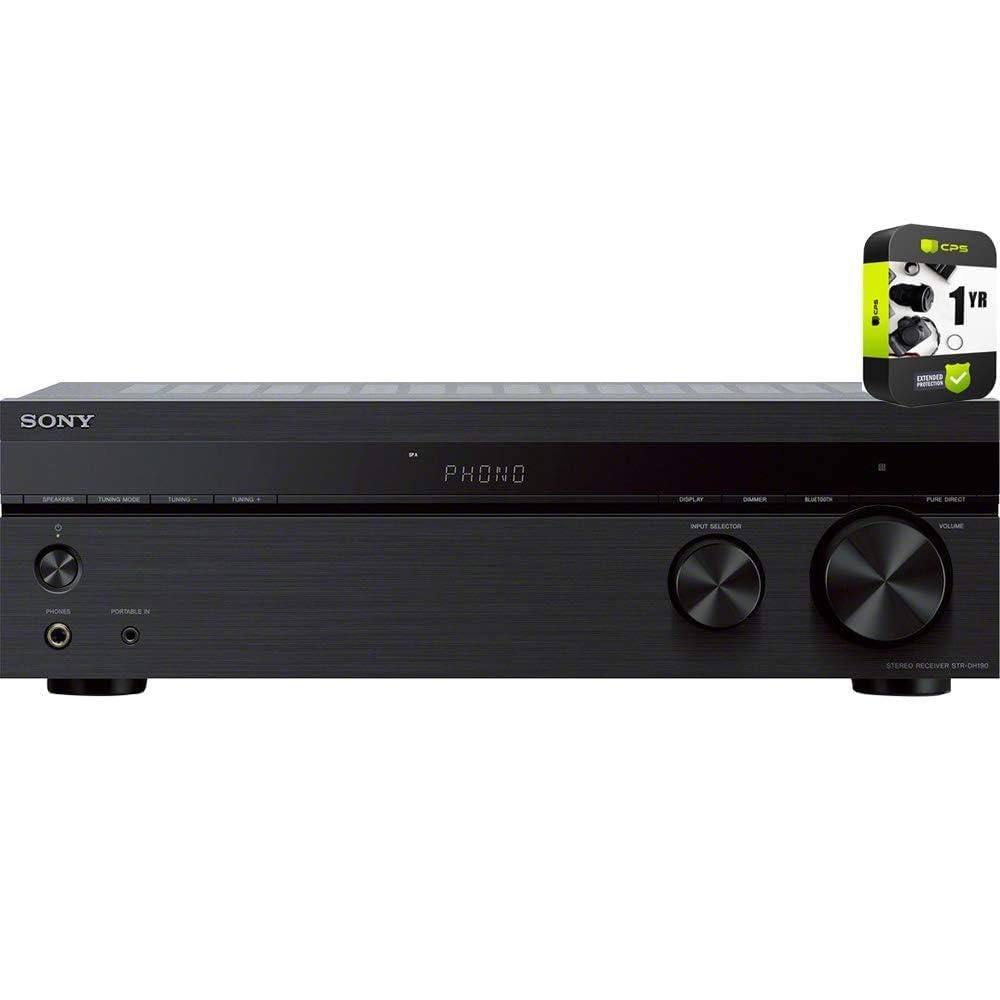
A simple, affordable receiver that brings Bluetooth and a phono preamp together in one clean box.
The Sony STRDH190 is as straightforward as stereo receivers get. It has a phono input for your turntable, Bluetooth for wireless streaming, and both 3.5mm jack and RCA inputs for other devices. Its dimensions (11.25″D x 17″W x 5.25″H) make it 78% shallower than the Yamaha R-S202, which is a big deal if your media cabinet is not deep. Reviewers point out one replaced “JVC amp with Sony 200W receiver” and found the Bluetooth delivered “crisp, clean sound with 500W speakers.” The front-panel headphone jack is also handy for late-night listening without disturbing anyone.
The catch is that some units have no FM capability, and the FM setup process itself is confusing — multiple buyers noted the directions were “complicated” and stations hard to set. Also, one unit arrived dead on arrival, so quality control seems inconsistent. If you want FM radio, this is not the receiver for you. But if all you need is a reliable phono + Bluetooth hub for your living room, it is tough to top at this price point. Unlike the Onkyo TX-8470, it has no Wi-Fi or app — you control everything from the remote or front buttons, which is simpler and faster once set up.
Strong points
- Phono input included — no separate preamp for your turntable
- Compact depth fits in tighter cabinets than the Yamaha R-S202
- Bluetooth works well and sounds clean with decent speakers
Weak points
- FM tuner is absent on some units and confusing to set up on others
- A few reported units arrived non-functional
Best for: the vinyl enthusiast on a budget who wants Bluetooth as a bonus and does not care about FM radio.
skip it if: you need dependable FM reception or want network streaming — the Onkyo TX-8470 or Yamaha R-S202 serve those needs better.
5. Yamaha Audio R-S202 Stereo Receiver (Renewed)

The no-frills Yamaha R-S202 delivers sturdy 100W per channel with a tuner for radio lovers.
This is a pure stereo receiver with no surround-sound gimmicks. It delivers 100W per channel at 8 ohms, so it has enough headroom to drive two pairs of speakers (selectable via a front-panel button). It also has a 40-station FM/AM preset tuner — a feature that is becoming rare — and Bluetooth built in for streaming. Buyers call it a “100W per channel, no-frills amp with sturdy sound” and note it pairs well with vintage speakers. The front-panel headphone output (a 1/4-inch jack) is there for private listening. The dimensions (20″D x 15″W x 8″H) mean it takes up a fair bit of shelf space — the Sony STRDH190 is 78% less deep.
One quirk: the volume knob requires many turns to go from quiet to loud, which some owners found annoying. The remote control is not backlit, which one reviewer noted they would have paid extra for. Still, for the price, this is among the most reliable entry-level receivers you can buy. Unlike the Denon PMA-600NE which is an integrated amplifier with analog-only focus, the Yamaha includes a built-in tuner and speaker switching, making it the better pick if you have two sets of speakers or still listen to FM radio.
Highlights
- Built-in FM/AM tuner with 40 presets for radio fans
- Speaker A/B switching for two speaker sets
- Solid 100W per channel easily drives vintage floorstanders
Lowlights
- Volume knob needs many rotations — not quick to adjust
- Large footprint; requires deep shelf space
Who this is for: someone with two pairs of speakers (maybe one in the living room and one on a patio) who still listens to the radio and wants Yamaha reliability.
Who should skip it: anyone with a shallow media cabinet — the Sony STRDH190 fits much better — or anyone who hates turning a knob many times to change volume.
6. Technics SA-C100 Premium Class Network CD Receiver

A premium all-in-one that packs a CD player, network streaming, and a high-resolution DAC into a compact chassis.
The Technics SA-C100 is a do-everything hub for the serious listener. It has a built-in CD player (with a quiet, illuminated slot), a phono equaliser compatible with MM cartridges, and a full digital amplifier using Technics’ JENO Engine (a technology that reduces noise and distortion by shaping the signal). It also includes Wi-Fi, Bluetooth, USB, and both optical and coaxial inputs. The dimensions (13.39″D x 13.39″W x 3.7″H) are almost square and notably short, so it fits under a TV or on a narrow shelf. Shoppers say “superb sound quality” and note the FM radio is “crisp with the included antenna.”
There are some polarizing issues. The receiver has no internal crossover (a filter that would send only lows to a subwoofer and mids/highs to speakers), so the subwoofer output sends full-range mono signal — you need a sub that has its own crossover. Some users found the sound “muddy and bassy” at default settings and needed to dial bass down and treble up. The price positions it firmly as a lifestyle product for those who want a single elegant box that does CD, streaming, and vinyl. Compared to the Onkyo TX-8470, the Technics is smaller, has a CD player, and uses a digital amp, while the Onkyo has HDMI inputs and more flexible network integration.
Premium touches
- Built-in CD player with quiet mechanism and illuminated slot
- JENO Engine digital amp delivers clean, powerful sound (50W into 4Ω)
- Compact, well-built metal chassis takes up little shelf space
Things to know
- No internal crossover for subwoofer — you need a powered sub with its own crossover
- Some users report muddy bass that requires EQ adjustment
- THD rating causes confusion (1% due to new FTC regulation, not typical performance)
Perfect if: you want a single, elegant component that plays CDs, streams wirelessly, and works with your turntable, all in a smaller footprint than the Yamaha R-S202.
Not if: you need a simple, no-tuning-required receiver or you plan to use the subwoofer output with a passive sub — the Denon PMA-600NE is more straightforward for those needs.
Understanding the Specs
Watts Per Channel (W x 2)
This tells you how loud the receiver can get. But the number only matters relative to your speakers’ sensitivity (how easily they convert power into sound). A speaker rated at 90dB sensitivity will sound just as loud with 30W as a 86dB speaker does with 70W. The Fosi Audio BT20A Pro claims 300W x 2, which is massive for a desktop amp, while the Denon PMA-600NE puts out 70W x 2 at 4 ohms — fine for most bookshelf speakers in a medium room.
Phono Input
A phono input is a specialized input that amplifies the very weak signal from a turntable’s cartridge (the needle and magnet assembly) and applies the correct equalization curve (a specific bass-cut and treble-boost needed for vinyl records). Without it, a turntable will sound quiet and tinny. The Sony STRDH190 and Denon PMA-600NE both have built-in phono preamps. If you buy a receiver without one (like the Fosi Audio BT20A Pro), you will need a separate small box called a phono preamp to connect your turntable.
Class D vs Class A/B Amplifier
A Class D amplifier uses high-speed switching to turn the signal on and off very fast, which makes it more efficient (less heat, smaller size). The Fosi Audio BT20A Pro is a Class D amp. A Class A/B amplifier is the traditional design — less efficient but often preferred for its “musical” quality. The Denon PMA-600NE is a Class A/B amp (specifically an Advanced High Current circuit). The Onkyo TX-8470 uses a Class G design, which is a variation of Class AB that switches to higher voltage rails for louder passages to stay efficient.
Bluetooth Streaming & Codecs
Bluetooth lets you play music from your phone wirelessly. The Fosi Audio BT20A Pro uses Bluetooth 5.0 for a stable connection. The Denon PMA-600NE and Yamaha R-S202 also have Bluetooth. Some receivers like the Technics SA-C100 and Onkyo TX-8470 add Wi-Fi for higher-resolution streaming (up to 192kHz/24-bit) that Bluetooth cannot carry. If you plan to stream lossless audio (audio compressed without losing quality) from services like Tidal, a receiver with Wi-Fi or a wired network connection is worth considering.
FAQ
Can I connect a turntable to any 2.0 channel stereo receiver?
What does 2.0 channel mean exactly?
How many watts do I really need for a living room?
Is a Class D amplifier worse than Class A/B for sound quality?
Will my old speakers work with a modern 2.0 receiver?
What is the difference between an integrated amplifier and a stereo receiver?
Can I use a 2.0 channel receiver for TV audio?
What does “Roon Ready” mean on the Onkyo TX-8470?
Is the Technics SA-C100 worth the price over the others?
Can I add a subwoofer to any 2.0 channel receiver?
Final Thoughts: The Verdict
For most people, the best 2.0 channel stereo receiver is the Denon PMA-600NE because it blends warm, engaging sound with built-in Bluetooth, a phono input for vinyl, and the unique Analog Mode that removes all digital noise — all in a solid, well-built chassis. If you want a compact, high-powered alternative for a second room or desktop, grab the Fosi Audio BT20A Pro. And for the network-centric listener who wants Wi-Fi, Roon, and HDMI, the Onkyo TX-8470 is the feature-rich hub to build your system around.
How We Picked
We do not accept paid placement. Every pick is matched to a real buyer and a real use-case; we do not hands-on test units.
Sources & Methodology
Specifications: manufacturer listings and product documentation. Review insights: verified customer reviews, as of July 2026. Pricing: not shown on this page (it changes often); check the current price via the retailer link.
As an Amazon Associate, Gadgets Feed earns from qualifying purchases. This does not affect which products we feature.