
That hollow, tinny sound from your TV speakers is robbing you of every movie explosion, every deep bass note in your music, and every whisper of dialogue. A true 2.1 home theater system separates the left and right audio channels into dedicated speakers, paired with a subwoofer dedicated to low frequencies, creating a soundstage a single soundbar simply cannot achieve. This guide cuts through the marketing hype to compare the best systems that deliver real channel separation, impactful bass, and lasting build quality.
I’m Min — the co-founder and writer behind Gadgets Feed. I’ve spent hundreds of hours analyzing the frequency response, power handling, driver materials, and connectivity options that define a genuinely great system in this crowded category.
After combing through thousands of reviews and technical specs, I’ve built this definitive ranking to help you find the best 2.1 home theater system for your room, your content, and your budget.
How To Choose The Best 2.1 Home Theater System
A strong 2.1 system hinges on three pillars: the quality of the main speakers, the depth and control of the subwoofer, and the connectivity that ties it all together. Ignoring any one of these leads to an experience that feels flat, boomy, or frustrating to use.
Speaker Build & Driver Quality
The heart of any 2.1 system is the left and right speakers. Look for cabinets made of solid wood or dense MDF rather than thin plastic, as they resonate less and produce cleaner midrange and treble. The driver material matters — aluminum-magnesium alloy diaphragms with reinforced ribs, as seen on some premium models, are stiffer and more accurate than paper or basic polypropylene cones. Pay attention to the tweeter; a dedicated tweeter is essential for crisp highs and clear dialogue, while a full-range driver alone often sounds muddy.
Subwoofer Performance
The ‘1’ in 2.1 is arguably the most important component. The subwoofer’s cone size — typically 5.25 inches to 10 inches — directly correlates with the depth and pressure of the bass. A larger cone can move more air, producing lower frequencies with less distortion at high volumes. The cabinet design is critical: a down-firing subwoofer (firing into the floor) generally distributes bass more evenly across a room, while a front-firing design offers a more direct, punchy feel. Pay attention to the frequency response specification; a system that reliably reaches down to 35 Hz or lower will reproduce the deepest rumbles in movies and music.
Connectivity & Power
Your system needs to integrate with your TV and other devices seamlessly. HDMI ARC or eARC is the gold standard, as it carries lossless audio from your TV to the system and allows control with a single remote. Optical is a reliable fallback for 5.1 Dolby Digital, but it cannot carry high-bitrate formats. Bluetooth 5.3 or higher is necessary for low-latency streaming from your phone. Power is often quoted as peak watts, which is a short-burst figure; RMS power, a continuous measurement, is a more honest indicator of how loud and clean the system can play.
Quick Comparison
On smaller screens, swipe sideways to see the full table.
| Model | Category | Best For | Key Spec | Amazon |
|---|---|---|---|---|
| SAMSUNG Q990D | Premium | Cinema-grade immersion | 11.1.4 channels / Wireless Dolby Atmos | Amazon |
| ULTIMEA Skywave X50 | Premium | Wireless surround convenience | 760W Peak / 28Hz sub-bass | Amazon |
| LG S95TR | Premium | LG TV integration & gaming | 9.1.5 channels / 120Hz VRR passthrough | Amazon |
| ULTIMEA Poseidon D80 | Premium | Versatile app-controlled sound | 7.1Ch / Dolby Atmos / 121 EQ presets | Amazon |
| Monoprice 5.1.2 | Mid-Range | True entry-level Atmos kit | 8″ 200W subwoofer / Upward-firing drivers | Amazon |
| Bobtot 5.1/2.1 | Mid-Range | High volume & LED party lighting | 1200W Peak / 10″ subwoofer | Amazon |
| Rockville HTS56 | Entry-Level | Budget-friendly karaoke & 5.1 | 1000W Peak / 8″ subwoofer / Mic inputs | Amazon |
| Hiwill-Audio N512 | Mid-Range | Wood cabinets & wired stability | 400W Peak / 5.25″ subwoofer / 11 drivers | Amazon |
| Pyle 5.2 Receiver | Entry-Level | Flexible receiver for passive speakers | 1000W MAX / 4K Ultra HD pass-through | Amazon |
In‑Depth Reviews
1. SAMSUNG Q990D 11.1.4ch Soundbar w/Wireless Dolby Atmos Audio

The Samsung Q990D is the undisputed benchmark for home theater audio. Its 11.1.4-channel configuration — with 11 front-facing drivers, a powerful subwoofer, and four up-firing channels — creates a dense, three-dimensional sound bubble that is unmatched by any other system in this guide. The wireless rear speaker kit includes both up-firing and side-firing drivers to bounce sound off your ceiling and walls, delivering true Atmos height effects without running speaker wire across the room.
Q-Symphony works flawlessly when paired with a Samsung TV, allowing the TV’s speakers to harmonize with the soundbar for a wider, more powerful front soundstage. Adaptive Sound and SpaceFit Sound Pro analyze your content and room acoustics in real time, optimizing dialogue clarity and bass response automatically. With built-in Alexa, Chromecast, and AirPlay 2, it’s also the most feature-complete smart soundbar available.
The only caveat is a very small number of users reports a random one-second audio drop when using eARC, a Samsung-related bug that appears on some TV models. Despite this, the Q990D remains the system that sets the standard for “Best 2.1 Home Theater System” — and its channel count far exceeds that label, offering a truly future-proof experience.
Why it’s great
- Industry-leading 11.1.4 channel immersion with true Atmos height effects
- Wireless rear speakers with dual-firing drivers simplify placement
- Q-Symphony and SpaceFit Sound Pro intelligently optimize audio to your room
Good to know
- eARC audio drop bug reported on certain Samsung TV models
- Premium price point reflects the cost of top-tier components
2. ULTIMEA Skywave X50 5.1.4ch Wireless Surround Sound System
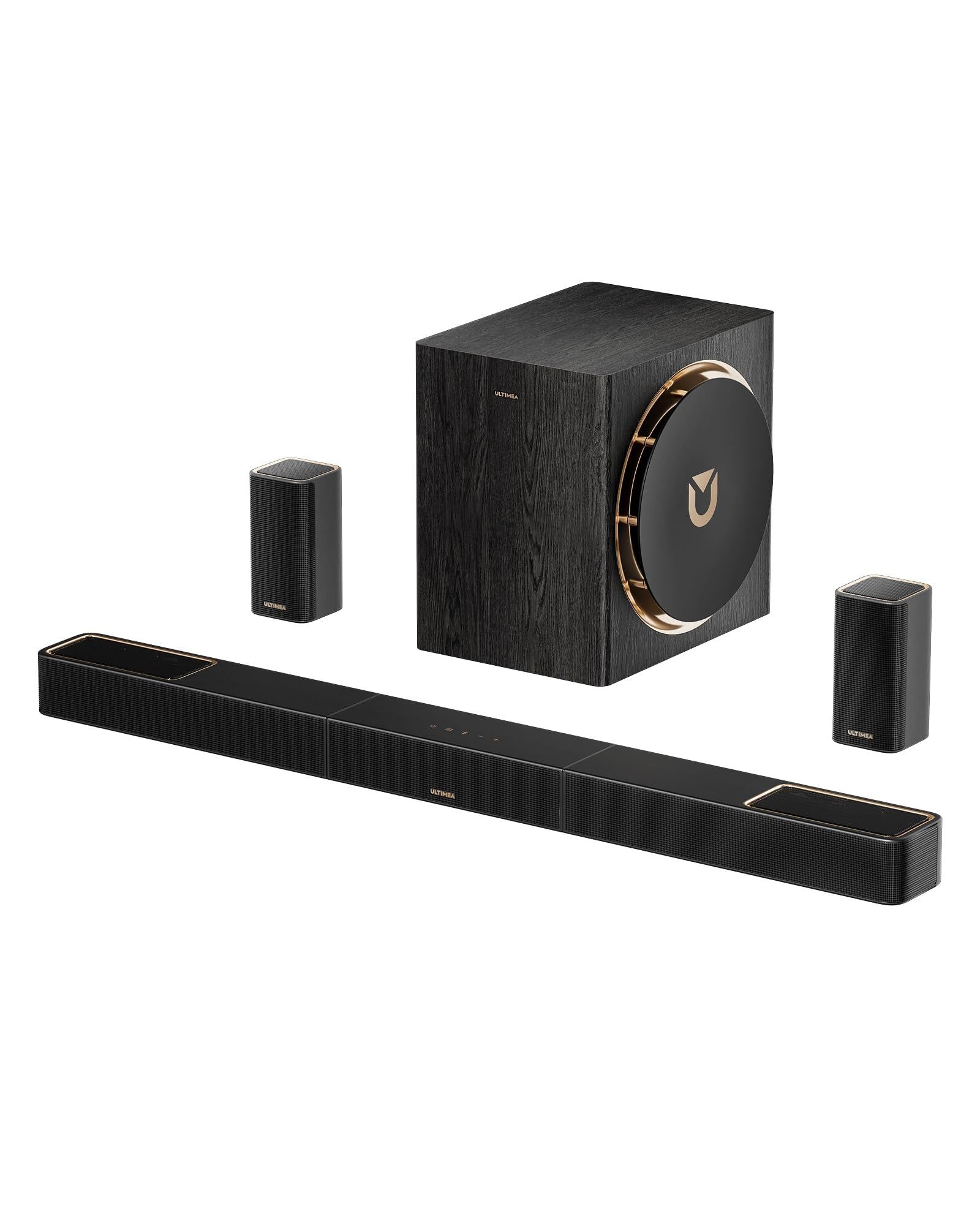
The Skywave X50 is a no-compromise wireless system that uses dual 5GHz transmission bands to keep the rear speakers perfectly in sync with the soundbar, eliminating the pairing and drop-out issues that plague cheaper wireless setups. Its 5.1.4-channel layout delivers a full Dolby Atmos experience, with two upward-firing drivers in the soundbar and two more in the wireless rear satellites, creating a convincing overhead sound field for rain, helicopter flyovers, and thunder.
The subwoofer is the system’s real weapon: an 8-inch driver in a wood-crafted enclosure, powered by Ultimea’s Gravus Ultra-Linear Bass Technology, which hits a remarkably low 28Hz with clean, distortion-free pressure. The GaN amplifier provides up to 98% efficiency, meaning less heat and more headroom for dynamic peaks. The NEURACORE multi-channel audio engine processes 24-bit/192kHz audio with under 0.5% total harmonic distortion, revealing details that most soundbars simply bury.
The bass can be so powerful that it may overshadow the dialogue or midrange depending on your content, and the app requires some initial setup to find the right EQ balance. However, for the price, the Skywave X50 offers a level of clarity, bass depth, and wireless convenience that rivals systems costing significantly more.
Why it’s great
- Rock-solid dual-5GHz wireless rear speaker connection
- Exceptional 28Hz sub-bass output from a wood-crafted 8-inch subwoofer
- GaN amplifier and NEURACORE DSP deliver ultra-clean, high-power sound
Good to know
- Powerful bass can mask dialogue without app EQ adjustment
- Requires initial setup of app-based sound profiles for best results
3. LG S95TR 9.1.5-Channel Home Theater Soundbar

The LG S95TR is engineered for the modern gamer and movie enthusiast who demands the lowest latency and highest bandwidth. Its 9.1.5-channel layout includes triple up-firing speakers — including an industry-exclusive center up-firing driver — which anchors dialogue to the screen while the height channels create a convincing dome of sound. The true wireless rear speakers are plug-and-play, needing only a power outlet, and LG’s advanced room calibration uses the built-in microphone to detect rear speaker placement and optimize the sound field automatically.
HDMI passthrough supports up to 120Hz VRR and ALLM, making it a perfect companion for the PlayStation 5 or Xbox Series X. The WOW Orchestra feature synchronizes the soundbar with compatible LG TV speakers for a wider, more cohesive front stage. Dolby Atmos and DTS:X are both supported natively, and the built-in WOWCAST allows wireless Dolby Atmos streaming directly from an LG TV, eliminating the need for an HDMI cable entirely.
The system is on the larger side, and its full retail price is steep for a soundbar package. On sale, it’s a strong value — but at full price, it faces stiff competition from Samsung’s Q990D. If you own an LG OLED TV and prioritize gaming features, the S95TR is the perfect match.
Why it’s great
- 120Hz VRR and ALLM passthrough for competitive gaming
- Triple up-firing drivers with dedicated center height channel for dialogue
- WOWCAST enables wireless Dolby Atmos from LG TVs
Good to know
- Requires LG TV for full WOW Orchestra and WOWCAST functionality
- Premium pricing; better value when purchased on sale
4. ULTIMEA Poseidon D80 7.1Ch Soundbar with Dolby Atmos

The Poseidon D80 is an upgraded version of the popular D60, and it brings two additional front surround speakers to the party, expanding the soundstage significantly. This is a 7.1-channel system with a wireless 6.5-inch subwoofer, and it supports Dolby Atmos decoding, which is rare at this price point. The 8 high-performance drivers include dedicated tweeters and full-range speakers, ensuring clear, detailed sound across the frequency spectrum.
What sets the D80 apart is its software intelligence. The ULTIMEA Smart App offers 121 expert-crafted EQ presets covering genres like Bass, Pop, Classical, and Rock, plus a full 10-band custom equalizer. Six tailored sound modes — Movie, Music, Voice, Sport, Game, and Night — let you optimize the system instantly for any content. The SurroundX System and 360° Aural Spatial Localization Technology work together to create a convincing bubble of sound, even from a 7.1-channel layout.
The remote requires direct line-of-sight to the soundbar, which is inconvenient if your system is not in clear view. Some users also report that the eARC power-on can be inconsistent. However, for the price, the D80 delivers a level of customizability and surround immersion that makes it a strong contender for the most versatile system in this guide.
Why it’s great
- 121 EQ presets and 10-band custom equalizer via app
- Wired front and rear surround speakers expand soundstage effectively
- Dolby Atmos decoding at a price point where it’s rarely found
Good to know
- Remote control requires direct line-of-sight to the soundbar
- eARC power-on behavior can be inconsistent across different TV brands
5. Monoprice Premium 5.1.2 Channel Immersive Home Theater System

The Monoprice 5.1.2 system is the most affordable way to get actual Dolby Atmos height effects in a traditional passive speaker setup. The two main front speakers include upward-firing drivers that bounce sound off the ceiling to create a sense of overhead immersion. When paired with a budget-friendly Atmos-capable AV receiver, this system can outperform many soundbars at double the price in terms of raw soundstage width and clarity.
The included 8-inch 200-watt subwoofer provides solid, authoritative bass that works well in medium-sized rooms up to about 400 square feet. The satellite speakers are 2-way designs with separate tweeters and woofers, which is a significant step up from cheap single-driver speakers. Users report that the system sounds crisp and clear, with excellent dialogue articulation and a convincing Atmos effect that pulls you into movies and games.
The subwoofer’s 8-inch driver can bottom out under very heavy bass loads, and the center channel speaker has a slightly boxy resonance at certain frequencies. Replacing the center and sub with higher-end components is a common upgrade path. This is a system for the buyer who wants a real AV receiver-based setup and is willing to do the wiring, not a plug-and-play solution.
Why it’s great
- True Dolby Atmos height effects at an entry-level passive speaker price
- 2-way satellite speakers with dedicated tweeters for clear sound
- Solid 200W subwoofer handles medium-sized rooms with authority
Good to know
- Requires a separate Atmos-capable AV receiver to function
- 8-inch subwoofer can bottom out on demanding low-frequency content
6. Bobtot Home Theater Systems Surround Sound Speakers 1200 Watts
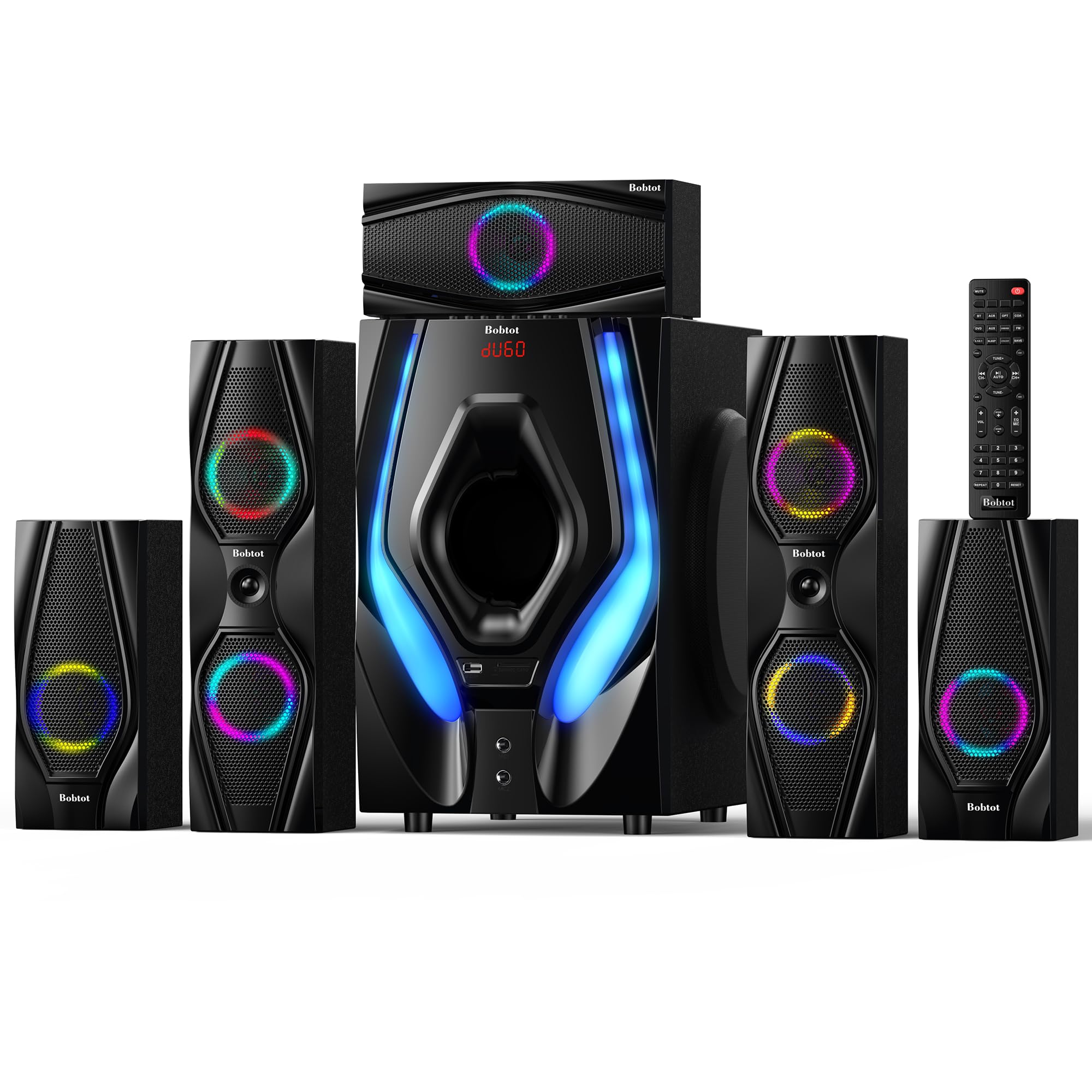
The Bobtot system is built for one thing: raw, high-volume power with a visual show. Its 10-inch subwoofer is the largest in this guide, and it delivers thunderous, room-shaking bass that is perfect for movies and parties. The system can switch between 5.1 and 2.1 channel modes, making it flexible for both surround sound content and simple stereo music playback. The four LED lighting modes on the subwoofer — blink-to-the-beat, solid on, spectrum EQ analyzer, and off — add a real club-like atmosphere.
The satellite speakers are wired, with long built-in cables: 13 feet for the front speakers and an impressive 31 feet for the rear satellites, allowing for flexible placement even in large living rooms. The system supports Bluetooth 5.3, HDMI ARC, Optical, Coaxial, AUX, USB, and SD card inputs, making it one of the most connectivity-rich options available. Two 1/4-inch microphone inputs with echo control turn this into a capable karaoke machine.
Build quality and reliability are the primary concerns here. A significant number of user reports describe failures within the first year, including channel dropout and complete system death. While the customer service is responsive, the failure rate is higher than average. If you value raw power and party features above long-term bulletproof reliability, this system delivers — but budget for a potential replacement.
Why it’s great
- Massive 10-inch subwoofer delivers the deepest, loudest bass in this category
- Flexible 5.1/2.1 channel switching and extensive input options
- Karaoke-ready with dual mic inputs and LED atmosphere lighting
Good to know
- Higher-than-average failure rate after 6-12 months of use
- Only email-based customer support located overseas
7. Rockville HTS56 1000W 5.1 Channel Home Theater System

The Rockville HTS56 is a classic entry-level 5.1 system that has been a popular choice for budget buyers for years. Its 8-inch subwoofer, while not as deep as larger models, produces a punchy and satisfying low end that more than fills a small to medium-sized room. The five satellite speakers are compact but surprisingly loud, and the included subwoofer amplifier handles all the processing and power delivery. The system includes Bluetooth, USB, SD card, FM radio, and two microphone inputs with echo, making it a complete entertainment hub for the price.
The visual design is enhanced by LED lights on both the subwoofer and the satellite speakers, with multiple modes including a beat-blinking spectrum analyzer that adds a fun, theatrical touch. The setup is straightforward, with color-coded cables, and the remote control allows for independent volume adjustment of each speaker and the subwoofer. For under two hundred dollars, this is a massive amount of hardware.
The system has a critical limitation: its optical input cannot decode a full 5.1 Dolby Digital stream, only 2.1 PCM. To get true 5.1 surround, you need an external DAC or you must use the RCA inputs. The speaker fidelity is also fairly basic, with some distortion at high volumes and a lack of detail in the mids and highs. It is a loud, fun system for parties and casual movie nights, not for critical listening.
Why it’s great
- Incredible value for a complete 5.1 system with subwoofer and receiver
- Built-in karaoke with two mic inputs and echo control
- LED light modes on speakers and subwoofer add a party atmosphere
Good to know
- Optical input only supports 2.1 PCM, requires external DAC for 5.1
- Speaker fidelity is basic with some distortion at high volume
8. Hiwill-Audio N512 Wooden 5.1.2 Virtual Surround Sound System
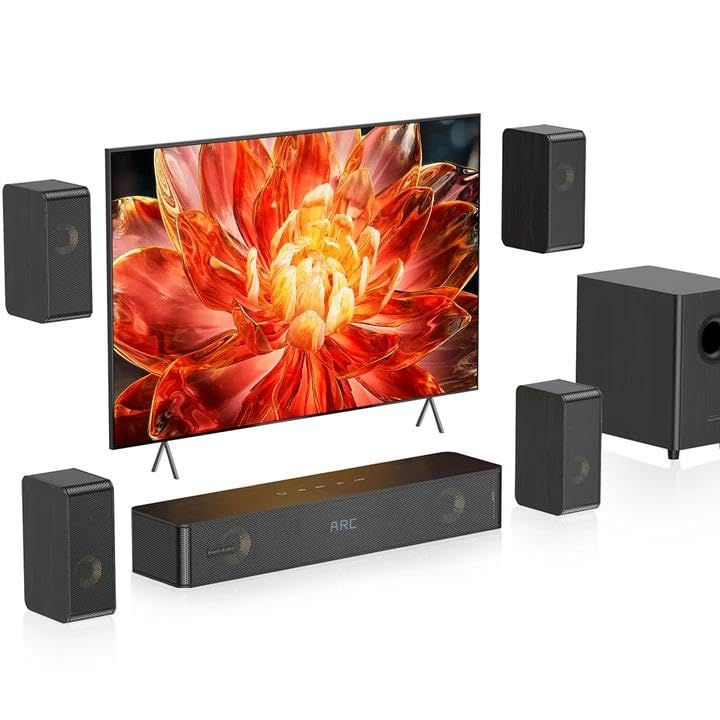
The Hiwill-Audio N512 stands out because of its materials. While most systems in its price bracket use thin plastic cabinets, the N512 uses solid wood for the main soundbar and enclosures. It houses 11 custom drivers, including dedicated tweeters and full-range speakers, all featuring aluminum-magnesium alloy diaphragms with reinforced ribs. This combination of materials produces noticeably cleaner, more accurate sound with less cabinet resonance and better transient response than plastic competitors.
The system uses a pro-grade hybrid surround design: the rear speakers connect wirelessly to the main unit but are wired to each other with a single cable. This eliminates the pairing dropouts common in fully wireless setups while maintaining easy placement flexibility. The 5.25-inch down-firing subwoofer is well-tuned for a small to medium room, and the adjustable bass control (-6 to +6) lets you fine-tune the low end without distortion.
The system does not support Dolby Atmos or DTS decoding, relying instead on its own Discrete Spatial Expansion technology to create a virtual surround field. Music lovers will appreciate the clean, balanced sound signature, but movie purists seeking native object-based audio decoding will be disappointed. The rear speakers occasionally emit a soft pop due to Bluetooth interference, though a firmware update from the manufacturer addresses the issue.
Why it’s great
- Solid wood cabinets with aluminum-magnesium alloy drivers for superior clarity
- Hybrid wireless/wired rear speaker design eliminates dropouts
- Adjustable bass, treble, and rear surround volume via preset EQ modes
Good to know
- No Dolby Atmos or DTS decoding support
- Rear speakers may emit soft pops due to Bluetooth interference
9. Pyle 5.2 Channel Hi-Fi Home Theater Receiver

The Pyle 5.2 receiver is the right choice if you already own a set of passive speakers and just need an amplifier and processor to drive them. It outputs a claimed 1000 watts of peak power across 5.2 channels, and it supports 4K Ultra HD video passthrough with H.264 encoding. The built-in DAC allows for digital audio input from a computer via optical or coaxial, which is a very useful feature for desktop setups or PC gaming.
Bluetooth streaming is included, and the connection range is adequate for a typical living room. The receiver also features overcurrent, short circuit, and overvoltage protection, which is a welcome safety measure at this price point. For users looking to build a budget 5.1 or 5.2 system around existing speakers, this unit provides the necessary amplification and connectivity without the complexity of higher-end AV receivers.
Build quality is a significant concern. A number of user reports describe the unit failing within weeks, including scrambled optical output and remote control failure. The amplifier’s power output is also limited in practice — it is suitable for an apartment or dorm room but will struggle to drive low-sensitivity speakers or fill a large room with clean sound. Consider this a low-cost starting point for experimentation, not a permanent solution.
Why it’s great
- Affordable 5.2 channel receiver with 4K video passthrough
- Built-in DAC for high-quality digital audio from a computer
- Multiple protection circuits for overcurrent and overvoltage
Good to know
- Questionable reliability with some units failing quickly
- Limited real-world power; best suited for small rooms or desktop setups
FAQ
Is a 2.1 system better than a soundbar for music and movies?
Do I need an AV receiver for a 2.1 system?
What is the ideal subwoofer size for a living room?
Final Thoughts: The Verdict
For most users, the best 2.1 home theater system winner is the SAMSUNG Q990D because it delivers an unmatched 11.1.4-channel soundscape with true Dolby Atmos height effects and wireless rear speakers that eliminate cable management. If you want a system with rock-solid wireless rear connectivity and thunderous 28Hz sub-bass, grab the ULTIMEA Skywave X50. And for the best raw volume and party-friendly features at a mid-range price, nothing beats the Bobtot 5.1/2.1 System.