
Our readers keep the lights on and my morning glass full of iced black tea. As an Amazon Associate, I earn from qualifying purchases.
Specs are compiled from manufacturer listings and verified buyer reviews and can change over time — please confirm the key details on the product page before buying.
Dandelions are the lawn equivalent of that one houseguest who never leaves — they show up in spring, drop thousands of seeds, and laugh at a single spraying. A 2,4-D based selective herbicide kills dandelions to the root without harming your turf grass., but the shelf is crowded with concentrates, ready-to-use wands, and farm-grade jugs that all promise the same thing. This guide ranks them by active ingredient strength, coverage per bottle, speed of visible results, and mixing effort.
I’m Min — the founder and writer behind Gadgets Feed. This guide is built by comparing the manufacturers’ published specifications and the patterns across verified customer reviews, so you get each pick’s real strengths and trade-offs instead of marketing spin.
You’ll see exactly which concentrated formulas wipe out dandelions fastest and which ready-to-use options are worth the convenience. Here’s the practical breakdown of the best 2,4-D herbicide for dandelions, tailored for homeowners who want a clean lawn without a chemistry degree.
Our Picks at a Glance


How To Choose The Best 2,4-D Herbicide For Dandelions
To kill dandelions without killing your grass, you first pick a format that fits your yard. A ready-to-use bottle works for spot-treating a few weeds, while a concentrated jug is better if you’re covering a whole lawn or a large property.
Read the Active Ingredient Percentage
The active ingredient is the part that actually kills the weed. A product with a higher percentage of 2,4-D, like 47.2%, needs a smaller amount per gallon to be effective. Lower percentages mean you use more product per tank, which can make a “cheap” bottle disappear fast.
Check the Coverage and Bottle Size
Coverage is stated in square feet, and it varies wildly — a 32-ounce concentrate might cover 5,000 square feet, while a gallon jug of another might treat 32,000. Always do the math on how many square feet your lawn actually is before you buy, so you don’t run out halfway through.
Decide Between Mix-Your-Own and Ready-to-Use
Concentrates require a sprayer, measuring, and careful mixing, but they cost less per application and let you treat large areas. Ready-to-use bottles with a wand are instantly grab-and-go for a quick spot spray, but they cost more per ounce and you carry the weight of the water around the yard.
Quick Comparison
| Model | Best For | Active Ingredients | Liquid Volume | Coverage | Amazon |
|---|---|---|---|---|---|
| Winfield Shredder 2,4-D Amine★ Best Overall | Large properties & food plots | 2,4-D Amine | 2.5 gallons | — | Amazon |
| SpeedZone EWFastest Knockdown | Fast visible results | 2,4-D, Dicamba, Carfentrazone, Mecoprop | 20 fluid ounces | 1,000 sq ft per mix | Amazon |
| Liquid Harvest Lawn Weed KillerPremium Value | Low odor three-way control | 2,4-D, MCPA, Dicamba | 32 fluid ounces | 1,000 sq ft per mix | Amazon |
| GORDON’S Trimec | Creeping charlie & clover | Trimec (2,4-D based) | 32 fluid ounces | 8,000 sq ft | Amazon |
| Southern Ag Lawn Weed Killer | Value on common weeds | Trimec (2,4-D based) | 32 fluid ounces | 5,000 sq. ft. | Amazon |
| Ortho WeedClear Comfort Wand | No-mix spot treatment | 2,4-D based | 1.33 gallons | — | Amazon |
| Spectracide Weed Stop Concentrate | Huge lawn coverage | 2,4-D based | 128 fluid ounces | 32,000 sq ft | Amazon |
| ALLIGARE 2,4-D Amine | Farm-grade strength | 2,4-D Amine (47.2%) | 1 gallon | — | Amazon |
| Select Source Triad QC Select | Crabgrass plus broadleaf | 2,4-D, Dicamba, Quinclorac | 32 fluid ounces | — | Amazon |
In‑Depth Reviews
1. Winfield Shredder 2,4-D Amine 4 Herbicide 2.5 Gallon
Our pick — over 4.5★ from 200+ verified ratings; the strongest balance of quality and price.
The 2.5-gallon jug that eliminates dandelions for years on large properties.
This is the jug you buy when you’re done messing around — a 2.5-gallon container of straight 2,4-D Amine concentrate that weighs in at 25 pounds. That’s roughly double the physical weight of the Ortho ready-to-use wand bottle, but you’re getting far more than double the actual weed-killing chemistry. On a 3-acre Georgia lawn, a single mix of 1 ounce per gallon, sprayed twice two weeks apart, wiped out every lawn spur and left the grass, vetch, and clover untouched — with plenty of concentrate left over for years of follow-ups.
Because it’s a pure 2,4-D Amine formula, no adjuvants or extra spreader-stickers are needed before spraying. It’s labeled for turf and other crops, and it’s also cleared for use in slow-moving waters like ponds, lakes, drainage ditches, and canals — a versatility most homeowner brands don’t offer. The trade-off is in the math: this is a farm-scale jug, and the instructions skew toward agricultural use. Homeowners report the label is vague for simple yard work, so you’ll want to follow the 1-ounce-per-gallon ratio that’s proven to work on residential lawns.
For food plot prep, it shines when combined with a grass killer like Roundup, tackling both broadleaf weeds and small shrubs for a clean seedbed. The crowd favorite here — 4.7 stars across 200+ owners — keeps coming back to the same verdict: it kills broadleaf weeds fast, and the value per gallon is tough to top.
Why the big jug wins
- Pure 2,4-D Amine needs no extra adjuvants before you spray
- 2.5-gallon size lasts multiple seasons on a large property
- Legal for aquatic sites like ponds and drainage ditches
Who should pass
- 25-pound jug is heavy and awkward to pour for small yards
- Label directions read like an ag manual, not a lawn guide
- Not sold to CA or TX — orders to those states get cancelled
Reach for this if: you have acreage, a food plot, or serious weed pressure and want a multi-year supply of straight 2,4-D.
Look elsewhere if: you just want to spot-spray a townhouse lawn — this is far more concentrate than you need.
2. SpeedZone EW Lawn Weed Killer
The fastest-acting formula, showing visible results within hours.
When you’re tired of waiting two weeks to see if a spray worked, SpeedZone EW is the answer. Its four-way blend of 2,4-D, dicamba, carfentrazone, and mecoprop delivers visible effects within hours, with weeds typically burned by day three and completely dead by day seven. One owner sprayed a 13,000-square-foot lawn with a mower-mounted boom and found nearly every weed dead within a week, with the few survivors easy to hand-pull — no follow-up application needed.
It controls 90+ listed weeds including dandelion, white clover, ground ivy, and spurge, and it’s labeled for fescue, Kentucky bluegrass, perennial ryegrass, Bermudagrass, and zoysiagrass. The cool-weather performance is a standout: it keeps working when temperatures drop, which is exactly when spring and fall dandelions are most active. It’s also rainfast in as little as 3 hours, so an afternoon shower won’t wash away your work — and you can reseed in as little as 7 days, which is unusually fast for this category.
The catch is precision. The mixing instructions differ by grass type — 1.8 fluid ounces per 0.5 to 1 gallon of water for warm-season grasses, 1.5 fluid ounces for cool-season — and overspray onto grass can cause browning. The active ingredient list shows it’s a heavier hitter than the straight 2,4-D options above, which is exactly why careful application matters.
The speed read: no other pick in this lineup shows results in hours rather than days, and the 3-hour rainfast window makes it the most schedule-friendly concentrate here.
Just know: the 20-ounce bottle is small for big lawns, and you’ll pay a premium per ounce for that fast-acting chemistry.
Best for: homeowners who want to see the weeds curl up this weekend, not next month, and who follow mixing directions carefully.
Not for: casual sprayers who eyeball the ratio — this one punishes sloppy mixing with grass burn.
3. Liquid Harvest Lawn Weed Killer – 32 Ounces
The low-odor three-way concentrate with a high active-ingredient percentage at a value price.
Liquid Harvest builds its case right on the label: 30.89% 2,4-D, 8.23% MCPA, and 2.77% Dicamba. That’s a serious active-ingredient lineup for a 32-ounce concentrate, and it’s why the review pages keep landing on the same conclusion — this is a premium-level product at a value price. One owner who’d fought bindweed in a xeriscaped front yard for years with vinegar, salt, and soap finally killed it with about an ounce of this stuff.
The three-way combination is what makes it more versatile than a straight 2,4-D product. MCPA and dicamba expand the weed list to include creeping charlie, broadleaf plantain, and clover, which is exactly the mix of weeds that invades most lawns alongside dandelions. The low-odor formulation is a real bonus — you can treat the yard without that harsh chemical smell lingering for hours, and the review pages confirm it’s far more pleasant to apply than typical box-store brands.
Mixing is straightforward:.67 to 1.5 fluid ounces per gallon of water covers 1,000 square feet. It kills fast — one owner reported everything dead less than 24 hours after spraying around the house. The only honest caveat is that creeping charlie took a second application for full control, so stubborn perennial weeds may test your patience.
Grab it if: you want a three-way concentrate with heavy hitter ingredients and a smell that won’t clear the neighborhood.
Think twice if: you need one-pass perfection on creeping charlie — plan on a follow-up spray in a few weeks.
4. GORDON’S Trimec Lawn Weed Killer

The commercial-grade Trimec formula that eradicates creeping charlie and ground ivy.
GORDON’S Trimec has a resume most homeowner brands can’t touch — it’s the same formula used by certified technicians on commercial properties. This 32-ounce concentrate covers 8,000 square feet, which is 60% more ground than the Southern Ag Trimec bottle below, making it the smarter buy if your lawn is on the larger side. The review pages are emphatic: if you have creeping charlie, this stuff does a great job of getting rid of it.
It’s a 2,4-D based three-way formula, and the “buy this one” energy in the reviews is strong — one long-time user who’d tried several weed killers with mixed results called this the best, “not even close.” For property managers and lawn pros, it’s the familiar go-to. The application guidance is worth heeding: don’t spray on a windy day, follow the labeled ratio, and use a little in your sprayer per the recommendation.
The fair warning is in the name of one review: “slow working.” Some users find it takes its time on clover, which it only partially kills in some cases. That’s a mild knock against a product that otherwise earns consistent “best I’ve used” verdicts, but if you have creeping charlie or ground ivy as your main foe, this is the one the pros reach for.
The pro angle: commercial-grade Trimec formula with the widest coverage per dollar in the 32-ounce tier — 8,000 sq ft.
The patience note: clover can stubbornly survive a single pass; plan for a second application.
Choose this for: creeping charlie, ground ivy, and mixed broadleaf invasions where proven chemistry beats gimmicks.
Pass if: you expect one spray to nuke everything overnight — this one rewards patience and proper timing.
5. Southern Ag Lawn Weed Killer with Trimec – 32oz

The budget Trimec concentrate that kills dandelions in two weeks.
Southern Ag packs the same patented Trimec three-way chemistry into a 32-ounce bottle that covers 5,000 square feet, and it’s consistently cheaper than the GORDON’S equivalent. The review pages tell a clear story: “Killed dandelion invasion in 2 weeks with no harm to lawn.” That’s the headline benefit for anyone whose yard is a sea of yellow — it takes down the dandelions without sacrificing the grass. About 10% of weeds needed a respray, and clover is the weak spot, so set expectations accordingly.
It’s labeled for 9 turf types and works in both conventional and hose-end sprayers. The hybrid approach makes it flexible: mix 2 ounces per gallon for a tank sprayer, or attach a hose-end unit for larger passes. The effectiveness is the most-praised trait by a huge margin — over a hundred owners single it out — and it’s also called out for being less expensive than the alternatives while still getting the job done.
The honest catch is that weeds can return faster than you’d like. It delivers great knockdown power, but the effect isn’t season-long — expect to reapply every few weeks during peak growing season. One owner noted some grass may die if you’re aggressive with a full-yard spray, so spot-treating young weeds is the smarter play.
Buy it for: a budget-friendly three-way concentrate that reliably wipes out dandelions in two weeks on centipede grass and other common turf.
Skip if: you want a single application per season — this needs a repeat spray every few weeks while weeds are popping.
6. Ortho WeedClear Lawn Weed Killer Ready-to-Use with Comfort Wand

The grab-and-go wand for people who’d rather spray than measure.
If the idea of mixing concentrate and calibrating a sprayer makes you want to hire a lawn service, this is the pick. The Ortho WeedClear comes pre-mixed in a 1.33-gallon container — the same liquid volume that weighs 12.2 pounds at the shelf — with a battery-powered Comfort Wand that targets weeds on contact. There’s no measuring cup, no math, and no tank to clean. You pull the trigger, spot-treat the dandelion, and move on. The no-mixing convenience is exactly what owners praise most.
It’s labeled for Bermudagrass, Buffalograss, Fescues, Kentucky Bluegrass, Ryegrass, and Zoysiagrass, and it kills crabgrass, dandelion, clover, chickweed, and creeping charlie down to the root in one application. The wand-based design minimizes overspray, so you can hit weeds growing right next to desirable plants without nuking them. It’s best applied when weeds are young and actively growing, in temperatures between 45°F and 90°F.
Here’s the honest trade-off: “Takes a while but works as indicated” is the recurring verdict. This is slow-acting — think weeks to a month to fully kill a weed, not the hours-to-days of a concentrate. The effectiveness feedback is genuinely mixed, with some owners finding it didn’t work on their weeds at all, and one reporting a batch that discolored the lawn. It’s the easiest option here, but you trade speed and reliability for that ease.
The convenience win
- Zero mixing — the battery wand sprays straight from the jug
- Targeted application spares nearby grass and clover
- Safe on mixed turf like Fescues and Kentucky Bluegrass
The patience tax
- Slow to show results — weeks to a month for full kill
- Effectiveness is the most-discussed mixed point; some weeds shrug it off
- You carry 12.2 pounds of water around the yard with each pass
Reach for this if: you want to spot-treat a modest lawn with zero setup and zero cleanup on a sunny afternoon.
Look elsewhere if: you have a heavy invasion that needs fast chemical knockdown — you’ll want a concentrate instead.
7. Spectracide Large Plot Weed Stop for Lawns Concentrate – 1 Gal

One gallon of concentrate built for the acreage set and the dandelion armada.
Spectracide’s Large Plot formula is the answer when your “lawn” is measured in acres, not feet. This 1-gallon jug of concentrate treats up to 32,000 square feet of Northern grasses — or 42,500 square feet of Southern grasses — which puts it in a completely different coverage class than the 32-ounce bottles. It kills 200+ weed types down to the root, including the big three of dandelion, chickweed, and clover.
The “see results in hours” claim gets real support from the review pages, which call it fast at wilting weeds while keeping the lawn healthy. It also holds up to weather: rainfall or watering 6 hours after application won’t wash away the effectiveness, making it a strong pick if you can’t control when the sky opens up. Owners who are picky about their yards call it a winner for hitting broadleaf plants without hurting the turf, and it’s been noted as working better than a certain big-box green bottle.
The value math is the sticking point. Some owners think it’s a great deal for the coverage; others aren’t convinced it’s worth the money. There’s also a “no results in hours” minority who found it slow on tough fuzzy rosette weeds and foxtails — it works on dollarweed, chickweed, and nutsedge, but the hardest weeds may need a third application at a higher dose.
The scale story: none of the 32-ounce concentrates here come close to the 32,000 sq ft this single gallon covers.
The reality check: rainfast in 6 hours is a real advantage, but the toughest weeds like foxtail may laugh at a single pass.
Get this if: your property is measured in acres or you’re tired of buying concentrate every month.
Pass if: you’re spot-treating a postage-stamp lawn — this is more than you’ll ever use.
8. ALLIGARE 2,4-D Amine Weed Killer Concentrate – 1 Gallon
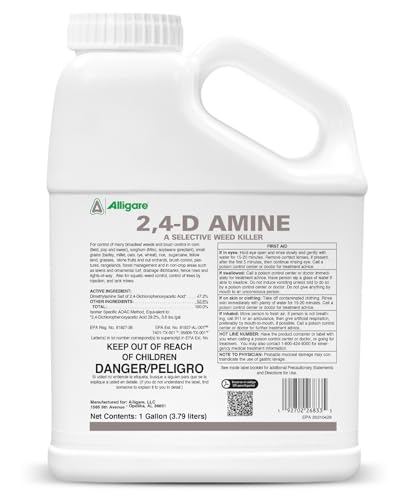
The 47.2% active-ingredient jug that blurs the line between lawn care and agriculture.
ALLIGARE doesn’t mess around with dilution. This 1-gallon concentrate packs 47.2% active ingredient — the highest concentration in this lineup by a wide margin — making it a farm-grade solution that works for pastures, lawns, landscape, and even aquatic sites. The strength is the whole story: just a few ounces per gallon of water covers large areas quickly, and buyers report weeds dead within a few days when mixed correctly.
It’s a straight 2,4-D Amine formulation, so it’s the purest dandelion-and-broadleaf killer here. The post-emergent formula targets pigweed, thistle, ragweed, and other tough broadleaf weeds across crops, forests, and drainage ditches. For a large property owner who also manages pasture or field edges, this one bottle replaces several homeowner products.
Two honest warnings come straight from the review pages. First, mix it correctly or “you will fry your grass” — the concentration is unforgiving if you guess at the ratio. Second, check availability for your state: it’s not cleared for sale everywhere, and one Texas owner found they could no longer order it. If you’re outside the restricted zones and comfortable with precise mixing, this is the strongest straight 2,4-D value in the list.
The power read: 47.2% active ingredient towers over the 30.89% in the Liquid Harvest bottle — this is the heavy artillery.
The precision demand: sloppy mixing burns grass; this is not a beginner’s first herbicide.
Best for: owners of large properties who want farm-grade 2,4-D strength and are disciplined about measuring.
Not for: casual weekend sprayers who eyeball ratios, or anyone in a restricted state.
9. Select Source Triad QC Select – 3-Way Herbicide with Quinclorac

The rare three-way that hunts crabgrass and dandelions in the same pass.
Most 2,4-D products are broadleaf-only, which means crabgrass survives to ruin your lawn anyway. Select Source Triad QC Select breaks that rule by adding quinclorac to the 2,4-D and dicamba base — a combination that takes down broadleaf weeds like dandelion and clover while also controlling grassy weeds up to and including mature crabgrass at 5 tillers or more. It’s a late-season cleanup specialist for areas that skipped spring pre-emergent treatment.
The use sites read like a municipal contract: residential and non-residential lawns, athletic fields, roadsides, parks, and golf turf (except tees, greens, and collars). The review pages back up the broad utility — it’s become a yearly purchase for homeowners who’d rather spray it themselves than pay a professional. One owner with a severe Dallisgrass problem watched it turn purple and die in about two weeks, though they noted it’s weaker on standard weeds and crabgrass unless used with a surfactant and multiple passes.
If your lawn has both broadleaf weeds and grassy invaders, this is the single-bottle solution the others can’t offer. The value opinions are split — some call it amazing, others overpriced — but the effectiveness and quality both get consistently positive feedback. It’s slow to show results on some weeds, then they die all at once, which takes a little faith.
Choose this if: crabgrass is half your problem and dandelions are the other half — quinclorac covers ground no other pick here touches.
Pass if: you only have broadleaf weeds and want the simplest label — a straight 2,4-D will save you money.
Understanding the Specs
Active Ingredient Percentage
This number tells you how much of the bottle is actual weed-killing chemistry versus filler and water. A product with 47.2% active ingredient, like the ALLIGARE, needs only a few ounces per gallon to work. A lower percentage means you’ll pour more product into each tank, which makes a “cheap” bottle disappear faster than you expect. Compare this number first when choosing between two similar prices.
Three-Way vs. Straight 2,4-D
A straight 2,4-D product is great for dandelions and basic broadleaf weeds but can struggle with clover, creeping charlie, and ground ivy. A three-way formula adds dicamba, MCPA, or mecoprop to widen the weed-killing spectrum. If your lawn has a mix of weed types, a three-way like GORDON’S Trimec or Liquid Harvest gives you more coverage from a single bottle.
FAQ
How long does a 2,4-D herbicide take to kill dandelions?
Will 2,4-D kill my grass or just the dandelions?
What is the difference between 2,4-D and a three-way herbicide?
How much 2,4-D concentrate do I mix per gallon of water?
How much area will a 32-ounce bottle of concentrate cover?
Can I use 2,4-D after it rains or before a storm?
Is there a 2,4-D herbicide that also kills crabgrass?
Why is 2,4-D not sold in some states?
How often should I reapply 2,4-D for dandelions?
Is it better to spray dandelions in spring or fall?
Final Thoughts: The Verdict
If you want one dependable pick, the 2, 4-d herbicide for dandelions winner is the Winfield Shredder 2,4-D Amine because its 2.5-gallon jug of straight 2,4-D delivers the best cost-per-application for the people who actually have a dandelion problem worth solving. If you want the fastest visible results, grab the SpeedZone EW. And for a low-odor, premium three-way that handles clover and creeping charlie alongside dandelions, the Liquid Harvest is the one to reach for.
How We Picked
We do not accept paid placement. Every pick is matched to a real buyer and a real use-case; we do not hands-on test units.
Sources & Methodology
Specifications: manufacturer listings and product documentation. Review insights: verified customer reviews, as of August 2026. Pricing: not shown on this page (it changes often); check the current price via the retailer link.
As an Amazon Associate, Gadgets Feed earns from qualifying purchases. This does not affect which products we feature.