
Our readers keep the lights on and my morning glass full of iced black tea. As an Amazon Associate, I earn from qualifying purchases.
Specs are compiled from manufacturer listings and verified buyer reviews and can change over time — please confirm the key details on the product page before buying.
You already know the routine: you walk into the garage, the basement, or the far end of the yard, and your phone drops from three bars to one. The fix is not a bigger router. It is a 2.4GHz extender — a small box that catches your existing WiFi signal and re-broadcasts it deeper into the house or out into the garden. The catch is that almost every extender on Amazon promises a coverage number in the tens of thousands of square feet, and those numbers are best-case, open-air figures. What actually decides whether you get usable signal is the band it runs on, the antennas it carries, and whether it has a wired Ethernet port for the devices that cannot afford to drop.
I’m Min — the founder and writer behind Gadgets Feed. This guide is built by comparing the manufacturers’ published specifications and the patterns across verified customer reviews, so you get each pick’s real strengths and trade-offs instead of marketing spin.
If your WiFi dies in a detached workshop or at a rack-mounted industrial DVR, the fix depends on what is actually dropping. An off-grid solar unit is the only pick here that works outdoors with no power outlet, which is why it earns the top spot on this list of the best 2.4ghz wifi extender picks.
Our Picks at a Glance

How To Choose The Best 2.4GHz WiFi Extender
The single most common mistake is buying an extender for the wrong reason. People see a big coverage figure and assume more square feet means better signal everywhere. It does not. Coverage claims describe the widest possible spread in open air, and the moment a wall, a floor, or a metal appliance gets in the way, that number collapses. What you should actually be shopping for is the right band, the right number of antennas, and a physical way to get a wire to the devices that matter most.
Why 2.4GHz is the band that actually travels
A 2.4GHz extender works on the lower-frequency WiFi band — the one that pushes through drywall, brick, and cinder block better than the higher 5GHz band. That is why a 2.4GHz-only extender is the standard choice for garages, basements, and back gardens. The trade-off is top speed: these units typically top out around 300Mbps, which is plenty for streaming and browsing but not a match for a fibre line feeding a wired desktop.
Match the extender to what it is powering
Count the devices in your dead zone before you buy. A single smart camera needs far less bandwidth than a gaming console or a work laptop on a video call. If the thing that keeps dropping is fixed equipment — a DVR, a printer, a TV — look for an extender with an RJ45 Ethernet port (the standard square network socket) so you can run a cable instead of relying on radio signal.
Quick Comparison
| Model | Best For | Top Speed | Band | Key Hardware | Amazon |
|---|---|---|---|---|---|
| Solar Powered WiFi Extender (Tigerpai)★ Best Overall | Unpowered outdoor spaces | 300 Mbps | 2.4 GHz | 4 antennas, 15W solar, 26000mAh battery, IP65 | Amazon |
| Baetaey 4-Mode ExtenderTop Performer | Whole-home coverage behind thick walls | 300 Mbps | 2.4 GHz | 4 adjustable antennas, Ethernet port, 4 modes | Amazon |
| FLBI 5-Mode ExtenderBest Range | Large homes with many devices | 300 Mbps | 2.4 GHz | 4 external antennas, 5 modes, WPA/WPA2 | Amazon |
| Finwarm Mesh Extender | Fast coverage across floors | 300 Mbps | 2.4 GHz | High-gain antennas, beamforming, Ethernet port | Amazon |
| Vonets VAP11S-232 | Industrial DVR and serial gear | 300 Mbps | 2.4 GHz | 2 RJ45 ports, RS232 serial server, DC5V-24V | Amazon |
| Vonets VAP11S Mini | Equipment cabinets and PLCs | 300 Mbps | 2.4 GHz | 2 external antennas, 2 RJ45 ports, DC5V-24V | Amazon |
| ZMISDRI WiFi Extender | Budget whole-home fill-in | 300 Mbps | 2.4 GHz | Ethernet port, access point mode, WPA/WPA2 | Amazon |
| HIMALU R11 | First-time dead-zone fix | 300 Mbps | 2.4 GHz | RJ45 port, single-band, plug-and-play | Amazon |
| Aodcaopul Range Extender | Simple wall-plug bridging | 300 Mbps | 2.4 GHz | Wall-plug, one-key setup, single-band | Amazon |
In‑Depth Reviews
1. Solar Powered WiFi Extender, 26000mAh Battery Solar WiFi Extender, 2.4GHz 150m Range Outdoor WiFi Extender Signal Booster, IP65 Waterproof WiFi Repeater for Farm Garden Ranch
Our pick — over 4★ from 20+ verified ratings; the strongest balance of quality and price.
The only pick here that works where there is no outlet at all — a barn, a ranch gate, a hunting shack.
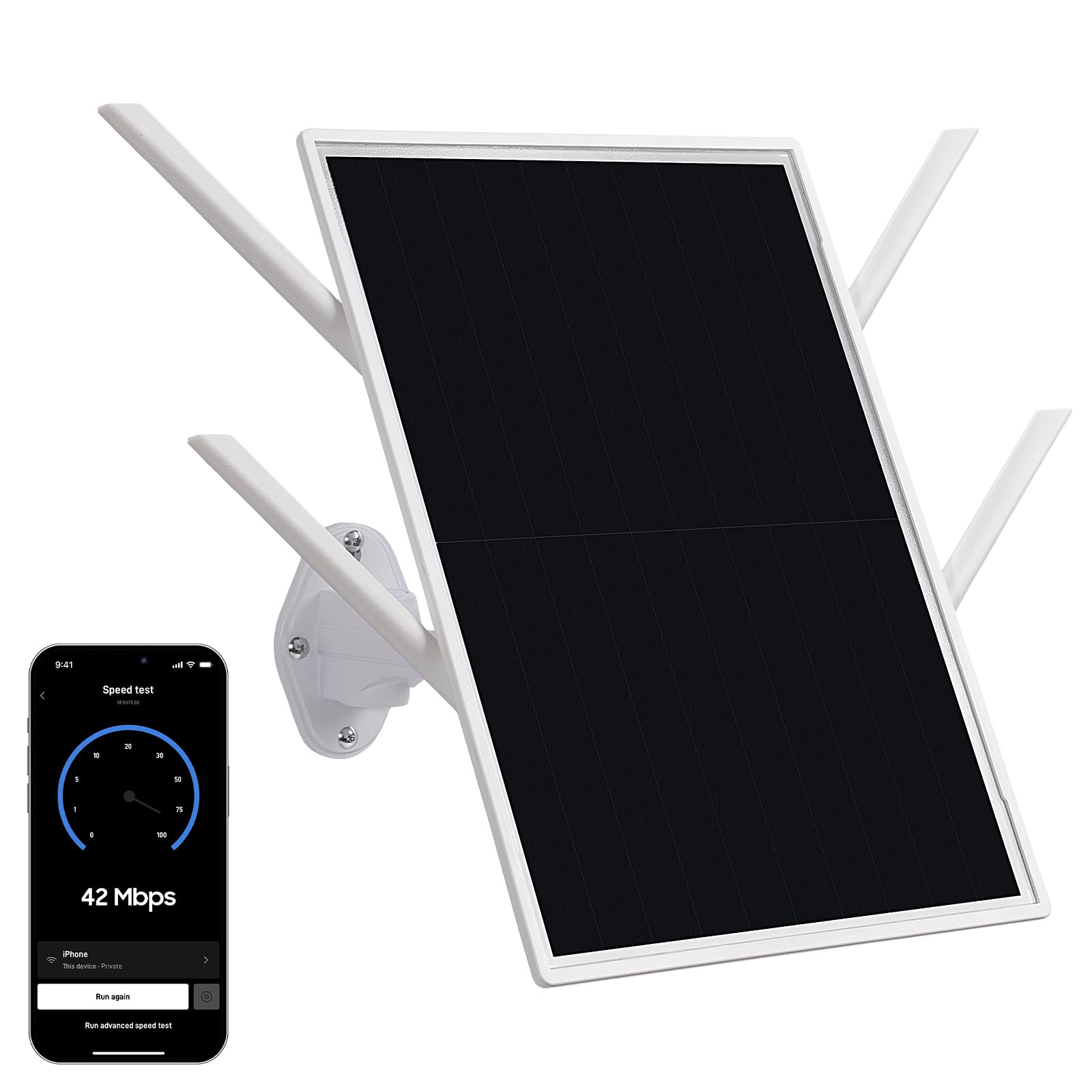
Most extenders need a wall socket within arm’s reach. This one runs on a 15W solar panel and a 26000mAh rechargeable battery, so it can sit on a fence post in a field and keep broadcasting. It has four high-gain antennas and pushes a 2.4GHz signal up to 492 feet, the widest figure on this list. But the number that matters for daily use is the honest footnote Tigerpai prints alongside it: best signal lands between 280 and 300 feet, so plan your mounting point against that figure, not the maximum.
What makes this the top pick is where it fits and what it survives. The IP65 rating means it is sealed against dust and against water sprayed from any direction, so heavy rain, freezing snow, and direct summer sun are all covered. It is wire-free by design — no buried Ethernet, no trenching, no running power out to the far corner of the property. Buyers report it pushing WiFi about 100 feet to a detached shop, with signal climbing from -80dBm to -68dBm while the panel still charges in shade and cloud. That dBm shift is real-world proof the thing is doing its job.
The honest catch is power management in bad weather. The 26000mAh battery needs one USB charge before solar takes over, and after several cloudy days the 15W panel can leave it short enough to die overnight. Owners in extreme climates also caution the battery housing is on the thin side. Size your expectations to your climate and it is a smart, self-sufficient piece of kit rather than a plug-in box with a solar sticker.
Where it earns its keep
- 15W solar panel plus 26000mAh battery means no wiring and no outlet needed
- Up to 492ft 2.4GHz range, with best signal at 280–300ft for outdoor devices
- IP65 sealed against rain, dust, and direct sun
- 360° adjustable mounting bracket for pointing the signal where you need it
What to plan around
- Needs a one-time USB charge before solar takes over
- Extended cloudy spells can drain the battery overnight
- Battery housing is thin for extreme climates
Reach for this if: your dead zone is outdoors with no power — a ranch, farm, large garden, or shop in a separate building.
Think twice if: you want a cheap indoor fill-in for one upstairs bedroom; a plug-in wall unit handles that for far less.
2. 2026 WiFi Extender Signal Booster for Home, 15000sq.ft Wireless Internet Repeater, Long Range WiFi Booster and Signal Amplifier w/Ethernet Port, WiFi Router Extender Support 99% Devices, 1-Tap Setup
Four antennas you can aim by hand, and a setup that finishes in about 30 seconds.
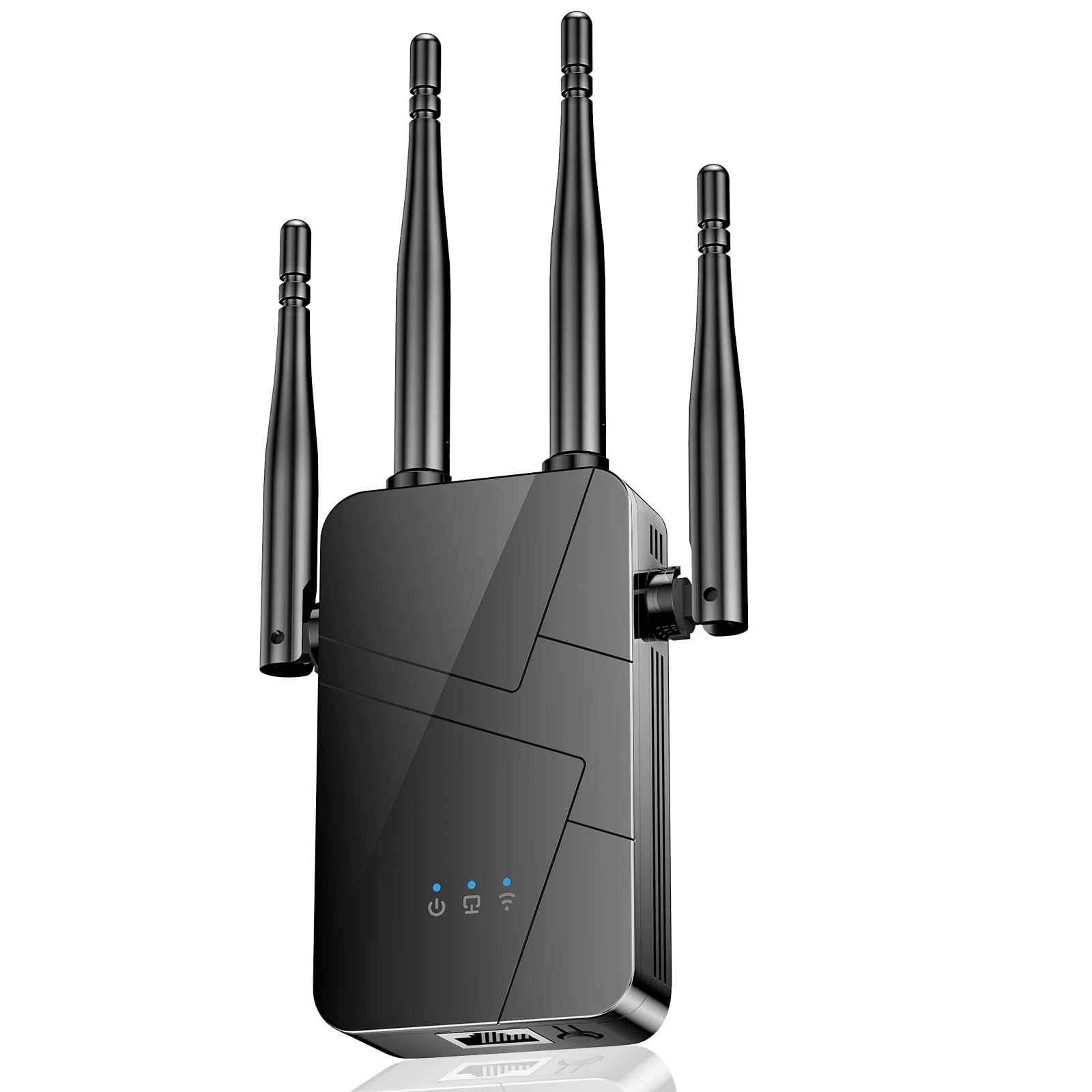
If your dead zone is behind a cinder block wall or a concrete floor, this is the indoor pick to beat. The four external antennas are adjustable, which means you can angle them toward the room that is struggling instead of leaving everything to chance. Setup is a single WPS press on your router followed by a press on the extender, and the maker puts that handshake at under 30 seconds. Owners put the full process at around two minutes, and the movable antennas are specifically called out for fitting tight socket spaces.
It runs 2.4GHz at 300Mbps and the maker claims coverage up to 15000 square feet — treat that as the open-air ceiling. The feature set is broad for the price: four working modes (Repeater, Bridge, Access Point, and Router), an Ethernet port for wiring in a TV or console, and support for 70+ devices across laptops, cameras, tablets, and streaming sticks. Security covers WEP and WPA/WPA2, the baseline you want on any device repeating your home network.
The recurring note in the review pages is about placement, not performance. Range is honest rather than magical — one owner replaced an old unit covering 45+ acres and found the coverage perfectly satisfying, but only after mounting it sensibly. Set it too far from the router and it repeats a weak signal, which no extender can fix. Put it roughly halfway between router and dead zone and it earns its keep, including for outdoor gear like fence lights and cameras.
Clean install, real coverage: the standout is how quickly this goes from box to working — a 30-second WPS handshake, no app hunting, no manual IP fiddling. That speed plus the 4-mode flexibility is what pushes it above the plug-only budget units.
Mount it right: half the complaints about any extender trace back to sitting it next to the router. Give this one a socket in the middle of the run and the 2.4GHz wall penetration does the rest.
The smart pick: indoor homes with a stubborn far room or two behind solid walls, where you want maximum control over where the signal goes.
Not your fit: if you need to cover a shed with no electrical hookup nearby — the plug requirement rules this one out.
3. 2026 New WiFi Extender Signal Booster for Home, 15715sq.ft Long Range WiFi Repeater Wireless Routers Signal Amplifier, Mesh WiFi 15X Faster Access Point with Ethernet Port, Easy Setup, 5 Working Mode
Five modes, four external antennas, and a two-year warranty you rarely see on a networking accessory.
What separates this from cheaper single-mode boxes is flexibility. You get five working modes, four high-performance external antennas, and a real Ethernet port. There is a 20-month warranty, which matters on a device that will sit powered on in a basement for years. Range is listed at up to 16000 square feet, and the antennas are there for penetration rather than decoration — this is built for a router in a basement trying to reach a garage and second floor through four walls and a floor slab.
Setup is the WPS one-tap route: a few seconds to press, a few minutes total. Owners mention a five-minute install, then full bars in the trouble rooms, faster downloads, clear video calls, and no buffering. It also helps security cameras and smart devices at the property edge, where a stable connection matters more than raw speed. Compatibility covers 99% of routers on the market, so it should slot into whatever you already run.
The honest limitation is the marketing text itself. The listing leans hard on phrases like “military-grade encryption” and “bionic chip,” and those are branding rather than measurable specs. What you can actually verify is a 300Mbps 2.4GHz single-band radio, WPA/WPA2 encryption, 802.11bgn support, and the antenna count. Buy it for the hardware and the modes, not for the security adjectives.
What stands out
- Five working modes versus two or three on most rivals
- Up to 16000 sq ft coverage with four external antennas for wall penetration
- 20-month warranty attached to the device
- WPA/WPA2 encryption and 802.11bgn support
Keep in mind
- Listing leans on unmeasurable phrases like “military-grade encryption”
- Single-band 2.4GHz only — no 5GHz radio on board
Who it suits: a larger home with several trouble rooms and a mix of streaming, gaming, and cameras that all need the same solid 2.4GHz signal.
Where it falls short: if speed is your priority and you already own a 5GHz router, this single-band unit will not match a dual-band extender on raw throughput.
4. VONETS 2026 VAP11S-232 300Mbps WiFi to Ethernet Adapter 2.4G WiFi Bridge/Repeater/Mini Router/ RJ45 to RS232 Serial Server with 2 RJ45 Ports/Antennas USB/DC Powered for DVR Monitor Network Devices

Half WiFi extender, half wired-to-wireless translator — with an RS232 port most homes will never touch.
This is the pick for hardware that has no WiFi of its own. It turns a wired Ethernet connection into a wireless one, or the reverse, using a three-in-one design: WiFi router, WiFi bridge, and WiFi repeater, all running 2.4GHz at 300Mbps. Two external omnidirectional antennas push the signal a claimed maximum of 200 meters point-to-point with no obstacles and light data traffic, dropping to under 100 meters when you are pushing video. For a printer, DVR, monitor, or industrial gadget that only speaks wired, that bridge function is the whole reason to buy it.
Where this differs from the consumer extenders above is the power and connectivity side. It runs on wide-voltage DC5V-24V supply with two-stage automatic overvoltage protection capping at 27V, so it can be fed from an industrial cabinet instead of a wall adapter. There is also an RS232 serial server built in, aimed at commercial equipment. One buyer bridged an older TV with unstable WiFi to Ethernet, restoring AirPlay and smart-home control; another got an older DVR onto the network, where the detachable antennas helped reception. Note that the data rate quoted is real-world 300Mbps on the 2.4GHz band only.
Be honest about the audience here. The setup is not a one-tap consumer experience — the browser-based configuration can be fussy, and the instruction manual leaves people guessing more than once. Buyers use phrases that suggest it “takes a minute” and rewards care rather than impatience. The hardware is fine; the documentation is the weak link.
Fit for the wired-to-wireless job: if the device that keeps dropping is a TV, DVR, or printer with no WiFi radio, this is the piece that gets it online, thanks to its dual RJ45 ports and 2.4GHz bridge mode.
Read the manual twice: the setup interface is the recurring friction point — one buyer had to switch to Microsoft Edge after Chrome refused to recognise the login screen. Patience pays off, but this is not a plug-and-forget device.
Aiming this at: shop-floor and mixed-device setups — an older DVR, a printer, a TV — where you need 2.4GHz WiFi bridging rather than a consumer wall-plug.
Look elsewhere if: you want a five-minute install. This one rewards a technical owner and will frustrate someone expecting plug-and-play.
5. 2026 WiFi Extender, 15888 sq.ft Internet Extender WiFi Booster, Long Range Wireless Repeater Signal Amplifier for Home, Mesh Wi-Fi 99% Faster | Broader Than Ever, Support 55+ Devices, 1-Tap Setup

A five-minute setup that owners keep describing as the best extender they have tried.
Finwarm built this around two things: a five-minute install and signal that reaches rooms a standard router abandons. High-gain antennas with beamforming technology send targeted signal toward your devices rather than spraying it evenly, and the maker claims coverage up to 15888 square feet with support for 55+ devices. It handles repeater, bridge, access point, and router modes, so it works if you need a simple repeater or a wired feed via the Ethernet port for a console or streaming box.
The proof is in what owners do with it. It sets up in about five minutes, and customers note strong signal over 40 feet from the router plus upstairs and basement coverage they never had before. One owner plugged it in and had it working within minutes, with strong signal upstairs and down in the basement. Netflix and Xbox Live run without stutter, with ping around 62ms. Optional Ethernet and adjustable, sturdy antennas round out the package.
The one thing reviewers grumble about is price relative to its budget rivals. There is no 5GHz radio on board, so that money is not buying you top-end throughput either — it is buying reliable 2.4GHz coverage.
Speed and reach, verified by owners: the standout is how far this holds signal without breaking — from your router to an upstairs room and a basement, reported at over 40 feet and still solid. That is the practical range that matters, not the on-box number.
If cheap is your only criteria, the ZMISDRI unit below covers similar ground in the same band.
Made for: a multi-floor home where signal dies upstairs and again in the basement, and where you want the setup done in one coffee break.
Consider skipping if: you already own a working extender and just need a second one for a small area — the budget picks handle that job.
6. Vonets VAP11S Mini Repeater/Wireless Bridge Ethernet/WiFi Router 2.4GHz Industrial with 2 RJ45 Ethernet Ports and 2 External Antennas, Great Partner for Electronic Scale, PLC, DVR

Card-sized industrial bridge built to live inside an equipment cabinet, not on your kitchen shelf.
This is the sibling of the VAP11S-232 above, aimed squarely at control cabinets and PLC equipment. It runs 2.4GHz at 300Mbps with two external antennas, and the point-to-point figures are explicit: 150–200 meters maximum with clear line of sight and light data, under 100 meters when the link is carrying video. Power is the standout spec for industrial work — a flexible DC5V-24V input means you can tap a control panel’s 24V rail instead of running a separate adapter.
Where people actually use it tells the story: connecting HVAC and refrigeration gear to the network, feeding a tower gaming PC as a wireless receiver, and getting older commercial equipment online without pulling cable. Setup is described as genuinely easy by owners who understood the use case. It also carries the same overvoltage protection as its sibling, capping surge voltage at 27V, which is exactly the sort of safeguard industrial installs need. It weighs 80 grams and its card-sized footprint means it fits where a consumer extender never would.
The honest note is reliability under sustained load. The device draws measurable power and is a poor fit for a battery-pack-plus-small-solar setup, which is why owners warn against using it as a solar repeater. And while most installs are smooth, some reviewers point out dropped connections on DHCP, needing static IP addresses to stay stable, and a general expectation that you bring some networking expertise. That is not a dealbreaker for an industrial buyer — it is a warning for a first-timer.
Built for the cabinet
- Card-sized form factor that fits into industrial enclosures
- DC5V-24V wide voltage input and 27V overvoltage protection
- 2 RJ45 Ethernet ports and 2 external antennas
- Point-to-point range of 150–200 meters in clear air, under 100 meters for video
The honest watch-outs
- Power-hungry — not suited to battery-bank or solar runs
- DHCP dropouts reported; some installs need a static IP
- Best left to buyers comfortable in network settings
Built for: control cabinets, PLCs, DVRs, and commercial equipment that needs to join a 2.4GHz network from inside an enclosure.
Not the one for: a casual home owner who just wants to extend WiFi to a bedroom — the setup burden and power draw are unnecessary there.
7. WiFi Extender, 2026 New 20X WiFi Extender Signal Booster
The simplest way to fill a single dead room — plug it in, wait seconds, done.
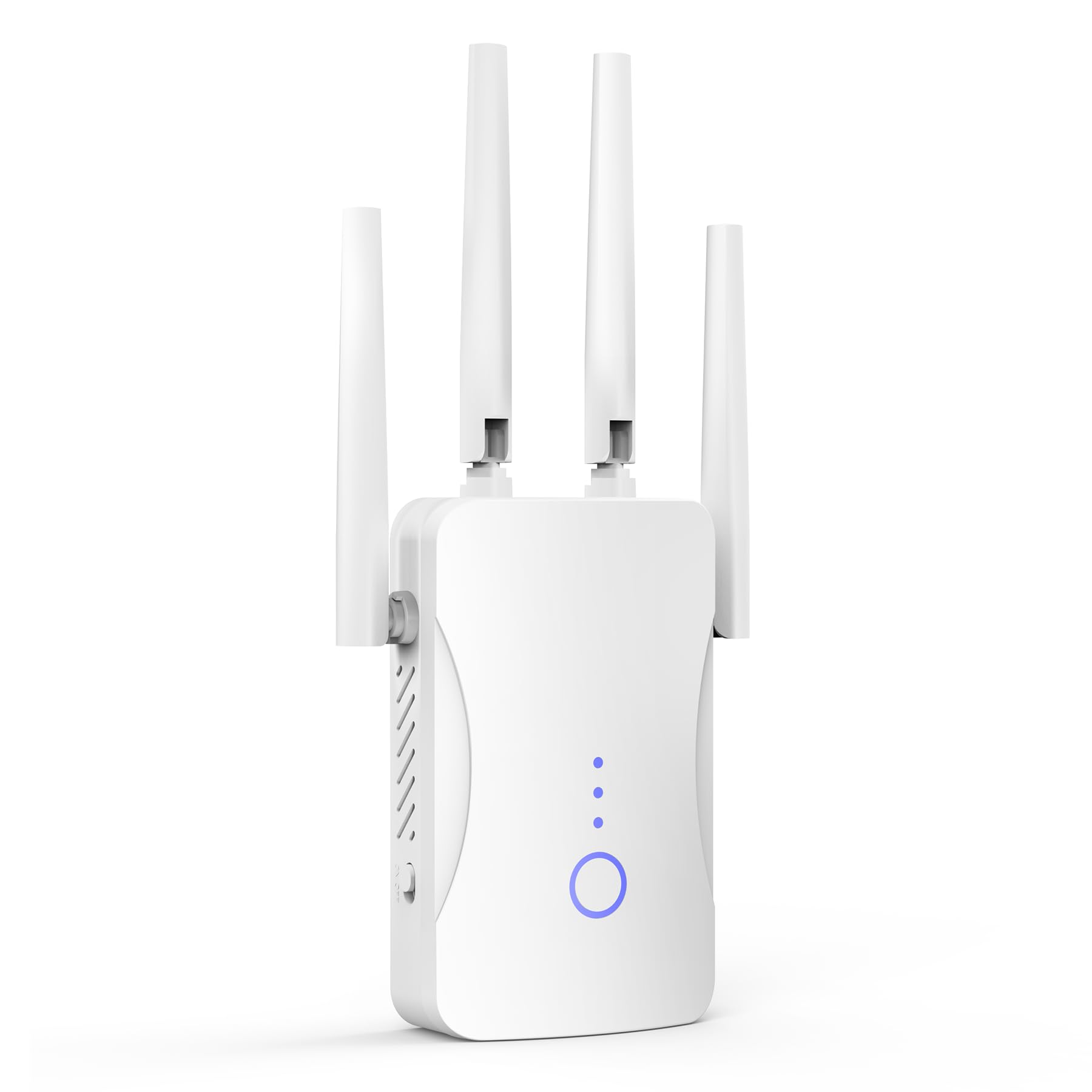
This is the extender for anyone who just wants the far bedroom or the garage corner to stop dropping signal. It is a 2.4GHz unit running 300Mbps with WEP/WPA/WPA2 security and support for 85+ devices across phones, laptops, tablets, speakers, cameras, smart TVs, and robot vacuums. The maker lists coverage up to 11999 square feet, which is the open-air figure, not what you will see through interior walls. The setup is plug-and-play — press the WPS pairing button and it connects in seconds, no app download or account required.
What owners praise is stability under load. Run smart TVs, gaming consoles, and a household of screens at once and the connection stays consistent — that is the recurring theme across the review pages. It holds multiple devices easily and eliminates the dead zones that prompted the purchase in the first place. There is an Ethernet port on board for wiring a device directly, plus an access point mode if you would rather convert a wired feed to wireless. For the price, it is a straightforward way to add coverage without buying new networking gear.
Two honest notes for buyers. First, this is a 2.4GHz single-band device — if you want 5GHz throughput for transferring large files between devices, it will not deliver. Second, the 11999 square foot figure is a marketing maximum. The real number depends heavily on how many walls sit between this unit and your router, so mount it toward the weak room rather than at the router.
Stable under a busy household: the standout is how it handles a full home of devices at once without the usual drop-outs — gaming consoles, streaming, and video calls all running at the same time. For the money, that consistency is the whole point.
One limit to plan for: the 2.4GHz band alone is the constraint. If you want speed for big local file transfers, you are shopping in the wrong tier.
Great starting point: a first-time buyer with one or two stubborn dead zones who wants a working fix without spending premium money.
Move along if: your issue is speed, not reach — a 5GHz capable unit would serve you better.
8. 2026 Fastest WiFi Extender Signal Booster Covers 10000 Sq.ft and 80 Devices 2.4GHz High Speed WiFi Repeater with Ethernet Port Eliminate Dead Zones with Wireless Internet Booster for Home
The most-used extender on this list because it does the simple job without drama.
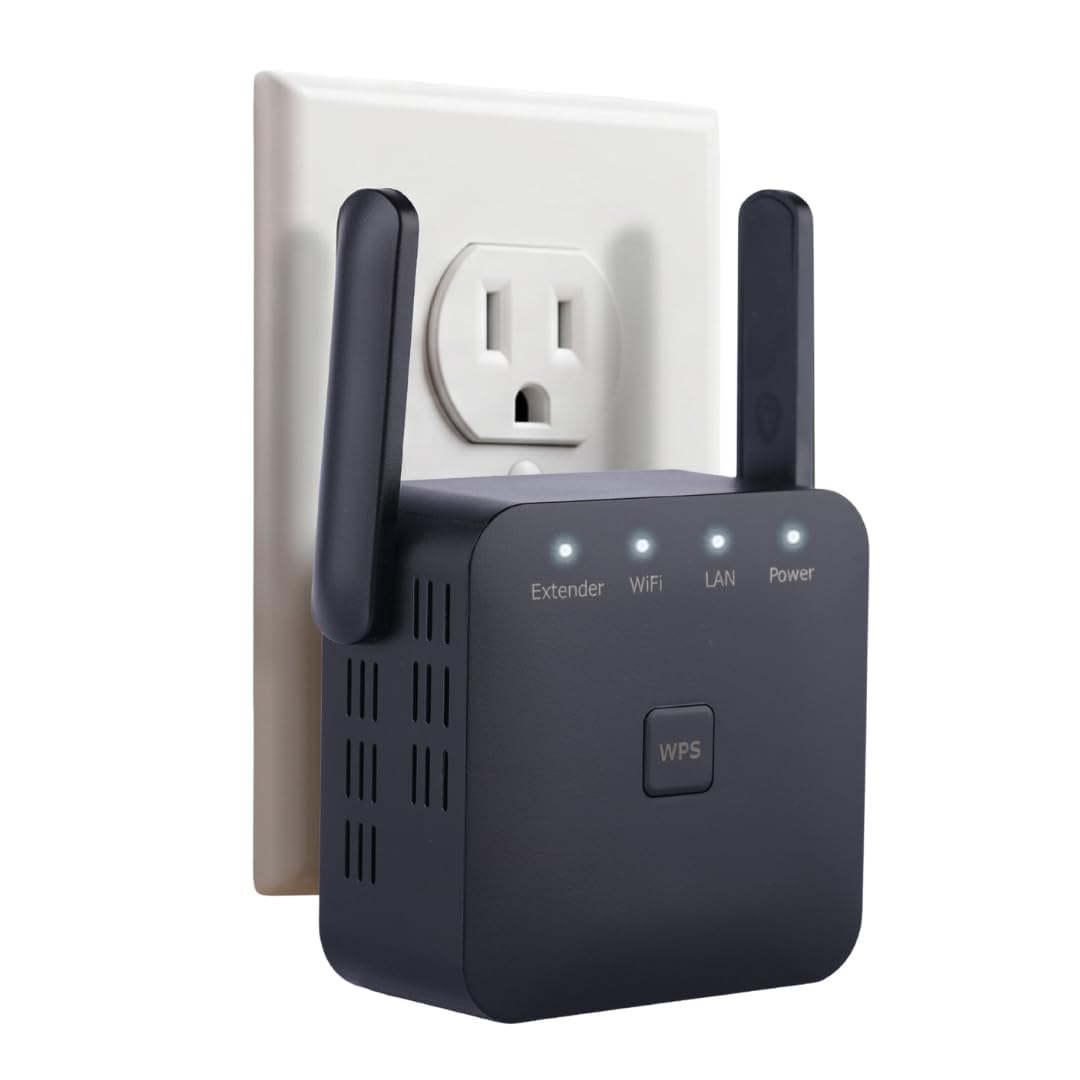
HIMALU’s R11 is the highest-volume pick here, and the reason is simple: it works, it is easy, and it is priced for people who just want the kitchen, garage, or upstairs office to stop buffering. It runs 2.4GHz at 300Mbps with a single band, a compact wall-plug body, and an RJ45 Ethernet port for cabled devices. Stated coverage is up to 10000 square feet from a single unit, with support for 60+ devices on the network at once.
The setup process is where this shines. Plug it in near the router, wait about 30 seconds for the light to go solid green, connect your phone to its temporary network, log in with the default password “admin,” pick your home network from the list, and enter your router’s password. After that, your home WiFi name reappears with “PRO” in front, and you connect to it. Total time is a few minutes, and no laptop or app is needed — only a phone.
The honest caveat is that volume comes with variance. Most units work exactly as described, but reviews show occasional connectivity complaints — some users report a unit that simply will not pair, or brief drops that reconnect on their own. Given the number of units in circulation, that is a fair percentage rather than a pattern, but it is a reason to buy from a seller with easy returns. If yours pairs cleanly, it is a solid, unglamorous dead-zone fix.
Where it delivers
- Phone-only setup, no app or laptop required
- 300Mbps on 2.4GHz with a real RJ45 Ethernet port
- Covers up to 10000 sq ft and supports 60+ devices
- Compact plug-in body with a reset pin for easy recovery
Be aware
- Occasional units fail to pair or drop briefly
- Single-band 2.4GHz only, so speed is capped at 300Mbps
Suited to: a first extender for a home with one or two weak rooms, where phone-only setup and a low outlay are what you want.
Pass if: you need 5GHz speed or plan to cover a large property — this is a one-room-at-a-time tool.
9. WiFi Range Extender Single Band 2.4G..
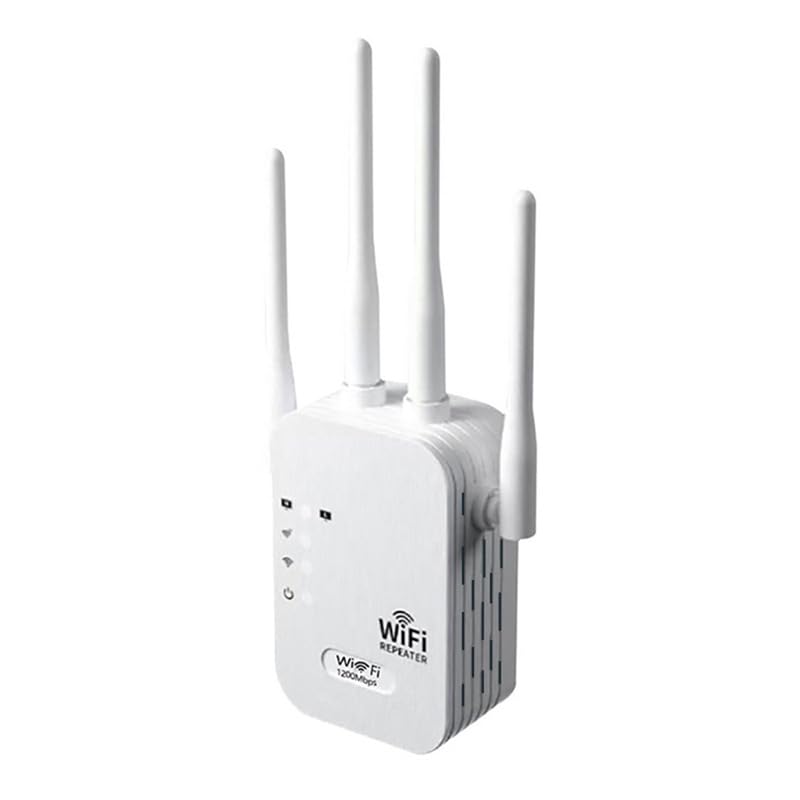
A bare-bones wall plug for stretching basic signal into a garage or hallway.
This Aodcaopul unit is the simplest thing on the list: a compact 2.4GHz single-band repeater that plugs straight into a wall socket, no cables, no bracket, no mounting kit. Stated coverage is up to 9800 square feet, and it claims compatibility with smart speakers, cameras, phones, and notebooks — the everyday devices you would want signal for in a bedroom, garage, or hallway. Setup is a one-key pairing process, and there is a 2-year spare-parts availability window for EU buyers.
Where this differs from the top picks is ambition. It is not trying to be an ethernet-capable multi-mode router or an outdoor weatherproof bridge. It is trying to be the cheapest way to put signal into a room your router cannot reach, and for that narrow task it is serviceable. The wall-plug form factor is the practical advantage: nothing to mount, nothing to power separately, and no cable clutter.
Be realistic about what you are buying. Reviews for this model are genuinely mixed on connectivity, with some buyers reporting strong signal and others finding it will not pair. If you want a proven one, the HIMALU or Finwarm units are safer bets. If you want the absolute lowest outlay and can accept a bit of lottery, this fills the gap.
Cheapest way to try: the appeal is the format — a direct wall-plug with no separate power supply and no on-device app, which means trying it in a hallway or garage takes about a minute.
Why results vary: the connectivity is the widely-reported weak point across reviews, with the useful and the broken in roughly equal measure. Buy where returns are easy and this is a fair entry-level gamble.
Pick it for: a cheap, no-commitment experiment — buying one to see if it clears a single stubborn room before investing in a stronger unit.
Choose differently if: you have a demanding setup, an outdoor install, or a property where reliability is not optional. The picks above are the safer route.
Understanding the Specs
Coverage in Square Feet
The giant coverage figures on these boxes — 10000, 15000, or 16000 square feet — are the widest possible footprint in open air, measured without walls, floors, or appliances in the way. Treat them as a marketing ceiling, not a promise. Real coverage in a home with drywall, studs, and concrete floors is often a fraction of the number, so plan your mounting position based on the weaker real-world figures the better listings publish, like the 280–300 foot guidance on the top pick.
2.4GHz vs 5GHz
Every extender here runs on the 2.4GHz band. That is the slower band, capped around 300Mbps, but it is also the one that pushes further and penetrates walls, floors, and vegetation. 5GHz is faster over short distances but struggles to cross the same obstacles. If your dead zone is separated by solid walls, 2.4GHz is the right choice; if you simply want faster transfer speeds inside one room, a 5GHz capab
FAQ
Will a 2.4GHz extender work with my 5GHz router?
Where should I physically place my extender for best results?
Can I use an outdoor extender like the Tigerpai unit indoors?
Do I need an Ethernet port on my extender?
What is the difference between a WiFi repeater and a WiFi bridge?
How long does an extender last before it needs to be replaced?
Will my smart home devices connect to an extender?
Final Thoughts: The Verdict
For most people, the winner is the Solar Powered WiFi Extender (Tigerpai) — it is the only pick here that solves the unpowered outdoor dead zone, which is the hardest problem a home extender faces. If your trouble spot is indoors behind thick walls, reach for the Baetaey 4-mode extender, whose four adjustable antennas and 30-second WPS setup make it the cleanest indoor install on this list. And if you need to put a wired DVR, printer, or legacy equipment onto a 2.4GHz network, the VONETS VAP11S-232 is the one to grab — its dual RJ45 ports and RS232 serial support handle jobs the consumer extenders simply cannot.
The 2.4GHz band is the workhorse here: it will not set speed records, but it is the band that gets through walls, and every product on this list is built around that one job. Match the pick to your dead zone and the coverage claim on the box stops mattering — the signal in the room does.
How We Picked
We do not accept paid placement. Every pick is matched to a real buyer and a real use-case; we do not hands-on test units.
Sources & Methodology
Specifications: manufacturer listings and product documentation. Review insights: verified customer reviews, as of September 2026. Pricing: not shown on this page (it changes often); check the current price via the retailer link.
As an Amazon Associate, Gadgets Feed earns from qualifying purchases. This does not affect which products we feature.