
Running a 100-amp sub-panel to a detached garage, workshop, or she-shed demands a feeder cable that balances ampacity, flexibility during pull, and long-term corrosion resistance. 2 AWG aluminum wire delivers that balance at a fraction of the cost of copper, making it the standard choice for service entrance and branch circuits rated up to 100 amps at 90°C. The trick is picking the right cable configuration and jacket type for your specific run — above ground, direct burial, or inside conduit.
I’m Min — the co-founder and writer behind Gadgets Feed. I’ve spent hundreds of hours cross-referencing NEC ampacity tables, UL listings, and real-world installation feedback to separate the wire that pulls cleanly from the stuff that fights you every inch of the way.
This guide breaks down six proven 2 AWG aluminum cable options — from 50-foot building wire cuts to 180-foot direct-burial quadplex — so you can confidently choose the best 2″ aluminum wire for your project without guessing which jacket, strand count, or conductor configuration fits the job.
How To Choose The Best 2″ Aluminum Wire
Picking the right 2 AWG aluminum cable means matching the jacket type to your installation path, verifying the voltage and ampacity ratings against your panel requirements, and choosing a cut length that avoids wasteful splices. The three most common cable constructions are XHHW-2 single conductors, SER service entrance cable, and URD direct-burial quadplex — each designed for a different environment and termination method.
Match the Jacket to the Installation Method
XHHW-2 individual conductors are rated for wet or dry locations and pull smoothly through conduit because each wire moves independently. SER cable bundles three insulated conductors plus a bare neutral under a single gray jacket — it’s the go-to for above-ground service entrance runs but is not rated for direct burial. URD quadplex has a heavy black jacket that withstands ground contact without conduit, making it the fastest option for trench-fed sub-panels. Using SER in a direct-burial trench will fail inspection; using URD inside a building without additional conduit violates most local codes.
Read the Ampacity Table — Not the Wire Label
2 AWG aluminum is rated for 100 amps at 90°C conductor temperature, but terminations (breakers, lugs, splices) are typically rated at 75°C or 60°C. The NEC forces you to use the lowest rating in the circuit path, which drops 2 AWG aluminum to 90 amps at 75°C. If your breaker and lugs are rated 75°C, plan for 90 amps continuous, not 100. Always confirm the termination temperature rating before sizing the feeder.
Calculate Voltage Drop for Long Runs
At 100 feet, 2 AWG aluminum carrying 90 amps drops roughly 3.2 volts (less than 3% at 120/240V), which is acceptable. At 200 feet, the drop approaches 6.4 volts — enough to cause nuisance tripping and voltage-sensitive equipment issues. For runs over 150 feet, consider stepping up to 1/0 AWG aluminum or verify that your load calculation stays well below the breaker rating to keep the voltage drop under 3%.
Quick Comparison
On smaller screens, swipe sideways to see the full table.
| Model | Category | Best For | Key Spec | Amazon |
|---|---|---|---|---|
| Wirenco 2-2-2-4 SER (50ft) | Mid-Range | Standard above-ground service | 100A @ 600V, 0.359 lb/ft | Amazon |
| Wirenco 2 AWG XHHW-2 (50ft) | Mid-Range | Conduit runs, individual pulls | 100A @ 90°C, 7-strand compact | Amazon |
| Wirenco 2-2-2-4 SER (25ft) | Mid-Range | Short above-ground feeds | 100A @ 600V, single-jacket bundle | Amazon |
| Wirenco 2-2-2-4 SER (75ft) | Premium | Medium-length service entrance | 100A @ 600V, 0.359 lb/ft | Amazon |
| Nassau 2-2-2-4 SER (100ft) | Premium | Long above-ground runs | 100A @ 600V, 4-conductor bundle | Amazon |
| Nassau URD Dyke 2-2-2-4 (180ft) | Premium | Long direct-burial trench feeds | 155A direct burial, 0.973 in OD | Amazon |
In‑Depth Reviews
1. Wirenco 2-2-2-4 SER Aluminum Service Entrance Cable (50FT Cut)

This 50-foot SER bundle from Wirenco hits the sweet spot for the vast majority of residential sub-panel jobs. With three 2 AWG insulated conductors and a bare 4 AWG neutral wrapped in a gray moisture-resistant jacket, it delivers 100 amps at 600 volts while weighing 0.359 pounds per foot — heavy enough to feel substantial but light enough that a single person can maneuver it through a crawlspace or along a wall.
The cable is UL-listed for above-ground wet and dry locations, which covers service entrance mast runs, exterior walls, and interior raceways. Buyers consistently report that the jacket strips cleanly without gouging the conductor insulation and that the cut length arrives within a foot of the advertised measurement — critical when you are terminating into a panel with zero slack to waste.
You will need to support this cable every four to six feet per NEC guidelines, and the bare neutral should be bushings or taped to avoid abrasion against knockout edges. For a straightforward 50-foot run from meter to main lug panel, this is the most practical all-in-one feeder available at this tier.
Why it’s great
- UL-listed for wet and dry above-ground locations
- Pre-assembled 4-conductor bundle saves installation time
- Consistent 50 ft length with minimal variance
Good to know
- Not rated for direct burial without conduit
- Jacket is stiff in cold weather below 40°F
2. Wirenco 2 AWG XHHW-2 Aluminum Building Wire (50 FT Cut)

When your installation involves pulling individual conductors through conduit — especially PVC schedule 40 or 80 — this XHHW-2 single-conductor wire is the correct choice. The compact stranded 7-wire construction gives it a smaller overall diameter than traditional concentric stranding, which reduces pulling friction and lets you fit more conductors per conduit fill percentage.
Rated for 600 volts and 100 amps at 90°C, this wire is UL 44 and ASTM B800/B801 certified, meaning the aluminum alloy meets the same mechanical and electrical standards that professional electrical suppliers stock. At just 0.081 pounds per foot, a single 50-foot coil weighs roughly 4 pounds, making it easy to handle during a pull through a long conduit run.
Buyers note that the insulation is tough enough to survive being dragged across rough conduit edges without tearing, but still flexible enough to make tight bends near the panel. Because this is a single conductor, you will need to order three or four separate lengths for a 120/240V feed — plan for the total cost across all phases and the neutral.
Why it’s great
- Compact stranded design minimizes conduit fill friction
- Full UL and ASTM certification for code compliance
- Lightweight — easy to handle during long pulls
Good to know
- Sold per single conductor — buy multiples for a full feeder
- Exposed to mechanical damage if run outside conduit
3. Wirenco 2-2-2-4 SER Aluminum Service Entrance Cable (25FT Cut)
If your sub-panel sits just a few feet from the main panel — inside the same basement, on the opposite side of a wall, or in an attached garage — the 25-foot cut of this same SER cable avoids ordering 50 feet and wasting half. The construction is identical to the 50-foot version: three 2 AWG insulated conductors plus a 4 AWG bare neutral, rated 100 amps at 600 volts, with a gray outer jacket.
Owners consistently report that the wire arrives well-coiled without kinks and that the cut length is honest — one reviewer noted an extra foot beyond the advertised 25 feet, which is a welcome buffer for service entrance loops. At 0.359 pounds per foot, the 25-foot coil weighs under 9 pounds, making it the most manageable option for a one-person install.
This is the ideal choice for feeding a sub-panel in a structure that shares a foundation with the main building, where the entire run stays above ground and within a conditioned or dry space. Just remember that SER cable cannot be buried, so if your route dips below grade for even a few feet, switch to XHHW-2 conductors inside conduit or a URD cable.
Why it’s great
- Perfect 25 ft length avoids cable waste on short runs
- Light and easy to handle for DIY installations
- All four conductors pre-bundled in a single jacket
Good to know
- Jacket may be difficult to strip without a cable ripper
- Not suitable for direct burial or underground conduit
4. Wirenco 2-2-2-4 SER Aluminum Service Entrance Cable (75FT Cut)
A 75-foot above-ground run covers the gap between detached garages that are 50 to 70 feet from the main structure. This SER cable from Wirenco delivers the same 100-amp capacity with the same UL listing as the shorter cuts, but the 75-foot length means you can route the cable along an exterior wall, through a conduit nipple at the meter, and into a remote panel without splicing.
The 0.359-pounds-per-foot weight adds up — a 75-foot coil weighs about 27 pounds — so you will want a helper or a cable roller for the pull. Buyers highlight that the jacket holds up well during routing around corners and that the individual conductor ends strip cleanly, which matters when you are working at the end of a long cable that cannot be easily replaced.
At this length, voltage drop becomes a real consideration. At 90 amps continuous load, a 75-foot 2 AWG aluminum feeder will drop roughly 2.4 volts — well within the 3% recommendation. If your load is consistently near the 100-amp breaker limit, consider bumping up to a 1/0 AWG feeder for the extra headroom.
Why it’s great
- 75 ft is ideal for medium-distance detached structures
- Same UL listing and conductor quality as shorter versions
- Clean stripping and consistent conductor gauge
Good to know
- Heavier coil — plan for two-person handling
- Voltage drop becomes noticeable near full load at this length
5. NASSAU ELECTRICAL SUPPLY 2-2-2-4 SER Aluminum Service Entrance Cable Wire (100FT)

When your service entrance run stretches 100 feet — feeding a remote workshop, a large garage, or an agricultural outbuilding — the Nassau SER cable provides the full length you need without field-splicing. The 2-2-2-4 configuration delivers 100 amps at 600 volts, with multi-strand conductors that offer slightly more flexibility than compact-stranded wire during the pull.
The nominal outer diameter of this cable is 0.955 inches, so a 1-inch or 1.25-inch conduit is required for any interior sections. Buyers report that the cable arrives wound on a spool that prevents sharp kinks, which is critical because a kinked 2 AWG conductor can create a high-resistance hot spot that is nearly impossible to detect after the jacket is sealed.
Multiple verified purchasers have used this cable for EV charger installations and sub-panel feeds, noting that the connections hold up under continuous 48-amp Level 2 charging loads without measurable heat rise at the terminals. If your run is 100 feet or more and stays entirely above ground, the Nassau 100-foot SER is a reliable one-piece solution.
Why it’s great
- Full 100 ft length eliminates the need for a splice
- Multi-strand construction improves bend radius
- Verified for EV charger and continuous-load applications
Good to know
- Requires conduit for any underground or interior sections
- Outer diameter may be tight in 1-inch conduit
6. Nassau Electrical Supply 180′ Aluminum URD Dyke 2-2-2-4 Cable
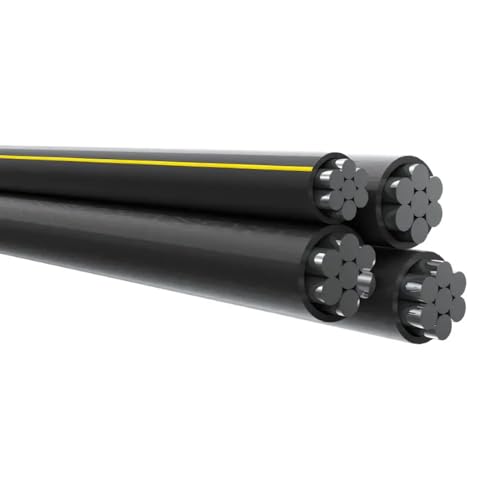
For trench-fed sub-panels where conduit is not required by code — typical for residential detached structures fed from a main panel — this URD quadplex cable is the correct tool. The heavy black jacket is formulated for direct soil contact, with insulation thickness of 60 mils and an overall diameter of 0.973 inches. It is rated for 155 amps in direct burial conditions, giving you significant headroom above the usual 90-amp termination limit.
The 2-2-2-4 configuration includes three 2 AWG insulated conductors and one 4 AWG bare neutral, exactly matching standard quadplex service entrance needs. At 367 pounds per thousand feet, the 180-foot spool weighs roughly 66 pounds — you will want a helper and a cable cart for the trench run. Buyers report that the cable pulls easily with pulling lubricant and preps cleanly for termination.
One buyer noted that a shipping-damaged spool was replaced promptly with a partial refund for the labor of re-spooling — a sign the vendor stands behind the product. Multiple verified purchasers have used this cable for 100-amp sub-panels in detached garages at distances over 100 feet, with six months or more of trouble-free service. For a long direct-burial feeder, this is the most complete solution on the list.
Why it’s great
- Rated for direct burial with 155A ampacity in soil
- 180 ft covers very long trench runs without a splice
- Heavy-duty jacket withstands soil chemicals and moisture
Good to know
- Very heavy spool — requires two people and a cart
- Conductors are stiff; pre-warming helps in cold weather
FAQ
Can I use SER cable for direct burial?
What is the actual ampacity of 2 AWG aluminum at 75°C terminals?
Do I need anti-oxidant compound on aluminum wire connections?
How do I calculate voltage drop for a 200-foot run of 2 AWG aluminum?
Final Thoughts: The Verdict
For most users, the best 2″ aluminum wire winner is the Wirenco 2-2-2-4 SER 50ft because it packages the correct 4-conductor feeder configuration at the length that covers the majority of above-ground sub-panel installations without waste or splicing. If you are pulling individual conductors through conduit, grab the Wirenco 2 AWG XHHW-2 50ft for its compact stranding and low friction. And for a long direct-burial trench feed, nothing beats the Nassau URD Dyke 180ft for ampacity headroom and soil-rated jacket durability.