
A 2″ ball valve is the critical control point in any serious water, irrigation, or industrial line, and choosing the wrong material or connection type can mean the difference between a decade of reliable service and a weekend of digging up a failed fitting. Whether you are plumbing a pool, a pressure tank, or a ranch irrigation system, the valve body material, seat seal, and port configuration directly determine how long the valve holds up under constant pressure and temperature cycling.
I’m Min — the co-founder and writer behind Gadgets Feed. I’ve spent over 100 hours analyzing the specific pressure ratings, chemical resistance, and thread tolerances of the 2-inch ball valve market to separate the parts that actually seal from those that leak at the first winter freeze.
The best approach is to match the valve’s material and pressure rating to your specific medium and environment, and exactly which 2″ ball valve fits each scenario is what this guide breaks down with concrete, verified specs.
How To Choose The Best 2″ Ball Valve
The 2-inch ball valve market runs the gamut from commodity-grade PVC socket valves at entry-level pricing to high-performance stainless steel threaded valves rated for 1000 PSI. The three specifications that will make or break your installation are the material family, the connection type, and the pressure/temperature envelope.
PVC vs. Stainless Steel vs. Brass
PVC is chemically inert, lightweight, and ideal for cold water irrigation and pool use up to 140°F, but it becomes brittle below freezing and cannot handle high-pressure air or gas. Stainless steel (304 or 316 grade) handles up to 1000 PSI, tolerates extreme temperatures from -60°F to 450°F, and resists corrosion in chemical and marine environments, but it costs significantly more and requires careful thread sealing. Brass is a middle-ground option but suffers from dezincification in soft water and typically has shorter handle stems that corrode over time, as multiple user reviews confirm.
Socket (Glue-On) vs. Threaded (NPT) Connections
Socket-end ball valves require PVC solvent cement and create a permanent, leak-proof bond — ideal for buried irrigation lines or pool plumbing where you never plan to disassemble. The downside: you must cut the pipe to replace the valve. Threaded NPT valves allow removal and servicing without cutting, but the threads must be compatible — some budget stainless steel valves ship with non-standard thread tolerances that fail to seal even with tape and pipe dope, a documented complaint on certain models.
Full-Port vs. Standard-Port
A full-port ball valve has a bore diameter equal to the pipe inner diameter, meaning zero flow restriction when fully open — critical for pump discharge lines and gravity-fed systems where every PSI counts. Standard-port valves have a reduced bore that creates turbulence and pressure drop, acceptable only in non-critical drain or vent lines. Every product on this list uses either full-port or standard-port construction; the difference is measurable by simple flow testing.
Quick Comparison
On smaller screens, swipe sideways to see the full table.
| Model | Category | Best For | Key Spec | Amazon |
|---|---|---|---|---|
| DERNORD True Union PVC | PVC Union | Servicing without cutting | 200 PSI, True Union, PTFE seats | Amazon |
| HYDROSEAL Kaplan True Union PVC | PVC Union | Commercial-grade reliability | 200 PSI, ASTM F1970, actuator-ready | Amazon |
| DERNORD 304 Stainless Steel | SS Threaded | High-pressure water, oil, gas | 1000 WOG, 304 SS, blue locking handle | Amazon |
| DAN SPEED 316 Stainless Steel | SS Threaded | Corrosive environments, marine | 1000 WOG, 316 SS, PTFE seals | Amazon |
| AIPOR 2″ PVC Ball Valve | PVC Socket | Easy-turn handle, 2-pack value | 150 PSI, solvent weld, 2-pack | Amazon |
| YADIAN 2″ PVC Ball Valve | PVC Socket | Budget 2-pack for basic irrigation | 150 PSI, socket, 2-pack | Amazon |
| Lswteiz 2″ PVC Ball Valve | PVC Socket | Entry-level single valve | 150 PSI, EPDM O-rings, TPE seats | Amazon |
In‑Depth Reviews
1. DERNORD PVC True Union Ball Valve

This DERNORD valve distinguishes itself with a true union design — the valve body unscrews from the socket ends without cutting the pipe. For anyone who has ever had to saw out a glued-in failed valve, this single feature saves hours of rework. The full-port bore ensures the 2-inch flow path is completely unobstructed when open, critical for pool pump suction lines and gravity-fed irrigation.
The construction uses two EPDM O-rings and reversible PTFE seats, both of which resist chemical attack from fertilizers and pool chlorine better than the generic TPE seats found on bargain valves. Rated at 200 PSI at 73°F, it exceeds the standard 150 PSI baseline, giving a safety margin in warm-water systems. ASTM, ASME, and NSF certifications confirm it meets commercial plumbing standards.
Real-world users report using this valve to replace big-box store failures in pool and irrigation lines, with several noting that the union ends allowed them to swap the valve without cutting or re-gluing the existing pipe stubs. The handle attaches via a keyed shaft rather than a press-fit, which eliminates the wobble issue common on cheaper valves.
Why it’s great
- True union ends allow servicing without pipe cutting
- Full-port design delivers zero flow restriction
- Reversible PTFE seats extend service life
Good to know
- Handle attach method can loosen over time if not periodically tightened
- Slightly larger footprint than simple socket valves
2. HYDROSEAL Kaplan True Union PVC Ball Valve

The HYDROSEAL Kaplan is the benchmark against which other true union PVC ball valves should be measured. It carries ASTM F1970 certification — the specific standard for PVC ball valves — and is built with a gray PVC body that resists UV degradation better than white PVC for exposed outdoor installations. The full-port bore and quarter-turn operation are standard for the premium tier, but the actuator-ready mounting pad sets it apart for anyone planning to automate their valve with an electric or pneumatic actuator later.
Internally, the valve uses dual EPDM O-rings and reversible PTFE seats, identical in quality to the DERNORD but manufactured to HYDROSEAL’s ISO-controlled tolerances. The socket ends are designed for solvent welding to Schedule 40 pipe and have a generous socket depth that ensures proper glue coverage. At 200 PSI, it handles peak pressure spikes from pump startup without weeping.
Owners consistently call out the smooth operating torque — even after months in service — and the fact that the valve is not made in China, a factor that matters to some buyers. The union design allows the valve center section to be removed while the socket ends remain glued in place, making future replacement a five-minute job instead of a re-plumbing project.
Why it’s great
- Actuator-ready mounting pad for automation
- UV-resistant gray PVC body
- Quarter-turn operation stays smooth under pressure
Good to know
- Gray PVC may not match existing white pipe installations
- Premium price relative to basic socket valves
3. DERNORD 304 Stainless Steel Full Port Ball Valve
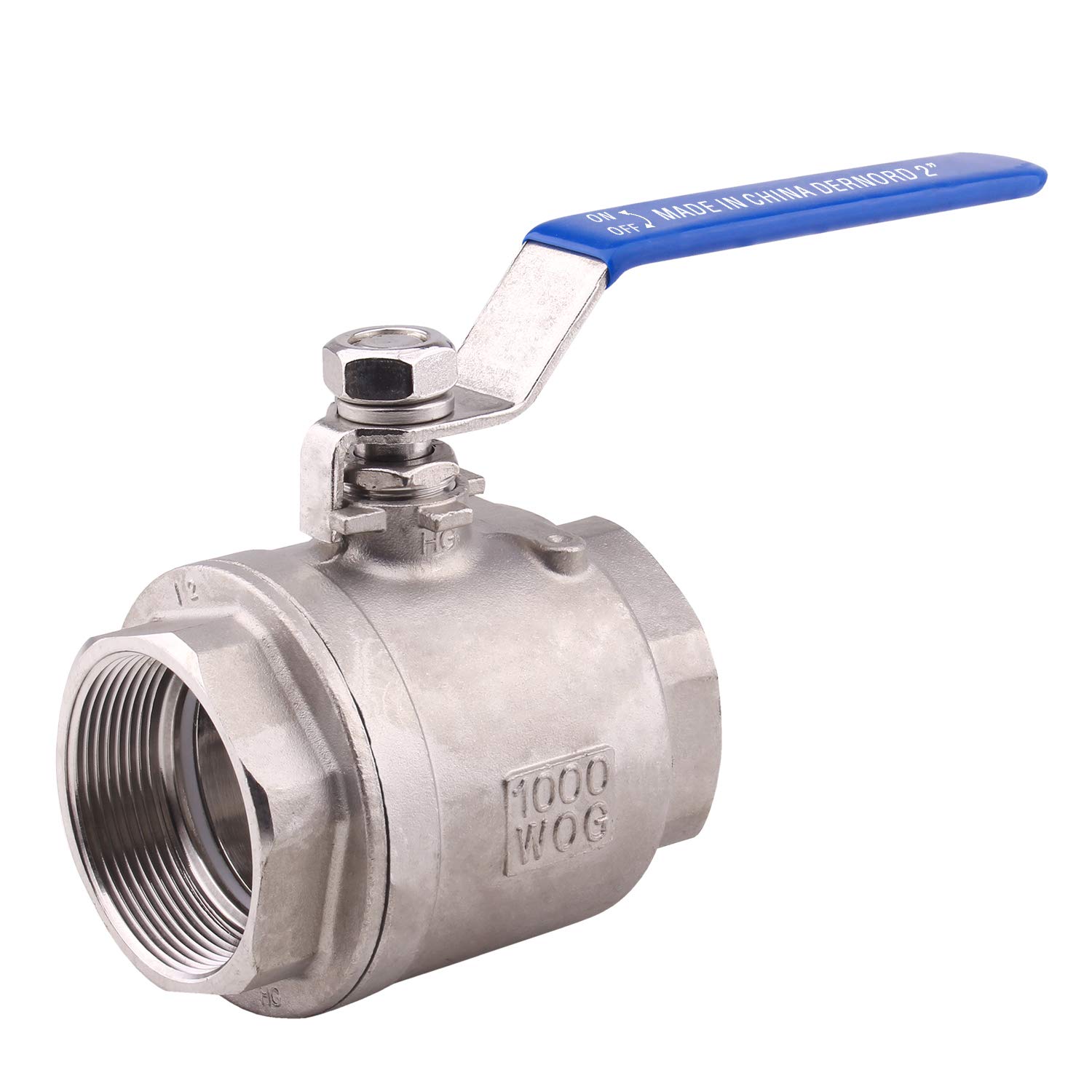
When the application demands metal — high-pressure water, oil, gas, or temperatures that melt PVC — this DERNORD 304 stainless steel valve delivers a 1000 WOG (Water, Oil, Gas) rating that dwarfs any plastic valve’s capability. The full-port design maintains the full 2-inch flow path, and the threaded female NPT ports allow direct connection to iron or galvanized pipe without adapters. The blue vinyl-insulated handle provides a comfortable grip and includes a locking mechanism to prevent accidental operation.
The valve body is serviceable — the stem packing can be tightened and the ball and seats accessed through the threaded end cap. Temperature range spans -60°F to 450°F, making this the correct choice for hot water boiler lines, steam vents, and freeze-thaw outdoor installations where PVC would shatter. Professional users in car wash systems report these valves outlasting brass replacements by a factor of ten because the stainless steel handle does not corrode and seize.
One caveat: stainless steel threads require a Teflon-based paste rather than tape for reliable sealing, as the threads are harder than brass and tape can allow galling. Multiple buyers confirm the threads cut clean and deep, but a minority report needing paste to achieve a drip-free seal at 100 PSI.
Why it’s great
- 1000 PSI pressure rating handles high-demand systems
- Full-port stainless steel bore for unrestricted flow
- Handle locking feature prevents accidental operation
Good to know
- Requires Teflon paste instead of tape for thread sealing
- Heavier than PVC; need proper pipe support
4. DAN SPEED 316 Stainless Steel Ball Valve

The DAN SPEED valve uses 316 stainless steel, which contains molybdenum for superior pitting resistance in chloride environments such as seawater, fertilizer solutions, and pool chemical dosing. This makes it a smarter choice than 304 for coastal properties or agricultural operations handling liquid fertilizers. The 1000 WOG rating applies across the same temperature range as the DERNORD 304, and the vinyl handle provides the same locking capability.
PTFE seals maximize corrosion resistance and lifespan, and the valve can be disassembled via the threaded end cap for cleaning or seat replacement. The full-port bore ensures that a 2-inch line remains a 2-inch line when the valve is open. Professional users on ranches and water trucks report these valves holding up where brass and PVC failed repeatedly.
The primary concern is thread consistency — one buyer reported that 6 out of 7 units had non-standard female threads that prevented CPVC adapters from engaging more than two threads deep, causing leaks at 50 PSI even with sealant. This appears to be a batch quality issue rather than a design flaw, but it suggests that buyers should pressure-test each valve before final installation.
Why it’s great
- 316 stainless for superior chloride resistance
- PTFE seals for maximum corrosion resistance
- Full-port bore maintains full pipe flow
Good to know
- Reported thread tolerance inconsistencies in some batches
- Pressure test before final installation recommended
5. AIPOR 2″ PVC Ball Valve

This AIPOR 2-pack hits the sweet spot for anyone needing multiple valves for an irrigation manifold or pool equipment pad. The solvent-weld socket ends mate directly to 2-inch Schedule 40 PVC pipe, and the one-piece body design minimizes potential leak paths compared to multi-part valves. The extended T-handle is noticeably easier to operate than the short stubby handles found on generic valves, a detail confirmed by multiple buyers.
At 150 PSI and 140°F maximum, this valve is perfectly matched to standard residential well systems and sprinkler zones. The PVC construction keeps it lightweight and chemically inert, suitable for potable water if installed correctly with NSF-rated cement. The 2-pack pricing brings the per-unit cost below most single premium valves, making it a practical choice for large installations.
A few owners noted that one valve in their two-pack became stiff after six months in a high-pressure pump line, but the majority report smooth operation even after seasonal use. The larger handle is the standout feature — it provides enough leverage that you can operate the valve with wet or gloved hands without slipping.
Why it’s great
- Extended T-handle provides easier operation than short-handle valves
- 2-pack offers solid value for multi-valve projects
- One-piece body reduces leak risk
Good to know
- Occasional stiffness reported after extended high-pressure use
- Maximum temperature 140°F limits hot water applications
6. YADIAN 2″ PVC Ball Valve

YADIAN’s 2-pack delivers a functional 2-inch PVC ball valve at a very accessible price point for budget-conscious irrigation and pool projects. The red T-handle is easy to spot in a crowded valve box, and the socket connections meet ASTM and ANSI standards for solvent welding. The 150 PSI rating at 73°F covers standard residential water pressure with margin.
The construction is straightforward — no union, no actuator mount, just a basic socket ball valve with an integrated handle. For simple on/off duty on a secondary line where you never need to service the valve, this keeps the project cost low. Buyers report these installed easily on sprinkler systems and pool pump lines, with several commenting that the quality exceeded what they expected at this price.
The trade-offs are the short handle (less leverage than extended-handle models) and a plastic construction that feels less substantial than premium valves. If you need a valve for an easily accessible line where replacement is straightforward, this 2-pack makes financial sense. For buried lines or hard-to-reach locations, investing in a true union valve is a better long-term strategy.
Why it’s great
- Very low per-unit cost in the 2-pack
- Meets ASTM and ANSI standards for safe installation
- Red handle visible in crowded valve boxes
Good to know
- Short handle provides less leverage than extended-handle models
- No union or serviceability — must cut pipe to remove
7. Lswteiz 2″ PVC Ball Valve

Lswteiz offers a single 2-inch PVC socket ball valve that covers the basics for a very low entry cost. The valve uses EPDM O-rings and TPE seats — the same materials found in many mid-range valves — to achieve a seal rated at 150 PSI and 140°F. The butterfly-style handle provides a large gripping surface, and the white PVC body is compatible with standard Schedule 40 fittings.
The valve meets ASTM D2466 and D1784 standards, ensuring dimensional consistency with other Schedule 40 components. It is suited for cold water supply lines, irrigation, and drainage where the valve will be operated infrequently. The simple socket connection means installation requires only PVC primer and cement, and the one-piece body eliminates gasket leaks.
Customer feedback is uniformly positive, with buyers praising the smooth operation straight out of the box and the sturdy feel of the handle. A few owners were initially concerned about stiffness based on other reviews, but the units they received operated freely. At this price point, the Lswteiz valve represents the lowest cost of entry for a functional 2-inch ball valve, though it lacks the serviceability features of union-style valves.
Why it’s great
- EPDM O-rings and TPE seats for reliable sealing
- Meets ASTM D2466 and D1784 standards
- Smooth operation out of the box per user reports
Good to know
- No union — must cut pipe to replace the valve
- Limited to cold water applications (140°F max)
FAQ
Can I use a 2″ PVC ball valve for hot water?
What is the difference between a union ball valve and a standard ball valve?
Should I choose socket or threaded connections for my 2″ ball valve?
Final Thoughts: The Verdict
For most users, the 2″ ball valve winner is the DERNORD PVC True Union Ball Valve because it combines a full-port bore, 200 PSI rating, and a true union design that saves hours of labor when servicing buried irrigation or pool lines. If you need a metal valve for high-pressure or high-temperature applications, grab the DERNORD 304 Stainless Steel Full Port Ball Valve for its 1000 WOG rating and locking handle. And for budget-conscious multi-valve installations where future service is not a concern, nothing beats the per-unit value of the AIPOR 2″ PVC Ball Valve 2-pack.