
A 2-channel mixer is the control center for any DJ or live performer who needs to blend two audio sources without compromise. Whether you’re scratching over a beat, fading between turntables, or mixing a podcast with a guest mic, the wrong mixer introduces noise, feels flimsy, and kills your flow before you even start.
I’m Min — the co-founder and writer behind Gadgets Feed. I’ve spent countless hours dissecting the specifications, crossfader mechanisms, EQ curves, and build quality of dozens of small-format mixers to separate the gear that truly performs from the units that only look the part on paper.
After analyzing signal-to-noise ratios, fader feel, and connectivity options across seven distinct models, this guide identifies the best 2-channel mixer for scratching, broadcasting, and everyday mixing.
How To Choose The Best 2-Channel Mixer
Selecting the right small-format mixer requires looking past the channel count to the components that define your sound and your workflow. The fader mechanism, preamp quality, and EQ architecture are what separate a mixer you will outgrow from one you will keep for years.
Crossfader Design and Curve Adjustment
The crossfader is the most touched component on any mixer. An entry-level unit uses a basic conductive plastic fader with no curve control, forcing you into a single fade slope that may feel either too sticky or too loose. Premium mixers like those with the Innofader or Magvel fader offer slope and reverse controls, letting you dial in a sharp cut for scratching or a gradual blend for smooth transitions. If you scratch even occasionally, a replaceable crossfader with curve adjustment is non-negotiable.
Preamp Quality and Phono Inputs
Turntable users need a built-in phono preamp that rejects hum and delivers clean gain at the source. Customer reviews consistently report that budget mixers introduce static or hiss when using phono-level inputs because the preamp stage is poorly shielded. A mixer with a dedicated ground terminal and a preamp that achieves a noise floor below -80dB ensures your vinyl stays quiet. For line-level devices like CDJs or media players, the preamp matters less, but the overall signal-to-noise ratio of the mixer still determines how much hiss you hear in the quiet parts of your mix.
EQ Band Count and Kill Range
The number of EQ bands directly shapes your mixing technique. A 2-band EQ (bass and treble) is sufficient for basic fades and level matching, but a 3-band EQ with a full-kill filter allows you to completely remove frequencies for dramatic sweep effects and phrase transitions. Some mixers advertise “full-kill” filters that only attenuate to -30dB, while true full-kill extends to -∞. If you rely on EQ drops as a signature part of your mix, seek out a mixer that fully kills each band.
Connectivity for Your Specific Gear Chain
Map your current and planned gear before buying. A mixer with only RCA inputs and outputs will integrate fine with most home setups, but if you ever plan to play through a PA system or record directly to a computer, balanced XLR outputs and a built-in USB sound card save you from buying extra adapters. Bluetooth input is a convenient addition for incorporating phone-based playlists, but it introduces latency and noise on poorly shielded budget boards — weigh that trade-off carefully.
Quick Comparison
On smaller screens, swipe sideways to see the full table.
| Model | Category | Best For | Key Spec | Amazon |
|---|---|---|---|---|
| Pioneer DJ DJM-250MK2 | Premium | Digital/Analog Hybrid | Magvel Crossfader / 105 dB S/N | Amazon |
| Numark Scratch | Premium | Serato DVS Scratch | Innofader / 108 dB S/N | Amazon |
| Behringer NOX101 | Mid-Range | VCA Fader Control | Full VCA / Ultraglide Fader | Amazon |
| Numark M2 | Mid-Range | Scratch & Rack Mount | 3-Band EQ / Replaceable Fader | Amazon |
| Rockville RDJ3BT | Value | USB & Bluetooth Playback | USB/MP3 Player / 4 Line Inputs | Amazon |
| Gemini MM1BT | Budget | Ultra-Portable Bluetooth | 2.6 lb Weight / Bluetooth Input | Amazon |
| Gemini MM1 | Budget | Entry-Level Scratch | 1.2 lb / Full-Size Crossfader | Amazon |
In‑Depth Reviews
1. Pioneer DJ DJM-250MK2

The Pioneer DJ DJM-250MK2 earns its top spot through a combination of build precision and smart integration that few 2-channel mixers achieve. Its Magvel crossfader is one of the smoothest on the market, offering a contactless magnetic mechanism that delivers consistent tension over years of scratching without the degradation common in cheap conductive-plastic faders. The built-in USB sound card unlocks direct connection to a computer for recording or DVS control with the included rekordbox license, effectively eliminating the need for a separate audio interface.
The analog signal path is clean, with a 105 dB signal-to-noise ratio that keeps floor hum out of your master output even when you crank the gain on quieter sources. Two headphone outputs — one 1/4-inch and one 3.5mm — let you share cue monitoring with a guest DJ without an adapter. The dual-band isolator-style filter on each channel adds creative sweep options beyond the standard 3-band EQ, though some users note the digital-to-analog converter sounds slightly thin compared to higher-end standalone DACs.
At over four hundred dollars, this mixer sits clearly in the premium tier, but the value is defensible when you factor in the software bundle and the pro-grade fader. The absence of a dedicated booth output is the only omission that might affect mobile DJs who need independent monitor mixing. For anyone building a home studio or playing regular club gigs, the DJM-250MK2 delivers professional feel and sound quality that justifies its price.
Why it’s great
- Magvel crossfader is contactless and built for heavy scratch use
- Built-in USB sound card with included rekordbox DVS license
- Dual headphone jacks for collaborative cue monitoring
- Isolator-style filter knobs on each channel for creative sweeps
Good to know
- No dedicated booth output for independent speaker monitoring
- Digital-to-analog converter quality is average for its price tier
2. Numark Scratch
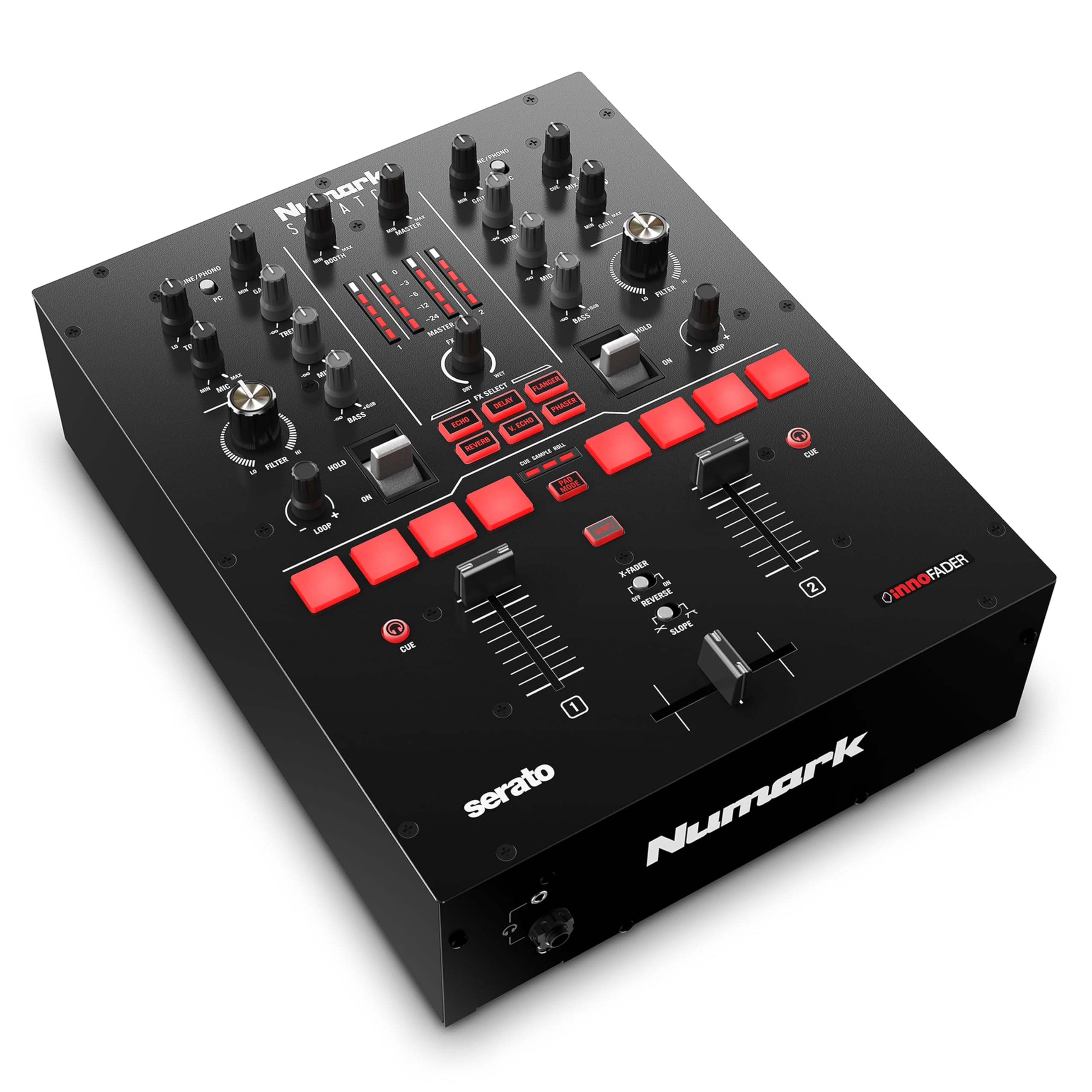
The Numark Scratch is purpose-built for Serato DJ Pro users who demand tight integration between hardware and software. It ships with a full Serato DJ Pro license and a DVS control license, meaning you can connect turntables or CDJs with control vinyl and scratch digital files immediately without any extra purchase — a value-add that shaves roughly off the software cost alone. The Innofader crossfader is widely considered the best production fader on the market, offering dual-contact optical sensors that provide zero-touch point adjustment and a buttery-smooth glide that works equally well for quick cuts and long blends.
The layout is optimized for battle-style performance, with six direct-access effect selectors, dual paddle launch triggers, and a dry/wet FX control that puts software effects at your fingertips without requiring a mouse. The 24-bit sound quality delivers clean audio reproduction with a 108 dB signal-to-noise ratio that matches most club-standard mixers. The combo mic input accepts both XLR and 1/4-inch connectors, and the balanced XLR master outputs ensure clean signal delivery to professional PA systems over long cable runs.
The main limitation is the lack of an auxiliary input — you cannot easily connect a third source like a phone or a media player without unplugging something. The performance pads also feel slightly softer than those on dedicated controllers, though they function reliably for cue point triggering and loop rolls. For any DJ committed to the Serato ecosystem, the Numark Scratch offers the most complete feature set in a 2-channel battle mixer at its price point.
Why it’s great
- Includes full Serato DJ Pro and DVS license (+ value)
- Innofader crossfader is optical, contactless, and user-replaceable
- Balanced XLR outputs for clean long-cable PA runs
- Six direct-access effect selectors with paddle triggers
Good to know
- No AUX input for adding a third audio source
- Performance pads feel slightly soft compared to dedicated controllers
3. Behringer PRO MIXER NOX101
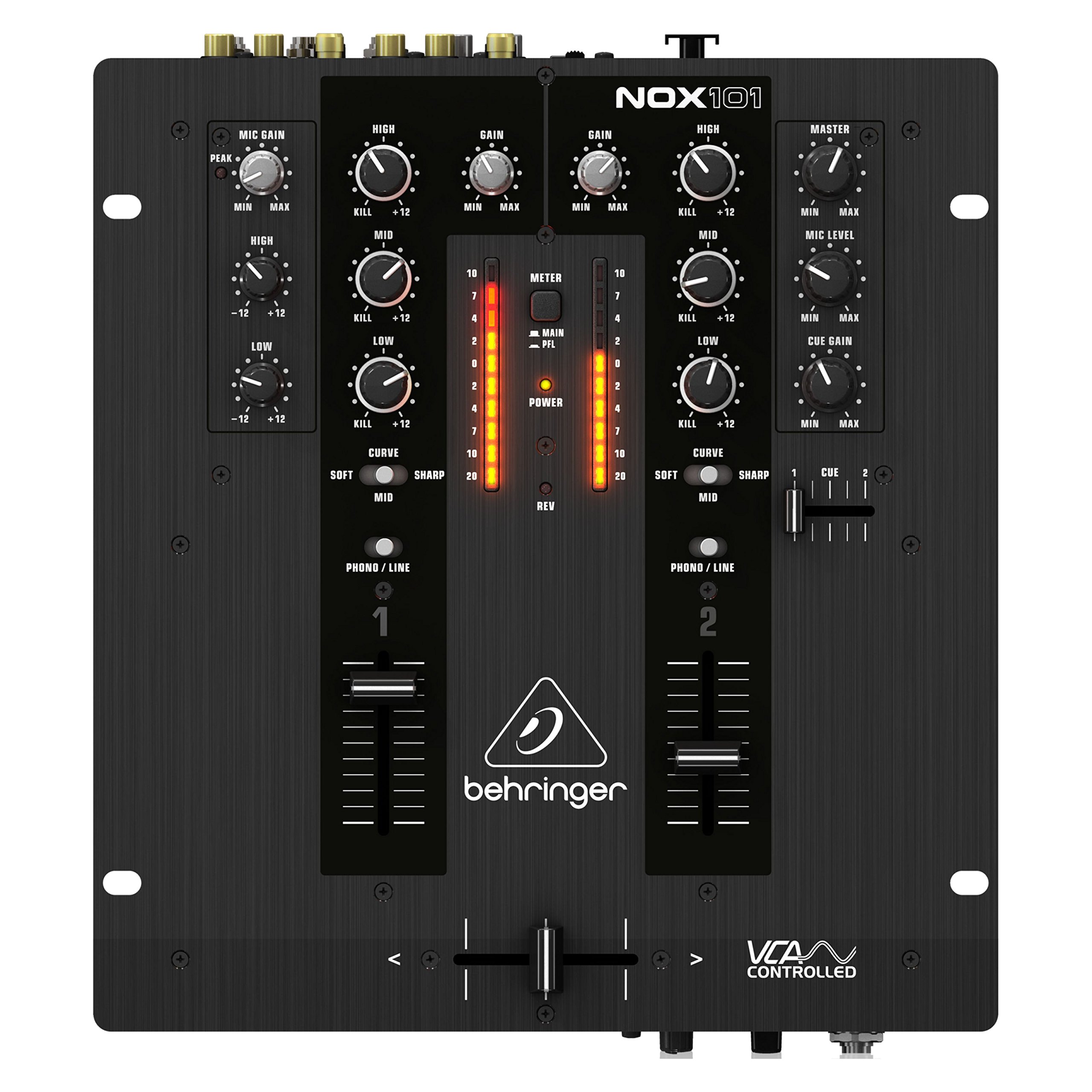
The Behringer NOX101 stands out in the mid-range category by bringing VCA (Voltage Controlled Amplifier) technology to a sub- 2-channel mixer. VCA faders use an electrical signal to control the audio level rather than routing the audio directly through the slider, which eliminates the scratchy noise and signal loss that plague cheap potentiometer-based faders over time. The result is a much cleaner sound at low levels and a consistent response curve across both channel faders and the Ultraglide crossfader.
The 3-band EQ on each channel includes full-kill filters that completely remove the selected frequency band, giving you the ability to create dramatic silent drops without any residual signal bleeding through. The phono preamps are noticeably stronger than those on the similarly-priced Numark M2, providing cleaner gain for vinyl sources with less audible noise floor. The NOX101 also includes both XLR and TRS balanced outputs, offering professional connectivity that budget mixers often omit entirely.
Some users report that the master output introduces slight noise when cranked to maximum volume, and the unit is not truly compact at roughly 10 by 11 inches. The sliders, while smooth, are not designed for aggressive scratching use and lack the replaceable mechanism found on purpose-built scratch mixers. For home DJs or mobile performers who want VCA performance and full-kill EQ without paying premium-tier prices, the NOX101 represents excellent value.
Why it’s great
- Full VCA control for clean, long-lasting fader performance
- 3-band EQ with true full-kill filters for dramatic drops
- Strong phono preamps that handle vinyl with low noise
- Balanced XLR and TRS outputs for pro audio integration
Good to know
- Master output can introduce noise at maximum volume
- Faders are not designed for heavy scratching or rapid cuts
4. Numark M2

The Numark M2 is a reliable workhorse that focuses on the fundamentals of scratch mixing without unnecessary frills. Its replaceable crossfader includes both reverse and slope controls, allowing you to adjust the fade curve from a sharp cut (ideal for crab scratches) to a gradual crossfade for smoother transitions. The 3-band EQ gives you bass control centered around 80Hz, which works well for tightening the low end in live mixes without the muddy overlap that cheaper 2-band EOs produce.
Dual phono/line switchable inputs per channel plus two additional line-level RCA inputs give you flexibility to connect two turntables and two CDJs or media players simultaneously. The microphone input is a simple 1/4-inch jack — it works for basic announcements but lacks the XLR connectivity or gain staging needed for serious vocal work. The included rackmount ears make it easy to install in a standard 19-inch equipment rack, a feature rarely found on 2-channel mixers in this price range.
The main critiques center on the fader feel. Several users note that both the channel faders and the crossfader move too freely with minimal resistance, making precise volume adjustments tricky during quiet sections. The bass EQ, while effective, only provides frequency-specific control and does not offer the full-kill functionality found on the Behringer NOX101 or Pioneer DJM-250MK2. For DJs who need a solid, rack-mountable mixer for mobile setups or permanent installations, the M2 delivers dependable performance with replaceable components that extend its usable life.
Why it’s great
- Replaceable crossfader with reverse and slope controls
- Rackmount ears included for permanent installation
- Four total line inputs with phono/line switching for turntables
- 3-band EQ with useful 80Hz bass control
Good to know
- Channel and crossfaders have very light resistance, feel loose
- Mic input is 1/4-inch only, no XLR option
5. Rockville RDJ3BT
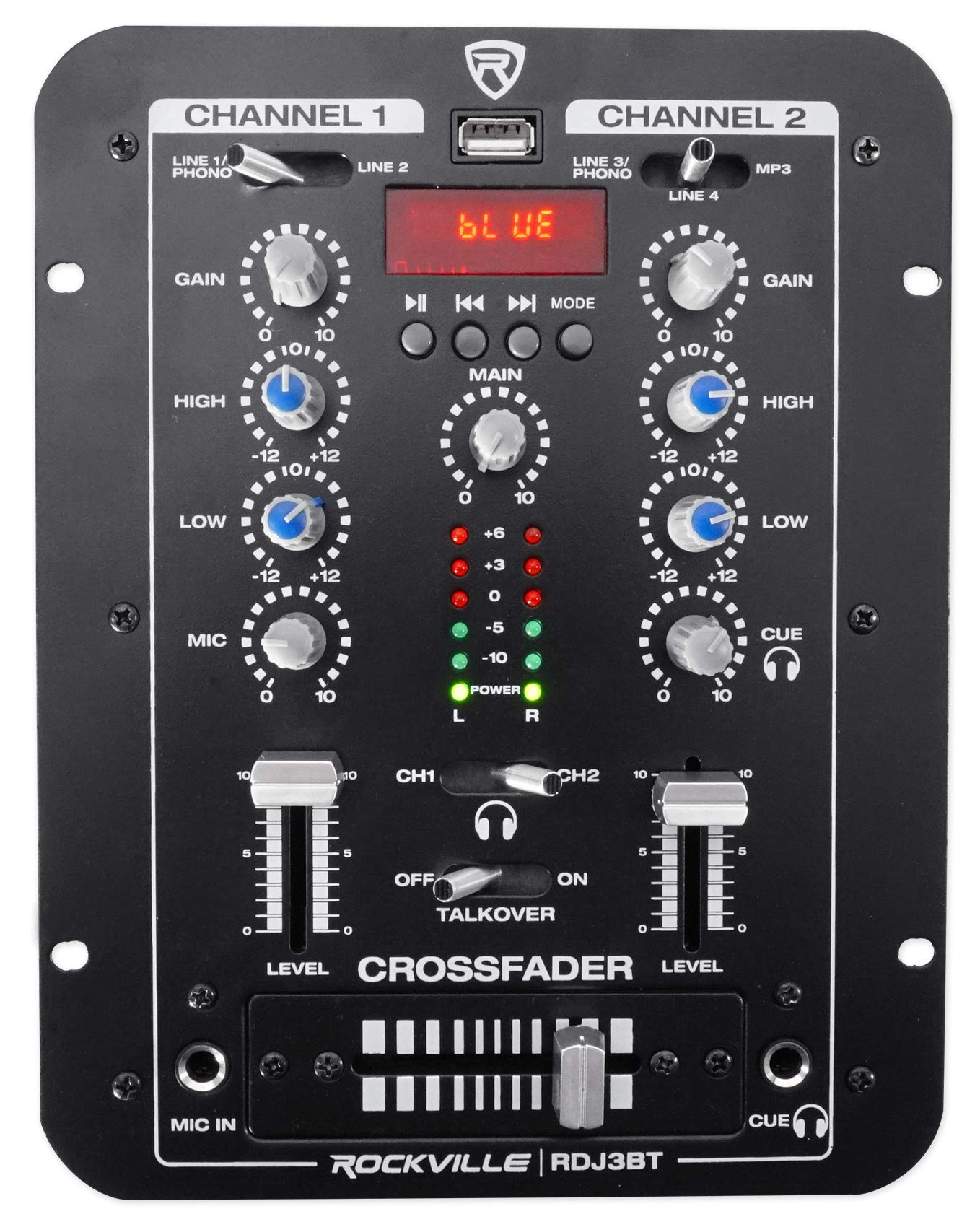
The Rockville RDJ3BT packs a surprising amount of functionality into a compact, all-metal chassis, starting with its built-in USB and MP3 player that reads tracks directly from a flash drive. The LCD screen displays file information, though it lacks subfolder navigation — you will need to organize your tracks in a single directory for it to work smoothly. The Bluetooth input allows wireless streaming from a phone or tablet, although some units produce noticeable digital noise when the Bluetooth circuit is active, a common issue in lower-cost wireless implementations.
The four RCA line inputs give you two inputs per channel, allowing you to connect up to four line-level sources without unplugging cables. The mic input is 1/4-inch mono and the talkover feature automatically attenuates music volume by -16dB when you speak, which is useful for basic announcements at small events. The selectable input switching per channel lets you toggle between two sources on the fly, though there is no phono preamp, so turntables will require an external preamp before connecting.
Build quality is generally solid, but the rotary knobs feel slightly flimsy and the main faders drop off sharply near the ends of their travel, which makes fine volume adjustments difficult. The included power supply has been flagged by multiple users as a weak point. For mobile DJs who need a versatile backup mixer or want to play music directly from a USB drive at small gigs, the RDJ3BT delivers a unique feature set that no other 2-channel mixer in its price bracket offers.
Why it’s great
- Built-in USB/MP3 player with LCD display for direct track playback
- Four line inputs with per-channel source selection
- Bluetooth wireless input for phone streaming
- Talkover mic function for announcements
Good to know
- Bluetooth circuit can introduce audible digital noise
- No phono preamp — turntables need an external preamp
- Faders drop off sharply at the ends for imprecise volume control
6. Gemini MM1BT

The Gemini MM1BT takes the core simplicity of the MM1 and adds Bluetooth wireless input, making it the most portable option for DJs who want to stream from a phone while mixing from turntables or line sources. The all-metal body weighs just over 2 pounds and measures roughly 6.5 by 4 inches, small enough to slip into a laptop bag alongside your headphones. Despite its tiny footprint, it retains a full-size 45mm crossfader and 2-band EQ with gain control on each channel, giving you real mixing capability in a form factor that fits in your palm.
Connectivity includes dual RCA inputs, a 1/4-inch microphone jack, and separate Master and Booth RCA outputs, allowing you to cue tracks through headphones while sending the main mix to speakers. The Bluetooth function works reliably for streaming music from a phone, and several users note that it remains stable throughout entire sets without dropouts. The phono inputs, however, can introduce static that gets amplified by downstream preamps — the fix is to use line-level sources or run each turntable through an external phono preamp before the mixer.
The MM1BT is not designed for heavy scratching or club-level durability, and it lacks features like EQ kill switches, a replaceable crossfader, or balanced outputs. The minimalist design means no USB connectivity, no software integration, and no effects. For bedroom DJs, mobile performers who need a backup, or anyone building a compact portable setup on a tight budget, the MM1BT delivers surprising sound quality and genuine mixing control in an ultra-portable package.
Why it’s great
- Ultra-portable at 2.6 pounds with metal body construction
- Bluetooth input for wireless streaming alongside wired sources
- Full-size crossfader with gain and 2-band EQ per channel
- Separate Master and Booth RCA outputs for cueing
Good to know
- Phono inputs introduce static without external preamps
- No USB connectivity, replaceable fader, or balanced outputs
7. Gemini MM1

The Gemini MM1 is the most affordable entry point into proper 2-channel DJ mixing, stripping away everything except the core components needed to blend and fade between two sources. Its all-metal body and compact dimensions (almost pocket-sized at 4.13 by 6.5 inches) make it ideal for DJs who need a mixer they can throw in a backpack without worrying about cracked plastic or broken jacks. The full-size crossfader provides genuine scratch capability that no ultra-budget USB controller can match.
Controls are refreshingly straightforward: each channel gets a gain knob, a 2-band EQ (high and low), and a volume fader, plus a master fader and a crossfader. The RCA inputs accept line-level sources directly, and the 1/4-inch microphone jack lets you add vocal announcements without a separate mixer. Users consistently praise the fader feel, noting that the crossfader slides easily and the metal chassis prevents the unit from sliding around on a table during use.
The MM1 lacks Bluetooth, USB playback, any sort of effects processing, and has no replaceable or adjustable crossfader. The phono inputs, similar to the MM1BT, can introduce static unless you feed them from a preamped line source or an external phono preamp. For the complete beginner who wants to learn the fundamentals of beatmatching and fading with real hardware rather than a toy, the Gemini MM1 offers a surprisingly capable and durable foundation.
Why it’s great
- Compact all-metal body at just 1.2 pounds for maximum portability
- Full-size crossfader with smooth action for basic scratching
- Gain and 2-band EQ per channel for sound shaping
- 1/4-inch mic input adds vocal capability
Good to know
- Phono inputs need external preamps to avoid static noise
- No Bluetooth, USB playback, or replaceable fader
FAQ
Can I use a 2-channel mixer as a microphone preamp for recording?
What is the difference between VCA and standard faders?
Why does my mixer produce static when I connect turntables?
Is Bluetooth input reliable for live DJ performance?
Can I record directly from a 2-channel mixer to my computer?
Final Thoughts: The Verdict
For most users, the best 2-channel mixer winner is the Pioneer DJ DJM-250MK2 because its Magvel crossfader, built-in USB sound card, and bundled rekordbox DVS license deliver a complete mixing package that works equally well for analog turntables and digital controllers. If you want deep Serato DJ Pro integration with the industry’s best fader, grab the Numark Scratch. And for a scratch-focused hybrid setup on a tighter budget, nothing beats the Behringer NOX101.