
A garden that fights back with compacted clay, stubborn sod, and rocky patches needs a machine that digs in without tearing your arms from their sockets. The right 2-cycle cultivator turns that back-breaking struggle into a straight-through job, chewing through rows and flower beds with a mix of engine displacement and tine geometry that matters more than any brand sticker.
I’m Min — the co-founder and writer behind Gadgets Feed. After sifting through hundreds of verified owner reports and cross-referencing every engine spec from displacement to gear-drive type, I’ve mapped which machines actually hold up and which ones fold on the first buried rock.
This guide distills everything into a clear, no-fluff breakdown of the 2026 best 2-cycle cultivator options that deliver real results without the usual marketing fog.
How To Choose The Best 2-Cycle Cultivator
Picking the right 2-cycle cultivator comes down to three things: how much raw spinning force the engine can deliver, whether the transmission can handle a sudden rock impact without snapping, and how the tines are shaped to grab soil without walking the machine all over your garden. Every one of these factors is concrete and measurable — nothing here is up for interpretation.
Engine Displacement and Torque
The cubic centimeter (cc) rating on a 2-cycle engine tells you the volume of the combustion chamber. More displacement means more torque at the tines, which matters tremendously when you hit hard-packed dirt or buried roots. A 33cc engine can handle weeding and shallow cultivation in loose soil, but a 52cc engine powers through compacted clay and sod without bogging down. Many beginners assume any engine will work for any soil type — that assumption breaks tines and frustrates owners who end up making three passes instead of one. Match the displacement to your soil density, not your budget.
Transmission Type: Gear Drive vs. Worm Drive
The transmission is the backbone that converts engine rpm into tine rotation force. Gear-drive systems use interlocking metal gears inside a sealed case — they handle sudden shock loads from rocks far better than worm-drive transmissions, which rely on a sliding gear that wears faster under heavy torque. A gear-drive unit will feel heavier in the hand but delivers consistent digging power without the bouncy, jumping behavior that plagues worm-drive machines in hard soil. If your garden has any rocks at all, gear drive is the only choice that won’t leave you stranded mid-row.
Tine Material and Configuration
Steel-forged tines are the standard for durability, but the thickness of the steel and the shape of the tine tip determine how aggressively the machine digs. Four-tine configurations are typical for 2-cycle cultivators, with adjustable tine widths letting you switch between narrow row work and wider bed coverage. Some machines let you reverse the tine rotation direction, which changes whether the cultivator pulls itself forward or stays more stationary — a feature that matters when you’re weeding around established plants. Tines made from cheap stamped steel bend the first time they hit a root, and a bent tine throws the entire rotation out of balance.
Quick Comparison
On smaller screens, swipe sideways to see the full table.
| Model | Category | Best For | Key Spec | Amazon |
|---|---|---|---|---|
| Earthquake MC33 | Mini Tiller | Versatile weeding & aeration | 33cc Viper engine, gear drive | Amazon |
| Mantis 7920 | Mini Cultivator | Best lightweight power | 20 lbs, 2-cycle engine, serrated tines | Amazon |
| Thunderbay TB522 | Compact Tiller | Small gardens & flower beds | 52cc engine, 4 steel forged tines | Amazon |
| VEVOR 43CC | Garden Tiller | Entry-level vegetable beds | 43cc 2-stroke, 11.8″ width | Amazon |
| GardenTrax GT-TILLER | Mini Tiller | Tough rocky soil | 33cc engine, worm-drive | Amazon |
| Troy-Bilt TB225 | Garden Cultivator | Easy-start home use | 25cc engine, SpringAssist | Amazon |
| Baotree 62cc | Heavy Duty Tiller | Larger plots & clay soil | 62cc engine, self-propelled wheels | Amazon |
| BILT HARD 99cc | 4-Cycle Tiller | Deep tilling & compacted earth | 99cc 4-cycle, 11.8″ depth | Amazon |
| Echo TC-210 | Forward-Rotating Tiller | Trusted brand for small jobs | 21.2cc engine, 9″ width | Amazon |
In-Depth Reviews
1. Earthquake MC33 Mini Tiller Cultivator

The Earthquake MC33 packs a 33cc Viper engine mated to a gear-drive transmission, a combination that delivers steady, vibration-dampened power through tough soil without the bouncy ride that plagues worm-drive machines. Multiple verified users report it breaks sod and compacted ground effectively, though the manual advises against virgin soil — real-world performance clearly exceeds that cautious rating.
On-board adjustable wheels serve double duty: they set the tilling depth precisely and allow easy transport without dragging the tines across your driveway. The overhand handle design reduces the machine’s natural tendency to jump and bounce, giving you more control between rows of plants. At 29 pounds, it’s light enough for most users to maneuver yet heavy enough to stay planted during work.
The 5-year limited warranty from Ardisam, a US-based company with actual phone support, adds genuine long-term confidence that most budget-tier machines simply don’t offer. A few owners report minor casting flaws or wheel mount issues, but the majority of reviews highlight easy starting, simple assembly, and reliable performance season after season.
Why it’s great
- Gear-drive transmission handles rocks without shock damage
- Reversible tines allow both forward tilling and stationary weeding
- Industry-leading 5-year warranty with US-based support
Good to know
- Overhand throttle requires firm grip to keep from stalling at idle
- Some units arrive with cosmetic blemishes from shipping
2. Mantis 7920 2-Cycle Plus Tiller/Cultivator

The Mantis 7920 weighs just 20 pounds, making it the lightest serious cultivator in this comparison, but its patented serrated tines spin fast enough to break clay mounds and compacted soil that heavier machines often struggle with. The secret is the high-rpm 2-cycle engine that drives the tines at a speed that lets the serrations slice through roots rather than just pushing against them.
Handle bars fold down for compact storage, and the built-in carrying handle means you can haul it to the shed with one hand. Multiple long-term owners report tilling entire gardens on less than one tank of mixed fuel, which speaks to both the engine’s efficiency and the tine design’s ability to move soil without wasted passes. The machine is quieter than most 2-stroke cultivators, a detail noticed by owners who work near neighbors.
The 2-year limited warranty is shorter than some competitors, but the brand’s reputation and parts availability through Schiller Grounds Care mitigate the risk. Some owners note that keeping the machine in a straight line requires practice because the tines are so aggressive — it wants to walk forward quickly rather than staying in place for deep cultivation.
Why it’s great
- Extremely lightweight design reduces operator fatigue significantly
- Serrated tines slice through roots and clay more effectively than plain steel
- Folding handles and carrying handle make storage and transport effortless
Good to know
- Requires active steering — does not track straight on its own
- 2-year warranty is shorter than the Earthquake MC33’s 5-year coverage
3. Thunderbay Cultivator 52cc

The Thunderbay TB522 delivers a 52cc 2-cycle engine at a price point that undercuts nearly every other machine in this category, making it the easiest entry point for anyone who needs real displacement without the premium markup. The four steel forged tines adjust from 6 to 12 inches in width and dig down to 6 inches deep, covering both narrow row work and wider bed cultivation in a single machine.
The U-turn handlebar design includes rubber grips intended to dampen vibration, and multiple owners confirm the machine handles light to medium garden work without the exhausting bounce that cheap tillers produce. The reversible design means you can set the engine right-side-up without fuel spillage during transport, a practical detail that matters more on the third use than the first.
A 2-year limited warranty on the engine provides baseline coverage, though some owners report difficulty reaching customer support after issues arise. The mixed reviews (several 5-star ratings alongside reports of early breakage) suggest quality control varies between units, so inspect your machine thoroughly during the first use and be prepared to exercise the warranty if needed.
Why it’s great
- 52cc displacement provides power that outperforms most 33cc competitors
- Tool-free assembly saves setup time right out of the box
- Adjustable tine width covers both narrow rows and wide beds
Good to know
- Customer support responsiveness is inconsistent based on owner reports
- Lacks power in hard-packed clay at full tine width
4. GardenTrax Mini Tiller 33cc

The GardenTrax GT-TILLER proves that a 33cc engine with a worm-drive transmission can handle surprisingly tough conditions when the tines are aggressive enough. Verified owners report launching rocks out of compacted soil and running the machine for two hours straight without overheating, which speaks to the engine’s thermal management even under sustained load.
The 10-inch cultivating width and maximum 4-inch depth make this a true mini tiller — it excels at weeding between established plants and aerating loose soil, but it will require multiple passes for any serious soil preparation. Several long-term users note that dense weeds and grass wrap around the tine shaft, which can lead to gearbox overheating if not cleaned regularly. The worm-drive transmission is quieter than a gear-drive system but less tolerant of sudden shock loads from rocks.
At around 20 pounds, it’s light enough that a smaller-framed user can handle it easily, though the T-bolts that secure the handle have a tendency to vibrate loose over time — several owners replaced them with locking nuts for a permanent fix. The machine is loud enough to require ear protection, consistent with most 2-cycle engines at this displacement.
Why it’s great
- Surprisingly capable in rocky, compacted soil for a 33cc machine
- Lightweight design makes it easy to maneuver in tight garden rows
- Simple assembly with mostly pre-installed components
Good to know
- Worm-drive transmission is less durable than gear-drive under heavy load
- T-bolts vibrate loose and should be replaced with locking hardware
5. Troy-Bilt TB225 Gas Garden Tiller
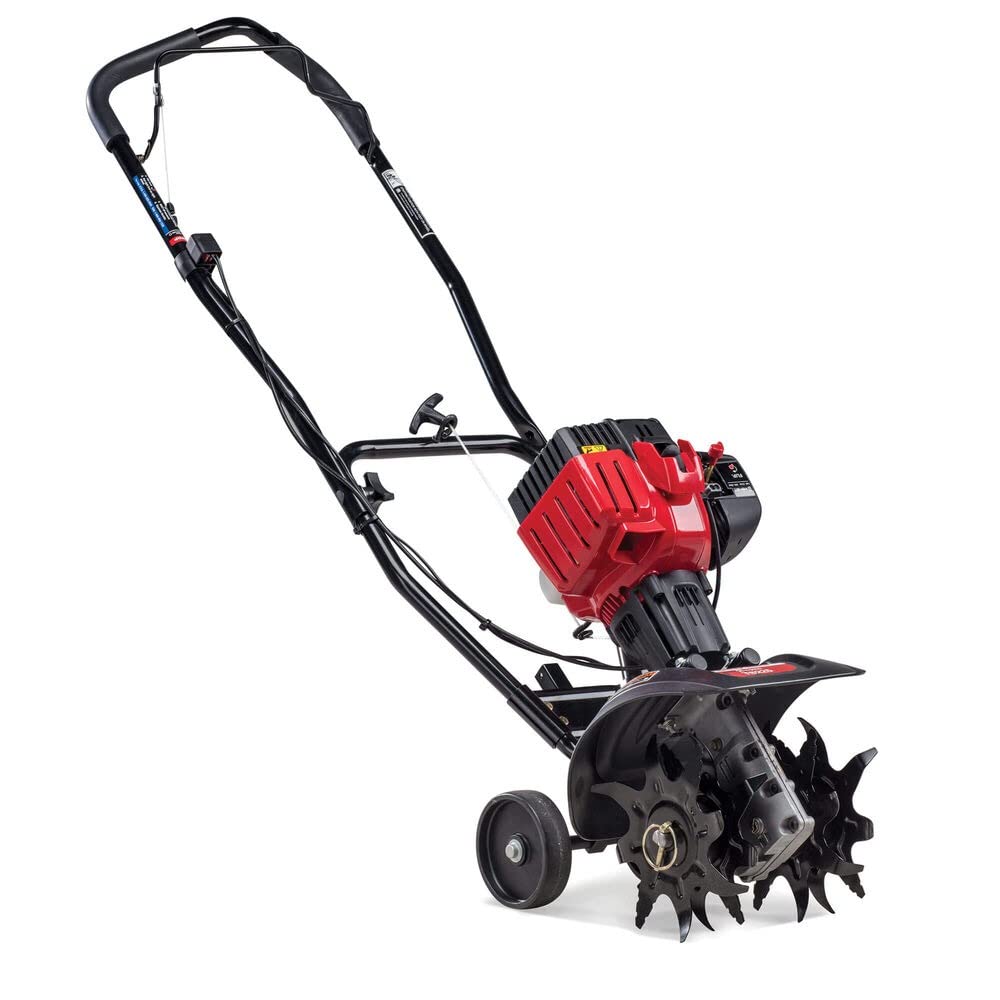
The Troy-Bilt TB225 uses a 25cc 2-cycle engine with SpringAssist technology, which mechanically reduces the effort required to pull the starter cord — a genuine benefit for users who struggle with the hard pull of many 2-cycle machines. The Prime, Flip & Go system simplifies the starting procedure to three steps, making this the most approachable cultivator for first-time users who don’t want to fiddle with choke positions and throttle settings.
The four patented steel tines adjust for both width and depth, reaching a maximum tilling depth of 5 inches. This is a cultivator designed for maintenance and mixing, not for primary soil breaking in virgin ground. Owners consistently report it works great for homestead use, weeding, and turning in amendments, but the 25cc displacement means it struggles in hard clay or rocky soil where larger engines would power through.
Reports of pull cord breakage after limited use appear in the review data, alongside complaints about the throttle handle placement that requires the engine to run at full open to stay running. The warranty experience reported by some owners was poor, with Troy-Bilt allegedly not honoring coverage on a machine that broke within 60 minutes — a cautionary data point despite the brand’s household name recognition.
Why it’s great
- SpringAssist start system reduces pull cord effort significantly
- Adjustable tilling width and depth provide versatility for beds and rows
- Brand recognition with wide parts availability at local retailers
Good to know
- 25cc engine lacks power for compacted clay or sod-breaking work
- Pull cord and throttle design have reported durability issues
6. Baotree 62cc Gas Tiller Cultivator
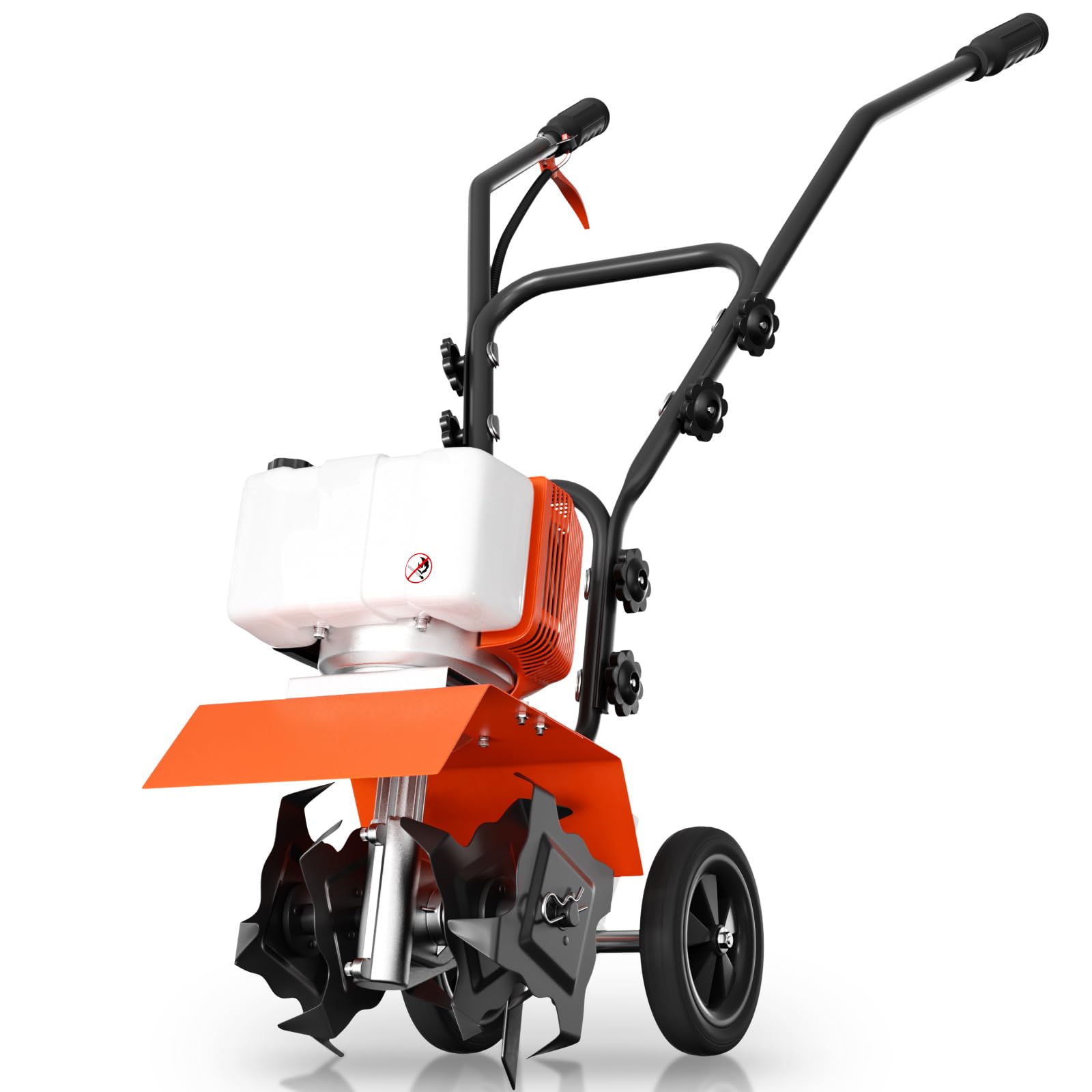
The Baotree 62cc cultivator brings the highest displacement in the 2-cycle group, promising enough torque to handle heavy clay and larger garden plots that smaller engines can’t manage in a single pass. The self-propelled wheel design and adjustable handle aim to reduce operator fatigue during longer sessions, and the four steel tines provide a 10-inch cultivating width for efficient coverage.
However, the review data reveals significant quality control problems that undermine the displacement advantage. Multiple owners report the pull rope assembly breaking on the first use, wheels detaching during operation, and the wheel mounting components bending under normal turning stress. One detailed account describes the machine losing drive entirely after hitting a rock for just 3 seconds — a failure mode that suggests the transmission casing or gear engagement is not robust enough for the 62cc engine’s torque output.
At a price point that competes with the Thunderbay 52cc, the Baotree offers more displacement but substantially higher risk based on verified owner reports. The handful of positive reviews confirm it can dig well when everything works, but the failure rate appears elevated compared to similarly priced competitors.
Why it’s great
- 62cc displacement provides maximum power for clay and dense soil
- Self-propelled wheels reduce physical effort during operation
- Adjustable handle accommodates different operator heights
Good to know
- Multiple reports of wheels bending and pull rope breaking on first use
- Transmission appears unable to handle shock loads from buried rocks
7. VEVOR 43CC 2-Stroke Cultivator

The VEVOR 43CC cultivator sits in the middle of the displacement range, offering a 43cc 2-stroke engine with an alloy steel gearbox and enlarged heat dissipation holes designed to prevent overheating during extended use. The cultivation width of 11.8 inches and depth of 3.9 inches make it suitable for vegetable gardens and flower beds, with the adjustable skid assembly letting you set the working depth precisely.
The stand-up operation design reduces back strain, and the 5.8-inch large drive wheels provide decent traction on loose soil. Several owners report that the machine starts easily with good instructions and tills garden beds effectively, with some noting it performs better than expected for the price point. The 3-step assembly process is genuinely simple, and shipping without separate packages reduces the chance of losing small parts.
Review data includes reports of the tiller head breaking after only two uses, oil leaks from the engine, and instructions that sometimes mismatch the actual product (one unit shipped with instructions for an auger instead of the cultivator). The 43cc engine produces enough power for light to medium soil but struggles in heavy clay or when trying to achieve the full 3.9-inch depth on the first pass.
Why it’s great
- Easy 3-step assembly gets you working quickly
- Heat dissipation holes prevent overheating during longer sessions
- Adjustable skid assembly allows precise depth control
Good to know
- Some units arrive with oil leaks or broken tiller heads
- Inconsistent packaging with wrong instructions reported
8. BILT HARD 99cc 4-Cycle Tiller
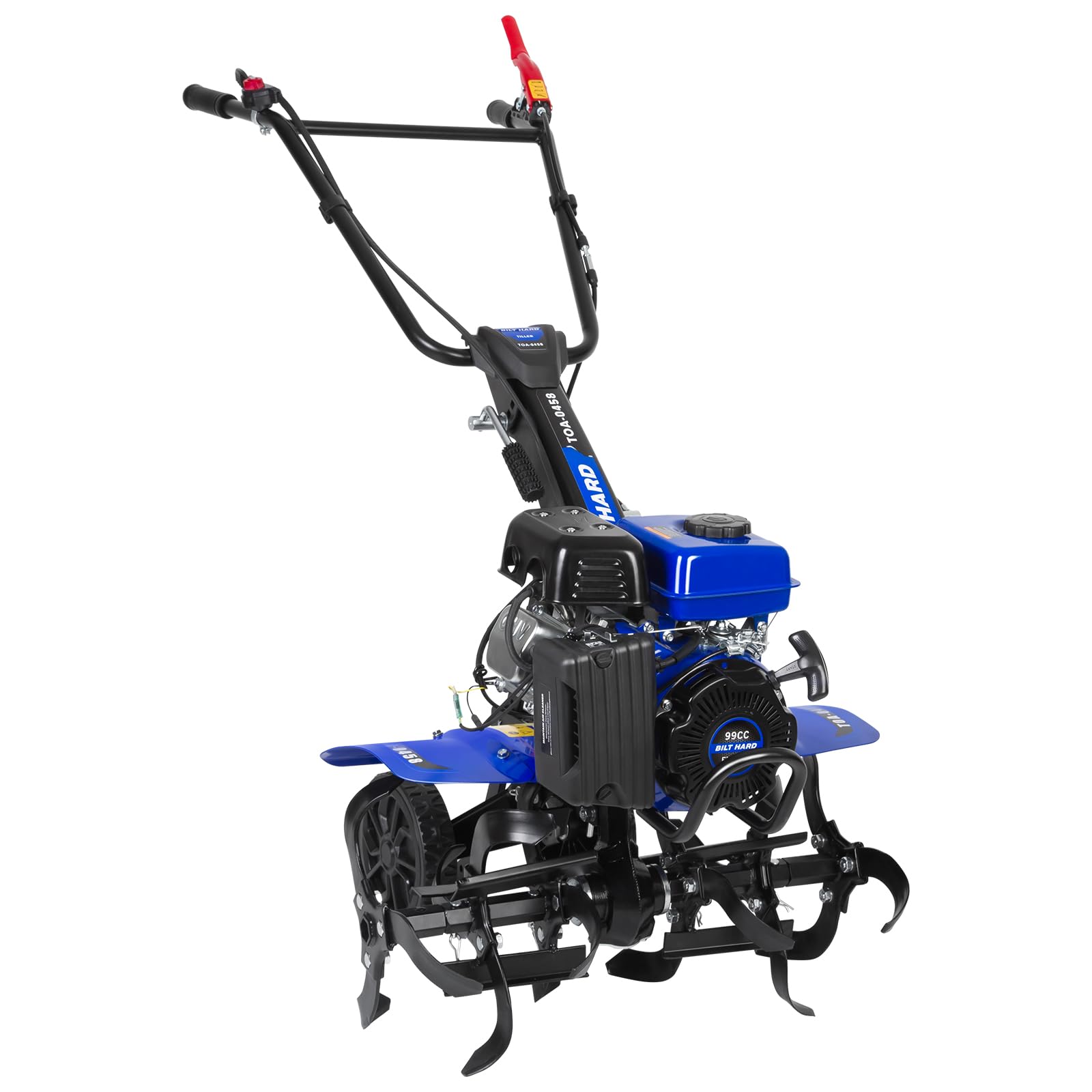
The BILT HARD 99cc is technically a 4-cycle engine, not a 2-cycle, but it’s included in this comparison because many shoppers cross-shop both types when looking for a gas-powered cultivator in this price tier. The 99cc displacement produces 3 HP at 3600 RPM, delivering the highest torque in this group by a wide margin, with an adjustable working width from 17 to 24 inches and tilling depth up to 11.8 inches.
The dual-action safety system stops tine rotation when you release the clutch grip, with a separate throttle switch for system shutdown — a safety setup that matches higher-end machines. The 8-inch rear wheels adjust vertically for transport or tilling position, and the handle adjusts to three height settings. Multiple owners confirm the machine starts within three pulls using ethanol-free 4-cycle fuel and handles heavy soil without bogging down.
At over 50 pounds, this is not a machine you’ll carry around one-handed, and the 4-cycle engine means no fuel mixing — but also adds weight and complexity compared to a 2-cycle. One owner reported a non-starting unit that the seller replaced within three business days at no charge, indicating responsive customer support that addresses the main risk of buying heavy equipment online.
Why it’s great
- 99cc engine provides unmatched torque for deep tilling and compacted earth
- No fuel mixing required — runs on straight gasoline
- Responsive customer support with no-hassle replacement policy
Good to know
- Significantly heavier than all 2-cycle options at over 50 pounds
- 4-cycle design requires oil changes and more regular maintenance
9. Echo TC-210 21.2cc Gas Tiller/Cultivator

The Echo TC-210 brings a well-known brand name to the entry-level end of the 2-cycle cultivator market, with a 21.2cc engine and forward-rotating tines in a 9-inch working width. Echo has a strong reputation in outdoor power equipment, and this model benefits from the brand’s dealer network and parts availability that aftermarket brands can’t match.
The machine is light and maneuverable, designed for small-scale cultivating and weeding rather than primary soil breaking. Owners who love it describe it as a fantastic little tool that shreds dirt and loosens plantings effectively, though they note it has no frame body to absorb shock — you have to drive it with your wrists and back, which can be fatiguing over longer sessions.
The negative reviews are telling: multiple owners report the machine is hard to start and “very cold blooded,” requiring extensive warm-up before it runs smoothly. Several verified purchases describe the unit as defective or junk, which is an unusually high failure rate for a brand with Echo’s reputation. The 21.2cc displacement is the smallest in this comparison, putting it at a significant disadvantage against any 33cc or larger machine when soil conditions become anything beyond loose and prepared.
Why it’s great
- Trusted brand with extensive dealer network for parts and service
- Light enough for small users to handle in tight spaces
- Forward-rotating tines provide aggressive digging action
Good to know
- Notorious for hard starting and requiring long warm-up periods
- 21.2cc engine is underpowered for anything beyond loose soil
FAQ
Can a 2-cycle cultivator break virgin sod or clay soil?
What fuel mix ratio does a 2-cycle cultivator need?
How do I prevent the cultivator from bouncing and jumping?
Final Thoughts: The Verdict
For most users, the best 2-cycle cultivator winner is the Earthquake MC33 because its gear-drive transmission and 33cc Viper engine provide a reliable balance of power, control, and the best warranty in the category. If you want the lightest machine that still handles tough soil, grab the Mantis 7920. And for a budget-friendly entry with the highest displacement, nothing beats the value of the Thunderbay 52cc.