
Our readers keep the lights on and my morning glass full of iced black tea. As an Amazon Associate, I earn from qualifying purchases.
Specs are compiled from manufacturer listings and verified buyer reviews and can change over time — please confirm the key details on the product page before buying.
Drilling a two-inch hole in hardwood is where cheap bits go to die — they burn, wobble, and dull before you finish the second row. The right 2″ Forstner bit should cut clean flat-bottom holes without forcing, chattering, or overheating, whether you are sinking barrel hinges into oak or boring pocket holes in plywood.
I’m Min — the founder and writer behind Gadgets Feed. This guide is built by comparing the manufacturers’ published specifications and the patterns across verified customer reviews, so you get each pick’s real strengths and trade-offs instead of marketing spin.
You will find the right balance of cutting speed, edge life, and hole quality by reading our picks for the best 2″ drill bit for your workshop.
Our Picks at a Glance

How To Choose The Best 2″ Drill Bit
A 2″ Forstner bit is a big cutter — it removes a lot of material in one pass, so the construction and the cutting material matter more than with smaller bits.
Carbide vs. High-Speed Steel vs. Carbon Steel
Carbide-tipped bits (often labeled TCT for Tungsten Carbide Tipped) hold an edge much longer in abrasive hardwoods like oak and walnut — A carbide-tipped bit can exceed 490 holes in white oak with only two hone sessions.. High-speed steel (HSS) bits are tougher and less brittle, making them a good mid-range choice for mixed softwood and hardwood use. Carbon steel is the most affordable option, but it dulls fastest and is best reserved for softwoods or occasional use.
Flute Count and Cutting-Edge Geometry
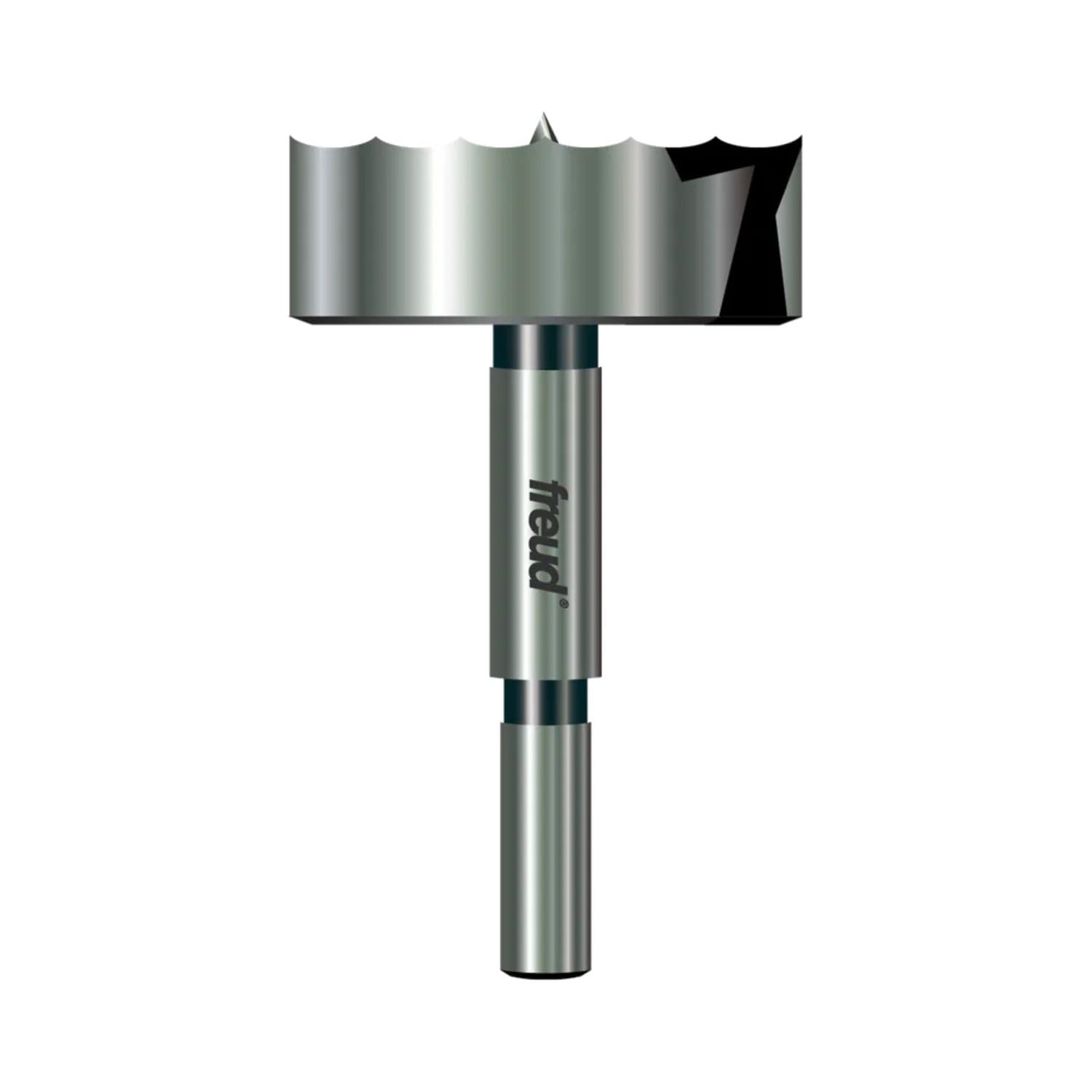
Most 2″ Forstner bits have two cutting flutes, but some use three — the extra flute means more cutting edges contacting the wood per revolution, which can produce a smoother finish and faster chip removal in a drill press. A serrated outer rim (like the Freud PB-015) slices the wood fibers instead of scraping them, which reduces splintering on plywood and composite boards. A brad-point center tip keeps the bit from walking (sliding off your mark) at the start of the hole — critical for hinge installations where accuracy matters.
Shank Type and Drill Compatibility
Round shanks fit standard 3/8″ and larger chucks on handheld drills and drill presses — most 2″ bits come with a 3/8″ round shank. Hex shanks offer more grip in the chuck and resist slipping under higher torque, but some hex shanks are oversize and may not fit every handheld drill’s chuck. Check your drill’s chuck capacity before buying: a 1/2″ or 10mm chuck is usually needed for hex-shank 2″ bits.
Quick Comparison
| Model | Best For | Cutting Material | Shank Type | Flute Count | Amazon |
|---|---|---|---|---|---|
| NICAVKIT Carbide Forstner★ Best Overall | Production runs in white oak | Tungsten Carbide | Round | 2 | Amazon |
| Freud PB-015Top Performer | Flawless flat-bottom holes in hardwood | Hardened Steel | Round | 2 | Amazon |
| MOLLOM Carbide Forstner | High-precision drilling within 0.1mm | YG8 Carbide (2.0mm thick) | Round | 2 | Amazon |
| Greycore Tools HSS Forstner | Drill-press work in seasoned hardwood | High Speed Steel (HSS) | Round (reduced) | 3 | Amazon |
| HPHOPE 2″ Forstner | Shallow depressions and keyhole hangers | Carbon Steel | Round | 2 | Amazon |
| NIBBLAX HSS Forstner | Budget-friendly hex-shank drilling | High Speed Carbon Steel | Hex | 2 | Amazon |
In‑Depth Reviews
1. NICAVKIT 2 Inch Carbide Forstner Drill Bit
Our pick — 4.5★ from 999 verified ratings; the strongest balance of quality and price.
The carbide-tipped workhorse that ran 491 holes in white oak before needing a touch-up.
For production woodworkers or anyone drilling a lot of dense hardwood, edge life is the metric that matters — and this NICAVKIT bit delivers it. The cutting diameter is a true 2 inches, and the tungsten carbide tips bonded to a hardened steel body stay sharp far longer than standard HSS bits. One buyer reports 491 holes through white oak with only 2 diamond-hone sessions., compared to 75-150 holes from conventional bits before needing a belt-sander sharpening. That is not marketing spin — it is a verified review that gives you a real durability benchmark.
The trade-off is that the same hardness that gives long life can chip if the bit catches an edge or hits a knot too aggressively. One reviewer using it on a drill press in oak noted it started feeling dull after about 30 half-inch-deep holes, so results vary by density and feed speed. Unlike the Freud above which focuses on hole finish, this bit is about staying in production longer between sharpenings — and at this price point, that is a rare combination.
Production-ready edge life: Owners mention 491 holes in white oak with only 2 hone sessions., which beats the typical 75-150 holes from standard bits by a wide margin.
One limitation: in very dense oak on a drill press, some reviewers saw noticeable dulling around the 30-hole mark — for continuous heavy production you may want an even thicker carbide blade.
2. Freud PB-015 2″ Forstner Bit
The serrated-rim specialist that slices hardwood without tear-out.
If you drill flat-bottom holes for hinges or shelf pins in expensive plywood, the single feature that saves your work from chip-out is a serrated outer edge — and the Freud PB-015 has a double-ground, razor-sharp serrated edge that cuts fibers cleanly throughout the rotation. This forged steel bit (not cast, which means a denser, stronger body) produces chisel-like curls instead of dust, so chip clearance stays fast and the hole bottom comes out smooth. Buyers report it cuts through bourbon oak barrel staves and hardwood like “a hot knife thru butter” even after dozens of holes.
The trade-off is that the bit’s cutting edge can arrive less-than-sharp out of the package; one reviewer noted both edges needed a file touch-up before first use. At 0.33 pounds, it has a solid, premium heft that feels planted in a drill press, and the ultra-sharp spur prevents walking on your mark. Unlike the NICAVKIT carbide bit below, which leans on extreme wear life for production work, the Freud is built for the woodworker who prioritizes hole finish over raw longevity — you pay for that finish, but the clean results justify the cost.
What makes it worth the money
- Serrated rim virtually eliminates splintering on plywood and veneered boards
- Forged steel construction is stronger and longer-lasting than cast bits
- Razor-sharp spur prevents the bit from sliding off your mark
- Steep angled edges produce smooth flat-bottom holes with fast chip removal
One honest catch
- A few units need a light sharpening on the cutting edges from the start before first use
Reach for it if: you need flawless flat-bottom holes in hardwood, plywood, or barrel staves and you value hole finish above all else.
Look elsewhere if: you are on a tight budget or mostly drill softwood where a simpler edge geometry performs just as well.
3. MOLLOM 2″ (51mm) Carbide Forstner Drill Bit

A 2.0mm thick carbide blade with hole accuracy inside 0.1mm for exact-fit joints.
If your work requires a hole diameter that fits a hinge barrel or dowel with zero slop, the MOLLOM’s claimed hole error of within 0.1mm is the spec to pay attention to. The cutting diameter is 51mm (a hair over 2 inches), and the blade uses industrial-grade YG8 carbide at 2.0mm thickness . The shank is 10mm (2/5 inch) round, and the total length is 94mm (3-11/16 inches), giving you enough reach for most door hinge and furniture work.
Reviewers confirm it cuts smooth holes in hardwood with no tear-out — one used it to drill 8mm holes for barrel hinges and says “perfect fit.” The recommended spindle speed is 2200-2500 RPM, which is faster than some bits, so check your drill press adjustment. The NICAVKIT above has a slight edge in raw production longevity, but the MOLLOM leads on dimensional precision for joinery where every fraction of a millimeter counts.
what separates it
- 2.0mm thick YG8 carbide blade is significantly thicker than standard 1.3mm blades
- Claimed hole accuracy within 0.1mm for precision joinery
- Buyers confirm sharp cutting and no tear-out in hardwood with a drill press
- Resharpenable — you can hone the carbide edges when they dull
One thing to know
- Best results come from a drill press or high-power handheld drill with the material clamped securely
Best suited for: woodworkers who need tight-tolerance holes for barrel hinges, dowels, or precision joinery.
Better to skip if: you only need a bit for occasional rough drilling in softwood — the premium carbide is overkill for that use.
4. Greycore Tools 2 Inch x 3-1/2 Inch HSS Forstner Bit

The three-flute HSS bit that drills smoother holes in seasoned hardwood at a fair price.
With 3 flutes versus the standard 2, this Greycore bit puts more cutting edges into the wood per revolution — and that extra edge translates to a noticeably smoother finish in dense materials like hard oak. One buyer used it in a drill press to bore smooth holes for a replacement part in a yarn swift (a 5/8″ dowel repair), and it made a clean, accurate hole without burning. The ultra-sharp brad point keeps the bit from walking, and the 3/8 inch round reduced shank fits both 3/8″ and larger chucks for handheld drills and drill presses.
The catch is that at 3 flutes, you have less space between the flutes for chip evacuation compared to a 2-flute bit, so in deep blind holes you may need to pull the bit out and clear chips more often. One buyer mentioned that materials caught on the edge during a cut, so a steady feed rate matters. At 4.5 stars from 141 ratings, it is the least-reviewed pick here, but the user feedback is consistently positive on value — especially compared to the premium-priced Freud PB-015 above.
Why the extra flute helps: the 3-flute design contacts more wood surface per revolution, producing a finer finish in hardwoods than 2-flute bits — a measurable difference you can feel in the chip load.
Where it stumbles: chip clearance is tighter with 3 flutes, so you need to clear the hole more frequently during deep cuts.
5. HPHOPE 2 Inch Forstner Bit
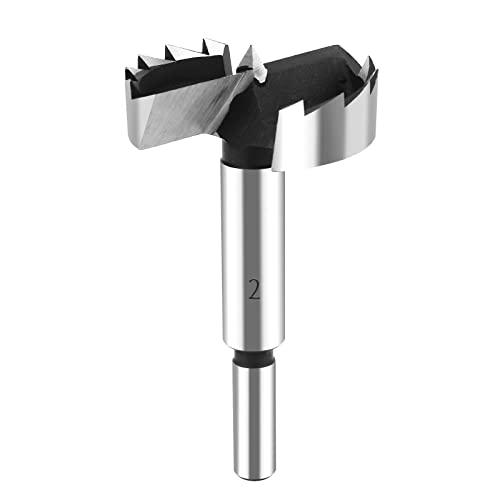
The affordable carbon-steel bit that does one job well — shallow depressions in softwood.
Not every 2″ hole needs a top-tier carbide or HSS bit. If your project involves shallow holes for keyhole hangers, door stops, or light-duty shelf supports in pine or plywood, this HPHOPE bit at a carbon steel price point gets the job done without overspending. One buyer reports it works perfectly for drilling shallow depressions for 1-inch keyhole hangers — a specific use case where a premium bit would be wasted money. The 3/8″ cylindrical shank fits standard chucks, and the center point design gives you a clean start without walking.
The limit is durability. Unlike the Greycore with its 3-flute design for smoother finish, this bit is for light, occasional use where budget is the primary concern. The lifetime after-sales service is a nice safety net for a budget tool.
What it does well
- Center point design ensures accurate starts without slipping on the surface
- Lifetime after-sales service provides confidence on a budget purchase
- Works perfectly for shallow depressions and keyhole hangers per buyer reports
Where it falls short
- Carbon steel edge dulls much faster than carbide or HSS bits in hardwood
- Not suited for production work or deep drilling in dense oak
Best for: one-off projects in softwood, plywood, or non-laminated chipboard — shallow flat-bottom holes only.
Not ideal for: hardwood production runs, hinge boring in oak, or any job where edge life matters.
6. NIBBLAX 2 Inch HSS Forstner Drill Bit (Hex Shank)

A hex-shank 2″ bit that grips tight in the chuck and cuts fast through cedar.
If you have ever had a round-shank Forstner bit slip in a handheld drill’s chuck under load, the NIBBLAX hex shank solves that — the flat sides give the chuck jaws more bite, so you can push harder without the bit spinning in place. The cutting diameter is 50.8mm (just a hair under 2 inches), and the high-speed carbon steel body cuts cleanly through hardwood, softwood, composites, veneered plywood, and plastic. One buyer drilled six clean holes through two layers of 3/4-inch cedar and described the cut speed as fast with excellent accuracy from the pointed tip.
The caveat is the hex shank itself: one owner reported the hex is large enough that a standard 3/8″ chuck could not accept it, and they had to switch to a hammer drill or a drill with a 1/2″ or 10mm chuck. The bit is metric-sized at 51mm labeled as 2″, so if you need a dead-nuts 2.000″ hole for a hinge, check the actual cut diameter first. Compared to the HPHOPE above, this bit costs less and uses HSS steel (which holds an edge longer than carbon steel), but the hex shank compatibility issue makes it less universal.
Key strength: the hex shank provides superior anti-slip grip compared to round shanks, which matters for handheld drilling at this large diameter.
Key limitation: the hex shank may not fit a standard 3/8″ handheld drill chuck — confirm your chuck can accept a larger hex before buying.
Understanding the Specs
Cutting Material (Carbide, HSS, Carbon Steel)
Tungsten carbide (the hardest of the three) stays sharp through hundreds of holes in dense hardwood — customers note 491 holes in white oak from a carbide bit with only two hone sessions. High-speed steel (HSS) is a middle ground: tougher and less brittle than carbide, it resists chipping and holds a decent edge for mixed woodworking. Carbon steel is the softest and cheapest, fine for occasional drilling in pine or plywood but dulls quickly in oak or maple.
Flute Count and Edge Geometry
Most 2″ Forstner bits have 2 flutes (cutting edges), but a 3-flute design puts more edges into the wood per revolution for a potentially smoother finish — the downside is less space for chip evacuation. A serrated outer rim (like the Freud PB-015) cuts wood fibers instead of scraping them, which reduces splintering on plywood. A brad-point center tip prevents the bit from walking off your mark at the start of the hole, critical for accurate hinge installations.
Shank Type: Round vs. Hex
Round shanks are universal — a 3/8″ round shank fits nearly all handheld drills and drill presses. Hex shanks have flat sides that prevent the chuck from slipping under torque, which is useful for large-diameter bits that encounter resistance. The catch is that hex shanks can be thicker than a standard 3/8″ chuck can accept — some buyers find they need a hammer drill or a 1/2″ chuck to use hex-shank 2″ Forstner bits.
Cutting Diameter Tolerance
A bit labeled “2 inches” actually has a cutting diameter that varies between manufacturers and countries. Some bits cut at exactly 2 inches (50.8mm), while others cut at 51mm (a metric equivalent that produces a hole about 0.2mm larger). For hinge barrels or dowels that need a precise fit, look for a bit with a stated tolerance — the MOLLOM bit claims hole error within 0.1mm, which matters for tight joinery.
FAQ
What is the difference between a 2-inch forstner bit and a hole saw for 2-inch holes?
Can I use a 2-inch forstner bit in a handheld drill?
How many holes should a 2-inch forstner bit cut before it needs sharpening?
What speed should I run a 2-inch forstner bit at on a drill press?
Is a carbide-tipped forstner bit worth the higher price versus HSS?
Will a 2-inch forstner bit fit a standard 3/8-inch drill chuck?
What is a brad-point tip on a forstner bit?
Can a 2-inch forstner bit drill through metal or plastic?
How do I keep a 2-inch forstner bit from overheating?
What is the difference between 2-flute and 3-flute forstner bits?
Final Thoughts: The Verdict
Across the board, the best 2″ drill bit is the NICAVKIT Carbide Forstner Bit because it combines carbide edge life with a price that undercuts premium brands while delivering verified results of 491 holes in white oak. If you want flawless flat-bottom holes with zero tear-out on plywood, grab the Freud PB-015. And for precise joinery where hole accuracy inside 0.1mm matters, the standout is the MOLLOM Carbide Forstner Bit.
How We Picked
We do not accept paid placement. Every pick is matched to a real buyer and a real use-case; we do not hands-on test units.
Sources & Methodology
Specifications: manufacturer listings and product documentation. Review insights: verified customer reviews, as of July 2026. Pricing: not shown on this page (it changes often); check the current price via the retailer link.
As an Amazon Associate, Gadgets Feed earns from qualifying purchases. This does not affect which products we feature.