
Our readers keep the lights on and my morning glass full of iced black tea. As an Amazon Associate, I earn from qualifying purchases.
Specs are compiled from manufacturer listings and verified buyer reviews and can change over time — please confirm the key details on the product page before buying.
Drilling a clean 2-inch hole in hardwood without splintering, burning the wood, or dulling the bit after a dozen holes is the real challenge. A bit’s cutting material and outer rim design determine hole quality and drilling ease. This guide compares three 2-inch Forstner bits to match your wood type.
I’m Min — the founder and writer behind Gadgets Feed. This guide is built by comparing the manufacturers’ published specifications and the patterns across verified customer reviews, so you get each pick’s real strengths and trade-offs instead of marketing spin.
Swapping a paddle bit for a Forstner bit eliminates tear-out and burning on the exit side. Here is everything you need to know before picking the right 2-inch Forstner bit.
Our Picks at a Glance

How To Choose The Best 2-Inch Forstner Bit
A “paddle bit” is a flat blade with a sharp point, and while cheap and fast, it tends to tear out the bottom of the hole. A Forstner bit cuts a cleaner, flat-bottomed hole with a sharp outer rim, making it the better choice for furniture, hinges, and visible joinery. Here is what separates a good one from a frustrating one.
Cutting Material — Carbide vs HSS vs Carbon Steel
This is the single biggest durability factor. Carbide-tipped bits (tungsten carbide bonded to a steel body) hold their edge many times longer in abrasive hardwoods like white oak. High-speed steel (HSS) is a reliable mid-ground — sharp from the start but dulls faster. Carbon steel is the most affordable but softest, which means it can lose its edge quickly if you hit glue lines or dense grain. Carbide bits reduce sharpening frequency in heavy or production use.
Shank Type and Drill Compatibility
Most 2-inch Forstner bits have a round shank, typically 3/8-inch diameter. A round shank fits any standard drill chuck, whether you are using a handheld drill or a drill press. For large bits like 2-inch, a drill press is safer and gives you more control — the bit has a lot of surface area contacting the wood, which generates torque that a handheld drill can twist your wrist with.
Centering Tip and Cutting Rim Design
The center point guides the bit into the wood so it does not wander. A sharp, centered tip ensures easy and accurate hole starts. The tooth-shaped outer rim scores wood fibers cleanly before the inner flutes remove waste. A jagged rim causes tear-out and burning on plywood and cross-grain cuts.
Quick Comparison
| Model | Best For | Material | Shank | Cutting Diameter | Amazon |
|---|---|---|---|---|---|
| NICAVKIT Carbide Forstner★ Best Overall | Hardwood durability | Tungsten Carbide | Round | 2 Inches | $15.19$15.99PrimeAmazon |
| HPHOPE Forstner Bit | Budget-friendly precision | Carbon Steel | Round, 3/8″ | 2 Inches | $13.69Amazon |
| BAIDETS Forstner Bit | General woodworking | High Speed Steel | Round | 2 Inches | $15.99Amazon |
In-Depth Reviews
1. NICAVKIT 2 Inch Carbide Forstner Drill Bit
Our pick — 4.5★ from 950+ verified ratings; the strongest balance of quality and price.
The carbide-tipped workhorse that can drill hundreds of holes in white oak without a trip to the sharpener.
If hardwood is your daily reality — think oak, maple, or walnut — this bit is built for that abuse. The cutting edges are tungsten carbide, not standard HSS, so it stays sharp far longer than the BAIDETS or HPHOPE options here. Buyers report a jaw-dropping result: “White oak gun/fishing rod racks: 491 holes with 2 diamond hone sessions vs. 75-150 holes with conventional bits.” That is the difference carbide makes on a production run. You stop to sharpen every 200-250 holes instead of every 75. The solid hardened steel body resists rust. The 2-inch cutting depth (up to 2-3/8 inches) handles hinge mortises and through-holes in thick stock.
The trade-off is that this bit is best used on a drill press or a fixed drilling machine, especially at this 2-inch size. The maker notes that large Forstner bits generate enough torque that a handheld drill can become hard to control — a vice or drill press is really recommended. At 4.5 stars from nearly 1,000 reviews, most buyers confirm it cuts smooth, cool, and clean. One review noted it started dulling after about 30 half-inch-deep holes in oak, which is still a solid run for any bit at this price tier.
What gives it the edge
- Tungsten carbide cutting edges hold sharpness many times longer than HSS in abrasive hardwoods
- Scoring tooth design keeps the bit cool and minimizes burning during extended use
- Nearly 1,000 reviews average 4.5 stars — strong buyer confidence in real workshop conditions
Where it asks for the right setup
- Really needs a drill press or a well-mounted machine for best control at this 2-inch size
- One reviewer noted noticeable dulling after 30 holes in oak with half-inch depth
Reach for this if: you regularly drill hardwood in moderate to high volume and want to minimize downtime for sharpening.
Look elsewhere if: you only use a handheld drill for occasional softwood jobs and do not need carbide-level durability.
2. BAIDETS 2 Inch Forstner Bit

A lightweight HSS bit that punches above its price on softwood and plywood with clean flat-bottom holes.
If your projects lean toward plywood, MDF, chipboard, and softwood, this High Speed Steel bit from BAIDETS is a fine everyday choice. The tooth-shaped rim design is meant to keep friction and heat down while clearing chips efficiently. Weighing only 0.1 pounds, it is noticeably lighter than some steel-heavy bits, which reduces fatigue during longer drilling sessions. One buyer mentioned it gave “a clean 1-3/4″ hole, no tear out” and recommended it for home shop woodworkers. The centering tip prevents skating for precise flat-bottom hole placement.
The biggest catch is that HSS simply cannot match carbide in tough hardwoods like the NICAVKIT can. One reviewer had a harsh experience: “Would not cut into end grain at all and barely went into side grain” — though that is an extreme case of a single bit, it highlights that for dense end-grain drilling, you need the carbide option above. The 2-inch cutting diameter and round shank fit standard chucks. The 100% satisfaction service from the brand covers any issues. At about 4.3 stars from 250 ratings, it is a strong mid-range pick for general woodworking, but not the one you want for production oak.
Why it works for daily shop use
- HSS material stays sharp for normal softwood and plywood cuts without the premium cost of carbide
- Very lightweight at 0.1 pounds, reducing wrist fatigue on long drilling sessions
- Tooth-shaped rim design clears chips well and reduces heat buildup for cleaner holes
Where it hits its limit
- Several reviews report poor performance on end grain and dense hardwood — not a bit for heavy oak or maple work
- Lower rating count (253 reviews) means less long-term data on consistency batch to batch
Best suited for: the home workshop woodworker doing shelves, jigs, and plywood projects who wants clean holes without overspending.
Not the one if: your main material is white oak, hard maple, or any dense hardwood where you need hundreds of holes per session.
3. HPHOPE 2 Inch Forstner Bit
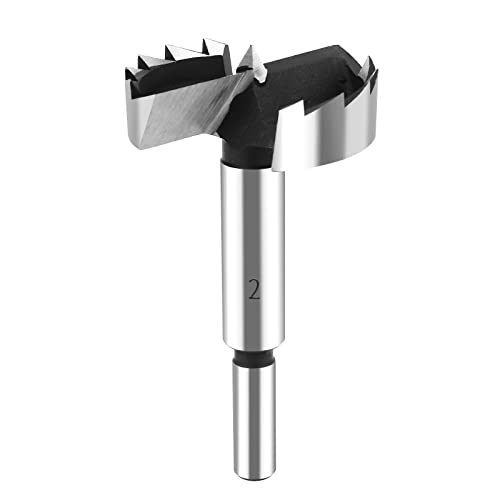
A no-frills carbon steel bit that gets the job done on softwood and non-laminated boards at a very low entry cost.
If you need a 2-inch Forstner bit for occasional projects in softwood, veneered wood, or non-laminated chipboard, and you want to spend the least money possible, this HPHOPE bit is the sensible pick. It uses carbon steel rather than HSS or carbide, which is the softest of the three materials, but it is perfectly adequate for light-duty drilling. The 3/8-inch round shank fits standard drills. The 3-1/2-inch overall length gives you enough reach for most mortise and hinge work. The center point design helps with accurate starts without walking. One buyer confirmed it “works perfectly” for shallow depressions for 1-inch keyhole hangers. Another simply said it is a “solid piece of equipment” for the price.
The limitation is that carbon steel dulls faster than HSS or carbide, especially if you hit glue lines, knots, or dense grain. This is not a bit you want for hardwood cabinets or production runs — it is a budget option for weekend projects in pine, poplar, or plywood. At 4.4 stars from over 900 ratings, most buyers are satisfied, but the reviews skew toward light, occasional use. The brand offers lifetime after-sales service, which is a nice safety net for a commodity-priced tool. Keep it for the jobs where it fits, and save your spending for the NICAVKIT carbide bit if hardwood becomes routine.
What makes it worth considering
- Lowest price tier among the three — ideal for beginners or very occasional drilling needs
- 3-1/2-inch overall length and 3/8-inch shank fit standard drill chucks easily
- Strong rating at 4.4 stars from over 900 reviews, with many reporting clean cuts on softwood
Where it falls short
- Carbon steel material means it will dull faster than HSS or carbide, especially in abrasive woods
- Not designed for hardwood, end grain, or high-volume work — keep expectations realistic
Grab this if: you need an inexpensive 2-inch Forstner bit for simple softwood projects or one-off hinge jobs and want to avoid overspending.
skip it if: you regularly cut dense hardwoods or need a bit that stays sharp through dozens of holes without replacement.
Understanding the Specs
Cutting Material — Carbide vs HSS vs Carbon Steel
The cutting material determines how long the bit stays sharp. Tungsten carbide is the hardest of the three, so it resists wear from abrasive hardwoods like oak and maple many times longer than HSS. High-speed steel (HSS) is a good middle ground — tough enough for softwood and plywood but soft enough to be affordable. Carbon steel is the softest option and dulls fastest, making it suitable only for light, occasional use in softwood. If you drill frequently, spend the extra on carbide: it means fewer stops to sharpen and more consistent hole quality.
Center Point and Rim Design
The center point is a small sharp tip at the center of the bit that sinks into the wood to keep the bit from wandering. A well-designed tip makes starting the hole easy and accurate. The outer rim is a ring of sharp teeth that scores the wood fibers before the inner flutes remove the waste. A clean, sharp rim produces flat-bottom holes with minimal splintering on the exit side. Dull or poorly shaped rims cause burning, tear-out, and rough edges. When reading reviews, look for mentions of “clean hole” and “no tear out” — that signals a good rim geometry.
FAQ
Will a 2-inch Forstner bit fit my regular handheld drill?
Can I use a Forstner bit in a drill press?
What is the difference between a Forstner bit and a paddle bit?
How do I keep a Forstner bit from burning the wood?
Why does my Forstner bit leave a rough edge on plywood?
How deep can a 2-inch Forstner bit drill?
Can I sharpen a Forstner bit at home?
What materials can a Forstner bit cut besides wood?
Is a 2-inch Forstner bit good for drilling through 2×4 lumber?
Which is better for end grain — carbide or HSS?
Final Thoughts: The Verdict
For the majority of shoppers, the best 2-inch Forstner bit is the NICAVKIT Carbide Forstner Bit because it trades a small upfront cost for dramatically longer edge life in hardwoods and clean, burn-free holes even over hundreds of cuts. If you want a lightweight everyday bit for softwood and plywood without the carbide price, grab the BAIDETS Forstner Bit. And for the most budget-conscious occasional user, the HPHOPE Forstner Bit gets the job done on softwood projects while staying affordable.
How We Picked
We do not accept paid placement. Every pick is matched to a real buyer and a real use-case; we do not hands-on test units.
Sources & Methodology
Specifications: manufacturer listings and product documentation. Review insights: verified customer reviews, as of July 2026. Pricing: not shown on this page (it changes often); check the current price via the retailer link.
As an Amazon Associate, Gadgets Feed earns from qualifying purchases. This does not affect which products we feature.
Related Guides
Product prices and availability are accurate as of the date/time indicated and are subject to change. Any price and availability information displayed on Amazon at the time of purchase will apply to the purchase of this product. As an Amazon Associate I earn from qualifying purchases.
CERTAIN CONTENT THAT APPEARS ON THIS SITE COMES FROM AMAZON. THIS CONTENT IS PROVIDED "AS IS" AND IS SUBJECT TO CHANGE OR REMOVAL AT ANY TIME.
Amazon and the Amazon logo are trademarks of Amazon.com, Inc. or its affiliates.