
Finding a board game that truly shines with exactly two players can be surprisingly difficult. Many so-called “two-player” options feel like scaled-down afterthoughts, but the best designs are built from the ground up for head-to-head intensity, delivering tight decisions, direct conflict, and a satisfying arc that only a dedicated duel can provide.
I’m Min — the co-founder and writer behind Gadgets Feed. I’ve spent countless hours analyzing the mechanics, component quality, and replay value of the most acclaimed two-player titles to identify the ones that justify a spot on your shelf.
After careful analysis of playtime, complexity, and strategic depth across dozens of options, this guide to the best 2-player board games covers only titles that demand your full attention and deliver a genuinely competitive experience.
How To Choose The Best 2-Player Board Games
The two-player board game market has matured significantly, moving beyond simple abstract filler games to include deep strategic experiences. The right choice for you depends on the kind of tension you want at the table — cooperative anxiety, direct competition, or a race to a specific victory condition.
Playtime and Complexity
Most dedicated two-player games clock in between 15 and 45 minutes. Shorter games (under 20 minutes) are ideal for quick sessions between other activities, while games in the 30-45 minute range allow for more meaningful engine-building and tactical depth without overstaying their welcome. Complexity is equally important; games like Boop can be taught in three minutes, while titles like 7 Wonders Duel require a full explanation of card symbols and multiple win paths.
Competitive vs. Cooperative
Not every pair wants to fight. Cooperative games like Sky Team put both players on the same side against the game system, relying on silent communication and mutual trust. Competitive games like Splendor Duel and Azul Duel create direct head-to-head conflicts where denying your opponent’s scoring potential is just as important as advancing your own position. Be honest about whether your game nights lean toward shared victory or friendly rivalry.
Replayability and Variable Setup
A game that feels solved after five plays isn’t worth the shelf space. The best two-player games incorporate variable starting conditions — shuffled card pyramids, randomized tile layouts, modular scenario decks — to ensure each match presents fresh strategic puzzles. Look for games that offer multiple victory conditions, asymmetric player powers, or scenario packs that introduce new rules without requiring expansion purchases.
Quick Comparison
On smaller screens, swipe sideways to see the full table.
| Model | Category | Best For | Key Spec | Amazon |
|---|---|---|---|---|
| 7 Wonders Duel | Strategy | Civilization building with multiple win paths | 30-min playtime, 3 victory conditions | Amazon |
| Lord of the Rings: Duel | Thematic | Asymmetric LOTR strategies | 3-chapter campaign, 3 win conditions | Amazon |
| Splendor Duel | Engine-Building | Fast-paced gem collecting | 30-min playtime, special gem powers | Amazon |
| Sky Team | Cooperative | Silent dice-based co-op | 20-min playtime, 20 scenarios | Amazon |
| Azul Duel | Tile-Placement | Direct tile drafting competition | 30-min playtime, variable setups | Amazon |
| Boop | Abstract | Cute 3-in-a-row variant | 20-min playtime, push mechanics | Amazon |
| Dittle | Dexterity | Quick wooden dice battles | 15-min playtime, eco-friendly wood | Amazon |
In‑Depth Reviews
1. 7 Wonders Duel

7 Wonders Duel is the definitive two-player civilization game, taking the core card-drafting engine of its parent and rebuilding it for direct head-to-head conflict. Cards are arranged in a shared pyramid structure that players pick from alternately, creating agonizing decisions about which available resource to claim and which to force your opponent to take. The military track acts as a tug-of-war that can end the game immediately if one player pushes far enough.
The genius of this design lies in its three distinct victory paths: military conquest, scientific supremacy, and plain old victory points. This forces every game to evolve differently, as you cannot simply ignore one avenue without risking a sudden loss. The Wonders themselves are expensive to build but grant powerful one-time abilities, including the coveted extra turn that can chain into devastating combos. Setup takes under two minutes, and the random pyramid arrangement ensures no two games feel identical.
Component quality is excellent for the price point, with thick card stock and clear iconography that becomes intuitive after a single play. The 30-minute playtime is accurate once both players understand the symbols, and the tension remains high throughout. This is the gold standard for competitive two-player board gaming, particularly for couples or friends who enjoy engine-building with sharp interaction.
Why it’s great
- Three distinct win conditions keep every game fresh
- Quick setup and 30-minute playtime fit any evening
- Pyramid drafting creates constant meaningful decisions
Good to know
- Symbol-heavy iconography requires a learning game
- Some early cards can feel overpowering to new players
2. The Lord of the Rings: Duel for Middle-Earth

Lord of the Rings: Duel for Middle-Earth takes the mechanical foundation of 7 Wonders Duel and wraps it in rich asymmetric gameplay — one player controls the Fellowship racing to destroy the Ring, the other commands Sauron’s forces aiming for total conquest. The three-chapter structure adds a narrative arc that most abstract duels lack, with each chapter introducing new tactical wrinkles via High Places and ally recruitment.
The asymmetry is genuine and balanced. The Fellowship player focuses on stealth and progress along the Ring track, while Sauron expands influence across the board and summons Nazgûl to hunt the Ring-bearer. Both sides have three possible victory conditions, but they are not the same three — the Fellowship wins by completing the Quest, forming alliances with six Peoples, or claiming the Ring, while Sauron wins by conquest, domination, or corrupting the Ring-bearer. This creates a tense cat-and-mouse dynamic where each player must read the other’s strategy and pivot accordingly.
Component quality exceeds expectations, with sturdy cards, clear iconography, and an art style that captures the epic tone without feeling cluttered. Games consistently wrap up in 30 minutes once both players know the rules, and the high-quality production makes it a centerpiece box. For Lord of the Rings fans or anyone who enjoys asymmetric duels with real thematic weight, this is a must-buy.
Why it’s great
- Genuine asymmetric play with perfectly balanced win conditions
- Three-chapter campaign structure adds narrative depth
- Stunning component quality and thematic artwork
Good to know
- Rules overhead is higher than pure abstract games
- Asymmetric roles require both players to learn separate strategies
3. Splendor Duel
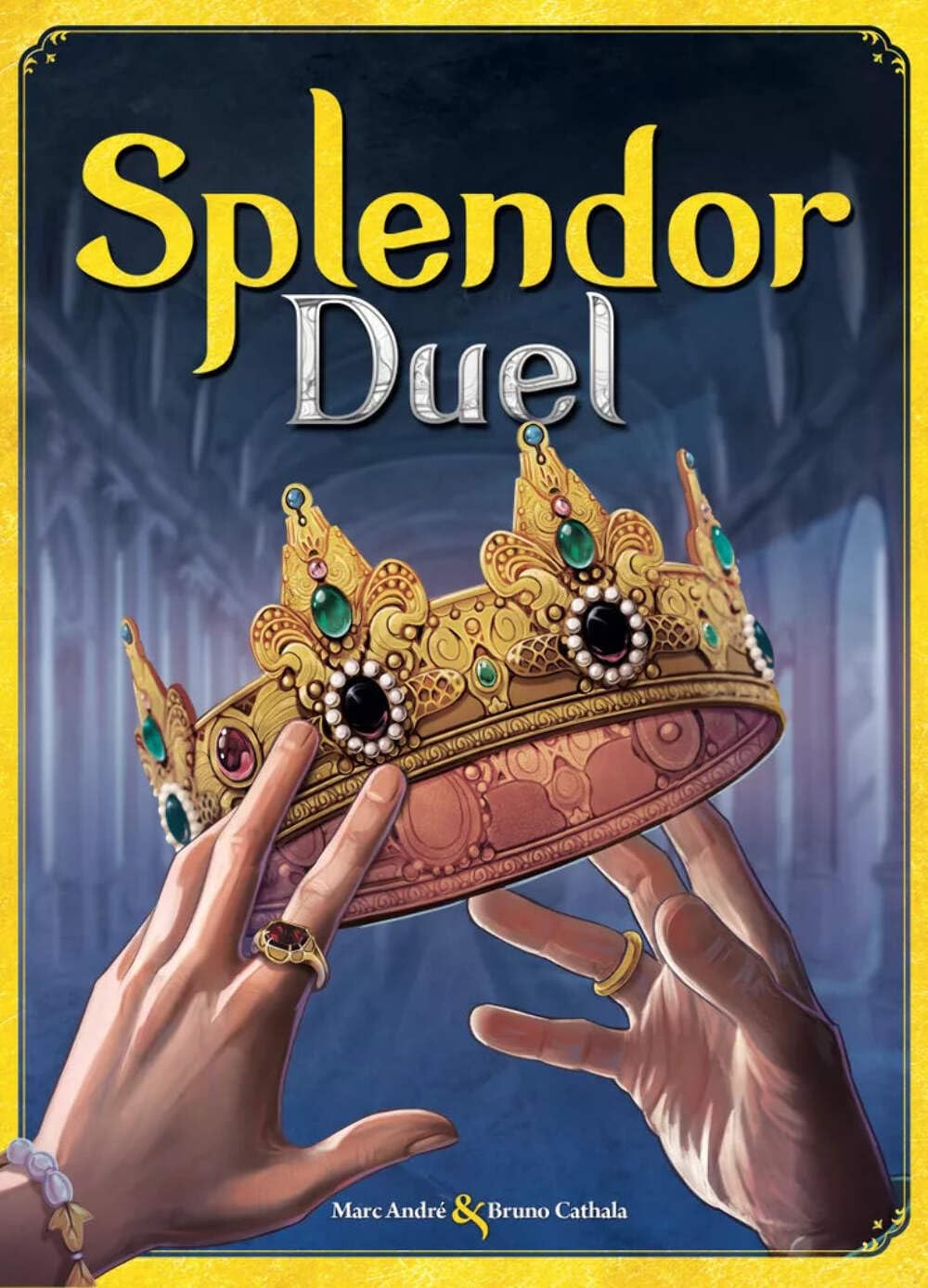
Splendor Duel takes the polished gem-collecting engine of the original Splendor and retools it specifically for two players, introducing a shared board with restricted access that forces direct competition for precious gem tokens. Unlike the original, where players could mostly ignore each other, Duel adds special pearl tokens, privilege scrolls that grant extra actions, and an alternate win condition based on collecting royal tiles.
The game shines in its pacing. Rounds fly by in 30 minutes, with each turn presenting a clear puzzle: do you grab the gem you need, or do you block your opponent from completing their card set? The restricted board — certain gem positions are only accessible after removing covering tokens — adds a spatial layer that elevates the decision-making beyond simple resource management. The privilege scroll system allows explosive turns where you can chain multiple actions, creating moments of genuine excitement.
Component quality is outstanding for this price tier, with chunky plastic gem tokens that feel satisfying to handle and thick development cards printed with vibrant colors. The compact box makes it easy to bring to a cafe or on vacation. For players who want a fast, satisfying engine-builder that plays exclusively at two, Splendor Duel delivers exceptional value.
Why it’s great
- Premium component quality with chunky gem tokens
- Restricted board access creates constant player conflict
- Privilege scrolls enable exciting multi-action turns
Good to know
- Less strategic variety than 7 Wonders Duel
- Original Splendor fans may miss the larger player count
4. Sky Team

Sky Team won the Spiel des Jahres (Game of the Year) in 2024 for good reason — it is a two-player cooperative game that eliminates the alpha-player problem entirely through silent dice placement. Each round, both players secretly roll their dice and then simultaneously place them on the shared cockpit board to control speed, altitude, heading, and landing gear. The catch? You cannot talk about your dice values or placement plans during the placement phase.
The tension is extraordinary. You might place your dice expecting your partner to handle brakes, only to watch them divert resources to leveling the wings. Coffee tokens provide a limited ability to reroll bad results, but they cannot fix poor coordination. The 20 scenarios — each representing a different airport with unique landing conditions — introduce variable difficulty and special rules like ice on the tarmac or kerosene leaks, giving the game enormous replayability.
Component design is clean and thematic, with a compact box that fits easily on a pub table. The quiet masterpiece here is how the game forces genuine non-verbal communication; by the third scenario, many couples develop their own shorthand through dice placement alone. For any pair that enjoys working as a team under pressure, Sky Team is an essential addition.
Why it’s great
- Silent dice placement eliminates quarterbacking completely
- 20 scenarios with variable rules offer deep replayability
- Compact box and 20-minute sessions fit any setting
Good to know
- Cooperative only — not for competitive players
- Early scenarios are quite easy for experienced gamers
5. Azul Duel

Azul Duel refines the classic tile-laying formula into a tight two-player experience where every tile selection directly impacts your opponent’s options. Players draft acrylic tiles from shared factory displays and place them on their personal boards to complete patterns, with the twist that leftover tiles penalize the player stuck with them. The streamlined ruleset removes the larger player count variables to focus on pure head-to-head tension.
The visual design is a highlight, with tiles inspired by traditional Chinese shadow theatre art that looks striking on the table. Variable scoring opportunities and setup configurations mean no two games play out the same way. The decision space is deceptively deep — grabbing a tile that completes your pattern might also leave your opponent with exactly the tiles they need for a high-value scoring row.
Component quality is mixed; the acrylic tiles themselves are excellent, but the cardboard boards and scoring tower feel flimsy compared to the price point. Some reviewers noted the board material could benefit from reinforcement. That said, the core gameplay loop is addictive enough that most players overlook the production shortcomings. For fans of spatial tile-placement games who want a dedicated two-player option, Azul Duel delivers exactly that.
Why it’s great
- Beautiful shadow theatre-inspired acrylic tiles
- Variable setups ensure high replayability
- Direct competition through shared factory drafts
Good to know
- Cardboard board and tower feel lower quality than expected
- Rulebook could be clearer for first-time players
6. Boop

Boop is a deceptively strategic three-in-a-row variant where wooden kitten pieces push each other across a quilted fabric board. When you place a kitten, it “boops” any adjacent piece one space away, which can disrupt your opponent’s formations or set up unexpected chains. Place three kittens in a row, and they graduate into cats — but those cats can also be booped by larger pieces, adding a constantly shifting tactical layer.
The game can be taught in under three minutes and plays in 20 minutes, making it perfect for casual sessions after dinner or as a warm-up for heavier games. The fabric board prevents pieces from sliding accidentally, though some players noted the surface can actually make intentional sliding a bit too easy. The wooden cat and kitten pieces are charmingly crafted and add to the high table presence.
Beneath the cute exterior lies real strategic depth. The boop mechanic rewards careful positioning and long-term planning, as a single misplaced kitten can cascade into a chain that costs you the game. For couples who enjoy abstract strategy but want something more tactile and visually appealing than classic checkers or chess, Boop is an ideal entry point.
Why it’s great
- Extremely easy to learn in three minutes
- Boop mechanic adds unique tactical depth to 3-in-a-row
- Adorable wooden pieces and fabric board look great on display
Good to know
- Fabric board can make pieces slide more than expected
- Strategy ceiling may feel limited for hardcore gamers
7. Dittle

Dittle is a tactile dice-battle game where players tilt a wooden board to roll their dice toward the opponent’s side, scoring points based on the face value of each die that crosses the line. The twist is that dice can knock into each other mid-journey, changing face values and redirecting trajectories in unpredictable ways. It combines light dexterity with push-your-luck strategy in a package that plays in 15 minutes.
The components are exceptional for the price — a sustainably sourced New Zealand wood board with large, easy-to-read dice that feel premium. The rules are simple enough for a six-year-old to grasp, but the strategic layer of aiming for higher face values while disrupting opponent dice keeps adults engaged. The wooden construction also means it doubles as a coffee table decoration when not in active play.
The main limitation is strategic depth. While there is genuine decision-making about which dice to target and when to play defensively, the dexterity element introduces enough randomness that Dittle will never satisfy players seeking pure cerebral strategy. As a quick, party-friendly two-player game with high-quality materials, however, it is hard to beat at this price point.
Why it’s great
- Beautifully crafted from sustainably sourced wood
- Easy to learn and plays in under 15 minutes
- Doubles as an attractive coffee table piece
Good to know
- Dexterity element introduces significant randomness
- Limited strategic depth for serious board gamers
FAQ
Can two-player board games work for couples who prefer cooperative play?
How do I know if a two-player game has enough replay value?
Final Thoughts: The Verdict
For most users, the best 2-player board games winner is the 7 Wonders Duel because it offers unmatched replayability, clean rules, and three distinct victory paths that keep every match tense and unpredictable. If you want a cooperative experience that builds genuine teamwork, grab the Sky Team. And for lightweight fun with premium wooden components, nothing beats the Dittle.