
A rack full of hardware means nothing if the only way you hear it is through headphones or a mismatched set of consumer speakers. The 2 RU mountable speaker format solves a specific problem: delivering honest, reference-grade audio from within your studio rack or equipment cabinet without consuming desk space or requiring a separate speaker stand setup.
I’m Rikta — the co-founder and writer behind Gadgets Feed. I’ve spent years digging through signal chains, amplifier topologies, and transducer material science to understand what makes a near-field monitor translate a mix correctly versus just sounding pleasant in a showroom. (And Homer 🐱 supervised from a stack of foam isolation pads, tail swishing approval at each driver test.)
A pair of active monitors that fit within a standard rack height unlocks a clean, space-efficient workflow for producers and engineers. This guide dissects the current market to help you find the 2 ru mountable speakers that deliver accurate mix translation for your specific room and setup.
How To Choose The Best 2 RU Mountable Speakers
The smartest investment you can make for a rack-based monitoring setup starts with choosing a speaker that prioritizes flat frequency response over boosted bass. Unlike hi-fi speakers that flatter recordings, the best active monitors for your rack must reveal flaws in a mix so you can correct them before the final bounce.
Driver Size and Room Coupling
An 8-inch woofer moves more air and delivers deeper bass extension, but it also requires more physical distance from the listening position to allow the low frequencies to fully develop. A 5-inch driver, by contrast, couples better to smaller rooms and shorter listening triangles, making it the more predictable choice for a compact home studio rack. Match the driver size to your room volume, not your ego.
Amplifier Topology and Heat Dissipation
Class D amplifiers run cooler and more efficiently than traditional Class AB designs, a crucial factor when monitors sit in a rack with other heat-generating gear. Lower heat output reduces the risk of thermal drift in nearby analog processors and extends the lifespan of electrolytic capacitors inside the speaker itself. If your rack is enclosed or semi-enclosed, prioritize monitors with Class D amplification.
Input Flexibility and Signal Chain Integration
XLR balanced inputs are the gold standard for rejecting ground-loop hum over long cable runs inside a rack. TRS quarter-inch inputs offer similar performance with a different connector format. RCA unbalanced inputs are workable for consumer sources but introduce noise susceptibility. Before choosing a monitor, audit your audio interface’s output connectors and plan for short, high-quality balanced cables.
Quick Comparison
On smaller screens, swipe sideways to see the full table.
| Model | Category | Best For | Key Spec | Amazon |
|---|---|---|---|---|
| PreSonus Eris 3.5 | Near-Field Monitor | Desktop studios & synth rigs | 50W Class AB (25W per channel) | Amazon |
| Sound Town STRK-M8U | Rack Enclosure | Housing your monitor chain | 8U, 19-inch steel construction | Amazon |
| KRK Kreate 8 | Studio Monitor | Wireless monitoring & bass response | 8-inch Glass Aramid Woofer | Amazon |
| JBL 305P MkII | Studio Monitor | Wide sweet spot mixing | Image Control Waveguide | Amazon |
| Mackie MR824 | Studio Monitor | Full-range mix translation | 65W bi-amplified Class A/B | Amazon |
| JBL 306P MkII | Studio Monitor | Intermediate-level production | 6.5-inch woofer, 100hr test | Amazon |
| KRK RP5G3 | Studio Monitor | Versatile genre monitoring | Glass-Aramid composite woofer | Amazon |
| KALI AUDIO LP-UNF | Ultra Nearfield | Tight desk/rack positioning | 4.5-inch woofer, 3D waveguide | Amazon |
| Yamaha HS5 | Reference Monitor | Flat uncolored mixing | 54Hz–30kHz frequency response | Amazon |
In‑Depth Reviews
1. JBL 305P MkII 5″ Powered Studio Reference Monitors

The JBL 305P MkII pair anchors this list because it delivers the widest listening sweet spot in its driver class — the patented Image Control Waveguide extends neutral frequency response across a broad off-axis angle, meaning you can move your head without losing mix accuracy. Dual 41-Watt Class-D amplifiers drive a 5-inch woofer and 1-inch tweeter, keeping the rack cool while providing enough headroom for critical listening at moderate levels.
Users consistently report an immediate improvement in stereo width and low-mid clarity compared to entry-level monitors, and the Boundary EQ and HF Trim controls let you compensate for desk or wall placement without external DSP. The 100-hour reliability test and MDF enclosure with XLR/TRS inputs make this a durable, professional choice for any rack build.
The 5-inch woofer means you will need a subwoofer for full-range monitoring in genres that depend on sub-50Hz content, but the accurate bass it does produce is tight and free of port chuffing. For the majority of producers working in small to medium rooms, this is the most balanced return on investment available today.
Why it’s great
- Image Control Waveguide creates a forgiving, wide sweet spot
- Dual Class-D amps keep heat low inside enclosed racks
- Boundary EQ and HF trim tailor response to room placement
Good to know
- 5-inch driver limits deep sub-bass without a subwoofer
- Requires balanced TRS or XLR cables for best noise rejection
2. Yamaha HS5 Powered Studio Monitor, Pair

The Yamaha HS5 pair is the reference standard for producers who demand absolute tonal neutrality from their monitoring chain. A 45W LF plus 25W HF bi-amp system drives a 5-inch cone woofer and 1-inch dome tweeter, delivering a frequency response that spans 54Hz to 30kHz with no intentional coloration — the white cone design is iconic precisely because it prioritizes sonic purity over marketing-friendly bass curves.
User feedback across recording forums consistently highlights how mixes created on HS5s translate reliably to car stereos, earbuds, and club systems. The XLR and TRS phone jack inputs accept balanced or unbalanced signals, and the two-way bass reflex cabinet is compact enough for tight rack-adjacent placement. Many users pair these with a Focusrite interface and report an immediate improvement in detail retrieval over budget monitors.
The HS5 lacks Bluetooth, a subwoofer output, or any DSP-driven room correction — this is a deliberate design choice that keeps the signal path pure. If you prefer to manage room treatment and subwoofer integration with external hardware or software, the HS5 offers the cleanest starting point for your mix.
Why it’s great
- Exceptionally flat response with no frequency boost
- Bi-amped 70W total power for accurate dynamic range
- Compact cabinet fits easily near rack systems
Good to know
- No Bluetooth or wireless input options
- Requires external audio interface for best performance
3. JBL 306P MkII 6.5″ Studio Monitoring Speakers (Pair)

The JBL 306P MkII steps up to a 6.5-inch woofer, delivering noticeably deeper bass extension than its 5-inch sibling while retaining the same Image Control Waveguide technology that makes JBL’s MkII series so forgiving in imperfect rooms. The updated HF and LF transducers feature optimized damping for superior transient response, and the dual Class-D amplifiers provide clean power without excessive heat buildup inside your rack enclosure.
Owners frequently note that the 306P MkII pair eliminates the need for a subwoofer in many pop and rock production workflows, freeing up rack space and reducing system complexity. The Boundary EQ switch restores neutral low-frequency response when monitors sit on a work surface or near a wall, a common scenario in rack-based setups where speaker placement is constrained by rack dimensions.
At a rated max draw that handles dynamic peaks cleanly, these monitors work exceptionally well with audio interfaces like the Focusrite Scarlett series. The reinforced XLR jacks with double sleeves add long-term reliability in a rack environment where cables are plugged and unplugged frequently during gear swaps.
Why it’s great
- 6.5-inch woofer provides fuller bass without a sub
- Boundary EQ compensates for wall and desk reflections
- Reinforced XLR jacks for durable rack life
Good to know
- Larger cabinet requires more rack-adjacent space
- No Bluetooth — purely wired operation
4. KALI AUDIO LP-UNF Ultra Nearfield Monitor System

The KALI AUDIO LP-UNF is engineered specifically for the ultra-nearfield distances typical of a desk or small rack setup, with a 4.5-inch woofer and 1-inch tweeter that produce surprising bass extension down to 39Hz — a feat achieved through boundary-coupled DSP rather than a large driver. The 3D Imaging Waveguide creates a phantom center image that rivals much larger monitors, making it exceptionally useful for stereo mixing in confined spaces.
Bluetooth connectivity and USB input give the LP-UNF unusual versatility for a reference monitor, allowing direct connection to a laptop without an interface for quick referencing or casual listening. The touch-sensitive volume slider and Boundary EQ DIP switches on the rear panel let you fine-tune the monitor’s response to your exact rack position, correcting for early reflections and boundary gain.
Users praise the LP-UNF’s ability to maintain clarity at low volumes, a critical trait for late-night mixing sessions in shared spaces. The flimsy interconnect cable included with some units is a minor annoyance, and there is no subwoofer output or high-pass filter, so future sub integration requires a separate crossover solution.
Why it’s great
- Exceptional low-end extension for a 4.5-inch driver
- 3D Imaging Waveguide creates wide, cohesive soundstage
- Bluetooth and USB inputs simplify source switching
Good to know
- No subwoofer output or built-in high-pass filter
- Short interconnect cable; may need replacement for rack spacing
5. Mackie MR824 Studio Monitor
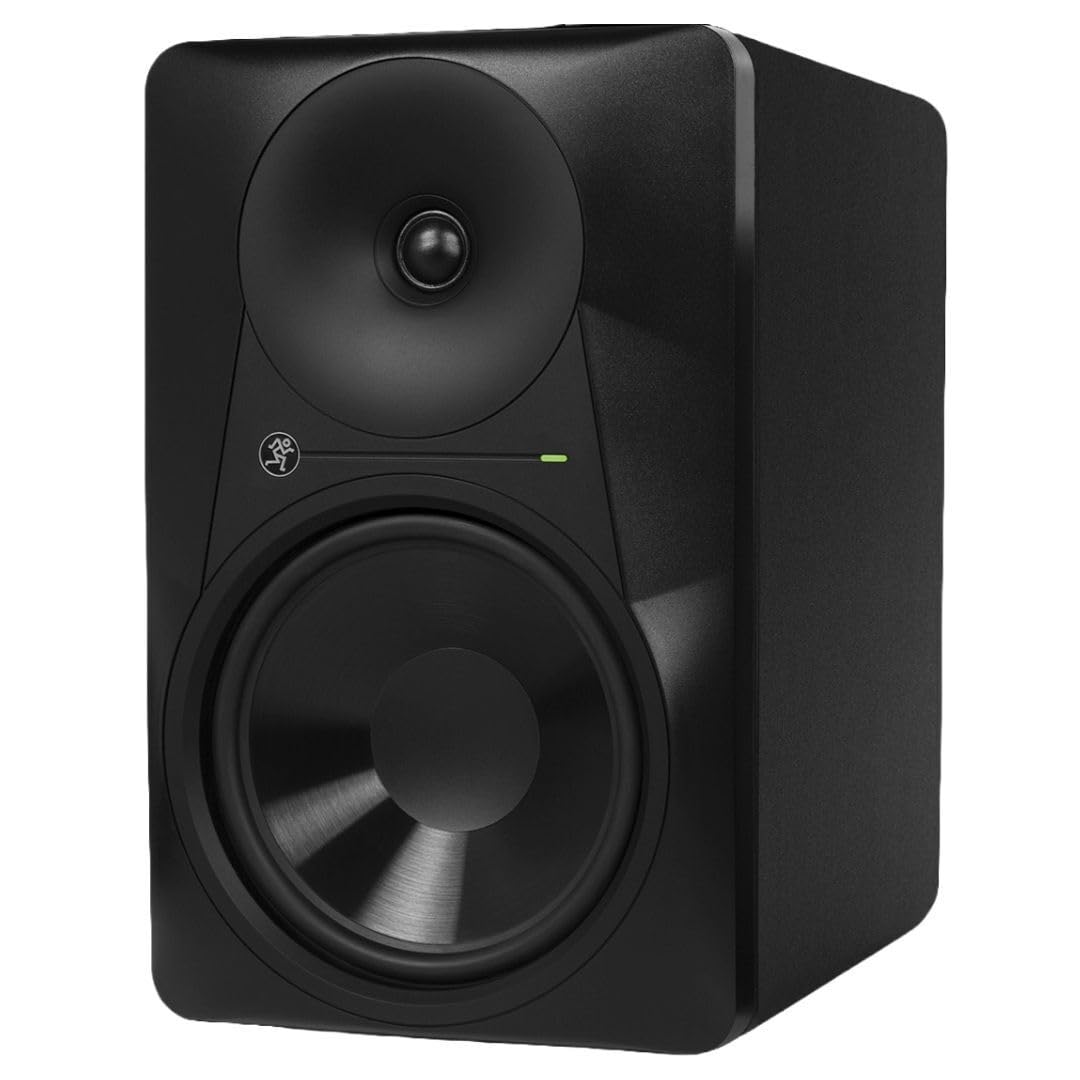
The Mackie MR824 is a no-compromise 8-inch two-way monitor designed for engineers who need accurate low-frequency reproduction without a separate subwoofer in their signal chain. A 65-Watt bi-amplified Class A/B system drives a polypropylene woofer and 1-inch silk dome tweeter, the latter chosen for its fast transient response and non-fatiguing high-end presentation over long mixing sessions.
Mackie’s logarithmic waveguide design delivers ultra-wide dispersion, expanding the listening sweet spot enough that multiple people can evaluate a mix from different rack-adjacent positions without hearing drastic tonal shifts. The MR824 includes adjustable high-frequency and low-frequency trim controls, and the polypropylene cone resists environmental humidity changes better than paper-based cones — a real advantage for monitors stored in basements or garages.
The deep cabinet depth required for the 8-inch driver may protrude beyond standard rack rails in some configurations, so measure your rack depth before purchasing. The power switch on the rear panel is inconvenient for racks where the back is not easily accessible, but the overall sonic transparency at this price point is difficult to match.
Why it’s great
- 8-inch woofer delivers authority in sub-60Hz range
- Log waveguide provides wide horizontal dispersion
- Silk dome tweeter prevents ear fatigue during long sessions
Good to know
- Deep cabinet may not fit shallow rack enclosures
- Rear power switch is hard to reach in a rack
6. KRK Kreate 8 Powered Studio Monitor
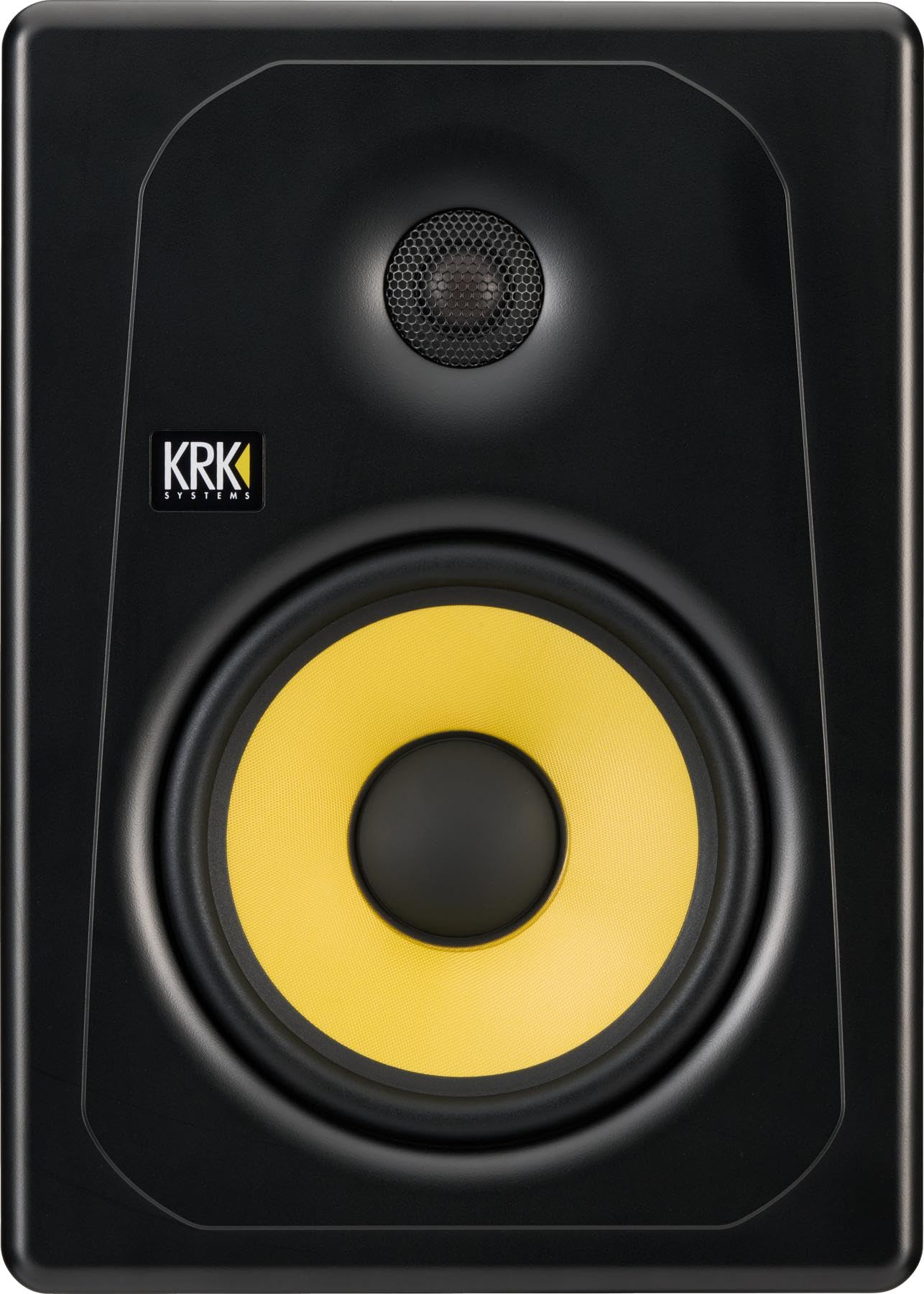
The KRK Kreate 8 combines a lightweight woven glass-fiber composite woofer with a 1-inch textile dome tweeter, resulting in a monitor that delivers punchy bass and articulate highs without the heavy cabinet weight that often complicates rack placement. Bluetooth input adds the convenience of wireless streaming directly from a phone or tablet, useful for A/B referencing commercial tracks against your mix.
Users consistently highlight the Kreate 8’s bass response as surprisingly deep and tight for a single 8-inch driver, handling kick drums and bass synths with authority. The standby mode automatically activates after a period of signal inactivity, reducing power consumption in setups where monitors are left powered on between sessions — a practical feature for rack systems that stay wired.
The Bluetooth pairing process requires a specific three-press sequence that is not clearly documented in the quick-start guide, causing initial confusion for some users. The Kreate 8 also lacks the waveguide technology found in competitors like JBL and Kali, resulting in a narrower sweet spot that demands more precise listener positioning relative to the rack.
Why it’s great
- Woven glass-fiber woofer for tight, responsive bass
- Bluetooth input for convenient source switching
- Automatic standby mode reduces rack heat buildup
Good to know
- Narrow sweet spot compared to waveguide-equipped designs
- Bluetooth pairing sequence is not intuitive
7. KRK RP5G3 Rokit 5 Generation 3 Powered Studio Monitor

The KRK RP5G3 Rokit 5 Generation 3 remains a staple in home and project studios thanks to its forgiving voicing and robust build quality. The glass-aramid composite woofer and soft-dome tweeter with optimized waveguide produce a smooth, non-fatiguing top end that extends to 35kHz, while the +2dB bass boost switch gives producers the option to check how a mix sounds with elevated low-end for club-oriented genres.
Users appreciate that the RP5G3 sounds good out of the box without requiring extensive break-in time, though a brief low-volume period does help the drivers settle. The front-facing bass port allows for closer wall placement than rear-ported designs, a real advantage when rack positioning forces monitors nearer to a back wall than ideal.
The RP5G3 lacks the sub-bass extension below 55Hz needed for dubstep and modern hip-hop production, so a subwoofer is strongly recommended for those genres. The coaxial connectivity protocol listed in specs refers to the coaxial input wiring standard, not a digital coaxial input — these are purely analog monitors.
Why it’s great
- Front port allows flexible rack placement near walls
- Smooth, non-fatiguing high-frequency reproduction
- Bass boost switch for genre-specific mix checking
Good to know
- Limited sub-bass extension below 55Hz
- Requires audio interface to avoid crackle from laptop output
8. PreSonus Eris 3.5 Studio Monitors, Pair

The PreSonus Eris 3.5 monitors are the budget-friendly entry point into accurate near-field monitoring without sacrificing critical input flexibility. With 50 Watts of Class AB dual amplification (25W per channel), woven-composite woofers, and 1-inch silk-dome tweeters, these produce remarkably clean sound for a 3.5-inch driver format. The front-panel headphone output with built-in amplifier and aux input make them instantly useful for quick referencing without reaching behind the rack.
Users consistently note that the Eris 3.5 delivers deeper bass than expected from a 3.5-inch woofer, though the low end is boosted compared to truly flat monitors — the high and low-frequency tuning controls on the back panel help compensate for room placement. The power saver mode that engages after 40 minutes of idle time is a thoughtful touch for rack setups where monitors may be left powered on.
The 3.5-inch driver limits maximum SPL and headroom, making these unsuitable for large control rooms or loud monitoring scenarios. For a bedroom studio or synth rig where accurate but quiet monitoring is the goal, however, the Eris 3.5 offers exceptional value and connectivity options including balanced TRS, unbalanced RCA, and front-panel aux.
Why it’s great
- Flexible input selection including front-panel aux and headphone out
- Acoustic tuning controls adapt to room and placement
- Compact size fits easily into tight rack-adjacent spaces
Good to know
- Limited headroom and max SPL for critical mix decisions
- Built-in bass boost deviates from true flat response
9. Sound Town 8U Universal Steel Rack

The Sound Town 8U Universal Steel Rack is the enclosure foundation that makes a 2 RU mountable speaker system practical. Its rugged steel construction with vented side panels promotes the airflow your active monitors need to stay thermally stable during long sessions, and the four heavy-duty locking casters let you roll the entire rig into optimal listening position without lifting.
Users praise the rack’s easy assembly — all screw holes are correctly threaded, and the included hardware suits most standard gear. The rack provides 8U of 19-inch spacing with dual sets of rack rails, offering flexibility for both shallow and deep monitor cabinets. The top shelf accommodates gear that doesn’t mount conventionally, such as audio interfaces or monitor controllers.
The rack is built for studio and home theater use rather than heavy touring, with a 16-kilogram weight that provides stability without being immovable. For protecting your monitoring investment and creating a clean, organized signal chain, this rack delivers professional build quality at a price that leaves budget for better monitors.
Why it’s great
- Vented side panels keep active monitors cool
- Locking casters enable easy repositioning of the listening triangle
- Rugged steel construction with accurate thread alignment
Good to know
- Not designed for heavy touring or road case abuse
- Included rack screws may not fit every brand’s mounting brackets
FAQ
Can I mount these monitors directly on standard 19-inch rack rails?
Do I always need a subwoofer with 5-inch studio monitors?
Final Thoughts: The Verdict
For most users, the 2 ru mountable speakers winner is the JBL 305P MkII pair because its Image Control Waveguide combines a forgiving sweet spot with accurate mix translation, and the Class-D amplification keeps heat manageable inside a rack enclosure. If you need fuller bass without a subwoofer for mid-size rooms, grab the JBL 306P MkII for its 6.5-inch woofer and Boundary EQ. And for ultra-tight desk-rack setups where listening distance is under two feet, nothing beats the KALI AUDIO LP-UNF with its 3D Imaging Waveguide and surprising 39Hz low-end extension.