
Our readers keep the lights on and my morning glass full of iced black tea. As an Amazon Associate, I earn from qualifying purchases.
Specs are compiled from manufacturer listings and verified buyer reviews and can change over time — please confirm the key details on the product page before buying.
If you are drowning in stacks of paper—old tax returns, receipts, legal contracts, or decades of family photos—the single feature that saves you hours is a scanner that flips each page electronically without you touching it. A two-sided (duplex) scanner reads both sides of a document in one pass through the feed slot, cutting scanning time by half and eliminating the need to manually flip paper. This guide breaks down which models actually deliver on that promise, sorted by what matters: speed, software that works, and how many pages you can load at once without jams.
I’m Min — the founder and writer behind Gadgets Feed. This guide is built by comparing the manufacturers’ published specifications and the patterns across verified customer reviews, so you get each pick’s real strengths and trade-offs instead of marketing spin.
From compact desktop units that slip into a bag to high-volume workgroup machines, these are the real-world reasons each model earns a spot on a list of the 2 sided scanner worth considering right now.
Quick Picks
- Canon imageFORMULA R30 — Best Overall
- Brother ADS-2200 — Speed Champ
- Epson ES-580W — Wireless Hub
- Fujitsu fi-7160 — Pro Grade
- ScanSnap iX1300 — Compact Winner
- Epson ES-C220 — Space Saver
- HPPS200 — Travel Pick
- Doxie Pro — Budget Champion
How To Choose The Best 2 Sided Scanner
Buying a duplex scanner means focusing on a few key specs that define whether it will be a time-saver or a desk ornament. Here is what separates the daily drivers from the duds.
Feeder Capacity and Paper Path
The Auto Document Feeder (ADF) is the tray that holds your stack. A 20-sheet feeder is fine for a monthly stack of receipts, but if you routinely scan 50-page contracts or 100-page notebooks, look for a 50-sheet or 100-sheet ADF. Also check the paper path—a straight-through path (like on the Canon imageFORMULA R30) handles thick cards and envelopes better than a U-turn path that can jam on curled paper.
Speed and Duplex (Two-Sided) Performance
Manufacturers quote speed in “pages per minute” (ppm) for single-sided and “images per minute” (ipm) for two-sided. Double the ipm number roughly matches the ppm number, but real-world bottlenecks are the software processing the scan. A 25-ppm duplex scanner like the Canon R30 or HPPS200 will feel noticeably slower than a 35-ppm machine like the Brother ADS-2200 when you are feeding a thick batch.
Software and Driver Reliability
You want a scanner that works without fighting the software. The Canon R30, for example, has the scanning program built into the hardware—you plug in a USB and it appears as a drive, no installation required. Other models need a download, and the most common complaint across reviews is finicky drivers. Look for scanners that offer automatic blank page removal, auto-crop, and OCR (optical character recognition, which turns scanned text into an editable Word or searchable PDF file) built into the bundled software so you are not buying a separate program.
Quick Comparison
| Model | Best For | Duplex Speed | Feeder Capacity | Color Depth | Amazon |
|---|---|---|---|---|---|
| Canon imageFORMULA R30 | High-volume batch scanning with no software install | 25 ppm / 50 ipm | 60 sheets | 24 Bits | $259.00$323.00Amazon |
| Brother ADS-2200 | Fast duplex with Linux support | 35 ppm / 70 ipm | 50 sheets | 48-bit | $487.00Amazon |
| Epson ES-580W | Wireless scan-to-cloud with a touchscreen | 35 ppm / 70 ipm | 100 sheets | 30 bits | Amazon |
| Fujitsu fi-7160 | Heavy-duty workgroup reliability | ~60 ppm | — | 24 Bits | $1,239.49Amazon |
| ScanSnap iX1300 | Wireless compact desk-saver | 30 ppm / 60 ipm | — | 48 bits | $279.99Amazon |
| Epson ES-C220 | Ultra-compact space-saving duplex | 30 ppm / 60 ipm | 20 sheets | 24-bit output bpp | $279.99Amazon |
| HPPS200 | Ultra-light portable travel duplex | 25 ppm | 25 sheets | 24 bpp | $279.99Amazon |
| Doxie Pro | Entry-level price in a proven package | Duplex | 20 sheets | 24 bits | $229.00Amazon |
In‑Depth Reviews
1. Canon imageFORMULA R30

The Canon imageFORMULA R30 scanned a 1,022-page diary in about three hours with no driver installation needed.
If you hate installing drivers, this is your machine. The Canon imageFORMULA R30 has the scanning software built right into the hardware—you plug in the USB cable, the computer sees it as an external drive, and you run the program from there. No discs, no downloads, no account creation. One reviewer noted the scanner worked perfectly for scanning a 1,022-page diary in roughly three hours, which gives you a concrete benchmark for how fast it handles real-world big jobs. You get a 60-sheet automatic feeder, which is bigger than the 20-sheet trays on compact models, so you can drop a thick stack and walk away. It scans both sides simultaneously at up to 25 pages per minute.
The trade-off is size and weight. At 9.88″D x 11.54″W x 9.65″H, it is the largest unit on this mid-range list—the Doxie Pro measures 3.94″D x 12.01″W x 2.95″H and weighs 3 pounds. The color depth is 24 bits, which is standard for office documents while the ScanSnap iX1300 offers 48 bits. Also, buyers report that accurate OCR (optical character recognition, turning a scanned image into editable text) requires an external program—the built-in software scans to PDF, but you need Word or another tool to convert it to text.
Overall, the R30 is the pick for anyone who wants zero-fuss setup and the highest feeder capacity in the sub- tier. It is a desk-hogger, but a reliable one.
Why It Wins
- Built-in scanning software—no driver or download install needed
- 60-sheet ADF handles bigger batches than most mid-range rivals
- Duplex 25 ppm speed is fast enough for the thousand-page jobs
- Proven with heavy use: reviewers mention scanning over 1,000 pages without issue
Know Before You Buy
- Largest footprint on this list: 9.88″D x 11.54″W x 9.65″H and weighs 6.6 lbs
- OCR requires a separate program—not built into the scanner
- Driver can be temperamental: a few reviewers report needing to reinstall on every restart
Best for: The person who wants a box that just works from the start—no install, no fumbling, just feed and scan.
Look elsewhere if: Your desk is tight or you need to carry the scanner between locations; the R30 is a fixed desk anchor.
2. Brother ADS-2200

The Brother ADS-2200 scans legal-size double-sided pages at 35 ppm, completing each in under five seconds.
The Brother ADS-2200 is built for speed and versatility. It scans both sides of a document at up to 35 pages per minute (70 images per minute), which makes it noticeably faster than the 25-ppm Canon R30 or HPPS200. One buyer mentioned it scanned over 500 photos in three hours at 300 dpi. It supports a wide range of media types including plastic cards, embossed cards, and glossy paper, and its 50-sheet auto document feeder lets you load medium-size jobs. The color depth is 48-bit, while many mid-range rivals offer 24-bit depth, which means finer color gradation for photos and detailed documents.
This is also one of the few models with official support for Linux, along with TWAIN, WIA, and SANE drivers—a rare find if you are not on Windows or macOS. The scanner weighs 5.5 pounds and has a compact footprint, smaller than the Canon R30. Some reviewers point out that the maximum optical resolution is 600 x 600 dpi in practice, even though the spec sheet says 1200. The size is also a consideration: at 11.6″D x 6.6″H, it is still deeper than most compact models.
If throughput is your priority, the ADS-2200 leads the mid-range pack on raw speed and format support.
The Speed Advantage
- Fastest duplex mid-range pick at 35 ppm / 70 ipm
- 48-bit color depth for richer photo scans
- Native Linux support—rare in this category
- Handles plastic, embossed, and glossy cards
Heads Up
- Real-world optical resolution is 600×600, not the advertised 1200
- Some units arrive with a defective power adapter
- Deeper than ultra-compact rivals at 11.6 inches
Reach for this if: You need the fastest duplex speed at this price tier and scan mixed media (cards, glossy paper) regularly.
Avoid it if: You rely on the full 1200 dpi spec for high-resolution archival scanning; real-world may disappoint.
3. Epson ES-580W
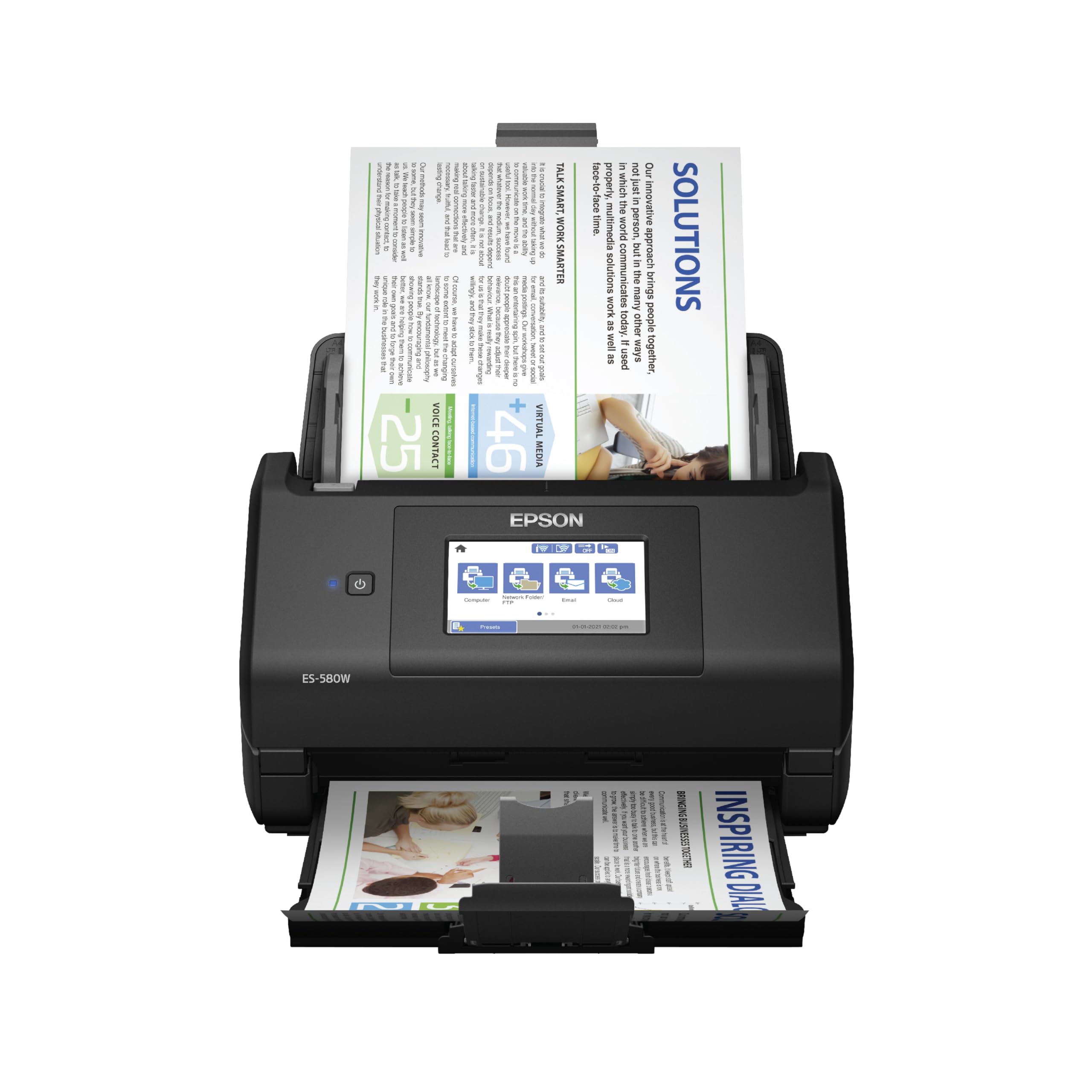
The Epson ES-580W scans directly to cloud services via its 4.3-inch touchscreen, no computer required.
The Epson ES-580W earns its spot for cable-free workflows because it has a 100-sheet auto document feeder, the largest in this price range—you can load a full ream of paper and let it run. It scans at up to 35 ppm duplex and uses a CCD sensor (an older, higher-quality image sensor technology) rather than the cheaper CIS found on most desktop scanners, typically delivering better depth-of-field and more accurate colors on curved or bound pages. A 4.3-inch color touchscreen sits on top, letting you start scans to email, cloud services (Dropbox, Google Drive, Evernote, OneDrive), or a USB drive without a PC. One buyer running a high-volume notary practice calls it a must-have for the 100-sheet feeder and direct cloud scanning. This is for you if you need to scan without a PC nearby; skip it if you want the smallest possible footprint, as the ES-580W is larger than the ScanSnap iX1300.
The color depth is 30 bits, which is above the 24-bit baseline but behind the 48-bit on the Brother ADS-2200. Some owners mention the lack of an Ethernet port—it is Wi-Fi and USB only, so if your network prefers wired connections, you will be stuck on Wi-Fi. The scanner is also the heaviest in this group at around 3.7 kilograms (about 8.2 pounds), so it is not a travel machine.
If you scan huge batches wirelessly and want to skip the computer entirely, the ES-580W is a serious step up from compact models.
Standout Features
- Massive 100-sheet ADF—load it and walk away
- Wireless scan-to-cloud and USB drive without a PC
- CCD sensor gives better image quality than CIS on curved/bound pages
- 4.3-inch color touchscreen for easy operation
Limitations
- No Ethernet port—wireless or USB only
- Heaviest in group at ~8.2 lbs—not portable
- Color depth (30-bit) falls short of the Brother’s 48-bit
Go for this if: You scan hundreds of pages per session and want to send them to cloud storage without a PC.
Pass if: You need Ethernet connectivity or a lightweight portable design.
4. Fujitsu fi-7160

The Fujitsu fi-7160 handles thousands of pages weekly with only about two misfeeds per 5,000 pages.
The Fujitsu fi-7160 is in a different league. It is a professional workgroup scanner that scans about 60 pages per minute (single-sided) and handles both sides at once. One buyer reports scanning at roughly one page per second at 300 dpi duplex and, after 5,000 pages, experienced only two misfeeds. That kind of reliability is why Fujitsu claims this is the world’s most popular business scanner. It uses a CCD sensor (superior image quality) and comes with PaperStream ClickScan software, which lets you push a button to send scans to email, a folder, or a printer without needing to open complex menus. The scanner ships with a 1-year warranty and supports TWAIN/ISIS and Kofax VRS compatibility for integrating with document-management software.
The catch is the size, weight, and cost. At 9.5″D x 17.7″W x 11.2″H, it sits at 9.3 pounds and takes up significant desk space—far larger than any mid-range option. The software also has a steep learning curve; customers note that PaperStream IP offers powerful features like blank page removal, auto-crop, and rotation, but configuring the profiles can be complex. Staple detection is less ideal than the sheet-feeder itself, according to one reviewer.
If you need a machine that devours thousands of pages every week without nursing it, the fi-7160 is the gold standard at a premium price.
Why It Dominates
- Extreme reliability: ~2 misfeeds in 5,000 pages
- Very fast duplex scanning (~1 page/sec at 300 dpi)
- CCD sensor for high-quality image capture
- TWAIN/ISIS and Kofax VRS support for enterprise integration
Room for Improvement
- Expensive—entry price is over four times the budget models
- Large footprint (17.7″W) and heavy (9.3 lbs)
- PaperStream software has a steep learning curve
- Staple detection could be better
The pick for heavy-duty offices: If you scan thousands of pages weekly and cannot afford downtime, this is the one.
Too much if: You scan part-time; the complexity and footprint will be wasted.
5. ScanSnap iX1300

The ScanSnap iX1300 scanned 25 semesters of notes in under three hours, folding away into a drawer when not in use.
The ScanSnap iX1300 is the best balance of small size and wireless convenience. It measures only 4.5″D x 11.7″W x 3.3″H, so it folds away into a drawer when not in use. One owner reported scanning 25 classes of college notes in under three hours, whereas the same job with a printer-based scanner would have taken one hour per class. That is the value proposition: a fast, duplex scanner that tucks away. It scans at up to 30 ppm duplex and offers a 48-bit color depth, while the Canon R30 and Epson ES-C220 offer 24-bit, so photos and documents with subtle color gradients look better. Connectivity is dual: USB or Wi-Fi, and it works with Mac, PC, Chromebook, and mobile devices via the app.
Not everyone has a perfect experience. Some reviewers point out jams every 4–5 scans where the machine pulls paper at an angle, wrinkling or ripping it. Auto-sizing can also cut off 0.5 to 1 inch from document edges. The feeder capacity is smaller than the Canon R30’s 60-sheet tray, so you will reload more often with big stacks. That said, the software (ScanSnap Home) receives high marks for its auto-naming and organization features.
If desk space is your biggest constraint and you want wireless scanning, the iX1300 is the best compact duplex option at this price point.
What It Does Well
- Ultra-compact: folds into a drawer; 4.5″D
- 48-bit color depth for richer scans than 24-bit rivals
- Wi-Fi and USB connectivity
- Reviewers praise the easy wireless setup and fast duplex scanning
Be Aware
- Higher jam rate than some competitors in this price tier
- Auto-crop can cut off document edges
- Smaller feeder than the Canon R30—more reloading for large jobs
Your pick if: Desk space is precious and you want a wireless scanner that slips out of sight when done.
Not for you if: You need a 60+ sheet feeder or have bad luck with paper jams—some reviewers report reliability issues.
6. Epson ES-C220

The Epson ES-C220 has the smallest desk footprint in Epson’s lineup, saving an advertised 60% of desk space.
The Epson ES-C220 is a space-saving duplex scanner that takes up minimal real estate. It measures 4.1″D x 11.7″W x 4.9″H, making it about the same depth as the ScanSnap iX1300 but a bit taller. It scans at 30 ppm duplex (60 ipm) and has a 20-page auto document feeder, which is fine for small batches but means constant reloading if you have more than 20 pages. The image quality is driven by a 24-bit color depth and automatic features like cropping, blank page deletion, background removal, and skew correction. One buyer calls it “the best value for double-sided scanning” and notes that it allows continuous scanning even if the page limit is exceeded—meaning you can keep feeding pages through the feeder as it processes.
Setting up the drivers took some effort, according to one reviewer who said they were not easy to find online. Once installed, the scanner runs well. Another reviewer had a completely negative experience, stating it is incompatible with a Surface Pro running Windows 11 and that customer support was unhelpful. The 20-sheet feeder also lags behind the 60-sheet Canon R30 and the 50-sheet Brother ADS-2200, so if you regularly scan more than 20 pages at a time, you might find yourself babysitting the machine.
If you need a small, fast duplex scanner for light daily use (receipts, invoices, short documents) and desk space is your top priority, the ES-C220 is a solid choice from the #1 best-selling scanner brand at retail.
Desk-Friendly Features
- Ultra-compact design saves desk space
- Fast duplex at 30 ppm / 60 ipm
- Auto-crop, blank page delete, dirt detection built in
- Allows continuous scanning beyond the 20-page feeder limit
Consider Before Buying
- 20-sheet feeder is small—requires frequent reloading
- Driver download process is not intuitive
- Reported incompatibility with Windows 11 on Surface devices
Ideal for: The home office with limited desk space that needs a fast, reliable duplex scanner for small batches.
pass on it if: Your scanning jobs are consistently over 20 pages or you need a wireless connection.
7. HPPS200

The HPPS200 weighs 3.14 pounds and stands 2.9 inches tall, claiming 1200 dpi for portable scanning.
The HPPS200 is the lightest scanner on this list by a significant margin. It weighs just 3.14 pounds (compared to the Canon R30 at 6.6 pounds) and is only 2.9 inches tall, making it easy to slide into a laptop bag. HP markets it as the fastest and lightest sheet-fed scanner in its class, with a quoted 25 ppm duplex speed and a 25-sheet auto feeder. The spec sheet says it handles documents from 2 x 2.9 inches up to 8.5 x 14 inches (legal size). One buyer, replacing a travel scanner after 20 years, calls it “compact, fast, vibrant” and perfect for travel.
The software situation is messy. A verified buyer reports that there is no official software available from HP to run the scanner—the device came with no download link, and using third-party software that will never be updated is risky. Another reviewer says the 1200 dpi resolution is a lie, stating the scanner maxes out at 200 ppi. The same reviewer had problems with two-sided scanning not working, auto-cropping ruining photos, a “ADF Bulb rear Error” appearing after just five days, and settings not saving. These two negative experiences are consistent enough to treat the HPPS200 as a high-risk pickup.
If you absolutely need the lightest possible duplex scanner for travel and are willing to gamble on software, the HPPS200 fits in a bag. But the reliable bet for portability is the Doxie Pro or the ScanSnap iX1300.
Portability Pros
- Lightest scanner in this guide: 3.14 lbs
- Slim 2.9-inch height fits in a bag easily
- 25-sheet feeder for medium batches on the go
- Scans up to legal size (14 inches long)
Serious Risks
- No official software available from HP, according to buyers
- Some users report 1200 dpi is unattainable; max 200 ppi
- Hardware errors (ADF bulb) reported within days of purchase
- Two-sided scanning and auto-crop reported as unreliable
Only for the risk-tolerant: If the weight and size are worth the gamble, it is the lightest option here.
For reliable portability: You are safer with the Doxie Pro or ScanSnap iX1300, which have confirmed software support and fewer critical failures.
8. Doxie Pro

The Doxie Pro is a compact entry-level duplex scanner with a jam rate of about once every 300 pages.
The Doxie Pro is an entry-level duplex scanner that has a loyal following for its simplicity and small footprint. It measures 3.94″D x 12.01″W x 2.95″H, which makes it one of the shallowest models available—about 2.5 times less depth than the Canon R30. At just 3 pounds, it is almost 2.2 pounds lighter than the Canon R30. The color depth is 24 bits, which matches most budget-to-mid-range competitors but is half the 48 bits of the ScanSnap iX1300. Shoppers say that fast duplex scanning works well, with jams happening roughly only once every 300 pages. The auto-enhancement features (crop, straighten, contrast boost) earn praise, and the software (Doxie’s own) integrates with Dropbox, Evernote, OneNote, and iCloud without complex drivers.
The main limitation is the 20-page feeder, which is the same small capacity as the Epson ES-C220. If you need to scan thick stacks, you will reload constantly. The Doxie Pro also lacks an SD card slot and a built-in battery, so it must be plugged in while scanning. One buyer mentions there is no Chromebook app.
For the lowest price of the bunch, the Doxie Pro gives you a proven, reliable duplex scanner that handles standard document workflows without any fuss. It is the best value entry point if you do not need high-volume speed.
What It Delivers
- Lowest price in the guide—best value for entry-level duplex scanning
- Lightest and shallowest of the list: 3 lbs, 3.94″D
- Reliable duplex scanning with a low jam rate (~1/300 pages)
- Simple software integrates with cloud apps
What It Lacks
- Small 20-page feeder—frequent reloading for big jobs
- 24-bit color depth, not as rich as 48-bit models
- No SD card slot, no battery, no Chromebook app
For budget buyers: A proven, compact duplex scanner that handles the basics reliably for the lowest cost.
Not for high-volume users: You will be reloading too often if your stacks are thicker than 20 pages at a time.
Understanding the Specs
Color Depth (bits)
Color depth measures how many distinct colors each pixel can capture. A 24-bit scanner captures 16.7 million colors—enough for sharp text and basic photos. A 48-bit scanner captures 281 trillion colors, which provides much finer gradation in shadows and highlights, especially noticeable when scanning photographs or documents with subtle gradients. For pure text and standard office forms, 24-bit is fine; for archival photo scanning, the 48-bit models (ScanSnap iX1300, Brother ADS-2200) give you more editing headroom.
ADF Capacity (Auto Document Feeder)
The ADF capacity tells you how many pages you can load into the scanner at once before needing to reload. A 20-sheet feeder (Doxie Pro, Epson ES-C220) is fine for a day’s worth of receipts or a short contract. A 60-sheet feeder (Canon R30) already saves you two reloads on a 60-page job. The 100-sheet feeder on the Epson ES-580W and the reliability of the Fujitsu fi-7160 are for users who scan hundreds of pages per session and do not want to stand there feeding paper.
CIS vs CCD Sensors
Most compact duplex scanners use a CIS (Contact Image Sensor) because it is thinner, lighter, and cheaper. A CCD (Charge-Coupled Device) sensor, found on the Epson ES-580W, Brother ADS-2200, and Fujitsu fi-7160, is older technology but typically produces sharper images with better depth-of-field—meaning it handles thick books, curled paper, or stapled pages more accurately. For flat, clean paper, CIS is fine; for mixed or imperfect media, CCD is usually better.
Resolutions (dpi) and True vs Interpolated
The optical resolution (true hardware) of most duplex scanners is 300 to 600 dpi. The HPPS200 claims 1200 dpi, but a reviewer says that is interpolated (software-calculated) and the real maximum is 200 ppi. Higher dpi produces larger, clearer files but also slower scanning and bigger storage sizes. 300 dpi is the balance for text documents that you intend to OCR; 600 dpi is for photograph archives. Always check whether the spec is optical or interpolated.
FAQ
What does “duplex” mean on a scanner?
Can a duplex scanner scan single-sided pages too?
How many pages per minute (ppm) is fast enough for home use?
Will a duplex scanner work with a Chromebook?
What is the difference between 24-bit and 48-bit color depth in scanners?
What is the difference between CIS and CCD sensors?
Can a duplex scanner also scan business cards and IDs?
How do I clean a duplex scanner’s document feeder?
What is the difference between ppm and ipm in scanner speed?
Does a duplex scanner need a computer to work?
Final Thoughts: The Verdict
If you want one dependable pick, the top 2 sided scanner is the Canon imageFORMULA R30 because it offers the largest feeder capacity in the mid-range tier (60 sheets), the simplest setup (no driver installation required), and proven reliability at a fair price point. If you want wireless scanning and a compact footprint that tucks into a drawer, grab the ScanSnap iX1300 for its 48-bit color and Wi-Fi flexibility. And for heavy-duty office volume where every minute counts, the standout is the Fujitsu fi-7160 with its near-flawless jam rate and professional-grade CCD sensor.
How We Picked
We do not accept paid placement. Every pick is matched to a real buyer and a real use-case; we do not hands-on test units.
Sources & Methodology
Specifications: manufacturer listings and product documentation. Review insights: verified customer reviews, as of July 2026. Pricing: not shown on this page (it changes often); check the current price via the retailer link.
As an Amazon Associate, Gadgets Feed earns from qualifying purchases. This does not affect which products we feature.
Product prices and availability are accurate as of the date/time indicated and are subject to change. Any price and availability information displayed on Amazon at the time of purchase will apply to the purchase of this product. As an Amazon Associate I earn from qualifying purchases.
CERTAIN CONTENT THAT APPEARS ON THIS SITE COMES FROM AMAZON. THIS CONTENT IS PROVIDED "AS IS" AND IS SUBJECT TO CHANGE OR REMOVAL AT ANY TIME.
Amazon and the Amazon logo are trademarks of Amazon.com, Inc. or its affiliates.