
Our readers keep the lights on and my morning glass full of iced black tea. As an Amazon Associate, I earn from qualifying purchases.
Specs are compiled from manufacturer listings and verified buyer reviews and can change over time — please confirm the key details on the product page before buying.
Walking into a garage where a compressor rattles the walls is a familiar pain. The real challenge with a 2 stage air compressor isn’t just raw power — it’s finding one that delivers high pressure without turning your workshop into a noise hazard. This guide breaks down five stationary units that balance air output, tank size, and noise levels so you can pick the one that fits your shop’s daily demands.
I’m Min — the founder and writer behind Gadgets Feed. This guide is built by comparing the manufacturers’ published specifications and the patterns across verified customer reviews, so you get each pick’s real strengths and trade-offs instead of marketing spin.
Getting a 2-stage compressor means choosing between raw volume and quiet operation, and we have the details you need to decide. This guide to the best 2 stage air compressor focuses on real-world performance you can hear and feel.
Our Picks at a Glance

How To Choose The Best 2 Stage Air Compressor
Before you buy a 400-pound compressor, you need to match its output to your tools’ air appetite. Compare airflow (SCFM, or standard cubic feet per minute—how much air the pump delivers), tank capacity, and the electrical supply your garage can handle.
Match the Airflow to Your Tools
Every air tool has an SCFM (Standard Cubic Feet per Minute) requirement — the volume of air it gulps while running. A DA sander might need around 8 SCFM, while a framing nailer needs far less. If your compressor’s SCFM at the pressure you use is lower than the tool’s demand, the tank drains faster than it refills.
Check the Electrical Reality
The biggest surprise for first-time buyers is the power source. Most of these heavy-duty 2-stage units run on 230/240V, not a standard 115V wall outlet. You’re often looking at a dedicated circuit and a 30-amp breaker, and a professional install if you’re not comfortable with electrical work.
Quick Comparison
| Model | Best For | Motor | Tank Size | Max Airflow | Amazon |
|---|---|---|---|---|---|
| Campbell Hausfeld 60-Gallon★ Best Overall | Balanced value and performance | 3.7 HP | 60 gallons | 7.6 cfm | Amazon |
| California Air Tools 20015HPQuiet Champion | Noise-sensitive home shops | 1.5 HP | 20 gallons | 4 cfm | Amazon |
| DEWALT DXCMV5076055 | High-volume continuous work | 5 HP | 60 gallons | 15.3 cfm | Amazon |
| Ingersoll Rand 2340L5-V | Continuous-duty professional use | 5 HP | 60 gallons | 14 cfm | Amazon |
| Ingersoll Rand 2475N7.5 | Large shops with heavy demand | 7.5 HP | 80 gallons | 24 cfm | Amazon |
In‑Depth Reviews
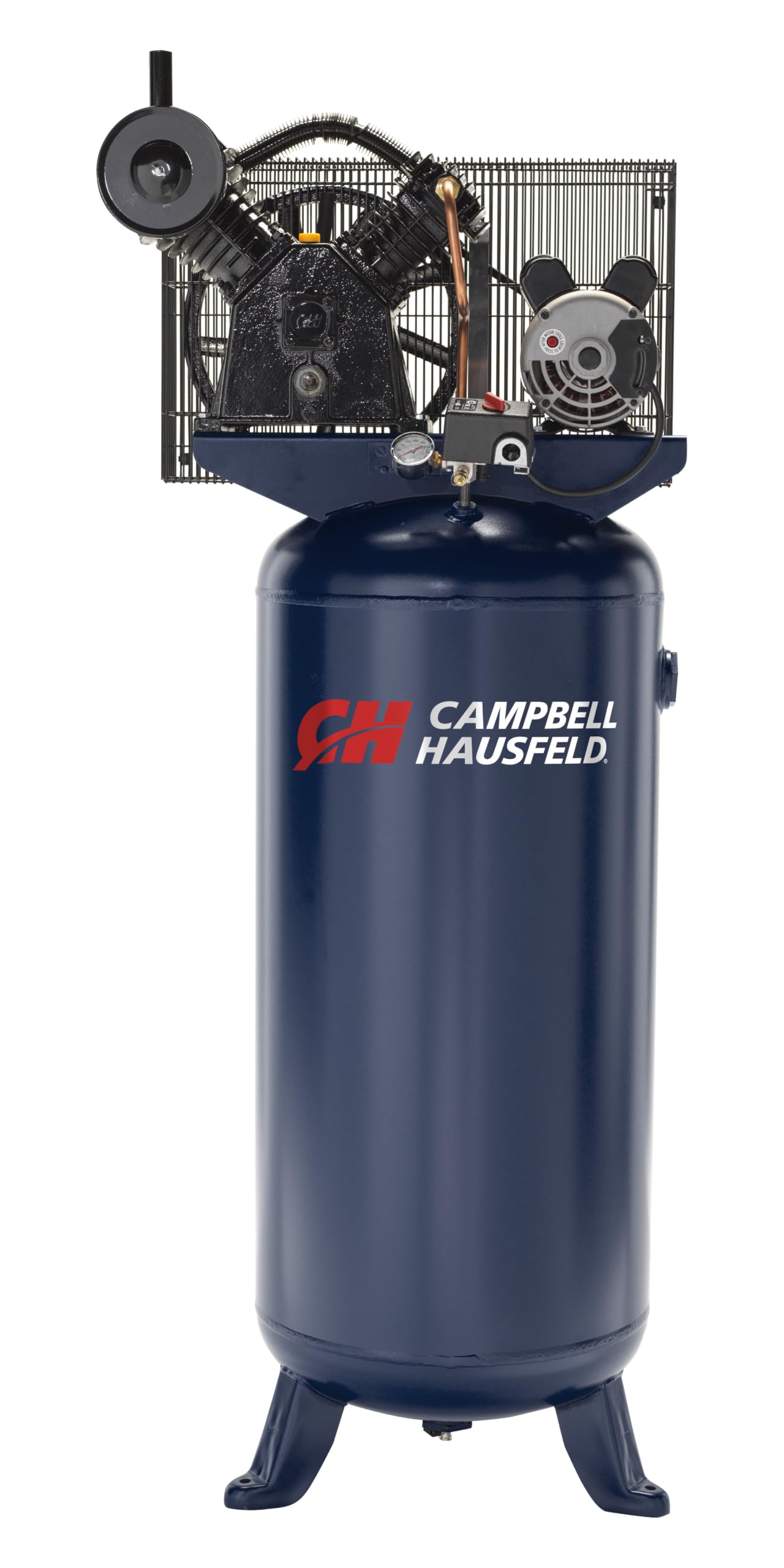
1. Campbell Hausfeld 60-Gallon 2-Stage Air Compressor
Our pick — over 4★ from 100+ verified ratings; the strongest balance of quality and price.
The oil-lubricated 2-stage workhorse that makes the jump to 175 PSI noticeably easier on your ears.
The two-stage cast-iron pump runs cooler and quieter than a single-stage while pushing up to 175 PSI. You get 7.6 SCFM at 90 PSI and 6.9 SCFM at 175 PSI, which owners say keeps pace with demanding DA sanding without the motor bogging down.
This 60-gallon vertical tank takes up only a 23 x 23-inch floor footprint, so it fits in tight corners where horizontal units won’t. Buyers are split on noise: some call it impressively quiet for a 2-stage, but others report the vibration makes it “walk” on the floor unless you bolt it down.
Most buyers report it holds pressure reliably and delivers the fast recovery needed for removing stubborn nuts at higher PSI. The recurring caveat is its weight and top-heaviness — owners mention it’s “extremely top-heavy,” weighing over 300 pounds, so you’ll absolutely need help moving it into place, and bolting it down is strongly advised.
Shop-floor verdict: The performance and value are the main reasons owners recommend it, with the cast-iron durability being a close second. The mixed feedback centers on setup — the vibration and the sheer heft are real things to plan around, not flaws in the air delivery itself.
Reach for this if: you want a serious 60-gallon upgrade without jumping to a premium price tier, and you can handle a 230V install.
Plan for this: the unit is top-heavy and needs bolting down; occasional units arrive with shipping damage, so inspect the delivery carefully.
2. California Air Tools 20015HP Ultra Quiet
The oil-free 2-stage that runs at 70 dB, so you can hold a conversation while it works.
If your workshop sits near a living space or you value your hearing, this is the standout. At 70 dB (decibels, a sound level roughly like a normal conversation), it earns its “Ultra Quiet” name—one reviewer writes, “It is the quietest compressor I have ever owned.” That’s a world away from the industrial rumble of bigger units.
The trade-off for that silence is airflow. This 1.5 HP unit delivers just 4 cfm, which is a fraction of the volume bigger units push — the DEWALT above moves 15.3 cfm, nearly four times as much. That means it suits jobs like running a 1/2″ impact driver or blowing out sprinklers, not continuous high-volume sanding.
It’s a 20-gallon tank, so storage is more modest, and it operates on a standard 110V outlet drawing just 12 amps — no electrician required, which is a huge convenience. The oil-free pump promises a 3000-hour life cycle with less maintenance, and at 113 pounds it’s genuinely portable on its wheels.
Quiet-life trade-off: The quiet operation is the thing everyone raves about, and the portability is a bonus. The honest limit is the low CFM — one owner found the pressure regulator drifted after a few months, so treat the gauge with a little skepticism.
Best for: home garages and small shops where noise is the primary concern and tools are light-duty.
Look elsewhere if: you’re running high-volume tools like DA sanders all day — you’ll outpace what 4 cfm can replenish.
3. DEWALT 60-Gallon Stationary Vertical Air Compressor
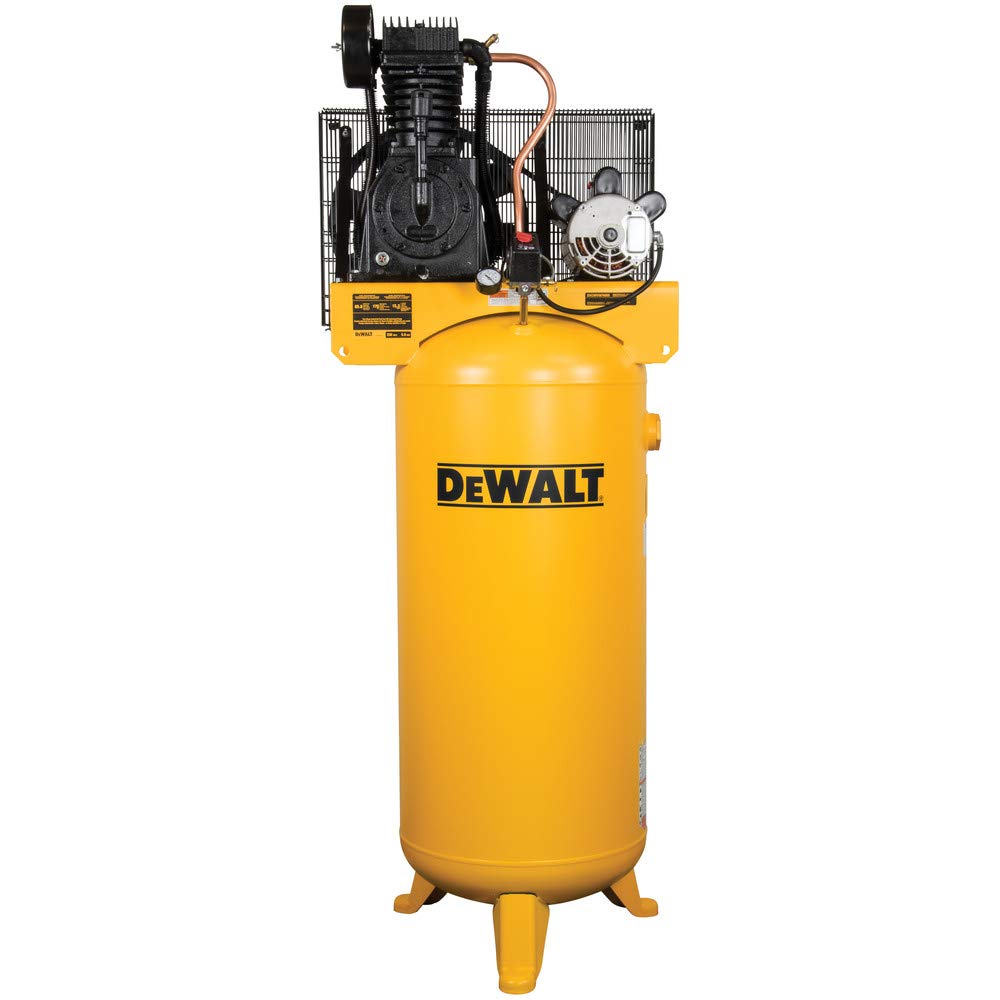
A 5 HP, 15.3 cfm monster that holds pressure for days — the definition of set-and-forget shop power.
This is the raw-output pick. The 5 HP, 230-volt motor drives a 2-stage pump that delivers a massive 15.3 SCFM at 100 PSI and 13.5 SCFM at 175 PSI, so it keeps up with the hungriest tools without breaking a sweat. It’s nearly four times the airflow of the California Air Tools above, putting it in a completely different league for heavy work.
Owners praise the build quality and air retention. They report it hits 170 PSI (pounds per square inch, the air pressure) quickly, and one sums up the seal quality: “After 7 days with off still has pressure.” That leak-free hold means the pump doesn’t cycle on constantly, saving wear and electricity.
It runs at a claimed 65 dB, which is quieter than the California Air Tools’ 70 dB despite being vastly more powerful — the two-stage pump design pays off here. The vertical design with a 60-gallon tank fits a 40″L x 31″W footprint, but at 80 inches tall, you’ll want ceiling clearance. It’s a stationary unit, so portability means a forklift or a very strong friend.
What owners love
- Blistering 15.3 cfm keeps high-volume tools fed
- Holds pressure for days — no constant recharging
- Remarkably quiet 65 dB for its output class
What to watch
- Needs a dedicated 230V circuit — no plug-and-play
- Occasional units ship with a defective weld seam
- No wiring instructions included, per owner feedback
Grab this for: serious fabrication or collision work where you need relentless airflow and pressure retention is king.
Think twice if: you don’t have 230V available or you’re not prepared to deal with a heavy, stationary install.
4. Ingersoll Rand 2340L5-V 5 HP Type 30

An industrial legend that’s built to run 100% of the time, not just start and stop.
This is for buyers who treat their compressor as permanent shop infrastructure. The Type 30 design (a classic two-cylinder layout) uses individually cast cylinders, an overhung crankshaft, and a one-piece connecting rod, making maintenance easier and rating the pump for 100% continuous duty—so it’s designed to run all day without a break.
With 5 HP on a 230V single-phase supply and a 60-gallon vertical tank, it pushes 14 cfm of airflow to handle high volumes at high pressure. Owners upgrading from smaller non-oil units are consistently impressed by how quiet it runs “for being 5 HP” and how dependably it operates, with one calling the performance “phenomenal compared to industry standard equipment.”
It’s a heavy beast at 430 pounds, so plan your delivery path. The build quality is the headline, but the assembly QC draws some criticism — owners advise checking all bolts on arrival, as one unit shipped with pump bolts not even started and a stripped drain plug. It’s not a reason to avoid the brand, just a compelling reason to inspect before you wire it up.
Continuous-duty verdict: Built to run non-stop, which is exactly what a working shop needs. The catch is the setup inspection — give every bolt and fitting a check before first start.
Choose this if: you need a compressor that won’t complain about an 8-hour workday, and you value easy service access.
Be ready for: a 430-pound delivery that needs a plan, and a mandatory pre-flight bolt check.
5. Ingersoll Rand 2475N7.5 7.5 HP Two-Stage

The 7.5 HP, 24 cfm endgame that makes “running out of air” a phrase you forget.
This is the unit you buy when you want to stop thinking about air capacity forever. With a 7.5 HP motor driving a 24 cfm output into an 80-gallon ASME tank, it delivers a 175 psig maximum operating pressure that can feed a medium-sized shop without breaking a sweat. Owners say “even a medium sized shop will never run out of air” — and with 24 cfm on tap, that’s a credible claim.
The cast-iron pump is rated for over 15,000 hours of trouble-free use. All-Season Select synthetic lubricant extends service intervals to 2,000 hours between changeouts. That’s a significant reduction in maintenance downtime for a busy shop.
It’s also the heaviest unit here at 611 pounds, so this is a permanent installation, not something you move around. The included components list just the compressor itself, so plan for the electrical work. It’s the most expensive pick in this lineup, but for a professional setting, the capacity and continuous-duty rating justify the premium.
Heavy-duty verdict: The sheer output and the 15,000-hour pump life make it the long-term value play for serious users. One honest note: the synthetic oil is expensive, so budget for that ongoing cost.
Invest in this if: you run a professional shop with high, constant air demand and can handle a 611-pound install.
Know before you buy: it’s the biggest commitment here in price, weight, and power draw — it’s overkill for casual home use.
Understanding the Specs
SCFM and PSI
SCFM (Standard Cubic Feet per Minute) is the volume of air the pump delivers, and PSI (Pounds per Square Inch) is the pressure. A 2-stage pump compresses air twice, which lets it hit higher pressures like 175 PSI more efficiently. For high-volume tools, you want to check the SCFM at the pressure you actually use, like 90 PSI.
Tank Capacity and Motor Power
The tank (measured in gallons) is your air reserve — bigger tanks mean more stored air for short bursts of heavy use. The motor horsepower determines how fast the pump refills the tank. A 5 HP motor refills a 60-gallon tank faster than a 1.5 HP motor, which matters for continuous work like sanding or blasting.
FAQ
What is the difference between a single-stage and a 2-stage air compressor?
Will a 2-stage air compressor run on a standard 110V outlet?
How much airflow (SCFM) do I need for common air tools?
What does “continuous duty” mean for an air compressor?
Is an oil-free or oil-lubricated pump better?
How much noise does a 2-stage air compressor make?
Do I need to bolt my air compressor to the floor?
How often should I drain the tank on my air compressor?
Can I run a sandblaster or a DA sander with a 20-gallon compressor?
What warranty comes with these 2-stage air compressors?
Final Thoughts: The Verdict
For most people, the best 2 stage air compressor winner is the Campbell Hausfeld 60-Gallon because it delivers cast-iron durability and 175 PSI output that serious DIYers and small shops need, without the premium price of industrial brands. If you want the highest airflow at a reasonable noise level, grab the DEWALT DXCMV5076055 with its 15.3 cfm output. For a noise-sensitive home garage where you just fill tires and run light tools, the California Air Tools 20015HP is the quietest and easiest to live with.
How We Picked
We do not accept paid placement. Every pick is matched to a real buyer and a real use-case; we do not hands-on test units.
Sources & Methodology
Specifications: manufacturer listings and product documentation. Review insights: verified customer reviews, as of August 2026. Pricing: not shown on this page (it changes often); check the current price via the retailer link.
As an Amazon Associate, Gadgets Feed earns from qualifying purchases. This does not affect which products we feature.